
My first encounter with SOAS was in 2005 when I studied Hausa with Professor Malami Buba in Sokoto. He had done his PhD in Linguistics at SOAS and had taught Hausa at the university and had also worked with Professor Graham Furniss on a searchable bibliography of Hausa popular fiction hosted on the SOAS website (but which I have not been able to find in recent searches). From early on in my studies, therefore, SOAS was my ideal as one of the best archives of Hausa literature in the world. When I first visited SOAS in 2013 to attend the Africa Writes festival, I visited legendary Hausa professors Graham Furniss and Philip Jaggar and got visitor’s access to the SOAS library where I scanned in a Hausa novel I had been looking for, part of the impressive collection of over 2000 Hausa novels Graham Furniss collected and donated to the library. I was still a PhD student at that time, and I thought “this is my dream job.” Imagine, living in London in close proximity to Nigeria, getting to have access to such valuable resources on Hausa literature and culture. Fast-forward 9 years later to 2022 and I was moving from Santa Barbara, CA, to London to start work in the School of Languages, Cultures and Linguistics at SOAS. I could hardly believe my luck.
Sadly, in the years since I had visited, the Hausa programme had suffered due in part to the retirement of the two professors I had been so excited to meet in 2012 and a falling number of students. It carried on, however, until the global COVID crisis, when it went on indefinite hiatus. When I had the opportunity to interview with SOAS, I recalled that old excitement at being in an institution that had Africa in its name and the potential of having such a wealth of Hausa resources at hand. My goal when I arrived was to get the Hausa language course back up and running. It had, afterall, been taught at SOAS since the 1930s. Hausa is the largest language spoken in Africa after Arabic and Swahili, with approximately 150 million speakers. And, yet, policies that privilege numbers of students over the strategic importance of language has meant the loss of many important languages at universities in the US and the UK, leading to the question: how do students know the importance of languages in regions where those languages are not taught if universities do not highlight their importance? After witnessing Hausa programmes in the US closing one by one as professors retired (I was the last student at the University of Wisconsin Madison to study Hausa to advanced levels before professor of Hausa Linda Hunter retired and was not replaced), I was shocked that it had finally closed at SOAS as well. However, if COVID was a turning point in the loss of many of our institutions, it also brought a rapid development in video conferencing technology. So, we decided to try to harness that and build a partnership with a Nigerian institution that has a long history of teaching Hausa to international students.
When I was living in Kano from 2008-2011, I remember meeting Polish, German and Chinese exchange students on campus who were in large Hausa classes being taught in collaboration with the Centre for Research in Nigerian Languages, Translation and Folklore at Bayero University Kano. At one time SOAS students had also travelled to Bayero University. The Centre had taught Hausa online for Beijing Foreign Studies during COVID. We decided to see if they could do something similar for SOAS. I don’t know that online teaching is always ideal, but it does open up new opportunities for global collaborations. (During COVID, one of the most exciting things I experienced was attending African Studies Association conferences online, when suddenly many more academics from African institutions were able to attend because they weren’t blocked by harsh US visa policies. The panels and conversations were instantly richer than they had been before.) It has taken a few years, but we have finally concluded several years of discussions and paperwork, and I am delighted to announce that SOAS is offering Hausa 1a as an online class in collaboration with Bayero University- Kano, an institution that has recently been recognized by Times Higher Education as being in the top three Nigerian universities and the first in the northern region. I am particularly grateful to the director of the CRNLT&F, Professor Yakubu Magaji Azare, who has put in a huge amount of work into making this happen. Below I reproduce some of the advertising I have been spamming my colleagues at universities around the world:
Because it is an online class, we can accept associate students outside of London. The fee for online associate students for Hausa is £850 a semester. Although the usual associate students deadline is in December for classes starting in January, the associate students office is willing to accept late applications (this week) in order to support our recently revived Hausa programme. Classes will start on January 19.
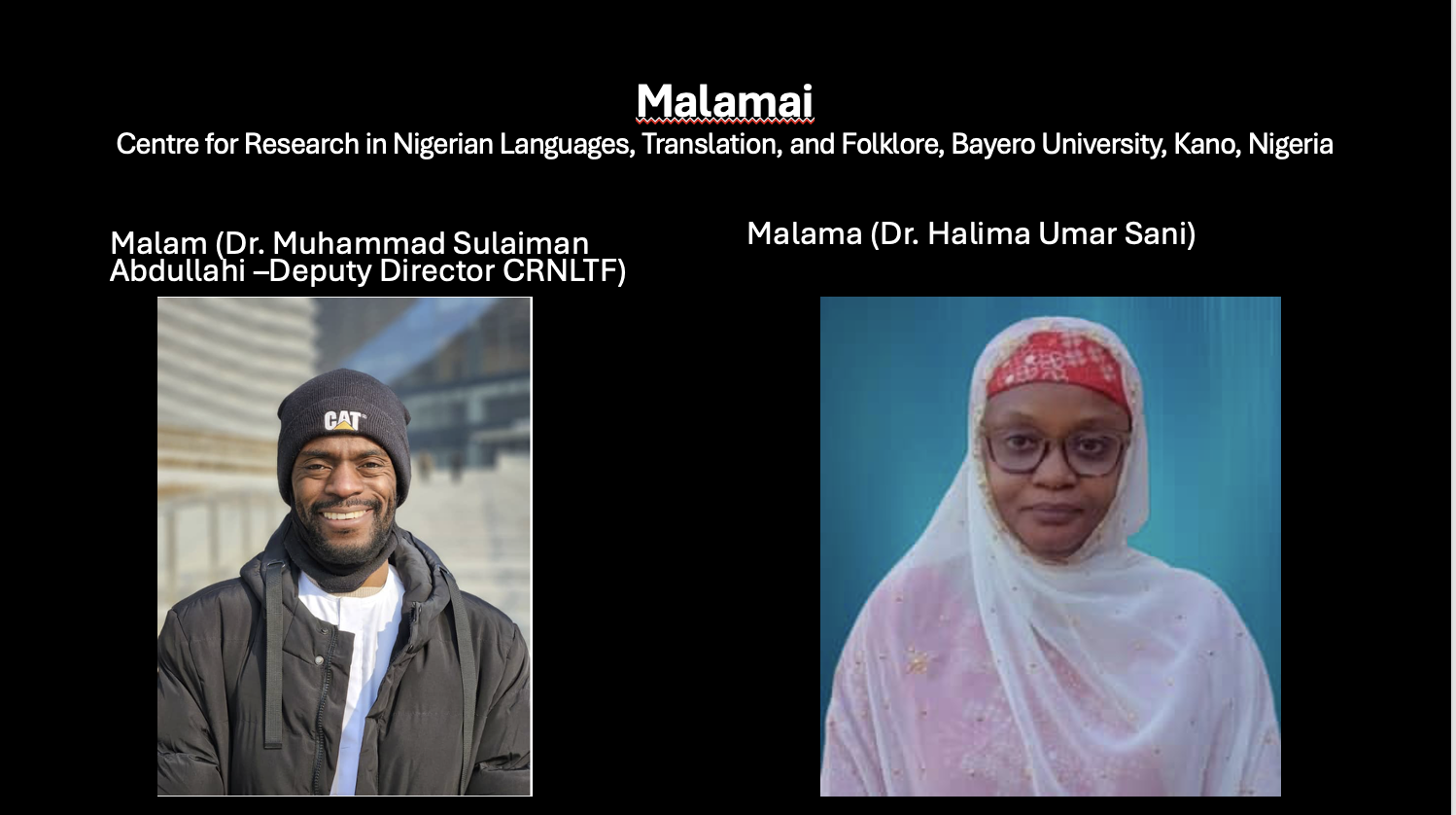
Bayero University lecturers Dr. Muhammad Sulaiman Abdullahi and Dr. Halima Umar Sani will teach Hausa for us online. We will be starting a combined UG/PG Hausa 1a class this semester (semester 2-January to April) on Mondays and Thursdays at 3pm UK time (4pm Nigeria time, and 10am Eastern time, 9am Central time, and 8am Pacific time). In the upcoming academic year 2026-2027, we will be offering Hausa 1a again in Semester 1 and Hausa 1b in Semester 2.
Our partner Bayero University has had a long relationship with SOAS and has taught Hausa to international students from the UK, Poland, Germany, China and elsewhere for about 50 years. They have experience with online teaching for Beijing Foreign Studies University, and one of the Hausa lecturers will visit SOAS for a week or two to meet the students and give a lecture for the Centre of African Studies during semester 2.
Hausa is the most widely spoken language in Africa after Arabic and Swahili and is spoken by an estimated 150 million people in Nigeria, Niger, Chad, Benin, Togo, Ghana, Burkina Faso, the Sudan, and other African countries. There are also Hausa diaspora communities in Saudi Arabia, the UAE and elsewhere. There is a thriving Hausa film and music industry, and literature has been written in Hausa for at least 5 centuries in ajami script and for over 100 years in roman script. There are thousands of published Hausa novels and a burgeoning digital literary scene. The SOAS library, with Hausa manuscript collections and about 2000 novels in the Furniss collection, has one of the largest collections of Hausa literature in the world, so students who take Hausa will have a wealth of resources for further research at SOAS.
Any interested students may contact me for more information: cm74 [at] soas.ac.uk
Thank you,
Carmen


 A Tunanina...