Championing literary translation in Nigeria

Yesterday, I read an excellent article by Carl Terver on “The Middleclass Problem of Nigerian Writing.” He writes about the inaccessibility of contemporary Nigerian literature to the masses of people. It is too expensive, it is not well-marketed, it is not available in schools or universities.

Complaints about reading culture in Nigeria are not new, but he speaks to the contemporary divide between the well-stocked bookshops of Lagos and Abuja (where books are regularly over N10,000) and what an ordinary reader can afford. The hot new publisher Masobe Books, which has been turning out quite a few impressive publications in the past few years, seems to have figured out one good way to market its books–making a deal to sell books in the Medplus chain of pharmacies across the country. I was shocked and delighted 3-4 years ago when I found the novel I had searched for unsuccessfully in several Lagos bookshops in the pharmacy next door to my brother’s flat. However, those books are still unaffordable for most people. Even coming from London last year, I found many books in a pharmacy that I wanted to buy, but I had to put half of them back because I didn’t have enough naira in my account. Not only are books expensive, but he points out that sometimes the most celebrated literature is too “comfortable”–and does not necessarily speak to “the common man.”

“Nigerian writing now almost exists for itself, as an indulgence or luxury, a product for a kind of haute couture for the literary community. And it keeps getting so, our writers becoming mere apparatuses in the mechanism of the middleclass problem.” Terver writes. –

In his conclusion, he speculates on what alternatives there might be, pointing to the historic Onitsha Market Literature and the MacMillan Pacesetters series. In this he gestures at but does not name the thriving literary cultures that are so often left out of conversations about literature in Nigeria, and that is popular literature that cannot be found in middle class bookshops, and cultural production in Nigerian languages.

There are tens of thousands of Hausa novels that have been written in the past 100 years and a vibrant reading culture, from the early novels published by the NNPC from the 1930s to the 1970s, to the explosion of young people writing and self publishing serial novels on cheap newsprint in the 1980s to the 2010s, to most recently a gigantic eco-system of digital literature. These novels have given rise to large private lending libraries of physical novels, novels read serially over the radio, pirated audiobooks, private whatsapp groups where authors will release one chapter at a time, and a host of novels on wattpad and released in ebook formats. I have posted on the literature of the 1990s and 2010s often on this blog and in my 2010-2014 column in Daily Trust. Most recently, there is an excellent issue of the Journal of African Literature Association on Social media as a new canvas, space, and channel for Afrophone literatures, where there are 5 articles on Hausa by Abdalla Uba Adamu, Zaynab Ango, Umma Aliyu, Nura Ibrahim, and Ado Ahmad Gidan Dabino. This may not be a middle class space for Anglophone literary fiction, but it is a vibrant space that invites in ordinary readers in Hausa.

And yet despite this burgeoning literary space, of these tens of thousands of novels, there are fewer than ten that have been published in translation to English, at least in translations that are widely accessible to readers. The translations include a few translations of the early contest-winning Hausa novels published in the 1930s but which were abridged and simplified for primary school readers. This includes Abubakar Imam’s Ruwan Bagaja, which was translated as Water of Cure or Muhammadu Bello Kagara’s Gandoki, which has been published as Gandoki the Warrior. These fantasy novels are widely available in bookshops and in the school curricula, but I still have not been able to find the names of the translators because NNPC nowhere acknowledged them. (Sada Malumfashi has recently published the opening pages of a new translation of Gandoki for National Translation Month) The scholar Mervyn Hiskett translated Shaihu Umar, a historical novel about one young boy’s experience of the trans-saharan slave trade by Nigeria’s first prime minister Abubakar Tafawa Balewa. Of the thousands of novels that have been published since the 1980s, there are a few commissioned translations of Ado Ahmad Gidan Dabino’s novels, including a translation of his bestselling novel (the original of which sold over 400,000 copies) In da So da Kauna, as The Soul of My Heart. But the translation violently abridges a 200 page novel to 60 pages and translates the banter and dialogue and proverbial wordplay that I think makes Gidan Dabino’s novels so pleasurable to read into English-language cliches. It badly needs re-translation. The only novel from the last 40 years that is available in translation internationally and currently the only Hausa novel in translation by a woman (although it is regularly claimed that women are the majority of the readers and writers) is Aliyu Kamal’s translation of Balaraba Ramat Yakubu’s novel Alhaki Kuykuyo Ne as Sin is a Puppy that Follows You Home, published by Indian publisher Blaft. Since 2015 when I began designing my own Nigerian/African literature classes, I have taught this novel, and for the past 11 years, it has been a student favourite, with students choosing to write about it for their midterm or final papers probably more than any other novel I teach. Several students with southern Nigerian backgrounds have told me that they found it illuminating and our discussions of the novel challenged stereotypes they had about the north. They would like to read more, but there are just no more accessible translations of contemporary Hausa literature. (Since coming back to Nigeria this month, I have heard some exciting stories about a few more translations in progress.)

When we speak of African literature without discussing African language literatures, we are missing out on important conversations, aesthetic conventions, and styles. A few days ago, I saw a video of someone critiquing the bland sameness of some English-language literary fiction that comes out of MFA programmes–which is related, I think, to Carl Terver’s critique of the “Middleclass” trap of Nigerian literature.

By contrast, literary translation lets us have a glimpse at other traditions and styles (I think of the exuberant style of Ngũgĩ wa Thiong’o once he started writing primarily in Gikuyu, captured even in translation, or the way Balaraba Ramat Yakubu’s storytelling style comes over even in flawed translations), and can enrich our understanding of African experiences and styles, not unlike the way that speaking two or more languages can expand our understanding and ability to think in multidimensional ways.

From the time I first started reading Hausa literature in my halting Hausa in 2005, I have wanted to translate it. But I am very slow, and academia is very demanding, and I think the best way for me to translate is to collaborate with someone for whom Hausa is a first language. I have such a collaboration in the works. But more urgent than my own fumbling attempts at translation is to motivate MORE LITERARY TRANSLATORS, to find better funding for literary translation, and to think about ways to make translations accessible to ordinary Nigerian readers, so that the translations don’t run into the limitations that Carl Terver points out.

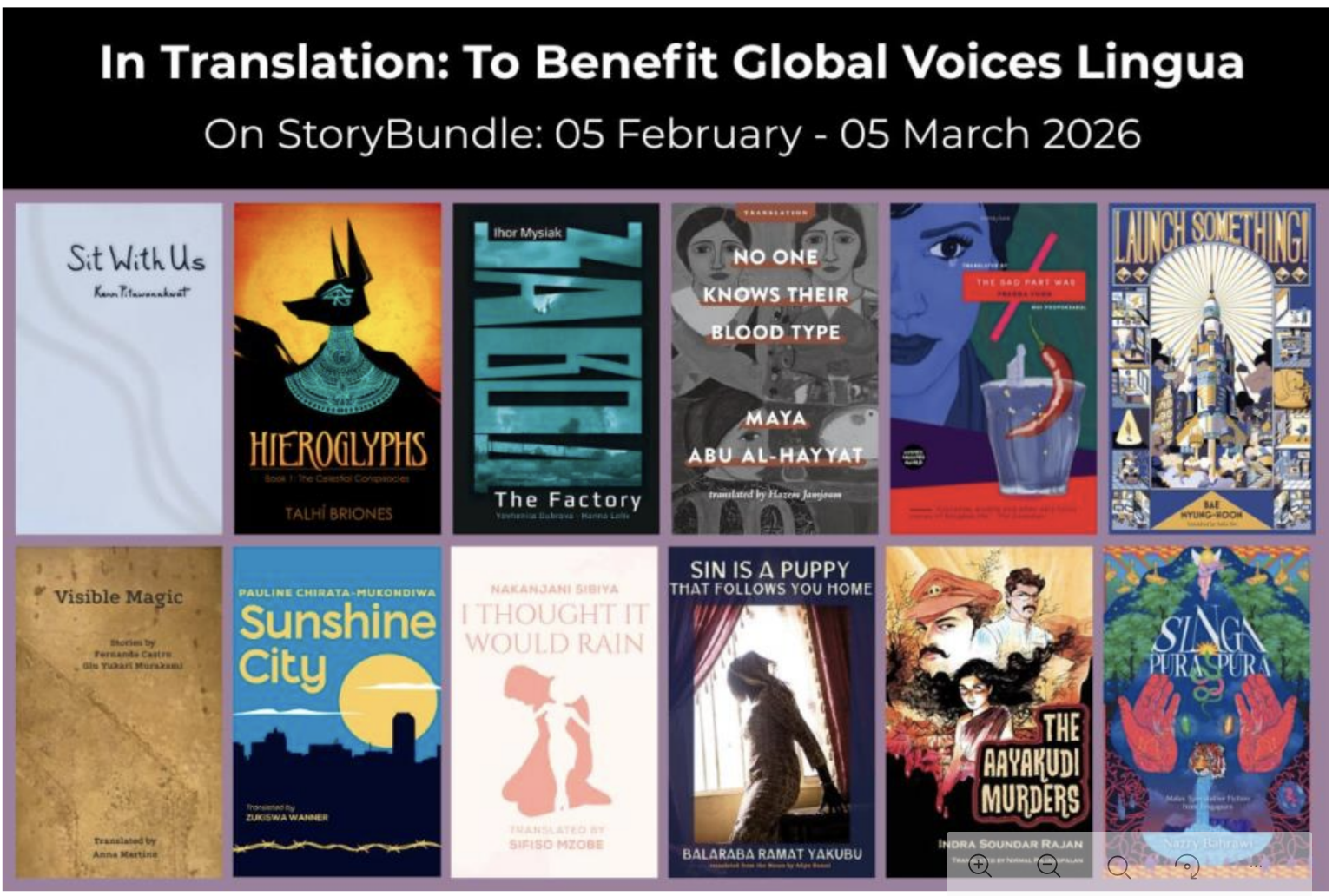
This is where I am lucky to be at SOAS, an institution that has taught Hausa since the 1930s, and to follow greats like Graham Furniss, who collected over 2000 Hausa novels now housed in the SOAS library special collections, and who together with Malami Buba and William Burgess, put together a bibliography of this collection (reviewed here by Ibrahim Sheme, a author, translator, journalist and publisher). I am also lucky to work closely with my colleague Ida Hadjivayanis, who teaches Swahili and translation, and has translated two of Nobel laureate Abdulrazak Gurnah’s novels into Swahili: Paradise as Peponi (see her article on that here) and Theft as Dhulma, and is currently working on her translation of Afterlives. The two of us have had many conversations about popular Swahili and Hausa literature, which share some cultural preoccupations. I published an article on my research on literary translation into and out of Hausa last year “The alchemy of translation in Hausa: cosmopolitanism, gatekeeping, and infrastructure in Hausa-English translation,” which Ida generously read before hand. And this past year, we ended up putting together a small “Research Cultures” group at SOAS to encourage literary translation in and out of African languages. We are particularly interested in seeing more African literature published in African languages and more African-language literature being translated into other languages so that it is more accessible to larger conversations about “African Literature.” Our colleagues and PhD students are doing some really exciting work, and we have a working translation blog in the works. (I’m in the process of building it). There are other efforts being made to publish translations of African-language literature including Blaft, the African Language literatures in Translation series at University of Georgia Press, and “The African Translation Project” an initiative by Zukiswa Wanner to publish contemporary African fiction in translation and included Balaraba Ramat Yakubu’s Sin is a Puppy in a recent ebundle . Kọ́lá Túbọ̀sún has been doing a massive amount of work on Yoruba language and translation.

Image courtesy of Global Voices Lingua

In the meantime, we have also been trying to link up with some of these exciting innovations being done on African-language literature, publication, and translation on the continent. Ida’s publisher in Tanzania Mkuki Na Nyota has been proactive in seeking out Swahili language translations of Abdulrazak Gurnah. In Nigeria, Richard Ali has worked hard to get Mudassir Abdullahi and Ismail Bala’s translation of Paulo Coelho’s The Alchemist into Hausa in print at Paresia and has been part of the Jalada team, which has had several groundbreaking translation projects with Ngũgĩ wa Thiong’o Gikuyu short story “Ituĩka Rĩa Mũrũngarũ: Kana Kĩrĩa Gĩtũmaga Andũ Mathiĩ Marũngiĩ” translated into 100 languages and Wọlé Ṣóyínká’s English-language poem “Mandela Comes to Leah” translated into 49 languages. Sada Malumfashi and the Open Arts Team have been promoting Hausa language literature with the Hausa International Book and Arts Festival, and Bayero University’s Centre for Research in Nigerian Languages, Translation, and Folklore had been innovating with online training courses for professional translators.

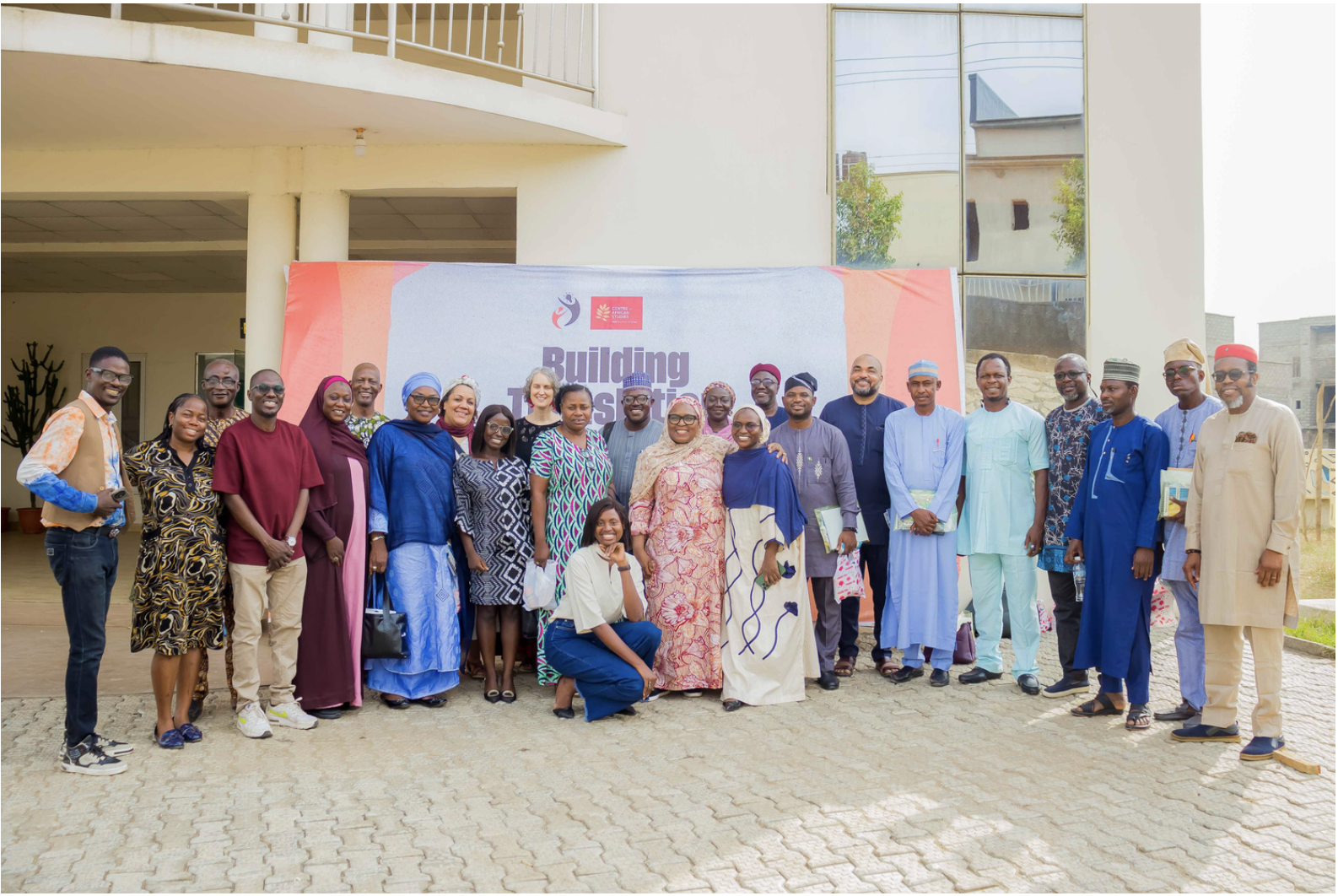
In late January I was delighted to receive some last minute support from the ISPF ODA fund for our proposed cultural exchange travel. We hosted Sada Malumfashi, director of the Hausa International Book and Arts Festival, and Professor Yakubu Magaji Azare, the director of the Centre for Research in Nigerian Languages, Translation, and Folklore at Bayero University, both of them translators themselves, to come to London and speak with our research group and others about their innovations in translation. Sada spoke on “Indigenous Knowledge Production: Promoting Hausa Cultural Production through Festivals and Translation.” And Professor Azare spoke on “A Decade of refocusing the Centre for Research in Nigerian Languages, Translation, and Folklore: Promoting Translation as a new mandate'” while Hausa novelist Sa’adatu Baba Ahmad (currently in the UK for her PhD) spoke about her writing career. Ida Hadjivayanis and I are now reciprocating with trips to Bayero University, Kano, and to the Mamman Vatsa Writer’s Village in Abuja to contribute to conversations about literary translation organized by our Nigerian partners. How can we support networks of literary translation in Nigeria? How can we build translation bridges between Swahili literature in Tanzania and Hausa literature in Nigeria? What kind of language, publishing and funding infrastructures can we build?

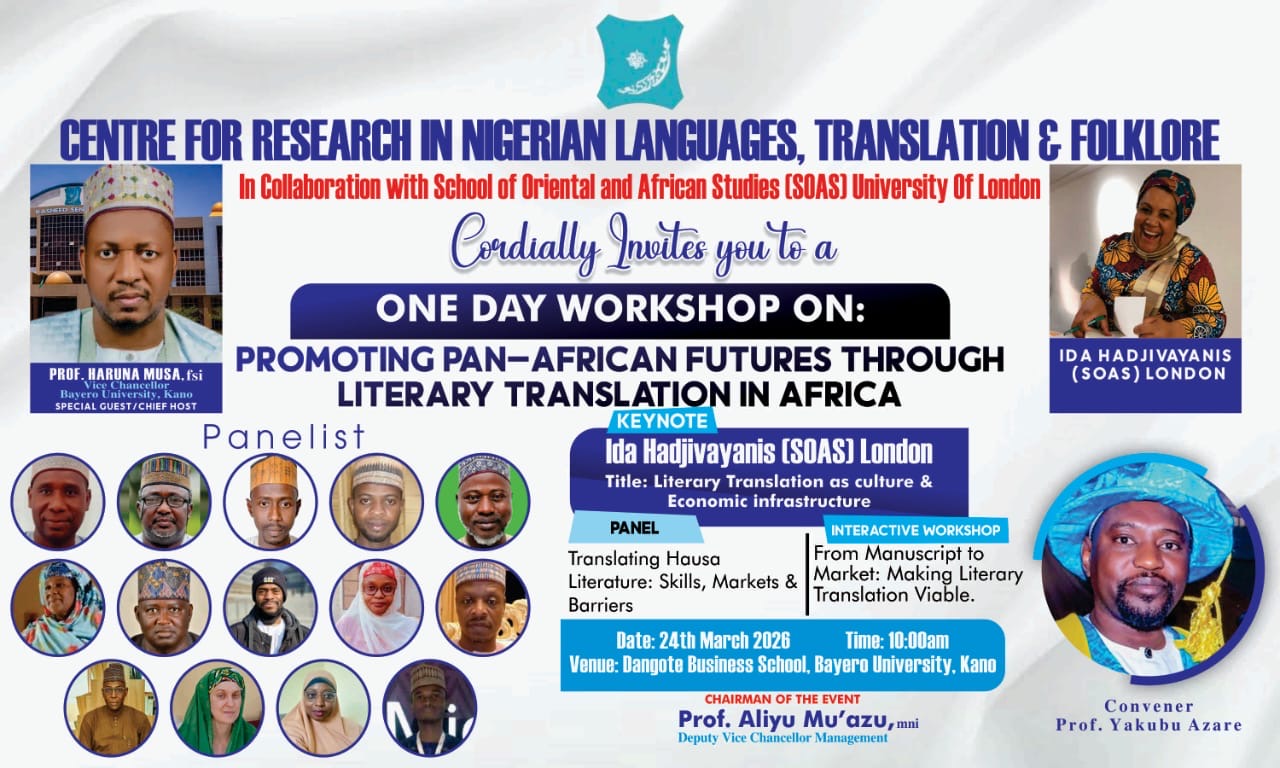
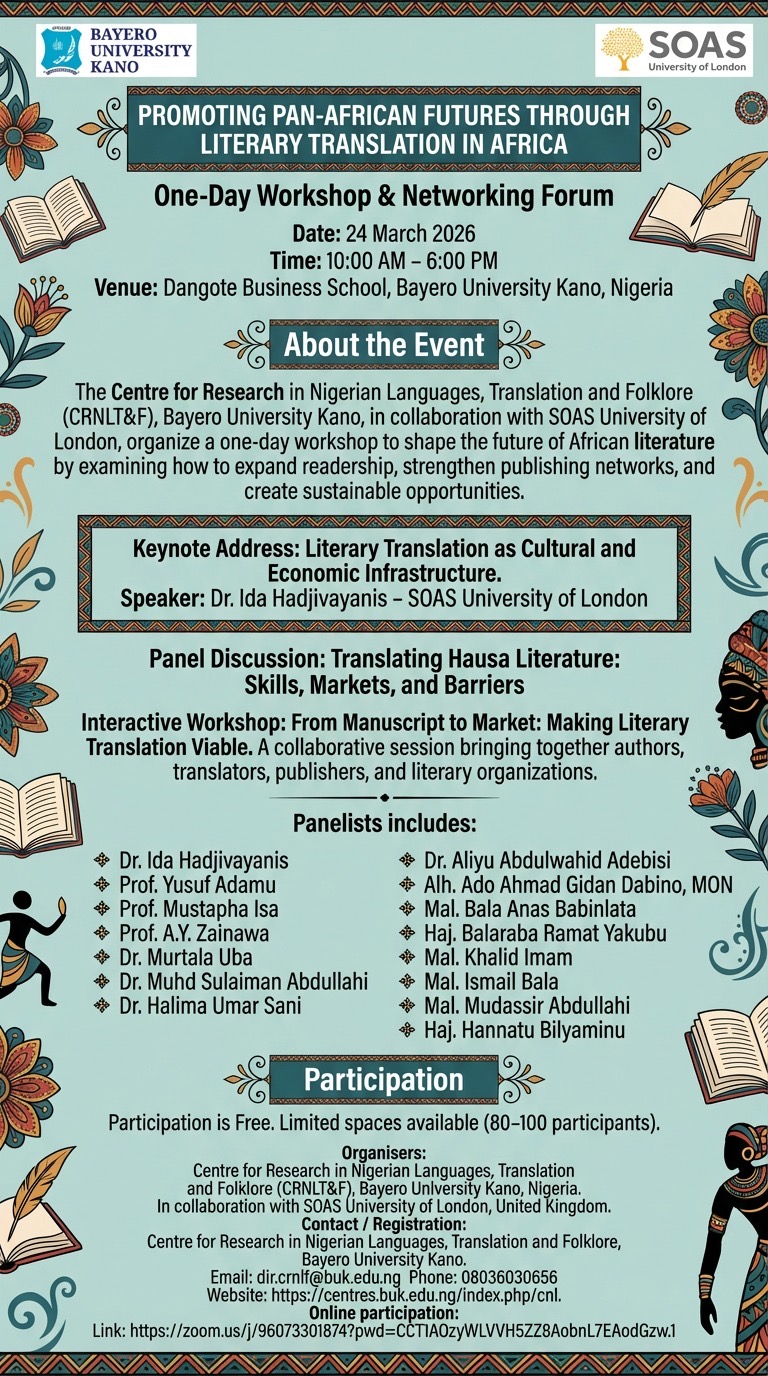
The Centre for Research in Nigerian Languages, Translation, and Folklore is hosting a workshop at the Dangote Business School on Tuesday, 24 March, 10-6pm and have an exciting group of translators and Hausa writers set for conversation. Ida Hadjivayanis will give the keynote and start off the conversation thinking about how we can build connections between Swahili and Hausa literature. If you are in Kano, we hope you’ll come. If you’re not in Kano but you’re interested, you can join by Zoom.

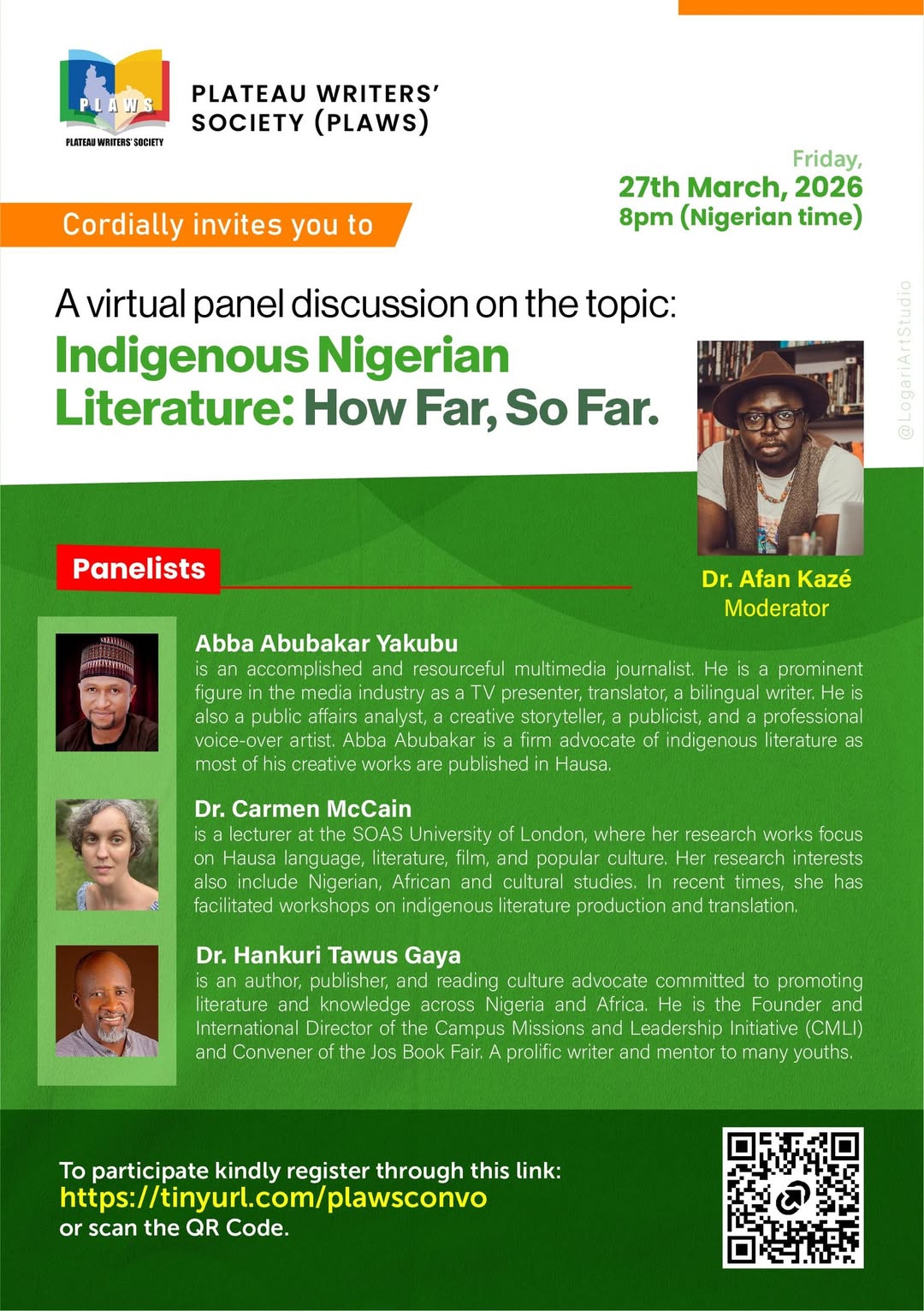
Next, the Open Arts Foundation in collaboration with the Association of Nigerian Authors will be hosting an event in Abuja on Friday, March 27, 10-5pm. After an invitation only strategy meeting on Thursday, March 26, there will be a public forum for anyone interested in Nigerian-language literature, translation, and publishing, as we try to think together about how to strengthen this sector. For example, the NLNG prize for literature is one of the biggest literary prizes in the world. Each year it cycles between Prose Fiction, Poetry, Drama, and Children’s Fiction, giving each winner a $100,000 prize. Why don’t they add a fifth year to that cycle for translations in any of those genres–or split the 5th year’s prize into four and fund translations in each category? Or could some of the extremely wealthy people in Nigeria, Aliko Dangote, Abdul Samad Rabiu or Mike Adenuga, for example, use a drop of their wealth to help fund a translation prize or subsidize translation imprints for Nigerian publishers? What of Nigeria’s education system? Primary school children already read abridged translations of Nigerian literature? What about incorporating translations from Nigerian language literature into the curriculum at all levels? How can we promote literary translation in such a way that it speaks to ordinary readers and does not fall into the “Middle Class” trap Carl Terver has identified. These will be some of the things we discuss in these two different events. See the press release for the Abuja event below. Please feel free to copy and paste the press release into your own media as needed. I will post the Zoom link here once I have created it.

PRESS RELEASE

FOR IMMEDIATE RELEASE

International Forum on Literary Translation and Nigeria’s Creative Economy

Abuja, Nigeria – March 2026

Writers, translators, publishers, and scholars from Nigeria and the United Kingdom will gather in Abuja later this month for a public forum exploring the role of literary translation in expanding Nigeria’s creative economy and strengthening the global visibility of African-language literature.

The event, titled “Building Networks, Partnerships, and Infrastructure for Literary Translation between the UK and Nigeria” will take place on Friday, 27 March 2026 at the Mamman Vatsa Writers Village, sponsored by SOAS University of London and the International Science Partnerships (ISPF) ODA fund in collaboration with Open Arts Development Foundation.

The forum brings together leading figures from Nigeria’s literary and publishing communities alongside international scholars to discuss how translation can help Nigerian writers reach wider audiences while creating new professional opportunities for translators, editors, and publishers.

The Abuja gathering is a collaboration between Nigerian cultural organisations and SOAS University of London designed to strengthen networks for translating Nigerian-language literature and to develop sustainable pathways for literary translation in Nigeria. A keynote lecture will be delivered by literary translator Ida Hadjivayanis of SOAS University of London, who has translated two novels by Nobel literature laureate Abdulrazak Gurnah into Swahili and will speak on the role of translation in connecting African literary markets and supporting creative industries.

Panel discussions will explore practical issues including publishing translated African literature, developing sustainable translation careers, and expanding the circulation of literature written in Nigerian languages such as Hausa.

The event will feature contributions from Nigerian writers, translators, publishers, and cultural organisations, including representatives from independent publishing houses and literary initiatives working to expand opportunities for Nigerian literature both locally and internationally.

According to project organiser Dr. Carmen McCain, the forum aims to strengthen collaboration between translators and publishers while highlighting the importance of translation as both cultural work and professional practice.

“Nigeria has one of the most vibrant literary cultures in Africa. While Nigeria is most known internationally for its English language literature, there are tens of thousands of novels in Hausa, and yet fewer than ten of them have been translated into English. Other Nigerian language literatures are also rarely translated or circulated internationally. By bringing together writers, translators, and publishers, we hope to build stronger networks that can support translation and help Nigerian stories reach wider audiences, while also following Ngũgĩ wa Thiong’o to encourage writers to “enrich” Nigerian languages by translating other African and world literatures into those languages.”

Writer and cultural organiser Sada Malumfashi, founder of the Open Arts Foundation, emphasised the importance of building translation infrastructure within Nigeria itself.

“Nigeria has a vast literary tradition in languages such as Hausa, yet many of these works remain inaccessible to wider audiences. Strengthening literary translation will create opportunities for writers, translators, publishers, and readers. By building stronger networks, we can ensure that stories written in our languages travel further and reach new generations of readers.”

The public forum is open to writers, students, translators, publishers, and anyone interested in Nigerian literature and the future of translation in Africa.

Attendance is free and open to the public.

Event Details

Event: Building Translation Bridges – Public Forum
Date: 27 March 2026
Venue: Mamman Vatsa Writers Village
Host: Association of Nigerian Authors
Time: 10:00 AM – 5:00 PM

Media Contact

Sada Malumfashi

Curator, Open Arts Development Foundation/Hausa International Book and Arts Festival

sada@openartsworld.org

07038570607

Hausa returns to SOAS, University of London, via a partnership with Bayero University Kano


From a slide for a Hausa taster I ran during our Welcome Week in September 2025, highlight Bayero University academics who are partnering with us to offer Hausa classes at SOAS

My first encounter with SOAS was in 2005 when I studied Hausa with Professor Malami Buba in Sokoto. He had done his PhD in Linguistics at SOAS and had taught Hausa at the university and had also worked with Professor Graham Furniss on a searchable bibliography of Hausa popular fiction hosted on the SOAS website (but which I have not been able to find in recent searches). From early on in my studies, therefore, SOAS was my ideal as one of the best archives of Hausa literature in the world. When I first visited SOAS in 2013 to attend the Africa Writes festival, I visited legendary Hausa professors Graham Furniss and Philip Jaggar and got visitor’s access to the SOAS library where I scanned in a Hausa novel I had been looking for, part of the impressive collection of over 2000 Hausa novels Graham Furniss collected and donated to the library. I was still a PhD student at that time, and I thought “this is my dream job.” Imagine, living in London in close proximity to Nigeria, getting to have access to such valuable resources on Hausa literature and culture. Fast-forward 9 years later to 2022 and I was moving from Santa Barbara, CA, to London to start work in the School of Languages, Cultures and Linguistics at SOAS. I could hardly believe my luck.

Sadly, in the years since I had visited, the Hausa programme had suffered due in part to the retirement of the two professors I had been so excited to meet in 2012 and a falling number of students. It carried on, however, until the global COVID crisis, when it went on indefinite hiatus. When I had the opportunity to interview with SOAS, I recalled that old excitement at being in an institution that had Africa in its name and the potential of having such a wealth of Hausa resources at hand. My goal when I arrived was to get the Hausa language course back up and running. It had, afterall, been taught at SOAS since the 1930s. Hausa is the largest language spoken in Africa after Arabic and Swahili, with approximately 150 million speakers. And, yet, policies that privilege numbers of students over the strategic importance of language has meant the loss of many important languages at universities in the US and the UK, leading to the question: how do students know the importance of languages in regions where those languages are not taught if universities do not highlight their importance? After witnessing Hausa programmes in the US closing one by one as professors retired (I was the last student at the University of Wisconsin Madison to study Hausa to advanced levels before professor of Hausa Linda Hunter retired and was not replaced), I was shocked that it had finally closed at SOAS as well. However, if COVID was a turning point in the loss of many of our institutions, it also brought a rapid development in video conferencing technology. So, we decided to try to harness that and build a partnership with a Nigerian institution that has a long history of teaching Hausa to international students.

When I was living in Kano from 2008-2011, I remember meeting Polish, German and Chinese exchange students on campus who were in large Hausa classes being taught in collaboration with the Centre for Research in Nigerian Languages, Translation and Folklore at Bayero University Kano. At one time SOAS students had also travelled to Bayero University. The Centre had taught Hausa online for Beijing Foreign Studies during COVID. We decided to see if they could do something similar for SOAS. I don’t know that online teaching is always ideal, but it does open up new opportunities for global collaborations. (During COVID, one of the most exciting things I experienced was attending African Studies Association conferences online, when suddenly many more academics from African institutions were able to attend because they weren’t blocked by harsh US visa policies. The panels and conversations were instantly richer than they had been before.) It has taken a few years, but we have finally concluded several years of discussions and paperwork, and I am delighted to announce that SOAS is offering Hausa 1a as an online class in collaboration with Bayero University- Kano, an institution that has recently been recognized by Times Higher Education as being in the top three Nigerian universities and the first in the northern region. I am particularly grateful to the director of the CRNLT&F, Professor Yakubu Magaji Azare, who has put in a huge amount of work into making this happen. Below I reproduce some of the advertising I have been spamming my colleagues at universities around the world:

Because it is an online class, we can accept associate students outside of London. The fee for online associate students for Hausa is £850 a semester. Although the usual associate students deadline is in December for classes starting in January, the associate students office is willing to accept late applications (this week) in order to support our recently revived Hausa programme.  Classes will start on January 19.

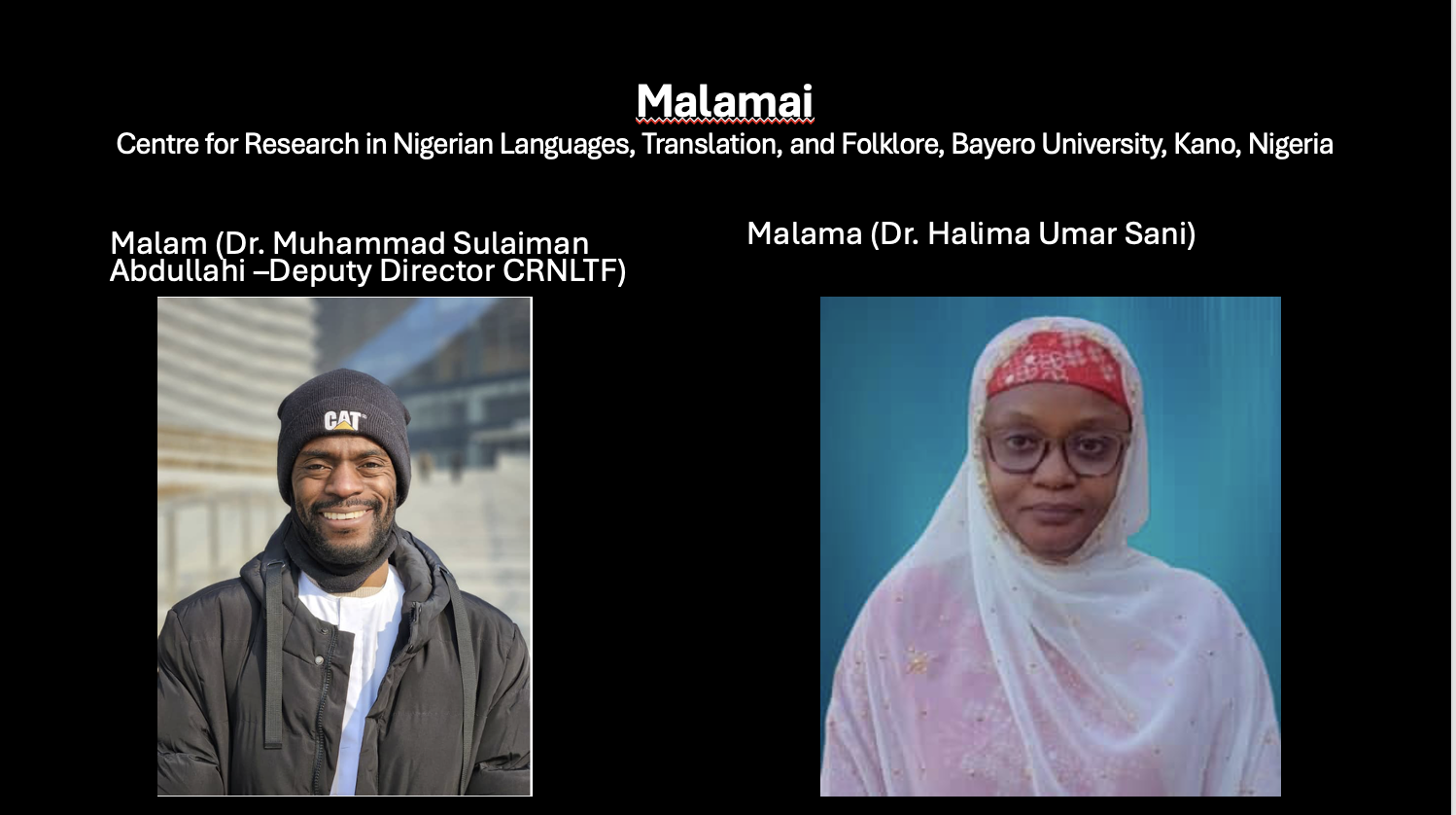
Bayero University lecturers Dr. Muhammad Sulaiman Abdullahi and Dr. Halima Umar Sani will teach Hausa for us online. We will be starting a combined UG/PG Hausa 1a class this semester (semester 2-January to April) on Mondays and Thursdays at 3pm UK time (4pm Nigeria time, and 10am Eastern time, 9am Central time, and 8am Pacific time). In the upcoming academic year 2026-2027, we will be offering Hausa 1a again in Semester 1 and Hausa 1b in Semester 2. 

There are partial scholarships available to support current Masters students who study Hausa this year or incoming students next academic year

Our partner Bayero University has had a long relationship with SOAS and has taught Hausa to international students from the UK, Poland, Germany, China and elsewhere for about 50 years. They have experience with online teaching for Beijing Foreign Studies University, and one of the Hausa lecturers  will visit SOAS for a week or two to meet the students and give a lecture for the Centre of African Studies during semester 2. 

Hausa is the most widely spoken language in Africa after Arabic and Swahili and is spoken by an estimated 150 million people in Nigeria, Niger, Chad, Benin, Togo, Ghana, Burkina Faso, the Sudan, and other African countries. There are also Hausa diaspora communities in Saudi Arabia, the UAE and elsewhere. There is a thriving Hausa film and music industry, and literature has been written in Hausa for at least 5 centuries in ajami script and for over 100 years in roman script. There are thousands of published Hausa novels and a burgeoning digital literary scene. The SOAS library, with Hausa manuscript collections and about 2000 novels in the Furniss collection, has one of the largest collections of  Hausa literature in the world, so students who take Hausa will have a wealth of resources for further research at SOAS. 

Any interested students may contact me for more information: cm74 [at] soas.ac.uk

Thank you,

Carmen

Transcript of Bishop Mariann Bude’s sermon during the 2025 US inaugural prayer service

So, I haven’t posted to this blog in over five years, since before COVID. My apologies. I have been meaning to revive it for years now. So, here’s my first post back.

Today, I saw clips from Episcopal Bishop Mariann Edgar Budde‘s sermon during the inaugural prayer service at the National Cathedral in Washington DC, so I went and watched the whole thing on YouTube. It was a thoughtful and gentle sermon, a call for unity and mercy in keeping with the teachings of Jesus (see Matthew 5, for example) and, indeed, the Bible at large, against which, however, the man now back in the White House has been raging. Listening to it several times, I am struck by courage of this pastor, who stated “when we know what is true, it is incumbent upon us to speak the truth, even when, especially when it costs us.” She knew this sermon would cost her something. The church has been receiving angry messages from MAGA supporters, including those who say they wish she were dead. (She’s in good company. The same supporters have been attacking Pope Francis for his criticism of the new president’s mass deportation plans.)

In an interview with Time Magazine, she said

“I did my best to try and speak to, to present an alternative to the culture of contempt, and to say that we can bring multiple perspectives into a common space and do so with dignity and respect. And that we need that, and the culture of contempt is threatening to destroy us. And I’m getting a little bit of a taste of that this week.”

But, my God, what a powerful testimony to the teachings of Jesus, who said (Matthew 5:11-12)

“Blessed are you when people insult you, persecute you, and falsely say all kinds of evil against you because of Me. Rejoice and be glad, because great is your reward in heaven, for in the same way they persecuted the prophets before you.”

I couldn’t find a transcript online (although I’m sure someone has probably posted it by now), so I had Word transcribe her sermon, using the dictate function, and then I put in the punctuation and paragraph breaks. I will embed the video under which you can find the transcript.

(Now that I’ve broken my 5 year silence, I will try to start posting on this blog again, as I am able, with some updates on my life and research.)

The transcript of the sermon by Rev. Marianne Budde is as follows:

May the words of my mouth and the meditation of all our hearts be acceptable in your sight, oh God, for you are our strength and our Redeemer. Amen. Please be seated.

Again, my warm welcome to all who have gathered in this House of prayer for all people and for those who are joining us via live stream. As a country we have gathered this morning to pray for unity as a people and a nation, not for agreement, political or otherwise, but for the kind of unity that fosters community across diversity and division, a unity that serves the common good. Unity in this sense is a threshold requirement for people to live in freedom and together in a free society. It is the solid rock, as Jesus said, in this case upon which to build a nation. It is not conformity. It is not victory. It is not polite weariness or passive passivity born of exhaustion. Unity is not partisan, rather unity is a way of being with one another that encompasses and respects our differences, that teaches us to hold multiple perspectives and life experiences as valid and worthy of respect, that enables us in our communities and in the halls of power to genuinely care for one another even when we disagree.

Those are across our country who dedicate their lives or who volunteer to help others in times of natural disaster, often at great risk to themselves, never ask those they are helping for whom they voted in a past election or what positions they hold on a particular issue. And we are at our best when we follow their example. For unity at times is sacrificial in the way that love is sacrificial, a giving of ourselves for the sake of another. In his sermon on the mount, Jesus of Nazareth exhorts us to love not only our neighbors but to love our enemies and to pray for those who persecute us, to be merciful as our God is merciful, to forgive others as God forgives us. And Jesus went out of his way to welcome those whom his society deemed as outcasts.

Now I grant you that unity in this broad expansive sense is aspirational, and it’s a lot to pray for. It’s a big ask of our God, worthy of the best of who we are and who we can be. But there isn’t much to be gained by our prayers if we act in ways that further deepen the divisions among us. Our scriptures are quite clear about this that God is never impressed with prayers when actions are not informed by them. Nor does God spare us from the consequences of our deeds, which always in the end matter more than the words we pray. Those of us gathered here in the cathedral, we are not naive about the realities of politics, when power and wealth and competing interests are at stake, when views of what America should be are in conflict, when there are strong opinions across a spectrum of possibilities and starkly different understandings of what the right course of action is. There will be winners and losers. When votes are cast–decisions made that set the course of public policy and the prioritization of resources, it goes without saying that in a democracy not everyone’s particular hopes and dreams can be realized in a given legislative session or a presidential term not even in a generation. Which is to say, not everyone’s specific prayers, for those of us who are people of prayer, not everyone’s prayers will be answered in the way we would like. But for some, the loss of their hopes and dreams will be far more than political defeat but instead a loss of equality and dignity and their livelihoods. Given this then, is true unity among us even possible? And why should we care about it?

Well, I hope we care. I hope we care because the culture of contempt that has become normalized in this country threatens to destroy us. We are all bombarded daily with messages from what sociologists now call the outrage industrial complex, some of that driven by external forces whose interests are furthered by a polarized America. Contempt fuels political campaigns and social media, and many profit from that. But it’s a worrisome–it’s a dangerous way to lead a country. I’m a person of faith surrounded by people of faith, and, with God’s help, I believe that unity in this country is possible. Not perfectly, for we are imperfect people and an imperfect union but sufficient enough to keep us all believing in and working to realize the ideals of the United States of America, ideals expressed in the Declaration of Independence, with its assertion of innate human equality and dignity. And we are right to pray for God’s help as we seek unity, for we need God’s help, but only if we ourselves are willing to tend to the foundations upon which unity depends, like Jesus’s analogy of building a House of faith on the rock of his teachings as opposed to building a house on sand. The foundations we need for unity must be sturdy enough to withstand the many storms that threaten it. And, so what are they, the foundations of unity?

Drawing from our sacred traditions and texts, let me suggest that there are at least three. The first foundation for unity is honoring the inherent dignity of every human being, which is, as all the faiths represented here affirm, the birthright of all people as children of our one God. In public discourse, honoring each other’s dignity means refusing to mock or discount or demonize those with whom we differ, choosing instead to respectfully debate our differences and whenever possible to seek common ground. And if common ground is not possible, dignity demands that we remain true to our convictions without contempt for those who hold convictions of their own.

Second, foundation for unity is honesty, in both private conversation and public discourse. If we are not willing to be honest, there is no use in praying for unity because our actions work against the prayers themselves. We might, for a time, experience a false sense of unity among some but not the sturdier broader unity that we need to address the challenges that we face. Now to be fair we don’t always know where the truth lies, and there is a lot working against the truth now. But when we do know, when we know what is true, it is incumbent upon us to speak the truth, even when, especially when it costs us.

On the third and last foundation, I’ll mention today is, foundation for unity, is humility, which we all need, because we are all fallible human beings. We make mistakes. We say and do things that we later regret. We have our blind spots and our biases. And perhaps we are most dangerous to ourselves and others when we are persuaded without a doubt that we are absolutely right and someone else is absolutely wrong, because then we are just a few steps from labeling ourselves as the good people versus the bad people. And the truth is that we are all people. We are both capable of good and bad. Alexander Solzhenitsyn once astutely observed that the line separating good and evil passes not through states, not between classes, nor between political parties, but through, right through every human heart, through all human hearts. And the more we realize this, the more room we have within ourselves for humility and openness to one another across our differences, because in fact we are more like one another than we realize, and we need each other. Unity is relatively easy to pray for on occasions of great solemnity. It’s a lot harder to realize when we’re dealing with real differences in our private lives and in the public arena. But without unity, we’re building our nation’s house on sand, and with a commitment to unity that incorporates diversity and transcends disagreement and with the solid foundations of dignity, honesty, and humility that such unity requires, we can do our part and in our time to realize the ideals and the dream of America.

Let me make one final plea, Mr. President. Millions have put their trust in you and, as you told the nation yesterday, you have felt the providential hand of a loving God. In the name of our God, I ask you to have mercy upon the people in our country who are scared now. There are gay, lesbian, and transgender children in Democratic, Republican and Independent families, some who fear for their lives. And the people, the people who pick our crops and clean our office buildings, who labor in poultry farms and meat packing plants, who wash the dishes after we eat in restaurants and work the night shifts in hospitals. They, they may not be citizens or have the proper documentation, but the vast majority of immigrants are not criminals. They pay taxes and are good neighbors. They are faithful members of our churches and mosques, synagogues, wadara and temples. I ask you to have mercy, Mr. President, on those in our communities whose children fear that their parents will be taken away and that you help those who are fleeing war zones and persecution in their own lands, to find compassion and welcome here. Our God teaches us that we are to be merciful to the stranger for we were all once strangers in this land. May God grant us the strength and courage to honour the dignity of every human being, to speak the truth to one another in love and walk humbly with each other and our God for the good of all people. The good of all people in this nation and the world.

Amen.

Charles Etubiebi’s one man performance of Africa Ukoh’s play 54 Silhouettes at the United Solo Festival in New York, 20 November 2019

2019 United Solo-54 Silhouettes-poster

This Wednesday, November 20, 2019, Charles Etubiebi will perform a one man show adaptation of Africa Ukoh’s play 54 Silhouettes at the United Solo Theatre Festival in New York. (You can buy tickets here).  54 Silhouettes is the first Nigerian play to feature at the the world’s largest solo theatre festival, which is celebrating its tenth anniversary this year. [UPDATE: And the play was honoured with Best International Show at the festival.]

The satirical 54 Silhouettes explores with both hilarity and gut-punching conviction the double bind of an actor, Victor Chimezie, who hopes to break through to a major role in Hollywood but finds himself cast in yet another poorly written stereotypical film about Africa. The play is a sly critique of Hollywood but also a self-reflexive examination of African performers who enable such representations.

To attend the event, here are the basics:

Date: November 20.
Time: 7:30pm.
Location: 410 West 42nd street, New York, NY 10036.

I reviewed the premiere stage performance of 54 Silhouettes in 2013 for the Daily Trust.


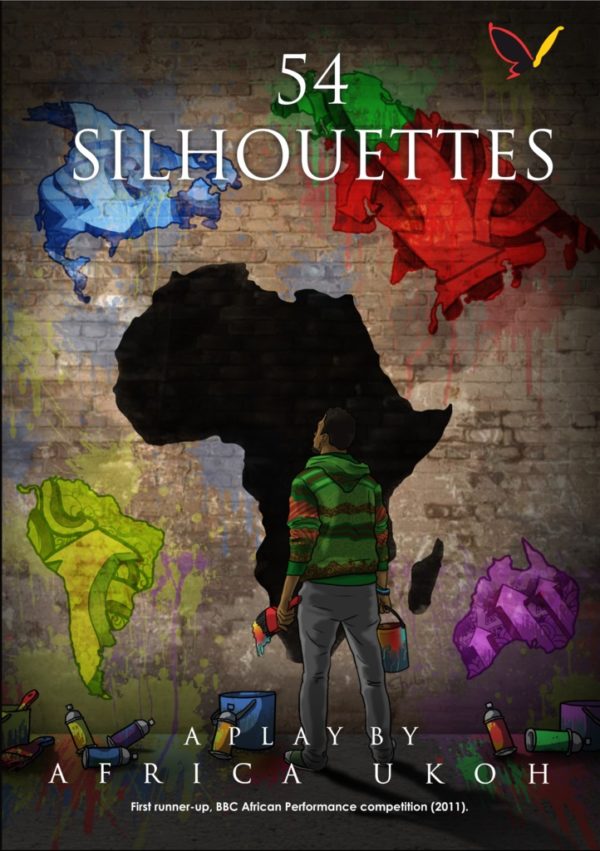
Original 54 Silhouettes poster 2013

Courtesy of Africa Ukoh (photographs by Victor Audu)

The play was originally produced for radio on BBC after coming first runner up in the 2011 BBC African Performance competition, and being awarded a Stratford East/30 Nigeria House grant.  I didn’t know anything about the play before I showed up at the Alliance Francaise in Jos where I had seen it advertised in November 2013, but I was blown away by it. I had seen very little Nigerian theatre set in the contemporary moment, and this was fresh and urgent and original. In particular in my review, I highlighted the performance of Charles Etubiebi who played the part of the British-born actor Kayode Adetoba.

Sparks also fly between Chimezie and Kayode Adetoba (brilliantly played by Charles Etubiebi), the Brighton-born British-Nigerian actor whom everyone calls Tobi. He speaks with a South London accent, mispronounces Chimezie’s name just as Larry and Flynn do, and when he plays a warlord speaks with what internet critics call a “generic African accent.”

IMG_5141

Kayode Adetoba (Charles Etubiebi) and Victor Chimezie (Promise Ebichi) during the Jos premiere, 16 November 2013. (c) Carmen McCain

It seems appropriate, therefore, that Charles Etubiebi, whose performance I so admired in the original stage play,  is the actor to play all five parts in the solo adaptation, and who often refers to the importance of accent in interviews about the play, as does the playwright Africa Ukoh, whom I recently interviewed for Brittle Paper. Etubiebi explains to Noah Tsika in this fantastic interview for Africa is a Country how after being invited to the NEAP Fest theatre festival in Brazil, he asked Ukoh to adapt the play into a one man show, which he then performed in Rio de Janeiro and at several different festivals in Lagos. Here are two videos from his performances in Lagos where, Etubiebi talks about  the background to the play.


And on BBC pidgin:


Having previewed the Lagos show on YouTube, I think it is the tightest and best version of the play that I’ve encountered. It is a really an outstanding performance that speaks to the creative synergy between Charles Etubiebi, as a performer, and Africa Ukoh, as a writer and director.

In the interview with Noah Tsika, Etubiebi describes his working relationship with Ukoh:

We got accepted to the Lagos Theatre Festival, which is run by the British Council. We performed [54 Silhouettes] there, and this time Africa came to Lagos and directed it himself. And this is when I most enjoyed the performance, because when you work with someone who actually created the thing … Working with Africa, we have a special dynamic. We ate the play, we talked the play, and when we did it in Lagos, at the festival, I genuinely enjoyed being this character, and telling this story. It was absolutely amazing.

As an actor, I know that I’m supposed to cry on demand, but I don’t do that easily. But the last rehearsal we had [in Lagos] … there’s a scene where the main actor gives this monologue about how we as Africans have to confront stereotypes of Africans—what people see from far off. They say, “Let’s just put them in a box and leave them there.” No, we’re more than that. We’re like every other person. Before you can get to know us—who we really are—you have to really look. Don’t just chalk us up as “black Africans”—first of all, in Nigeria, we have many languages. Let’s just start there, first of all. So we’re a lot more than you see. Africa’s a big continent. Those lines [in 54 Silhouettes], about how we need to educate and reeducate the world about who we really are—at the last rehearsal, I got emotional. And Africa said, “You’re ready.”

Since Etubiebi began to perform the one-man version of the play, the play has also been picked up for other dramatic readings, presented by Etubiebi’s Theatre Emissary partner Taiwo Afolabi at the Puente Theatre for the Spark Festival in Victoria, British Columbia and an African Voices event at the Roundhouse Theatre in London. London-based reviewer Nick Awde writes that 54 Silhouettes offers an “incisive slice of Nigeria while simultaneously channeling David Mamet.”

The United Solo Festival will be the first opportunity for American audiences to see this striking performance put together by two of the most exciting members of a creative cohort of artists that are revolutionizing Nigerian cinema and theatre. Africa Ukoh and Charles Etubiebi both have prestigious film credentials—Ukoh having written two critically acclaimed films making rounds on the recent film festival circuit, Abba Makama’s films Green White Green (available on Netflix) and The Lost Okoroshi, and Etubiebi having acted in films like Steve Gukas’s compelling 93 Days (available on Netflix and on Amazon Prime) and Kemi Adetiba’s King of Boys (also on Netflix). But this feels like an exciting moment for Nigerian theatre as well, where Nigeria’s film industry invigorates and gives new life to Nigeria’s theatre tradition. 54 Silhouettes comments on Hollywood portrayals of Africa, but also reaches back and alludes to the dilemma of Wole Soyinka’s tragic hero Elesin in Death and the King’s Horseman. As I wrote in my review of the stage performance,

In Soyinka’s play, a patronizing colonial district officer Pilkings denounces as savage the tradition of ritual suicide by the oba’s companion after an oba’s death, but in “saving” Elesin he contributes to the death of Elesin’s son Olunde, who takes his father’s place. Chimezie and Larry recite dialogue from the scene where Elesin tells Pilkings, “You have shattered the peace of the world forever. There is no sleep in the world tonight.”

This symbolic tribute to Soyinka’s play resonates throughout 54 Silhouettes: Chimezie, like Elesin, faces great temptation to betray his people for a good life, and the well-meaning Larry, like Pilkings, is so blinded by his prejudices that he undermines (through his writing) the cultures he tries to represent.

Yet, in Chimezie’s turn away from the Hollywood stereotypes of Africa and, perhaps, a turn towards Nigeria’s new wave of theatre and cinema(?), is this the birth of the the unborn left at the end of Soyinka’s play?

If you are in New York, by all means go to the United Solo performance on Wednesday, 20 November, (tickets available here). Charles Etubiebi is already in New York for his performance in a few days.

If you are in Nigeria, hopefully there will be other performances soon, but, in the meantime, you may want to check out the published version of Africa Ukoh’s play, which can be purchased at the following bookshops:

Jos:

54_silhouettes_curve_12_edited_-_copy_1024x1024-e1554654369983

  • Achison Bookshop, Rwang Pam Street
  • Modern Bookshop, Rwang Pam Street
  • Waltricks Bookstore, Adjacent UBA, Rwang Pam Street
  • Coal Bookstore, DSTV Plaza, Shop No. 8, Adjacent Mchez Eatery, Yingi Rayfield

Abuja:

  • Adam’s Pages, Machima Plaza, No. 2 Mambolo Close, Off Sultan Abubakar Way, Wuze Zone 2
  • The Booksellers, Ground Floor, City Plaza, Ahmadu Bello Way, Garki II
  • Salamander Cafe, 5 Buumbura Street, Wuse 2

Lagos:

  • Glendora Booktore in the Ikeja City Mall;
  • Parresia Bookstore, Ibiola Nelson House, Allen Avenue, Ikeja
  • Terra Kulture, 1376 Tiamiyu Savage Street, Victoria Island), Abuja, and Jos

As I’ve also mentioned elsewhere on this blog, Ukoh’s unpublished play Token Dead White Guy was shortlisted for the 2018 BBC International Playwriting Competition. You can read more about it in our conversation on Brittle Paper. Hopefully, this performance of 54 Silhouettes will only be the first of many of his plays to hit theatres in Nigeria and beyond. In the meantime, check out some of the recent films Ukoh has written scripts for: Green White Green (on Netflix), The Three Thieves, and The Lost Okoroshi. I’ve only been able to watch Green White Green so far, but the trailers promise more of what I’ve come to expect from him: smart, funny, and real:


Abba Makama’s new film The Lost Okoroshi (screenplay by Africa Ukoh) to premiere at the 2019 Toronto Film Festival

The-Lost-Okoroshi

Creative duo director Abba Makama and screenwriter Africa Ukoh strike again. For the second time a film collaboration between the two will premiere at the Toronto International Film Festival. (Update 5 September 2019: The film has also been selected to screen at the BFI London Film Festival in October 3 and 5. You can see information about where to see it on the BFI site here. Mike Omonua’s debut film The Man Who Cut Tattoos, which Makama produced, will premiere at BFI this year.)

The Lost Okoroshi, Makama’s second feature film, (though he also has a stable of hilarious short films and a really great documentary on Nollywood, which I teach) imagines a bored security guard whose life takes a turn when his dreams of masquerades invade the world of the living. Courtney Small writing for Cinema Axis calls it a “vibrant and wildly surreal ride.”

IndieWire describes Makama as

 one of the leading voices for Nigerian cinema today. He previously directed “Green White Green,” another TIFF selection that is now streaming on Netflix, as well as “Nollywood,” the Al Jazeera documentary about Nigeria’s film industry. He should be a presence at major festivals for years to come.

More recently, Native Magazine has interviewed him about some of the thinking behind his work.

Watch the trailer here

Green White Green, Makama’s first feature, which he also co-wrote with Africa Ukoh, has been one of my favourites since I first saw it on an Air France flight back in 2017 and have since watched it over and over again on Netflix.  Film critic Noah Tsika calls it “a hopeful, downright energizing love letter to Nigeria’s enterprising youth — to a new generation plainly capable of greatness.” As I’ve written in another blog post,

The film is a youthful takedown of the prejudices that tear Nigeria apart. It mocks Nollywood, with the good-natured ribbing of a son who follows in his father’s footsteps but laughs at his outdated affectations. It is a satire, but it is also  filled with a restless joy and a tenderness that draws me in to watch it over and over again on homesick nights.

mv5bnwjhytg3zjgtnjqxzs00y2mxlwjhngutmme3yzu2ytdkzjrixkeyxkfqcgdeqxvynjc1mjiynzg40._v1_sy1000_cr006751000_al_

The Lost Okoroshi promises to be stylistically similar (the energetic jump-cuts, actors posed and staring into the camera as if for a family portrait) while pushing the conceit imagined by the young filmmakers in Green White Green a little further. In Green White Green, the young secondary school graduates shoot a metaphoric film about Nigeria, taking great delight in masquerades,  as both protective spirits and (in a fire breathing incarnation) as the “Beast of Corruption,” riffing on Fela’s “beasts of no nation.” In The Lost Okoroshi, the masquerade/s unfold into full-fledged characters, which seems to represent (as much as one can interpret a trailer) a reclamation of the ancestral masquerade not as an “evil beast” as often represented in Nollywood movies but as a way of bringing tradition into the future. And, as with Green White Green, there continues to be a sly Nollywood self-referentiality: “Forget all this Pete Edochie proverbs,” the subtitled Igbo reads, “This is not a Nollywood home video.”  Thus while building on an older tradition (incorporating, for example, the Nollywood comedian Chiwetalu Agu), Makama and Ukoh push their narratives out to the cutting edge of Nigerian cinema. This is not a Nollywood home video, no. But, it draws affectionately on Nollywood to create something exciting and new.

In its imagination of the masquerade in a 21st century city context, the film reminds me of contemporary Nigerian writers Nnedi Okorafor and Chikodili Emelumadu and the inadequacy of the sort of literary labels placed on these texts. Is this Afrofuturism? Nnedi Okorafor resists that label, preferring africanfuturism. Is this magical realism? Or what Ben Okri’s critics have called “spiritual realism“? Abba Makama recently quoted Newton Aduaka (the Nigerian filmmaker who won the FESPACO film festival’s highest prize, the Golden Stallion of Yennenga for his 2007 film Ezra):

Labels are useful but ultimately they reduce the subject. Yet, I like the idea of the hyper-real, a realism that captures not only the surface but the spirit behind it–this idea captures Nigerian life well, and the way filmmakers capture that life.

This is an exciting moment not only for Abba Makama, but also for his collaborator Africa Ukoh, whom I have featured on this blog before and interviewed for Brittle Paper. Today (I published this post a little bit too late!) Ukoh’s play 54 Silhouettes, which I reviewed back in 2013 and was published in 2018, was featured as a part of the Global Black Voices event at the Roundhouse in London. Ukoh also revised 54 Silhouettes into a remarkable one-man play, which Charles Etubiebi has been performing from Rio de Janeiro to Lagos to (forthcoming) New York. Etubiebi’s next scheduled performance of the play is at the November United Solo theatre festival in New York. You can see an interview with Etubiebi below:


If you’re in Toronto or Lagos or London or New York, go see the film, go see the play. And for those in Nigeria who are not in Lagos, I hope that they will both also come to a theatre near you.

P.S. One more note on Nigerian cinema. I just realized yesterday that Steve Gukas’s moving film 93 Days, also at the 2016 TIFF, which tells the story of the courageous doctors and public health officials who contained the ebola virus in Lagos, is out on Amazon Prime. Although ebola is a topic often sensationalized in Western media, Gukas handles the story sensitively, telling it from the perspective of Dr. Ada Igonoh, who survived the disease. It is a great example of Nigerians telling their own stories without making “poverty porn.” And in a direct link to the rest of the content of this post, actor Charles Etubiebi plays a significant role in the film as Bankole Cardoso.

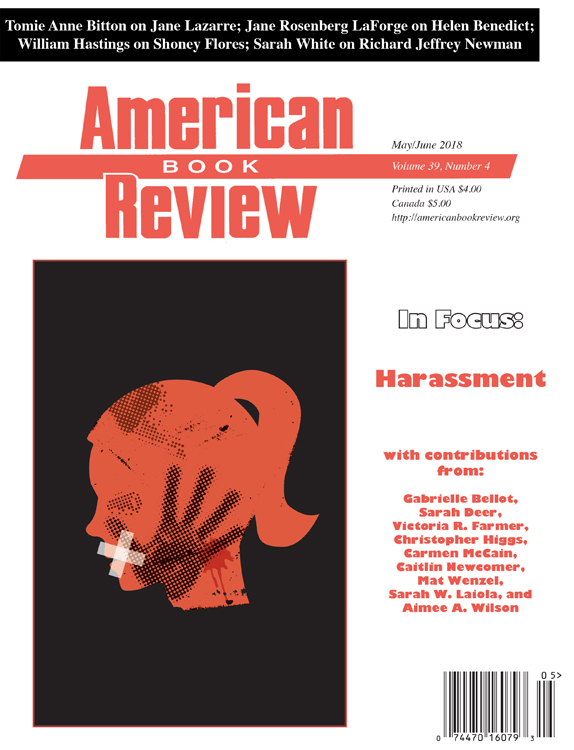
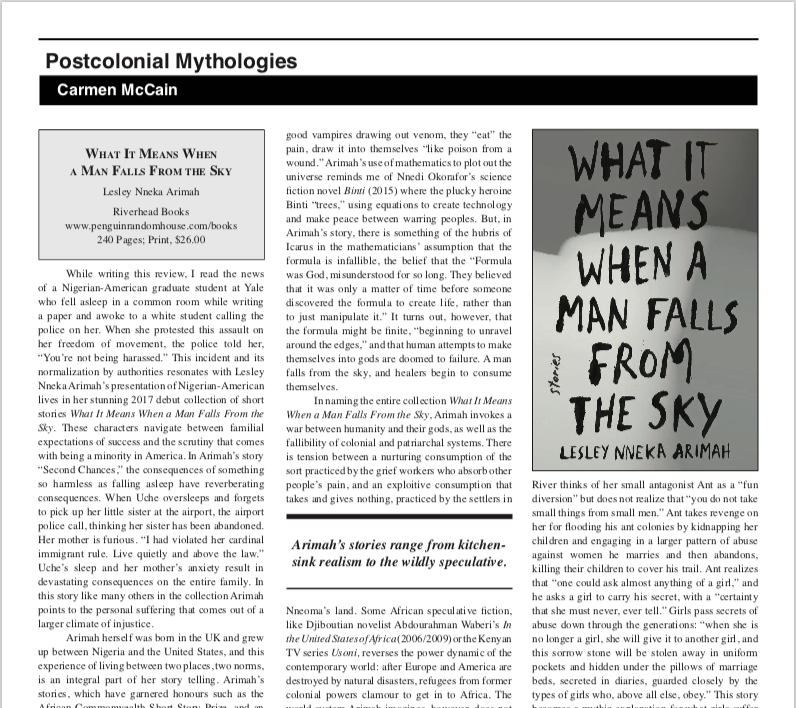
My review of Lesley Nneka Arimah’s collection of short stories What it Means When a Man Falls from the Sky in the American Book Review

gzctslkbobi45d258790dc9ba

Image courtesy of Kenya’s The Standard

As with almost all of my posts these days, this one is a year overdue, but with Lesley Nneka Arimah’s recent Caine Prize win for her fantastic short story “Skinned” first published in McSweeney’s, I was reminded that I had not yet posted about my review for American Book Review of her collection of short stories What It Means When a Man Falls from the SkySince it was published over a year ago in the May-June 2018 issue, it is quite late, but better late than never.

07.02.18_ABRCover_38.4_Final.indd


Screen Shot 2019-07-17 at 5.57.41 PM

Screenshot of the beginning of my review. To read the whole thing, access the pdf via this link

I was asked to submit the review as part of a special issue on “Harassment” edited by Amiee Armande Wilson, so my review focused a little more on that topic than I might have otherwise. Although American Book Review is behind a paywall, Amiee Armande Wilson worked to make sure that the “harassment” focus was open access. You can access a pdf of the insert here. It includes

Caitlin Newcomer’s review of Khadijah Queen’s  collection of poems, I’m So Fine: A List of Famous Men & What I Had On (pp. 4-5);

Gabrielle Bellot’s review of Carmen Maria Machado’s collection of short stories Her Body and Other Parties on pp. 5-6  (a review I found so compelling that I immediately got the audiobook out of the library and finished it in a couple of days);

Carmen McCain’s (yours truly) review of Lesley Nneka Arimah’s collection of short stories What It Means When a Man Falls from the Sky (pp. 7-8);

Sarah Deer’s review of Allison Hargreaves’ monograph Violence Against Indigenous Women: Literature, Activism, Resistance (pp. 8-9);

Victoria Reynolds Farmer’s review of Laura Kipnis’s feminist critique  Unwanted Advances: Sexual Paranoia Comes to Campus (pp. 10-11);

Mat Wenzel’s review of Sarah Schulman’s Conflict is Not Abuse: Overstating Harm, Community Responsibility and the Duty of Repair (pp. 11-12);

Sarah Whitcomb Laiola’s review of Angela Nagle’s  Kill All Normies: Online Culture Wars from 4Chan and Tumbler to Trump and the Alt-Right (pp. 13-14)

Christopher Higg’s review of a collection of writing about sexual assault edited by Joanna C. Valente, A Shadow Map: An Anthology of Survivor’s of Sexual Assault (pp. 15).

If you haven’t yet read What It Means When a Man Falls from the Sky, I highly recommend it. But read “Skinned” first. It draws attention to existing social treatment of single women by pushing things just a little bit further. What if women were only allowed to cover themselves if they were living in their father’s or husband’s houses?

(And for a follow-up on my last post–an interview with playwright, actor, and screenwriter and Africa Ukoh–there are several new performances of his play on the calendar. Charles Etubiebi who has taken a one-man performance of the play to festivals in Rio de Janeiro and Lagos  will also be bringing the one-man performance of 54 Silhouettes to the United Solo theatre festival in New York City on November 20, 2019. An excerpt of the play will also be performed in London as part of the Global Black Voices event at The Roundhouse Theatre on 10 August 2019. For those in London and New York, go see it!)

Interview with playwright and screenwriter Africa Ukoh, whose play is currently on at the Lagos Theatre Festival

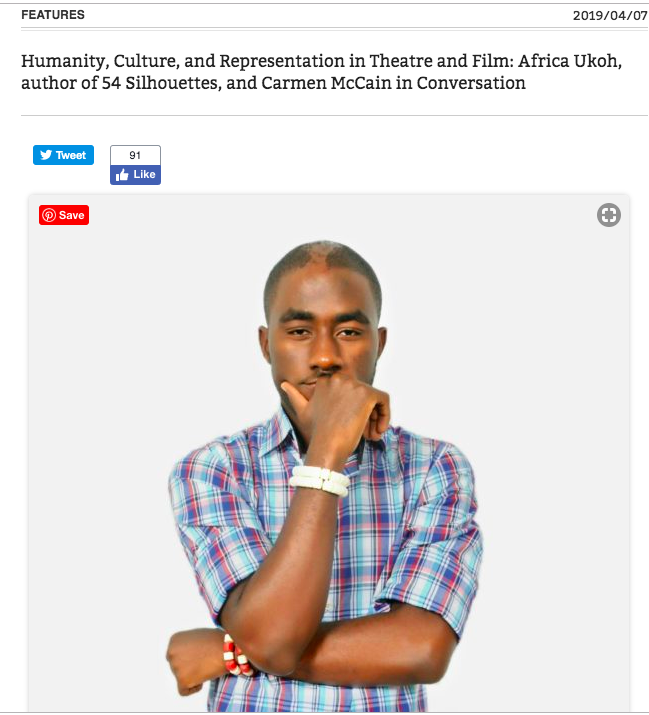
It’s been over a year since I’ve posted on this blog (to the extent that wordpress refused to let me log in for a few days), so I have much to catch up on. Most recently an interview I did last July with playwright and screenwriter Africa Ukoh has been published by Brittle Paper. His play 54 Silhouettes is currently being performed as a one-man show at the Lagos Theatre Festival.

(Update 17 July 2019: Charles Etubiebi will also be bringing the one-man performance of 54 Silhouettes to the United Solo theatre festival in New York City on November 20, 2019, and an excerpt of the play will be performed in London as part of the Global Black Voices event at The Roundhouse Theatre on 10 August 2019.)

(Update 9 August 2019: Abba Makama’s film The Lost Okoroshi, for which Africa Ukoh wrote the screenplay, will be premiering at the Toronto Film Festival this September)

Screen Shot 2019-04-12 at 10.17.57 PM

I first came across Africa’s work when I attended the November 2013 premiere of his play 54 Silhouettes in Jos, because the blurb of his play that I saw advertised at the Alliance Francaise looked interesting. The play follows a Nigerian actor who pursues his dream of acting in Hollywood but is troubled by the increasingly more disturbing “African” roles he is asked to play. It is a smart, thoughtful, passionate play. I loved it.

54 Silhouettes performance

Premiere performance of 54 Silhouettes in Jos, November 2013 (c) Carmen McCain


In my column in Daily Trust,reviewed 54 Silhouettes, which in its earlier incarnation had won the 30 Nigeria House prize and had been performed as a radio play after it won the the first runner up of the 2011 BBC African performance competition.  Last year, in 2018, Africa finally published the play with Parresia Press’s Origami imprint.

54_silhouettes_curve_12_edited_-_copy_1024x1024-e1554654369983

It can be purchased at bookshops in Lagos, Abuja, and Jos, and online at sites like konga.com. Since its publication, he has adapted it into a one-man performance for actor Charles Etubiebi, who has performed it in Lagos and Brazil. In March, Taiwo Afolabi directed a staged reading of the play at the Puente Theatre in Victoria, Canada, at the Spark Festival. Currently, Charles Etubiebi is performing the play on Friday, Saturday, and Sunday, April 12, 13, and 14 as part of the Lagos Film Festival at Esther’s Revenge, Freedom Park, Broad Street, Lagos Island. You can purchase tickets for N3000 online at ariiyatickets.com. (Update 9 August 2019: This Saturday, 10 August, the play will also be featured as part of the African Voices event at the Roundhouse in London.)

Aside from 54 Silhouettes, Africa’s unpublished play Token Dead White Guy was shortlisted for the 2018 BBC International Playwriting Competition.

Africa also works as a screenwriter. He co-wrote, with the director Abba Makama, the film Green White Green that premiered at Toronto Film Festival in 2016 and is currently available on Netflix. Noah Tsika calls it “a hopeful, downright energizing love letter to Nigeria’s enterprising youth — to a new generation plainly capable of greatness.”

The film is a youthful takedown of the prejudices that tear Nigeria apart. It mocks Nollywood, with the good-natured ribbing of a son who follows in his father’s footsteps but laughs at his outdated affectations. It is a satire, but it is also  filled with a restless joy and a tenderness that draws me in to watch it over and over again on homesick nights. I can’t wait to see future collaborations between Makama and Ukoh. (Update 9 August 2019: And one of those collaborations is premiering at the 2019 Toronto Film Festival: The Lost Okoroshi directed by Makama and written by Ukoh. Check it out. The trailer is on fire.)

To hear more of Africa’s thoughts on 54 Silhouettes, Token Dead White Guy, Green White Green, and the current state of theatre in Nigeria, check out our conversation on Brittle Paper,  follow him on Twitter or Instagram, or, even better, go see the play this weekend.  If you can’t get to Lagos for the performance, you can buy a copy of it online and stay tuned for future performances.

More blog posts  to come.

2018 Santa Barbara Film Festival begins with loss and love in Emilio Estevez’s social drama, the public


From Emilio Estevez’s film the public. (Photo from Deadline Hollywood)

“You’ve come close to the 7 horses of the apocalypse” my friend told me yesterday when I confided how disappointed I was in myself for missing an opportunity. “These things can weigh on you emotionally,” another friend said, “where even a ‘little email’ is no longer so little.” My friends are kind. I am grateful for them, these faces over Skype and words in type traveling over time zones to be with me.

And so it is in Montecito, after the fire passed by and the mountain came down. It is in these moments of communal trauma that I begin to feel that I love this place and the people in it–it begins to feel like a community I might be able to belong to.

Tonight the Santa Barbara International Film Festival kicked off, so I and my 18 students (clutching packets of discounted student tickets) found ourselves at the grand Arlington Theatre in downtown Santa Barbara, under a ceiling of constellations traced out in lights. We were attending the premiere of Emilio Estevez’s film the public, in a moment when the “issue” of homelessness feels closer than ever. Hundreds of California homes have been destroyed over the past two months by fire and mud, and as a character in the film points out, homelessness is only a job-loss away.

Perhaps it is because the festival was beginning as the loss is still hanging in the air, as we are still navigating our ways around road blocks where streets were swept away, that the festival opener felt like church. The director of the film festival, Roger Durling, read out the names of those who died in the Montecito mudslides, like a liturgy:

Faviola Benitez, Jonathan Benitez, Kailly Benitez, Joseph Francis Bleckel, Martin Cabrera-Munoz, David Cantin, Morgan Christine Corey, Sawyer Corey, Peter Fleurat, Josephine Gower, John McManigal, Alice Mitchell, James Mitchell, Mark Montgomery, Caroline Montgomery, Marilyn Ramos, Rebecca Riskin, Roy Rohter, Peerawat Sutthithepa, Pinit Sutthithepa, Richard Taylor, and the two still missing Jack Cantin and little Lydia Sutthithepa.

And then, as if we were in church, he had us turn around and introduce ourselves to someone we did not know. After Emilio Estevez introduced the some of the cast members to the audience, Alec Baldwin, Michael K. Williams, Jena Malone, Jacob Vargas, he bid us watch the film with a  “God bless you.”

Church did not end when the film began. There was a certain sweetness to the story, despite the street-smart mouthing of “mother-fuckas” and the reoccurring (humourous, male) nudity. the public feels old fashioned in a good way–a touch of Jimmy Stewart–a moral tale without smugness or self-righteous. Although the film is political, it is not cynical. When pastors appear, they are good people. You see the church, specifically the Black Church,  making space for the homeless and defying the police to bring food and supplies into a stand-off where violent tension has escalated beyond all reason.

But if the film feels old fashioned in its unabashed ideals, it is also a film that speaks perfectly to the moment. This is the dark side of America, one of the wealthiest nations on earth, where hundreds of people freeze to death every winter. And then there the America where corrupt institutions and selfish individualism converge:  the public prosecutor campaigning for mayor calls for law and order and then manufactures “fake news” to help his cause, heavy-handed police tactics turn a low-key protest into a life or death situation, and a TV reporter is so obsessed with her Twitter following that she gets the story completely wrong. While glued to her smart phone, she misses the opportunity for multiple scoops. In an era of climate change, there is even a polar bear looming over the library, perhaps as a warning that knowledge and institutions are fleeting in the face of a climate and a future we cannot control.

And indeed the climate and what it means for human survival is the driver of the conflict in the film. It is winter in Cincinatti, polar vortex cold, and the homeless people come in the library to get warm, to wash up in the bathrooms, to even try out the world of online dating from the library desktops.

The gatekeeper between the warmth of the library and the harsh cold of the outside is the “boring” white-guy librarian, Stuart, played by Emilio Estevez himself, whom acquaintances believe has a job where he gets to read all day. But–as we should keep in mind in this age of snap judgments–appearances are not always what they seem. He and his coworkers share a love for literature–John Steinbeck is a reoccurring motif–but their daily tasks have more in common with social workers. Stuart arrives at work to find his patrons impatiently waiting outside. As soon as the library is open “to the public,” they stream in.

He has a good rapport with the library’s patrons.  He knows them all–at least the regulars–by name and has a certain intuition that enables him to stop fights before they happen, share their jokes and patiently endure their idiosyncrasies. (“Hail Caesar.”) As librarian, he has to enforce the rules–opening time, closing time, no nudity in the library. But when he arrives at work one day to see the body of a patron he knows well being hauled away in an ambulance–dead from cold–and when his own hard work is undermined by soulless library board members, he begins to question the rules. The homeless man he is closest to (played by Michael K. Williams) asks him why they have to leave the library when there are record cold temperatures outside and no more room in the homeless shelters.

The hard-nosed prosecutor running for mayor (played by a sharp-featured Christian Slater), of course, has all the answers. “Law and Order.” “We can’t set precedent.” “The library is not a homeless shelter.” We need to follow the protocol where the police can clear these people out within the hour. But, if the prosecutor represents all that is wrong with our current public discourse, the other characters increasingly question why they are upholding laws that are cruel:  the head librarian (Jeffrey Wright) begins to lose his officiousness, the librarian (Jena Malone) who initially tries to sneak away ends up sticking around as a witness; even the police negotiator (Alec Baldwin), who is living with a loss that is eating him alive, finds himself struggling to do the job that is expected of him. Yet when our boring white protagonist does the right thing, the past he had worked so hard to escape comes looming up before him.

There is a danger in “issue” films in coming across heavy-handed, and occasionally, I did feel a certain self-awareness in the actors recitation of their lines. I grew frustrated with characters who refused to see the obvious (though this is a frustration that grows daily in the world we live in, as well). And the postcolonial critic in me also wonders why it’s always got to be the white guy who is the protagonist and the leader. That said, Estevez plays the role of the understated but passionate librarian brilliantly; the cast is wonderful and varied, with people of colour playing some of the most compelling roles: Jeffrey Wright as the head librarian who undergoes a moral crisis alongside his employee, the charming Jacob Vargas as a sympathetic security guard, Gabrielle Union as the self-obsessed TV reporter, and the two most well-developed homeless characters,  Che “Rymefest” Smith who is obsessed with the belief that he has lasers in his eyes, and Michael K. Williams as the independent philosopher who instigates his homeless friends to protest and prods his librarian friend’s conscious.

Yet, although the film deals with heavy themes, it is not weighted down by them. There is a humour and affection and humanity here. The characters may be drunkards, drug addicts, and conspiracy theorists, and many of them may struggle with mental illness, yet they also are also readers and philosophers, veterans who fought for their country and former family men who paid their taxes before they lost it all. And while there are many moments of irony, as the police march into the library under the looming portrait of Frederick Douglass, or when our librarian reads out the opening paragraphs of The Grapes of Wrath to the social-media obsessed reporter who thinks he is raving mad, the irony is not so bitter that it turns rancid. There are cynical people here–the prosecutor is as cynical as they get–and bitter injustice exists at the heart of the city, but the film itself is not cynical. Instead it celebrates the goodness and beauty and ingenuity of its human characters.

There is no conventional beauty here, although there were some lyrical opening shots of people walking across urban spaces. Our librarian protagonist Stuart is small and mousy. His co-librarian has messy bangs and frumpy clothes and starts out judgy. The library where they work is functional but not an elegant space. It is filled with homeless people with wild hair and old clothes. Yet, the film takes the very ordinariness of the setting and transforms it. Small characters become big, those so often treated as throw-away people demonstrate courage and thoughtfulness. There is hardness here but there is also hope. “The public library is the last bastion of true democracy that we have in this country,” says the head librarian, and thus this library space, a source of knowledge and quite literally of life, becomes a symbolic setting for a drama in which democratic ideals are stretched and challenged and acted upon.

I like this film. I like it enough to sit down and blog about it right away  until  3am instead of preparing my lesson plan for tomorrow.

I like that the public lets its morals show.  I like the hints of church in it and the hints of sentimentality edged with steel. I like that it has complicated characters who nevertheless do the right thing. In this era of fake news and cruel policy and narcissistic self absorption, we do not need cynicism, we need uprightness, we need earnest truth-telling, and people who take a stand for right. Yet we also need the  right amount of humor and self deprecation so that we don’t become judgy or smug. This is what The Public does. I hope it becomes more widely available soon.

Watch the trailer here.

Photographic Memory 1: props for Blood and Henna

It has been nearly a year since I posted on this blog, in the fevered anguish so many of us felt after the election and inauguration of America’s current glorious leader. After that, I lost the heart to write and I filled my time with teaching and and social media, that succubus.

But I miss writing. I miss my column in Daily Trust. And because I have no urgent deadline, I write very little these days, at least writing for myself. I do try to eke out what academic writing I need to get the job done. But, because I am not exercising my writing muscles, what I write is creaky and awkward.

Tonight, I was looking through my photos for one such academic project. I have thousands of photos, hidden in thousands of files on my laptop. And I have often thought that I should give myself a blog assignment of posting a photo a day and to write about the memory that rushes to mind. A photo a day is probably much too ambitious, so I will merely say that I will try to post more often, and I will try to look at my photos more often, and I will let myself remember and write more often. It is 2am here, but I have determined to do this, so let’s go.


So for today’s photo I went back to 5 November 2011. Only a few months earlier I had moved from Kano to Jos to try to work full time on my PhD dissertation. But in late October I went back to Kano for the Goethe Institut premiere of Duniya Juyi Juyi, a film produced by the researcher Hannah Hoechner but written, directed, and acted in by almajirai. I see, via my photos, that this was also the first time I saw my friend Sa’adatu Baba Ahmed’s newborn daughter, who is now a big girl of seven.

While in Kano, Kenneth Gyang, one of Nigeria’s most exciting and experimental directors, got in touch with me (I believe via Nafisa) and asked if I could act a bit part as an ugly-American Pfizer researcher in his historical film Blood and Henna, which touches on the tragic 1996 Pfizer meningitis trials in Kano. I said yes. So, on my way back to Kano I detoured through Kaduna where the film was being shot. We shot the hospital scenes in a school made to look like a hospital. Here a props guy is hanging a chart of a skeleton. (More photos in my flickr album, from the first and second day of shooting)

Feeling keenly my lack of training in acting and the exaggerated American accent I had put on after years of being back in Nigeria, I actually dreaded seeing this for years. It received 6 nominations at the 2013 Africa Movie Academy Awards–the first Hausa film to be honoured as such by AMAA. I finally saw it at a screening at KABAFEST, the Kaduna Book and Arts Festival put together by Lola Shoneyin this summer, and the film blew me away. Fortunately, my part is very small, and Sadiq Sani Sadiq and Nafisa Abdullahi carry the film with their powerful understated acted.  It is a quiet, moving film about the ordinary people behind the sensational headlines that make up history. It’s not as experimental as Gyang’s film Confusion Na Wa, but it’s just as striking.

I should write more, but it is much too late, and I have more academic writing and class preparations to do to tomorrow. But let this serve as a start. I will post more.

For my loved ones in Republican states, call your representatives

Dear Republican loved one living in a “Red” State (from your non-Republican loved one living in a “Blue” state),

Thank you for listening, two days ago, to me talk about my concerns about the Man in the White House. Thank you for listening, and thank you for asking me to send you a list of the things I am concerned about. I appreciate your openness to hearing my perspective.

There are some relatives I know voted for Donald Trump. I do not know if you did. I do not ask. What I do ask, however, of all my loved ones no matter how they voted is to please call your representatives and register your concerns with the ongoing executive overreach.

I realize that some people may have “held their noses” and voted along party lines or over concerns about abortion or high healthcare costs. I know those same people have serious concerns about his personal character and leadership ability. On the other hand, to those people who continue to defend the Man in the White House or to even celebrate him, please consider reading the links to the articles I provide below and giving some thought to our concerns.

I believe those of you who are Republicans and who live in states with Republican representatives have more power than those of us who live in states with Democratic representatives, since the Republicans currently have control of all three branches of government: the executive, legislative, and judiciary. Unless Republican lawmakers and those who voted for them stand up against abuse from the executive branch, I seriously fear for the future of this country.

Since the day of the inauguration, things have been moving so fast that it has been hard to keep up with everything that is going on (it’s similar to the days of the campaign, where Trump would blitz us with multiple things at one time so that when we focused on some new sensationalistic outrage, we missed the quieter but more dangerous discussions going on). However, this New York Times interactive site shows what Trump has done and what he still has to do on his agenda. PBS has a similar page from a few days ago that looks at 10 executive orders Trump signed with only one week in office.

Here is a partial (but not complete because I don’t have enough time to do that) list of some of my most pressing concerns.

Because I am alarmed at the amount of disinformation, fake news, and “alternative facts” floating around, I have decided to support institutions that are well known for investigative journalism and fact checking; therefore, I have subscribed to digital access for The New York Times, The Washington Post, and The Wall Street Journal. I have also donated to The Guardian, and have other magazine subscriptions, including Time, The Atlantic, The New Yorker, as well as The Sun and Essence. (And no, I don’t have time to read them all but the digital access to news is invaluable) If you find that you cannot access some of these articles because you aren’t a subscriber, please let me know and I can send you a pdf of the article. If you do not read news from these organizations because you think they are “biased,” please take a look at this “news literacy toolkit” one of my smartest students sent me last semester on how to evaluate what you read.

Commitment to a free and fair media.

I am alarmed by Trump’s proclaimed “war with the media.” A free press has long been considered one of the pillars of democracy, alongside the executive, legislative, and judicial branches—an essential check and balance to hold the government accountable. However, Trump’s “war against the media” has involved refusing to take questions from media outlets during press conferences, talk of moving the presscorps out of the White House, and restricting government agencies from speaking to the press or even publishing information on their websites. His “gag order” on Federal agencies does not allow them to engage in any external communications until Trump has completed putting political appointees into place.  While some analysts think this is merely temporary and not a big deal, it seems that he has targeted agencies, like the EPA, which are involved “environmental protection and scientific research.”. You can read more about this at The New York Times and PBS.

He has also been involved in propaganda efforts, such as demanding the acting director of the National Park Service to produce additional photographs of crowds on the Mall during inauguration and bringing a crowd to applaud him at his address at the CIA headquarters.; His advisor Steve Bannon reinforces this “war” with the media, and 6 journalists were charged with felonies while covering the inauguration protests on the day of the inauguration.

John Fea, a historian who teaches at Messiah College, points to the multiple untruths told by Trump, including the infamous appeal to “alternative facts” and his team since the inauguration and asks where the Christians who will stand up for truth are.

Ban on Refugees AND legal immigrants with visas/greencards

My most immediate concern is Trump’s executive order banning refugees entry from Iraq, Syria, Iran, Sudan, Libya, Somalia, or Yemen (full text here following on an earlier draft, which proposed to “indefinitely block Syrian refugees from entering the United States and bar all refugees from the rest of the world for at least 120 days.” ). The ban also includes green card holders—that is permanent residents of the United States—and dual citizens of other countries—for example a British-Iranian or a Dutch-Somalian. If they are currently travelling, whether on business to go to a funeral etc, they will not be allowed to enter. Here are some of the stories of those travellers who were affected when the executive order was signed. (UPDATE, 29 January 2016: This story of a Somali woman travelling with her two children [American citizens] to join her husband in the U.S. is particularly upsetting. She was continuously browbeaten to try to get her to sign documents invalidating her visa, told she would be sent back to “Africa,” she was handcuffed, and she and her children were not fed during their 20 hour ordeal.)

These stories, as told by the New York Times, include the family of Fuad Shareef of Iraq, who worked as an interpreter and translator for the U.S. armed forces in Iraq, a job for which he had received death threats. He and his family were given clearance to move to the U.S. and they sold their home and car and gave up jobs to move to America, but were not allowed to board their flight in Cairo and are stuck there.  Nisrin Omer a Sudanese woman who is a PhD student at Stanford and a greencard holder was handcuffed, aggressively patted down and interrogated for hours after returning from a research trip in Sudan. Similarly Ali Abdi, a PhD student at Yale who has a green card is stuck outside of the country; an Iranian scholar who had a fellowship to study at Harvard is now unable to come. The stories also include a Yazidi refugee from Iraq who was about to join her husband; Christian Syrian relatives of U.S. citizens who have already landed in Philadelphia,; a dual British-Iranian citizen unable to get home to Scotland from Costa Rica because her flight connected through the U.S.; etc. etc, etc. This NYT article follows up some of these stories and describes the fear and unrest all over the world caused by this ban. Although immigration policy analysts say the ban is illegal and the ACLU was able to obtain a stay of action from a federal judge in Brooklyn so that travellers would not be deported, they may still be detained. Furthermore, this is only temporary, and White House senior advisor Stephen Miller has said, “Nothing in the Brooklyn judge’s order in anyway impedes or prevents the implementation of the president’s executive order which remains in full, complete and total effect.” (UPDATE 29 January 2016: The American Immigration Lawyers Association report that “border agents were checking the social media accounts of those detained and were interrogating them about their political beliefs before allowing them into the U.S.”Note that these were people with legal visas.)

This has already caused a massive international relations problem. Iran, which had recently signed a nuclear non-proliferation deal with the U.S., has called it “an obvious insult to the Islamic world.” Deutche Welle covers more global responses to the ban.

Donald Trump’s executive order on immigration also states that it will publish the “criminal acts committed by aliens.” For analysis on why this is problematic, see these articles,  on Simcha Fisher and the Daily Kos, which point to similar actions taken against Jews in Nazi Germany. The constant association of immigrants with criminality serves to dehumanize them and desensitize people to abuses against them.

A few Republican lawmakers, are joining Democratic lawmakers, to question the ban, but there should be more. [Update 29 January 2016 – Time Magazine now reports on “more than a dozen GOP members of Congress” who have spoken out against the executive order] [Update 30 January 2016  In particular, John McCain “has called the new Trump ban on immigration from a set of Muslim-majority countries a recruiting boon for Islamic State radicals.”]  Please call your representatives and register your protest.

American University history professor Richard Breitman has written about Anne Frank and her family were also denied entry into the U.S. and were eventually murdered in Nazi concentration camps. In a 2007 paper, he wrote “Otto Frank’s efforts to get his family to the United States ran afoul of restrictive American immigration policies designed to protect national security and guard against an influx of foreigners during time of war.” [UPDATE 29 January 2016 For Holocaust Memorial Day–the day Trump signed the executive order banning refugees–The Smithsonian has an article commemorating 254 Jewish refugees, passengers on the ship  the St. Louis, murdered in the Holocaust after being turned back from the shores of Cuba and the United States and sent back to Europe.]

Many members of our family have visited the Anne Frank house in Amsterdam and also visited the house of Corrie Ten Boom, a Christian who protected many Jewish refugees from the Nazis. Consider this in relation to the Syrian crisis today.  Can we not draw connections? What was the point of visiting those houses if we don’t learn from them? Will we be able to live with our consciences if we deny refuge to those running for their lives?

Here are several Christianity Today articles talking about the Christian responsibility to speak up for refugees, and those Christian organizations who already have: “How to Respond as a follower of Christ to Trump’s ban of refugees” and “Evangelical experts oppose Trump’s plan to ban Syrian Refugees.” [UPDATE 29 January 2016: a coalition of evangelical groups has written a letter opposing the privileging of Christian refugees over Muslim refugees. Those who signed it included the CEO of the Accord Network, the president of the Council for Christian Colleges and Universities,  the President of Korean Churches for Community Development, the President the President of the National Association of Evangelicals, the President of National Hispanic Christian Leadership, an Ambassador for the Wesleyan Church, the President of World Relief, and the President of World Vision US. Catholic and Mormon leaders have also opposed the executive order. The New York Times also interviews Christian leaders who oppose Trump’s plan.]

 The Wall

On 25 January, Trump signed an executive order on the immediate commencement of building a $20 billion border wall, which he concedes that “US taxpayers would have to initially fund” while simulateously defunding a myriad of far less expensive other programs including NPR and PBS, the Office of Community Oriented Policing Services, Violence Against Women grants, the Office of Energy Efficiency and Renewable Energy, the Office of Fossil Energy, etc but he cannot start building it until Congress approves. Please urge your representatives to oppose the wall. This article describes some of the problems Trump will face in trying to implement the wall, including  the huge expense of the wall, the ire of citizens whose land will need to be seized to provide property for the wall and those who are concerned that patrolling border communities with “tens of thousands of heavily armed, poorly trained, unaccountable agents puts lives at risk. This will turn these communities into de facto military zones” Christian Ramirez, director of the Southern Border Communities Colaition immigrant advocacy group says (The Guardian). See also, the New York Times.

It is not just advocacy groups who are criticizing the wall, however. Republican congressman Will Hurd of Texas has also said that “Building a wall is the most expensive and least effective way to secure the border” NPR points out that Trump’s suggested “import tax” means that Americans, not Mexico, would pay for the wall.

And I haven’t even gotten into Trump’s worrisome appointments yet. Most recently, Trump has “restructured the National Security Council” and has given Steve Bannon, filmmaker and former publisher of sensationalist, conspiracy theorizing Brietbart News who has links to white supremacist organizations, a seat on the National Security Council.

Other issues of international concern

 China is talking about a WAR with the U.S.

Fox News points out the damage Trump is doing to American democracy and its reputation in the world.

Foreign policy experts are so concerned by Trump’s decisions that the “entire senior management team” of the state department resigned. These are people who had worked under both Republican and Democratic presidents in the past. Additionally over 100 diplomats and state department officials have signed “a draft document formally protesting President Donald Trump’s immigration and refugee order.” [You can read the full text of the document here.]

(Update 29 January 2016: Conservative analyst Eliot Cohen, who worked as a counselor to Condoleeza Rice,  has written):

Trump, in one spectacular week, has already shown himself one of the worst of our presidents, who has no regard for the truth (indeed a contempt for it), whose patriotism is a belligerent nationalism, whose prior public service lay in avoiding both the draft and taxes, who does not know the Constitution, does not read and therefore does not understand our history, and who, at his moment of greatest success, obsesses about approval ratings, how many people listened to him on the Mall, and enemies.

He will do much more damage before he departs the scene, to become a subject of horrified wonder in our grandchildren’s history books. To repair the damage he will have done Americans must give particular care to how they educate their children, not only in love of country but in fair-mindedness; not only in democratic processes but democratic values. Americans, in their own communities, can find common ground with those whom they have been accustomed to think of as political opponents. They can attempt to renew a political culture damaged by their decayed systems of civic education, and by the cynicism of their popular culture.

[…]

There was nothing unanticipated in this first disturbing week of the Trump administration. It will not get better. Americans should therefore steel themselves, and hold their representatives to account. Those in a position to take a stand should do so, and those who are not should lay the groundwork for a better day. There is nothing great about the America that Trump thinks he is going to make; but in the end, it is the greatness of America that will stop him.

The Environment

Trump approved pipelines to pass near Sioux lands, building on a long history of disrespect, genocide, forced migration, and land seizure from Native Americans. Indigenous people are not protesting for no reason. According to Reuters, as recently as January 23, 2017, an oil pipeline in Saskatchewan, Canada, leaked over 50,000 gallons onto indigenous lands.  According to the New York Times, Trump owned stock in the company that is building the Dakota Access Pipeline. He claims he sold it, but he has provided no documentation to prove the sell–just as he has never released his tax returns. Trump also believes climate change is a hoax perpetrated by China and  plans to reverse environmental legislation.

The Rachel Maddow show gives researched evidence of serious environmental concerns under Trump.

Conflicts of Interest

Related to my concerns about Trump’s many falsehoods are my concerns about his ethics in other areas of life (and I don’t even have time to get into his abuse of women here). He has never released his tax returns and he has not divested from his business as presidents are expected to do. For comparison Jimmy Carter had to sell his family farm so as to not have a conflict of interest. By contrast, Trump did not put his business in a blind trust—instead having his sons manage his business. Now, there are reports that the fees at the club Mar-a-lago have raised membership fees from 100,000 to 200,000, cashing in on Trump’s new position and attracting those who might wish to have some influence over Trump or the government. There’s a lot more of this. I don’t have time to post it all right now. (Update: This piece by a Fordham University law professor explains Trump’s violation of the emoluments clause) But my question is, where are all of our checks and balances I heard people talking about before the election when they were saying Trump couldn’t do everything he said he would do? Who is enforcing our laws? And why aren’t we holding the man in the White House and our lawmakers responsible?

Education appointment

According to the Washington Post and the Wall Street Journal, a Senate Ethics review found that Betsy DeVos, Trump’s nominee for Education Secretary, who has never worked at an educational institution and has no experience in public education or education standards and who seemed quite unprepared during the hearing, is involved in 102 companies that could cause a conflict of interest. She also believes there needs to be guns in schools. During the hearing, DeVos would not agree that there should be equal accountability for private or charter schools that receive federal funds: Here is more from The Washington Post and The Wall Street Journal.

Hundreds of Calvin College alumni (the college DeVos attended) sign a letter outlining the concerns they have about the appointment.

This is just a very preliminary list that covers only a fraction of the fears I have over this new government. The only encouraging things to me in the past week have been the massive women’s marches that took place all over America and all over the world. I went to the march in Santa Barbara where over 6000 people came out.

We did not have a street permit, but when the police saw how many of us there were, they opened the streets for us.

I am also encouraged by the people who have gone to airports in the last 24 hours to demand that people with valid visas be let into the country.

Now is my time to get over my anger at those who voted (based on what they saw as “morals”) for Trump and to appeal to you to stand up for your values with us. You can’t get your vote back, but you can stand up for what is right. We will not agree on every issue, but I think (and hope) that many of those who voted for Trump believe in kindness, goodness, hospitality, love for our neighbour. It is only when we can realize, as President Obama said, in the face of grief and anger, that “we are not as divided as we seem,”  that we can stand up against the kind of reckless authoritarianism we are seeing manifest in the man currently in the White House and those around him.

Please. Call your representatives. Remind them of the ideals for which you voted: life, liberty, freedom and justice for all.