Category Archives: Column

Conversation with Nkem Ivara, author of Closer than a Brother and literary event “Excuse Us, London!” on April 6

The death of Chinua Achebe has been much on my mind that past few weeks. He was one of my favourite authors and a life mentor through his writing. I plan to post some of my thoughts on him by the end of the week.

In the meantime, I wanted to post this email interview I did with Nkem Ivara, whose first novel/novella Closer than a Brother was published by Whispers Publishing on 8 March. She will be reading from the romance novel Closer than a Brother alongside artist and writer Victor Ehikhamenor, who will be reading from his nonfiction essay collectionExcuse Me!, published by Parresia Publishers, at the literary event, Excuse Us London! at The Africa Centre, 38 King Street, Covent Garden, London, Saturday, April 6, 2013, 2-5:30pm. Popular literary critic Ikhide Ikheloa and writer Ike Anya will moderate, and artist Inua Ellams will give a poetry performance. I wish I were going to be in London, as it sounds like one of the funnest literary events of the year!

(I downloaded the poster below from Facebook, where it has been making the rounds. I love it that Pa Ikhide, as we twitter groupies call him, is pictured on his keke, on which he is always *cycling slowly away*)
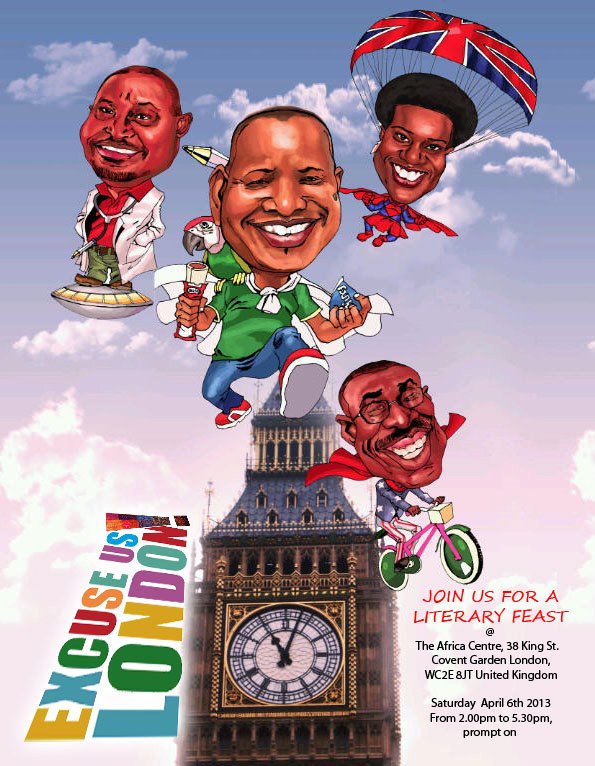
Excuse me London--advert

publicity poster by Victor Ehikhamenor

For a few interviews and other relevant sites for Nkem Ivara and Victor Ehikhamenor, see these links:

Victor Ehikhamenor (his website) To purchase Excuse Me!, if you are in Nigeria, you can order through Parresia or the online vendors Konga.com.ng or Jumia.com.ng. If you are outside of Nigeria, you can order  it from Amazon.com

March/April 2008 Sentinel Poetry interview 

27 November 2012 YNaija interview 

30 November 2012 BBC podcast 

3 January 2013 Author Q&A on Miss Ojikutu

Nkem Ivara (her blogTo purchase Closer than a Brother, you can order it online from Amazon.com or other online vendors listed at the end of the interview below.

16 November 2011, She writes the charming story of how she met her husband on Myne Whitman’s blog.

6 March 2013 JustJoxy’s review of Closer than a Brother

9 March 2013 An Interview with Myne Whitman

11 March 2013 An Interview with Kiru Taye

Here is the email interview I did with Nkem Ivara. It was originally published in Weekly Trust on 30 March 2013. Because the Weekly Trust website is having some malware issues, I’m providing a link to the interview as it appeared on AllAfrica.com.

I hope to write more about Closer than a Brother in the future and read more of the romance literature being written by Ivara’s contemporaries. I think this writing is really important, in part, because there is a huge reading public for it. Closer than a Brother already has 6 reader reviews on Amazon. When people repeat the cliche that there is no reading public in Nigeria, they don’t seem to be taking into consideration the appetite for popular literature, such as the thousands of Hausa romances and thrillers being published in northern Nigeria, or the rapidly expanding English-language Nigerian romance and erotica being made available online, whether through formally published e-novels like Closer than a Brother or informally published stories on blogs. Here is the interview. Enjoy.
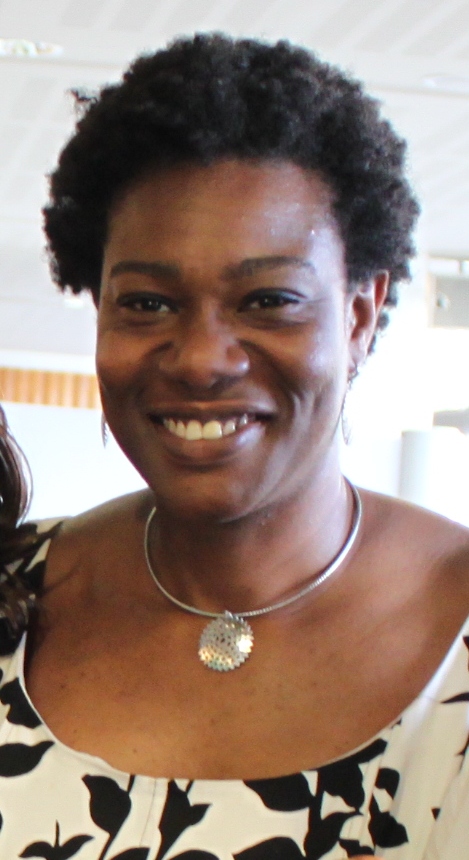
Nkem Ivara (c) CM

Nkem Ivara (c) CM

Conversation With Nkem Ivara, 

Author of ‘Closer Than a Brother’

BY CARMEN MCCAIN, 30 MARCH 2013

INTERVIEW

Happy Easter! The most momentous news in world literature since I turned in last week’s column has been the passing of one of Nigeria’s greatest authors, Chinua Achebe. This week I will highlight the work of one of his literary granddaughters, London-based author Nkem Ivara, whose first novel, the 80-page Closer than a Brother was published on 8 March by Whispers Publishing. In the novel, Daye and Sami have been like brother and sister ever since 15-year-old Daye saved 12-year-old Sami from bullies. Fifteen years later in London, can Daye and Sami can make something more of their relationship without putting their long friendship at risk? Fans of romance will love the banter and sexual tension between these best friends. Will they end up together? Read to find out.Nkem Ivara agreed to an email interview for today’s column. She will read from the novel during a shared literary event with Victor Ehikhaminor at the Africa Centre in London on 6 April 2013.

Tell me a little bit about yourself and your novel Closer than a Brother?

I am married to a real-life drop-dead gorgeous, tall, dark and handsome hero and we have two very active boys. I enjoy playing word games, reading and hanging out with friends over a meal. I love to organise and co-ordinate events. I also enjoy watching back-to-back episodes of some American TV series e.g. Scandal, Criminal Minds, The Good Wife, Greys’ Anatomy etc.

I have been writing for a while but only started doing so seriously when I met some other writers who encouraged me to pursue it in earnest. Closer than a Brother is my first published novel. It is about best friends who fall in love but are completely unaware their feelings are mutual. Daye Thompson and Samantha Egbuson grew up in Port Harcourt, Nigeria and now live in London. Neither is willing to risk losing the friendship by revealing their true feelings. The story is told from both points of view and explores the resulting conflict and complications as they each try to conceal their feelings for the other.

When did you start writing?

Since my teens, I have dabbled in writing on and off but was reluctant to call myself a writer for fear of being asked to prove it by showing published work. That all changed a few years ago when I started writing in earnest.

What inspires you to write?

I am inspired by the world around me; and human stories of love and triumph in the face of difficulty speak to me evocatively. I love to watch people and then make up stories about them. I tend to play a game of ‘What if?’ in my head. I imagine what would happen if things went a different way. Sometimes stories are birthed from this silly exercise. For me, writing is therapeutic, it centres me and helps sort out my thought processes. It affords me the chance to let my imagination run wild.

How did the idea for this novel come to you?

I cannot remember exactly and I feel a bit like this Steve Jobs quote, “Creativity is just connecting things. When you ask creative people how they did something, they feel a little guilty because they didn’t really do it, they just saw something. It seemed obvious to them after a while. That’s because they were able to connect experiences they’ve had and synthesize new things.”

I sat down one day determined to write a story. I wanted to write something I would enjoy reading, and I have always liked the idea of best friends falling in love. I think friendship is a great foundation for building a romantic relationship. It is different from meeting someone new and trying to put your best foot forward to make yourself more appealing. The awkwardness of making new acquaintances may be absent but it presents its own set of challenges too. To fall in love with someone whose faults and foibles one is all too familiar with takes some doing. I think that is just special.

What was the process like?

The actual writing process was a lot of fun. I would write a chapter a day, and then send it to my beta-readers to critique. Beta-readers are people who read works-in-progress with the aim of improving the plot, characters, grammar etc. Their feedback was generally very positive and their suggestions helped me fine-tune the story.

Could you tell me a little bit about the Romance Writers of West Africa online community that you are a part of?

RWoWA is a support group for writers of West African origin dedicated to the growth of African romantic fiction worldwide. It was founded originally with four members, Kiru Taye, Lara Daniels, Myne Whitman and me in 2011. With the increasing demand for the African romance genre, RWoWA strives to support established and aspiring romance authors who emphasise African plot lines. All sub-categories in romance writing are covered: contemporary, historical, inspirational, paranormal and science fiction. It provides a platform for peer-to-peer critique of works-in-progress. The members have been extremely supportive by acting as beta-readers, suggesting tips and tricks to improve my work and also suggesting publishers to pitch to.

Do you write other kinds of genres, or is romance your main oeuvre?

I write whatever takes my fancy, but I am a hopeless romantic, and I do have a soft spot for romance. I write it because there is something profoundly fulfilling about the trials and triumphs of love and relationships. That whimsical combination of wistful melancholy and joyous rhapsody gets to me every time.

Could you tell me about how you found your publisher and the editing process?

Kiru Taye, a friend and founding member of RWoWA, suggested a list of publishers I should submit to. I chose four of those in addition to an African publisher. I submitted to all five according to their guidelines, and three of them responded within a few weeks. The first wanted to publish it subject to some changes of certain words and phrases like brand names etc. The second wanted to publish as it was, and the third was a very positive upbeat rejection.

I decided to go with Whispers because they liked the story exactly as it was and would only make editorial changes. The fourth publisher contacted me saying they, too, wanted to publish it but I had already signed with Whispers, so I had to turn them down.

The editing process was not as painful as I had anticipated. We had two rounds of edits. The first highlighted certain words that had occurred too often and the second was mostly getting rid of some of my 116 exclamation marks!

Any plans for future books set in Nigeria?

Yes, I have two books in the offing, both of which are set in Nigeria. One is about a married couple who have to deal with the pain and betrayal of infidelity. The other is about a couple who are manipulated into getting married.

What is your writing process like? How does your family factor into your writing?

My writing process is fluid and adaptable. As a wife and mother of two young boys, I have learned to be flexible about my schedule. I try to write everyday but I am not always successful. There are good days and some not so good days. I do not like to call them bad because though I may not actually have written anything, I am constantly thinking about the story and working on it in my head.

My husband is extremely supportive. He not only gives me room to write when I need to, but also actively encourages me to do so. I usually wait until the boys are in school or after they are in bed; it is quieter then and I can hear myself think. However, if I have a deadline, I will sometimes write to the noise of their boisterous play.

Where is the book available?

Your readers can buy my book at the Whispers Website, All Romance Ebooks, Amazon.co.uk and Amazon.com. You don’t need an e-reader to read an e-book. You can download the Kindle app to your computer, android phone, iPad etc. Readers can find me on Twitter as @thewordsmythe and my blog www.thewordsmythe.wordpress.com

Making History with Balaraba Ramat Yakubu’s novel Sin is a Puppy… (a review)

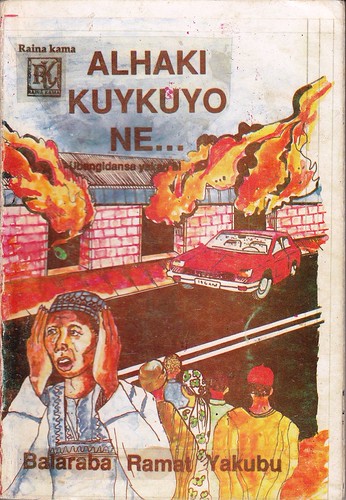
A few months ago, I posted the news about the publication of a translation of Hajiya Balaraba Ramat Yakubu’s Alhaki Kuykuyo Ne as Sin is a Puppy… by Indian Publisher Blaft. 

On 3 November 2012 I published a review of the novel-in-translation in my column in Weekly Trust. I am only just now getting around to posting it on my blog, which you can read if you scroll down past the links below. Since publication in October 2012, there have been quite a few reviews and articles about the novel posted online, most of them from India. In fact the number of reviews I’ve found are overwhelming. How many Nigerian novels published in Nigeria get this kind of critical response? We need to do better. But I’m thrilled that Hajiya Balaraba is finally getting the attention she deserves!

5 August 2012 A brief mention as a forthcoming book in DNA India’s “Booked in the Second Half.” 

26 October 2012 Bookshy mentions Sin is a Puppy in a post about Hausa popular literature.

1 November 2012 A mention in The Caravan: A Journal of Politics and Culture

3 November 2012  My own review of the novel for Weekly Trust.

4 November 2012 Dhamini Ratnam’s article for the Pune Mirror: “A Filmi Affair in Nigeria” (Reprinted by Blueprint)

4 November 2012 Deepanjana Pal’s article for DNA: “How Bollywood Fought for the Nigerian Woman.” (She posts the “unsnipped version” on her own blog.)

17 November 2012 A promotion for the novel on Nana Fredua-Agyeman’s blog ImageNations

22 November 2012 Seema Misra’s review on her blog. 

25 November 2012 A Review on The Financial Express  and The Times of India

29 November 2012 Aishwarya S’s Review on the blog “Practically Marzipan.”

7 December 2012 Subashini Navaratnam’s detailed and thoughtful review on Pop Matters. (And some follow-up observations on her own The Blog of Disquiet)

14 December 2012 Deepa Dharmadhikari’s charming review on Live Mint. (reposted on Emeka Lison’s blog.)

16 December 2012 Tolu Ihidero’s review for Ariya Today.

30 December 2012 The heroine Rabi gets a mention in DNA India’s list of unforgettable fictional characters of 2012!

5 January 2013 A thoughtful review on President Blink-Blink

6 January 2013 Shelley Walia’s review in The Hindu, one of India’s most respected papers.

1 March 2013 Sandra Rafaela’s post on the Women of the African Diaspora site.

18 March 2013 Guernica Art Editor Glenna Gordon picks Sin is a Puppy as her Springtime Read, Guernica Magazine.

You can find other reviews on the Goodreads page for Sin is a Puppy.

If you would like to read Sin is a Puppy, you can buy it directly from Blaft, or read it as an ebook on Kindle or Nook. Blaft has made the first chapter available for free.  You can read an interview with Hajiya Balaraba here. 

Here is my review for Weekly Trust, published on 3 November 2012:

Hajiya Balaraba Ramat Yakubu

Making History with Balaraba Ramat Yakubu’s novel Sin is a Puppy…

Category: My thoughts exactly
Published on Saturday, 03 November 2012 06:00
Written by Carmen McCain
Last week independent Indian publisher Blaft released Sin is a Puppy (that Follows you Home), a translation by Aliyu Kamal, of Balaraba Ramat Yakubu’s 1990 Hausa novel Alhaki Kuykuyo Ne (Ubangidansa yakan bi). Publisher Rakesh Khanna makes an unfortunate error when he claims that “This book, is to the best of our knowledge, the first published English translation of a complete novel from Hausa,” an inaccuracy that I hope he will change in their next print run. Hausa novels like Abubakar Imam’s Ruwan Bagaja and Muhammadu Bello Wali’s Gandoki have been abridged and translated and used in the Nigerian school curriculum, and a translation of Abubakar Tafawa Balewa’s novel Shaihu Umar is available for sale abroad. [Ado Ahmad Gidan Dabino’s brilliant bestselling novel In da So da Kauna was also violently abridged and awkwardly translated into The Soul of My Heart.] However, this publication is still quite significant. It marks the first international publication in translation of a contemporary Hausa novel from what is sometimes called the Hausa “soyayya/love” genre, a literary movement of mostly self-published authors that began in the mid-1980s. In fact, as far as I know, Hajiya Balaraba is the first female Hausa novelist to be published in translation. An excerpt of Alhaki Kukuyo Ne was earlier translated by William Burgess and published in the 2002 anthology, Readings in African Popular Fiction, edited by Stephanie Newell. The novel was also adapted into a film directed by Abdulkareem Muhammad in 1998 and has been the subject of scholarly work by Abdalla Uba Adamu, Novian Whitsitt, and others.

The novel tells the story of a Rabi, a woman married to a stingy, womanizing business man, Alhaji Abdu. Although she has nine children to take care of, her husband only gives her five naira a day to prepare their meals, while he spends over ten naira a day on restaurants and entertaining other women.  (Beyond literary value, the novel is also useful for tracking the inflation of the past twenty years!) Rabi pays for school fees from the money she makes cooking and selling food and takes care of Alhaji Abdu’s daughter from another marriage as if she were her own. Alhaji Abdu’s decision to marry an old prostitute as a second wife, however, brings Rabi’s misery to a climax. When the women quarrel, Alhaji Abdu throws Rabi and her nine children out on the street. The rest of the novel traces the decisions Rabi makes in her newly independent life, her daughter Saudatu’s marriage, and the continuing drama as Alhaji Abdu continues to alienate friends and family on behalf of his new ungrateful wife.

The suffering of the women in the novel seems to be, in large part, because of the patriarchal attitudes of polygamous husbands. As much as Rabi’s daughter Saudatu’s marriage to the devoted Alhaji Abubakar is described in romantic terms, she does suffer in the marriage as the third wife in a household of quarrelsome women. Even when she is alone with her husband, she is unable to rest after she gives birth because her husband wants her to continue looking after all the children he has had with his other wives. The other wives are portrayed harshly, but there is a sense that their quarrels come out of their being forced to co-exist with rivals. Even the men described sympathetically in the novel are sometimes unkind and imperious towards their wives. There are no feminist directives here, but a sense of unease and dissatisfaction at the plight in which women find themselves.  The happiest couples seem to be those who are made up of one man and one wife.

Although so-called soyayya novels are often stereotyped as being unrealistic romance novels, Alhaki Kuykuyo Ne, reminds me more of the classic muckraking novels of Charles Dickens, who threw a harsh moral light on the injustices of his own society. Neither does the narrative work like a typical English-language “romance novel” but rather with the uncertainty and ambiguity of modernist social realism. The novel does not resolve into a happy ending. There are no neat ends tied off.  Alhaji Abdu does get his comeuppance, when, as the proverbial title foreshadows, his sins catch up with him. However, there is no reward for the virtuous Rabi. Male relatives, who had initially denounced Alhaji for his abuse and vowed their support for Rabi, end up transferring their loyalties back to their fellow man in the end. The status quo is preserved. Lessons are learned, and society continues on, but no one is left very happy. Hajiya Balaraba questions whether men, in such situations, are actually following religious prescriptions or merely following cultural norms that privilege their own comfort and pleasure over their wives’ wellbeing.

The translator Aliyu Kamal, an English professor at Bayero University, does fine work here. His translation for Blaft reads much more smoothly and naturally than the excerpt translated by William Burgess for Readings in African Popular Fiction. Professor Kamal’s writing skills as the author of ten novels in English are obvious. This is not to say there were not issues with the translation. He sometimes leaves out important content and nuance. In the original preface, for example, Hajiya Balaraba begins the novel with a prayer of gratitude to Allah before launching into a summary of the novel. The translation leaves out the prayer and goes directly to the summary. He also leaves out another particularly pointed sentence in the preface, where Hajiya Balaraba says that abusive, neglectful men “exist in every corner of this state.” He sometimes makes odd translation choices such as describing Rabi as “putting on her makeup” after a bath, rather than “oiling her body” as it is in the original, and sometimes he translates out certain ironies.  In the original, Alhaji Abdu tells his first wife Rabi that he’s got “good news” for her, that he plans to give her “a little sister,” a euphemism for adding a wife. In Kamal’s translation, however, the irony is translated out with Alhaji Abdu merely saying, “I have something to tell you. I plan to take a second wife.” A more careful translation could have maintained the nuance. I would, additionally, have preferred if he had left common food words in Hausa, allowing readers to infer from context that they are foods rather than translating “koko” and “kosai” and “tuwo” as “porridge” and “bean cakes” and “pudding.” Although I was originally startled by some of the larger structural adjustments to the texts, including rearranged chapters, perhaps these were wise editorial decisions, as they do make the story flow more smoothly. Overall, despite these flaws, the translation makes for a good read and I would love to see Professor Kamal do more of such work.

I am particularly delighted by the publication of this translation because it indicates that the larger world is beginning to appreciate novels that have often been denigrated by an intellectual elite in Nigeria. Critics, many of whom have read only a few of the novels, or none at all, often condemn an entire range of genres and literary accomplishment as “trashy romance novels.”  Ironically, while for the past twenty years thousands of novels have been written and consumed by eager readers, Nigeria’s well-known publishers have looked the other way and bemoaned the “lack of reading culture in Nigeria. It took an Indian company to recognize these innovations and search for translators to midwife Hausa creative expression to a larger global readership. Because of this, although the book can be ordered from India and is available in e-book versions, Sin is a Puppy…., like so many other contemporary Nigerian literary works, is more easily available to audiences abroad than it is to Nigerian audiences.  I hope this publication will wake up Nigerian publishers and encourage more English-language novelists to try their hands at translation. Perhaps the Association of Nigerian authors, a university, or other literary initiative could award funding to at least one writer/translator team a year?

Note: My heart goes out to those who lost loved ones and those who were wounded in the bomb at St. Rita’s church in Kaduna on 28 October and in the reprisal attacks that followed. May God bring the murderers to justice and grant us all comfort and peace.

A Tunanina: 2012 in review

Despite being a mathematical incompetent, I have grown more and more fascinated with statistics, especially when they have to do with my own blog.

I have neglected this blog recently, in part, because I am desperately trying to “dissertate.” But I am gratified to see that  many of my old posts are still drawing traffic. In case it is of interest to anyone besides myself, I am posting the wordpress report on 2012 and hope to follow it with some of my own blog posts soon. I do continue to write a weekly column for Weekly Trust, which you can access on my Weekly Trust page here. When I have a chance, I will try to cross-post some of my articles here with more links and illustrations.

The WordPress.com stats helper monkeys prepared a 2012 annual report for this blog.

Here’s an excerpt:

About 55,000 tourists visit Liechtenstein every year. This blog was viewed about 180,000 times in 2012. If it were Liechtenstein, it would take about 3 years for that many people to see it. Your blog had more visits than a small country in Europe!

Click here to see the complete report.

Ramadan pieces from Last year: “Why, as a Christian, I Fast during Ramadan” and “Under the Mango Tree”

I have been reading back recently over several of the articles I wrote last Ramadan, when I was fasting alongside my Muslim friends in Kano. It was the third year I was fasting, and I had settled into the rhythm of the month. I did not fast this year, though, at points throughout the month I have wished I were. I think it may have made me feel a little bit more in tune with what is happening around me. As I never posted my articles last year, in part because I was never able to find a hard copies of them to include online, I figured, in honour of Ramadan, before it ends in the next few days, I would put up at least two of them right now. “Why, as a Christian, I Fast during Ramadan” published 20 August 2011 and “Under the Mango Tree” published 27 August 2011.

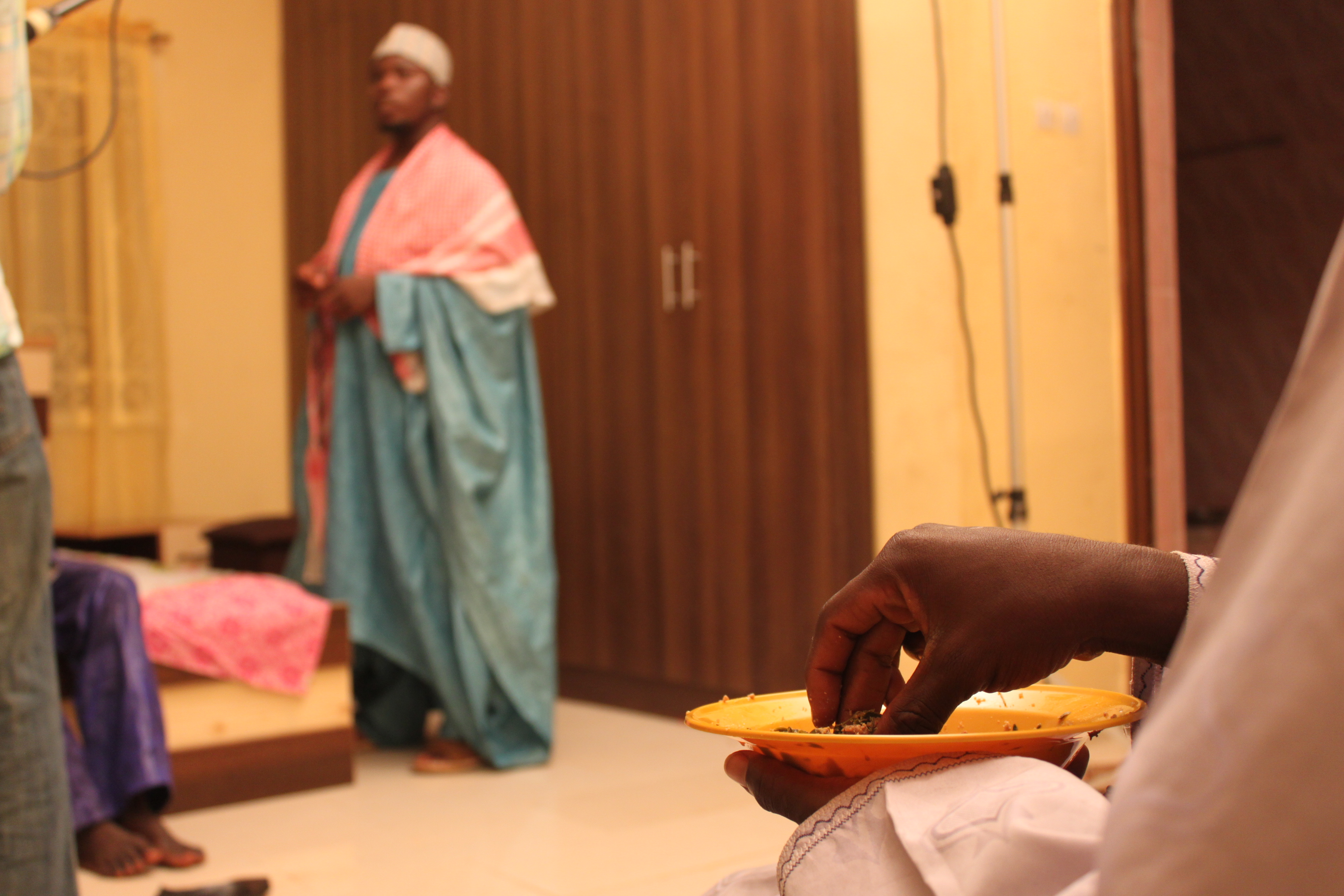
Breaking fast on the set of Jani-Jani, Kaduna, 29 August 2010. (c) Carmen McCain

“Why, as a Christian, I Fast During Ramadan”

20 August 2011

Recently, my blog was accessed six times with the search phrase “Is Carmen McCain a Muslim.” I’m not. I’m a devout Christian, but I can understand how some people might be confused. Most of my friends in Kano are Muslim, the people I write about are often Muslims, and this is the third Ramadan have fasted alongside my Muslim friends. When I brought up the issue on Facebook, several Christian friends told me they also had been confused about my religious identity because I had mentioned fasting, and in Christianity, one is not supposed to advertise one’s fast. Although there are also Christian traditions of public fasting, I tried to explain that ultimately I AM fasting with Muslims, but that does not mean I am any less a Christian. I won’t necessarily fast for Ramadan for the rest of my life, neither do I expect other Christians to do the same, though Christians in Bethlehem and other parts of the Arab world have done so for centuries. It is a personal decision I have made for the time being to participate in my community.

Last week, I walked into a Zoo Road studio a few minutes before maghriba with a bag of sliced watermelon. “Are you fasting?” novelist and scriptwriter Nazir Adam Salih asked me. “I am,” I said. “Kina taya mana azumi.” he said. “You are helping us with the fast.” I had not heard it put that way before but his expression felt exactly right. I am not as strict with my fast as a Muslim would be. When I am sick, as I was for the first week of Ramadan this year, I eat without any plans to later “make up” the missed days. But the experience of Ramadan and fasting out of love for my community has been one of the most powerful things in helping me empathize with my Muslim neighbors. This week, I share a piece I wrote three years ago in 2008, during my first Ramadan fast.

Ever since I knew I was going to be in Kano for a year, I thought that I would try to fast during Ramadan. First, I thought it would not be appropriate to eat in front of other people who are fasting, even if it’s just sneaking a meatpie and sachet of water from the canteen to my office at Bayero University; second, I thought it would be good to experience what millions of people, and specifically those around me, experience every year. As I told one of my friends on the first day of Ramadan, “If you are hungry, I will be hungry. If you are thirsty, I too will be thirsty.” The day before the fast began, I bought a book on fasting from an Islamic book seller to better understand fasting from an Islamic perspective—what my friends believe. But ultimately, what I hope to gain out of this is spiritual discipline practiced from the perspective of my own faith. Although not compulsory, fasting is a spiritual discipline in Christianity as well (Jesus fasted for forty days in the desert in preparation for his three years of ministry). I thought that, though I am Christian, I live among Muslims, so I will fast when they fast and pray when they pray. And I will hopefully grow in my own spiritual life.

Today, on the second day of Ramadan, walking wearily across campus to wait for the bus at around 5pm, I thought, maybe I should stop this. It’s not a requirement for me, and I’m finding myself dull, forgetful, distracted, irritable, impatient, on edge. It’s not easy to manifest the Christian “fruits of the spirit,” (love, joy, peace, patience, kindness, goodness, faithfulness, gentleness, and self control), when I have not eaten or drunk all day. On further thought, as I was walking from the bus stop to my house clutching two packets of dates and a sliver of watermelon I had bought to break my fast with, I realized that perhaps that is the point of fasting, at least for me. It forces me to realize, humbly, how much of my good spirits, my mostly cheerful demeanor are chemically-based, physical attributes. I have been blessed with good health, with chemical balance, with a fairly even and laid back temper (though my good friends know the exceptions). Peeling back those layers of the physical, one comes closer to the core of one’s being, what is underneath the surface pleasantness—what comes out when there is no protective politeness—and it’s not always very attractive. I have thought often over the past few years of what Christian writer and thinker C.S. Lewis says in his book Mere Christianity, about the difference between human perspective and God’s perspective:

 “Some of us who seem quite nice people may, in fact, have made so little use of a good heredity and a good upbringing that we are really worse than those whom we regard as fiends. Can we be quite certain how we should have behaved if we had been saddled with the psychological outfit, and then with the bad upbringing, and then with the power, say, of [Nazi war criminal] Himmler? That is why Christians are told not to judge. We see only the results which a man’s choices make out of his raw material. But God does not judge him on the raw material at all, but on what he has done with it. Most of the man’s psychological make-up is probably due to his body: when his body dies all that will fall off him, and the real central man, the thing that chose, that made the best or the worst out of this material, will stand naked. All sorts of nice things which we thought our own, but which were really due to a good digestion, will fall off some of us: all sorts of nasty things which were due to complexes or bad health will fall off others. We shall then, for the first tune, see every one as he really was. There will be surprises.”

I meditate on this in relation to fasting. When fasting, those base human characteristics, the instincts, the first reactions, come out more dramatically, and you have to deal with them. You are impatient but you force yourself to speak patiently. You don’t feel gracious but you make yourself be gracious anyway. It becomes a discipline, training and subduing those initial reactions that surface more clearly when you are hungry and tired, and it encourages humility. You don’t have that easy excuse—oh sorry, I haven’t eaten yet today, and I can’t think clearly—because no one else has either. You become weaker and more vulnerable to your community while stronger in your individual will. This is spiritual growth—going beyond one’s personality to something deeper.

At the same time, you also become more aware of the joys of the physical. The pleasure that comes at the end of the day, especially when you are breaking the fast with other people. The lilting greeting “A sha ruwa lafiya,” “Enjoy quenching your thirst”—the sweetness of the crystallized sugar in a dry date when it is the first thing that has touched your tongue all day; the fresh wetness of a tangy orange or sweet watermelon or solid banana; the way the spicy flavours of Hausa shayi detach themselves and come one by one: cardamom, ginger, other flavours that I cannot yet identify. The first burst of energy after the sugar enters your blood stream and the pleasant stuffed feeling when your stomach is extended with tuwon shinkafa and miyan taushe or fried yam and potatoes, peppered tofu and kosai. Denied for 13 or 14 hours a day, the senses are heightened. Listening to the Ramadan service on the radio, the chanted Arabic, the call and response, it reminds me of listening to a mass—Gregorian chants in Latin—or a BBC broadcast of the Nine Lessons in Carols on Christmas eve.

These common elements of our faiths are what I am reminded of at Ramadan. Though Christians and Muslims have many differing religious beliefs we will never be able to agree on, at core, all three Abrahamic religions are linked by what Jesus identified as the “greatest commandments”: First, “Hear, O Israel, the Lord our God, the Lord is one. Love the Lord God with all your heart and with all your soul and with all your mind and with all your strength. The second is this: ‘Love your neighbor as yourself.’” I believe that, beyond our differences, if we encourage each other in love to seek this truth, we will find peace. A sha ruwa lafiya.

–FIN

“Under the Mango Tree”

27 August 2011

One of my main joys of Ramadan this year, whenever it is not raining in the evening, has been to take a mat outside and sit under the mango tree that grows outside my window. I read or write or just lie staring up at the leaves above me, mind at rest, until the maghriba prayer is called and I reach for my packet of dates. I am close to the dirt there and the strands of grass that find enough sun to poke up under the trees. One evening I moved around the mat for an hour trying to move out of the path of a slow but persistent little snail who seemed to want to follow me wherever I went. Eventually, I placed a leaf into his path and then carried the leaf to a muddy patch far from my mat. A neem tree arches over the wall of my house, branches mingling with those of the mango tree and when I lie under them, I look up through layers and layers of leaves, watch them sway in the breeze, hear them rustling together, merging with the sound of the neighbor children outside the wall and the distant honk of horns on the main road. If I gaze up long enough, I feel like I am floating.

This week, when I spread the mat out under the tree I could see dark clouds billowing in the East and thought I might not make it to maghriba before the rain came. All the same, I piled up fruit in a basket, and took out newspapers, a pen and a notebook. The leaves were mostly silent that evening. The air was still, in anticipation of rain. I lay on the straw mat under the tree, and thought, as the thunder began to break and the first fine droplets filtered through the trees, about the motion of the universe. This flat soil I lie on, this surface of the planet that seems so solid and still, is actually spinning through star studded space. This sun I am waiting to set on my face of the planet, my little patch of ground under the mango tree, is only one star in one galaxy out of a million. The sun does not, in fact, move down towards the horizon. We are the ones, clinging to this fragile planet, who are spinning past fire.

There is a peace in these moments, an awareness of my own smallness, as I listen to the rhythms of the earth. I am both as still as I will ever be and hurtling through space.  I am reminded that when we fast we acknowledge our own desires are ephemeral in the vastness of God’s design. We give up pleasures, which we may at times over-indulge, joys, not always necessary for life. This year, I have realized how weighted down we become with loves, which are not ours to own, the heaviness of commitments to unnecessary habits. It is sometimes in the pain of giving up that which we think nourishes us, gives us life, that we float free. In this time of discipline, it is only when the sun passes that we realize the sweetness of its fruit.

One of my favourite music videos is “Patience” by reggae artist Damian Marley and rapper Nas. The musicians quietly ask piercing questions about life, challenging the arrogant presumptions of the privileged about “modern development,” sound-byte answers in the face of eternal mystery. The musicians emerge out of a backdrop with the perspective of a Renaissance painting, camera sweeping through layers of images, through clouds past pyramids, into a mythic African past:

We born not knowing, are we born knowing all?

We growing wiser, are we just growing tall?

Can you read thoughts? can you read palms?

Can you predict the future? can you see storms, coming?

The Earth was flat if you went too far you would fall off

Now the Earth is round, if the shape change again everybody woulda start laugh

The average man can’t prove of most of the things that he chooses to speak of

And still won’t research and find out the root of the truth that you seek of

Scholars teach in universities and claim that they’re smart and cunning

Tell them find a cure when we sneeze and that’s when their nose start running

And the rich get stitched up, when we get cut

Man a heal dem broken bones in the bush with the wet mud

Can you read signs? can you read stars?

Can you make peace? can you fight war?

Can you milk cows, even though you drive cars? huh

Can you survive against all odds, now?

Marley and Nas pace through a shallow river to where it spills over the edge of the world. Galaxies and planets stretch out above them: “Who made up words? who made up numbers?” Nas asks. “And what kind of spell is mankind under?”

I hear the song echo under the mango tree as dusk moves in, and hunger moves towards its end. The first time I broke fast for Ramadan in 2008, a friend took me home for dinner. We walked under the sunset, past the ancient sloping Kano wall grown over with grass, down winding paths through the old city, spitting out date seeds. I sat on a mat under the cloudy sky eating oranges, fried yam, drinking tea, tucking my skirt firmly around my ankles and mayafi around my neck as mosquitos began to bite. I answered in fumbling Hausa, those questions my friend’s mother asked, but I mostly sat quietly under the sky and listened to the chatter of teenage girls, the banter of young men, the good natured laughter of their parents. Above us the clouds scudded past in a darkening sky. After that first evening, I mostly broke fast with musicians and editors and actors on Zoo Road, sharing out quartered oranges and slices of watermelon, crispy kosai and fried potatoes served on a newspaper transparent with oil, hot thick koko sweet with sugar in plastic cups. As my Hausa began to improve, we’d have long conversations in the studios, about film and politics, music and religion.  At night, I’d speed home on an achaba,  moon rising overhead, as stars began to peak out from beyond the clouds.

Well into my fourth year in Kano, my days have grown busier. This week, as Ramadan draws to a close, I break the fast by myself on this straw mat, waiting for the sun to set or the rain to come, wondering which will come first. It’s good to be under the mango tree, under the leaves, under the clouds, beyond which stretch the stars. I am glad I am not inside with my laptop open to the insistent demands of the internet, emails that must be answered and people on Facebook demanding responses, the guilt-inducing cursor blinking on the blank white page of articles long overdue.

I let my mind sway with the trees. The rain comes before the sun sets. The ink on my page blurs into little wet patches. I slowly stand up and carry the straw mat, my basket of fruit, newspapers and books to shelter. Dark clouds are piled up in the east, blowing in with the approaching night, but in the west where the sun hovers on the horizon, the rain falls through light, glimmering and sparkling to the earth, watering the grass which thrives today and dies tomorrow. So many things we love are fleeting, the raindrops that fall from sky to soil, bushes that grow green and lush now, and fade to brown later, the light which rises with promise each day only to fall into dark. But it’s all beautiful while it lasts.

–FIN

[Please NOTE that the video “Patience” has been embedded into this blog post under Fair Use laws for review purposes.]

The Caine Prize, the “Tragic Continent”, and the Politics of the “Happy African Story”

Behind as usual in posting on this blog, I’m going to jump back in (with minimal apologies about my absence and the usual promises to catch up) with my most recent article, published today, “The Caine Prize, the Tragic Continent, and the Politics of the Happy African Story.” Here, I engage with British novelist, and the 2012 chair of judges for the Caine Prize for African Writing, Bernadine Evaristo’s  ideas expressed, in an essay on the Caine Prize blog, on what a new African literature should look like. (If you don’t want to read my long, half memoir, half academic preface to the article, just skip down to the photo to read my article and other responses to Evaristo’s article by other Nigerian writers.)

A Preface:

Some of the issues I brought up in the piece have been haunting me for years, as I have struggled with my identity as a white American who moved as a child to Nigeria with my parents and have since occupied the privileged position of the global wanderer. As an undergraduate, I wrote a creative senior thesis of collected  poems,  which I introduced with an essay, “Writing Home.” I wrote that  I had  become “a member of a certain community of writers,” perhaps best expressed  by expatriate Indian writer Salman Rushdie in his essay“Imaginary Homelands”:

It may be that writers in my position, exiles or emigrants or expatriates, are haunted by some sense of loss, some urge to reclaim, to look back, even at the risk of being mutated into pillars of salt. But if we do look back, we must also do so in the knowledge–which gives rise to profound uncertainties–that our physical alienation from India almost inevitably means that we will not be capable of reclaiming precisely the thing that was lost; that we will, in short, create fictions, not actual cities or villages, but invisible ones, imaginary homelands, Indias of the mind. . . . (Imaginary Homelands 10)

At age 21, on the cusp of my adult life, I was relieved by the idea of not having to choose a place to be rooted. I found home in the metaphoric space of the trans-Atlantic flight, writing,

Perhaps more than any other place, I have felt at home on airplanes.  There, I do not have to claim one piece of soil but rather every place we fly over. Sometimes, at night, I wake up and crave being on an airplane, any airplane, but specifically a transatlantic one: the familiar feel of take off, being pressed into the cushions, my suddenly sleepy eyes seeing through an oval pane of plastic the land stretched out beneath me. The rain forest of Lagos, the desert of Kano, the lights of New York or Atlanta, the misty clouds of London or Amsterdam slowly drop away and look like maps, or aerial photographs. I love to fly through the clouds, which make odd airy sculptures, or at night to press my cheek against the cold window and with a blanket over my head gaze up at the stars: constellations which can be seen from three different continents. Orion, I can see in America, England, and Nigeria. But somehow from a plane, the patterns are even more brilliant, closer, larger, and almost tangible through the frosty pane.

As I grow older and as I pour much of my focus into the study of Hausa literature and film, which is often neglected in studies of Nigerian literature (often focused on English-language literature), I have become more troubled about issues of privilege and my own problematic position, as one who, by virtue of my American passport, has access to world travel and research grants and privileged treatment in Nigeria that most Nigerians do not have. My lifestyle, in a way, is made possible by the immobility of others. I now deconstruct my earlier romantic notions of being able to claim “every place we fly over.” Now, when I read Simon Kuper’s essay “Take the plunge and emigrate,” which argues from a similar unrooted position, my reaction is less celebratory.  I ask–as the youth of the West roam free, what does this mean for the places and the people where they decide to settle?

As I work on my PhD dissertation, I mull over Gayatri Chakravorty Spivak’s often misunderstood essay “Can the Subaltern Speak” and the various ways she has revisited the topic since her first presentation of it in 1983.  In a 2010 response to other scholars’ engagement with the question, she clarified that her “point was not to say that they couldn’t speak, but that, when someone did try to do something different, it could not be acknowledged because there was no institutional validation” (2010: 228).   In thinking about the field of postcolonial studies, in which I locate my own research, I have become increasingly concerned by the full-scale celebration of cosmopolitanism, hybridity, migration, and diaspora so prevalent in the field, the happily ambivalent identity of “in between” that I reveled in as I wrote my senior thesis.

It’s not that I don’t think the concepts are useful. They are–on many levels. And, of course, postcolonial scholars theorize them in much more sophisticated ways than I did as an undergraduate attempting to claim a hybrid identity. But I have become more concerned about the ways that these theories of hybridity, et al. sometimes gloss over class issues and privilege the experience of the “diaspora” intellectual over the experience of the so-called “subaltern” left at home. The problem is one of framing, that the voices most often heard by a global media and global academia are those situated in the cosmopolitan centres of the West.

Spivak is useful in helping think through these issues. On the one hand, as a postcolonial intellectual situated in a powerful American ivy league university and often counted as one of the Big Three postcolonial theorists (Spivak, Said, and Bhaba), she is also complicit in this privileging of expatriate voices. Indian intellectuals, Rahsmi Bhatnager, Lola Chatterjee, and Rajeshwari Sunder Rajen based at Jawaharlal Nehru University, point out, in a 1987 interview,  “Perhaps the relationship of distance and proximity between you and us is that what we write and teach has political and other actual consequences for us that are in a sense different from the consequences or lack of consequences for you.” I would also argue that the abstruse language which Spivak chooses to make her arguments, which could otherwise be quite politically powerful, limit their discussion mainly to other academics.

On the other hand, she constantly questions her own positions and ideas, in a way that any scholar or writer who has privileged access to travel and funding, must do. While bemoaning the institutions which are often deaf to the voice of the subaltern, she has also become personally involved in learning from those she defines as “subaltern” and thinking through ways in which they can be empowered through education. 

Much theory, I’m beginning to understand, is dependent on positioning and audience.While living in the U.S. and teaching introductory African studies to American students, I was (and still am) quite sensitive about negative portrayals of Africa–the barrage of images of flies and dirt and poverty and ads from charities that always featured tears trembling in the eyes or the snot running out of the nose of some ragged African child. I would open my classes by having students read Binyavanga Wainaina’s “How to Write about Africa,” then juxtaposing that with a few Naija music videos. If I find myself teaching in America again, I may pair Wainaina’s essay with Teju Cole’s “The White Savior Industrial Complex.”

When, last month, I reviewed Abidemi Sanusi’s gut-wrenching novel Eyo, that was nominated for a Commonwealth Prize in 2010, I felt the tension between being a postcolonial critic whose institution is located in the United States and being a resident of Nigeria, where I become ever conscious of the many abuses that Nigerians constantly talk about. On the one hand as I read Eyo, I thought, hey, Nigerians look really bad in this book. On the other hand, I thought–Sanusi is exposing the horrific underworld of human trafficking and manages to humanize every character in it–a striking accomplishment. (Read my review here.)

My reaction to Evaristo’s statements, then, came out of all of this mulling about ideas of privilege, positioning and audience, as well as from some mind-stretching conversations with writer friends who live here in Nigeria.  [UPDATE 13 May 2012: Let me just further clarify, that I think that writers in Africa or anywhere else in the world should write whatever they like in whatever style and whatever language that they like. My main point in the essay below is basically combating what seems to me to be a certain amount of prescriptiveness in telling African writers (especially those living on the continent) “how to write about Africa.” Telling writers not to write about suffering just follows up on older instruction to writers to write about the nation or to write about politics.  South African writer Njabulo Ndebele, in Rediscovery of the Ordinary, similarly protests the imperative of the “spectacular” in South African writing, arguing for more representation of the daily struggles of ordinary people to try to make their lives as normal as possible–which he calls an “active social consciousness.” I am not trying to defend those writers who cynically exploit suffering in order to become popular with non-African readers–it does happen–I’ve read it–and I’m not a fan. I dislike sensationalism and pandering to a Western audience as much as the next critic, and I agree with Ndebele (and with Evaristo if this is what she was saying) that there should be more focus on ordinary life. My main point is that I think we must be careful about saying that writing that depicts suffering is necessarily “pandering.” Ndebele points out that the spectacular writing that grew up in South Africa was in response to the almost surreal conditions people found themselves in. To say that writing that reacts to one’s environment is meant for Western audiences falls into the same trap that Graham Huggan falls into in his book The Post-colonial Exotic: Marketing the Margins.  Huggan  implicates the field of postcolonial literary production and publishing as well as the academic field of postcolonial studies in capitalist structures of selling exoticism. Yet, in his rush to denounce the Western reader of “exotic” postcolonial literature, he only briefly acknowledges in a few caveats that that the readers “by no means form a homogenous or readily identifiable consumer group” (30), almost completely glossing over the reader of postcolonial literature in formerly colonized locations. Stating that Chinua Achebe’s Things Fall Apart “implicitly address[es] a Western model reader who is constructed as an outsider to the text and to the cultural environment(s) it represents” (2000, 46), he seems to have completely missed Achebe’s defense that “African writers who have chosen to write in English or French are not unpatriotic smart alecs, with an eye on the main chance outside their countries” but are indeed writing for heterogenous peoples of different languages and cultures that make up “the new nation-states of Africa” (1965, 344). In this article, then, I try to point out that to focus so obsessively on the reaction of a Western audience, when many writers are writing out of their own experiences that include love and laughter and tenderness in addition to moments of suffering and are usually thinking of readers closer to home, is to put almost impossible strictures on the writer. Let the writer write what she wants.  If that happens to be science fiction, fantasy, historical fiction, crime fiction (and I’m a HUGE fan of Nazir Adam Salih’s fantasy and crime fiction written in Hausa, in addition to the more scathing and sensational social critique of writers like Balaraba Ramat Yakubu ),  great. If that happens to be more straightforward realistic narrative based out of the writer’s own experiences, this too is important writing.

To read my original article as it was published, click on the photo below to be taken to a readable version. Otherwise, scroll below the photo, to read the article with references hyperlinked. Following the article, I have copied a few of the responses I got on facebook from writer/artist friends when I asked for reactions to Evaristo’s essay. (Responses reproduced by permission of authors)

[UPDATE 3 July 2012: I’m honoured that this blog post was mentioned in Stephen Derwent Partington’s East African article “More Responsibilities than bonuses for the African Writer,” in which he summarizes what I was trying to say much better than I did, myself. A former professor of mine, Peter Kerry Powers also engaged with my article on his own blog. ]

The Caine Prize, the Tragic Continent, and the Politics of the Happy African Story

Written by Carmen McCain Saturday, 12 May 2012 05:00

 On 23 April 2012, the chair of judges for the Caine Prize for African Writing, British-Nigerian writer Bernadine Evaristo wrote a blog post about selecting the soon to be released short-list: “I’m looking for stories about Africa that enlarge our concept of the continent beyond the familiar images that dominate the media: War-torn Africa, Starving Africa, Corrupt Africa – in short: The Tragic Continent. [… W]hile we are all aware of these negative realities, and some African writers have written great novels along these lines (as was necessary, crucial), isn’t it time now to move on?” Her critique of “stereotypical” African stories is similar to those made by other African writers, such as Kenyan writer Binyavanga Wainaina in “How To Write About Africa” and Nigerian-American writer Teju Cole in “The White Savior Industrial Complex.” Her opinion piece also invokes previous critiques of the Caine prize. Last year columnist Ikhide R. Ikheloa wrote, “Aided by some needy ‘African’ writers, Africa is being portrayed as an issues-laden continent that is best viewed on a fly-infested canvas.”

I share these concerns about dehumanizing images of Africa. When living and teaching in the U.S., I tried to “enlarge” my American students “concept of the continent” by emphasizing exciting current trends in African fashion, music, and movies, as well as the daily lives of ordinary people. My aim was much like that of Samantha Pinto, one of the other Caine Prize judges who blogged this week: “I hope as a teacher that my students learn to carry some of these beautifully crafted stories into a much larger conversation about Africa than the one that exists in mainstream American media.” My own scholarly interest in Hausa popular literature and film began precisely because I was enchanted by the love stories and tales of everyday life consumed by popular audiences but largely ignored by African literary scholarship preoccupied with grand narratives of the nation.

However, I admit that as I read Evaristo’s comments, I felt a tension between her impatient charge to “move on” past representations of suffering, and the context of currently living in northern Nigeria, where people leave their homes daily knowing that they could be blown up or shot at by unknown gunmen. Only two weeks ago in Kano, an attack on churches that met on Bayero University’s old campus killed dozens of university students and professors, the very cosmopolitan middle class often celebrated by writers abroad, and more bombs were found planted around campus. Suffering is not limited to bombs, as I was reminded when recently attending a church in Jos. Pointing to a dramatic decrease in tithes and offerings as evidence of hard times, an elder sought prayer for those who lost their livelihoods in the Plateau State’s demolition campaign of “illegal structures” and would lose more in the recently-announced motorcycle ban.

Kaduna-based writer Elnathan John, in a conversation with other African writers on Facebook (quoted by permission), wrote that writers should be more concerned with the quality of the writing than in dictating to other writers the correct topics to write about.  “When I am told to tell a happy African story,” He said, “I ask, why? Where I live, EVERYTHING is driven by fear of conflict, bomb blasts, and daylight assassinations unreported by the media. Every kilometer of road has a checkpoint like those in the Occupied Palestinian Territories. Now, I am a writer writing my realities. […]Our problems in Africa will not disappear when we stop writing about them.”

While not every place in Nigeria is bomb-torn and certainly not every story from as big and complex a continent as Africa must reflect such tragedies, a predicament remains that Kano-based writer Abdulaziz A. Abdulaziz identified in a Facebook conversation with me. While agreeing with Evaristo on the need to move past stereotypes, he wrote, “There is a dilemma here; what do Africans have to export again. For me, African contemporary artists have no better theme than corruption and bad governance as the main issues dominant in our everyday life[…]”

Elnathan John continued, “A lot of the Happy Africa story activists live outside the continent. Not that I begrudge them anything, but it is easier to dictate to people living a reality when you don’t know or live that reality. […] Every Sunday morning (in many Northern States), we expect a bomb or a shooting spree. People who live in Maiduguri even have it worse. Their entire lives are ruled by violence and chaos. Nigerians, like Zimbabweans (and many other African countries suffering decay and violence) do not have the luxury of Always writing about beach house romances. Our problems are too real, too present, too big to be wiped out from our stories.”

Thus, while we can all identify with Evaristo’s frustrations in how Africa is misread by the West, her first flawed assumption seems to be that African writers who write tragic settings are not writing of their own experiences but rather pandering to a Western audience that expects to hear about tragedy. To say we must “move on” past stories of hardship suggests to those who are suffering that their stories don’t matter—that such stories are no longer fashionable. Writers who live amidst suffering are in the unfortunate position of inhabiting an inconvenient stereotype. They are silenced by threats of terrorists inside the country and by the disapproval of cosmopolitan sophisticates outside.

Such literary prescription begins to feel like Dora Akunyili’s erstwhile rebranding campaign—a luxury of those who do not want to be embarrassed while abroad, which does little to solve the problems on the ground. Although Evaristo asks, “are too many African writers writing for the approval of non-African readerships”?, her admonition to avoid stories of suffering seems to be just as implicated in seeking the approval of  those “big, international markets in Europe and America”. Directly after she asks “to what extent does published African fiction pander to received notions about the continent, and at what cost?” , she argues, “For African fiction to remain more than a passing fad on the world stage, it needs to diversify more than it does at present. What about crime fiction, science fiction, fantasy, horror, more history, chick lit?”

Now, I love science fiction, fantasy, historical fiction et al, and know of African writers, including Evaristo, who are doing exciting things with these genres, especially in African languages, but Evaristo’s focus on the “world stage” reveals her second problematic assumption—that the most important readers of African literature reside outside of Africa. It is a reminder that though the Caine prize is awarded to “African writing”, it is still based in London.

Last week, overwhelmed by the attacks on Bayero University, I printed reader responses to  an earlier article on film rather than writing about the tragedy. Afterwards, one of my readers chastised me for writing about film rather than about what the “army are doing to our people.” While, like Evaristo, I defend my right to talk about a diversity of subjects, the comment reminded me that there is a large reading public here in Nigeria looking for writing that is relevant to their lives. It also made me think of my dear friend, Hausa novelist, Sa’adatu Baba Ahmad’s refrain that for her “literature is a mirror to society.” That every conversation these days seems to return to bombs and shootings does not mean that people do not laugh or joke or gossip or dream or love.  Indeed, I believe that the best writing captures the humour, the humanity, and the gossip alongside the backdrop of suffering.

So, by all means let us, as Evaristo appeals, have new genres, new styles, that are “as  diverse as, for example, European literature and its myriad manifestations” Let us have “thousands of disparate, published writers, with careers at every level and reaching every kind of reader.” But let us also be true, let us be relevant. And let us not, in pursuit of a global recognition, erase the voices of ordinary people, who so often bear up under immense suffering with grace and humour. For it is these stories of survival that give us the most direction in how to navigate an increasingly terrifying world.

Fin

While writing the article, I asked my friends on Facebook what they thought of Evaristo’s article. Some of them responded after I had already turned in the article, so I asked their permission to republish their comments here. See them copied below. [Update 13 May 2012: The quotes in the above article from Elnathan John, who writes a popular satirical column for Daily Times and short stories on a wide variety of themes, including facebook and middle class love in Nigeria as well as darker issues based on current events, came from comments on another writer’s page. They were part of a larger discussion in which he was expressing frustration at writers telling other writers what to write. He was insisting, like other writers I’ve seen in conversation, that he should have the freedom to write about whatever he likes, and that themes and topics in writing will change over time in response to what is relevant.  Following his statement that “Our problems are too real, too present, too big to be wiped out from our stories,” he says, “In the end, like you say: ‘Just tell me whether my work is good or bad. That conversation, I am very happy to have.'”]

Kano-based writer Abdulaziz A. Abdulaziz reacted positively to Evaristo’s essay, but still noted the tension between writing stereotypes and writing about ongoing problems:

I agree with Evaristo. It is indeed time to move on. For example, isnt it shameful that in 2012, a story about second World War is making the list? I think African writers have rendered so many themes to cliches. Why, for example, should we still be reading novels about Biafra or the mau mau guerilla war in Kenya? On another pedestal, it is indeed ironic that Africans complain about stereotypical depiction of a grotesque Africa by non-African writers, the same African writers are not doing any better. It is just like feminists lambasting gory representation of women yet they go about writing about naive women and prostitutes! Even the classical Achebe, according to some acidic critics, did no better than Conrad regarding the image of Africa. However, there is a dilemma here; what do Africans have to export again? For me African contemporary artist has no better theme than corruption and bad governance, as the main issues dorminant on our everyday life especially since we all fed from Achebe, Armah, Ngugi and Ousmane who instructed us to responsive to the society.

May 8 at 12:57pm ·

I responded to Abdulaziz:

Hi Abdulaziz, just to jump in here a bit (before hitting the road to a conference and then hopefully checking again later tonight). I liked Evaristo’s call for new themes and genres–I’d love to see more African science fiction etc–, but I was troubled by what felt like a prescription to “move on” past depictions of suffering, when as you note that there is corruption, bad governance, and currently bombs etc going off around us. If one writes what one knows than it seems to me that it would be difficult and even escapist NOT to write about some of these things. (That said, one can metaphorically write about things in non-cliched ways in new genres etc) It felt to me that in her appeal to move past “stereotypes” about Africa, she was still appealing to African writers to please or “teach” a Western audience rather than responding to the preoccupations of one’s own society. As for writing about Biafra or WWII etc, I don’t really have a problem with that because I think these topics actually have not been explored enough. I’ve never actually read African fiction about the experience of African WWII soldiers, so I actually thought that story was refreshing and new.

Ukamaka Olisakwe, whose novel On the Eyes of a goddess was recently released, responded passionately:
Have we moved on, or have we only moved onto a new level of ignorance and stupidity?Should I write about a beautiful Africa? Should I distort the truth just so to satisfy some school of thought that frown at the continuous dent on the ‘inglorious’ African image.Last time I listened in on the conversation of intellectuals. They were thoroughly fed up with stories of suffering Africa; of child soldiers, abused women and children, of wars and corruption. African writers should move on, should tell flurry stories: chicklit, thrillers, comedy, commercial fiction, etc etc, they said. I agree, some stories have been told over and over again, like a clothe washed for too long, until it began splitting at the seams. Yes, I do not want to read anymore of Biafra stories- that have been well documented. Instead I wish to learn new details about that war from the Nigerian side. I want to read a biography of Chukwuemeka Odimegwu Ojukwu. I want to know how he felt years after he made that declaration. Did he feel regret or fulfillment? I want to learn new details, information, that hadn’t been brought under the sun.But should we, writers, move on and desist from telling it as it is. A new war is on in Nigeria, a kind that could gradually wipe the fragments that we are. Should writers ignore this salient moment, or begin to please those who think they know better?I refuse to be conned into that, because at the end of the day, you end up just satisfying those sect, and also, definitely, writing another single story of Africa. I say, write about Africa the way she is, the way you see her: beautiful, sad, hungry, raped, beaten, classy, sexy, girlie, scholastic! Be eclectic dammit! But do not tell lies and do not leave out important details that matter. I can’t wrap my suffering and malnourished mother in colourful wrappers, adorn her neck with heavy, priceless gems, so that outsiders would marvel at her supposed beauty, but only to strip her at home and let her to more suffering and wretchedness. That would be a sham, a badly written fiction. Each day we are slapped with our gory reality. We – or rather – I, will not write what I don’t see. Writers are torch-bearers, those who would document each moment in history for posterity. We need change, and to attain that position, we must keep screaming until our cries pierce the deafest of ears. We have the worst leaders in the third worlds – those that are so blind and misguided we are bereft of words, adjectives, to qualify the alarming shame. We just weep. They roam about their sand castles, kings that they are, ruining the lives of many, and I’m supposed to turn a blind eye? Funny.I refuse to lie about her(Africa) state. I will write about her the way I see her. If you see her differently, then write her that way.

Abdulaziz responded:
Way to go Uka. What a spirited response. I concur. No to a Potemskin village: a beautiful facade to an ugly house.

And finally, after I posted the article copied above, writer and visual artist Temidayo Odutokun responded:
I shared the link and posted that ” We cannot write or make art of what we do not experience, but when we choose subject matter, let us have them reflect the unpleasant things as well as the joys of our society buried in layers of the rubble that we see piling on everyday.” […] For even when we make imaginative art or fiction, materials are gotten from experiences we have had or heard of or seen happen to other people or a combination of all these. However while we tell of the general hardship that is the dominant issue in our society we could put in same weave, the little joys and pleasantness that punctuate our struggling through, daily; The things that help us catch our breath; The things that cushion the heartache that comes from reading of these things or seeing them in other forms of art like visual or performing, for those too are part of the reality.

A mixed-up people: When Wainaina writes about Africa

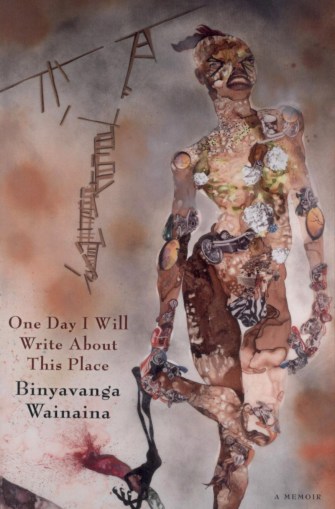
I wrote the following in early February after my parents returned from a trip to the U.S. and brought with them Binyavanga Wainaina’s memoir One Day I Will Write About This Place I had ordered for my friend Daily Times columnist and author  Elnathan John:


Before I send it off to Elnathan, I crack it open curiously, read a chapter before I go to bed. The next morning I wake up and open it again. I read greedily. The way I used to when I was in high school with my science fiction and fantasy. The way I read when I would neglect my homework, come home with a novel, which I would finish before I would start my homework late at night, working on my bed far into the night with a candle. I would fall asleep, my head inches from the candle balanced on a plate, sometimes not yet done with the algebra, which I would try to hurriedly finish in shaky pencil in the car on the way to school the next morning.


Those days, I poured the stories into me. Every day a new novel. Greedily. In grad school, I began to read more slowly, pencil in hand. I read theory and criticism, and long academic papers that I printed from the Internet. It was no longer a joy to read. I stopped reading. I became addicted to the Internet. In grad school when trying to finish my MA thesis, I started a blog. It was such a relief to have that outlet–to write my thoughts effortlessly in that forum when I was so stuck with academic writing. Then Facebook came along, and I became doubly addicted—to the inane games, the well-turned status update, the latest news–link upon link upon link.


I am two days late on an academic paper deadline, and yet I am sitting here in an office chair in my parent’s spare room, sitting at the desk in front of my computer, reading shamelessly–even when my mother comes in, the computer screen dead–reading Wainaina like a science fiction novel. It is not what I am supposed to be doing. It is not work. It is pleasure. Wainaina’s musings awaken in me memories of my own life, of the daydreams at fifteen, when I would stare dreamily out the windows of our van at the misty mountains of the green plateau in rainy season and imagine fantasy novels about a shepherdess name Merrony tending flocks on a long sunflower strewn Plateau. It was to be a trilogy. I can still remember the story now, as if it were a novel I had read long ago, a novel that will always remain in that “to-be-written” stage. My preoccupations have moved past Merrony, but Wainaina makes me want to write again in that way.


When I planned to write a review of Wainaina’s memoir for my column, I thought at first maybe I’d write something stream of consciousness. What I’ve copied above was the beginning of my brainstorm. But it felt too self-indulgent for the Weekly Trust. I let it be a blog post. Instead, I decided to focus on the parts of the memoir that seemed the most strikingly relevant to Nigeria right now. I can’t find the hard copy of the article, but if you scroll down below or click on this link, you can read what I wrote.


A mixed-up people: When Wainaina writes about Africa


Written by Carmen McCain, Saturday, 11 February 2012 05:00


This past week, I procrastinated revisions on an academic article to greedily devour Kenyan author Binyavanga Wainaina’s 2011 memoir One Day I Will Write About this Place. Wainaina won the Caine Prize for African Writing in 2002 for his short story “Discovering Home” and is perhaps best known for his satirical essay “How to Write about Africa” published in Granta in 2005, a piece that skewers stereotypical ways in which non-Africans write about the continent. In a later reflection on the essay, Wainaina reveals that it “grew out of an email” written “in a fit of anger, responding to Granta’s “‘Africa’ issue, which was populated by every literary bogeyman that any African has ever known.” When Granta later published an edited version of the email, he wryly remarks: “I went viral; I became spam. […] Now I am ‘that guy,’ the conscience of Africa.”


As my own familiarity with Wainaina’s writing was limited to

Binyavanga Wainaina

Binyavanga Wainaina (Photo credit: Internaz)

having read a couple of his sardonic essays and interviews, I admit that the lilting dreaminess, even sweetness, of his memoir came as a surprise. If “How to Write About Africa” bitingly mocks how foreign reporters or celebrity activists write about Africa as if Africans had “no conflicts or resolutions in their stories, no depth or quirks” then Wainaina’s memoir explores the depths and quirks through the remembered details of his own life.


Wainaina writes in an impressionistic present tense: the haze of childhood, an early obsession with words, his mother’s patient love. He changes schools, goes to South Africa for university, holes himself up in a room, drinking, reading, partying, never finishing school. He takes a trip to Uganda for a family reunion, out of which comes his first publication in a South African newspaper. A turn in the narrative comes when he submits the hastily revised piece, re-published as a short story in an e-journal, to the Caine prize. Although they initially respond that they do not accept electronically published material,  one day he receives another “email from the bloody colonizers” inviting him “to come to England, and have dinner in the House of Lords, and do readings, and go to the Bodleian Library for a dinner of many courses, with wine, and all of London’s literati.”


Following his Caine prize win, the memoir becomes more travelogue of the African countries he visits on writing business, impressions of Lagos, Lome, Accra; Kenyan election violence; African news browsed for on the internet, the writing life in America’s cold winter, where he is now director of the Chinua Achebe Centre for African Writers and Artists at Bard College. What struck me most in this sprawling account of family and personal history was the reoccurring motif of the ambiguity of borders, the way people change personalities as they switch languages, the shifting identities of ethnicity and naming that languages bring, how they include and exclude.


Wainaina grew up in Nairobi, son of a Ugandan Bufumbira mother and a Kenyan Gikuyu father, speaking Swahili and English. Following Gikuyu tradition, he, as second son, was named after his maternal Ugandan grandfather, Binyavanga, a Bufumbira nickname that means “mixed up”. His name becomes an appropriate lens through which to read his memoir.


Lessons about the way language and ethnicity exclude come early. One of his earliest childhood memories is of a quarrelsome woman who insults his mother because she is Ugandan. As a teenager while Kalenjin Daniel Arap Moi is in power, Binyavanga and his sister are among the top twenty students in their province, yet neither of them is called to any secondary school, “Rumors are spreading everywhere. We hear that […] names are matched to numbers, and scrutinized, word by word, line by scientific line, for Gikuyu names in the secret office by Special Branch people.” Discriminated against because of his father’s Gikuyu name, when a Gikuyu becomes president, “for the first time in my life, to be Gikuyu is a public event. […] The rest of Kenya has become Tribes. There is a text message being sent to Gikuyus calling Luos and people from western Kenya ‘beasts from the west.’” The Ugandan origin of his first name becomes confusing for those who want to pigeon hole him into one of “us” or “them.” He describes an airline hostess who insists on knowing where his first name came from before she lets him pass. “One person stops me on a street to tell me how happy he was to see me in the newspaper—but that name of yours, my friends are asking, you are half what?”


And yet, Wainaina points out, these political uses of language and ethnicity are often colonial constructs. He frequently returns to a history of diverse kinship, rich old stories about the kingdom of Buganda, the Swahili culture the Arab explorer Ibn Batuta encountered centuries ago. “We are a mixed-up people,” he writes, describing how his Ugandan grandmother was originally from the Congo, his mother’s sister went into hiding in Rwanda, other family members settled in South Africa and America. In the two days of a reunion in Uganda, “we feel like a family. In French, Swahili, English, Gikuyu, Kinyarwanda, Kiganda, and Ndebele, we sing one song, a multitude of passports in our luggage.”


Of his nanny Wambui, he writes, “Her aunt is half Nandi, her grandmother an Ngong Maasai. Wambui is Gikuyu by fear, or Kenyatta-issued title deed, or school registration or because her maternal Gikuyu uncle paid her father’s fees, or because they chose a Gikuyu name to get into a cooperative scheme in the seventies. […]She could have become a Luo, if they stayed there long enough, and she married there; she is dark skinned enough to get away with it.”


Though Wainaina’s memoir is written in English, he invokes his compatriot Ngugi wa Thiong’o, the great champion of writing in African languages, in a celebration of how multiple languages, though sometimes abused politically, are one of the riches of Kenya’s national character: English for official business, “brotherhood” in Swahili, more intimacy in mother tongues. “All city people inhabit several worlds in many languages. […Some] speak six or seven languages.”


Personalities change from language to language. A Maasai girl he meets is shy and awkward in English, but in Swahili and the street language of Sheng, “she pours herself into another person, talkative, aggressive. A person who must have a Tupac T-shirt stashed away somewhere.” On a bus, he watches a conductor whose “body language, his expressions, his character even, change from language to language—he is a brash town guy, a Gikuyu matatu guy, in Gikuyu, and even in Kiswahili. When he speaks Kalenjin, his face is gentler, more humorous, ironic rather than sarcastic, conservative, shy eyes.”


In his travels around Africa, Wainaina’s observes, along with delightful new quirks of national character, similar discrimination over language, class and ethnicity. Towards the end of the book, he writes in a fog of horror about the Kenyan election violence of 2007-2008.


Yet the mixed-up nature of his own family background points to relationships of familiarity possible all over the continent. When, a kind South African friend hires Wainaina, at his most destitute, as a marketer, he remembers in a rush of warmth other acts of compassion: how another South African friend  “offered to let me stay rent free in her house” and how her “father, a physics professor […] left South Africa in the fifties unable to get a job in Verwoerd South Africa [… but] was adopted in Nigeria where they lived for many years, […teaching]  a generation of Nigerian physicists at Ibadan.” “This is how to become an African,” he writes.


The “place” Wainaina writes about is both his mother’s hometown and the continent he travels: His family history is one of blood and one of adoption by friends throughout Africa. This is how to write about Africa, he implies. This is how to write about this place.


The Strange Poisonous Fruit of Hate: South Africa, Nigeria, and the world

Here is last week’s column, “The Strange Poisonous Fruit of Hate.” I wrote it in a very scattered state of mind. At times, there was gunfire in the background which punctuated my own emotional turmoil. I’m afraid my attention span manifests itself in the piece, which jumps around a bit, but which perhaps gives a feeling of Jos following the St. Finbarr’s Catholic church bombing in Rayfield and the tragic ‘reprisal’ attacks that followed–as well as my increasing horror at the hatred I see creeping out on little cockroach feet to infest the world.

Abubakar Adam Ibrahim (left) with his publisher at Parresia, Richard Ali (right). A friend is in the background. (c)CM

I had been planning to write a piece on my personal boycott of South Africa, following the  deportation of around 150 Nigerians (125 initially and more thereafter) from the Johannesburg airport for supposed irregular yellow card certificates. I had spent the week before agonizing with my friends Elnathan John, a blogger with Daily Times whose most recent short story has been published in ZAM Magazine, and Abubakar Adam Ibrahim, the literary editor for Sunday Trust whose collection of short stories The Whispering Trees is forthcoming from Parresia Press. (For a taste of their work, see Abubakar’s story “Closure” and Elnathan’s story “Your Man” both published in Sentinel Nigeria, edited by Richard Ali.) Elnathan and Abubakar had been two of the twelve African writers invited for the prestigious Caine Prize for African Writing workshop to be held in South Africa this year. (The Caine Prize for African short stories is sometimes called the African Booker, and luminaries like Helon Habila and Binyavanga Wainaina have been among the recipients of the prize.)

Elnathan John in Abuja. (c) CM

Elnathan had applied for his visa over a month earlier but, because of a technicality regarding a deadline he was not told about for paying a N110,000 ‘repatriation fee’ that South Africa requires many Nigerians to pay before granting them visas, his visa was delayed until 3 days after he had supposed to travel the trip had to be cancelled.  Abubakar was able to get the visa in time but when he got to Johannesburg was told that his yellow fever certificate (which he had gotten following an inoculation in the Abuja Airport port health office) did not have the manufacturer’s batch number, and he was sent back to Lagos.  (Abubakar describes his travails in this article in Sunday Trust). Ironically, the day Abubakar was sent back, Elnathan got a call from the visa office saying that he should come pay the N110,000 visa fee. (He declined.)

Following this outrage, I determined to boycott South Africa. South Africa businesses make billions of naira in Nigeria (the largest market in Africa for South African businesses like MTN and DSTV), yet they continue to treat Nigerians with disrespect. In 2005, Nigerian Nobel Laureate Wole Soyinka, incidentally one of the patrons of the Caine Prize,was held at the airport for over nine hours. (see here and here).

My Boycott: My phone had been slowly dying for about a year (and I had been stubbornly putting up with it.) But upon my resolve to boycott South African businesses, I took the opportunity to buy a new two-sim card phone and along with it a new glo line to gradually replace my MTN line. I also recently switched over from MTN internet to Glo (a Nigerian company), which gives more bandwidth and is cheaper. So far, I have been very pleased. Although the Thursday (8 March) after the deportations, South Africa’s foreign minister came out with a humble apology, later followed by an apology from South African President Zuma himself, the apology was too late for both Elnathan and Abubakar who missed the Caine workshop. Neither does South Africa seem to have any plans to compensate the nearly 150 visitors who were sent back to Nigeria by over-zealous immigration officials. Although I have long been invested in an “Africa without Borders” and while I am pleased with the apologies from the South African government over the diplomatic incident, I think this is an appropriate time to challenge the hegemony of  South Africa’s businesses on the continent.

As I was writing my column, I was struggling with a bit of cognitive dissonance over my belligerence to South Africa vs my plea for peace in Nigeria. I didn’t get into that in the column, but I think I can settle my internal inconsistencies by thinking about inequitable power structures. Diplomatic relations between two sovereign nations are quite a different matter than people taking justice into their own hands.

As usual, to read my column, you can click on the photo below to be taken to a readable version of the original, or you can scroll down below the photo to read it on my blog (with lots of links added).

The strange, poisonous fruit of hate

 Written by Carmen McCain Saturday, 17 March 2012 05:00

 It’s a little before midnight on Monday, the day after the bombing at St. Finbar’s Catholic church in Jos. There was automatic gunfire a few hours earlier and I am having trouble concentrating on anything. I turn on the TV and Centurion is on. It is a film about a group of Roman soldiers fleeing a band of indigenous warrior Celts in ancient Britain. The movie is violent. Arrows thunk into the chests of soldiers. One Roman soldier betrays another, stabbing him so that he becomes bait for the wolves pursuing them, while the other man escapes. During an interlude, I hear, in my own world of Jos 2012, what sounds like the shouts of spectators at a football match. I know it is not football. I turn down the volume on the TV to listen. Onscreen, Romans soundlessly slam Celt faces into log walls. Celts stab spears through Roman bellies. Outside I can hear the rumble of an angry mob, then gunfire.

This week I had planned to write about xenophobia in South Africa. About how two of my friends, Abubakar Adam Ibrahim and Elnathan John were unable to attend the prestigious Caine Prize for African Writing workshop that was to hold from March 5 to 15. Elnathan’s visa, for which he had applied at the beginning of February, was delayed until the travel date passed. Abubakar got the visa on time but was turned back at the Johannesburg airport because the immigration officials claimed he didn’t have the manufacturer’s number on his yellow fever certificate—even though he had been inoculated and received the certificate from the port authority in the Abuja airport. I spent the week furious at South Africa, which makes billions of naira in Nigeria from businesses like MTN and DSTV, and from Nigerian films on the Africa Magic channels, yet still treats Nigerians with such disrespect. South Africa eventually apologized for deporting around 150 Nigerians over the yellow fever issue. It was an appropriate gesture, but the apology came too late for my friends to represent Nigeria at the Caine workshop. I went ahead and bought a new phone SIM card from a Nigerian company and made it my main line. My ideal is an Africa without borders, but following South Africa’s display of contempt, I prefer to support Nigerian businesses.

Now Tuesday, it is still hard to concentrate. I read Internet news all day long. Hatred hangs in the air, a suffocating grey smog creeping along the earth. It is pathological, infectious. In South Africa, the poisonous structures of apartheid have been internalized and then erupt into violence. Xenophobic riots in May 2008 killed 62. Last week the hatred showed a more refined face, a more polite aggression. Uniformed immigration officials smiled cold professional smiles, while expelling Nigerians from their country.

But it is in Nigeria too. The hate. Writing in the Daily Times, Ademola Thomas Olanrewaju points out that Nigerians discriminate against each other much the same way South Africans discriminated against them. He cites how Fashola ‘deported beggars to their respective states’—how states all over Nigeria discriminate against so-called non-indigenes. Much of the violence in the country grows out of notions that people should stay in the land of their great grandfather’s origin or else live as second class citizens. This hatred also seems to be one of the factors behind the violence of Boko Haram, who have spoken about their plans to drive Christians, even those who are indigenes, out of the north and who tolerate no one except those who share their own purist ideals. Those claiming to be Jama’atu Ahlis Sunna Lidda’awati Wal-Jihad raze schools, shoot up mosques, bomb churches, police stations, soldier barracks, the UN headquarters. [A partial UN list of attacks up to 20 January 2012 here.] Leadership reported the story of a former member of Boko Haram who attempted to flee the sect in Maiduguri by running to Kaduna with his fiancée only to be found by them in Kaduna and carted away to unknown tortures.

In her classic science fiction novel A Wrinkle in Time, Madeline L’Engle writes of our planet as being covered by a dark shadow of evil. The shadow feeds on hatred. It covers the globe and is lodged like shrapnel in every human. After the bombs went off at the COCIN church in Jos two weeks ago and then at St. Finbar’s Catholic church last Sunday, cyclical revenge violence killed nearly as many innocent people as the bombs had. In my own country of origin, the United States, politics has become a cynical game of pitting those who claim purist American and Christian ideals against everyone else. The toxins enter the soil, and strange fruits grow out. The Norwegian mass murderer Anders Behring Breivik praised anti-Islamic American bloggers Pamela Geller, Robert Spencer and others in the Internet manifesto he wrote before he killed 77 people. Since Breivik’s bombing and shooting, other bloggers have praised this self-confesssed killer as a patriot. [See for example, this one] In America’s war of revenge after 9-11, the poison entered the armed forces as it does in most wars, driving soldiers mad. Out of a jingoistic military culture grew the American torture in the Abu Ghraib prison in Iraq. Most recently an American soldier in Afghanistan went berserk, going out in the middle of the night to slaughter 17 Afghan civilians asleep in their homes.

Violence feeds violence. Hatred feeds hatred. Living in a violent environment, we are all traumatized. We feel helpless. Striking out against those perceived to be on the ‘other side’ seems to be the only thing we can do. Our first reactions are those of mistrust. But the only way out of this is to reach across boundaries to those who are as hurt and confused as we are—refusing to demonize the ‘other’. In the midst of all of the bad news, my father forwarded me some encouraging stories. On March 12, the Kaduna youth wing of the Christian Association of Nigeria and the Northern Youth Muslim Forum met to pray together and break the Christian Lent fast together. According to Leadership, the CAN youth chairman Diji Obadiah Haruna said that the breaking of Lent fast with Muslims was continuing a tradition that had been halted by crisis: “Our quest to bring back the true spirit of togetherness has given birth to an association that will foster unity between Muslim and Christian faithful […] Love is the key […] The more you plan for progress, definitely, the more some obstacles will come your way. But I believe we will conquer those evils that do not wish us well.” Likewise, the National President of the African Youths for Conflict Resolution, who led the Muslim delegation, Dr. Suleiman Shu’aibu Shinkafi said, “I urge us all to respect each other’s religion and to stop the incessant killings and bombings or any act of terrorism against each other through whatever name that both Christian and Muslim doctrine has disowned. ‘We pray that God will expose those who want to see us apart and may God continue to join us together in his glory and mercy.’”

The actions of Christian and Muslim youth in Kaduna offer a glimmer of hope in troubled times. But beyond formal meetings, we need to rebuild those informal friendships across faith and ethnic boundaries that are often interrupted in times of crisis. It is in these personal relationships that we recognize that the ‘other’, so easily labeled as an enemy, is actually a brother or sister. It is only by this sort of unity that we will be able to rebuild Nigeria, Africa, and the world.

The Darkness only Love can Drive out: the COCIN church bombing, Jos, on 26 February 2012

A COCIN church newsletter on the ground outside the church gates after the bomb blast. (c)CM


(This is written 19 March 2012 but time-stamped earlier for blog organization purposes)As I describe in my Weekly Trust column

Onlookers at the COCIN headquarters church the evening after the bombing. (c)CM

below, I was not far from the bomb blast at the COCIN headquarters Church on 26 February 2012, the first suicide bombing in Jos. (Since then, there has been another suicide bomb on March 11, at St. Finbarr’s Catholic Church in Rayfield) It literally shook me out of bed at around 7:15am. Later in the day after things had calmed down a bit, I went to the church and took a few photos. You can access the album, here. I had not planned to actually go into the compound so I went with a zoom lens that made it difficult to get much perspective once I did end up going into the church compound. This, as I wrote on Facebook that evening, is what I saw and some of the rumours I heard that day (some of them false–for example–tragically one of the men misidentified as a bomber and beaten to death was actually a church member):

Ok, before I go climb into my bed, an update. Jos is calm and quiet. I was able to pay a brief visit to the COCIN church this evening, and this is what I saw: lots of people in the compound taking a look. First, the initial description someone gave on Al-Jazeera this morning was incorrect. The bomber did not drive into the church towards the pulpit. The car entered the compound with three men in the car (how exactly he entered is still murky to me as I’ve heard different versions from people who were at the church shortly before the blasts). Somehow two of the men got out of the car and the driver sped towards the church building. Apparently the car detonated a few metres from the back of the church […]I saw the crater where the car exploded, which had filled up with scattered church bulletins. The damage is not as dramatic as you would expect from the kind of sound that came out of the explosion. The church is currently under construction with wooden scaffolding all around it, so it is hard to tell the extent of the damage, but what I saw seemed to be a crack in the wall in the back, and a small portion that was blown off, which might perhaps cause structural problems. No part of the church, however, was collapsing. Neither did any of the pews in the church seem to have been burnt or displaced, though they were covered in dust from the explosion. The most notable things were the parts from the suicide bombers car that were scattered all over the

One of the wheels of the car carrying the suicide bomber. (c)CM

compound. There was a tire lodged into the back pew of the church. There was an engine somewhere else and another tire that went around the side, the fusilage elsewhere. There was what looked like an orange plastic water tank that seemed to have been torn apart. Apparently earlier in the day, the bombers body parts were also strewn around, but fortunately, I did not see that. The other notable thing was that windows as far as a 2-3 blocks away were blown out. All of the cars in the parking lot outside of the church had their windows blown out and a few of the ones closest to the church were blackened and a little melted from the blast. The windows in the 4-5 story COCIN headquarters office building were mostly blown out. There was shattered glass everywhere.[…] As far as casualties, I’m not sure, but what I heard earlier in the day was that 3 church members died on the spot, and 3 more died in the hospital later. There could be more, but I don’t have any way to verify that.

It took me until the next Sunday to walk around in the neighborhood near the church and realize the extent of damage that had been done in reprisal violence. The fruit sellers in front of the First Bank down the street from the church told me that they heard the blast and saw the dust cloud. When the mob ran down the street, they ran away, and the mob burnt or looted all their merchandise. The mob also burnt a Muslim owned restaurant and other shops in the area. I went to give my condolences to the men selling spare parts across from the Mobile station in that area, and he told me that the morning of the bomb they had been at the house down the street where some Muslim women have a business selling masa and miya every morning in front of their house, waiting for the ladies to finish frying the masa for breakfast. When the bomb went off, a mob came and they all ran away. Not only did the mob burn all the businesses around but they also burned down the house of the women who sold the masa and miya every morning. I had bought food from them before, and I knew most of the Hausa business people in the area. This I think is when the devastation really hit home to me–the bomb was bad enough, but then the human desire for retaliation resulted in far more innocent people suffering.

Before reading my article “The Darkness only Love can Drive out” (to read the hard copy click on the photo below, or scroll down for a blog version with links), if you are interested in reading the stories of some of the other victims, here is the sad story of Hajara, who fled Boko Haram in Yobe only to be killed in the Jos COCIN church bombing, and Grace, a Sunday School teacher. Her family tell of how she was born prematurely and they see the years they had with her as God’s blessing.

The darkness only love can drive out

Written by Carmen McCain Saturday, 03 March 2012 05:00

 I was in Jos and staying with friends in town. Sunday morning, I had been hitting snooze on my phone alarm for an hour. At around 7:15am, I was just about to get out of bed to prepare for church, when it happened. The gritty boom that made the house shake.  “JESUS,” I shrieked in a brief instinctual prayer, and leapt out of bed, swatting at the mosquito net that tangled around me.

I had heard the bombs at the football viewing centres in December. They had an echoing, reverberating sound. This was more immediate. It sounded like rocks and metal crunching. When I stepped into the hallway, grit from the ceiling had fallen down over everything. Outside, thousands of bats were in the sky. The morning sun was bright.

Of course, we knew exactly what it was, when the sound shook the house. In those few seconds it took me to untangle myself from the mosquito netting, I knew it was a bomb, and that it was at one of the churches somewhere nearby.

When the bombs and the gun battles were exploding in in Kano, Bauchi, Yobe, Borno, Kaduna, and Gombe, Jos had remained unnaturally calm. In January, refugees from Yobe had fled to Jos. I joked that the city had temporarily gone back to being the ‘home of peace and tourism’. Of course we had known it was only a matter of time.

In the house we prayed and read the Psalms. My mother kept calling. A Nigerian friend called from the UK. As my shakiness subsided, I drank tea, sent text messages, went online to check for news.

Around 9:30am I began to smell smoke. Strange, I thought, that I hadn’t smelled it before when the bomb had gone off. Outside, there were sirens, and the sounds of shouting, punctuated with silence. A friend, who usually attends the 9am service at COCIN headquarters, had gone to the church shortly after it happened. She came back repeating what she had heard, that there had been several people in the car, that they were in military uniforms, that one of them had died in the bomb and one had been beaten to death by the angry crowd. That she had heard at least two church members were killed, one of them a female usher. The smoke we were smelling was not from the church. It was from nearby shops that a mob of youth had begun burning. A doctor from Plateau Hospital came by. He confirmed that three church members had died. Others had been taken to Plateau Hospital. Many had ear injuries. He said that achaba drivers were being attacked. One woman with a machete wound to her head said they had seen the mob coming. They achaba driver had tried to turn around, but he hadn’t been fast enough. She survived. He hadn’t.

That evening, when things had calmed down, I went to the church to see the damage for myself . There were over a hundred onlookers milling about. The church, which had been under construction, was still surrounded by wooden scaffolding. There was a long crack down the backside of the church and a section of blocks that looked as if they had been blown off. There was a crater in the ground a few metres away from the building where they told me the car had exploded. It had filled up with the church bulletins that were scattered all over the compound. All of the cars in the car park were damaged with shattered windows, and drooping frames. Those closest to the building were blackened and pocked, with door handles blown off.

Windows of cars smashed by the impact of the blast (c)CM

Shards hung in the windows in the office building behind the church. The impact of the bomb had smashed windows as far as three blocks away.

Windows smashed out in office building behind church (c)CM

Most striking were the car parts that were scattered everywhere. There was a tire nestled against the last dusty pew in the church. Another tire lay outside towards the side of the building. The engine was a few metres away. When I came out of the compound, friendly police wanted to see my photos. They asked me if I had seen the body parts. I said no. That was something I didn’t want to see.

A few days later, more information has come out. The death toll still seems ambiguous, but it seems that at least five church members were killed, fifty others wounded, and three or four other people killed in mob violence.

Of course, Jos came out of this particular attack better off than some places have. The Madalla bombing killed around thirty-five. In Kano, the multiple bomb blasts killed nearly two hundred and the fighting continued off and on even to last week. The Friday before, five people had been killed in an attack on a Kano mosque. Later bombs went off in Gombe. There were other attacks in a village in Kaduna on Sunday.

I am of course devastated by what happened in Jos—that innocent people who rose early in the morning to worship God were killed. It is something every Christian in the north now faces when we go to church. But equally horrifying are the reports of mob violence against innocent young men on okadas just trying to make money to feed their families, the smoke that came not from the bomb at the church but from the Hausa businesses a block away which the mob burned. And then there is the devastating story that the man the angry crowd beat to death that morning was actually a church member who had been misidentified. As another friend pointed out, because so many have escaped from prison, people feel the need for immediate justice. But that was not justice. The story sickens me.

Boko Haram, who has claimed responsibility for the COCIN church bombing and much of the other violence in the north, attack Christians and Muslims alike. The church attacks make the most news, but the Kano mosque attack on 24 February follows other attacks on mosques and Muslim religious leaders in Borno. [This UN publication, published 20 January 2012, gives a partial timeline of Boko Haram attacks.] The police attacked are from both faiths. What worries me is that Boko Haram seems to have become an umbrella under which all manner of violence can be excused, whether it is claimed by them, blamed on them, or in retaliation for what they’ve done. In a bizaare twist, papers (see Tribune ) reported that several church members in Bauchi were caught with explosives trying to attack a ‘rival’ COCIN church the same Sunday. The COCIN president denied it.  And such a story does seem suspicious coming as it did on the same day as the Jos attack on COCIN headquarters. [The story has since been confirmed]. But it does illustrate how Boko Haram seems to have become a cover for any other evil plans anyone may have.

All, I can do is to repeat what I keep saying, so that I grow tired of speaking, so that I resent having to keep writing about violence when I would much rather write about film and literature:  the only way to defeat this evil is to band together, Christians and Muslims, and refuse to let Boko Haram succeed in making us violent in turn. The words of Martin Luther King Jr., from Where Do We Go from Here: Chaos or Community are worth repeating:  “The ultimate weakness of violence is that it is a descending spiral, begetting the very thing it seeks to destroy. […] Returning violence for violence multiplies violence, adding deeper darkness to a night already devoid of stars. Darkness cannot drive out darkness: only light can do that. Hate cannot drive out hate: only love can do that.”

“Cross of crescents: Muslims around the Church” a guest column by Gimba Kakanda

Gimba Kakanda during the Fuel Subsidy Protests (used by permission of Gimba Kakanda)

Gimba Kakanda during the Fuel Subsidy Protests (used by permission of Gimba Kakanda)

On 14 January 2012, the poet Gimba Kakanda, one of the brains behind the active “Nation-wide Anti-Fuel Subsidy Removal” group on Facebook, wrote a guest article for my Weekly Trust column about his experiences organizing a group of Muslim youth in Minna to protect a church the Sunday before: “Cross of Crescents: Muslims around a Church”. To read his thoughtful and provocative piece, click on the link, click on the photo below, or scroll down to read here on my blog.

Cross of crescents: Muslims around the Church

 Written by Carmen McCain and Gimba Kakanda, Saturday, 14 January 2012

 Last weekend, the stories of the killings of Christians in Adamawa and Gombe left me with a constant dull ache. I realized, as boys hovered their metal detectors over my Bible before I walked into church, that we could die as we prayed. And though the pastor pointed us to the revolutionary nonviolent teachings of Jesus in Matthew 5, Christians I spoke to were angry.

“It’s just lies,” one told me, when I argued that most Muslims were aghast at the killings. I couldn’t blame him for his anger—he had just lost a friend in Adamawa—but I wished that he could experience the kindness of my Muslim friends and realize they too love and hurt and breathe. It was in this funk that I signed online and saw the photos, like those in Egypt last year, of Christians protesters in Kano and Kaduna protecting their Muslim friends while they prayed.

Poet Gimba Kakanda, whose collection of poetry Safari Pants was published by Kraftgriot in 2010,  wrote on Facebook that he and other Muslim friends had protected St. Mary’s Catholic Church in Minna during a Sunday service. Beginning to feel hopeful again, I asked Gimba if he would write something about his experiences. I yield the rest of my column to him.  –Carmen

When I heard of the covenant made in Kano during the anti-fuel subsidy removal protests–of Christians willing to stand guard for Muslims and vice versa during religious services–I was hurt that the bond of our relationship has waned over the years to the point that a Muslim is considered an enemy of Christianity, an inhumane being adept in violence.

I didn’t grow up in a tense religious atmosphere. My upbringing wasn’t bound to intolerance. The Muslims and Christians of my early days seemed like adherents of the same religion. We had so much regard for each other that we marked religious festivals together, irrespective of whose it was. As a child, Muslims marking Christmas was a popular practice. Mothers would obtain Christmas dress for their children who would join Christians at parks or any available amusing exercise. We referred to Christian festivals like Christmas and Easter, in my mother-tongue, as Christians’ Eid-el Kabir and Eid-el Fitr.

This Boko Haram debacle causes me so much pain; it causes my faith to be branded as an enemy of Christianity. For a long time now, I’ve been thinking over the best way to restore the dwindling trust between the faiths.

It was my return to Jos sometime in September last year that made me realize the horrible extent of our religious divide. It was in the month of Ramadan. I hate travelling while fasting, and to save myself the hassle of scouting for food on my arrival, I called my host on the phone and asked him to get some food ready for my fast. He was Christian. When I got into the neighborhood, I was unaware that the quarter was a ‘death zone’ for non-Christians. Chollom didn’t tell me. I only realised the danger when I stepped out to locate a mosque. The one I knew was no longer there – it might have been the burnt edifice I saw in its place. At once, I waved down an okada rider and asked him to take me to the bordering quarter, Nassarawa Gwong! He sized me up with wonder, shrugged and zoomed away. I had no clue. I stopped another. This rider smiled as one would at a known teaser. “I no dey go there o!” He blurted, without offering a reason. I made it to the border on foot, wondering as people poured to the street to watch me amble into the other ‘death zone’!

I was unhappy with Chollom, but he said that he could never come to terms with the idea of not hosting me. That incident made me began to think about ways to solve such religious segregation. I discussed this with the poet Richard Ali when we met on that visit to Jos, offering what I considered a solution. Richard and I agreed on soon setting up an NGO aimed at fostering unity between people of divergent ethnic and religious differences.

On the eve of my birthday this year, a Saturday, I was chatting with a Muslim friend, when I suggested that a way to end these growing attacks on places of worship might be a community security set-up where Muslims stand guard for Christians during church services and Christians for Muslims during Jummu’at prayers. He bought that. So I called a relative, Ahmad Ibrahim Gimba, and informed him about the plan. He too bought it, and immediately arranged with a friend of his to inform their priest of our mission.

As early as 6 am on Sunday the 8th of January, my birthday, I was already up for the day’s task. I live in Tunga but the church, Saint Mary’s Catholic Church at Kpakungu, one of the largest churches in Minna, is familiar to me. Ahmad Ibrahim and I got there and were soon joined by our other friends who were very keen on the mission. Our Christian friend who worships in the church took us to the security guard to explain our mission. Before the 7:30 am service commenced we were already spread round the church: Awaal Gata, Shuaibu Usman, Dantani Usman, Danjuma Mohammed, Idris Lade, Mohammed Saba, Kabiru Mohammed, Aminu Umar… We were eighteen in all!

After the service, there were some hitches. Policemen came around to know why Muslims would offer to guard a church. Even though we informed them that Ahmad had spoken to a member of the church and arranged that we would be coming, they were leery. The trouble with such system, I learnt a day later from a member of the church, Dominic Eigbegbea, is trust. Dominic is the president of the Catholic Youth Organisation of Nigeria (CYON), Minna Diocese. He was blunt, confiding in me that Christians don’t trust Muslims anymore, that whatever bound them together is handled with suspicion. He said that he discussed our arrangement with the other members of the church, and they cautioned that we shouldn’t be trusted, that we just want to infiltrate them, study everything about them and, when they are put at ease by our dubious gesture, launch an attack. Every Muslim is a terrorist, I gathered from their response.

The priest of the church, Reverend Father Emmanuel Jima, was philosophical about the development. He’s from Adamawa, a northerner(!) and was born to a Muslim family, he told me. We discussed the unfortunate happenings in the country, especially the insecurity situations aggravated by the dreaded Boko Haram militancy. The cleric lambasted the old generation for the present mess in the country. He talked softly but he was obviously unhappy that the bond between the two faiths has weakened to this extent, considering any forum that avails both Muslims and Christians a chance to rub each other’s back a way to restore the lost paradise of inter-faith fraternity. The youths are more perceptive, he iterated. ‘The burden of fixing the country is now left for you, the youth.’

Yes, a burden, this weighs me down. I must carry this cross. Unlike Christ’s, though, my cross is the weight of a faith, the crescent, deconstructed by too many misperceptions, too many stereotypes, unwitting and deliberate. May God save us from us, Ameen.

“Splitting a Nation: Lessons from History” by Dr. K.A. Korb

For the week of 7 January 2012, my friend Dr. K.A. Korb of the Faculty of Education at University of Jos wrote a guest column for my column in Weekly Trust.  Following much public discourse about the possibilities of splitting Nigeria into two or more nations,  in “Splitting a Nation: Lessons from History”, she looks at the results of nation-splitting in the last twenty years, and concludes that such an option is not a promising one.  To read, her article, click on the link above, the photo below, or scroll down to read it copied onto this blog.

Splitting a Nation: Lessons from History

Written by Dr. K.A. Korb Saturday, 07 January 2012 05:00

My friend Dr. K.A. Korb of the Faculty of Education, University of Jos, recently shared some thoughts with me about the frequently heard rhetoric of those who want Nigeria to split. I yield the rest of my column this week to her. – Carmen

In the early 1900s, philosopher George Santayana said, “Those who cannot remember the past are condemned to relive it.” In the Nigerian context, we can learn from events in world history to consider solutions to problems we face today. Countries who successfully solved similar problems can be studied for positive solutions. Likewise, approaches to similar problems that failed must be carefully analyzed so Nigeria will not be condemned to relive those failures.One issue that is currently being discussed in homes, in markets, and on the street is that of Nigeria separating into two distinct nations. A separation is believed to be a peaceful solution to the misunderstandings between a “north” and “south” joined by colonization. A brief examination of other countries that have split in the past twenty years can provide valuable information about whether a separation can indeed be a peaceful solution to Nigeria’s current problems.

The most recent split occurred just six months ago when Sudan divided into two countries: Republic of the Sudan and Republic of South Sudan. Because the north and south experienced five decades of civil war that killed over 2 million people, there was considerable fear that the separation would be marked by violence. However, much to the international community’s surprise, both the referendum in January 2011 and the independence day itself on 9 July 2011 were very peaceful.

However, despite a peaceful separation, the two new nations have not been able to sustain a lasting peace. Less than four months after the separation, a Human Rights Watch report stated, “Sudan’s wars have not ended. They have, in fact, multiplied.” Violent conflict remains, particularly along the border between the two new countries.

Two states directly north of the border are currently engaged in violent conflict, largely between Sudan government forces and armed opposition groups linked to southern rebels. Bombings, shellings, killings, and destruction of property have caused around 50,000 people to flee Blue Nile and Southern Kordofan states.

Within the new country of South Sudan, violent conflict also continues. Ongoing violent clashes related to cattle raids between the Lou Nuer and Murtle peoples have resulted in approximately 1,000 deaths since the country’s independence. A recent attack on 31 December 2011 caused over 20,000 Murtles to flee their homelands. On 2 January 2012, the United Nations warned other Southern Sudanese to flee their homes because six thousand Lou Nuer fighters continue to march through the countryside, burning homes and seizing livestock.

Prior to Sudan, the Democratic Republic of Timor-Leste, commonly known as East Timor, separated from the Republic of Indonesia. East Timor shares an island with Indonesia in the Pacific. Over 100,000 deaths are attributed to the twenty-year conflict between East Timor and Indonesia over its separation: 18,000 from violence and 84,000 from hunger and illness resulting from the conflict.

As a result of this long-term conflict, a referendum was held in 1999 to determine whether East Timor would split from Indonesia. About 79% voted for independence. Within hours of the election results announcement, violent protests broke out. Anti-independence militias killed about 1,400 Timorese and caused 300,000 to flee. Most of the country’s infrastructure was destroyed in post-election violence. Because of the post-election violence, East Timor did not officially become independent until 2002.

Returning to Africa, Eritrea began its campaign for independence from Ethiopia in the early 1960s, which resulted in thirty years of war. As Eritrea was fighting against Ethiopia for independence, there were two civil wars amongst the Eritreans themselves as different rebel groups splintered and disagreed. As the result of peace talks in 1991, Eritreans overwhelmingly voted in favor of independence. The State of Eritrea was officially created on 27 April 1993.

Just five years later, a border dispute erupted between Eritrea and Ethiopia that lasted for two years. In this border dispute, two of the poorest countries in world spent millions of dollars on a war that led to only minor border changes. In addition to tens of thousands of deaths, the conflict also resulted in reduced economic development, food shortages, and a severe land mine problem. Tension remains high between Eritrea and Ethiopia, with a brief border skirmish reported in January 2010.

Although Eritrea ratified a constitution in 1997, the constitution has yet to be implemented. National elections have been scheduled periodically, but have always been canceled so no election has ever been held. Eritrea’s human rights record has worsened since its independence from Ethiopia. Human Rights Watch reports, “Eritrea is one of the world’s youngest countries and has rapidly become one of the most repressive. There is no freedom of speech, no freedom of movement, no freedom of worship, and much of the adult male and female population is conscripted into indefinite national service where they receive a token wage.”

Finally, although Czechoslovakia in southeastern Europe did peacefully separate into the Czech Republic and the Slovak Republic in 1993, its near neighbor, the former country of Yugoslavia has not been so lucky. Beginning in 1991, Yugoslavia has repeatedly separated into smaller and smaller countries. Most recently, Kosovo declared independence in 2008. The former Yugoslavia is now divided into seven different nations, and many of these splits were associated with violent conflict.

A referendum for independence was held in Bosnia and Herzegovina on 29 February 1992. However, the people were divided on whether to stay with Yugoslavia or to seek independence. The referendum was boycotted by the Serb ethnic group that favored staying with Yugoslavia. However, despite low voter turnout, an independent state of Bosnia and Herzegovina was created on 3 March 1992.

Because many disagreed with the separation, a war began that lasted for three years. The Bosnian War was characterized by systematic mass rape, ethnic cleansing, genocide, and indiscriminate shelling of cities and towns. About 100,000 people were killed in the conflict and over 2.2 million people were displaced.

There have been three other violent conflicts in parts of the former Yugoslavia that have tried to separate. The Croatian War of Independence between forces wanting independence and those wanting to stay with Yugoslavia resulted in about 20,000 deaths  and cost $37 billion in damaged infrastructure and refugee-related costs. A ten-day war followed the Slovenian declaration of independence in 1991. The Kosovo War (1998-1999) fought by a group wanting independence resulted in 12,000 deaths and over a million refugees. War crimes during the Kosovo War included kidnapping, ethnic cleansing, and use of child soldiers. It is also alleged that prisoners-of-war were killed so their organs could be sold on the black market.

While none of the separations described above are identical to the Nigerian context, history teaches us that the peaceful separation of a country is remarkably difficult to achieve. Dividing a nation is much more complicated than dividing a state, involving new currencies, new constitutions, new political structures, and new borders. Although we may resent the complications that colonial borders brought to Africa, the experiences of nation-division in other parts of Africa, as well as Asia and Europe, should provide a warning to Nigerians that what may appear to be a peaceful solution on the surface may not be the best solution to its internal problems.