
Yesterday, I read an excellent article by Carl Terver on “The Middleclass Problem of Nigerian Writing.” He writes about the inaccessibility of contemporary Nigerian literature to the masses of people. It is too expensive, it is not well-marketed, it is not available in schools or universities.
Complaints about reading culture in Nigeria are not new, but he speaks to the contemporary divide between the well-stocked bookshops of Lagos and Abuja (where books are regularly over N10,000) and what an ordinary reader can afford. The hot new publisher Masobe Books, which has been turning out quite a few impressive publications in the past few years, seems to have figured out one good way to market its books–making a deal to sell books in the Medplus chain of pharmacies across the country. I was shocked and delighted 3-4 years ago when I found the novel I had searched for unsuccessfully in several Lagos bookshops in the pharmacy next door to my brother’s flat. However, those books are still unaffordable for most people. Even coming from London last year, I found many books in a pharmacy that I wanted to buy, but I had to put half of them back because I didn’t have enough naira in my account. Not only are books expensive, but he points out that sometimes the most celebrated literature is too “comfortable”–and does not necessarily speak to “the common man.”
“Nigerian writing now almost exists for itself, as an indulgence or luxury, a product for a kind of haute couture for the literary community. And it keeps getting so, our writers becoming mere apparatuses in the mechanism of the middleclass problem.” Terver writes. –
In his conclusion, he speculates on what alternatives there might be, pointing to the historic Onitsha Market Literature and the MacMillan Pacesetters series. In this he gestures at but does not name the thriving literary cultures that are so often left out of conversations about literature in Nigeria, and that is popular literature that cannot be found in middle class bookshops, and cultural production in Nigerian languages.
There are tens of thousands of Hausa novels that have been written in the past 100 years and a vibrant reading culture, from the early novels published by the NNPC from the 1930s to the 1970s, to the explosion of young people writing and self publishing serial novels on cheap newsprint in the 1980s to the 2010s, to most recently a gigantic eco-system of digital literature. These novels have given rise to large private lending libraries of physical novels, novels read serially over the radio, pirated audiobooks, private whatsapp groups where authors will release one chapter at a time, and a host of novels on wattpad and released in ebook formats. I have posted on the literature of the 1990s and 2010s often on this blog and in my 2010-2014 column in Daily Trust. Most recently, there is an excellent issue of the Journal of African Literature Association on Social media as a new canvas, space, and channel for Afrophone literatures, where there are 5 articles on Hausa writing by Abdalla Uba Adamu, Zaynab Ango, Umma Aliyu, Nura Ibrahim, and Ado Ahmad Gidan Dabino. This may not be a middle class space for Anglophone literary fiction, but it is a vibrant space that invites in ordinary readers in Hausa.
And yet despite this burgeoning literary space, of these tens of thousands of novels, there are fewer than ten that have been published in translation to English, at least in translations that are widely accessible to readers. The translations include a few translations of the early contest-winning Hausa novels published in the 1930s but which were abridged and simplified for primary school readers. This includes Abubakar Imam’s Ruwan Bagaja, which was translated as Water of Cure or Muhammadu Bello Kagara’s Gandoki, which has been published as Gandoki the Warrior. These fantasy novels are widely available in bookshops and in the school curricula, but I still have not been able to find the names of the translators because NNPC nowhere acknowledged them. (Sada Malumfashi has recently published the opening pages of a new translation of Gandoki for National Translation Month) The scholar Mervyn Hiskett translated Shaihu Umar, a historical novel about one young boy’s experience of the trans-saharan slave trade by Nigeria’s first prime minister Abubakar Tafawa Balewa. Of the thousands of novels that have been published since the 1980s, there are a few commissioned translations of Ado Ahmad Gidan Dabino’s novels, including a translation of his bestselling novel (the original of which sold over 400,000 copies) In da So da Kauna, as The Soul of My Heart. But the translation violently abridges a 200 page novel to 60 pages and translates the banter and dialogue and proverbial wordplay that I think makes Gidan Dabino’s novels so pleasurable to read into English-language cliches. It badly needs re-translation. The only novel from the last 40 years that is available in translation internationally and currently the only Hausa novel in translation by a woman (although it is regularly claimed that women are the majority of the readers and writers) is Aliyu Kamal’s translation of Balaraba Ramat Yakubu’s novel Alhaki Kuykuyo Ne as Sin is a Puppy that Follows You Home, published by Indian publisher Blaft. Since 2015 when I began designing my own Nigerian/African literature classes, I have taught this novel, and for the past 11 years, it has been a student favourite, with students choosing to write about it for their midterm or final papers probably more than any other novel I teach. Several students with southern Nigerian backgrounds have told me that they found it illuminating and our discussions of the novel challenged stereotypes they had about the north. They would like to read more, but there are just no more accessible translations of contemporary Hausa literature. (Since coming back to Nigeria this month, I have heard some exciting stories about a few more translations in progress.)
When we speak of African literature without discussing African language literatures, we are missing out on important conversations, aesthetic conventions, and styles. A few days ago, I saw a video of someone critiquing the bland sameness of some English-language literary fiction that comes out of MFA programmes–which is related, I think, to Carl Terver’s critique of the “Middleclass” trap of Nigerian literature.
By contrast, literary translation lets us have a glimpse at other traditions and styles (I think of the exuberant style of Ngũgĩ wa Thiong’o once he started writing primarily in Gikuyu, captured even in translation, or the way Balaraba Ramat Yakubu’s storytelling style comes over even in flawed translations), and can enrich our understanding of African experiences and styles, not unlike the way that speaking two or more languages can expand our understanding and ability to think in multidimensional ways.
From the time I first started reading Hausa literature in my halting Hausa in 2005, I have wanted to translate it. But I am very slow, and academia is very demanding, and I think the best way for me to translate is to collaborate with someone for whom Hausa is a first language. I have such a collaboration in the works. But more urgent than my own fumbling attempts at translation is to motivate MORE LITERARY TRANSLATORS, to find better funding for literary translation, and to think about ways to make translations accessible to ordinary Nigerian readers, so that the translations don’t run into the limitations that Carl Terver points out.
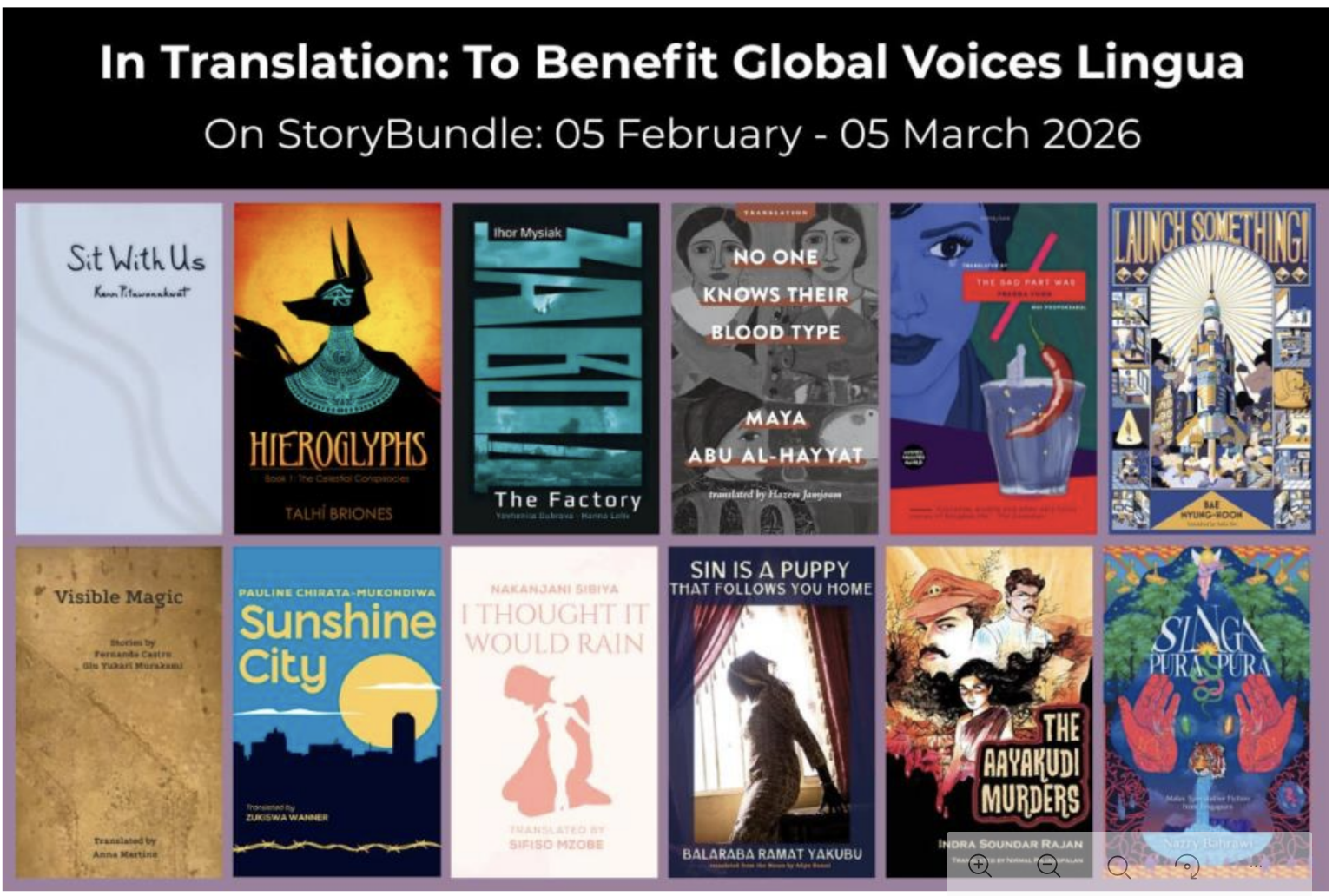
This is where I am lucky to be at SOAS, an institution that has taught Hausa since the 1930s, and to follow greats like Graham Furniss, who collected over 2000 Hausa novels now housed in the SOAS library special collections, and who together with Malami Buba and William Burgess, put together a bibliography of this collection (reviewed here by Ibrahim Sheme, a author, translator, journalist and publisher). I am also lucky to work closely with my colleague Ida Hadjivayanis, who teaches Swahili and translation, and has translated two of Nobel laureate Abdulrazak Gurnah’s novels into Swahili: Paradise as Peponi (see her article on that here) and Theft as Dhulma, and is currently working on her translation of Afterlives. The two of us have had many conversations about popular Swahili and Hausa literature, which share some cultural preoccupations. I published an article on my research on literary translation into and out of Hausa last year “The alchemy of translation in Hausa: cosmopolitanism, gatekeeping, and infrastructure in Hausa-English translation,” which Ida generously read beforehand. And this past year, we ended up putting together a small “Research Cultures” group at SOAS to encourage literary translation in and out of African languages. We are particularly interested in seeing more African literature published in African languages and more African-language literature being translated into other languages so that it is more accessible to larger conversations about “African Literature.” Our colleagues and PhD students are doing some really exciting work, and we have a working translation blog in the works. (I’m in the process of building it). There are other efforts being made to publish translations of African-language literature including Blaft, the African Language literatures in Translation series at University of Georgia Press, and “The African Translation Project” an initiative by Zukiswa Wanner to publish contemporary African fiction in translation which included Balaraba Ramat Yakubu’s Sin is a Puppy in a recent ebundle . Kọ́lá Túbọ̀sún has been doing a massive amount of work on Yoruba language and translation. See, in particular, this brilliant interview he did with writer Ukamaka Olisakwe in Isele Magazine.
In the meantime, we have also been trying to link up with some of these exciting innovations being done on African-language literature, publication, and translation on the continent. Ida’s publisher in Tanzania Mkuki Na Nyota has been proactive in seeking out Swahili language translations of Abdulrazak Gurnah. In Nigeria, Richard Ali has worked hard to get Mudassir Abdullahi and Ismail Bala’s translation of Paulo Coelho’s The Alchemist into Hausa in print at Paresia and has been part of the Jalada team, which has had several groundbreaking translation projects with Ngũgĩ wa Thiong’o Gikuyu short story “Ituĩka Rĩa Mũrũngarũ: Kana Kĩrĩa Gĩtũmaga Andũ Mathiĩ Marũngiĩ” translated into 100 languages and Wọlé Ṣóyínká’s English-language poem “Mandela Comes to Leah” translated into 49 languages. Sada Malumfashi and the Open Arts Team have been promoting Hausa language literature with the Hausa International Book and Arts Festival, and Bayero University’s Centre for Research in Nigerian Languages, Translation, and Folklore had been innovating with online training courses for professional translators.
In late January I was delighted to receive some last minute support from the ISPF ODA fund for our proposed cultural exchange travel. We hosted Sada Malumfashi, director of the Hausa International Book and Arts Festival, and Professor Yakubu Magaji Azare, the director of the Centre for Research in Nigerian Languages, Translation, and Folklore at Bayero University, both of them translators themselves, to come to London and speak with our research group and others about their innovations in translation. Sada spoke on “Indigenous Knowledge Production: Promoting Hausa Cultural Production through Festivals and Translation.” And Professor Azare spoke on “A Decade of refocusing the Centre for Research in Nigerian Languages, Translation, and Folklore: Promoting Translation as a new mandate'” while Hausa novelist Sa’adatu Baba Ahmad (currently in the UK for her PhD) spoke about her writing career. Ida Hadjivayanis and I are now reciprocating with trips to Bayero University, Kano, and to the Mamman Vatsa Writer’s Village in Abuja to contribute to conversations about literary translation organized by our Nigerian partners. How can we support networks of literary translation in Nigeria? How can we build translation bridges between Swahili literature in Tanzania and Hausa literature in Nigeria? What kind of language, publishing and funding infrastructures can we build?
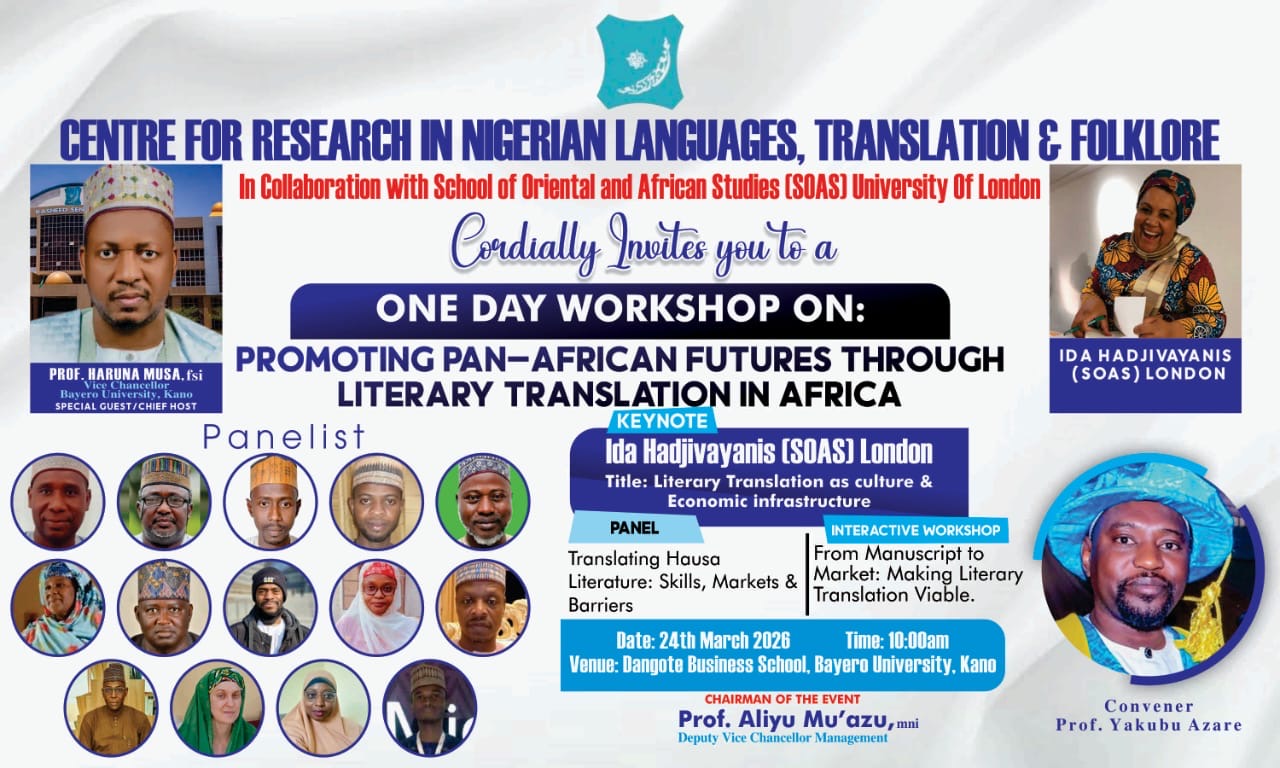
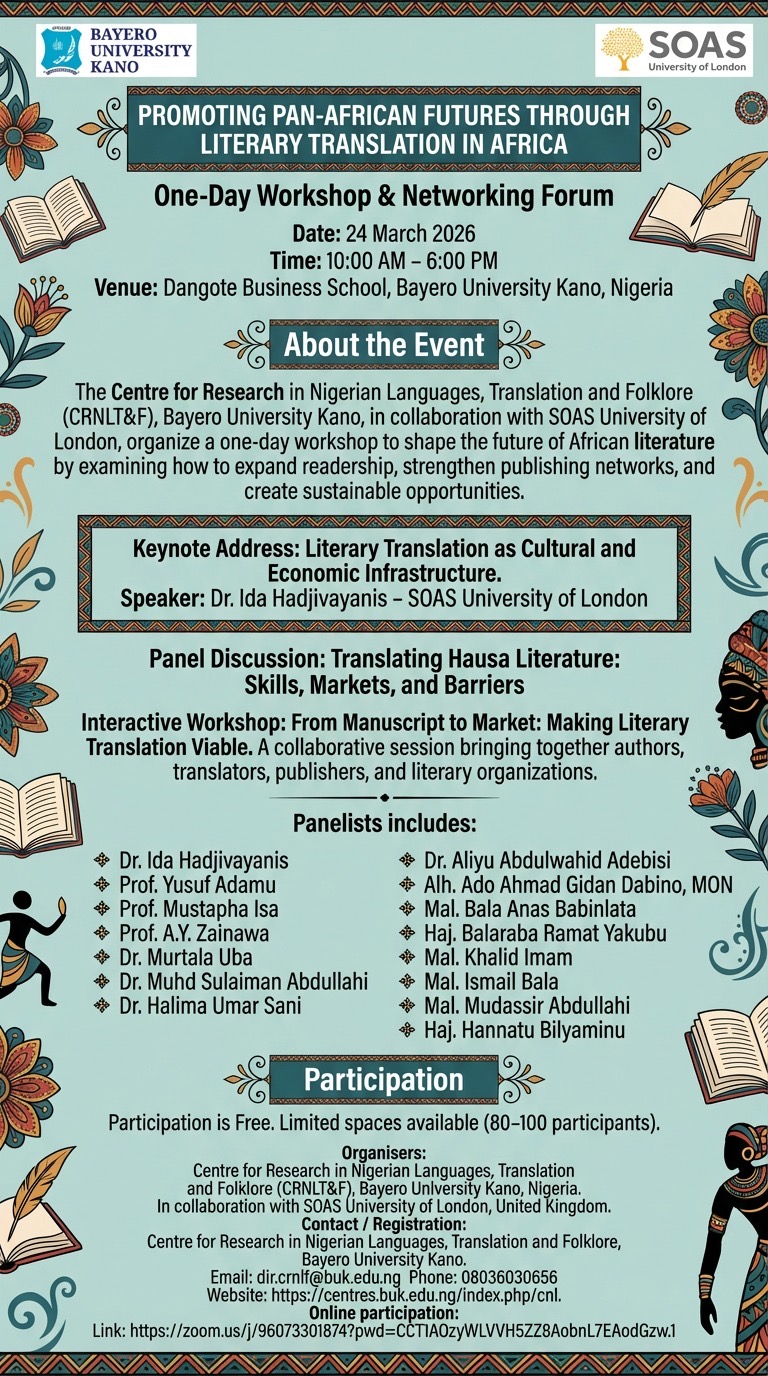
The Centre for Research in Nigerian Languages, Translation, and Folklore is hosting a workshop at the Dangote Business School on Tuesday, 24 March, 10-6pm and have an exciting group of translators and Hausa writers set for conversation. Ida Hadjivayanis will give the keynote and start off the conversation thinking about how we can build connections between Swahili and Hausa literature. If you are in Kano, we hope you’ll come. If you’re not in Kano but you’re interested, you can join by Zoom.
Next, the Open Arts Foundation in collaboration with the Association of Nigerian Authors will be hosting an event in Abuja on Friday, March 27, 10-5pm. After an invitation only strategy meeting on Thursday, March 26, there will be a public forum for anyone interested in Nigerian-language literature, translation, and publishing, as we try to think together about how to strengthen this sector. For example, the NLNG prize for literature is one of the biggest literary prizes in the world. Each year it cycles between Prose Fiction, Poetry, Drama, and Children’s Fiction, giving each winner a $100,000 prize. Kọ́lá Túbọ̀sún has previously interrogated the English-centric nature of the prize, in his interviews with Professor Ladiípọ̀ Ayọ̀dèjì Bánjọ, former chair of the prize. Why don’t they add a fifth year to that cycle for translations in any of those genres–or split the 5th year’s prize into four and fund translations in each category? What about if they provided funding to have each winning entry every year translated into the author’s language of origin, if the winning entry was in English? Or could some of the extremely wealthy people in Nigeria, Aliko Dangote, Abdul Samad Rabiu, Auwalu Abdullahi Rano, or Mike Adenuga, for example, use a drop of their wealth to help fund a translation prize or subsidize translation imprints for Nigerian publishers? What of Nigeria’s education system? Primary school children already read abridged translations of Nigerian literature? What about incorporating translations from Nigerian language literature into the curriculum at all levels? How can we promote literary translation in such a way that it speaks to ordinary readers and does not fall into the “Middle Class” trap Carl Terver has identified. These will be some of the things we discuss in these two different events. See the press release for the Abuja event below. Please feel free to copy and paste the press release into your own media as needed. Here is the Zoom link for the webinar.
PRESS RELEASE
FOR IMMEDIATE RELEASE
International Forum on Literary Translation and Nigeria’s Creative Economy
Abuja, Nigeria – March 2026
Writers, translators, publishers, and scholars from Nigeria and the United Kingdom will gather in Abuja later this month for a public forum exploring the role of literary translation in expanding Nigeria’s creative economy and strengthening the global visibility of African-language literature.
The event, titled “Building Networks, Partnerships, and Infrastructure for Literary Translation between the UK and Nigeria” will take place on Friday, 27 March 2026 at the Mamman Vatsa Writers Village, sponsored by SOAS University of London and the International Science Partnerships (ISPF) ODA fund in collaboration with Open Arts Development Foundation.
The forum brings together leading figures from Nigeria’s literary and publishing communities alongside international scholars to discuss how translation can help Nigerian writers reach wider audiences while creating new professional opportunities for translators, editors, and publishers.
The Abuja gathering is a collaboration between Nigerian cultural organisations and SOAS University of London designed to strengthen networks for translating Nigerian-language literature and to develop sustainable pathways for literary translation in Nigeria. A keynote lecture will be delivered by literary translator Ida Hadjivayanis of SOAS University of London, who has translated two novels by Nobel literature laureate Abdulrazak Gurnah into Swahili and will speak on the role of translation in connecting African literary markets and supporting creative industries.
Panel discussions will explore practical issues including publishing translated African literature, developing sustainable translation careers, and expanding the circulation of literature written in Nigerian languages such as Hausa.
The event will feature contributions from Nigerian writers, translators, publishers, and cultural organisations, including representatives from independent publishing houses and literary initiatives working to expand opportunities for Nigerian literature both locally and internationally.
According to project organiser Dr. Carmen McCain, the forum aims to strengthen collaboration between translators and publishers while highlighting the importance of translation as both cultural work and professional practice.
“Nigeria has one of the most vibrant literary cultures in Africa. While Nigeria is most known internationally for its English language literature, there are tens of thousands of novels in Hausa, and yet fewer than ten of them have been translated into English. Other Nigerian language literatures are also rarely translated or circulated internationally. By bringing together writers, translators, and publishers, we hope to build stronger networks that can support translation and help Nigerian stories reach wider audiences, while also following Ngũgĩ wa Thiong’o to encourage writers to “enrich” Nigerian languages by translating other African and world literatures into those languages.”
Writer and cultural organiser Sada Malumfashi, founder of the Open Arts Foundation, emphasised the importance of building translation infrastructure within Nigeria itself.
“Nigeria has a vast literary tradition in languages such as Hausa, yet many of these works remain inaccessible to wider audiences. Strengthening literary translation will create opportunities for writers, translators, publishers, and readers. By building stronger networks, we can ensure that stories written in our languages travel further and reach new generations of readers.”
The public forum is open to writers, students, translators, publishers, and anyone interested in Nigerian literature and the future of translation in Africa.
Attendance is free and open to the public.
Event Details
Event: Building Translation Bridges – Public Forum
Date: 27 March 2026
Venue: Mamman Vatsa Writers Village
Host: Association of Nigerian Authors
Time: 10:00 AM – 5:00 PMMedia Contact
Sada Malumfashi
Curator, Open Arts Development Foundation/Hausa International Book and Arts Festival
07038570607


 A Tunanina...