Tag Archives: Hausa literature in translation

Championing literary translation in Nigeria

Yesterday, I read an excellent article by Carl Terver on “The Middleclass Problem of Nigerian Writing.” He writes about the inaccessibility of contemporary Nigerian literature to the masses of people. It is too expensive, it is not well-marketed, it is not available in schools or universities.

Complaints about reading culture in Nigeria are not new, but he speaks to the contemporary divide between the well-stocked bookshops of Lagos and Abuja (where books are regularly over N10,000) and what an ordinary reader can afford. The hot new publisher Masobe Books, which has been turning out quite a few impressive publications in the past few years, seems to have figured out one good way to market its books–making a deal to sell books in the Medplus chain of pharmacies across the country. I was shocked and delighted 3-4 years ago when I found the novel I had searched for unsuccessfully in several Lagos bookshops in the pharmacy next door to my brother’s flat. However, those books are still unaffordable for most people. Even coming from London last year, I found many books in a pharmacy that I wanted to buy, but I had to put half of them back because I didn’t have enough naira in my account. Not only are books expensive, but he points out that sometimes the most celebrated literature is too “comfortable”–and does not necessarily speak to “the common man.”

“Nigerian writing now almost exists for itself, as an indulgence or luxury, a product for a kind of haute couture for the literary community. And it keeps getting so, our writers becoming mere apparatuses in the mechanism of the middleclass problem.” Terver writes. –

In his conclusion, he speculates on what alternatives there might be, pointing to the historic Onitsha Market Literature and the MacMillan Pacesetters series. In this he gestures at but does not name the thriving literary cultures that are so often left out of conversations about literature in Nigeria, and that is popular literature that cannot be found in middle class bookshops, and cultural production in Nigerian languages.

There are tens of thousands of Hausa novels that have been written in the past 100 years and a vibrant reading culture, from the early novels published by the NNPC from the 1930s to the 1970s, to the explosion of young people writing and self publishing serial novels on cheap newsprint in the 1980s to the 2010s, to most recently a gigantic eco-system of digital literature. These novels have given rise to large private lending libraries of physical novels, novels read serially over the radio, pirated audiobooks, private whatsapp groups where authors will release one chapter at a time, and a host of novels on wattpad and released in ebook formats. I have posted on the literature of the 1990s and 2010s often on this blog and in my 2010-2014 column in Daily Trust. Most recently, there is an excellent issue of the Journal of African Literature Association on Social media as a new canvas, space, and channel for Afrophone literatures, where there are 5 articles on Hausa writing by Abdalla Uba Adamu, Zaynab Ango, Umma Aliyu, Nura Ibrahim, and Ado Ahmad Gidan Dabino. This may not be a middle class space for Anglophone literary fiction, but it is a vibrant space that invites in ordinary readers in Hausa.

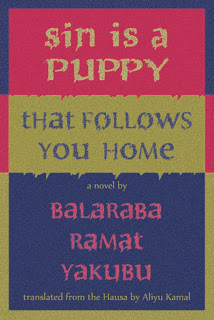
And yet despite this burgeoning literary space, of these tens of thousands of novels, there are fewer than ten that have been published in translation to English, at least in translations that are widely accessible to readers. The translations include a few translations of the early contest-winning Hausa novels published in the 1930s but which were abridged and simplified for primary school readers. This includes Abubakar Imam’s Ruwan Bagaja, which was translated as Water of Cure or Muhammadu Bello Kagara’s Gandoki, which has been published as Gandoki the Warrior. These fantasy novels are widely available in bookshops and in the school curricula, but I still have not been able to find the names of the translators because NNPC nowhere acknowledged them. (Sada Malumfashi has recently published the opening pages of a new translation of Gandoki for National Translation Month) The scholar Mervyn Hiskett translated Shaihu Umar, a historical novel about one young boy’s experience of the trans-saharan slave trade by Nigeria’s first prime minister Abubakar Tafawa Balewa. Of the thousands of novels that have been published since the 1980s, there are a few commissioned translations of Ado Ahmad Gidan Dabino’s novels, including a translation of his bestselling novel (the original of which sold over 400,000 copies) In da So da Kauna, as The Soul of My Heart. But the translation violently abridges a 200 page novel to 60 pages and translates the banter and dialogue and proverbial wordplay that I think makes Gidan Dabino’s novels so pleasurable to read into English-language cliches. It badly needs re-translation. The only novel from the last 40 years that is available in translation internationally and currently the only Hausa novel in translation by a woman (although it is regularly claimed that women are the majority of the readers and writers) is Aliyu Kamal’s translation of Balaraba Ramat Yakubu’s novel Alhaki Kuykuyo Ne as Sin is a Puppy that Follows You Home, published by Indian publisher Blaft. Since 2015 when I began designing my own Nigerian/African literature classes, I have taught this novel, and for the past 11 years, it has been a student favourite, with students choosing to write about it for their midterm or final papers probably more than any other novel I teach. Several students with southern Nigerian backgrounds have told me that they found it illuminating and our discussions of the novel challenged stereotypes they had about the north. They would like to read more, but there are just no more accessible translations of contemporary Hausa literature. (Since coming back to Nigeria this month, I have heard some exciting stories about a few more translations in progress.)

When we speak of African literature without discussing African language literatures, we are missing out on important conversations, aesthetic conventions, and styles. A few days ago, I saw a video of someone critiquing the bland sameness of some English-language literary fiction that comes out of MFA programmes–which is related, I think, to Carl Terver’s critique of the “Middleclass” trap of Nigerian literature.

By contrast, literary translation lets us have a glimpse at other traditions and styles (I think of the exuberant style of Ngũgĩ wa Thiong’o once he started writing primarily in Gikuyu, captured even in translation, or the way Balaraba Ramat Yakubu’s storytelling style comes over even in flawed translations), and can enrich our understanding of African experiences and styles, not unlike the way that speaking two or more languages can expand our understanding and ability to think in multidimensional ways.

From the time I first started reading Hausa literature in my halting Hausa in 2005, I have wanted to translate it. But I am very slow, and academia is very demanding, and I think the best way for me to translate is to collaborate with someone for whom Hausa is a first language. I have such a collaboration in the works. But more urgent than my own fumbling attempts at translation is to motivate MORE LITERARY TRANSLATORS, to find better funding for literary translation, and to think about ways to make translations accessible to ordinary Nigerian readers, so that the translations don’t run into the limitations that Carl Terver points out.

This is where I am lucky to be at SOAS, an institution that has taught Hausa since the 1930s, and to follow greats like Graham Furniss, who collected over 2000 Hausa novels now housed in the SOAS library special collections, and who together with Malami Buba and William Burgess, put together a bibliography of this collection (reviewed here by Ibrahim Sheme, a author, translator, journalist and publisher). I am also lucky to work closely with my colleague Ida Hadjivayanis, who teaches Swahili and translation, and has translated two of Nobel laureate Abdulrazak Gurnah’s novels into Swahili: Paradise as Peponi (see her article on that here) and Theft as Dhulma, and is currently working on her translation of Afterlives. The two of us have had many conversations about popular Swahili and Hausa literature, which share some cultural preoccupations. I published an article on my research on literary translation into and out of Hausa last year “The alchemy of translation in Hausa: cosmopolitanism, gatekeeping, and infrastructure in Hausa-English translation,” which Ida generously read beforehand. And this past year, we ended up putting together a small “Research Cultures” group at SOAS to encourage literary translation in and out of African languages. We are particularly interested in seeing more African literature published in African languages and more African-language literature being translated into other languages so that it is more accessible to larger conversations about “African Literature.” Our colleagues and PhD students are doing some really exciting work, and we have a working translation blog in the works. (I’m in the process of building it). There are other efforts being made to publish translations of African-language literature including Blaft, the African Language literatures in Translation series at University of Georgia Press, and “The African Translation Project” an initiative by Zukiswa Wanner to publish contemporary African fiction in translation which included Balaraba Ramat Yakubu’s Sin is a Puppy in a recent ebundle . Kọ́lá Túbọ̀sún has been doing a massive amount of work on Yoruba language and translation. See, in particular, this brilliant interview he did with writer Ukamaka Olisakwe in Isele Magazine.
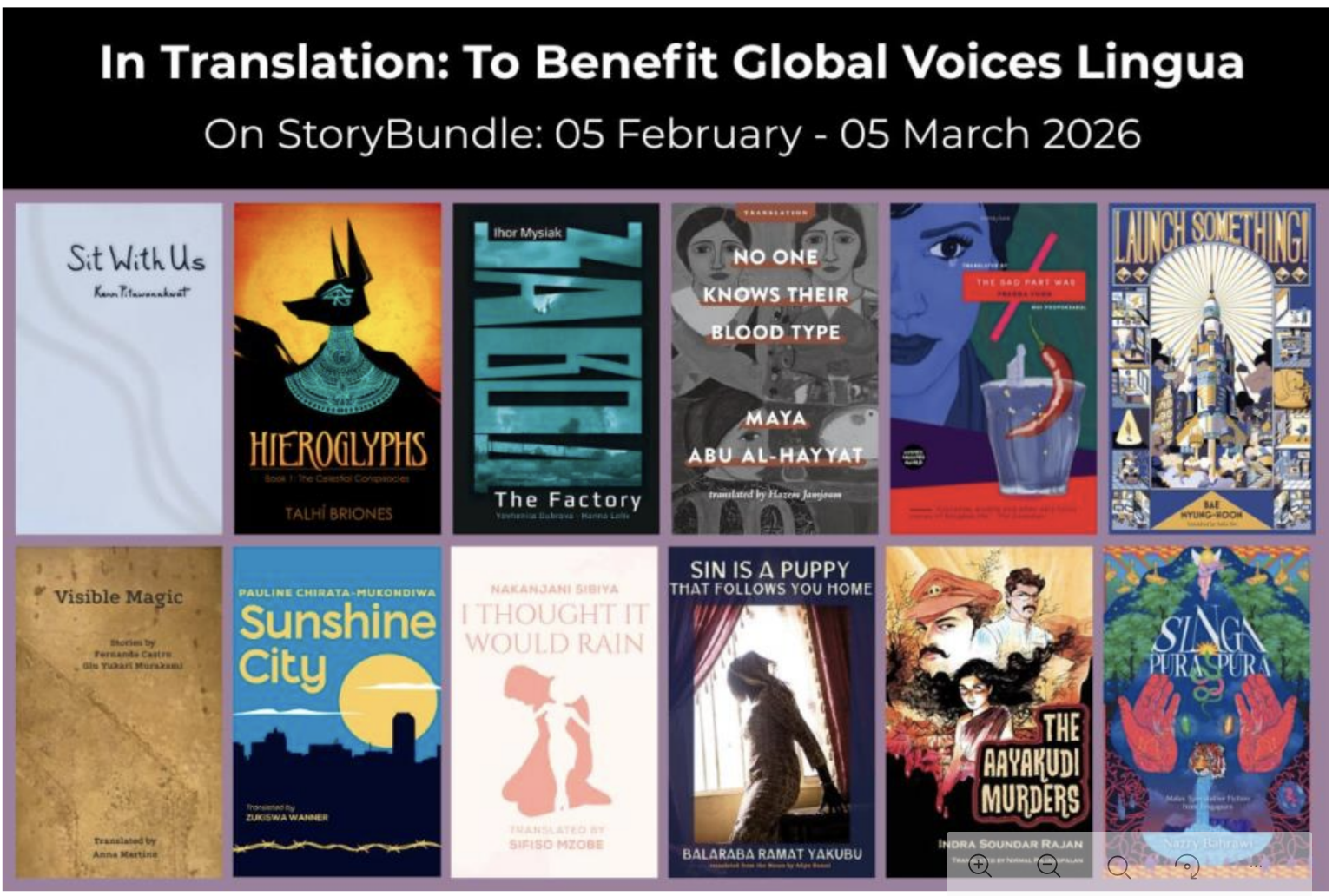
Image courtesy of Global Voices Lingua

In the meantime, we have also been trying to link up with some of these exciting innovations being done on African-language literature, publication, and translation on the continent. Ida’s publisher in Tanzania Mkuki Na Nyota has been proactive in seeking out Swahili language translations of Abdulrazak Gurnah. In Nigeria, Richard Ali has worked hard to get Mudassir Abdullahi and Ismail Bala’s translation of Paulo Coelho’s The Alchemist into Hausa in print at Paresia and has been part of the Jalada team, which has had several groundbreaking translation projects with Ngũgĩ wa Thiong’o Gikuyu short story “Ituĩka Rĩa Mũrũngarũ: Kana Kĩrĩa Gĩtũmaga Andũ Mathiĩ Marũngiĩ” translated into 100 languages and Wọlé Ṣóyínká’s English-language poem “Mandela Comes to Leah” translated into 49 languages. Sada Malumfashi and the Open Arts Team have been promoting Hausa language literature with the Hausa International Book and Arts Festival, and Bayero University’s Centre for Research in Nigerian Languages, Translation, and Folklore had been innovating with online training courses for professional translators.

In late January I was delighted to receive some last minute support from the ISPF ODA fund for our proposed cultural exchange travel. We hosted Sada Malumfashi, director of the Hausa International Book and Arts Festival, and Professor Yakubu Magaji Azare, the director of the Centre for Research in Nigerian Languages, Translation, and Folklore at Bayero University, both of them translators themselves, to come to London and speak with our research group and others about their innovations in translation. Sada spoke on “Indigenous Knowledge Production: Promoting Hausa Cultural Production through Festivals and Translation.” And Professor Azare spoke on “A Decade of refocusing the Centre for Research in Nigerian Languages, Translation, and Folklore: Promoting Translation as a new mandate'” while Hausa novelist Sa’adatu Baba Ahmad (currently in the UK for her PhD) spoke about her writing career. Ida Hadjivayanis and I are now reciprocating with trips to Bayero University, Kano, and to the Mamman Vatsa Writer’s Village in Abuja to contribute to conversations about literary translation organized by our Nigerian partners. How can we support networks of literary translation in Nigeria? How can we build translation bridges between Swahili literature in Tanzania and Hausa literature in Nigeria? What kind of language, publishing and funding infrastructures can we build?

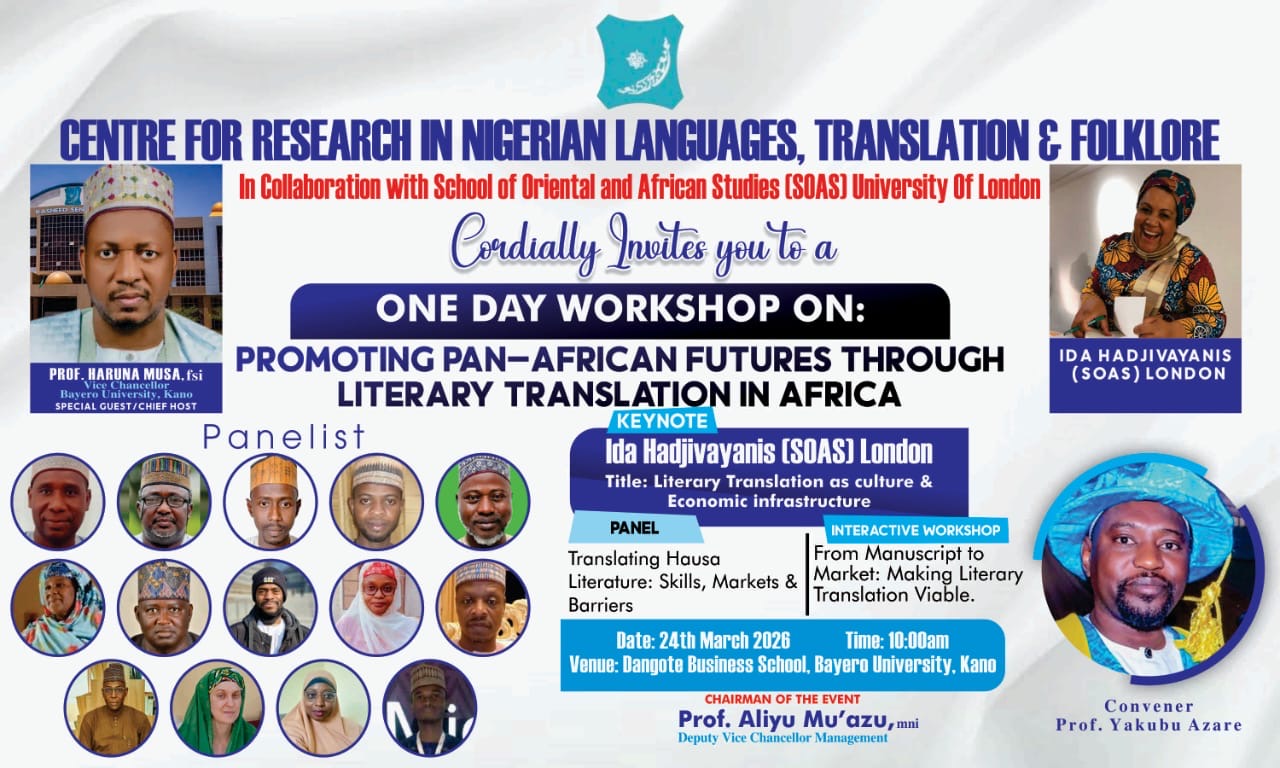
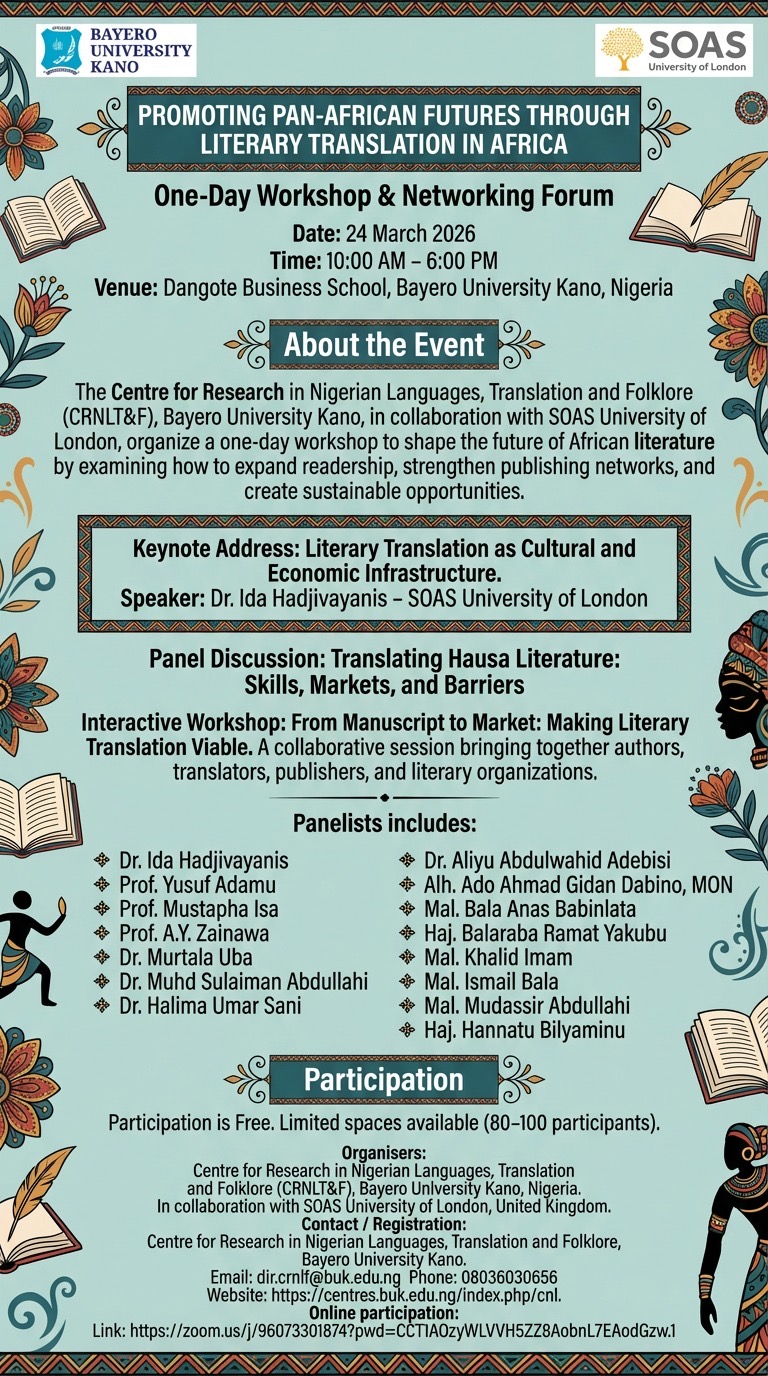
The Centre for Research in Nigerian Languages, Translation, and Folklore is hosting a workshop at the Dangote Business School on Tuesday, 24 March, 10-6pm and have an exciting group of translators and Hausa writers set for conversation. Ida Hadjivayanis will give the keynote and start off the conversation thinking about how we can build connections between Swahili and Hausa literature. If you are in Kano, we hope you’ll come. If you’re not in Kano but you’re interested, you can join by Zoom.
Next, the Open Arts Foundation in collaboration with the Association of Nigerian Authors will be hosting an event in Abuja on Friday, March 27, 10-5pm. After an invitation only strategy meeting on Thursday, March 26, there will be a public forum for anyone interested in Nigerian-language literature, translation, and publishing, as we try to think together about how to strengthen this sector. For example, the NLNG prize for literature is one of the biggest literary prizes in the world. Each year it cycles between Prose Fiction, Poetry, Drama, and Children’s Fiction, giving each winner a $100,000 prize. Kọ́lá Túbọ̀sún has previously interrogated the English-centric nature of the prize, in his interviews with Professor Ladiípọ̀ Ayọ̀dèjì Bánjọ, former chair of the prize. Why don’t they add a fifth year to that cycle for translations in any of those genres–or split the 5th year’s prize into four and fund translations in each category? What about if they provided funding to have each winning entry every year translated into the author’s language of origin, if the winning entry was in English? Or could some of the extremely wealthy people in Nigeria, Aliko Dangote, Abdul Samad Rabiu, Auwalu Abdullahi Rano, or Mike Adenuga, for example, use a drop of their wealth to help fund a translation prize or subsidize translation imprints for Nigerian publishers? What of Nigeria’s education system? Primary school children already read abridged translations of Nigerian literature? What about incorporating translations from Nigerian language literature into the curriculum at all levels? How can we promote literary translation in such a way that it speaks to ordinary readers and does not fall into the “Middle Class” trap Carl Terver has identified. These will be some of the things we discuss in these two different events. See the press release for the Abuja event below. Please feel free to copy and paste the press release into your own media as needed. Here is the Zoom link for the webinar.

PRESS RELEASE

FOR IMMEDIATE RELEASE

International Forum on Literary Translation and Nigeria’s Creative Economy

Abuja, Nigeria – March 2026

Writers, translators, publishers, and scholars from Nigeria and the United Kingdom will gather in Abuja later this month for a public forum exploring the role of literary translation in expanding Nigeria’s creative economy and strengthening the global visibility of African-language literature.

The event, titled “Building Networks, Partnerships, and Infrastructure for Literary Translation between the UK and Nigeria” will take place on Friday, 27 March 2026 at the Mamman Vatsa Writers Village, sponsored by SOAS University of London and the International Science Partnerships (ISPF) ODA fund in collaboration with Open Arts Development Foundation.

The forum brings together leading figures from Nigeria’s literary and publishing communities alongside international scholars to discuss how translation can help Nigerian writers reach wider audiences while creating new professional opportunities for translators, editors, and publishers.

The Abuja gathering is a collaboration between Nigerian cultural organisations and SOAS University of London designed to strengthen networks for translating Nigerian-language literature and to develop sustainable pathways for literary translation in Nigeria. A keynote lecture will be delivered by literary translator Ida Hadjivayanis of SOAS University of London, who has translated two novels by Nobel literature laureate Abdulrazak Gurnah into Swahili and will speak on the role of translation in connecting African literary markets and supporting creative industries.

Panel discussions will explore practical issues including publishing translated African literature, developing sustainable translation careers, and expanding the circulation of literature written in Nigerian languages such as Hausa.

The event will feature contributions from Nigerian writers, translators, publishers, and cultural organisations, including representatives from independent publishing houses and literary initiatives working to expand opportunities for Nigerian literature both locally and internationally.

According to project organiser Dr. Carmen McCain, the forum aims to strengthen collaboration between translators and publishers while highlighting the importance of translation as both cultural work and professional practice.

“Nigeria has one of the most vibrant literary cultures in Africa. While Nigeria is most known internationally for its English language literature, there are tens of thousands of novels in Hausa, and yet fewer than ten of them have been translated into English. Other Nigerian language literatures are also rarely translated or circulated internationally. By bringing together writers, translators, and publishers, we hope to build stronger networks that can support translation and help Nigerian stories reach wider audiences, while also following Ngũgĩ wa Thiong’o to encourage writers to “enrich” Nigerian languages by translating other African and world literatures into those languages.”

Writer and cultural organiser Sada Malumfashi, founder of the Open Arts Foundation, emphasised the importance of building translation infrastructure within Nigeria itself.

“Nigeria has a vast literary tradition in languages such as Hausa, yet many of these works remain inaccessible to wider audiences. Strengthening literary translation will create opportunities for writers, translators, publishers, and readers. By building stronger networks, we can ensure that stories written in our languages travel further and reach new generations of readers.”

The public forum is open to writers, students, translators, publishers, and anyone interested in Nigerian literature and the future of translation in Africa.

Attendance is free and open to the public.

Event Details

Event: Building Translation Bridges – Public Forum
Date: 27 March 2026
Venue: Mamman Vatsa Writers Village
Host: Association of Nigerian Authors
Time: 10:00 AM – 5:00 PM

Media Contact

Sada Malumfashi

Curator, Open Arts Development Foundation/Hausa International Book and Arts Festival

sada@openartsworld.org

07038570607

Translation Conference in Kano and Glenna Gordon’s exhibition of photographs of Hausa novelists opens this evening at New York’s Open Society

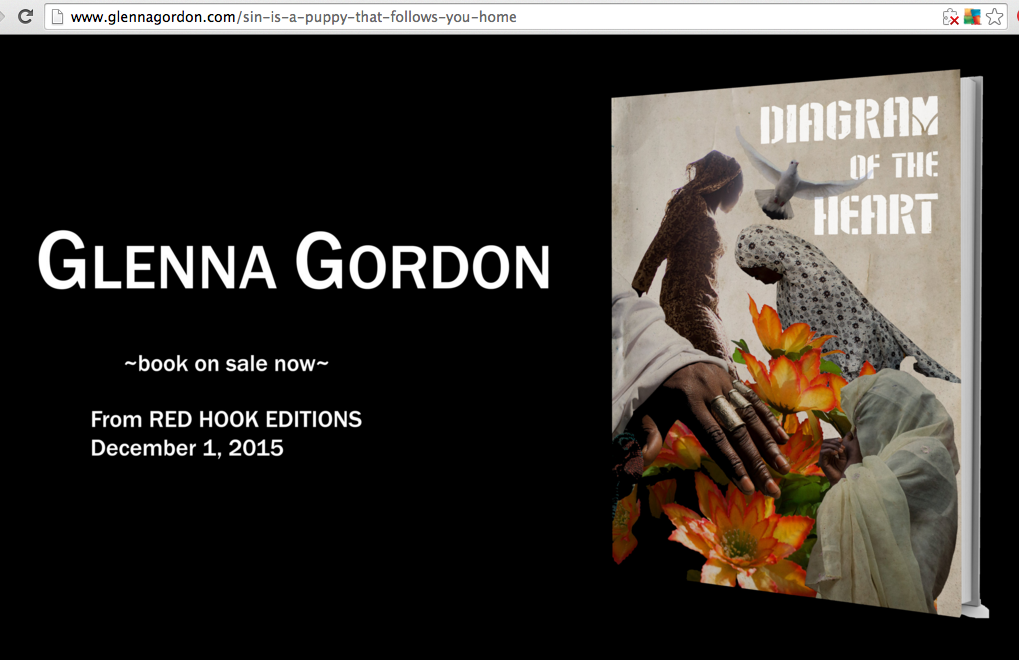
Glenna Gordon's photo book Diagram of a Heart advertised on her site.

Glenna Gordon’s photo book Diagram of a Heart advertised on her site.

I’ve just finished attending a translation conference at Bayero University, Kano, hosted by the Centre for Research in Nigerian Languages & Folklore and the Nigerian Institute of Translators & Interpreters (NITI).  I heard papers on translation from Hausa, Fulfulde, Igbo, Yoruba, and Swahili, and on proverbs, poetry, film subtitles, and novels, as well as papers looking at more technical translations in the media and the efficacy of google translate Hausa. It was an academic conference, but there were also dozens of journalists there, who regularly translate news from English into Hausa. As Hafizu Miko Yakasai, the current president of NITI pointed out, translation is particularly important to “national development” in Nigeria because of Nigeria’s diversity of languages and cultures “with over three hundred language groups.”

NITI is a useful resource for translators, although I was a little worried by the proposed legislation in the National Assembly that would require translators to be a part of the organization before doing this work.

In a document passed out at today’s Congress, entitled “Nigerian Institute of Translators and Interpreters (NITI) International Translation Day (ITD) 2015,” the Secretary General/Registrar of NITI Joachim Okeke writes that in 2008 NITI’s bill “passed the second Reading at the National Assembly and, shortly after that, we were invited to the House for the public hearing.” Although the bill has not been passed,

When the bill is passed and it becomes law, it will make the practice of translation and interpretation regulated in such a way that it would be an offence for those not authorized to claim to be members of the profession to practice, exactly like in other professions: accountancy, law, medicine, engineering etc.

Of course, such associations are excellent resources and can do much to “professionalize” the industry. Translators should be as respected as accountants, for example and renumerated accordingly. As such, it is a good idea to have a respected body that can vouch for the skill of translators and advocate for them. However, I am concerned about creating laws that force creative professionals to be certified to practice their craft, especially as it seems that so far NITI has been more focused on linguistics, interpretation, and technical translations than literary translation, which is much more closely related to creative writing. When someone commented that the translations of advertisements on the radio about birthdays were wrong because “there is no birthday in Hausa culture,” I worried that the forum could become more about policing narrow ideas about culture than supporting people interested in doing creative translations. That said, it is good to have an association to belong for that is looking out for the rights of translators and setting standard rates and skill levels that both translators and those who commission them are encouraged to meet.

It was literary translation that brought me to the conference. I wanted to find out more about who else was doing it and whether anyone else was translating contemporary Hausa literature. Abdulaziz A. Abdulaziz presented the only paper on translations of what he called “contemporary Hausa prose fiction” but which he pointed out has been

“variously described as Kano Market Literature (Malumfashi: 1994 cited in Adamu 2002; Whitsitt: 2000, 2003), Hausa Literary Movement (Adamu 2002), Hausa Popular Literature (Furniss: nd) or the ‘littattafan soyayya, love stories” (Larkin: 1997).”

The fact that he was the only one at a translation conference in Kano to talk about translating the thousands of novels that have built up one of the largest indigenous-language reading publics in Africa, indicates that there is a serious gap between the intellectual translators in the academy and the readers and writers creating the work. Several professors made condescending comments about contemporary literature after his presentation, even proposing that the novels were all “translations” from Western novels. Clearly, there  is much more work that needs to be done. And at the moment, much of this work is being done outside of the university.

Coincidentally, this conference comes at the same time as the opening of an exhibition in New York featuring photographs of several Hausa novelists, including several  of my translations of short novel excerpts.

A few years ago, photojournalist Glenna Gordon got in touch with me and asked if she could talk with me over Skype about culture in northern Nigeria. She had been doing a series of photographs on Nigerian weddings, but thus far most of the weddings she had photographed had been in the south. She was planning to go to Kano and wanted to know about northern Nigerian culture.

I told her about my own research on Hausa novels and films and sent her several academic articles on Hausa literature and culture. But I told her that the best thing for her to do would be to read Balaraba Ramat Yakubu’s novel translated as Sin is a Puppy by Aliyu Kamal (available on Amazon here). Glenna read it and was enchanted, featuring it as  her “springtime read” at Guernica, where she is photo editor. And later when she came to stay with me for a week in Jos while working on her wedding project, she photographed some of my collection of “soyayya” novels and told me she wanted to do a photography project on Hausa women who wrote. Although I had started my own project writing about Hausa novelists several years before, and had given an editor a brief chapter in a book to be published in Nigeria that has yet to come out, I was in the middle of the slough of despond that is ABD, trying to finish my dissertation. And I thought it would be a fine thing for Hausa novelists to receive publicity in the kind of publications Glenna had access to like Time and New York Times. So, I contacted several writers’ groups asking women if they would be interested in being photographed for the project, and I put her in touch with a few other writers I knew. She took it from there, visiting Kano, Kaduna, and other parts of the north off and on for two years taking photographs of writers, weddings, and other things.

Earlier this year, she told me she would be exhibiting the photos with the Open Society’s “Moving Walls” series in New York and asked me if I would travel to Kano to purchase some novels from the market for the exhibition, as well as help

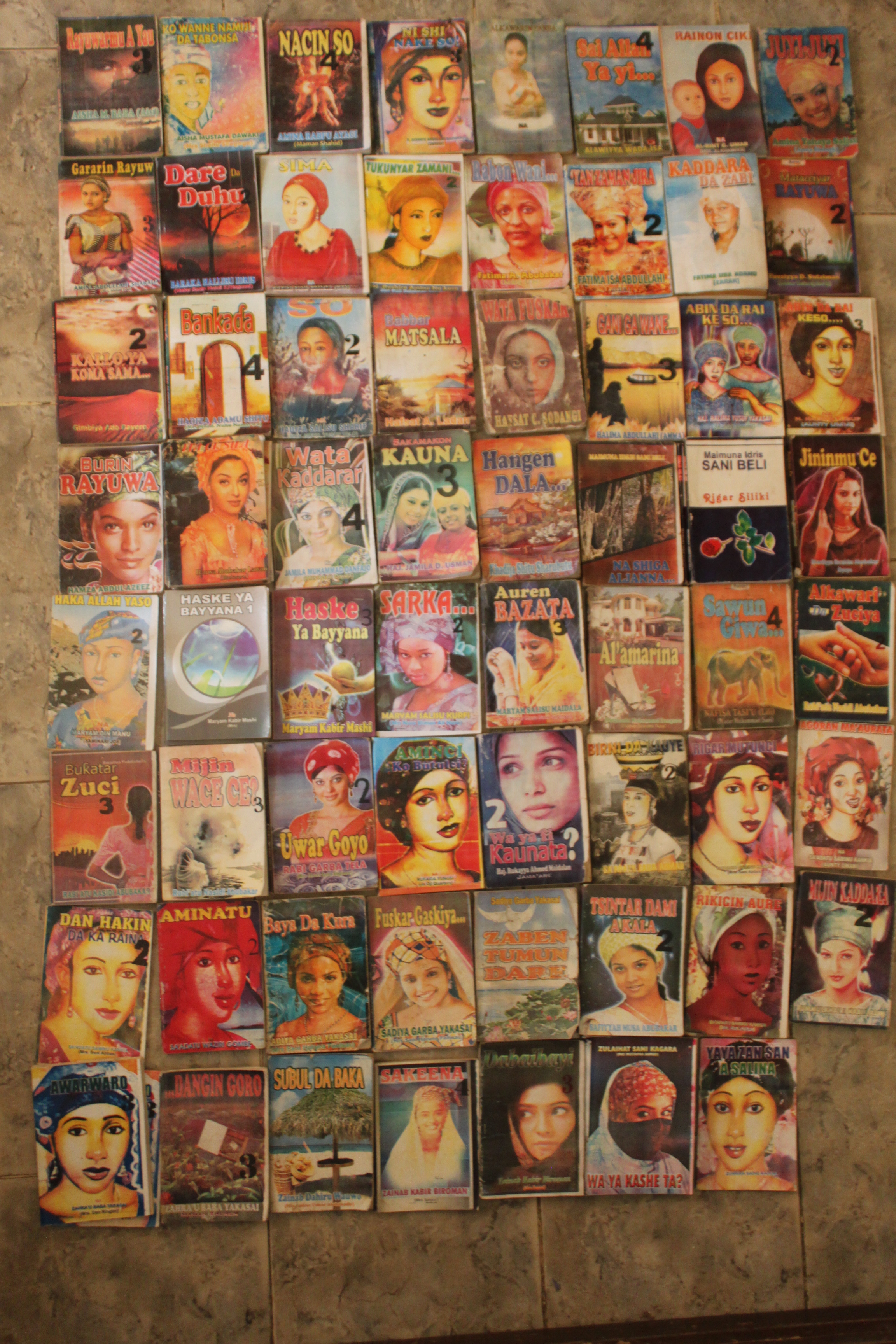
My own non-artistic photo of the books I was sending her before I shipped them off.

My own non-artistic photo of some of the books I was sending her before I shipped them off.

with summarizing some of the novels and translating excerpts for them for the exhibition. I did this in July, spending a week visiting writers, buying their novels and other novels in markets and at used book stalls, and interviewing them about their writing. As I read Hausa slowly, I recruited my friend Sa’adatu Baba Ahmad, a journalist and also one of the novelists Glenna has photographed to help me read and summarize some of the novels. She gave me ten summaries in Hausa, and then I wrote up the rest, depending (probably too heavily) on my interviews with the novelists about their books and from my own readings. I also translated five excerpts from novels by the authors Glenna was featuring: Balaraba Ramat Yakubu, Farida Ado Gachi, Hadiza Sani Garba, Jamila Umar, and Sa’adatu Baba Ahmad. After the exhibition has been up for a while, I will put up a few excerpts here.

The Open Society exhibition is opening this evening in New York  from 6-9pm and will be open until 13 May 2016. Glenna has also put together a book Diagram of the Heart featuring 75 photos and a few of my translations, which is currently available for pre-order on her site. (And now available on Amazon) Her photos were also earlier featured in the exhibition Photoville in Brooklyn. If you are in New York, check out the exhibit at Open Society at 224 W 57th St, New York, NY 10019. If you are not in New York, consider pre-ordering the book.

Words Without Borders features African Women writing in Indigenous Languages

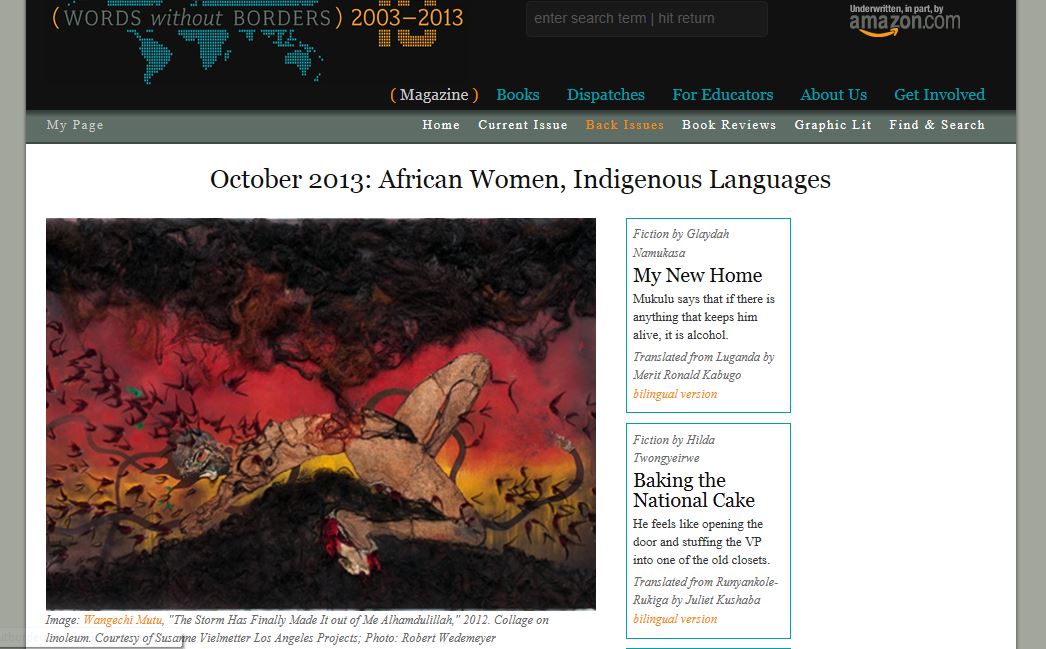
screenshot from the Words Without Borders October edition

screenshot from the Words Without Borders October edition

The October 2013 issue of translation journal Words Without Borders focuses on African Women writing in indigenous languages. The magazine has an impressive pedigree. Check out this statement from their “about” page, for example:

Every month we publish eight to twelve new works by international writers. We have published works by Nobel Prize laureates J.M.G. Le Clézio and Herta Müller and noted writers Mahmoud DarwishEtgar KeretPer PettersonFadhil Al-AzzawiW.G. Sebald, and Can Xue, as well as many new and rising international writers. To date we have published well over 1,600 pieces from 119 countries and 92 languages.

I am encouraged that they are drawing attention to the literature being written in African languages that often falls below the radar. Please check out their latest issue.  

I wrote a mini-review of the issue in my column this week, which you can read on the Weekly Trust site, the All Africa site, or copied below, with links and photos, on my blog.

Words Without Borders Draws Attention to African Women Writing in Indigenous Languages

BY CARMEN MCCAIN, 12 OCTOBER 2013

The online translation journal Words Without Borders, which has published English-language translations of creative work in 92 languages from 119 different countries since it started in 2003, has devoted its October 2013 issue to African women writing in indigenous languages.

The special issue, which also includes never-before-seen translations of Chilean poet Pablo Neruda’s poetry, features fiction translated from Hausa, Luganda, Runyankole-Rukiga, Tigrinya, and a non-fiction essay which includes translations of Wolof songs. In an African literary landscape where English-language literature often dominates discussions, this is a refreshing and important contribution. Because the journal is online and free, it is accessible to anyone in the world to read, and several of the stories have a bilingual version, where you can read the original and the English translation side by side. (See the English translation of “Baking the National Cake” side by side with the Runyankole-Rukiga original and the English translation  “My New Home” side by side with the Luganda original).

Rahma Abdul Majid (courtesy of Ibrahim Sheme’s blog Bahaushe Mai Ban Haushi)

Closest to home is Ibrahim Malumfashi’s translation of the first chapter of Nigerian author Rahma Abdul Majid’s massive Hausa novel Mace Mutum. This timely English translation comes close on the heels of the “child marriage” debate in Nigeria. [I’ve previously reviewed Balaraba Ramat Yakubu’s novel Wa Zai Auri Jahila, which also deals with the theme of young marriage.] In the opening of the novel, which is set in a rural village, an eight year old girl Godiya narrates, “My father, a farmer, has three wives. The only difference between our compound and others is that our household is not a kid factory; my father has only three children, while most of his compatriots boast a complete Barcelona team against Real Madrid, excluding the reserve.” Godiya tells her sister Lami’s story in this opening chapter, a girl who at fourteen is considered by gossips to be “old goods” until her father bestows her on a “haggard old” itinerant Qur’anic teacher. By the end of the chapter Godiya is nine and has seen girls die in childbirth and aunties divorced for being late with the cooking. What will she do

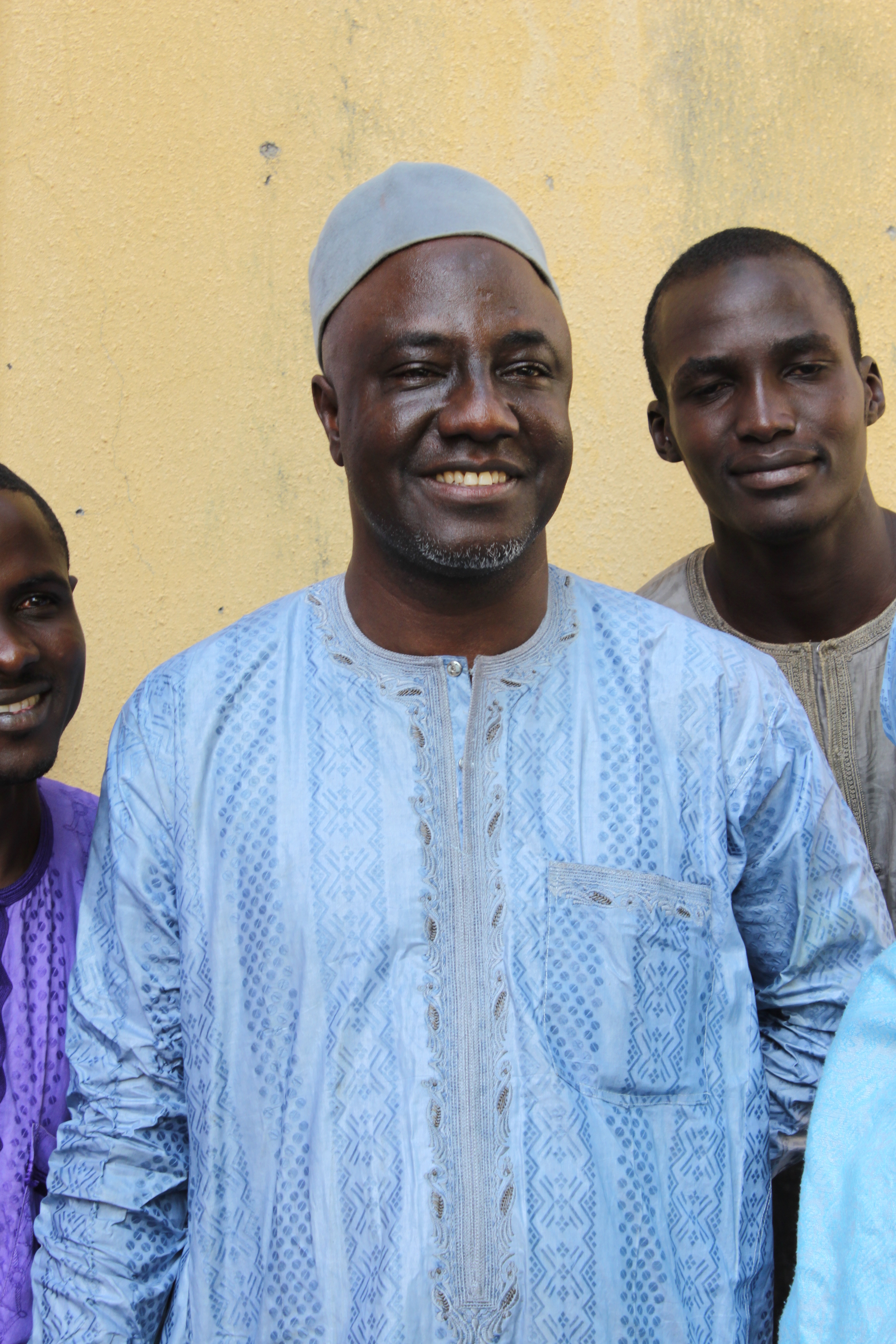
Professor Ibrahim Malumfashi, December 2012, Kaduna. (c) Carmen McCain

Professor Ibrahim Malumfashi, December 2012, Kaduna. (c) Carmen McCain

when she hears her parents talking about marrying her off as well? While I do not have the original Hausa novel on hand to compare it with the translation, Professor Malumfashi successfully carries the story over into English. I wonder whether the vocabulary used by the young characters is not sometimes too sophisticated for their age and level of education? Fourteen year old Lami, for example, in one of her soliloquies about the suffering of women, complains about the “Herculean task of taking care of another man’s household.” However, on the whole, the angry tone of the narrative reminds me of the novels of Egyptian novelist Nawal El Saadawi, whose Arabic novels available in English translation harshly chronicle the abuse, disrespect, and violence against women in Egyptian society. I’m so glad Professor Malumfashi has made Rahma Abdul Majid’s work available to English speakers.

Glaydah Namukasa (Photo Credit: Winston Barclay, Flickr, used by permission)

Ugandan author Glaydah Namukasa’s story “My New Home” translated from Luganda by Merit Ronald Kabugo is similarly narrated by an impoverished child, the young boy Musika. He begins his narrative: “I started drinking alcohol the day I fell into Maama’s womb. Maama died of alcohol. She started drinking young and died young. She drank too much alcohol until she could no longer drink; and then the alcohol in her body started drinking her up until she dried up dead.” Alcohol drives the conflict in the story. Musika hates his grandmother and adores his grandfather. His unreliable childish descriptions paint a portrait of a woman, Jjaja Mukyala, who is afraid her grandson will merely follow the footsteps of the other drunks in the family. Musika describes how Jjaja Mukyala resents him because she thinks he reflects badly on her dead son, who conceived him with a bar maid while drunk. She also hates Musika to accompany his grandfather Mukulu to bars. But Musika loves how tender Mukulu is when he is drunk. “Mukulu was drunk when he told me that he loved

Dr. Merit Ronald Kabugo (courtesy of Words Without Borders)

me, drunk when he told me that Maama loved me, that Maama’s friends Aunty Lito, Aunty Karo, and Aunty Naki, who took turns taking care of me after Maama died, all loved me. Every time he is drunk he tells me he is glad he has a grandson.” Musika ends up wondering “How can alcohol be so bad and so good? Every day Jjaja Mukyala shouts, ‘If there is anything that will kill you it will be alcohol.’ But Mukulu says that if there is anything that keeps him alive, it is alcohol. How can alcohol be so bad as to kill Maama, and yet so good as to keep Mukulu alive?” “My New Home” is beautifully written and beautifully translated. I’d love to read more translations of Namukasa’s work.

I found Eritrean author Haregu Keleta‘s story “The Girl who Carried a Gun,” translated from Tigrinya by Charles Cantalupo and Rahel Asgedom Zere, the most haunting of the fiction published here. As in Mace Mutum, the narrator’s family is trying to force her into a marriage with a man she does not love. She runs off to Ethiopia to join the Eritrean People’s Liberation Front, hoping to meet up again with her childhood sweetheart. In the meantime, she becomes a strong and fearless fighter. “… a few months of military training made my soft

Charles Cantalupo (courtesy Penn State)

body hard. I had muscles. My skin grew darker. I could run up and down the mountains. I sprinted over the sand. The oppression of Eritrea and especially of its women changed me into a fighter–far from a girl who was afraid to go outside.” Yet while the freedom fighters talk “about the oppression of women,” the actions of the men she fights with are not always consistent with their ideology, and she faces betrayal and disappointment. Despite her sacrifice to “liberate” her country, her family sees her only in terms of her body, caring only about whether she is married or has had a child. Keleta, who herself is a former member of the independence struggle in Eritrea, ironically invokes the double bind women find themselves in.

Hilda Twongyeirwe (courtesy of UGPulse Literature)

The final story “Baking the National Cake” by Ugandan author Hilda Twongyeirwe, translated from Runyankole-Rukiga by Juliet Kushaba, is quite different from the others in its opulent political setting and third person narration. The story describes the inner struggle of David, the Minister for the Presidency in a fictional African nation who “covers the tracks” of the hedonistic president and vice president: “They leave for two-day conferences and stay away for weeks. It

Juliet Kushaba (courtesy Transcultural Writing)

is David that ensures that the accounts are balanced to include the nonofficial days.” Although he is tired of their shenanigans he finds himself caught ever more tightly in the political web of the despised Vice President. The story was written originally in Runyankole-Rukiga, but the politics of it feel familiar.

Marame Gueye (courtesy East Carolina University)

The last “African” piece is a nonfiction essay in English, “Breaking the Taboo of Sex in Songs: the Laabaan Ceremony” by Marame Gueye that analyzes the sexual language in Wolof songs sung by women during the Laaban ceremony that is a part of Wolof weddings.

The journal importantly showcases writing in African languages often neglected in wider discussions of African literature. Ironically, however, in seeking out these stories, it also demonstrates another problem. Although there are thousands of works in Hausa, as well as literary communities working in Amharic, Arabic, Swahili, Shona, Yoruba and other African languages, Words Without Borders seems to have had trouble finding translations it could publish for this issue, despite a call for submissions put out months in advance. While most of its issues feature eight to twelve pieces that speak to its theme, only four translated works from African languages and one nonfiction essay written mostly in English were published here. It seems to me that this highlights the striking need for literary translators from and into African languages.

I hope several things come out of this issue: 1) An awareness on the part of those who talk about African literature that African literature goes much deeper than literature written in English or French (or even Portuguese); 2) An awareness on the level of writers who write in English but who are fluent in African languages that translation is an important contribution to African letters and that there are well-respected venues for publishing translations; 3) An awareness on the part of writers writing in indigenous languages that while the primary audience may be the most important, as it should be, that there are wider global audiences that could benefit from reading such work; 4) An awareness on the part of institutions that financial and infrastructural support for publication and translation would be a great boon to African literature. Overall, we need to see more interaction between writers in African languages and European languages and more support on the continent for both African language literature and translations.

Hajiya Balaraba Ramat Yakubu’s novel Alhaki Kuykuyo Ne/Sin is a Puppy Published in translation by Blaft

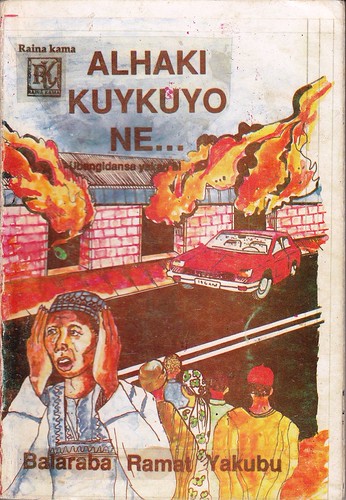
Exciting news! Indian publisher Blaft has published an English translation, by Aliyu Kamal, of Balaraba Ramat Yakubu’s 1990 novel Alhaki Kuykuyo Ne. Aliyu Kamal is a professor in the English Department at Bayero University and a prolific novelist in his own rightSee Blaft’s blog post on the release, where they give this blog a shout out. Hard copies can be ordered from their site, and ebooks for Kindle and epub ($4.99) are also available. To read the first chapter for free, click here. (Update 9 November 2012: Two Indian news sites have also published articles about the novel and the influence of Indian films on Hausa culture: Dhamini Ratnam writes “Filmi Affair in Nigeria” for the Pune Mirror (and briefly quotes me) and Deepanjana Pal writes “How Bollywood fought for the Nigerian Woman “for Daily News and Analysis. I’m not sure Sin is a Puppy… is the best novel to use as evidence of Indian films on Hausa culture, but I’m delighted at the attention the novel is receiving in India.) (UPDATE 8 March 2013: You can read my review of the novel published by Weekly Trust and find links to a lot of other reviews of the novel on my blog here.)

Hajiya Balaraba Ramat Yakubu was one of the earliest authors of what came to be known as the soyayya Hausa literary movement or Kano Market Literature. While these books were often disparaged by critics as romance novels and pulp, Hajiya Balaraba’s novels are often muck-raking exposes of abuses that occur in private domestic spaces and make a case for women’s education and independence. Other soyayya books tell love stories from the perspective of Hausa youth and tales of the home from the perspective of women.

Alhaki Kuykuyo Ne, one of Hajiya Balaraba’s most popular and critically acclaimed novels, tells the story of the family of businessman Alhaji Abdu and his longsuffering wife Rabi, the domestic fireworks that explode when he decides to marry the “old prostitute” Delu as a second wife, and the stories of his children as they make their way in the world with only the support of their mother.

When I first read the book in Hausa in 2006, I described it as follows:

Like many Hausa novels, the title is part of a proverb: “crime is like a dog”… (it follows it’s owner). When the wealthy trader Alhaji Abdu marries an “old prostitute,” as a second wife, his family goes through a crisis. After a fight between the uwargida and her children and the new wife, Alhaji Abdu kicks his first wife and her ten [nine because Alhaji Abdu kept one daughter from another marriage] children out of his house, denies them any kind of support, and refuses to even recognize any of them in chance meetings on the street or when his eldest daughter gets married. What was initially a disaster for the abandoned wife Rabi becomes a liberating self-sufficiency. Supporting her children through cooking and selling food, she is able to put her eldest son through university and see the marriage of her eldest daughter to a rich alhaji. The book follows the story of Rabi, as she makes a life apart from marriage, and her daughter Saudatu, as she enters into marriage.

I have read the translation by Aliyu Kamal and I intend to post a longer review in the next few weeks. The novel was adapted into a film Alhaki Kwikwiyo Ne directed by Abdulkareem Muhammed in 1998. Novian Whitsitt has discussed the novel in his PhD dissertation (2000), Kano Market Literature and the Construction of Hausa-Islamic Feminism: A Contrast in Feminist Perspectives of Balaraba Ramat Yakubu and Bilkisu Ahmed Funtuwa, and his article, “Islamic-Hausa Feminism and Kano Market Literature: Qur’anic Reinterpretation in the Novels of Balaraba Yakubu.” Professor Abdalla Uba Adamu has written about the screen adapatation in his book Transglobal Media Flows and African Popular Culture: Revolution and Reaction in Muslim Hausa Popular Culture and in a paper you can access online, “Private Sphere, Public Wahala: Gender and Delineation of Intimisphare in Muslim Hausa Video Films.”

As far as I know, this is the first time a full translation of a soyayya novel has been published internationally. An excerpt of Alhaki Kuykuyo Ne translated by William Burgess was published in Readings in African Popular Fiction, edited by Stephanie Newell, but Aliyu Kamal’s full translation, while it has a few issues, is much better–not quite so stiff. That is not to say there have been no other translations of Hausa literature. There are translations of the works of early authors like Abubakar Imam’s Ruwan Bagaja/The Water of Cure, Muhammadu Bello Wali’s Gandoki,  the first prime minister of Nigeria Abubakar Tafawa Balewa’s Shaihu Umar, Munir Muhammad Katsin’as Zabi Naka/Make Your Choice and others. Ado Ahmad Gidan Dabino’s bestselling novel In da So da Kauna (The two part novel sold over 100,000 copies) was translated as The Soul of My Heart,  but unfortunately, although the cover illustration (pictured here) was beautiful, the translation was exceedingly bad. It cut a charming novel that was over 200 pages down to about 80, turned witty banter into cliches, and translated out most of the dialogue Gidan-Dabino is so good at. The book needs to be re-translated, this time properly. I attempted to translate Gidan Dabino’s novel Kaico!, (an excerpt of the first chapter was published by Sentinel here), but stopped because of lack of time and because I felt like my translation was still too stiff and I needed to immerse in the language a little longer before attempting more translations. As the editorial of Nigerians Talk today pointed out, we need much more focus on translation in Nigeria.

[…] Hausa literature thrives. An old post on Jeremy Weate’s blog explores the disconnect between the idea of a thriving market selling up to “hundreds of thousands of copies” and a country that lives with a consensus that the Hausa don’t have a living literary establishment. Where are the top Hausa writers. How much of the content of their literature makes it into translation and out as a truly accessible text by other non-Hausa speakers? Where is the wall separating those work from the larger body of consumers all around Nigeria? What are the benefits and implications of this insularity that keeps a story locked only within a language medium, away from every other? And what is the value of such literature if it serves only a localized audience. What happened to universality? We won’t know any of this without active involvement of translators, and other conscious literary practitioners bringing us to the stories, and the stories to us. Like Achebe said, “my position…is that we must hear all the stories. That would be the first thing.”

I am very grateful to Blaft for initiating this translation and publication and hope that it will follow this novel with many more. The challenge will be finding translators. As I have said in a previous talk, I wish every Nigerian writer of English who spoke Hausa well would commit to translating at least one  Hausa novel, so as to bring this literature to a larger public. And while I am excited that, as Blaft notes

It’s also, we believe, the first time a translation of an African-language work has ever been published first in India. We like the idea of South-South literary exchange, and we wish this sort of thing would happen more often.

I hope that some of Nigeria’s publishers will take up the challenge to create their own translation imprints.

In the meantime, a big congratulations to Hajiya Balaraba. Here’s hoping that the rest of her novels will be translated soon! Stay tuned for a longer review of

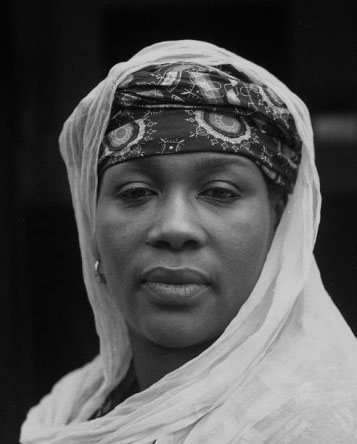
Hajiya Balaraba Ramat Yakubu. (c) Sunmi Smart-Cole

the novel itself.

For more articles and information on Hausa soyayya literature, see these links:

Interview with novelist Hajiya Balaraba Ramat Yakubu.

Interview with the first female novelist to publish a novel in Hausa, Hafsat Ahmed Abdulwahid.

Interview with novelist Bilkisu Funtua.

Interview with novelist Sa’adatu Baba Ahmed.

Hausa Popular Literature database at School of Oriental and African Studies

“Hausa Literary Movement and the 21st Century” by Yusuf Adamu

“Between the Word and the Screen: a hisorical perspective on the Hausa literary movement and the home video invasion” by Yusuf Adamu

“Hausa popular literature and the video film: the rapid rise of cultural production in times of economic decline” by Graham Furniss

“Loud Bubbles from a Silent Brook: Trends and Tendencies in Contemporary Hausa Prose Writing” by Abdalla Uba Adamu

“Islamic Hausa Feminism Meets Northern Nigerian Romance: the Cautious Rebellion of Bilkisu Funtuwa” by Novian Whitsitt

“Parallel Worlds: Reflective Womanism in Balaraba Ramat Yakubu’s Ina Son Sa Haka” by Abdalla Uba Adamu

Hausa Writers Database (in Hausa)

My blog post on a (mostly Hausa) writers conference in Niger

My translated excerpt of Ado Ahmad Gidan Dabino’s novel Kaico! published in Sentinel Nigeria

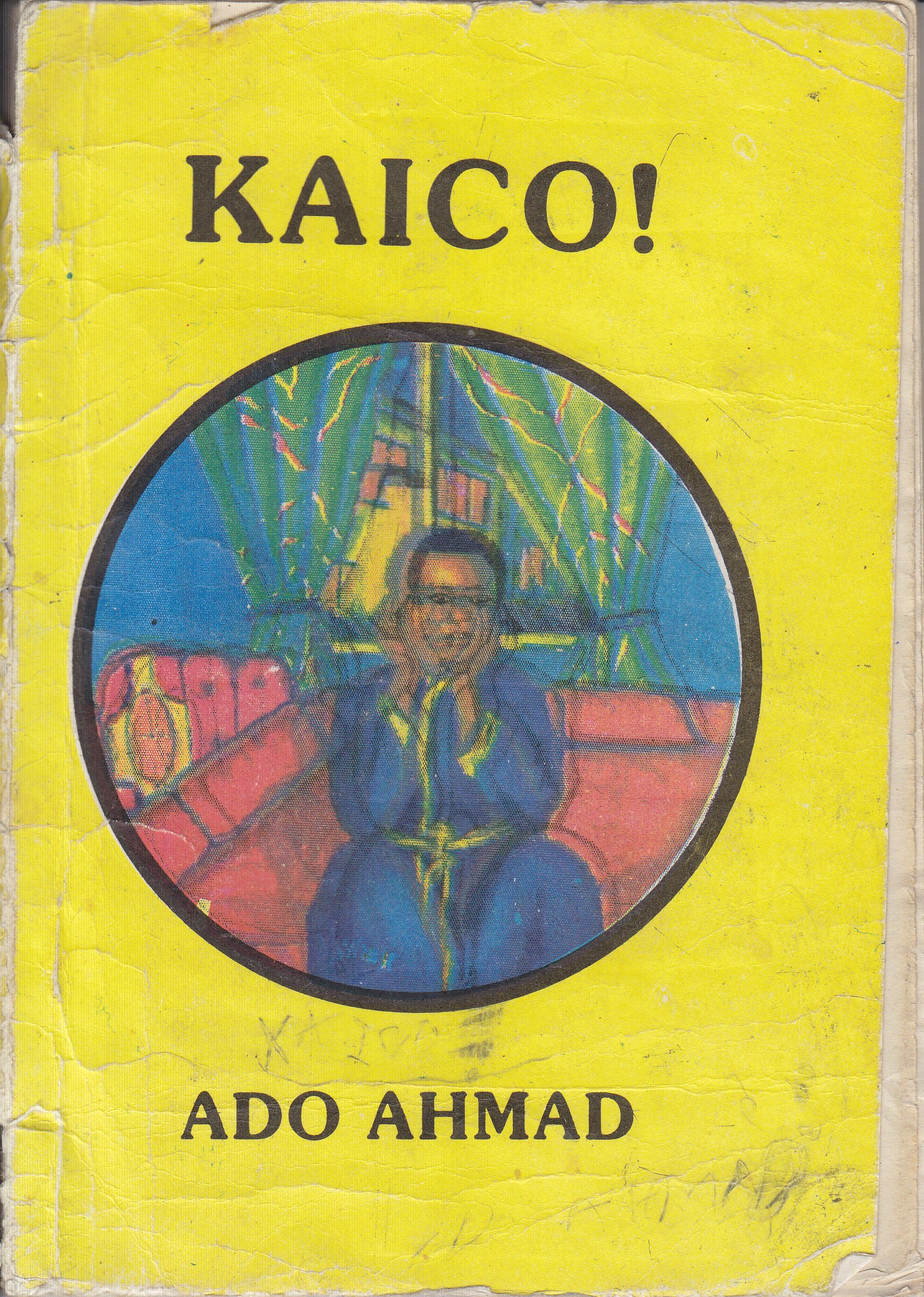
The beat-up cover of my working copy of Kaico! (complete with little kid pencil scribbles)

I’m behind on this blog, and there is much more to post, including my trip to Lagos and Yenegoa, for a “Reading Nollywood” conference and the AMAA awards. (For an excellent post on AMAA, see my friend Bic Leu’s blog, which uses a lot of the photos I took while there.) But, in the meantime, here is a link to an excerpt of my translation-in-progress of Ado Ahmad Gidan Dabino’s novel Kaico! that was published in the March 2011, Issue 5 of Sentinel Nigeria Online.

The excerpt comes from the first chapter of the novel, which I have completed three (rough) chapters of so far. In addition to needing to finish translating the entire novel, the translation of the three chapters I have completed still need a lot of polishing and editing. But I do appreciate Sentinel Editor, Richard Ali being so committed to start featuring translations of African-language works that he urged me to send this in as is.

Ado Ahmad Gidan Dabino is the bestselling author of In Da So Da Kauna, a Hausa language novel that sold over 100,000 copies. Winner of the 2009 Engineer Mohammad Bashir Karaye Prize in Hausa Literature for his play Malam Zalimu, he is also a founding member of the Hausa film industry, and has produced or directed sixteen films in Hausa, including his most recent Sandar Kiwo, which has been shown internationally.

Here is an excerpt from the excerpt:

On Monday, the 23rd day of Ramadan, after we broke fast, my good friend Kabiru visited our house. I saw him as he came into the room, and I quickly got up and grabbed his hand.
“Kai, look who we have here in town today. Kabiru, ashe, are you around? Long time no see!” I said, holding on to his hand.
As we sat down, Kabiru said, “I traveled for a week, that’s why you haven’t seen me. You know that if I hadn’t traveled, it would have been hard to go for seven days without seeing you.”
“I was thinking maybe the fasting was keeping you from going anywhere,” I answered. “You know how the fasting wears you out when the sun is beating down.”
“Well, the sun may be hot, but there’s no sun at night. I was told that you came to my house looking for me while I was gone. Have you forgotten?”
“Oh, I know. I just asked to see what you would say.” We both smiled.
Kabiru looked at me. “Oho, so you want to catch me out, do you?”
“Ai, well, that’s why you should marry relatives. They know you. You know them. If you take the bait, it’s not my fault,” I laughed.
“Ok, well, jokes aside. I have something important I want to talk to you about.”
“I’m listening. What’s up?” I tilted my head to one side to listen.

***

Unfortunately, the English translation published by Sentinel extends beyond the Hausa that was also given, and I have currently misplaced my copy of the book, but as soon as I find it, I will put up the Hausa portion of this excerpt for a side-by-side comparison. To read more, see the Sentinel site.

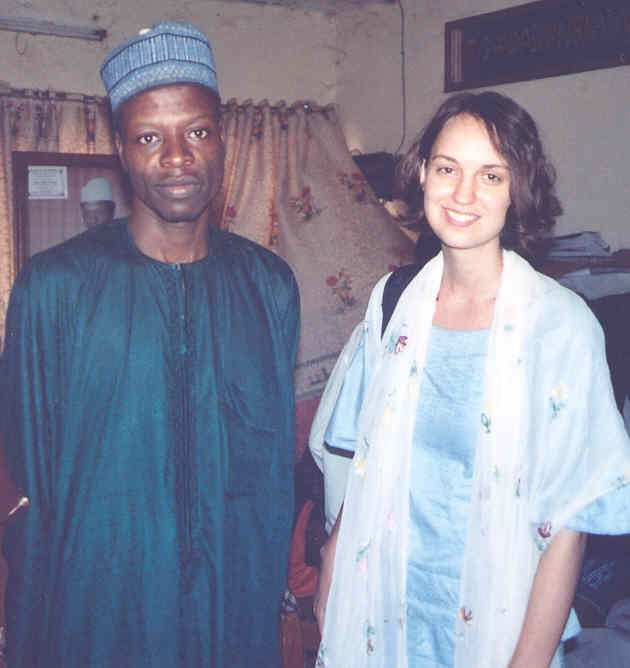
Hausa novelist Ado Ahmad Gidan Dabino and (translator) Carmen McCain in his office, August 2005.