
Category Archives: African literature

A Hausa Literary Expedition to Damagaram, Zinder, Niger

IMG_1029

Hausa writers Maryam Ali, Zainab Auta, Hafsat M.A. Abdulwahid, and Rabi’a Talle in Damagaram, Niger, 10 December 2009 (c) Carmen McCain

Last week I attended a conference on “The Importance of Indigenous Languages to Economic, Social, and Cultural Development (a rough translation of the conference name in French “Interet et Importance des Langues Nationales dans le Processus du Developpement Economique Social Culturel et Politique” and Hausa “Mahimmancin Harsunan Gida ta Hanyar Rubutu Don Ci Gaban Tattalin Arziki Al’Adu da Kyautata Rayuwa da Siyasa”), held in Damagaram, Niger, from 8-10 December 2009. From the papers presented, (all of which were in Hausa on matters related to Hausa language, literature, and culture) and the participants, involved, it mostly turned out to be a conference on the importance of Hausa, with the significant exception of the participation of Alhassane Hamed-Ittyoube, a Nigerien writer, translator, and illustrator of Tuareg heritage, with some beautiful looking books in the Tamajaq language using the Tifinar script he passed around for us to look at. Although his primary languages are Tamajaq and French, he speaks some Hausa and interacted well with the mostly Hausa literary crowd that arrived from Nigeria and other parts of Niger. Unfortunately, for some reason I can’t quite understand, he was stopped from reading an excerpt from one of his rewritings of Tamajaq oral literature at one of the open-mic events. He was reading a translation in French, which another Nigerien writer was translating into Hausa. He was about two minutes into his reading, and we were all enjoying the piece, when there was some discussion I couldn’t hear, and he was not able to finish. I was sorry about that because his involvement in the conference seemed very important in providing a voice for minority-language literatures in a conference that was ostensibly about indigenous language[S] rather than just Hausa. I will try to write a separate post on his work and the interaction we had during the conference.

With that aside, it was very enjoyable to be on an expedition with so many Hausa writers (including novelists, poets, journalists, and academics), and to be able to be a part of the two evenings of open-mic events, in which authors read poems/short stories/excerpts of novels and received much critical feedback from fellow writers. The atmosphere was relaxed, friendly, and full of jokes, especially when novelist/screenwriter/poet Nazir Adam Salih sang a love-song, with a full sing-along chorus, to an unknown lady and was mercilessly teased with spur-of-the-moment response songs for the rest of the trip.
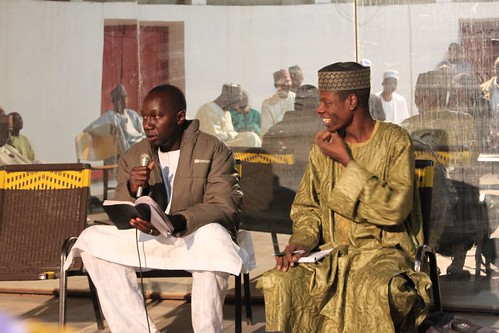
Hausa novelists Nazir Adam Salih and Ado Ahmad Gidan Dabino at a reading in Damagaram, Zinder, Niger, 8 December 2009 (c) Carmen McCain

There is much to say about the week, and I will likely split this post up into several smaller ones on specific themes. So watch out for further posts throughout the week.

The events of the week included arrival on Monday evening; an opening ceremony on Tuesday and an open-mic Tuesday night; paper presentations on Wednesday morning and afternoon and another open-mic Wednesday evening, a closing ceremony Thursday afternoon with visits to the museum and the Emir’s palace (or the Sultanate of Damagaram). About six of us women also took a trip to the market on Thursday evening.
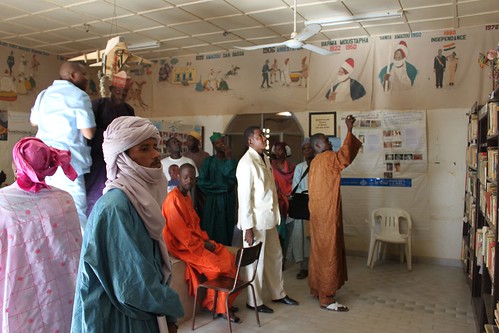
Tamajaq writer Alhassane Hamed Ittyoube and Hausa writers at the museum in Damagaram, Zinder, Niger 10 December 2009 (c) Carmen McCain

Friday morning, about seven of those of us who were heading back to Kano trekked, dragging rolling suitcases, laptop cases, and market bags of tapioca, to the Damagaram public transport depot. There was much haggling over pricing and space. We nearly left in a small bus, but when the driver attempted to cram more passengers in, though we had settled on a price for a certain number of seats, we disembarked and left the park to arrange for a vehicle elsewhere. I will tell the story of our rather dramatic border crossing in another post.

The most personally disconcerting part of the trip (other than the dramatic border crossing that I will write about later!) was being in Niger with no money!! I went to Niger in public transport with several writers from Kano. At the border, we decided to wait to change money until we got to Damagaram, assuming there would be a better rate there, but once there we were met at the public transport depot by one of our Nigerien hosts and never actually got to a place to change our naira to CFAs. So, many of us went for about three days without having any money. Fortunately, our hosts were generous enough to feed and house us, so it wasn’t a major hardship, but it was a little disorienting to not even have the money to buy a sachet of pure water or a bundle of tissue. On the last evening, some of us women took a trip to the market and were able to find a trader to change a little naira. I immediately went in search of pure water having not had anything to drink since early in the morning! That said, it is amazing that we were taken care of so well that we were not too pinched without our cash!

Overall, it was an excellent experience. There were a few grumblings about accommodations and organization, but that seems typical of most conferences. I did feel badly that Hajiya Hafsat M.A. Abdulwahid, an important writer, the first female novelist in Hausa and winner of the 1979 NNPC writing competition for her novel So Aljannar Duniya, was not given better accommodations. She graciously shared a room with me, but a person of her status should have been given something a little better.

More details later.

Professor Abdalla Uba Adamu’s fantastic Hausa “abdalla font”

Forgive me if I rave over something that is very old news to most Hausa computer-users, but today I just used the abdalla font, created by Professor Abdalla Uba Adamu, for the first time. I am ashamed to admit that I had not taken the time to figure out any of the Hausa fonts before–I had just lazily put an apostrophe for the hooked characters while Times New Roman font, and I was often reproved for that by Hausa speakers when they read my writing.  However, recently I had some documents I had written in Hausa proofread. The friend who helped me did a fantastic job of correcting my Hausa using the Rabiat font and sent me the Rabiat font so that the fonts would print correctly.  Unfortunately I had problems when the font would not show up after being turned from a Word file to a pdf,  so I tried the abdalla font instead (which Prof told me would be better for pdf). It’s a beautiful font. It blends perfectly with a Times New Roman font (whereas Rabiat looks like bold wherever a transition is made from Times New Roman) and the keys are easy to remember.

So, since I didn’t find this when I googled it (I’m sure this has done many times before–but I’m redoing it for the google searches), here is a little public service announcement for those hapless researchers like myself first trying to figure out the abdalla font fingerings.  (I’m sure this is unnecessary for most people in Kano using the font.)

Hooked capital D = [      (key to the right of “p”)

Hooked lower case d = ]     (key to the right of “[“)

Hooked capital K = {      (shift on the “[” key used for hooked D)

Hooked lower case k = }     (shift on the “]” key used for hooked d)

Hooked capital B = |    (shift on the “\” key to the right of the “]” key)

Hooked lower case b = ~     (shift on the “`” key to the left of the 1 key)

If you don’t have the abdalla font, you can download it at the Gaskiya ta fi Kwabo site here.

Allah ya ba da sa’a

DG of Kano Censor’s Board taken before shari’a court

In a fascinating turn of events, Alhaji Abubakar Rabo Abdulkarim, the Director-General of the Kano State Censorship Board, has been arrested by the police and taken before the shari’a court by the Kano State Filmmaker’s association.

Here is the article “Police Arrest DG Kano Censors Board” by Nasir Gwangwazo published yesterday, 4 August, in Leadership. Ibrahim Sheme has also republished the article on his blog.

Director-General of the Kano State Censorship Board, Malam Abubakar Rabo Abdulkareem, was yesterday arrested by the police over a complaint filed against him by the Kano State Filmmakers Association.

A reliable source told LEADERSHIP last night that Rabo had been dragged to a Sharia Court in Sabon Gari, Kano, by members of the association over an allegation credited to him, in which he was said to have described movie makers as a bunch of homosexuals and lesbians during an interview he granted Radio Kano recently.In the interview, a copy of which was made available to LEADERSHIP, Rabo stated that he had proof that many of the filmmakers were gay, saying his intervention in the industry had helped sanitise the situation.

The statement incensed the filmmakers, and they wrote him a letter demanding a retraction and an apology within 48 hours.But at a follow-up press conference recently in Kano, the director-general repeated his claim, warning that he would publish more damning reports about the alleged immorality in the industry if pressed further.The association went ahead with its threat, suing him before the Sharia court, which was said to have advised the association to report the matter to the police first. >p>According to a member of the association and the immediate former chairman of the state chapter of Association of Nigerian Authors (ANA), Malam Ado Ahmad Gidan Dabino, Rabo was picked up yesterday by two plain-clothes policemen at about 4pm and taken to the Metro police station located on Bank Road in the city, following a complaint by the filmmakers.At the police station, three leaders of the moviemaking association – Nura Hussain, Ahmad Alkanawy and Isma’ila Afakalla – endorsed the association’s formal complaint, which Rabo reportedly denied. According to Gidan Dabino, the case is due for hearing at the Sharia Court, Fagge, today. When our correspondent contacted Rabo on phone last night, however, he denied knowledge of the issue, saying he was in a meeting and promptly switched off.

Following the arrest, there has been much discussion, on the Finafinan Hausa yahoo group. Ibrahim Sheme has posted one of his responses on the internet group on his blog, saying that Rabo’s intention has never had the interests of the filmmaking in Kano at heart.

According to people who have written me about this (this is unverified rumour), Rabo was given bail, but apparently left his car and driver and went away on an acaba.  He is being charged in a shari’a court for “kazafi (invented lies to assinate character).” If convicted, the punishment is 80 lashes with a whip.

Readers will remember that this latest event was precipitated by accusations Rabo made on the radio, saying that filmmakers were homosexuals and lesbians. The filmmaker’s association responded with a letter asking him to withdraw and apologize for the remarks in the next 48 hours or face legal action in a shari’a court.  Rabo responded several days later with a press release, threatening to release more evidence saying, among other things:

This address is a by product of the pressing need of the media to balance their stories and the board to have a fair right to reply on the ‘empty threat’ of those practitioners who’s future is endangered or eroded due to our sustainable sanitization exercises. These miscreants are enemies to the present peaceful atmosphere and the cotemporary achievements of the Board because they are the beneficiaries of the old age. The age of un coordinated and un-professionalized Kannywood industry.

Hitherto, this nasty development will not in any way deter the Board on its commitment to safeguard the Kano State ideals in addition to societal values because our statutory legal undertakings are not only the promulgation of state legislation but also constitutional above all holy and sacred.

[…]

Moreso, additional doziers at our disposal will not in any way help the film stakeholders when released to public especially in this period where some further negative developments are continuously unveiling and circulating.

[…]

Furthermore, let me use this opportunities to re-iterate one of the fundamentals of this administration which is the rule of law where equality before law is necessary. Therefore, the Board is happy that constituted measures like threat to sue organisation or person(s) is welcome by our style of leadership. Even though the Board will not hesitate to table publically at the right time and at the right place all at its possession out of social responsibilities and trust but with no meaning to join issues or make filmmakers vulnerable. Let me at this juncture warn that: “Kada Dan Akuya yaje Barbara ya dawo da ciki”. [MY TRANSLATION—CM: A male goat should not go to a female goat and return pregnant…]

For the post on this blog that includes a transcript of Rabo’s statements on the radio, the  letter and press release from MOPPAN and the subsequent entire press release from Rabo, see this link.

Mukoma wa Ngugi nominated for the Caine Prize

Mukoma wa Ngugi (c) Carmen McCain

Mukoma wa Ngugi, September 2007 (c) Carmen McCain

I found out yesterday that my buddy Mukoma wa Ngugi has been nominated and shortlisted for the Caine Prize for African Writing.  The winner will be announced on July 6, 2009. Past winners have included (oh yes) Helon Habila, Monica Arec de Nyeko, Binyavanga Wainaina, Leila Aboulela,Yvonne Adhiambo Owuor, S.A. Afolabi, and others. You can read Mukoma’s nominated short story “How Kamau wa Mwangi Escaped into Exile” , which I was privileged to read still in draft a few years ago before its June 2008 publication in Wasafiri, here.  

Congratulations, Mukoma! And good luck! So exciting!
 

Image (c) Carmen McCain