Category Archives: African literature

“Cross of crescents: Muslims around the Church” a guest column by Gimba Kakanda

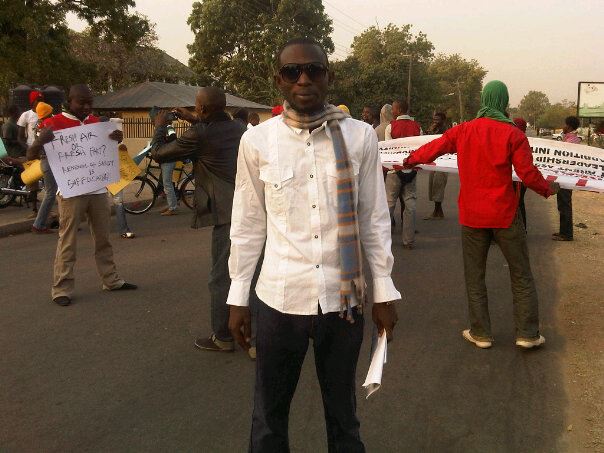
Gimba Kakanda during the Fuel Subsidy Protests (used by permission of Gimba Kakanda)

Gimba Kakanda during the Fuel Subsidy Protests (used by permission of Gimba Kakanda)

On 14 January 2012, the poet Gimba Kakanda, one of the brains behind the active “Nation-wide Anti-Fuel Subsidy Removal” group on Facebook, wrote a guest article for my Weekly Trust column about his experiences organizing a group of Muslim youth in Minna to protect a church the Sunday before: “Cross of Crescents: Muslims around a Church”. To read his thoughtful and provocative piece, click on the link, click on the photo below, or scroll down to read here on my blog.

Cross of crescents: Muslims around the Church

 Written by Carmen McCain and Gimba Kakanda, Saturday, 14 January 2012

 Last weekend, the stories of the killings of Christians in Adamawa and Gombe left me with a constant dull ache. I realized, as boys hovered their metal detectors over my Bible before I walked into church, that we could die as we prayed. And though the pastor pointed us to the revolutionary nonviolent teachings of Jesus in Matthew 5, Christians I spoke to were angry.

“It’s just lies,” one told me, when I argued that most Muslims were aghast at the killings. I couldn’t blame him for his anger—he had just lost a friend in Adamawa—but I wished that he could experience the kindness of my Muslim friends and realize they too love and hurt and breathe. It was in this funk that I signed online and saw the photos, like those in Egypt last year, of Christians protesters in Kano and Kaduna protecting their Muslim friends while they prayed.

Poet Gimba Kakanda, whose collection of poetry Safari Pants was published by Kraftgriot in 2010,  wrote on Facebook that he and other Muslim friends had protected St. Mary’s Catholic Church in Minna during a Sunday service. Beginning to feel hopeful again, I asked Gimba if he would write something about his experiences. I yield the rest of my column to him.  –Carmen

When I heard of the covenant made in Kano during the anti-fuel subsidy removal protests–of Christians willing to stand guard for Muslims and vice versa during religious services–I was hurt that the bond of our relationship has waned over the years to the point that a Muslim is considered an enemy of Christianity, an inhumane being adept in violence.

I didn’t grow up in a tense religious atmosphere. My upbringing wasn’t bound to intolerance. The Muslims and Christians of my early days seemed like adherents of the same religion. We had so much regard for each other that we marked religious festivals together, irrespective of whose it was. As a child, Muslims marking Christmas was a popular practice. Mothers would obtain Christmas dress for their children who would join Christians at parks or any available amusing exercise. We referred to Christian festivals like Christmas and Easter, in my mother-tongue, as Christians’ Eid-el Kabir and Eid-el Fitr.

This Boko Haram debacle causes me so much pain; it causes my faith to be branded as an enemy of Christianity. For a long time now, I’ve been thinking over the best way to restore the dwindling trust between the faiths.

It was my return to Jos sometime in September last year that made me realize the horrible extent of our religious divide. It was in the month of Ramadan. I hate travelling while fasting, and to save myself the hassle of scouting for food on my arrival, I called my host on the phone and asked him to get some food ready for my fast. He was Christian. When I got into the neighborhood, I was unaware that the quarter was a ‘death zone’ for non-Christians. Chollom didn’t tell me. I only realised the danger when I stepped out to locate a mosque. The one I knew was no longer there – it might have been the burnt edifice I saw in its place. At once, I waved down an okada rider and asked him to take me to the bordering quarter, Nassarawa Gwong! He sized me up with wonder, shrugged and zoomed away. I had no clue. I stopped another. This rider smiled as one would at a known teaser. “I no dey go there o!” He blurted, without offering a reason. I made it to the border on foot, wondering as people poured to the street to watch me amble into the other ‘death zone’!

I was unhappy with Chollom, but he said that he could never come to terms with the idea of not hosting me. That incident made me began to think about ways to solve such religious segregation. I discussed this with the poet Richard Ali when we met on that visit to Jos, offering what I considered a solution. Richard and I agreed on soon setting up an NGO aimed at fostering unity between people of divergent ethnic and religious differences.

On the eve of my birthday this year, a Saturday, I was chatting with a Muslim friend, when I suggested that a way to end these growing attacks on places of worship might be a community security set-up where Muslims stand guard for Christians during church services and Christians for Muslims during Jummu’at prayers. He bought that. So I called a relative, Ahmad Ibrahim Gimba, and informed him about the plan. He too bought it, and immediately arranged with a friend of his to inform their priest of our mission.

As early as 6 am on Sunday the 8th of January, my birthday, I was already up for the day’s task. I live in Tunga but the church, Saint Mary’s Catholic Church at Kpakungu, one of the largest churches in Minna, is familiar to me. Ahmad Ibrahim and I got there and were soon joined by our other friends who were very keen on the mission. Our Christian friend who worships in the church took us to the security guard to explain our mission. Before the 7:30 am service commenced we were already spread round the church: Awaal Gata, Shuaibu Usman, Dantani Usman, Danjuma Mohammed, Idris Lade, Mohammed Saba, Kabiru Mohammed, Aminu Umar… We were eighteen in all!

After the service, there were some hitches. Policemen came around to know why Muslims would offer to guard a church. Even though we informed them that Ahmad had spoken to a member of the church and arranged that we would be coming, they were leery. The trouble with such system, I learnt a day later from a member of the church, Dominic Eigbegbea, is trust. Dominic is the president of the Catholic Youth Organisation of Nigeria (CYON), Minna Diocese. He was blunt, confiding in me that Christians don’t trust Muslims anymore, that whatever bound them together is handled with suspicion. He said that he discussed our arrangement with the other members of the church, and they cautioned that we shouldn’t be trusted, that we just want to infiltrate them, study everything about them and, when they are put at ease by our dubious gesture, launch an attack. Every Muslim is a terrorist, I gathered from their response.

The priest of the church, Reverend Father Emmanuel Jima, was philosophical about the development. He’s from Adamawa, a northerner(!) and was born to a Muslim family, he told me. We discussed the unfortunate happenings in the country, especially the insecurity situations aggravated by the dreaded Boko Haram militancy. The cleric lambasted the old generation for the present mess in the country. He talked softly but he was obviously unhappy that the bond between the two faiths has weakened to this extent, considering any forum that avails both Muslims and Christians a chance to rub each other’s back a way to restore the lost paradise of inter-faith fraternity. The youths are more perceptive, he iterated. ‘The burden of fixing the country is now left for you, the youth.’

Yes, a burden, this weighs me down. I must carry this cross. Unlike Christ’s, though, my cross is the weight of a faith, the crescent, deconstructed by too many misperceptions, too many stereotypes, unwitting and deliberate. May God save us from us, Ameen.

The ‘second coming’ of Kannywood

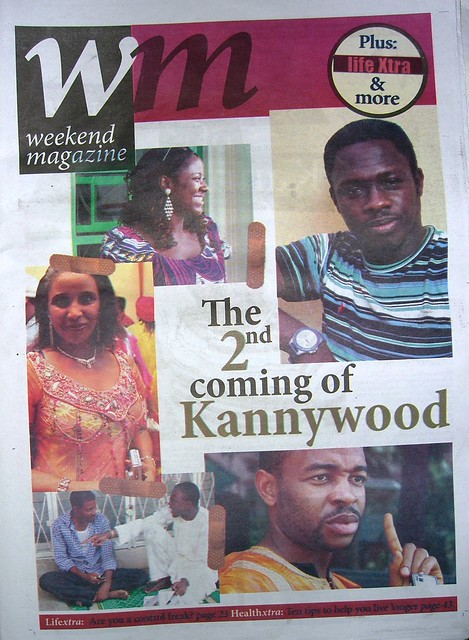
Still catching up on posts I am behind on. This feature piece  “The ‘second coming’ of Kannywood” was published over a month ago now in the Weekend Magazine of Weekly Trust on 21 May 2011, but gives a good summary of the challenges faced by the Kano film industry during the tenure of former ANPP Governor Ibrahim Shekarau, and the “director general” of the Kano State Censorship Board he appointed, Abubakar Rabo Abdulkarim. I also interviewed film practitioners about their hopes as PDP’s Rabi’u Musa Kwankwaso, who had been governor of Kano State from 1999-2003, returns to take up another four year term, aided in his political campaign by the Motion Picture Practitioners Association of Nigeria and Kannywood stars like Sani Danja and D’an Ibro. As usual, to read the hard copy of the article, click on the photos below, or scroll down to read the text I’ve copied here.

The ‘second coming’of Kannywood

Saturday, 21 May 2011 01:42 Carmen McCain

Wednesday evening, April 27, 2011, Zoo Road in Kano, the street lined with Kannywood studios, exploded into celebration. Young men pulled dramatic stunts with motorbikes and shouted their congratulations to Hausa filmmakers. “Welcome back home, brothers. Welcome back from Kaduna,” directors Falalu Dorayi and Ahmad Biffa recall them saying. “We embrace you ‘Yan fim.’ We are together with you. We are happy that he has returned.”The win of PDP

Governor Rabi’u Musa Kwankwaso, incoming governor of Kano State, and also governor from 1999 to 2003 (Photo Credit: Nigerian Best Forum)

candidate Dr. Rabiu Musa Kwankwaso as governor of Kano, his second tenure after a four-year term from 1999-2003, had just been announced.  INEC figures listed PDP as winning 46% of the vote with 1,108,345 votes, closely followed by Alhaji Salihu Sagir of ANPP with 43.5% of the vote with 1,048,317 votes.  To anyone familiar with the Hausa film industry, which according to recent National Film and Video Censor’s Board figures makes up over 30% of  the Nigerian film industry, this association of a political win with film was no surprise. Some of the most visible Hausa filmmakers have become increasingly politically active following a crackdown by the Kano State Censor’s Board, during which many practitioners and marketers of Hausa films had been fined, imprisoned, and harassed. While many of those associated with the film industry supported CPC and Buhari for president, the feeling among many filmmakers in Kano was that for governor any of the candidates would be better than ANPP. The two term ANPP governor and presidential candidate Ibrahim Shekarau, who had initially been passionately supported by

CIMG2970

Former Governor Ibrahim Shekarau, governor of Kano State fro 2003-2011, and ANPP presidential candidate in 2011. (I took this photo during his trip to Madison, Wisconsin in 2007)  (Photo credit: talatu-carmen)

at least some of Kano’s writers and artists, was now deeply disliked by most film practitioners, in part, for appointing Abubakar Rabo Abdulkarim former deputy commandant of the shari’a enforcement group hisbah as director general of the Kano State Censor’s Board. Malam Rabo, as he was known, regularly went onto the radio to denounce film practitioners for ostensible moral defects and had overseen a board which often arrested filmmakers.

After surveying candidates in the gubernatorial race for how they would support film, the Motion Pictures Practitioners Association of Nigeria (MOPPAN), as the association’s president Sani Muazu reported, publically campaigned for Kwankwaso. Movie star,

Comedian Klint de Drunk, with Kannywood stars Sani Danja and Baban Chinedu at an Abuja press conference for NAISOD, 2010. (c) Carmen McCain

producer, director, and musician Sani Danja, who founded Nigerian Artists in Support of Democracy (NAISOD), and comedians Rabilu Musa dan Ibro and Baban Chinedu were among those who lent their star power to the new  governor’s campaign. This public support for PDP among some of the most visible film practitioners had put Kano based filmmakers in danger the week before. Angry about the announcement of PDP’s Goodluck Jonathan as winner of the presidential election, area boys hunted for Sani Danja, threatened other recognizable actors and vandalized studios and shops owned by Kannywood stakeholders. (For this reason, while some filmmakers have come out publicly in support of candidates, there are others who are reluctant to speak openly about politics. The Dandalin Finafinan Hausa on Facebook has banned discussion of politics on its wall, requesting members to focus on discussions of film.) By the next week, however, as Falalu Dorayi relates, the same area boys who had been hunting Sani Danja were now celebrating him.

Producer and makeup artist Tahir S. Tahir with Director Falalu Dorayi celebrating Kwankwaso’s win. April 2011 (c) Carmen McCain

While Governor-elect Rabiu Musa Kwankwaso was seen as the champion of the filmmakers during the 2011 election cycle, it was under Kwankwaso, who first served as governor of Kano from 1999-2003, that the first ban on Hausa films was announced and that the Kano State Censor’s Board was created. Abdulkareem Mohammad, the pioneering president of MOPPAN from 2000 to 2007, narrated how in December 2000, the Kano State Government pronounced a prohibition on the sale, production and exhibition of films in Kano state because of the introduction of sharia. MOPPAN  organized and “assembled industry operators in associations like the Kano State Filmmakers association, Kano state artist’s guilds, the musicians and the cinema theatre owners, cassette sellers association” to petition the government to either allow them to continue making films or provide them with new livelihoods. It was the filmmakers themselves under MOPPAN who suggested a local state censorship board, which would ensure that film practitioners were able to continue their careers, while also allowing oversight to ensure that their films did not violate shari’a law. The censorship board was ultimately meant as a protection for the filmmakers to allow them to continue their work.

Outgoing President of MOPPAN, Sani Muazu points out that MOPPAN’s support of Kwankwaso was because he had promised re-establish the original intent for the censorship board, with a Kannywood stakeholder in the position as head of the Kano State Censorship Board, rather than an outsider who did not know the industry. Most Hausa filmmakers speak of the censorship board as a compromise between the film industry, the community and the government. Director Salisu T. Balarabe believes then Governor Kwankwaso was trying to follow the demands of those who voted for him, “If the government wants to have a good relationship with people it has to do what the people want.” Kannywood/Nollywood star Ali Nuhu said, “I won’t forget how in those three or four months [during the ban], they sat with our leaders at the time of Tijjani Ibrahim, Abdulkareem Muhammad, Hajiya Balaraba and the others.  They reached a consensus, they understood the problems that they wanted us to fix and the plan they wanted us to follow.”

Nollywood/Kannywood star Ali Nuhu on set of Armala with Executive Producer Aisha Halilu. April 2011 (c) Carmen McCain

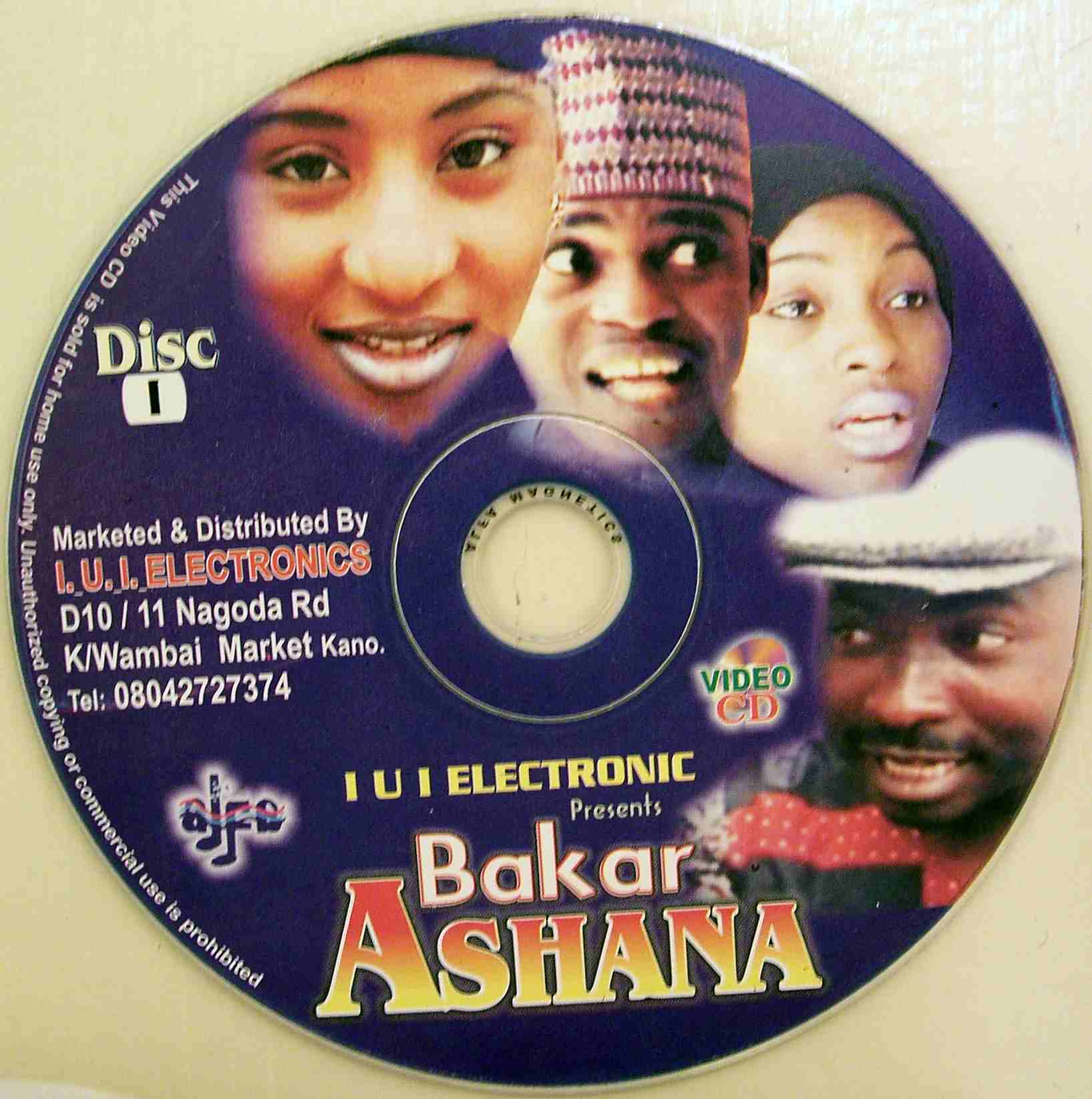
Although the censors board had banned several films, such as Aminu Bala’s 2004 cinema verite style film Bakar Ashana, which explored the moral complexities of the world of prostitution, and enforced rules on censorship

Aminu Bala’s film Bakar Ashana that was banned by the Kano State Censor’s Board in 2004.

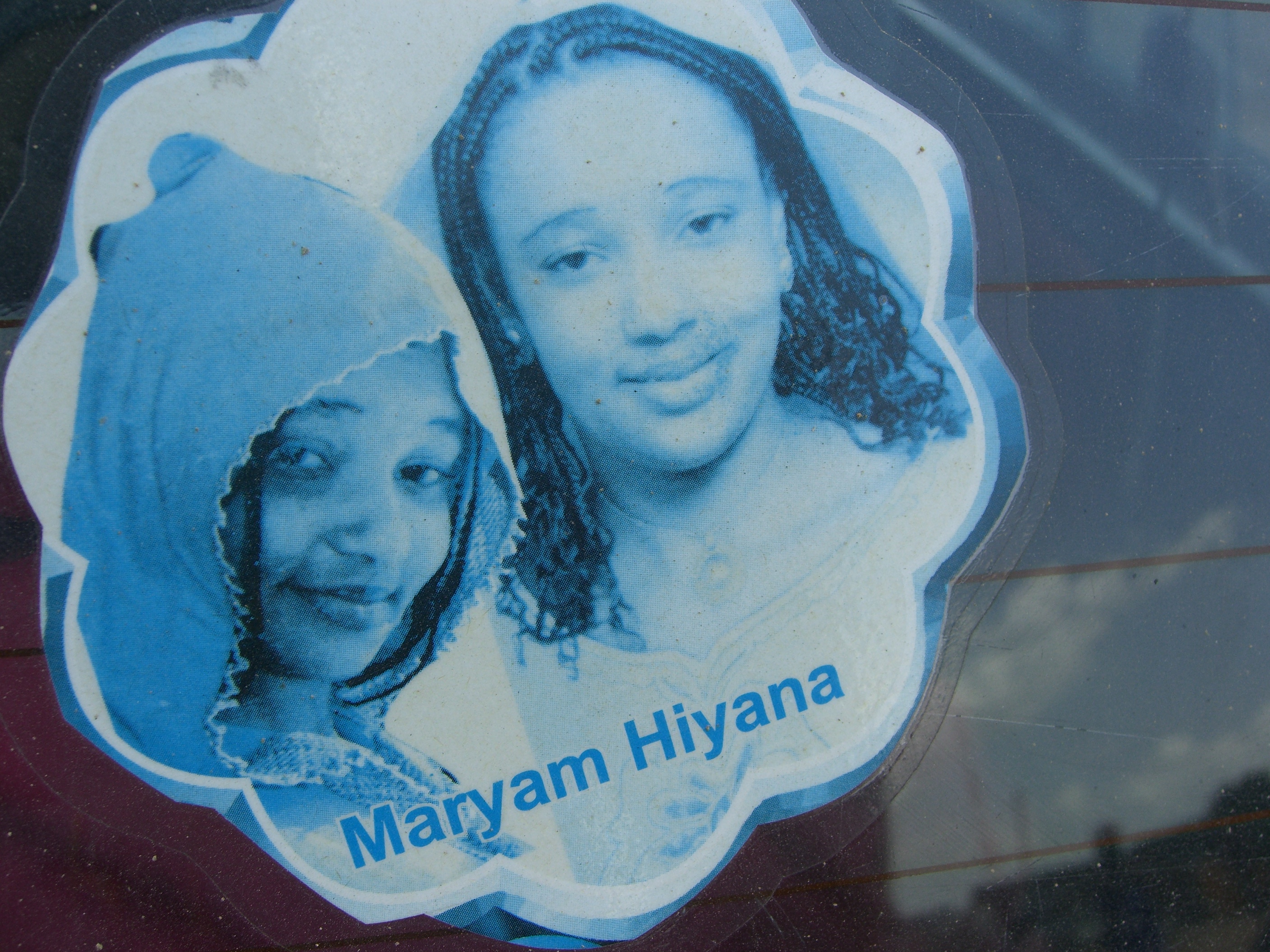
before marketing, filmmakers for the most part did not seem to have major problems with censorship until August 2007, when a sex scandal broke out in Kannywood. A privately made phone video of sexual activity between the actress known as Maryam “Hiyana” and a non-film industry lover Usman Bobo was leaked and became one of the most popular downloads in Kano. Alarmed by what some were calling the “first Hausa blue film,” although the clip was a private affair and had nothing to do with other Hausa filmmakers, critics called for serious measures to be taken. A new executive secretary Abubakar Rabo Abdulkarim (his position soon

Maryam Hiyana, who was seen as a victim in the scandel, became an unlikely folk hero with stickers of her likeness on public transport all over Northern Nigeria. (c) Carmen McCain, 2008

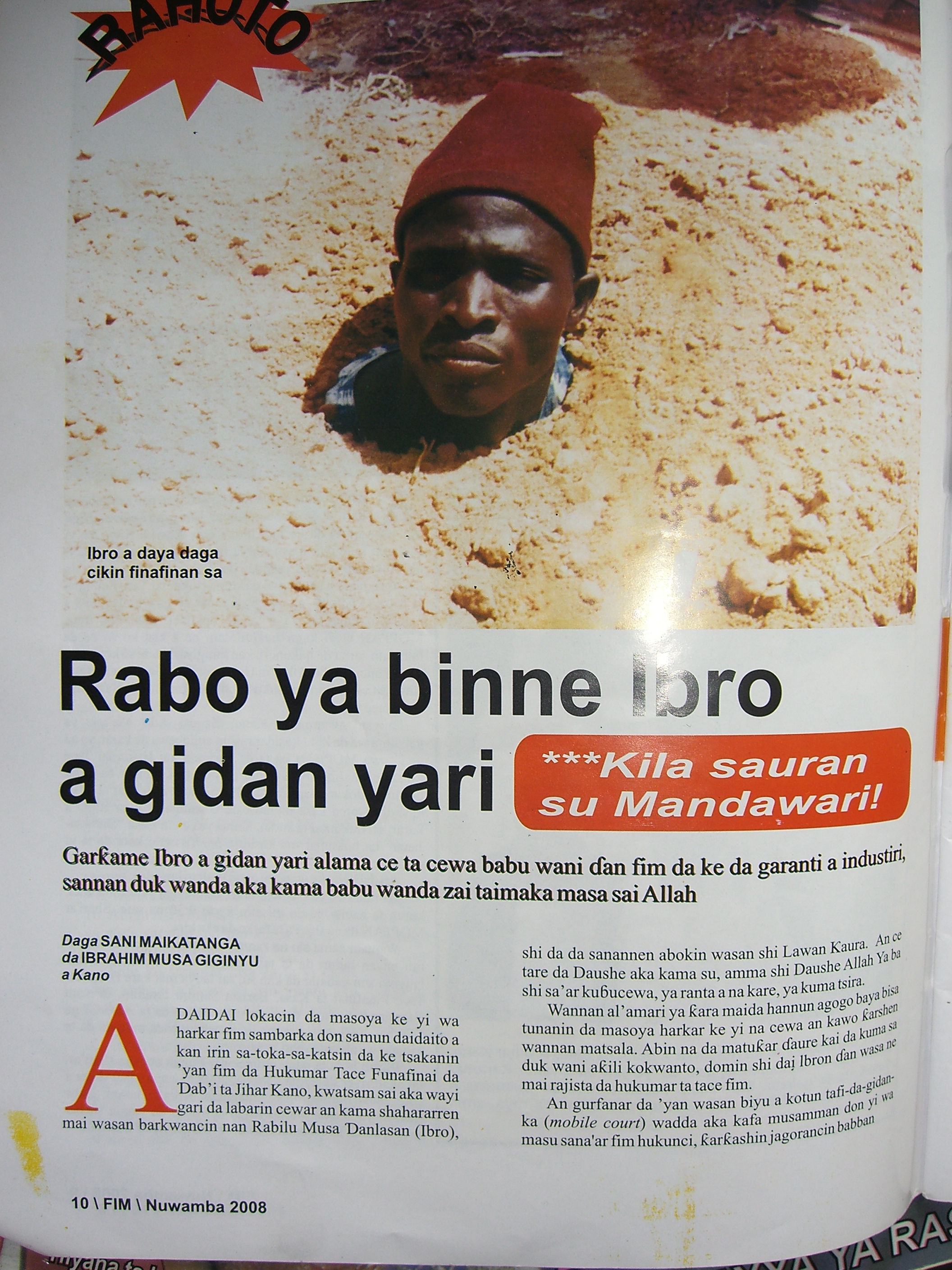
inflated to the title of director general) was appointed by Governor Shekarau to head the Kano State Censor’s Board. He required each film practitioner to register individually with the board, an action he defended as being provided for in the original censorship law. Not long after Rabo was appointed, actor and musician Adam Zango was arrested and sentenced to three months in prison for releasing his music video album Bahaushiya without passing it through the Kano State Censor’s Board. He was the first in a series of Hausa filmmakers to spend time in prison. Former Kano state gubernatorial candidate and Kannywood director Hamisu Lamido Iyan-Tama was arrested in May 2008 on his return to Kano from Abuja’s Zuma Film Festival where his film Tsintsiya, an inter-ethnic/religious romance made to promote peace, had won best social issue film. He was accused of releasing the film in Kano without censorship board approval.  Although Iyan-Tama served three months in prison, all charges were recently dropped against the filmmaker and his record cleared. Popular comedians dan Ibro and Lawal Kaura [both of whom are now late, see my memories of both Rabilu Musa and Lawal Kaura] also spent two months in prison after a hasty trial without a lawyer. Lawal Kaura claims that although they had insisted on their innocence, court workers advised them to plead guilty of having a production company not registered with the

FIM Magazine feature on Ibro’s time in prison, November 2008.

censorship board so that the judge “would have mercy” on them. These were only the most popular names. Others who made their livelihoods from the film industry, from editors to singers to marketers, spent the night in jail, paid large fines, and/or had their equipment seized by enforcers attached to the censorship board.

Although Governor Shekarau in a presidential debate organized by DSTV station NN24 had claimed that “the hisbah has nothing to do with censorship,” Director of Photography Felix Ebony of King Zuby International recounted how hisbah had come to a location he was working on and impounded four speakers and one camera, telling them they had not sought permission to shoot. Other filmmakers complained that there was confusion about under what jurisdiction arrests were being made. Although in a February 2009 interview with me, Rabo

Felix Ebony, director of photography with King Zuby International. (c) Carmen Mccain

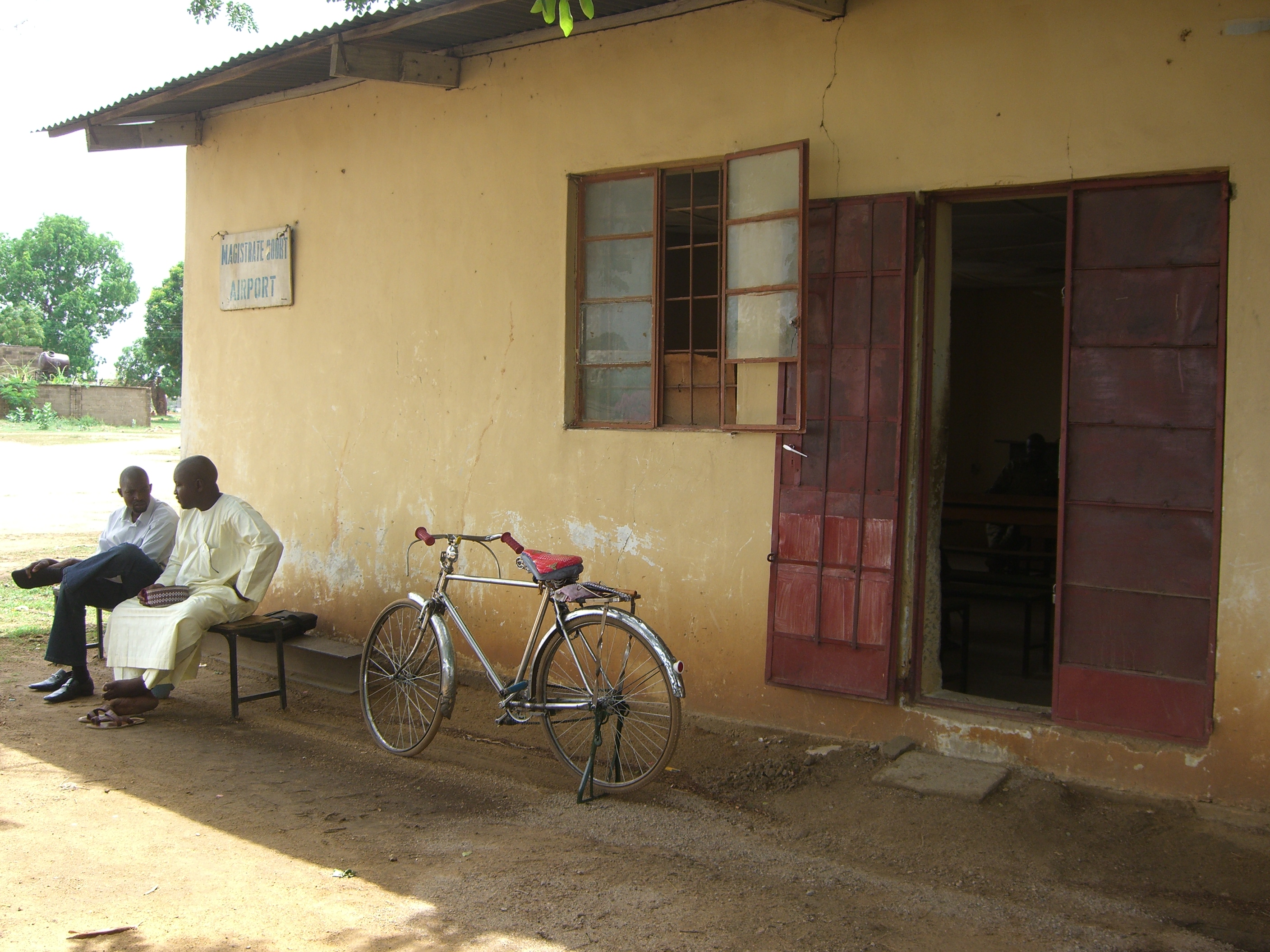
also claimed that the censorship law was a “purely constitutional and literary law […] on the ground before the shari’a agitations,” the public perception seemed to be that the board was operating under shari’a law, perhaps because of Rabo’s frequent radio appearances where he spoke of the censorship board’s importance in protecting the religious and cultural mores of the society. Director Ahmad Bifa argued, “They were invoking shari’a, arresting under shari’a. If they caught us, we all knew, that they had never taken us to a shari’a court. They would take us to a mobile court […] But since it was being advertised that we were being caught for an offense against religion, we should be taken to a religious Islamic court, and let us be judged there not at a mobile court.”

The ‘Mobile’ Magistrate Court at the Kano Airport where Censorship Board Cases were tried. This photo was taken in July 2009 during the trial of popular singer Aminu Ala. (c) Carmen McCain

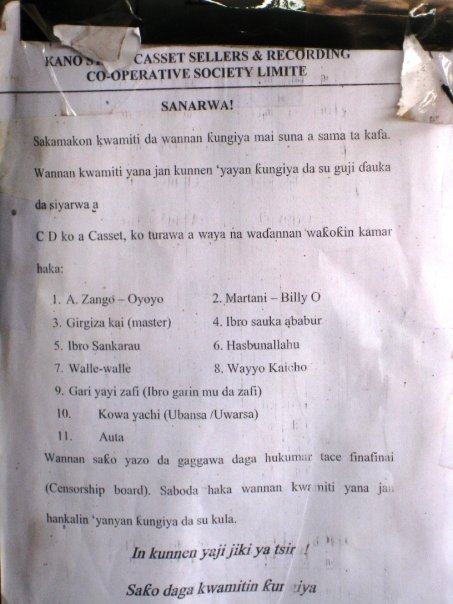
The mobile court Biffa referred to seemed to be attached to the censorship board and was presided over by Justice Mukhtar Ahmed at the Kano airport. After the Iyan-Tama case came under review, the Kano State attourney general found the judge’s ruling to be ““improper”, “incomplete”, a “mistake” and requiring a retrial before a more “competent magistrate.” Justice Ahmed was transferred to Wudil in August 2009; however, censorship cases continued to be taken to him. In January 2011, popular traditional musician Sani dan Indo was arrested and taken to Mukhtar Ahmad’s court, where he was given the option of a six month prison sentence or paying a fine of twenty-thousand naira.  The decisions made by the board and the mobile court often seemed of ambiguous motivation. In 2009, Justice Mukhtar Ahmed banned “listening, sale, and circulation” of eleven Hausa songs, citing obscenity, but obscenity was rarely as easily identified as the cutting political critiques in them.

11 Songs banned by Justice Mukhtar Ahmed. (c) Alex Johnson

The effect of these actions was to relocate the centre of the Hausa film industry away from the flourishing Kano market, to Kaduna. Many filmmakers began to claim their rights as national Nigerian filmmakers, taking their films only to the National Film and Video Censor’s Board, bypassing the Kano State Censorship Board altogether. Such films were often marked “not for sale in Kano” and if found in Kano state were known as “cocaine,” a dangerous product that could, as Iyan-Tama discovered, mean imprisonment for a filmmaker, even if filmmaker had advertised, as Iyan-Tama had, that the film was not for sale in Kano State. Another side effect of these actions was the loss of jobs among Kano youth. Ahmad Bifa pointed out that “the Hausa film industry helped reorient youth from being drug-users and area boys to finding jobs in the film profession. Sometimes if we needed production assistants we would take them and give them money. I can count many that the Hausa film industry helped become relevant people to society. But Abubakar Rabo made us go to Kaduna to do our shooting. So the young people of Kano lost the benefit of film in Kano, […] That’s why there are a lot of kids on Zoo Road who went back to being thugs because of lack of job opportunity.”

Ahmad Bifa, on set of the Aisha Halilu movie Armala, April 2011. (c) Carmen McCain

Although the impact of censorship on film was the most well known, the flourishing Hausa literary scene was also affected, with the director general initially requiring all writers to register individually with the censor’s board. With the intervention of the national president of the Association of Nigerian Authors, writers found some relief when Abubakar Rabo agreed to deal with the writer’s associations rather than with individual writers; however, there still seemed to be a requirement, at times ambiguous, that all Hausa novels sold in the state must be passed through the board. Rabo continued to make often seemingly arbitrary pronouncements about what he considered acceptable literature. In December 2009, for example, at a conference on indigenous literature in Damagaram, Niger, Rabo proclaimed that the board would not look at any more romantic novels for a year.

Abubakar Rabo Abdulkarim, DG of the Kano State Censor’s Board 2007-2011, proclaimed that he would not accept romantic novels for a year. International Conference on Authors and Researchers in Indigenous Languages, Damagaram, Niger, December 2009. (c) Carmen McCain

Those who protest the actions of the board do not have a problem with censorship so much as how censorship has been carried out. The original MOPPAN president Abdulkareem Mohammad argued that the intention of creating the censorship board had been one that would allow filmmakers to continue doing their work, “We really were doing things in good faith to ensure that things do work and eventually it is for the betterment of the majority.” He acknowledged wryly that there were flaws in the law that allowed for it to be abused, “I think that on insight, I would have done it differently.” Current president Sani Muazu continued in this vein saying that although the board had been meant to protect artists it had “become a weapon against artists.”  Director Salisu T. Balarabe says, “There was nothing wrong with making the censorship board but those put in charge of directing the board, sometimes put a personal interest into it.” Novelist and scriptwriter Nazir Adam Salih acknowledged “We have our faults. This is true. But the censor’s board was much harsher than it

Novelist and script writer Nazir Adam Salih passionately responds to Abubakar Rabo Abdulkarim, at the conference in Damagaram, Niger. December 2009. (c) Carmen McCain

needed to be. They put someone in power who didn’t know anything about the film industry, Malam Abubakar Rabo, who slandered and disrespected us.” It was this disrespect and the accompanying arrests that most seemed to upset film practitioners. Danjuma Salisu, who is involved in acting, lighting, and assisting production argued that Rabo’s actions were insulting to those whose careers in film “feed our children and parents and families.” Makeup artist Husseini Tupac argued passionately, “Film is a profession. It is a career.  In the same way a normal person will go to the office everyday, we will go the office, we do our work and get paid. When the honourable Dr. Rabiu Musa Kwankwaso was governor nobody ever came out on the radio and said that actresses were prostitutes, that we were making blue films, that we were rogues. No one came and arrested us.” Producer and director Salisu Umar Santa shared a similar sentiment, saying that he and other

Director Salisu Umar Santa with Dawwayya Productions, April 2011. (c) Carmen McCain

professionals he worked with, like Rukkaya Dawayya and Sadiyya Gyale, had registered and done everything the board required for working in Kano State and yet Abubakar Rabo continued to say that filmmakers were not decent members of society. Producer and Director of Photography Umar Gotip said that he felt like a refugee having to leave Kano. “You are practicing your profession, to the extent that some people even have a degree in it, but they say you are just rogues and rascals. We had no human rights.” Director Falalu Dorayi, claiming that the Kano State Censorship board regularly demanded bribes, asked “How can the one who collects a bribe say he will reform culture.” Cameraman, editor, and director Ahmad Gulu put it this way: “You should fix the leaky roof before you try to repair the floor.”

Despite his ostensible position as enforcer of public morality, Rabo himself came under suspicion of wrongdoing on several occasions. In August 2009, he was taken before a shari’a court by the Kano State Filmmakers Association and accused of slander for statements he had made about the film community on the radio. In May 2010, he was also sued in by Kaduna Filmmakers Association for accusations he had made on radio and television in Kaduna.  In a strange twist, he accused twelve filmmakers, several of whom were involved the lawsuit, of sending him death threats by text message. Police from Kano came to Kaduna, arresting the one person on the list they could locate—Aliyu Gora II, the editor

Editor of Fim Magazine, Aliyu Gora II, and Filmmaker Iyan-Tama, both former inmates of Goron Dutse Prison, after a hearing in Iyan-Tama’s lawsuit against the Abubakar Rabo Abdulkarim, 22 July 2010. (c) Carmen McCain

of Fim Magazine, who was held for a week without trial at Goron Dutse Prison in Kano.  In an even more bizarre twist, in September 2010, Trust and other papers reported that Rabo, after being observed late at night by police in suspicious circumstances with a young girl in his car, fled from police. In the car chase he was also reportedly involved in a hit and run incident with a motorcyclist. After he was eventually arrested and released by the police, Governor Shekarau promised to open an inquiry into the

Filmmakers on location in Northern Nigeria on Sunday, 29 August 2009, read the breaking news Sunday Trust article: “Rabo arrested for alleged sex related offence” (c) Carmen McCain

case [as requested by MOPPAN], but Rabo continued as director general of the censor’s board and filmmakers heard nothing more of the inquiry.

The treatment of filmmakers had the perhaps unintentional effect of politicizing the artists and those close to them. Sani Danja told me he had never been interested in politics until he saw the need to challenge what was going on in Kano State. A musician told me his mother never voted in elections but that she had gone out to stand in line for Kwankwaso as a protest at how her children were being treated. Filmmakers used fulsome praises to describe their delight at Kwankwaso’s

Kannywood star Sani Danja prepares for his the first press conference of his organization: Nigerian Artists in Support of Democracy (c) Carmen McCain

return. Director Falalu Dorayi said “It is as if your mother or father went on a journey and has returned with a gift for you.” Producer and director of photography Umar Gotip said Kwankwaso’s coming was “like that of an angel, bringing blessing for all those who love film.” Even those who are not fans of PDP told me they wished Kwankwaso well, were optimistic about change, and expected him to fulfill his promises in several areas: First, most of them expected that he would relieve Rabo of his post and replace him an actual filmmaker, who as Falalu Dorayi put it “knows what film is.” Secondly, several of them anticipated actual investments into the film industry “like Fashola has done for Lagos filmmakers,” as director and producer Salisu Umar Santa put it, possibly in the form of a film village. And most Kano-based filmmakers I spoke to mentioned their hopes that others who had gone into exile would come back home to Kano. Producer Zainab Ahmed Gusau, who is currently based in Abuja wrote that, “My thought is to go back to Kano, knowing there will be justice for all.We thank God for bringing Kwankwaso back to lead us.”

Hausa film producer Zainab Ahmad Gusai at the Savannah International Movie Awards, Abuja, 2010. (c) Carmen McCain

Other filmmakers saw it as a time for reflection on how they can improve the field. Director Salisu T. Balarabe mused “If you keep obsessing over what happened, the time will come and pass and you won’t have accomplished

Hausa film Director Salisu T. Balarabe on Zoo Road in the days following Kwankwaso’s win. April 2011. (c) Carmen McCain

anything. We should put aside what happened before and look for a way to move forward.”  Hamisu Lamido Iyan-Tama, the politician and filmmaker who was imprisoned for three months, focused on the positive, calling on filmmakers to continue making films that would have meaning and would build up the community.

Many also looked beyond the own interests of film to the entire community.

Ahmad Gulu, Kannywood cameraman, editor, and director, on Zoo Road in the days following Kwankwaso’s win. April 2011. (c) Carmen McCain

Ahmad Gulu, cameraman, editor, and director said “The change has not come to film practitioners alone. It has come to the whole state of Kano. Back then people would accept politicians who would put something in their pockets but now things have been exposed.” Star actor, director, and producer Ali Nuhu similarly pointed out that progress was not receiving money from politicians, saying that one of the most important changes Kwankwaso could bring would be a focus on electricity, drinking water, and children’s education. Writer Nazir Adam Salih said that if Kwankwaso could simply fulfill the promises politicians and leaders had been making for the past thirty years to provide electricity and water, he will have done his job. And finally two directors of photography Umar Gotip and Felix Ebony pointed to the need for peace and unity in the state. “He should try to bring people together,” said Umar Gotip. “This kind of fighting that has arisen between Muslims and Christians is not right. We should live together as one.”

Producer Bello A. Baffancy shows off his Kwankwaso support, Zoo Road, April 2011. (c) Carmen McCain

‘Yan Fim on Zoo Road following Kwankwaso’s win, April 2011. (c) Carmen McCain

I left banking job to direct movies – Kunle Afolayan (Weekly Trust Feature Interview)

Kunle Afolayan at FESPACO filmmaker hangout, Independance Hotel, Ouagadougou, Burkina Faso, 2 March 2011. (c) Carmen McCain

I usually post the edited versions of my articles that are published in Weekly Trust. This week, however, I’m going to post the original version of my interview with Kunle Afolayan as submitted before publication in the Weekend Magazine feature of the Weekly Trust last Saturday.

While I agree with some of the editorial cuts made for tightening purposes and take a few of them here, some of the questions I was personally the most interested in got cut in publication. I was also a little dismayed that the published version mentioned that The Figurine got ten African Movie Academy Award nominations but not that it actually won five of those. If you would like to read the published version (with the edits made), here is the link to the interview on  the Weekly Trust site. You can also click on the photos below to be taken to a large copy of each page on my flickr site. Here are the other posts I’ve written on Kunle Afolayan’s film The Figurine:

FESPACO: Politics of video and Afolayan’s The Figurine, posted on 13 March 2011

Champions of Our Time, The Figurine, and Nigeria’s Rebranding Project at FESPACO, posted on 19 March 2011

I conducted this interview the day after I met Afolayan at his first screening of The Figurine at FESPACO. Having since had more conversations with him, seen both of his feature-length films and read a lot more about the production of both, I now have deeper questions on language-use and philosophy, but this is a start. I saw Afolayan’s first feature film Irapada last night. It wasn’t as technically polished or tight as The Figurine, and I missed some of what was going on because the subtitles were too small and fast, but it was just as thought-provoking and rooted in Yoruba theatre/literature as The Figurine, if not more so. Although I disliked the synthesizer piano track, I loved the rest of the sound track which fit the mood of the film and included songs in Yoruba and Hausa, which (at least the one in Hausa) contributed ironic commentary on the story. While it may not necessarily work for a popular audience who don’t like reading subtitles, I’m a big fan of what Afolayan does with language in his films. He unapologetically switches between multiple Nigerian languages, subtitling each in English. The Figurine included Yoruba, pidgen, and standard Nigerian English. Irapada was even more ambitious in this regard with conversation in Yoruba, standard Nigerian English, Hausa, pidgen, and a short segment in Igbo. Some of this may be an influence of Afolayan’s mentor, filmmaker Tunde Kelani, whose films also make brilliant use of codeswitching. In Magun (Thunderbolt), for example, the Igbo father of Ngozi, the woman struck with the curse of magun curse, converses in Igbo with her in front of the Yoruba babalawo. (If I’m remembering correctly), Her landlady also hides her own conversation with her nephew from Ngozi by using Yoruba. There’s a dramatic irony that comes with the revelation to the audience via subtitles what is hidden through language from other characters. In Afolayan’s films, language flows in the way Nigerians actually use it. In The Figurine, Sola and Femi switch to Yoruba for intimate conversations; youth corpers use pidgen in informal situations at their NYSC camp; Sola and Mona use English at home in their mixed-ethnic marriage but make a point of teaching their son greetings in both languages. In Irapada, comic relief comes when the Yoruba-speaking mother of the main character Dewunmi attempts to communicate with a Hausa-speaking porter at a train station; or when the Igbo-speaking Amaka, Dewunmi’s wife’s best friend, overhears some mechanics planning to cheat her Hausa-speaking friend, Shehu. (See the trailer below for a clip of each). In addition to the use of language, you can also see Kelani’s  influence in other aspects of Afolayan’s of films (although some of this could be the influence of Yoruba theatre and film in general) in the questions about destiny vs independent human choices and the nods to the many cultures that make up Nigeria.

Before I paste the interview, here are trailers for Irapada and The Figurine. Enjoy.

IRAPADA (for a review from NEXT click here)

THE FIGURINE

‘Think of Nigeria First’: Kunle Afolayan on The Figurine, filmmaking, and Nollywood

Interview by Carmen McCain

Actor, producer, and director Kunle Afolayan grew up in the richly creative environment surrounding the Yoruba travelling theatre and early Nigerian cinema, of which his father, Ade Love, was one of the pioneers; however, it wasn’t until later in life, while working as a banker, that he became interested in making films himself. Mentored by one of Nigeria’s foremost filmmakers Tunde Kelani as he moved into an acting career and with training from the New York Film Academy, in 2010, Kunle Afolayan released his second film The Figurine, which earned him ten 2010 Africa Movie Academy Award nominations and five awards, including AMAA Best Picture Award, Heart of Africa Award for best film in Nigeria, Award for best actor in a leading role for Ramsey Nouah, Best Cinematography, and Best Achievement in Visual Effects. Carmen McCain spoke with him for the Weekly Trust on 2 March at FESPACO film festival.

How and when did you become interested in film-making?

I developed interest in filmmaking right from before I was an actor. All I wanted to do then was write my own story. I just felt there was a need for change in the Nigerian film industry, and I’m talking as far back as 1995. But there was no way I could achieve it because I was not a writer, I was not in any aspect of filmmaking. So, I went to Tunde Kelani, because I used to see him around when my father used to shoot film. I went to him to let my feelings be known. He said to me, “Instead of you wanting to start filming, why not start by being an actor? That might really work better.” So I said, ok, and I told him that I would like to be invited for audition, whenever they have any film. I got invited when they were going to shoot Saworoide in 1998, and I got selected to play the role. Saworoide was a blockbuster, and even up today is relevant in the Nigerian film circle. That was how I started acting.

Kunle Afolayan examines a toy camera at Independance Hotel, FESPACO. (c) Carmen McCain

Could you tell me a little bit about your father’s films? Were you ever involved in those?

I was never involved in the production. My father started as a theatre person, travelling theatre all around Nigeria and West Africa. His full name was Adeyemi Afolayan, also known as Ade Love. They started travelling theatre. He got invited to be part of a film project by Dr. Ola Balogun, who started commercial filmmaking in Nigeria in 1976. They shot a film titled Ajani Ogun, which featured my father. And thereafter, my father decided to go into filmmaking fully. So he shot his own first film, right after Ajani Ogun in 1978 or thereabout. That was how he started. He had eight celluloid films to his credit, and most of these films travelled to film festivals all over the world, especially Ajani Ogun, Ija Ominira, Kadara, and the rest of them.

Do you remember being at home and having other filmmakers around?

Well that was the memory. Cause, I grew up—sometimes I found myself on their sets. Myself and some of my sisters and brothers. We’d just go there to make noise and see how they do their things, and after some time, they’d be like ok, go home, you guys are disturbing us. I was familiar with some of the cast and crew, at that time, but I didn’t learn nothing. It was just children messing about at their father’s workplace. That was just it. So I didn’t start aspiring until the man was late.

So you started acting in 1998. How many films were you in?

They are not up to 15. Saworoide by Tunde Kelani and Agogo Eewo, which is a sequel to Saworoide, Dark Days, which is English, and some other films, but it’s not such a large number like some of my colleagues who have featured in about 1000 films. I resigned my appointment from the bank in 2005, and went to film school at New York Film Academy, studied digital filmmaking, came back, and set up Golden Effects, which is a production house.

How many films have you directed?

I’ve done two short films and two feature films. The first short film was a project in film school, and the second one was a collaboration with an American producer by the name of Catherine Sullivan. We shot with an all white cast and crew project, and I directed it. I co-directed Irapada, which is my first feature film, and soley directed The Figurine, which is the second.

Could you tell me a little bit about The Figurine, how you came up with the idea for it, and the process of producing, directing, and acting?

Ok, well, the idea came about in 2005, right after film school. For me, I think most Africans, most Nigerians, an average African is superstitious. So, I was looking around doing something that would not totally demystify the power of the gods but at the same time reveal human participation in our predicament and what happens in our lives. So that was what brought about the idea. I narrated my idea to a guy called Jovie Babs, who came up with the first draft, which we titled The Shrine, you know for like two years. We got the script ready, then Kemi Adesoye wrote this version of The Figurine. We had a script conference and did a lot of work and then we came and did the treatment and final script.

What was your biggest challenge in shooting?

One of my biggest challenges was getting the funding for the film, which took a while, but eventually we were able to. Then another major challenge was the location. Because of the time difference in the film, we had to do seven years, the first seven years, then the next seven years. There had to be a lot of make up differences, location differences. All those kind of things delayed, so we couldn’t move on to the next phase until we finished with the first seven years. So if any time we paint any scene, any shoot, it just keeps piling up, and that really slows it down. I had a bit of sound issue, because our 50K generator fell into the sea when we were trying to move to the location. So the shoot had to stop. A whole lot of things got messed up. When we eventually got smaller generators to power our stuff, the thing got burnt. I don’t know what happened. There was a spark and everything plugged to it got burnt. That set us back again. The lights, the laptop, the camera charger. The camera was pretty new, so we had to wait to order another charger.

What was the most rewarding thing for you?

The most rewarding thing for me so far is the acceptance. The film has really set a new standard, not only in Nigeria, but among the other filmmakers from other regions. Don’t forget that the film got ten nominations at the most prestigious African Movie Academy Awards and won five. And the dream of an average filmmaker is to win Best Picture category in any awards. I’m glad that the film has really travelled around to so many film festivals. And as a matter of fact, it was in competition, official selection and competition in some of them like FESPACO, Pan African Film festival, etc. Any time a festival is doing a retrospective on Nollywood, they are always inviting the film to be able to differentiate between the normal Nollywood style, and the New Nollywood, that is what I call it.

Kunle Afolayan at the 'Reading and Producing Nollywood' conference held at University of Lagos, 24 March 2011. (c) Carmen McCain

What kind of feedback have you gotten at other film festivals?

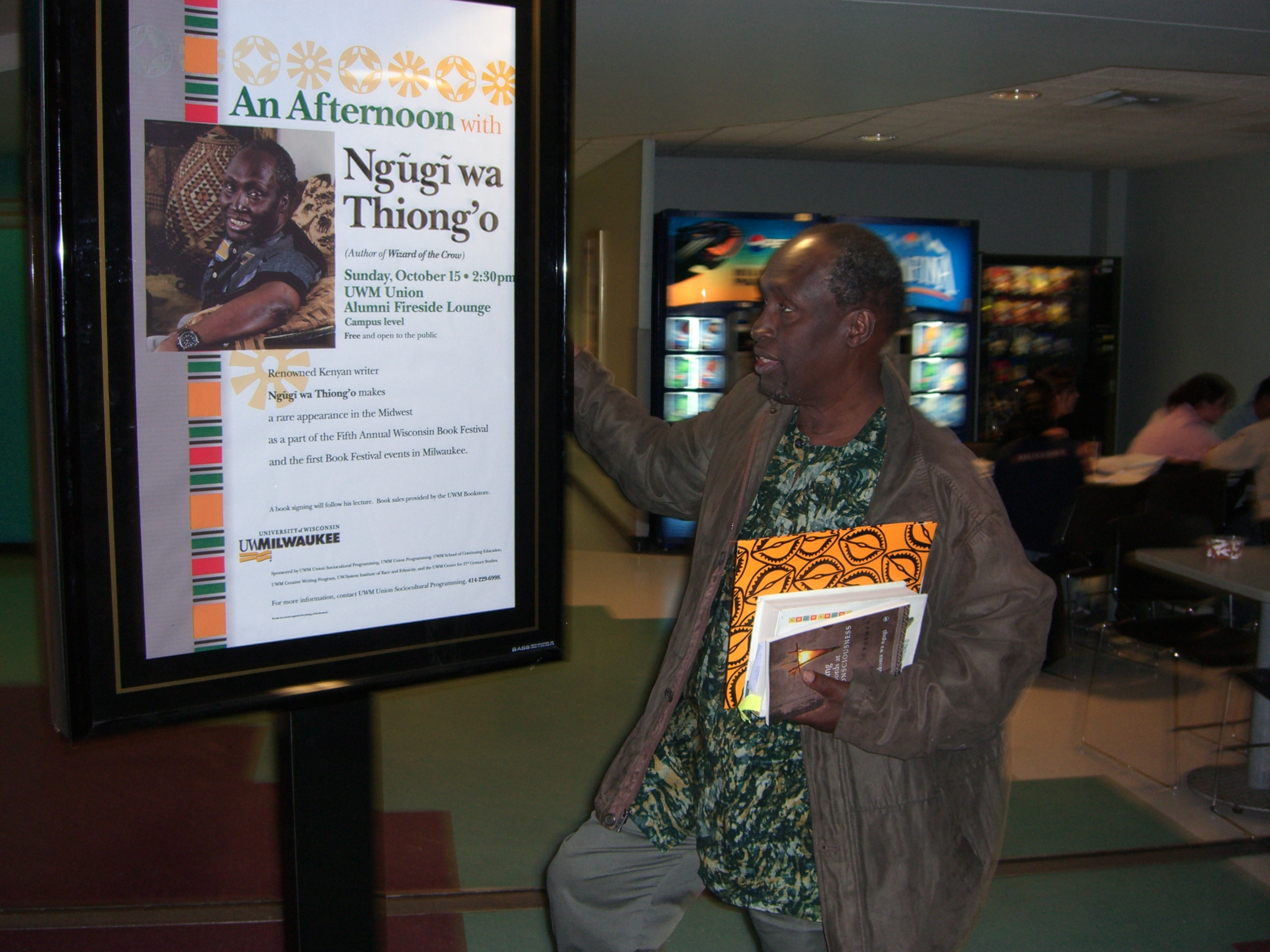
I realized after the screening, a lot of people want to wait for question and answer, to find out how we were able to do the film. Most of them seem surprised that such a high quality film could come out of Nigeria. An example is [Kenyan author] Ngugi [wa Thiong’o] when we were in Pan-African film festival. He came with his wife, and they stayed and watched the whole film and they stayed for the question and answer. And he stood up to commend the film by saying that he feels so proud to be an African, and he wrote me a letter, recommending the film to another film festival, saying he has not seen such in a long time, even as a writer, he feels so impressed. And that is like the review from every festival we’ve been. Amakula, Rotterdam,  the talent contest at Berlin, New York Africa Film Festival, Tarifa in Spain and the other ones. The same thing at FESPACO, a lot of people stayed and wanted to find out, so it has been good.

So, right now, we are actually at FESPACO, and you were put in the video category rather than the main competition. Would you like to talk about that?

Well, that’s like strange, because all the festivals we’ve been to, the film has always in the same category with every film, even films from Hollywood. Even big budget films worth 50 million dollars fall into the same category with this film. So it’s going to be the first time that there will be a segment for video and for 35 mm.  I mean, in this age and time, a lot of people would rather shoot on cheaper format but still achieve the same high quality. A good film is a good film regardless on what format it is being shot. If it looks good, it looks good. If it sounds good, it sounds good. There are no two ways to it. So I don’t think that is fair, and I don’t think that should continue. A lot of people were bitter about this, not just me. I met with other filmmakers, and a lot of them seemed to have a bit of issue with such decision.

You had also earlier talked about distribution of the film. Are you planning to release it anytime soon on video.

Yeah, we are now working on dvd release. We are discussing with the distribution company. Already we are in the middle of signing the agreement, and hopefully it should be out by April. Every copy will be encrypted, and it’s going to be well circulated. We have regional distributors, national distributors in the north, south, east, west part of Nigeria. It’s going to be all over Africa, UK, and it’s going to be online as well. So, I mean, we can rest assured that an average Nigerian will have access to the film.

To you, what are the major challenges of Nollywood, what does Nollywood need to do to go to the next level?

I think there is a lot of training [needed] within the industry, because a lot of people would rather say, we need infrastructure, we need sets and studios, and stuff like that. But what is the essence of building all those things if we don’t have people who will run them? Aside from training, there is need for a lot of support on government side. And that is why I’m glad that the president just channeled some money, two hundred million dollars toward the entertainment industry because that will help people who’ve really gotten trained and a good business plan to really benefit from such a gesture. I believe strongly that will take the industry to the next level. Especially if the money is given to the right people who can utilize it. Like, let’s say distribution, for example. There are quite a number of people who are trying to set up a proper distribution framework, from cinema to dvd and pay-tv, and all of it. So, if all those people can benefit, then content-providers as well, if they can benefit from this, I think it can change the industry. Distribution, I believe, is our major, major challenge. If we have all these benefits in place, I believe it will help change the industry.

So you suggest government set up structures that would allow people to make use of that?

The government doesn’t necessarily have to set up structures. But I mentioned the two hundred and fifty million dollars which the president has put in entertainment for people to apply for a loan. It’s not a grant, it’s a loan, but it’s only going to be subject to single-figure interest rates. So, instead of going to a bank where you have to pay 20-30 percent, this one will really help the industry.

Is there any major thing that you would like to tell other Nollywood filmmakers or young filmmakers starting out if they want to get to the place you are now.

Well, I think they should first consider starting at home. Because their primary audience are Nigerians. They should start by thinking of stories that will appeal to the average Nigerian before they start thinking of the outside audience, the international audience. When you think of Nigeria, then you think of Africa, because we reason alike, and the distribution channel that the likes of Silverbird is trying to put in place, will definitely cut across Africa. So you have platforms to distribute your films, all within Africa. And also there is need for them to really study whatever area of filmmaking that they may want to specialize. Be it scripting, be it lighting, hands-on-camera, sound, makeup, and you know the other departments, set design and all that. It’s better to get trained, so that, even if you’re getting people to do stuff for you, you’ll have a basic understanding of how things run. And also they should try to attend film festivals, even if they don’t have films there, at least, to see how things are run, to see what are the parameters for getting your film into festivals. You have opportunities like AMAA awards in Nigeria. You can explore such options. So majorly, story and production value. Those are the two major things that make them have a film that will be successful commercially and will be international.

Kunle Afolayan and Ghanaian actor Majid Michel on the red carpet at the 2011 AMAA awards. (c) Carmen McCain

So, when you say “get training,” do you mean on set or going to school for it?

I mean going to school for it. If you can do both, it will be nice because experience really counts. But if you go on set in Nigeria, you’ll only know—the capacity of the people you are working with is where your knowledge will end. But if you get others, even like short courses, workshops outside Nigeria in whatever area you want to specialize, it will broaden your thinking, broaden your mind.

You said that Tunde Kelani suggested that you act first before you made films. Do you feel like the acting experience helps you as a director?

Yes, and the fact that I watch a lot of films, even before going to film school. And I’m always conscious of the area that I want to specialize. I picked a few directors, I look out for films that are in that genre, and I watch them, do a case study on them, so that has really helped me.

Are there any particular films that are your favourites?

Apocalypto is one of my favourite films and Forest Gump. I love Forest Gump. The last Tarantino film, Inglourious Basterds. Films like that.

What about Nigerian films?

Hostages by Tade Ogidan, most of Tunde Kelani’s films, Owo Blow by Tade Ogidan, as well, and some of the films that were shot in the 70s and 80s and Ogunde’s films, Ade Love films.

Along with that are there particular directors? You mentioned Tunde Kelani, what about Hollywood directors?

Like I said, Tarantino, Mel Gibson, Spielberg. I like Spike Lee as well because he’s very experimental. I watch a lot of Indian films, as well.

There’s a lot of criticism of Nigerian films. People say they are all about rituals, they’re corrupting the youth, they’re bad quality etc, even the idea of relegating your film to a video category, how do you respond to people who look down on Nigerian films?

Well every industry has got their style, and if that is the style Nollywood has adopted right now, and it is working for them, then so be it. They’ve been able to create a market for their films, and if there is anyone who wants to do otherwise, like something not in that direction, then of course the industry is very, very big. But I just think that we all can’t continue to do the same thing. Most of those people who are criticizing. In Burkina Faso, I know that they used to do about ten films before, but now I’m sure they don’t do more than two films a year. Is that a growing industry or a deteriorating one?

The Nigerian industry is a phenomenon, because we are moving from one phase to another. There was a time that it was strictly celluloid, then people moved to video because it was cheaper to shoot, and now people are moving back to higher formats, higher definition. Mahmood Ali-Balogun just shot on 35 mm, and the film was actually submitted to FESPACO, but it wasn’t selected.  So, if it was all about format, then what are we talking about? Then, when you say story—an average Indian film portrays their police as being corrupt. So would you say that is affecting their economy or the Indian film industry? No. So, they should look inward and look at the best way to have a pan-African film industry, instead of condemning a growing industry from Nigeria.

If people say Nigerian film are giving Nigeria a bad image, how do you respond?

I don’t think it is giving Nigeria a bad image. If it was giving Nigeria a bad image, all those actors would not be celebrated all over Africa. Wherever it is they go… people are stuck on those films. That is where the Caribbeans, that is the only way they see that we actually have big houses and big cars. Those films might not be doing well in the world film circle, but commercially they are doing great. I’m not into such films but I think they are playing their own mark in the world film circle.

In conclusion, is there anything you would tell an audience, anything you think they should know about Nollywood or their films.

Keep supporting Nollywood, and you can get details of The Figurine from figurinemovie.com. Keep supporting Nigerian films.

Kunle Afolayan presents an award at the 2011 AMAA awards. (c) Carmen McCain

My translated excerpt of Ado Ahmad Gidan Dabino’s novel Kaico! published in Sentinel Nigeria

The beat-up cover of my working copy of Kaico! (complete with little kid pencil scribbles)

I’m behind on this blog, and there is much more to post, including my trip to Lagos and Yenegoa, for a “Reading Nollywood” conference and the AMAA awards. (For an excellent post on AMAA, see my friend Bic Leu’s blog, which uses a lot of the photos I took while there.) But, in the meantime, here is a link to an excerpt of my translation-in-progress of Ado Ahmad Gidan Dabino’s novel Kaico! that was published in the March 2011, Issue 5 of Sentinel Nigeria Online.

The excerpt comes from the first chapter of the novel, which I have completed three (rough) chapters of so far. In addition to needing to finish translating the entire novel, the translation of the three chapters I have completed still need a lot of polishing and editing. But I do appreciate Sentinel Editor, Richard Ali being so committed to start featuring translations of African-language works that he urged me to send this in as is.

Ado Ahmad Gidan Dabino is the bestselling author of In Da So Da Kauna, a Hausa language novel that sold over 100,000 copies. Winner of the 2009 Engineer Mohammad Bashir Karaye Prize in Hausa Literature for his play Malam Zalimu, he is also a founding member of the Hausa film industry, and has produced or directed sixteen films in Hausa, including his most recent Sandar Kiwo, which has been shown internationally.

Here is an excerpt from the excerpt:

On Monday, the 23rd day of Ramadan, after we broke fast, my good friend Kabiru visited our house. I saw him as he came into the room, and I quickly got up and grabbed his hand.
“Kai, look who we have here in town today. Kabiru, ashe, are you around? Long time no see!” I said, holding on to his hand.
As we sat down, Kabiru said, “I traveled for a week, that’s why you haven’t seen me. You know that if I hadn’t traveled, it would have been hard to go for seven days without seeing you.”
“I was thinking maybe the fasting was keeping you from going anywhere,” I answered. “You know how the fasting wears you out when the sun is beating down.”
“Well, the sun may be hot, but there’s no sun at night. I was told that you came to my house looking for me while I was gone. Have you forgotten?”
“Oh, I know. I just asked to see what you would say.” We both smiled.
Kabiru looked at me. “Oho, so you want to catch me out, do you?”
“Ai, well, that’s why you should marry relatives. They know you. You know them. If you take the bait, it’s not my fault,” I laughed.
“Ok, well, jokes aside. I have something important I want to talk to you about.”
“I’m listening. What’s up?” I tilted my head to one side to listen.

***

Unfortunately, the English translation published by Sentinel extends beyond the Hausa that was also given, and I have currently misplaced my copy of the book, but as soon as I find it, I will put up the Hausa portion of this excerpt for a side-by-side comparison. To read more, see the Sentinel site.

Hausa novelist Ado Ahmad Gidan Dabino and (translator) Carmen McCain in his office, August 2005.

Champions of Our Time, The Figurine, and Nigeria’s Rebranding Project at FESPACO

The past two weeks in my column “My Thoughts Exactly” in the Weekly Trust, I have briefly analyzed and compared the two Nigerian films, The Figurine and Champions of Our Time, that were in competition in the FESPACO Video Feature category. (The week before that I had talked about the politics of what FESPACO considers a film, in “FESPACO: Politics of Video and Afolayan’s The Figurine”). Champions of Our Time, directed by Mak Kusare, won the jury prize (second prize) in the category, as well as a special ECOWAS jury prize. I will copy the articles below (and will add the hard copy of this week’s article when I am able to find one. To read the hard copy, just click on the photo and it should take you to a version big enough to read.) To read on the Weekly Trust site, click here for Part 1, and here for Part 2.

Champions of Our Time, The Figurine and Nigeria’s rebranding project at FESPACO

Saturday, 12 March 2011 00:00 Carmen McCain

As Africa’s longest running and most famous “pan-African” film festival, FESPACO, kicked off last week, the absence of Nigeria’s sprawling film industry, cited as the second largest in the world by UNESCO, was glaring.

Out of the one hundred and eighty-seven films listed in the official festival catalogue index, only five films from Nigeria were scheduled. Restless City, made by expatriate Nigerian filmmaker Andrew Dosunmu Waheed, was the only Nigerian film in the main feature-length film competition but was withdrawn before it could be screened. Didi Cheeka’s gut-wrenching Bloodstones and Julius Morno’s whimsical The Camera (and apparently Mak Kusare’s Duty [Please note this is a correction from my earlier mistake of identifying the film as Ninety Degrees, a feature length film directed in 2006 by Mak Kusare-CM 9/4/11], though it was not listed in the catalogue) were shown as part of a short film special screening but were not in competition. Only two feature Nigerian films Champions of Our Time directed by Mak Kusare and The Figurine directed by Kunle Afolayan even made it into the condescending TV/Video Fiction Category, reserved for feature films submitted on digital formats rather than 35 millimeter film.

Considering the noticeable omission of Nigeria from the festival, I imagine that by the time the jury for the “Best work in TV/Video” category met, they were feeling a certain amount of political pressure to award a Nigerian film with a prize. They awarded South African film Hopeville directed by Trengoue John with the best video prize, and chose Nigeria’s Champions of Our Time directed by Mak Kusare, which was also awarded an ECOWAS special prize, for the special jury (second) prize.

Since I often argue that Nollywood films should be taken seriously, I should be ecstatic that the film Champions of Our Time, a heartwarming, nicely shot tale of a child in a wheelchair and her struggle to participate in a secondary school television quiz competition, did Nigeria proud by winning two prizes at FESPACO. Unfortunately, although I am happy that a Nigerian film received such recognition, I find the selection of Champions of Our Time for the video prize problematic, perhaps because it seemed such an obvious snub of the only other feature-length Nigerian film in the competition, The Figurine, a film I have mentioned in this column as being “the best Nigerian film I have ever seen.”

I had expected The Figurine to win the category. It pushes genre elements developed by Nollywood in a new direction with beautiful cinematography, a moving soundtrack placed at all the right moments, excellent acting and set design, and sophisticated story rooted in certain cultural obsessions as developed in both in Nigerian “high” literature and more popular art forms. I did not see Hopeville so have no point of comparison, but I saw Champions of Our Time, or at least enough of it, to conclude that, at least to me, The Figurine, is by far the superior film, in terms of literary and artistic merit, if not in terms of promotion of a certain social agenda.

Champions of Our Time deals with an important topic I’ve never seen featured in any other Nigerian film, Mak Kusare is a clearly talented director, and the film has a very real emotional power, featuring several touching performances between Segun Arinze and Treasure Obasi, and an electrifying one by Ejike Asiegbu, whose character observes on national television that people throw small change at him, assuming him to be a beggar simply because he is in a wheelchair. However, compared to The Figurine, Champions is formulaic and sentimental, the sort of “disadvantaged character comes out triumphant and teaches everyone else a lesson” that has been done hundreds of times in Hollywood and Bollywood. A formula is fine if it is done in an exciting way. After all, oral tradition is built of formulas, individual performances judged better or worse by the skill with which they are executed. But when it comes to a written screenplay, there’s only so much so much even the best director and actors can do with a stiff and didactic script that quickly reveals its government funding in long memorized textbook passages on Nigerian history parroted by the contestants in the quiz show.

I admit my viewing experience of both Nigerian films was not balanced and my comparison is perhaps not quite fair. First, Champions of Our Time and The Figurine are wildly different in genre, and ideally we should appreciate each on its own merits, the social motivation/advocacy film for what it is, the spiritual thriller for what it is. I would not normally discuss the two films in the same essay. In a different context, I would probably be more positive about the intentions of Champions of Our Time, which is geared towards children—the sort of film we need more of in Nigeria—and the laudable highlighting of difficulties faced by physically challenged people in Nigeria. Second, my viewing experience of the two films was not at all equal. I’ve seen The Figurine twice, once with a stunned audience at Zuma Film Festival in Abuja, and second at FESPACO. On the other hand, I have only seen a preview copy, not even the final cut, of Champions of Our Time at FESPACO after the official copy did not work in the projector. Not only did the picture have “preview” floating over it for a third of the screening, but I did not see the end of the film because the DVD stopped at the emotional climax of the film when Sophia, a young girl in the wheelchair, decides to speak out at the quiz show award ceremony.

In obsessing over what could have made both FESPACO and ECOWAS judges choose Champions of Our Time for their prizes, I have begun to think that the decision was rooted in privileging a simplistic interpretation of “third cinema” (even if funded by problematic sources) over the crowd-pleasing “popular art” of Nollywood. Perhaps Champions won because of its good intentions and because it dealt with a topic that has not been dealt with before in Nollywood—not because it was a particularly exceptional film

At first glance, Champions of Our Time is the film that more self-consciously deals with social issues in Nigerian society. It tells the story of a competition between a privileged girl, Sharon (Feyisola Owuyemi), who wants to win the St. Flair’s NGO sponsored secondary school quiz competition so her father will give her permission to stay in Lagos, and a physically challenged girl, Sophia (Treasure Obasi), who wants to win so that she will have the money to have surgery abroad. Over the course of the competition, Sophia becomes “the voice” of those living with physical challenges in Nigeria. One scene in the film provides insight into the politics of award-giving. As the two girls reveal their equally competitive skills at memorization for the quiz, Sharon’s wealthy mother (Ayo Adesanya) tries to undermine Sophia’s credibility to an already wildly prejudiced committee member (Joke Silva). The mother argues that the committee should think about the international reputation of Nigeria, especially with the new rebranding exercise: if Sophia went on to represent Nigeria in France, people outside would say that the best Nigeria could offer is a “crippled girl.” This statement reveals the character’s prejudice and serves as a critique, on the part of the filmmakers, of such shallow ideas of “rebranding.” Of course, the film implies, the “more enlightened” St. Flair’s organization of France, which was so wildly misinterpreted by its Nigerian committee members, would see nothing amiss or embarrassing about a contestant in a wheelchair.

Ostensibly speaking out in defense of those with physical differences, the film appeals to film festival judges with its political correct ideology. We are the opposite of the prejudiced mother, the film, and its government backers, seems to say. We dare to present a film to represent our nation that features a girl in a wheelchair as the main character and reveals the prejudice of our citizens. This is Nigeria rebranded as UN-charter compliant.

The problem is that it is all too obvious. The film glosses over the complexity of actual experience. The committee member villains are just a bit too flat and stupid and willfully hateful, and the physically challenged people are portrayed as helpless victims until bright young Sophia “becomes their voice.” Even the man with the most powerful voice in the film (Ejike Asiegbu), a PhD holder in agricultural engineering who crawls up three flights of stairs to interrupt the quiz show in defense of Sophia, sighs that he has not been able to get a job. Of course, there are terrible prejudices in Nigeria, as well as a lack of public policy to address the needs of the physically challenged. An exposé of such discrimination in film is a necessary corrective, but it would have been even more empowering and ultimately more respectful to those many professionals with physical challenges living in Nigeria to at least allow the PhD in the wheelchair a job.

(To be concluded)

Part 2 (click on link to go to Weekly Trust site version)

Saturday, 19 March 2011

Last week, I questioned the motivations behind FESPACO and ECOWAS juries awarding Champions of Our Time, a film dramatizing a quiz competition between two secondary school students, the wealthy Sharon (Feyisola Owuyemi) and the underprivileged and physically-challenged Sophia (Treasure Obasi). I argue that the more deserving Nigerian film in the FESPACO “video feature” competition was the The Figurine, which depicts the changed lives of several Youth Corpers after they find a figurine of the goddess Araromire.

The politics of prize-giving in Champions of Our Time, and the competition between the privileged Sharon and the marginalized Sophia, becomes a prescient introduction to the politics of prize-giving at FESPACO and other award ceremonies. On the face of it, it seems that Sophia has symbolically triumphed. A film highlighting a social problem in Nigeria, featuring a young girl living with a disability, was up against an unapologetically commercial film that had won five AMAA awards and had played to sold out theatres in London. In competition, it might seem that Champions of Our Time was a David against the Goliath of The Figurine. But is this really a fair comparison? Not to me.

While Kunle Afolayan worked independent of established funding structures, funding his film with product placement and a bank loan (which he paid off after screenings at sold out theatres, apparently accomplished by innovative word-of-mouth marketing on facebook), Champions of Our Time was apparently funded by the Lagos State government. Although, The Figurine won 5 AMAA awards, official structures in Nigeria seem to favour their own Champions of Our Time, which rebrands Nigeria as actually being concerned about social issues rather than just embarrassing “ritual films,” a theme The Figurine uses and questions rather than avoiding. At the Zuma Film festival in Abuja, I was shocked when The Figurine, which blew away the audience, received only an honorable mention. Champions of Our Time (which I had not yet seen) won best film category.

If, as I suggested last week, award juries are rewarding Champions for its compliance with the ideals of Third Cinema—outlined by theorist Teshome Gabriel as a “public service institution” which presents the “lives and struggles of Third World peoples” and works as “an ideological tool,” by performers “speaking indigenous language”—how well does the film measure up? On the surface, the exposé of how people living with disabilities are ostracized, seems to well fit the goals of such a political cinema. When one digs deeper, less so.

First, the dialogue was scripted in an over-formal English nobody, other than perhaps the Queen, actually speaks, and which the best of Nollywood has moved past. Second, the entire story revolves around a rather boring quiz show contest, to which the secret of winning seems to be how well one can memorize information in a study manual. If the producers were going after Slumdog Millionaires style success by dramatizing a quiz show, their intentions fell flat.

Even more problematic, while Champions of Our Time follows self-consciously in a “third cinema” tradition of national development, it also reveals a dependency on the affirmation of a Western audience, just as FESPACO and Nigeria’s rebranding program do. Despite all its Nigerian government sponsorship and reciting of Nigerian history, the characters in Champions of Our Time seem to look outward for help. St. Flairs, the organization that sponsors the competition, is based in France, and when the doctor (Segun Arinze) challenges the prejudiced interpretations of the Nigerian St. Flair’s members, he appeals to the more enlightened sensibilities of the European main branch. He goes into such a long description of St. Flairs that I had to google it afterwards to see if the protracted speech was part of a product placement. (It was not, though such valorization of a French NGO could be seen as a plug for French film funding.) The French founders are obviously more enlightened about “physically challenged” people than the Nigerian members. So is the UN, which, the doctor repeatedly claims, has “expunged” the term “disabled” from its language, though such a vocabulary distinction would only matter to an English-speaking audience, and I could find no evidence for this claim on the UN website for the “Rights and Dignity of Persons with Disabilities.” The superiority of NGO work in Nigeria or the appeal to the outside as the arbiter of “more enlightened” views and source of aid is not questioned.

As a teacher, I was particularly disturbed by the kinds of vague questions, expected to be answered in a few minutes, asked in the quiz show (one being “Explain Islam and its Origins”). At one point when Sophia gets stuck on a question, even though she is portrayed as an intelligent girl who reads Time Magazine and is interested in international politics, she doesn’t venture any response from her own general knowledge but rather complains that the answer was missing from the manual she was given to memorize. Instruction which encourages memorization of government textbooks rather than critical thinking is exactly the sort of neocolonial education that Burkinabé filmmaker Dani Kouyaté critiqued in his film Keita: the heritage of the Griot. But, this pedagogy, apparently endorsed by St. Flair’s of France, is not questioned here. Finally, while certainly understandable, the intention of Sophia to use prize money to travel abroad for surgery further reinforces a dependency on outside structures. Ultimately, though the film nobly attempts to “give voice” to the those living with disabilities in Nigeria, thus self-consciously following in a political “third cinema” tradition, Champions seems more an appeal to an elite to be more politically correct in their language than an actual challenge to the deep power structures of society. That said, if the film motivates the elite to use their power to to lobby for more inclusive policy changes, it will have done its job.

The only political claim Kunle Afolayan makes for The Figurine, on the other hand, is that it is an “all-Nigerian” production made by Nigerians in Nigeria. I would venture to argue that its success as a “national Nigerian film” comes from its independence of international, NGO, or government funding, as well as its story rooted in structures of Yoruba storytelling. The Figurine has much more in common with the concerns developed in Nigerian theatre and literature than Champions, asking deeper questions about the psyche of people who often shrug away from personal responsibility with spiritual explanations. It resonates with popular Yoruba plays from the traveling theatre, and intellectual plays by Wole Soyinka and Femi Osofisan; with Nollywood films, and novels by writers like Chinua Achebe, Flora Nwapa, and Helon Habila, which question how one navigates the complex interaction between one’s destiny as foretold by the gods and personal responsibility. The film makes self-conscious, though subtle references, to such influences as can be seen in the tributes to Soyinka scattered through the text and the casting of artist Chief Muraina Oyelami, one of the founding members of the Duro Lapido Theatre Company, as the Professor who explains the myth of Araromire (as well as using Oyelami’s gallery as a location and paintings as props).

In The Figurine the dialogue effortlessly transitions between Yoruba, English, and pidgin in the way Lagosians actually talk and adds to social characterization in the same way that codeswitching between French and Wolof does in Ousmane Sembene’s celebrated films. The pidgen banter between youth corpers and their trainer provides a crowd-pleasing humour I imagine got lost in translation to the FESPACO jury.

Of course The Figurine has its share of imperfections. When I first watched the film at Zuma Film Festival, I was looking for them. I wasn’t sure I believed all the characters were as young as they were supposed to be at the beginning. Tosin Sido, who plays Femi’s (Ramsey Noah) sister, sometimes has that Nollywood whine. I was initially annoyed by the dramatic excesses of Femi’s girlfriend played by Fulola Awofiyebi-Raimi, who is desperate to land a man in her life. I thought she embodied an unfair stereotype of the aging single woman, but, by the end of the film, she won me over as her character deepens and we see her giddiness harden into steel. On a technical level, there are a few moments where it looks like the camera operator was having trouble pulling focus, and the lighting in the storm scene seemed off.

But those moments are less important to me than the brilliance of the overall effect: the story, the soundtrack, the cinematography, the acting. It may be that The Figurine’s defiant independence, unapologetic Naija-ness, and unrepentant commercial appeal is what turned off the FESPACO judges. Yet, it is these same aspects that have made Nollywood Africa’s largest cinema and the second largest film industry in the world. And it is the snobbery against popular audience appeal and an uncritical promotion of tired interpretations of “third cinema” that make FESPACO increasingly more irrelevant.

Concluded.


UPDATE 9 April 2011

Here are the trailers for both films [NOTE that these trailers are embedded in this blog under Fair Use laws, for review purposes]:

Champions of Our Time

The Figurine


As I noted in my review, it was probably not fair of me to be so hard on the multiple award-winning Champions of Our Time without seeing the entire film, while comparing it to The Figurine, which I have now seen twice and am judging on overall effect. The reason I did so was because I didn’t know how I could see the entire film, which is not yet released on video, before the relevance of my article on FESPACO passed and I felt what I had seen was enough to make the specific critiques I made. As I also noted, the two films really shouldn’t be compared, as they are doing two very different things–my problem was in the politics of the award-giving. To read more positive articles about the film, see these links:

“Creatively packaged films that empower the Voiceless submitted to Nairobi’s 5th Lola Kenya Screen Film Festival” in Art Matters, 12 May 2010

“Nollywood Goes Abuzz as ‘Champions of Our Time’ Premiers in Lagos” in Modern Ghana News, 26 November 2010.

‘Champions of Our Time’: Another Big Nollywood Movie Already Winning Awards” in Leadership, 5 December 2010.

Champions of Our Time is a Must See Nollywood Movie” in 24/7 Nigeria, 10 December 2010.

Champions of Our Time Wins Multiple Awards” in Supple Magazine, 10 December 2010.

“Mak Kusare: Nollywood’s Finest” in NEXT,” 11 January 2011

“Nigerian Film Wins Award at FESPACO 2011” in The Compass, 19 March 2011

In response to Adaobi Tricia Nwaubani’s “In Africa, the Laureate’s Curse” an op-ed piece in today’s New York Times

Adaobi Tricia Nwaubani (c) Sunmi Smart-Cole via African-Writing Online

When I first began to read Adaobi Tricia Nwaubani’s op-ed piece “In Africa, the Laureate’s Curse,” published in on 12 December 2010 in the New York Times, I thought I would enjoy the piece. [If you have trouble finding the full text of the article without signing into the New York Times site, you can find it copied over onto the USA/Africa Dialogues blog and now also on the NEXT website.] She argues that it may be a blessing that Kenyan writer Ngugi wa Thiong’o did not win a Nobel Prize this year, reasoning that such a prize would encourage young African writers to aim to be the “next Ngugi.” New African writers should pursue their own style, Nwaubani contends, rather than slavishly imitating the elders of African literature.  Although it does not necessarily follow that honouring a writer for a lifetime of work must necessarily create slavish imitations, I am sympathetic to arguments about pursuing new styles and themes, especially coming from a new Nigerian author who in I Do Not Come to You by Chance has given us one of the freshest and funniest novels I’ve read in years. Nwaubani has been the Nigerian author you are most likely to hear me recommending as a good read this year.

However, my first eyebrow began to rise when I read her statement. “Ngugi, Achebe and Soyinka are certainly masters, but of an earnest and sober style.” This is a fair generalization. A Grain of Wheat, Arrow of God, and The Interpreters do make for studies in high seriousness. But has Nwaubani read the complete works of each of these authors? Sure, Ngugi’s English language work does tend to be quite sober and earnest, as do Achebe’s early novels. But Ngugi’s satirical fable Devil on the Cross(translated from Gikuyu) is one of the most simultaneously hilarious and ideological works of African literature I’ve read–and much of its richness, I think, comes from it’s original composition in Gikuyu. Soyinka’s fiction is, granted, famously obtuse, but performances of the Brother Jero plays are some of the funniest and most thought-provoking things my family has seen on stage. Achebe has similar humorous moments in Anthills of the Savannah.

Even if I were inclined to agree with her in general about the serious nature of the “old masters,” I nearly fell out of my chair when I read this statement:

“Many fans have extolled his brave decision to write in his mother tongue, Kikuyu, instead of English. If he truly desires a Nobel, I can’t help but wish him one. But I shudder to imagine how many African writers would be inspired by the prize to copy him. Instead of acclaimed Nigerian writers, we would have acclaimed Igbo, Yoruba and Hausa writers. We suffer enough from tribal differences already. This is not the kind of variety we need.”

I don’t greatly care if Ngugi wa Thiong’o wins the Nobel or not. I think it would be good prestige for African literature around the globe, and I think he certainly deserves it. Ngugi’s Devil on the Cross almost always makes my “favourite books” list, and I would be delighted if he received the Nobel in the future. But were I trying to make a point about the blessings of Ngugi not receiving the prize this year, as Nwaubani does, my argument would be that the value of Ngugi’s work and of other African literature does not depend on the judgment of some prize committee in Scandanavia, which has made quite conservative selections in the past, but rather on the importance it holds first in the eyes of its “home” audience in Africa.

Ngugi wa Thiong'o, Milwaukee, Wisconsin, 15 October 2006 (c) CM

Ngugi wa Thiong’o, Milwaukee, Wisconsin, 15 October 2006 (c) CM

I was, to put it bluntly, horrified by the assumptions with which Nwaubani draws her over-easy conclusions in this short piece. Whether or not Ngugi ever wins the prize, I wish there would be many more African writers who would copy, not him, or his style, but his commitment to writing in the language he grew up speaking. Why is great literature in Igbo, Yoruba, or Hausa (or Tiv, Itsikeri, or Nupe) a shudder-worthy accomplishment? Nwaubani seems to be implying that the mere fact that people speak and laugh and love and dare even to write in different languages is furthering “tribal differences”  She says “This is not the variety we need.” On the contrary, I would argue this is exactly the variety we need.

Of course, we also need translation. Translation, as I have heard Professor Ngugi say on multiple occasions, is the only equal relationship between languages. Why should we not translate works of Hausa, Yoruba, and Igbo into English or even into each other, in the same way that Norwegian or Japanese (smaller languages than many African languages) works are translated into other languages? Why is “the Nigerian reader,” by default, defined as an English speaker. This sort of thinking merely furthers the distinction between the elite and the masses in Nigeria. To my mind, it is not African language literature that furthers divisions between Nigerian peoples, but rather this sort of thinking that sees African languages the enemy rather than a source of creativity and celebration–promoting monolingualism in English rather than the multilingualism that has long been a strength of the continent.

Why is there a dearth of reading culture of African literature in Nigeria? Much of it probably is that there is not enough of the funny, light-reading novels like Nwaubani’s available. But much of it may also have to do  with how “reading culture” in the Nigerian context is almost always defined as reading culture in English. Does Nwaubani know that there is a flourishing market of Hausa language literature in Northern Nigeria that crosses borders into Niger, Cameroon, Ghana, and even further flung places like Saudi Arabia and Malaysia where there are Hausa speakers? Does she know that one of the richest sources of women’s writing and women’s voices in Nigeria is being written in Hausa, where hundreds of well-known and beloved female authors write about love, marriage and their everyday experiences, or that Hausa novelists have long dealt with the national experience of being Nigerian? The bestselling Hausa novel, thus far, In da So da Kauna self-published in two parts in 1991 and 1992 by Ado Ahmad Gidan Dabino sold over 100,000 copies (200,000 if you count both parts), which although hardly a New York Times bestseller is a good selling book even for Western publishers like Penguin or Random House. Is that literature (and what I hear is also a rather flourishing Yoruba literary scene) doomed to be trampled and denounced by Nigerian intellectuals and English-language writers because it is not written in the “language of unity,” which because of the history of colonialism happens to be English? Is it doomed to be trampled and denounced because, since no one has translated it, it has not been read by those large corporate publishers in America and the UK, who have made the careers of so many recent Nigerian authors writing in English?

I intend no disrespect for African literature in English here. It has its beauties and its advantages, such as a more immediate global and, yes, national audience. But we NEED literature in African languages because embedded within their etymology is history and a rich cultural heritage that we will lose if they die. These languages should be given the chance to develop same way that English language literature has developed, through literature. And this English language literature would never have developed had not rebels like Chaucer or Shakespeare insisted in writing in the vernacular rather than the more elite Latin that was the universal language of the educated elite in Europe at that time. We need such literature in the same way that we need literature in Danish, Mandarin, or Tamil. We need such literature because it is often in that literature you can capture exactly the kind of light-hearted banter, the vast reading audience, and the stories of ordinary working class Nigerians that Nwaubani is seeking. Perhaps, more people across the country would read if more Nigerian language literature were translated. Rather than calling for the death of African language literature, I would rather call for the investment in scholarship in and publication of this literature and the commitment of writers willing to translate it. Maybe then, Nwaubani will recognize her fellow “literary groundbreakers,” not in the old sober masters of the English language, but in those of her contemporaries who capture millions of readers in the language they speak every day.

UPDATE 19 December 2010. Since my response to Nwaubani’s article shortly after I read it last Sunday, a number of brilliant responses from African writers and intellectuals have popped up around the internet. Here are some of them:

“In Africa, The Laureate’s Curse” by Chielozona Eze on Africa Literature News and Reviews, December 12

“Not so, Adaobi” by Chuma Nwokolo on AfricanWriting.com, on December 12

“The Laureates Curse? I think not” on Kinna Reads, December 14

“The Nobel and Ngugi’s Cause–a short response to Tricia Adaobi’s article, In Africa the Laureate’s Curse” by Nana Fredua-Agyeman on ImageNations, December 14

“Why Nwaubani was Wrong” on Nigerians Talk, on December 15

“Nwaubani, Ngugi, and the Nobel” on Molara Wood’s Wordsbody, December 18

And for a piece arguing the opposite of what Nwaubani wrote, see Zoe Norridge’s piece in the Guardian, “Why Ngugi wa Thiong’o should have won the Nobel Prize for Literature.”

[UPDATE 13 February 2011. I am currently uploading photos and links to some my column in the Weekly Trust. I used this essay, slightly edited, as one of my columns on 18 December 2011: “Regarding Adaobi Tricia Nwaubani’s ‘In Africa, the Laureate’s Curse.’” To read the piece in the original version, click on the photo below which will take you to a photo large enough to read.

Creative Writing Workshop with Helon Habila, Abuja, July 16-22 (and an earlier review I wrote on his Waiting for an Angel and Measuring Time)

Helon Habila, author of Waiting for an Angel, Measuring Time, and his latest Oil on Water (publication date August 2010–but an excerpt from the novel published as a short story “Irekefe Island” can be read at the Virginia Quarterly Review), will be hosting a creative writing workshop in Abuja from July 16-22. For a chance to participate in the workshop, apply by June 20, 2010. The workshop is sponsored by Fidelity Bank. For more information about Habila’s workshop and other literary opportunities in Abuja, see the website of the Abuja Literary Forum. (UPDATE 21 July 2010: The final event, which is open to the public, will be held Thursday, 22 July 2010, 4pm, at the Abuja Sheraton.)

Helon Habila speaking at the closing ceremony for the Fidelity Creative Writing Workshop, Abuja, 22 July 2010 (c) Carmen McCain

Helon Habila speaking at the closing ceremony for the Fidelity Creative Writing Workshop, Abuja, 22 July 2010 (c) Carmen McCain

In my opinion, Helon Habila is one of Nigeria’s best contemporary prose stylists, although I may be biased as my (very flawed) MA thesis was an analysis of his first novel Waiting for an Angel. Elsewhere on this blog, I have posted an interview I did with him in November 2007 and my thoughts on a piece he wrote in Next questioning the actions of the Kano State Censor’s Board. In January 2008, I had also posted a review of Waiting for an Angel and Measuring Time on my personal blog, which I will re-post here:

My review of Waiting for an Angel and Measuring Time

If you’ve never read anything by the Caine and Commonwealth prize winning author Helon Habila, the first thing to know is that his use of language is exquisite. The second thing to know is that he makes generous use of irony. Although he is a clearly political writer, he questions over-easy assumptions and political binaries. In his latest novel, Measuring Time, Habila continues the project he began in his debut novel Waiting for an Angel—that is to tell history through the eyes of ordinary people.

Waiting for an Angel opens in a prison setting. The imprisoned journalist Lomba is engaged in a battle of wits with the prison superintendent who is extorting poetry from his prisoner in an attempt to impress a woman. If Lomba’s story were told in a straight line, the way it might appear in his prison file, it would be the story of a failure: a student who drops out of university, who loses friends to madness and military violence and the women he loves to other men, a writer who never finishes his novel and whose journalistic career is cut short by his arrest in the slums of Lagos. However, this is not the story that Habila tells. By breaking up and rearranging the linear story of Lomba’s life, he wrests control of the narrative away from an environment-determined fate. The novel starts at the end of the chronological sequence and then circles back to gather stories of other characters in Lomba’s Lagos: a young boy banished from his home in Jos for smoking Indian hemp, an abandoned out-of-wedlock mother, an intellectual in a tragic love affair with a former student turned prostitute, the daughter of a general whose mother is dying of cancer, a disillusioned woman who runs a neighborhood eatery, a man who defies the soldiers on the night of Abacha’s coup, an editor pursued by the police who refuses to go into exile, a legless tailor who dreams of bidding poverty goodbye.

While the form of Waiting for an Angel reflects the frenetic beat of life in Lagos, the small town setting of Habila’s second novel Measuring Time allows for a more meandering pace. Mamo and LaMamo are twins growing up in the middlebelt town of Keti, and they hate their father, a womanizing businessman with political ambitions. They hate him for breaking their mother’s heart before she died giving birth to them, and they hate him for his long absences and his neglect. The twins’ simultaneous desire for revenge and quest for fame ends in their separation. When LaMamo runs away in search of adventure as a mercenary soldier, Mamo’s sickle cell anemia forces him to stay at home, spending more and more time in his imagination. The narrative of Mamo’s day to day life in Keti is rhythmically punctuated by adventure-filled letters from LaMamo as he travels around West Africa. Mamo reimagines events in Nigerian history: the poet Christopher Okigbo did not die in Biafra but instead lay down his gun to travel around Africa with Mamo’s Uncle Haruna. LaMamo enacts Mamo’s imagined story, becoming a soldier-poet who reports from the Liberian war front, and his words capture the spiritual horror and the boredom of war as it is rarely recorded in international news. The twins long for the other: while Mamo imagines adventures beyond the borders of his small town, LaMamo constantly searches for reminders of home in foreign lands.
The narrative of Measuring Time is frequently interrupted by folktales told by Mamo’s Auntie Marina, letters from LaMamo and a professor in Uganda who becomes Mamo’s mentor, excerpts from the memoir of the first missionary in Keti, his wife’s diary, and colonial reports, and the oral histories told by other characters. One of the most remarkable aspects of Habila’s prose is this inclusion of multiple genres alongside a continuous pattern of tributes to preexisting literary works. In Waiting for an Angel, he borrows the character of the prison superintendent from Wole Soyinka’s The Man Died and gives him some of the associations of the folkloric dodo, a dim-witted monster who is often outwitted by the youth he kidnaps. Throughout the rest of Waiting for an Angel he references writers as varied as Ayi Kwei Armah, Ousmane Sembene, Ngugi wa Thiong’o, Franz Kafka, John Donne, and Sappho. Similarly in Measuring Time, he bundles together Plutarch, Christopher Okigbo, William Shakespeare, Wole Soyinka, Alex La Guma, the Arabian Nights and Faust legends, as well as references to oral tales and Nigerian video films. The effect of these competing voices is to open up the boundaries between his fiction and other fictions and historical accounts that lie outside the novel. The illusion of a smooth, progressive, and abbreviated history, such as the Brief History of West Africa that is brought to Lomba in prison (as the Letters of Queen Victoria had been brought to Soyinka in prison) is a false one. Habila’s fictional histories play a function similar to the colonial history the Pacification of the Primitive Tribes of the Lower Niger in Chinua Achebe’s Things Fall Apart in which the district commissioner writes only a paragraph on a man who has been the subject of Achebe’s entire novel. Habila parallels Achebe’s fictional colonial text in Measuring Time with the missionary text A Brief History of the People’s of Keti by Reverend Drinkwater.

It is with these “brief histories” that Habila’s project in both Waiting for an Angel and Measuring Time becomes clear. Mamo is determined to write a history that does not “cut details” as the colonial histories had—a history that tells the stories of “individuals, ordinary people who toil and dream and suffer” (MT 180). The traditional ruler’s story he has been hired to write, Mamo states, is “simply a part of the other biographies…. [that he would] eventually compile to form a biographical history of Keti. That’s what history really is, people and their lives, no matter how we try to manipulate it. It is the story of real people with real weaknesses and strengths and… not about some founding fathers and … even if we want to write about the founding fathers we shouldn’t privilege them, we should place them on par with other ordinary folks…” (225). In Mamo’s subsequent “biographical history,” he writes of his father the failed politician, and his aunt the divorced wife, placing their stories alongside the less than glorious history of the mai, the traditional ruler, of Keti. Every story has its own place alongside the others. When LaMamo returns with a revolutionary fervour reminiscent of Ngugi’s Matigari, the separate lives of the twins blend and become one—LaMamo’s panAfrican experience and his soon to be born child are given into Mamo’s safekeeping and for recording into Mamo’s history of Keti.

Such a history is not merely a radical rewrite of racist colonial histories but an empathetic window into the lives of even the unpleasant characters. The characterization of the prison superintendent in Waiting for an Angel follows Soyinka’s original caricature, but the man is given a more complex psychology. He is a man grieving for his dead wife, a father of a young son. As Lomba realizes when he meets the superintendent’s girlfriend, “The superintendent had a name, and a history, maybe even a soul” (WfA 37). While in Measuring Time, the sleepy-eyed traditional ruler of Keti and his evil vizier take on the typed characteristics of folktale or a video film, most of the characters in Measuring Time are treated with complexity and compassion. When LaMamo calls the old widows who had pursued their father all his life “shameless old women,” Mamo reminds him that “they weren’t so bad… People are just people” (MT 343). And although the missionary Reverend Drinkwater may have misrepresented the history of Keti, his family has become a part of the history of the town. The missionary’s daughters, now old women, live in Keti, tending their parents’ graves. Although they are not Nigerian, they belong in Keti. It is the only life they have ever known.

This concern with multiple perspectives on history is behind what at first glance might seem to be an editorial flaw in Habila’s two novels. When reconstructed in both novels, time doesn’t quite add up. According to the chronology given in “Mamo’s notes toward a biography of the Mai,” the number of years between the installation of the first mai by the British and the current mai should be about thirty two or three years, yet the time period is stretched from 1918 up to the 1980s (MT 238-240). The year-long planning period for the celebration of the mai’s tenth anniversary seems to turn into three. Similarly in Waiting for an Angel, the time between Lomba’s stay at the university and his imprisonment seem much longer than the actual historical tenure of Abacha’s regime. He supposedly meets and falls back in love with an old girlfriend some time after he becomes a journalist. Yet, two weeks before he is arrested (after he has worked at the Dial for two years), another girlfriend, with whom he has lived for a year, leaves him. The times between the two love affairs don’t quite seem to add up.

Placing the novels side by side gives a hint to what Habila is doing here. In Waiting for an Angel, Habila gathers up historical events that happened along a spectrum of ten years and bundles them into the space of a week. Although Nigeria is kicked out of the Commonwealth in November 1995, in the novel, a week after this event, Dele Giwa, the editor of Newswatch Magazine, is assassinated by a parcel bomb on the same day that Kudirat Abiola is assassinated by gunmen. Of course, historically, the two activists were killed ten years apart: Dele Giwa during the Babangida regime in October 1986 and Kudirat Abiola during the Abacha regime in June 1996. The quickening rhythm of disaster in this chapter of Waiting for an Angel parallels the last quarter of the Measuring Time in which Mamo falls into the hard-partying lifestyle of corrupt politicians, religious riots break out, and the quiet town of Keti goes up in flames. Time here is not a mathematical iambic pentameter that can be measured with a clock, but a living fluctuating force that lags behind and loops around to find the stories of multiple characters. It reminds me of the way time acts in Gabriel Garcia Marquez’s One Hundred Years of Solitude or in oral tales and epics. It cannot be diagramed into a dry progression of events such as those found in A Brief History of West Africa or A Brief History of the Peoples of Keti but instead can only be mediated through the memories of those who experienced it. In his afterward to Waiting for an Angel, Habila acknowledges the liberties he has taken with the chronological order of events, “[N]ot all of the above events are represented with strict regard to time and place—I did not feel obliged to do that; that would be mere historicity. My concern was for the story, that above everything else” (WfA 229).

Mamo’s story of Keti, like the story of Lomba in Waiting for an Angel, becomes in miniature the story of Nigeria—not that it can represent all the complex and multi-faceted stories of the nation, but that it offers an example of what can be written: the individual stories of ordinary people living in extraordinary times. Habila layers his work onto that of older writers such as Achebe and Ngugi who rewrote colonial history in their early works, and joins other contemporary Nigerian writers like Chimamanda Ngozi Adichie and Teju Cole whose writing seems similarly concerned with providing entry points into historical events as lived by ordinary people. Measuring Time ends with the performance of a play by church women’s group, both celebrating and mocking the appearance of the missionary Reverend Drinkwater into Keti history. Mamo realizes that through their caricatured performance, they are telling the story on their own terms, invoking a way of life much older than the colonial encounter: “They were celebrating because they had had the good sense to take whatever was good from another culture and add it to whatever was good in theirs: they had done this before when they first met the Komda, and many times before that in their travels and migrations, in times earlier than even the oldest among them could remember. This was their wisdom, the secret of their survival. This was why they were still able to laugh… each generation would bring to this play its own interpretation” (MT 382). This at root is the power of Habila’s work—the ability of humanity to laugh in the face of tragedy—the ability to undermine stories that have been told for you by telling them yourself.

Interview with me in last week’s Aminiya

Here is an interview Bashir Yahuza Malumfashi of the Hausa language weekly Aminiya did with me in December while at the Indigenous Language Literature conference in Damagaram, Niger, December 2009. It was published in last week’s Aminiya, 5-11 February, on pages 20-21. Despite the awful pictures of me, I was quite pleased with how the interview turned out (and pleased with how he edited and corrected my Hausa!). To read the interview, you will probably have to download the photos and open them at 100%. (If the photos are showing up too big to read, try clicking on my home page link. It should allow you to access beyond the margins. UPDATE: 13 February 2010: Actually probably the best way to read the article(as pointed out by Desertgills) is to click on the photos–that should take you to my flickr page. After that click on the All sizes icon at the top of the photo and pick “original size”–that should make it big enough to read… UPDATE 7 April 2010, I actually just found an online version of the interview, so no need to go to all the trouble clicking on photos.)

There were several funny things I thought I should note. First of all, the headline on the front page of Aminiya is “Ta Karya Hannun Mijinta kan Kud’in Cefane”/”She broke her husband’s arm over cooking money.” Aminiya typically features sensational tabloid-style headlines to human interest stories like this. I laughed when I saw it though, because of all the photos on the front of the paper, mine is the only one of a woman. So, naturally, the reader might think that there is this crazy baturiya who broke her husband’s arm….

from Aminiya 5-11 February 2010, pages 20-21

The second cringe moment comes on the second page (page 21) when I am talking about 19th century writers who were writing about “love” in addition to other social issues. I was making a point about the dangers of judging novels as “merely” romance novels because they include elements of romance, and also pointing out that Jane Austen, the Bronte sisters, and other literary icons of the early 19th century were writing in a reading culture that was filled with the popular “Gothic romances,”  often called “trash” in their day. Jane Austen mocked these novels in her satirical Northanger Abbey, while Charlotte and Emily Bronte took the tropes of the Gothic Romance to the next level in Jane Eyre and Wuthering Heights. My point was that these writers were reacting to and building on this popular literature and a reading culture that is necessary for the emergence of any literature. I remember in the interview, talking about “Jane Austen” and the “Charlotte Bronte.” Unfortunately, that somehow got transcribed as “Jeane Austin” and “Sheldon.” Please note, that while Sidney Sheldon is a popular writer, he was not writing in the 1800s, and he was not whom I was referring to…

Here is a summary of the interview in English.

Malam Bashir asks me how I started to become interested in Hausa.

I tell him that I grew up in Jos, where my father is a professor at the University of Jos, and I started learning Hausa there. But when I started my MA degree at the University of Wisconsin, Madison, I was required to learn an African language and decided to continue with Hausa. I went to Sokoto, where my teacher Dr. Malami Buba brought me Hausa novels and films.  I had been planning to base my research on English language Nigerian literature, but when I started watching Hausa films and reading Hausa novels, I realized that there were a lot of people outside of Hausa speaking areas who had no idea it existed, even to the point where people often complain about the lack of reading culture in Nigeria. But I saw it was not the case in the North where people were reading Hausa.

He asked me what I could say about Hausa writers and filmmakers.

I said that they really impressed me. I said I had always been interested in writer’s movements and the history of literature [such as the Romantic poets etc]. When I came to Hausaland, I realized that the sort of literary/art movement I had always been interested in was happening here in Hausa. I said that I was impressed by how writers and filmmakers and singers often worked together. I mentioned Ibrahim Sheme’s novel ‘Yar Tsana as particularly impressive and said I also loved the novels of Balaraba Ramat Yakubu, Ado Ahmad Gidan Dabino, Nazir Adam Salih, etc.

He asked me about which films most impressed me. This was the most embarrassing part of the interview because there were films I wanted to talk about but I couldn’t remember their names. I mentioned Sani Mu’azu’s film Hafsat and the film Zazzab’i.

He asked me about the importance of the Hausa language in the world.

I said it was one of the most important languages in Africa, that some statistics show it has more speakers than Swahili, which means it is the largest language spoken in Africa after perhaps Arabic. I also thought that the proliferation of Hausa films and novels was helping the development of Hausa. I gave the example of those who were not of Hausa ethnicity but who enjoyed the films. I mentioned also that when visiting the office of VOA-Hausa earlier that year, one of the reporters showed me some Ghanaian Hausa films made in Accra.  I further mentioned the writer Ngugi wa Thiong’o who is always talking about the importance of writing in African languages. Also if we look at the history of literature in English, if writers like Shakespeare [Chaucer] etc had not chosen to write in their own languages, although English was not yet the language of power at the time, English would be a much poorer language and we would not have these great literary works with us.

He asked me if I was thinking about writing a book in Hausa.

I said that there were certainly writers who wrote in languages of their adopted countries, like the Polish-British writer Joseph Conrad and the Russian-American writer [Vladimir Nabokov]. However, I said that my Hausa was not strong enough to write a book yet, but maybe if I lived in Northern Nigeria for the next fifty years, my Hausa would be good enough to write creatively in it. Right now I write in English.

I’ll skip the next question and move on to the first question on page 21, where he asked me what I think about what happened between filmmakers, writers, and the Kano State Censorship Board.

I said that I had much to say about this but I would focus my comments on my own area of expertise. Since I know about literature and the history of literature in English, I would talk about the parallels between what I saw here and what happened then. I said that Jane Austen and the Bronte sisters [which somehow got transcribed as “Jean Austin and Sheldon”] were writing in England during the 1800s, and they were writing about love. They were writing during a time when there were lots of books floating around [Gothic romances etc] that people said were not great literature, that these novels were spoiling the upbringing of young girls etc (the same things that are being said now about Hausa literature). But I said that though the novels of Austin and the Brontes talked about love, they also talked about other social issues of the time, poverty, and class and injustice.  I said that we could draw a parallel between this English literature and contemporary Hausa literature. Although there are films and novels that focus on love, there are also a lot of other social issues that are caught up in these stories. During the conference in Niger, Malam Rabo (the head of the Kano State Censorship board) proclaimed that he would not read any more love stories for a year [he said that writers should focus on more “important” social problems like declaiming drug use, etc]. But I would ask him, if he says he will ban love stories, what will that do to Hausa literature and films? There is danger if there is someone sitting in the government saying that writers and filmmakers must write or make films about certain prescribed issues and not about others. There should be some amount of distance between creative artists and the government, because the writers and filmmakers are the voice of the ordinary people. They have the power to present problems that ordinary people suffer, so they shouldn’t be prevented from bringing these things out. Also, if Malam Rabo says that for a year he will refuse to read love stories at the censorship board, this is a way of suppressing the voice of women, because many of the stories classified as “littattafan soyayya”/love stories are those novels written by women. Also, these books might deal with romantic love but they are also about problems of the household and the relationships between husbands and wives. If you say that writers must write about the problems of drugs etc., it seems that you are saying that the problems on the street are more important than the problems of the household or the family. I believe it is very dangerous to say you are going to ban an entire theme in literature and only allow the themes you are interested in. Each writer should be allowed to write on those things that he or she wants to write about. If you want to send a message to the readers, then you can write your own book. If the readers like it, then they can read your book and leave behind the love stories, but one mustn’t prevent writers from writing about their lives. There are a lot of complaints about writers writing on adult themes that spoil the upbringing of children, but there are other avenues to address this beside issuing bans. For example, there could be a law passed [like that of the National Film and Video Censors Board] that books with adult themes cannot be sold to children–there can be a differentiation between books written for children and those written for adults.
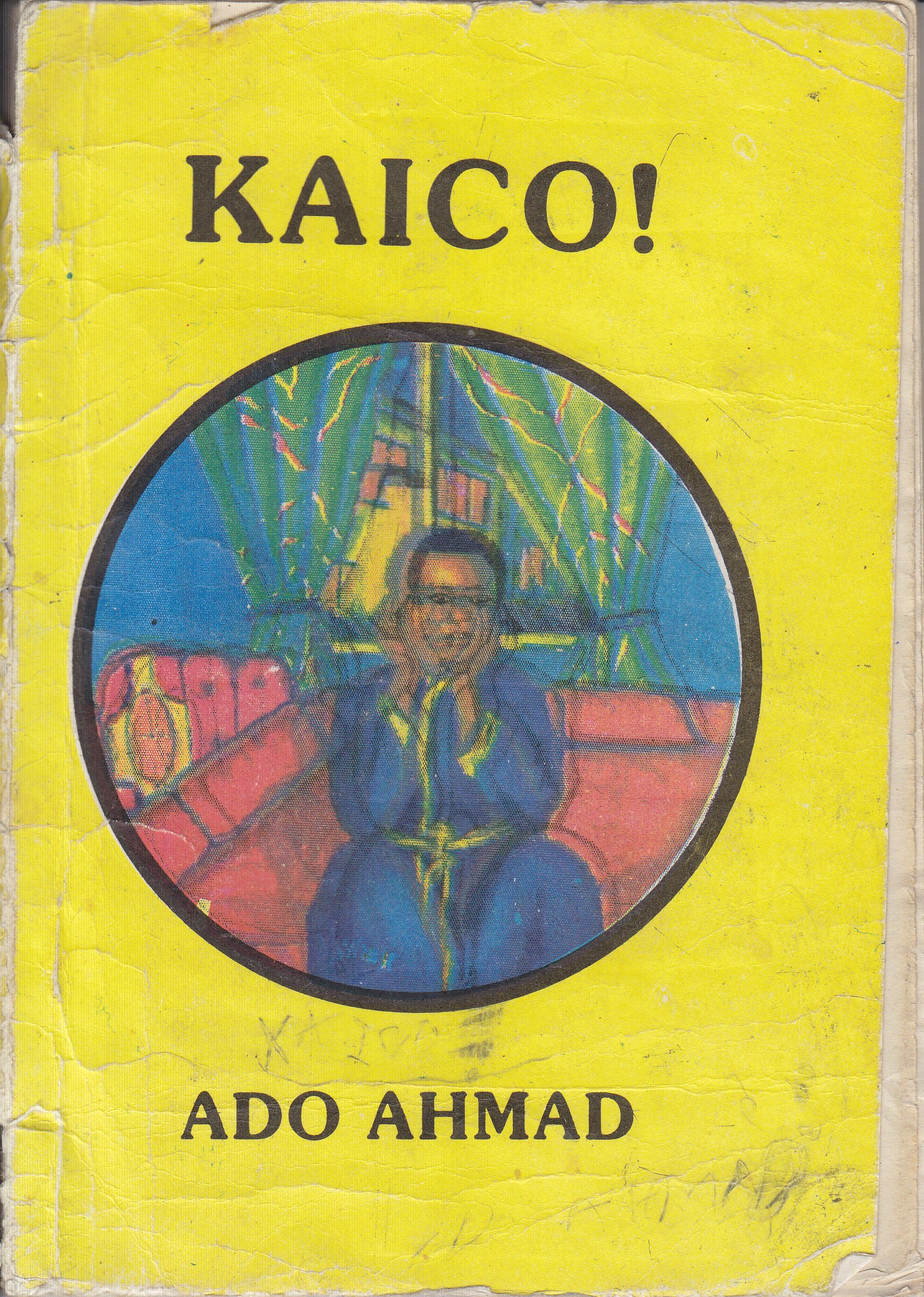
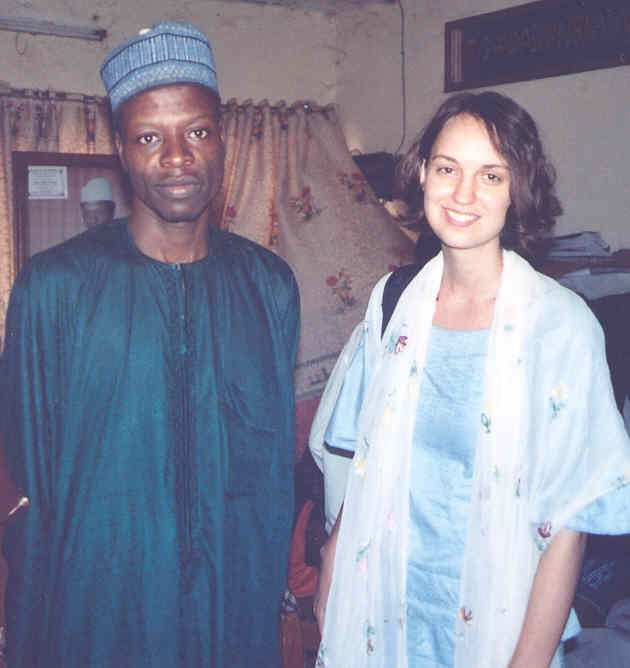
Bashir Yahuza Malumfashi asks me about what I think about Malam Rabo’s statement at the writer’s conference about how the foreigners and Europeans who said they were interested in Hausa language and culture were not really interested  in it–that they were just tricking and deceiving people for ulterior motives.

I say that I can only talk about myself–that there is no way that I can know about the motivations of every other European or foreigner who comes here. But I said that I truly do love Hausa language, literature, and culture. I came here to this country to do research and I would love to stay and live here and continue to raise the interest of those outside in Hausa language and culture. I am certainly not lying about this. I truly love Hausa and Hausa people.

He finally asks me about my marital status and whether I could marry a Hausa man and live here.

I said that marriage is according to God’s will, and that I will follow whatever God has prepared for me.

Presenting in Abuja today on the importance of contemporary Hausa literature

For those in Abuja, I will be presenting today on the importance of contemporary Hausa literature to national and world literature.  You are welcome to come heckle me. Greenlines Restaurant, 11 Aba close off Ogbomosho Street, Area 8, Garki. 5pm. Friday.

(Update 7 February 2010, Sunday: Another related event tonight, 6pm, GAP, Play bar and lounge, close to Pennial Apartments, Maitama, Abuja. I will be talking informally about Hausa literature and film.)

AN ELLITERATE INITIATIVE POWERED BY THE NATIONAL FILM AND VIDEO CENSORS BOARD, G.A.P

UPDATE 8 February 2010, since my presentations I have received questions about the details of the publication, etc, and I compiled this list of links. There are far more, but this is a good introduction:
Interview with Hausa novelist Sa’adatu Baba:http://ipsnews.net/africa/nota.asp?idnews=43816

Interview with bestselling author Bilkisu Funtua:
http://ibrahim-sheme.blogspot.com/2007/04/bilkisu-funtuwa-interview.html

Interview with groundbreaking author Balaraba Ramat Yakubu:
http://www.nigeriafilms.com/content.asp?contentid=2774&ContentTypeID=2

Interview with the first female novelist who wrote in Hausa Hafsat Abdulwahid: http://234next.com/csp/cms/sites/Next/ArtsandCulture/5501274-147/story.csp

Another interview with Hafsat Abdulwahid:
http://www.africanwriter.com/articles/310/1/Interview-with-Hafsatu-Ahmed-Abdulwahid/Page1.html

Info on the current censorship crisis in Kano:
http://ipsnews.net/africa/nota.asp?idnews=43857

Hausa Popular Literature Database at SOAS, London:http://hausa.soas.ac.uk/

“Hausa literary movement and the 21st century” by Yusuf Adamu: http://www.kanoonline.com/publications/pr_articles_hausa_literary_movement.html

“Between the word and the screen: A historical perspective on the Hausa Literary movement and the Home video invastion” academic article by Yusuf Adamu

“Hausa popular literature and the video film” academic article by Graham Furniss: http://www.ifeas.uni-mainz.de/workingpapers/FurnissHausa.pdf

“Loud Bubbles from a Silent Brook: Trends and Tendencies in Contemporary Hausa Prose Writing” academic article by Abdalla Uba Adamu
http://inscribe.iupress.org/doi/abs/10.2979/RAL.2006.37.3.133

“Islamic-Hausa Feminism Meets Northern Nigerian Romance: The Cautious Rebellion of Bilkisu Funtuwa” academic article by Novian Whitsitt
http://findarticles.com/p/articles/mi_qa4106/is_200304/ai_n9219184/

“Parallel Worlds: Reflective Womanism in Balaraba Ramat Yakubu’s Ina son sa haka” academic article by Prof Abdalla Uba Adamu
http://www.africaresource.com/jenda/issue4/adamu.html

Hausa writer’s database (in hausa):
http://marubutanhausa.blogspot.com/

My blog post on a Hausa writer’s conference in Niger:https://carmenmccain.wordpress.com/2009/12/16/a-hausa-literary-expedition-to-damagaram-zinder-niger/

etc, etc, etc….

A Hausa Literary Expedition to Damagaram, Zinder, Niger

IMG_1029

Hausa writers Maryam Ali, Zainab Auta, Hafsat M.A. Abdulwahid, and Rabi’a Talle in Damagaram, Niger, 10 December 2009 (c) Carmen McCain

Last week I attended a conference on “The Importance of Indigenous Languages to Economic, Social, and Cultural Development (a rough translation of the conference name in French “Interet et Importance des Langues Nationales dans le Processus du Developpement Economique Social Culturel et Politique” and Hausa “Mahimmancin Harsunan Gida ta Hanyar Rubutu Don Ci Gaban Tattalin Arziki Al’Adu da Kyautata Rayuwa da Siyasa”), held in Damagaram, Niger, from 8-10 December 2009. From the papers presented, (all of which were in Hausa on matters related to Hausa language, literature, and culture) and the participants, involved, it mostly turned out to be a conference on the importance of Hausa, with the significant exception of the participation of Alhassane Hamed-Ittyoube, a Nigerien writer, translator, and illustrator of Tuareg heritage, with some beautiful looking books in the Tamajaq language using the Tifinar script he passed around for us to look at. Although his primary languages are Tamajaq and French, he speaks some Hausa and interacted well with the mostly Hausa literary crowd that arrived from Nigeria and other parts of Niger. Unfortunately, for some reason I can’t quite understand, he was stopped from reading an excerpt from one of his rewritings of Tamajaq oral literature at one of the open-mic events. He was reading a translation in French, which another Nigerien writer was translating into Hausa. He was about two minutes into his reading, and we were all enjoying the piece, when there was some discussion I couldn’t hear, and he was not able to finish. I was sorry about that because his involvement in the conference seemed very important in providing a voice for minority-language literatures in a conference that was ostensibly about indigenous language[S] rather than just Hausa. I will try to write a separate post on his work and the interaction we had during the conference.

With that aside, it was very enjoyable to be on an expedition with so many Hausa writers (including novelists, poets, journalists, and academics), and to be able to be a part of the two evenings of open-mic events, in which authors read poems/short stories/excerpts of novels and received much critical feedback from fellow writers. The atmosphere was relaxed, friendly, and full of jokes, especially when novelist/screenwriter/poet Nazir Adam Salih sang a love-song, with a full sing-along chorus, to an unknown lady and was mercilessly teased with spur-of-the-moment response songs for the rest of the trip.

Hausa novelists Nazir Adam Salih and Ado Ahmad Gidan Dabino at a reading in Damagaram, Zinder, Niger, 8 December 2009 (c) Carmen McCain

There is much to say about the week, and I will likely split this post up into several smaller ones on specific themes. So watch out for further posts throughout the week.

The events of the week included arrival on Monday evening; an opening ceremony on Tuesday and an open-mic Tuesday night; paper presentations on Wednesday morning and afternoon and another open-mic Wednesday evening, a closing ceremony Thursday afternoon with visits to the museum and the Emir’s palace (or the Sultanate of Damagaram). About six of us women also took a trip to the market on Thursday evening.

Tamajaq writer Alhassane Hamed Ittyoube and Hausa writers at the museum in Damagaram, Zinder, Niger 10 December 2009 (c) Carmen McCain

Friday morning, about seven of those of us who were heading back to Kano trekked, dragging rolling suitcases, laptop cases, and market bags of tapioca, to the Damagaram public transport depot. There was much haggling over pricing and space. We nearly left in a small bus, but when the driver attempted to cram more passengers in, though we had settled on a price for a certain number of seats, we disembarked and left the park to arrange for a vehicle elsewhere. I will tell the story of our rather dramatic border crossing in another post.

The most personally disconcerting part of the trip (other than the dramatic border crossing that I will write about later!) was being in Niger with no money!! I went to Niger in public transport with several writers from Kano. At the border, we decided to wait to change money until we got to Damagaram, assuming there would be a better rate there, but once there we were met at the public transport depot by one of our Nigerien hosts and never actually got to a place to change our naira to CFAs. So, many of us went for about three days without having any money. Fortunately, our hosts were generous enough to feed and house us, so it wasn’t a major hardship, but it was a little disorienting to not even have the money to buy a sachet of pure water or a bundle of tissue. On the last evening, some of us women took a trip to the market and were able to find a trader to change a little naira. I immediately went in search of pure water having not had anything to drink since early in the morning! That said, it is amazing that we were taken care of so well that we were not too pinched without our cash!

Overall, it was an excellent experience. There were a few grumblings about accommodations and organization, but that seems typical of most conferences. I did feel badly that Hajiya Hafsat M.A. Abdulwahid, an important writer, the first female novelist in Hausa and winner of the 1979 NNPC writing competition for her novel So Aljannar Duniya, was not given better accommodations. She graciously shared a room with me, but a person of her status should have been given something a little better.

More details later.