Construction Company Bull-Dozes 500 year old Kano Monument–Kofar Na’isa


Weekly Trust article (17 April 2010) on the demolition of Kofar Na'isa in Kano

There is a lot of road construction going on in Kano, which brings hopes of smoother traffic in the future, but in the meantime makes for terrible go-slows. Another side-effect of the road construction has been the demolition of structures in an attempt to widen the roads. From what I’ve seen, the widened roads are creeping quite close to the edges of the ancient nearly thousand year old Kano wall, although there do seem to be efforts along BUK road to construct iron fences between BUK road and the wall. (According to the Kano State Tourism website, construction on the wall began in 1112 AD.) I didn’t think too much of it until today, when I read an upsetting story in the Weekly Trust by Jaafar Jaafar, Naziru Idris Ya’u and Mubarak Hassan Usman describing the destruction of one of the fifteen ancient city gates embedded into Kano wall by a road construction company.

An old monument of the ancient city of Kano, Kofar Na’isa, was demolished by a construction company in order to pave way for the ongoing road expansion in the state. Many metropolitan roads in Kano state are now undergoing expansion and reconstruction. Withstanding the greatest winds and rains of history for about five centuries ago, Kofar Na’isa stood firm without interference until last week when the construction firm rolled out its bulldozers against the gate.

The article continues:

Lamenting the destruction of the gate, the curator of the National Museum, Gidan Makama, Malam Aliyu Abdu, said the demolition has serious consequences on the cultural authenticity of Kano city walls, saying it is an infringement on a cultural site undergoing preparations for the World Heritage listing.

“The gate is over 500 years. Whatever kind of road that will be constructed, the sanctity of the old relic must be respected,” said the curator.

According to him, the museum cannot stop road construction but the gate should either be bypassed or let be. “We are supposed to be notified so that we direct how the monument would be carefully restructured but not to be demolished completely without our consent,” said the curator.

Continuing, he said: “the destruction of the site also constitutes a grievous setback to the conservation plan adopted by the National Commission for Museums and Monuments and the stakeholder committee on Kano city walls towards the preservation of the heritage sites of this great city.”

Malam Abdu said the NCMM in conjunction with the state government was preparing to submit Kano city walls and associated sites to UNESCO for enlistment into the World Heritage List.

“Already this demolished gate had been included in Nigeria’s tentative list and is receiving favourable attention as one of the sites with great potentials for the World Heritage enlistment,” he lamented.

While calling on government and private companies to desist from destroying the monuments, he said the museum will drag the construction company to court for wanton destruction of a national monument.

Also lamenting the destruction, the present lord of the demolished gate, Malam Abdullahi Usman, expressed displeasure with the destruction of the historical architectural piece. “The gate was demolished on April 19, without my permission as the custodian of the gate, nor the permission of the Emir of Kano, Alhaji Ado Bayero,” he said.

He further said the construction company desecrated the historical relic, saying Emir Bayero has convened an emergency meeting with the district heads and those who are responsible to look after the gates. “The emir was really bitter about the demolition,” said the lord of the gate.

Unfortunately, the Weekly Trust article does not list the name of the construction company which bull-dozed the gate, or information on who would have given the go-ahead to destroy a national monument “protected by law under the National Commission for Museums and Monuments (NCMM) Act, CAP 19 of the laws of the Federal Republic of Nigeria, 2004, vol X Chapter 19.” However, when I went in search of more information, I found another article in the SundayTrust of 11 April 2010 describing the demolition, meaning the news is over a week old now. Right before I posted this post, I also heard from another source that the name of the construction company that demolished the gate was Kano-based Triacta Nigeria Limited.

The demolished gate is pictured on the Kano Tourism website here, along with a colourful story about the construction of the gate:

Emir Suleiman received a complaint from the nomadic Fulani that they were attacked by a group of thieves who took away their cattle.  The Emir directed his son, Abubakar Mai Unguwar Mundubawa to go along with the complainants and capture the thieves at all cost.  At the end of the mission, the son of the Emir returned late and was disallowed by the gatekeeper to pass through the Kofar Dogo with his people.  There and then he decided to break a part of the wall close to the then Kofar Dogo (Dogo Gate).  It took them five days to complete the new entrance.  He then ordered the removal of the metal gate of Dogo, and fixed it at the new one called NA’ISA and blocked Kofar Dogo.  The gate was renamed Kofar Na’isa by Emir Suleiman.

A October 9, 2008 Daily Sun article describes other Kano City Gates that have been sacrificed to road widening exercises:

Owing to the pressures of traffic, it became necessary to expand or “dualize” some major roads in Kano. Thus, some of the antique gates had to give way. Among the gates, which proved too narrow, were “Kofar Nassarawa,” “Kofar Mata” and “Kofar Wambai.” Unfortunately, the original clay structures were replaced with massive concrete gates. However, Hambolu seven years ago commended those who handled the renovation for their wisdom in incorporating elements of Hausa traditional architecture into the design of the new gates.

Interview with Hiphop artist Ziriums in this week’s Aminiya

Mujullar Rayuwa, Aminiya, 16 April 2010
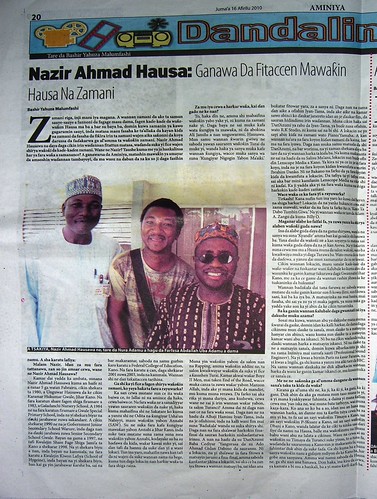
"Nazir Ahmad Hausawa: Ganawa da Fitaccen Mawak'in Hausa na Zamani"

This week’s Aminiya newspaper featured an interview with Hausa hiphop artist Ziriums, whose collaboration with Supreme Solar and T-Rex, I have written about earlier on this blog. The interview in Hausa (with my translation) is copied below. To read the interview on the Aminiya website, click here and to hear some of Zirium’s music, click on his myspace page, here. [[UPDATE 31 August 2010, You can also buy his new album “This is Me” on itunesamazon.com, and myspace.]]

The interview opens with an introduction that I will not directly translate. I have directly translated the rest of the interview, but keep in mind that I likely have made at least a few small errors. I welcome corrections. If you have any, please leave them in the comments section, and I will fix the translation. In the introduction,  Bashir Yahuza Malumfashi, the interviwer, talks about how as time brings new types of music the old is not left behind. The new music, too, can give sermons and teach lessons.

Malam Nazir, idan za mu fara tattanawa, zan so jin amsar cewa, wane ne Nazir Ahmad Hausawa?

Kamar dai yadda ka ambata, sunana Nazir Ahmad Hausawa kuma an haife ni a ranar 5 ga watan Fabrairu, cikin shekara ta 1980, a Unguwar Hausawa da ke cikin karamar Hukumar Gwale, Jihar Kano. Na fara karatun share fagen shiga firamare a 1983, a Galadanchi Nursery School. A 1984 ne na fara karatun firamare a Gwale Special Primary School, inda na yi shekara biyar na dauki jarabawar zuwa sakandare. A cikin shekarar 1990 ne na je Gobernment Junior Secondary School Warure, inda daga nan na dauki jarabawa zuwa Senior Secondary School Gwale. Bayan na gama a 1997, na tafi Kwalejin Share Fage Shiga Jami’a ta Kano a shekarar 1998. Na yi shekara biyu a nan, inda bayan na kammala, na fara karatu a Kwalejin Kiwon Lafiya (School of Hygeine), inda bayan na yi shekara biyu, ban kai ga yin jarabawar karshe ba, sai na bar makarantar, saboda na samu gurbin karo karatu a Federal College of Education, Kano. Na fara karatu a can, daga shekarar 2001 zuwa 2003, inda na kammala. Wannan shi ne dan takaitaccen tarihina.

Malam Nazir, if we may start, I’d like to hear you answer this question: Who is Nazir Ahmad Hausawa?

As you have mentioned, my name is Nazir Ahmad Hausawa. I was born on 5 February 1980 in Hausawa area, Gwale Local Government Area, Kano State. I started school in 1983 at Galadanci Nursery School. In 1984, I started primary school at Gwale Special Primary School where I spent five years before I took the exams to go on to secondary school. In 1990, I went to Government Junior Secondary School, Warure, which is where I took the exams to go on to Gwale Senior Secondary School. After I finished in 1997, in 1998 I went to University preparatory College of Share Fage. I did two years there, and after I finished, I started my studies at the School of Hygiene, where after I had spent two years, I left the school before I did my final exam. This is because I had gotten admission to Federal College of Education, Kano. I started my studies there from 2001 to 2003, where I finished. This is a brief recap of my life.

Ga shi ka yi fice a fagen shirya wakokin zamani, ko yaya haka ta faro a rayuwarka?
Ka san cewa mutane sun ce ita waka baiwa ce, to lallai ni na amince da haka, cewa baiwa ce. Na fara waka ne a sanadiyyar yawan sauraren wakokin da nake yi, haka kuma mahaifina shi ne Sakatare ko kuma a yanzu shi ne Odita na kungiyar Usha’un Nabiyyi, masu wakokin yabon Annabi (SAW). Su ne suka fara kafa kungiyar mawakan yabon Annabi a Jihar Kano, inda suke tara mutane suna zama suna rera wakokin yabon Annabi, kodayake su ba su hadawa da kida, wakar kawai suke yi, sai dan tafi da hannu da suke dan yi a wani lokaci. Tun ina yaro, mahaifin nawa kan tafi da ni wajen da suke wannan zama na bege, kuma tun daga lokacin nan harkar waka ta fara shiga raina.

Ok, so you’ve come out as a modern musician? How did your life bring you to this?

You know, they say that singing is a gift, and I agree with that—it is a gift. I started singing because I was always listening to music. My father is the secretary or actually now he is the Auditor of the Usha’un Nabiyyi Group, those who sing in praise of the Prophet (PBUH). They were the first ones in Kano State who established a group of praise singers to the Prophet. They would assemble people to sit  and sing praises to the Prophet. They didn’t combine it with drumming, they would just sing acapella. Every once in a while, they will wave their hands around [?]. Since I was a child, my father would go with me to the place where they would sing of their longing. And since that time, the love of music entered my soul.

Za mu iya cewa a harkar waka, kai dan gado ne ke nan?

To, haka din ne, amma shi mahaifina wakokin yabo yake yi, ni kuma na zamani nake yi. Daga baya ne sai muka kafa wata kungiya ta mawaka, ni da abokina Ali Jamilu a nan unguwarmu, Hausawa. Mun samu wannan kwarin gwiwa ne saboda yawan sauraren wakokin Turai da muke yi, wanda haka ya sanya muka kafa wannan kungiya, wacce muka sanya wa suna ‘kungiyar Nigogin Yabon Ma’aiki.’ Muna yin wakokin yabon da salon nan na Rapping, amma wakokin addini ne, ta salon kwaikwayar wakokin da suka yi fice a kasashen Turai. Kamar akwai wakar Boyz II Men, mai taken End of the Road, wacce muka canza ta zuwa wakar yabon Manzon Allah, inda ake yi mana kida da mandiri, mu kuma muna rerawa. Da farko sai aka rika yi mana dariya, ana kushewa, cewa wane ne zai ji irin wannan wakar yabon, ta salon Turanci? Amma dai ni daga nan zan ce na fara waka sosai. Daga nan ne na hadu da Alhaji Hamisu Iyan-Tama, inda na je ofishinsa, inda na kalli wani fim mai suna ‘Badakala’ wanda su suka shirya shi. Daga nan na fara sha’awar harkokin fina-finai da sauran harkokin nishadantarwa irinsu. A nan na hadu da su dan’Azumi Baba Cediyar ’Yangurasa da su Ado Ahmad Gidan Dabino da sauransu. Ni a lokacin, na yi sha’awar in fara fitowa a matsayin jarumi a fina-finai, amma saboda kankantar jikina a lokacin, sai aka ce ba zan iya fitowa a wannan matsayi ba, sai idan ana bukatar fitowar yara, za a sanya ni. Daga nan na zama dan aike a ofishin Iyan-Tama, inda ake aike na kamar sawo abinci ko daukar janereto idan an je daukar fim, da sauran hidindimu irin wadannan. Muna cikin haka sai dan’Azumi ya rabu da Iyan-Tama, ya bude nasa ofishin, wato R.K Studio, ni kuma sai na bi shi. A lokacin ne ya sayi abin kida na zamani wato Piano/Yamaha. A kan wannan na’ura na fara koyon kidan zamani da kaina, har ma na fara iyawa. Daga nan muka samu matsala da shi dan’Azumi, na bar wurinsa, na yi zaman shekara daya ba tare da na yi wannan harka ta kida ba. Na koma makaranta ne sai na hadu da su Salisu Mu’azu, lokacin sun bude ofis din Lenscope Media a Kano. Ya kira ni ya ce in je in fara koyo, inda na je na fara koyon kidan kwamfuta a wurin Ibrahim Danko. Ni ne Bakano na farko da ya fara koyon kida da kwamfuta a lokacin. Da tafiya ta yi tafiya ma, sai aka bar mini kamfanin Lenscope Media na rike shi ni kadai. Ka ji yadda aka yi na fara waka kuma na shiga harkokin kade-kaden zamani.

Could we say that you have inherited your music?

You could say that, but my father sings praises [to the Prophet] and I sing modern music. After some time, we started a singing group, me and my friend Ali Jamilu, in our neighborhood, Hausawa. We did this because we were always listening to Western music,,which is what made us establish this group. We named it “The Nigga’s Who Praise the Messenger.” We were doing this Islamic praise-singing in a rap style. But although they were using the style we learned from Western music, they were religious songs. Like the Boyz II Men song, “End of the Road,” we changed to become a song in praise of the Prophet of God. The mandiri beat would be done for us, and we would sing. At first, everyone was laughing at us and didn’t have any use for us. They said who has ever heard this kind of Islamic praise in a Western style. But from this time, that’s when I really started singing. After that I met with Alhaji Hamisu Iyan-Tama, when I to his office because I had seen a film named “Badak’ala” which his company had produced. From there I became interested in the film industry and the rest of the entertainment industry. This is where I met with ‘Dan Azumi Baba, Ced’iyar ‘Yangurasa, Ado Ahmad Gidan Dabino, and others. At the time I was interested in being an actor in films, but because I was very small then, they said that I couldn’t appear as an actor unless they needed children, then they would cast me. After that I found employment in Iyan-Tama’s office. They would send me to buy food or carry the generator if they went on a film shoot, and other services like these. I was going along like that, when ‘Dan Azumi left Iyan-Tama and opened his own office, R.K. Studio, and I followed him. At that time, he bought a new kind of instrument, the Yamaha piano. It was on this machine that I started teaching myself how to produce beats, until I started being able to do it. I ended up having a problem with D’an Azumi, so I left his place and spent about a year without doing anything with music production. I returned to school until I met with Salisu Mu’azu, when they opened the Lenscope Media office in Kano. He called me to come learn, and this is where I started learning how to produce music with a computer together with Ibrahim Danko. At that time, I was the first Kano-man who started learning music production on the computer.  As time passed and people left Lenscope Media company, I was left alone holding on to what I knew. [?] So now you have heard how I started singing and how I entered the contemporary music industry.

Wace waka ce ka fara yi a rayuwarka?
Tirkashi! Kana nufin tun ina yaro ko kuwa dai bayan na shiga harkar? Lokacin da na yanke hukuncin cewa na zama mawaki, wakar da na fara ta farko ita ce, ‘Kano Ta Dabo Tumbin Giwa.’ Na yi wannan waka ne tare da Adam A. Zango da kuma Billy O.

What is the first song you did in your life?

Tirk’ashi! Do you mean since I was a kid or after I entered the industry? When I made up my mind that I had become a singer, the first song I started with was “Kano ta Dabo Tumbin Giwa.” I sang this with Adam A. Zango and Billy O.

Maganar alabe ko faifai fa, ya zuwa yanzu ka shirya alaben wakoki guda nawa?
Ina da alabe guda daya da na gama shiryawa, wanda na sanya wa suna ‘Kyandir’ amma ban kai ga sakin shi kasuwa ba. Yana dauke da wakoki ne a kan soyayya ta matasa sai kuma waka guda daya da na yi kan Arewa. Na yi kokarin nuna cewa mu ma a Huasa muna da salon wakoki, wato ba kwaikwaya muka yi daga Turawa ba. Wato muna da su tun da dadewa, a yanzu dai mun zamanantar da su ne kawai.

So, let’s talk about your album or record. How many albums have you produced?

I have one album that I’ve finished producing, named “Kyandir” but I haven’t released it to the market yet. It’s comprised mostly of songs on love, and then there is one song that I did on the North. I tried to show that we Hausa have a style of singing that we didn’t copy from Europeans. We’ve had this music for a long time and now we are just modernizing it.

Cikin wannan lokacin, masu sana’ar kade-kade da wake-waker na fuskantar wani kalubale ko kuma abin da wasunku ke ganin kamar takurawa daga Gwamnatin Jihar Kano, me za ka ce game da wannan rashin jituwa da ke tsakaninku da hukuma?
Wannan badakala dai tana faruwa ne saboda wasu mutane da suke ganin kamar sun fi kowa ilimi, sun fi kowa sani, kai ba ka iya ba. A matsayinka na mai basira, mai fasaha, shi sai ya zo ya yi maka jagora, ya nuna maka ga yadda yake son ka yi abin da ke cikin tunaninka.

So during this time, musicians are facing pressures or what some of you see as restrictions from the Kano State Government. What can you say on the lack of harmony between you all and the [censorship] board?

These problems are occurring because some people think they have more knowledge than anyone else, they know more than anyone else—[saying] you aren’t able to do this. In your position you are talented and skilled. Then he comes and says he will guide you and show you how he wants you to do what you already know. [?]

Ba ka ganin wannan kalubale daga gwamnati zai iya dakushe muku azama?
Sosai ma kuwa, wannan abu ya dakushe mana azama kwarai da gaske, domin idan ka kalli harkar, da dama daga cikinmu mun dauke ta sana’a, mun dauke ta a matsayin hanyar cin abinci, wasu kuma sun dauke ta a matsayin kamar wani abu na iskanci. Ni ba na cikin wadanda suka dauki wannan harka a matsayin iskanci. Ni na dauke ta ne a matsayin sana’a, domin kuwa albarkacinta ga shi na zama Injiniya mai sarrafa sauti (Professional Sound Engineer). Na yi kwas a birnin Paris na kasar Faransa, na yi kwas a Ingila, ga shi kuma a yanzu ina aiki tare da BBC. Na samu wannan daukaka ne duk albarkacin wannan harka da wasu ke ganin kamar iskanci ce, mu kuwa muka ce sana’a ce.

You don’t think this pressure from the government could hinder your progress?

Sure it can, this thing has really, truly hindered our progress.  Because if you look at the industry. It is the opportunity that some of us have to take up a profession. We take it as the path to earn our daily bread. Others take it as a way to live immorally and get into trouble.  I’m not among those who are in the industry to be immoral. I take it as a profession. I have been blessed to become a Professional sound Engineer. I have done a course from Paris, France, and I’ve done a course from England, and now I’m working with BBC. I have found opportunities and all the blessings of this industry that some see as mere immoral living. But we say it is a profession.

Me ne ne  sakonka ga al’umma dangane da wannan sana’a taku ta kida da waka?
Kirana ga al’uma shi ne, ka ji, ka ki ji, ka gani, ka ki gani. Duk abin da aka ga matasa mun taso muna ta yi, a yi mana kyakkyawar fahimta, a daina yi mana kallon cewa mu ’yan iska ne, wai muna bata tarbiyya, wai muna kaza-kaza. Ko ana so ko ba a so, idan mu an hana mu wannan harka, an danne mu ta karfin tsiya cewa ba za mu yi ba, to fa sai an sayi wakokin Timaya a Kano, sai an sayi wakokin P-Skuare a Kano, sai an sayi wakokin Dbanj a Kano, wanda lalatar da ke ciki ta ninka sau dari fiye da namu na Hausa, balle ma wakokinmu na Huasa babu wani abu na lalata a cikinsu. Wasu na cewa ai su wakokin su Timaya da Turanci suke yinsu, to a tuna fa, wadanda ke saurarensu a Kano sun je makaranta fa, suna fahimtar duk abin da suke fada. Ga shi kuma ba a hana sanya wakokin nasu a gidajen rediyon da ke Kano ba, har gobe ana sanyawa. Amma wai namu saboda da Hausa ne, ga shi nan ana hanawa. Don haka, ina kira da cewa, ya kamata a bi mu a hankali, ba a yi mana karfi-karfi ba.

What is your message  to the readers about  your music profession?

What I have to say to the readers is this: whether you hear or you refuse to hear, whether you see or you refuse to see. Everything that is seen as a profession, we have introduced it and we are still doing it. Understand us very well and stop looking at us as if we are rogues, or that we are spoiling the upbringing of children, or we are doing this and that. Whether you like or you don’t like, if we are kept from this industry, if we are weighted down into destitution by those saying, we aren’t allowed to do it, well, then people will buy Timaya’s music in Kano or they will buy P-Square’s music in Kano , or Dbanj’s music in Kano, which are a hundred times worse than our Hausa songs. And there is not anything bad in our Hausa songs. Some are saying, oh, that Timaya’s songs are in English, but remember, those who are listening to them in Kano have gone to school, they know what’s being said in them. And those songs haven’t been banned from the radio stations in Kano. Until tomorrow they will keep playing them. But ours, supposedly because they are in Hausa, they ban them. So, I am saying that they should take care how they treat us and not be too hard on us.

Arresting the Music. Arresting Hope. Arrested for playing at a wedding “without permission”

Last night I wrote a post about a story my friend told me about some musicians being arrested for playing at a wedding “without permission.” However, since the case is still ongoing, I have decided to take down the post until things are a bit more settled.

[UPDATE: 16 March 2010: Abdulaziz A. Abdulaziz has just published a story in Leadership on the Alliance Francaise episode  that mentions the incident I am referring to here:

Meanwhile a six-man band known as Police Band who perform at weddings in the state was equally smashed by agents of the board on allegation that they were performing without a permit of the board. The band is led by one Solomon alias Solo, an emerging entertainer.

Members of the band were mopped up and taken to a court which subsequently sentenced them to six months with an option of fine of N20, 000. The group was thrown behind bars but was later released after paying the fine.]]

When I first heard about this story, my friend told me that the Police Band was registered with the Kano State History and Culture Bureau….

Readers may remember that two weeks ago, the Kano State Censorship Board also shut down a 23,000 euro international concert organized by the French embassy and the Kano State History and Culture Bureau, being hosted at the Alliance Francaise, for not “seeking permission” to hold the event.

Hausa Home Video Resource Centre

The Mass Communication Department at Bayero University has been very generous in their hosting of me while I have been doing my research in Kano. As part of my appreciation for their help, I am helping them to coordinate and put together a blog for the Hausa Home Video Resource Centre. You can check it out the blog, which I started working on yesterday, here:

The Hausa Home Video Resource Centre is an initiative of the Department of Mass Communication at Bayero University in Kano, Nigeria. It was founded with the aim to provide access to information about the Hausa film industry for researchers, journalists, and the general public and to provide useful resources for practitioners in the industry. It is currently being coordinated by Carmen McCain, a PhD candidate at the University of Wisconsin, Madison and a visiting scholar in the Department of Mass Communications at Bayero University

In the next few months, we hope to provide access to archived newspaper articles about the Hausa film industry, updates on resources for Hausa film practitioners, and summaries of Hausa films for the general public. You can access photos and documents at our picasa site: http://www.google.com/profiles/hausahomevideoresource#about

You can contact the Hausa Home Video Resource Centre at hausahomevideoresource @ gmail.com. We welcome any feedback or suggestions on how we can improve the site or the centre.

The Most recent violence in Plateau State

When I read the news last night (after receiving a text earlier in the day from one of my friends who had heard about it on the news), I wanted to vomit. There has been a fresh wave of violence in villages on the outskirts of southern Jos killing hundreds of innocent men, women, and children. The attacks on Dogo Nahawa, Shen village, and others seem to be reprisal attacks for atrocities committed during the January 2010 crisis (particularly the well-publicized case of the massacre at Kuru Karama).

According to BBC:

Some 500 people, including many women and children, are now reported to have been killed in a weekend ethnic clash near Jos in Nigeria, officials say.

The figure was earlier put at 100 and it is hard to verify casualties. Troops have been deployed and local officials said dozens of arrests had been made.

They said three mainly Christian villages near Jos were attacked from nearby hills by people with machetes.

There is a long history of local tension between Muslims and Christians.

The attacks are said to have been in revenge for the killing of several hundred people around Jos in January.

[UPDATE 9pm: Naijablog, at 3:25pm,  reposted a report by the Nigeria Red Cross Society, Plateau Branch, on a visit yesterday07/03/2010,  to Dogo Na Hauwa:

A joint team of the NRCS, Plateau state branch and NEMA visited Dogo Na Hauwa, a village about 20km from Jos the Plateau State Capital. It was reported that as early as 3.00am, some group of unknown persons attacked Dogo Na Hauwa and three other villages of Jos South LGA, all to the South east of Bukuru, Headquarters of Jos South LGA of Plateau state.

Findings

The visit revealed the following:

1) Four villages were attacked

(a) Dogo Na Hauwa

(b) Shen

(c) Zot-Foron

(d) Rasat

2) Several houses burnt

3) 23 injured and hospitalized at JUTH; one has died. Some other injured people were hospitalized at the Plateau State Hospital

4) We were able to see the corpses of about sixty people mostly women and children that were killed in Dogo Na Hauwa alone. The villagers claimed the figures could be more. The other three villages attacked were not accessible by us.

5) Several people were displaced within the communities

6) Police were seen at Dogo Na Hauwa]]]]]

[UPDATE 10 March 2010: To see the Human Rights Watch call for an investigation with three witness accounts, click here.]

My family, who live on the north side of Jos, says that so far, today (as of 10am this morning when I spoke to my father), things on their part of town seem to be calm. [UPDATE 12:20pm: I just received a phone call from my brother, who is visiting Jos right now, asking me to send him phone credit and saying he had received a phone call saying there were rumours (at this point it’s all rumours) of violence on Ahmadu Bello way.]

Here are a few more articles on the most recent violence, though you can find the same range of articles if you go to Google News and search for Jos. As I post these, I contemplate the double-edged nature of global news. While I think it is imperative that these atrocities be known and condemned by the world, at the same time, I wonder how much news coverage of events actually fuels hatred and violence in other locations. There are other links I am choosing not to post here, because I think they contain opinions that could be inflammatory, but, of course, all you have to do, if you’d like to see them, is google.

BBC: Nigeria Religious Clashes “kill 500” near Jos

NEXT: Herdsmen Raid Jos Village, Kill Hundreds

Al-Jazeera: Deadly Clashes in Central Nigeria

Punch: 150 Die in Fresh Jos Violence

NEXT: Jonathan places security on red alert in Jos

While this most recent violence was committed against Beroms (mostly identifying as Christians) by Fulani cattleherders (mostly identifying as Muslims), the use of the word genocide (I think the term “mutual genocide” might be appropriate) and allegations of conspiracy by victims of both side must be read in context of events going back for years. As those who have followed the case may recall, around 300 Muslim men, women, and children were killed in Kuru Karama by raiders self-identifying as Christians (as slogans written on a burned mosque testify). It is difficult to say who has “started” the crises, which often do seem to have a very planned feel about them, but the reality is that the tensions have gone back for years, from the resistance of people in the Plateau against the Fulani wars of aggression in the early 19th century to the resentment against colonial policies in the early 20th century to more recent national policies on indigine/settler rights.  My own knowledge of these tensions goes back to the beginning of the decade in Plateau State to the 2001 Jos crisis (Though there has certainly been much earlier violence in other parts of the middlebelt and north). From the early Jos crisis in 2001, the violence has since spread into a web of reprisal attacks.

I don’t know what will stop this cycle of hatred and atrocity, only that I keep going back to that 1957 Christmas sermon preached by Dr. Martin Luther King Jr, entitled, “Loving your Enemies.” It calls for a love and forgiveness that rises above our human nature. Is such a love possible, when we have so many truly potent grievances against each other? I think that, though of course, as those civil rights reformers did, we must pursue legal redress and seek to change a system that perpetuates such violence , in the end, a wide-scale change of heart–an insistence on reconciliation by this generation–is our only hope. [See for example, the song “Nigeria Tamu Ce” “Nigeria is Ours,” which calls for us to “unite as one,” by young Kano-based singer DJ Yaks. You can listen to the song in Hausa, with an English rap, on his myspace page.] In the last paragraph Martin Luther King, Jr, throws out this challenge to those living under the oppression of racist policies and segregation in the United States:

To our most bitter opponents we say: “We shall match your capacity to inflict suffering by our capacity to endure suffering. We shall meet your physical force with soul force. Do to us what you will, and we shall continue to love you. We cannot in all good conscience obey your unjust laws because noncooperation with evil is as much a moral obligation as is cooperation with good. Throw us in jail and we shall still love you. Bomb our homes and threaten our children, and we shall still love you. Send your hooded perpetrators of violence into our community at the midnight hour and beat us and leave us half dead, and we shall still love you. But be ye assured that we will wear you down by our capacity to suffer. One day we shall win freedom but not only for ourselves. We shall so appeal to your heart and conscience that we shall win you in the process and our victory will be a double victory.”

This is a very hard teaching. My sense of justice revolts against the idea of  wearing down the enemy by “our capacity to suffer.” But, in a system where justice is slow and faulty, what is the other choice?  King, who, like the early Christian writer Paul, knew what he was talking about when he spoke on suffering, warns that:

[W]hen Jesus says “Love your enemies,” he is setting forth a profound and ultimately inescapable admonition. Have we not come to such an impasse in the modern world that we must love our enemies-or else? The chain reaction of evil-hate begetting hate, wars producing more wars-must be broken, or we shall be plunged into the dark abyss of annihilation.

For more information on sectarian violence in middle-belt and northern Nigeria, particularly in Plateau State, see the following links:

Nigeria: Protect Survivors, Fully Investigate Massacre Reports, a January 2010 call by Human Rights Watch for the Nigerian government to investigate the massacre at Kuru Karama.

“Jonah Jang and the Jasawa: Ethno-Religious Conflict in Jos, Nigeria” an August report published by “Sharia Debates in Africa”  in August 2009 by Phil Ostien

Arbitrary Killings by Security Forces:a July 2009 Human Rights Watch Report on extrajudicial killings by security forces during the November 2008 crisis in Jos

“They Do Not Own This Place”A  2006 Human Rights Watch Report on the Indigene/Settler Policies in Nigeria that has often been blamed for these crises in the middlebelt, including a case study on violence in Plateau State

Revenge in the Name of ReligionA 2005 Human Rights Watch Description of violence, between Muslims and Christians, in the Plateau town of Yelwa in February and May 2004, and reprisal attacks in Kano May 2004

My own thoughts on the January 2010 crisis: January 21st  On the latest Jos crisis ; January 23rd Massacre at Kuru Kenta/Kuru Karama ; January 28th Taking Sides

and a very subjective/emotional reaction I wrote in December 2008 on the November 2008 Jos crisis, during which my family had had a refugee camp at our house.

God help us all.

French Ambassador rejects the conditions of KS Censorship board for lifting ban on music festival, Punch Reports

Today’s Punch carries an update on the recent cancellation by the Kano State Censorship Board of KAMFEST, the annual music festival hosted at the Alliance Francaise. [It took my browser a long time to open the Punch link. If you can’t get it to open, you can also find the article by Oluwole Josiah at Online Nigeria, unfortunately not credited…]:

The French Embassy has said it would not accept the conditions given by the Kano State Film Censor Board for lifting the ban on the annual music festival known as KANIFEST.

It also said it was unsure of staging the annual festival this year or next year, as the position of the Kano State Government would determine the fate of the festival.

French Ambassador to Nigeria, Jean-Michel Dumond, told our correspondent in an exclusive chat on Monday that discussions with the officials of the censorship board revealed that they were targeting one of the participating singers who was said to have criticised the board for banning music within the state.

He said the board wanted the singer to be withdrawn from the concert, but that condition was not acceptable to the embassy.

“We don’t want to be involved in that kind of situation where it has to do with this person or that person. Ours is to ensure that we promote culture and get the festival to benefit the people.

“If it is reduced to an individual or dealing with one person or the other, we are not interested in that. We have been discussing with the officials of the government, and we do not really have anything to do with the censorship board,” Dumond said.

He noted that the Kano State Governor was not aware of the decision of the censorship board and would be seriously disappointed at the turn of events.

To keep reading the Punch article, follow this link.

When I heard about the closure of the event on Saturday, I was told by filmmakers the rumour that the reason the event had been shut down was because popular Hausa singer Maryam Fantimoti, called the “the box of songs” by Hausa comedian Ari Baba (as cited in FIM Magazine, July 2009, p.41)  was slated to perform. (Maryam was also one of the finalists in Partners in Transforming Health in Nigeria in 2009). In a July 2009 interview with Fim Magazine, Fantimoti responded to a question about registering with the Kano State censorship board (my translation in italics):

Ana ta zuwa ana rijista da Hukumar Tace Finafinai ta Jihar Kano. Ke kin je kin yi kuwa?

People are going to be registered with the Kano State Film Censor’s Board. Have you gone?

Ban je ba, kuma ban yi ba, domin ni dai ba kamfani ne da ni ba, koyaushe ina gidan mu; in ka ga na fita an bugo waya ne ana nema na sannan in fita.

I haven’t gone, and I haven’t registered, because I am not with a company. I’m always at home. If you see me go out, it’s because I have been called [to work], that’s when I go out.

Ai ba kamfani ba, wai a matsayin ki na mawakiya tunda mawaka ma duk su na zuwa suna yi.

Not that you are a company, supposedly it’s supposed to be done because you are a musician, since all the other musicians are going to do it.

Ni ban sani ba, domin ban ga takarda a rubuce ba, kuma ni komai nawa cikin tsari na ke yi. Kai, ni tun da na ke jin mawak’a, na ke jin labarin su, ban tab’a jin an ce Shata ko Garba Supa ko D’ank’wairo ko Hassan Wayam da Barbani Choge sun yi ko suna da rijista ba. Shi kenan kuma don mu aka raina sai a ce sai mun yi wata rijista?

Me, I don’t know, because I haven’t seen anything written on it; everything I do is done properly and in order [NOTE: the translation of this last sentence could be off.] Kai, ever since I have listened to singers and heard news about them, I’ve never heard that [a list of older “traditional” Hausa musicians] Shata or Garba Supa or  D’ank’wairo or Hassan Wayam or Barbani Choge were registered. So, now we are held in contempt unless we go and do some registration?

[Note, that on the question of individual registrations for musicians, writers, or filmmakers, Director of the Kano State History and Culture Bureau (a Kano state government agency which helped plan the music festival), Ali Bature opined, when I asked him, a few days ago, that there was no such specification in the Kano State censorship law. The entire censorship law can be found in the library of the Kano State History and Culture Bureau for those interested in looking through it. If this interpretation of the law is correct, Maryam’s understanding that it was only companies that were supposed to register with the censorship board would be correct.)

Although Maryam Fantimoti was not able to perform at the music festival that was shut down by the Kano State Censorship Board, you can hear her singing along with DJ Yaks on his song “Rukky,” one of the songs featured (timecode 12:09) during the recent 26 February interview VOA did with DJ Yaks. ” (The link to the sound file is here–the written interview here.) “Rukky” can also be found on DJ Yak’s myspace page. (Please note that DJ Yak’s music is not for sale in Kano.) I will link to any other of Maryam Fantimoti’s music I can find online, as I find it.

She is also the female voice in the songs featured in the Hausa film Zo Mu Zauna

Update: 3-day international music festival cancelled by Kano State Censor’s Board

Daily Trust, 1 March 2010, p. 7

In an update to my last post, I spoke briefly today with Alain Service, the director of the Alliance Francaise in Kano, and he confirmed that the Kano State Censor’s Board sent a letter to the Alliance Francaise about two hours before the three-day KAMFEST music festival, an annual event that has taken place at the Alliance Francaise for the last 6 years, was to begin. Service said the letter told them to stop the festival. He claimed that the letter gave no other reason for cancelling the event other than saying that they had no right to hold the event without informing the Censor’s Board.

There were also brief articles in the Daily Trust and by AFP about the cancellation of the three-day event, which was to feature artists from Nigeria, Niger, Chad, and France.

The AFP news report says:

Sharia police ordered the closure of an annual music festival funded and organised by the French embassy in northern Nigeria at the weekend, local officials and diplomats said on Monday.

“We have banned the music festival for the reason that we were not notified and our permission was not sought,” Abubakar Rabo Abdulkarim, head of the film censorship board in the northern Kanoregion, told AFP.

The French embassy said they had been told they could not stage the event at the local French cultural centre as they did not have prior authorisation.

“Following a notification by the Kano state censorship board, the Kano festival of music is cancelled” the French embassy said in a statement emailed to AFP.

The embassy has organised the three-night KANFEST music festival for the past six years through its cultural centre in Kano, featuring performances from Nigeria and other African countries as well as French musicians.

It seems strange to me that the Kano State Censor’s Board had the power to halt the event, when another Kano State agency, the History and Culture Bureau had helped in planning the event. One person I spoke to at the Alliance Francaise said that she thought the Censor’s board was limited to censoring films, but that since the event was cancelled at the Alliance Francaise she had heard that the censor’s board is saying that even performances at weddings have to gain permission from the censorship board ahead of time. When I asked the director of the History and Culture Bureau, Ali Bature about the relationship between the two state agencies, he said that the History and Culture Bureau had a “cordial relationship” with the Kano State Censor’s Board and had in fact been instrumental in helping to found the board in 2000 as a way to protect filmmakers and allow them to continue making films after the establishment of shari’a law in Kano State. He did, however, note, when I asked him, that there was no legal basis in the Kano state censorship law, for the individual registration of artists. He said the expectation was that guilds would be registered with the censor’s board but that individual artists were the guild’s responsibility. A copy of the entire Kano State Censorship law can be found in the Kano State History and Culture Bureau, for anyone who would like to peruse it. According to film industry practitioners I have spoken to, censor’s board workers on multiple occasions(one such occasion is described in one of my March blog posts) have visited locations of films being made in Kano to check whether each member of the cast and crew is individually registered with the board. Although I was not able to confirm this with Mr. Service, the rumour I have heard from multiple sources is that part of the reason the Censor’s Board shut down the event was because Maryam Fantimoti, who is not registered with the Censor’s Board, was slated to perform at the event.

[[UPDATE 3 March 2009. In an article in today’s Punch, “France Rejects condition for lifting ban on Music Festival,” [If you have trouble getting the link to open, you can also find the article copied here] Oluwole Josiah reports:

French Ambassador to Nigeria, Jean-Michel Dumond, told our correspondent in an exclusive chat on Monday that discussions with the officials of the censorship board revealed that they were targeting one of the participating singers who was said to have criticised the board for banning music within the state.

He said the board wanted the singer to be withdrawn from the concert, but that condition was not acceptable to the embassy.

“We don’t want to be involved in that kind of situation where it has to do with this person or that person. Ours is to ensure that we promote culture and get the festival to benefit the people.

“If it is reduced to an individual or dealing with one person or the other, we are not interested in that. We have been discussing with the officials of the government, and we do not really have anything to do with the censorship board,” Dumond said.

He noted that the Kano State Governor was not aware of the decision of the censorship board and would be seriously disappointed at the turn of events.

Josiah also reports that:

The French Embassy has said it would not accept the conditions given by the Kano State Film Censor Board for lifting the ban on the annual music festival known as KANIFEST.

It also said it was unsure of staging the annual festival this year or next year, as the position of the Kano State Government would determine the fate of the festival.]]]

Today, I passed by a roundabout near the government house several times, and the banner advertising KAMFEST was still there, flapping abandoned in the breeze.

Kano State Censorship Board shuts down Kano Music Festival hosted at Alliance Francaise, Kano

I was told the following information by several people I will not name. I cannot, at this moment, verify the details of this report, only that it is oral testimony (over the phone) from several people who were involved in the event. I hope to talk to someone in the administration of the Alliance Francaise tomorrow to get more concrete details.

Apparently, yesterday, 26 February 2010, the three day Kano Music Festival, being hosted at the Alliance Francaise in Kano was shut down on the first day of the event by representatives of the Kano State Censorship Board and not allowed to continue with the rest of it’s scheduled events. According to one person I talked to, the festival was closed down because Hausa musician Maryam Fantimoti was to perform and she was not registered with the Kano State Censorship Board.

The organizers of the event had brought musicians from other parts of Africa and Europe to perform at the music festival. According to one press release on the Guide 2 Nigeria website:

There will be performances from several musical groups from across the globe including the famous Soubyana Music from Chad, the Dangana group from Niger, the Nassiru Garba group from Nigeria and the Trio Belhumeur from Upper Brittain.

Another source told me that over 20,000 euros had been spent on the cultural event, which did not end up holding, as it was closed by representatives of the Kano state government.

The Alliance Francaise has hosted the Kano Music Festival (Kamfest) for six years in a row.  The event had the support of the Kano State History and Culture Bureau.

Readers may recall that this is coming on the heels of a recent closure of 15 shops by the Kano State Censorship Board for selling films on the history of Islam. The Kano State Censorship Board has also been responsible for multiple arrests and business closures of those working in entertainment related fields. In a related closure of a cultural event, the hisbah closed down a fashion show organized in honour of designer Zainab Hamza in May 2009.

Allah ya jikan Kannywood actress Safiya Ahmed and director/producer Zulkiflu Muhammed

Safiya Ahmed (courtesy of Ibrahim Sheme at Bahaushe mai ban Haushi)

Inna lillahi wa Innah Ilahim Raji’un.

I received an email yesterday telling of the death of the young Kannywood actress Safiya Ahmed after an illness. She passed away in Kano on 26 February 2010. Safiya’s final words in a recent Fim magazine interview, when she was asked if she had anything to say or advice to give to her colleagues in the film industry,  were:

Kira na ba ya wuce in ce mu ci gaba da yin addu’a. Kuma ina kira da mu ji tsoron Allah, mu so junan mu.

I don’t have more to say except that we should keep praying. Also, I’m calling on us to fear God and love each other.

Safiya’s death comes only a week after the death of Kannywood director and producer Zilkiflu Muhammed (Zik) on the 18th of February, 2010. His obituary can be found in last week’ Aminiya. Ibrahim Sheme also has a tribute to Hauwa Ali Dodo, Zulkiflu Muhammad, and Safiya Ahmed on his blog Bahaushe Mai Ban Haushi.

The late Zulkiflu Muhammad (courtesy of Ibrahim Sheme on Bahaushe mai ban Haushi)

Allah ya jikansu. Allah ya sa su huta.

Amin

(UPDATE 27 December 2013. Unfortunately, the Fim Magazine site, which had a photo I had previously linked to now seems to be defunct.)

To read other tributes I’ve written for Hausa actors and filmmakers gone before their time, see my posts on

Actress Hauwa Ali Dodo, who died 1 January 2010,

Actress Amina Garba, who died on 21 November 2010,

Comedian and director Lawal Kaura, who died on 13 December 2011,

Actress Maryam Umar Aliyu, who died on 12 April 2011,

Director Muhammadu Balarabe Sango, who died on 1 December 2012

Kano State Censors Board bans films on the history of Islam and the prophets and shuts down 15 shops

"Kano films censors board shuts 15 shops," Sunday Trust, 14 February 2010, p. 33

Two days ago (my internet has been down for a day and a half–thus the delay in posting this), I read in the Sunday Trust and the Hausa language weekly Aminiya a story I had heard from filmmakers a week and a half ago before my trip to Abuja. I hadn’t blogged about it because I had only heard ji-ta-ji-ta (rumours) about it, but the newspapers confirm the story.

Apparently, according to Ruqayyah Yusuf Aliyu in the Sunday Trust, 14 February 2010, page 33, “Kano films censors board shuts 15 shops,” the Kano State Censorship Board closed 15 video shops over “selling tapes of the history of Prophet Yusuf.” (Unfortunately, I have not been able to find the link to the article online. If I find it, I will link to it here. In the meantime, here is a photograph of the article.)

The Director General of the Kano State Censorship Board, Abubakar Rabo Abdulkarim, “said in an interview in Kano that

“banning the sales of such films has become necessary as it is against the teachings of Islam and therefore will not be allowed in the state.”

Rabo also mentions that

“under aged children who can easily be influenced are also involved in hawking such films along the streets without knowing the implications. He also said the ban was as well in the interest of potential customers who might not get to these children even if they found the films were bad.”

In response,

[S]ecretary of the Kano film sellers association, Malam Isa, described shutting down the shops by the censorship board as unfortunate as the director general of the board did not keep to the promise of briefing them on what stand it is taking on the sales of the film before acting.

“I can recall that the DG sometimes in October last year invited us for a meeting at A Dai Daita Sahu and during the meeting, one Islamic scholar, Malam Aminu Daurawa, mentioned that watching the film was not appropriate and after the meeting, we met the DG at his office on the matter and he told us that was just a dialogue among scholars which does not involve us. He then promised that he was going to inform us on any development thereafter but unfortunately he didn’t. The next thing we saw was the closure of the shops” he said.

Malam Isa said that the film sellers:

“have reported the case to the Emir of Kano and as Muslims we are ready to comply with the ban so long as it is Islamic scholars that will come together to prove that the film is contrary to the teachings of Islam.”

He also lamented the loss of business this was causing to the shop owners saying:

“business has been their major source of livelihood and now that the board has closed the shops, these people are finding it hard to survive.”

The Hausa weekly Aminiya, 12 February 2010, provides more details. I will provide a summary of the article in English here—please note that this is NOT a direct translation but a summary in my own words.

Bashir Yahuza Malumfashi writes in “Hukuma ta haramta sayar da fina-finan tarihin Musulunci a Kano” (p. 21) (“The [Censor’s ]Board bans selling films on the history of Islam in Kano”) that the director of the censors Board Malam Abubakar Rabo went to the Kofar Wambai market and closed four shops where they were selling films on the history of Islam, specifically the film on the history of the Prophet Yusuf [Joseph] and the film The Message.

In a radio program on Radio Kano, DG Abubakar Rabo said that “the censors board had closed 15 shops in Kano and he warned others who were selling the films.”

Aminiya reporters went to the Kofar Wambai market to see the shops that had been closed, and one of the film marketers, Musa Abdullahi Sanka who started selling film cassettes in 1976, said that the story was true. The Censors board had come and closed shops selling films on the history of the Prophet Yusuf and the history of Islam, The Message.

When Aminya asked Abdullahi Sanka what reason the Censors Board had given for closing the shops, he said that the censors said that they should stop selling the film because apparently there were some Islamic scholars who had issued a fatwa on selling films on the history of the prophets, saying such films were not appropriate.

The marketer responded saying that the businessmen wanted the well-respected Islamic scholars in Kano to come together and say whether the films were appropriate or not. If they said they were not appropriate, then how could they correct them? If they gave very strong reasons for banning the films, then the marketers would stop selling them.

The marketer told Aminiya that four shops in Kofar Wambai had been closed: that of Alhaji Salisu, that of Ahmadu Hussaini, that of Anas, and another Igbo marketer whose name he did not give.

He said that the film sellers got the films from Misira, others from Lagos, others were brought from Arab countries. He said that he had heard that the film on the Prophet Yusuf (Joseph) was made by Shi’a in Iran, and that is why the Censorship Board had cooperated with the fatwa of an Izala scholar against the film.

When he was asked if he had seen the film and if it seemed to be appropriate, he said that he hadn’t seen the entire film but that he remembered how when he had been fifteen years old, the late Islamic Scholar Sheikh Nasiru Kabara had told the history of the Prophet Yusuf, and what he had seen of the film followed exactly what the scholar had told them.

The Secretary of the Film sellers association of Kofar Wambai Market, Malam L. Isa said that the discussion with the Censors board had started last year. The Censors Board had invited them to a meeting organized by A Dai Daita Sahu (the government sponsored Societal Reorientation Directorate) on 24 October, where it was said that Sheikh Aminu Daurawa had preached a sermon in which he said that it was not right to watch this type of film on the history of the Prophet Yusuf. “When we heard this, we asked the director of the Kano State Censorship board about this. He told us we shouldn’t worry that it would not affect us. But we were surprised that day, without notice, without letting us know, people came to the market and closed shops belonging to those in our association.”

He said that after the shops were closed, they complained to Malam Rabo who did not listen patiently to them. This is why they went with their complaint to the Emir of Kano. “What is happening with us right now. We went to Director Malam Rabo, but he didn’t listen to us or give us any good answer. He even kicked us out, so we got up and we went to our father, the emir of Kano, and carried our complaint to him. Since there are big men in power, we should let them know what is going on with us—If they don’t know what has been happening, they will now know.”

The Secretary continued,” We called on the emir to negotiate between us and Malam Rabo because we have been obeying the government and the censors board, but now there is no understanding between us. People were sent from the board to us without anyone letting us know there was  such a law.”

Another marketer Alhaji Nasiru Ibrahim K’ok’i, better known as Palasd’inawa, also expressed his unhappiness at the actions of the Censor’s Board. He said that they had been watching films on the lives of the prophets since they had been children. On Muslim holidays, the Kano state television station used to play them.

“It shouldn’t be that the judgment of a single Islamic scholar becomes the basis of the entire Muslim culture. Now Malam Rabo should tell us what kinds of films that we should be watching, because they have banned Hausa films saying that they are spoiling women and children. So now why are they banning films on Islamic history, since no one can say they are spoiling culture?’

The director of the Kano State Censors Board, Malam Abubakar Rabo Abdulkarim explained the reason for the ban. He said that it is in accordance with the culture and the findings of Islamic scholars who said that such films were not fitting as they were not respectful to the prophets.

The gist of Malam Rabo’s statement was that the Kano State Censors Board was created keeping in mind Islam and the judgments of Islamic scholars who guide the community. The board had heard from the association of Islamic scholars and other religious organizations that people were trying to make money on offensive films made about the lives of the messengers of God. He also noted that they had called a meeting through a Dai Daita Sahu (Societal Reorientation Directorate) where one of the Islamic scholars had shown the danger of these types of films that were insulting to the Messengers of God and culture.

Malam Rabo said that this is the reason the Censor’s board said that the selling of these types of films must stop because it was not fitting to show another man in the film claiming to be the Messenger of God. He further said that the Board would continue to hunt down those who brokered and spread films in Kano state, especially, he emphasized, those who were selling films on the sides of the roads because this is illegal.

To read the article in Hausa, see the photo of the article here:

Board bans selling films on the history of Islam in Kano”], Aminiya, 12 February 2010, p. 21″]