Tag Archives: Kano

Iyan Tama takes Rabo to court for defamation and other lawsuits

I apologize to everyone concerned for this blog post which is coming about a month late; however, hopefully it is still relevant.

On July 21, I posted about the most recent lawsuit in the continuing feud between Abubakar Rabo Abdulkarim, director general of the Kano State Censorship Board, and the Kaduna Filmmaker’s Association. Twelve filmmakers, under the auspices of the Kaduna Filmmaker’s association, sued 1. Commissioner of Police, Kano State; 2. Attorney General and Commissioner of Justice, Kano State, 3. Chief Magistrate Court 25 Kano, Kano State; 4. Abubakar Rabo for violations of human rights in the arrest of Fim Magazine editor Aliyu Gora II and the ordered arrest of eleven film practitioners for supposedly sending death threats by text message. According to the August Issue of Fim Magazine, the judge ruled that the commissioner of justice, the court, and Rabo were without fault, but he did fine the Kano State Police, N100,000 for violating the 35th section of the 1999 Nigerian constitution, which states that the “personal liberties” of a person may not be violated. In this case, the police detained Gora for five days, more time than was reasonable.

Singer Abubakar Sani, one of the applicants in the lawsuit against the Kano State entities, outside the Kaduna High Court. (c) CM

The applicants plan to take the case to the Kaduna Court of Appeal to protest the judge’s decision not to charge the three other respondents with wrongdoing. In addition to details of the trial, Fim Magazine (which is on sale in most video shops and other super markets in the North) contains a detailed description of its editor’s arrest in Kaduna, travel to Kano, and five day detention in Goron Dutse Prison, where filmmakers Adam Zango, Hamisu Lamido Iyan-Tama, and Rabilu Musa (dan Ibro) and Lawal Kaura have also been imprisoned for months at a time beginning in 2007. [See this link for a background to these arrests written in January 2009.] Apparently, Gora was kept in detention, and transported to Kano even after the police had checked his phone and had found no record of the numbers from which the threats had come.

Editor of Fim Magazine, Aliyu Gora II, and Filmmaker Iyan-Tama, both former inmates of Goron Dutse Prison, exchange notes after hearing in Iyan-Tama’s lawsuit against the Abubakar Rabo Abdulkarim, 22 July 2010. (c) CM

On July 22 following the July 20th court case, I was still in Kaduna, so I also attended the latest session in the lawsuit Filmmaker Hamisu Lamido Iyan Tama is filing against Abubakar Rabo Abdulkarim. Readers may remember that during a television broadcast on 24 May 2010, Rabo accused Iyan Tama of having operated his company for fifteen years “without registration.” However, when speaking to Iyan Tama’s lawyer, Barrister Sani Muhammad, he pointed out that Iyan Tama had been duly registered with the Corporate Affairs Commission since 1997, as well as having registered with the Kano censor’s board, and other entities and had been paying his taxes. A brief foray into the “Free Iyan Tama” blog, which was created during Iyan Tama’s first arrests, shows multiple certificates of registration with the National Film and Video Censor’s Board, the Corporate Affairs Commission, the Kano State Censorship Board, and the Kano State Ministry of Commerce, Industry, and Cooperatives. Barrister Sani Muhammad also pointed out that Rabo’s on air accusation had affected Iyan Tama’s “clientele outreach, because people before now see him as a responsible person who knows what is expected of him. But soon after this interview, he started losing some of his clientele, business-wise, so he has suffered some damages.” Iyan Tama, who had moved away from Kano so as to avoid problems with the censorship board, had initially not intended to take the case to court; instead his lawyer delivered a letter to Rabo requesting a letter of retraction, asking him to withdraw his statement within ten days. Rabo did not comply with the request within the specified time.
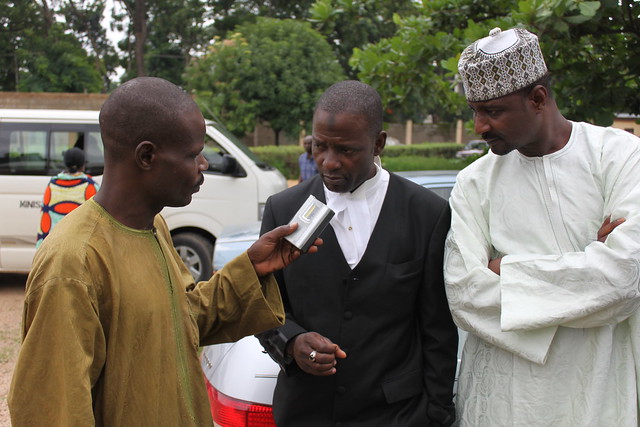
Fim Magazine Editor Aliyu Gora II, only a few weeks after his ordeal with the Kano State police, is back at work, interviewing Iyan-Tama’s lawyer Barrister Sani Muhammad Katu on the lawsuit against Abubakar Rabo Abdulkarim. Iyan-Tama listens in. (c) CM

In court on 22 July 2010, Iyan Tama’s lawyer, Barrister Sani Muhammad, protested the fact that legal counsel from the Kano State government were representing Abubakar Rabo Abdulkarim, saying that Iyan Tama was suing Rabo in his private capacity not in his position as director of the censors’s board and that Rabo should not be making use of Kano state resources in a private matter.  After the court was adjourned until September 23rd, I spoke to Barrister Rabi Suleiman Waya, the legal counsel for the Kano State government, and she told me,

“I am a state counsel, so apparently whenever a government official is sued, it is the state counsel who will come over and defend him, so he is sued as the director general of Kano State Censor’s Board, and as such it is the state counsel who will come and defend him.”
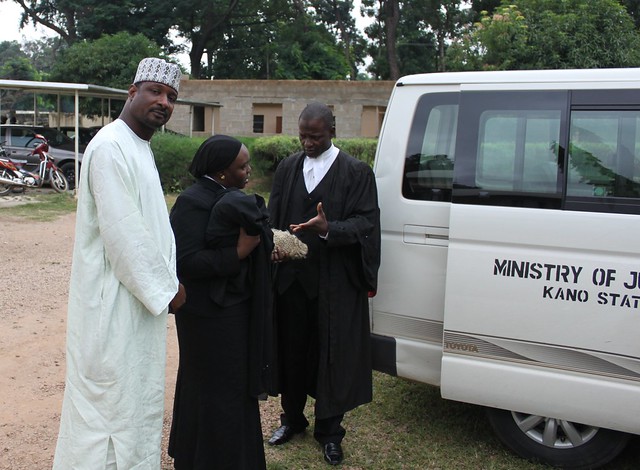
Iyan-Tama with Kano State lawyer Barrister Rabi Suleiman Waya, and Iyan-Tama’s lawyer Barrister Sani Muhammad Katu (c) CM

However, Iyan Tama’s lawyer, Barrister Sani Muhammad, countered that although the censor’s board had been on the initial summons, that was merely the address of service and was not referring to him in his official capacity:

“We are suing him in his private capacity, but he erroneously felt that because he is director of censor’s board, he now felt the best he could do was to use the government machinery […] so that government would now intervene, you understand? So that is why he now had to bring in a government lawyer. But the question of the law is very clear. If you are sued in your private capacity, that is private[…] So you have to engage a private legal practitioner.”

He pointed out that suing him in his private capacity places the plaintiff and the defendant on a more level playing ground, where Rabo does not have access to relatively unlimited government resources.

[UPDATE: 29 September 2010. Today’s Leadership reports that Rabo appeared in court yesterday, where his lawyer conceded that Iyan Tama had been registered with the proper government bodies.]

Readers may remember that Iyan Tama, who had, previous to the current Kano State censorship board administration, won awards from the Board for his positive portrayal of Hausa culture, has been arrested and jailed three times on accusations from the Board. His first arrest was on 8 May 2008, immediately on his return to Kano from the 2008 Zuma film festival after his film Tsintsiya won an award for Best Social Issue film. As can be read in more detail in Mansur Sani Malam’s Leadership article, Iyan Tama was charged with not having passed his film Tsintsiya through the Kano State Censor’s Board and operating his company without proper registration. According to his brother Dr. Ahmad Sarari and Iyan Tama himself, Iyan Tama had publically stated on the radio that his film was not for sale in Kano, and although the censor’s board claimed that he did not have a certificate to prove the renewal of his registration, Iyan Tama did have a receipt for the renewal. Apparently the censorship board had not issued anyone a certificate until after Iyan Tama’s initial arrest. Released on bail, Iyan Tama was again imprisoned when the court location for his trial was changed without informing him and he came late to court. His final arrest came in December, when he was sentenced by the mobile court attached to the censorship board to three months in prison. He served almost the entire sentence in the Goron Dutse prison, before being released in March by a judge who called for a retrial. According to Ibrahim Sheme,

“He was let out of prison this week, following a prayer to the High Court by the Kano State Attorney-General and Commissioner of Justice that the court should grant him bail and order for a retrial of the case. According to the Attorney-General, Barrister Aliyu Umar, the first trial was besmirched by irregularities. Due process was not followed in the trial that led to the conviction, he said. He used very uncomplimentary terms to describe the trial conducted by a senior magistrate, Alhaji Mukhtari Ahmed, such as “improper,” “incomplete,” “a mistake,” summing up by insisting that a “more competent magistrate” should be given the case to try again. Umar told the court presided over by Justice Tani Umar: “I am not in support of the conviction in this trial. It is obvious that the trial was not completed before judgement was delivered but there and then the presiding magistrate went ahead and delivered a judgement.”

Iyan Tama, who moved out of Kano following his release from prison hoping not to have any more run-ins with the censorshop board, was unpleasantly surprised when the director general came to Kaduna to repeat the same faulty accusations against him. Iyan Tama is now currently engaged in three different court cases: 1) the initial case brought against him by the censor’s board, which is currently under review; 2) a case in the Kaduna State Court of Appeal, where Iyan Tama  is protesting the ongoing review of the case, as he had already served the sentence of three months in prison; and 3) this lawsuit against Rabo for defamation of character.

I have followed Iyan Tama’s various court cases and the activities of the censorship board fairly closely over the course of this blog. Here is a list of past posts on the Iyan-Tama case and related matters that may be of interest:

On the Current Censorship Crisis in Kano, posted13 January 2009

Kano State High Court Chief Justice Postpones Iyan-Tama’s Appeal posted 22 January 2009

2:15am Raid on Iyan-Tama’s Family posted 23 January 2009

Iyan-Tama’s Case Not Listed posted 26 January 2009

Triumph/Trust Editorial Convergences posted 29 January 2009

Interviews with Alhaji Abubakar Rabo Abdulkarim, Director General of the Kano State Censorship Board, and Dr. Ahmad Sarari, Vice President of the Motion Pictures Practitioners Assocation of Nigeria posted 30 January 2009

The Mysterious Asabe Murtala/Muktar Writes Again posted 10 February 2009

Interview with Sani Mu’azu, President of Motion Pictures Practitioner’s Association of Nigeria (MOPPAN) posted 12 February 2009

Interview with Alhaji Abubakar Rabo Abdulkarim, Director General of the Kano State Censorship Board posted 13 February 2009

A Surprising Move by MOPPAN, and my friend Sulaiman Abubakar (MPEG) arrested on Tuesday posted 15 February 2009

Interview with Dr. Ahmad Sarari, Vice President of MOPPAN and brother of Iyan-Tama posted  16 February 2009

More Arrests along Zoo Road yesterday, and my article on Iyan Tama makes IPS front Page posted 17 February 2009

Update on the Iyan-Tama Case: Bail Hearing set for 5 March posted 19 February 2009

Updates on the Iyan-Tama case and other articles on the crisis in Kannywood posted 14 March 2009

Iyan-Tama granted bail, The Judge calls for a new Trial posted 17 March 2009

Raids on a film set last weekend and other developments in “Kano State Censor’s Board vs. Kannywood” posted 24 March 2009

Federal High Court strikes down Kano State Censorship Board’s objections; MOPPAN’s Lawsuit will go on posted 27 March 2009

Mobile Court bans listening to 11 Hausa songs posted 8 June 2009

Recent news on the activities of the Director General of the Kano State Censorship Board posted 24 June 2009

Arrest of singer Aminu Ala and the most recent scuffle of MOPPAN with the Kano State Censorship Board posted 6 July 2009

Breaking News: Singer Ala denied bail posted 7 July 2009

My notes on the court case of Aminu Ala today at the Mobile court attached to the Kano State Censorship Board posted 7 July 2009

Aminu Ala given bail on condition that he does not speak with media posted 10 July 2009

DG of Kano Censor’s Board taken before shari’a court posted 5 August 2009

The latest on the Iyan-Tama case from Nigerian News Service, plus new fees from the National Film and Video Censor’s Board posted 2 October 2009

Kano State Censorship Board shuts down Kano Music Festival hosted at Alliance Francaise, Kano posted 28 February 2010

Update: 3-day international music festival cancelled by Kano State Censor’s Board posted 1 March 2010

French Ambassador rejects the conditions of KS Censorship board for lifting ban on music festival, Punch reports posted 3 March 2010

Arresting the Music. Arresting Hope. Arrested for playing at a wedding “without permission” posted 11 March 2010

Interview with Hiphop artist Ziriums in this week’s Aminiya posted 18 April 2010

FIM Magazine Editor Arrested on accusation of Abubakar Rabo Abdulkarim, DG of Kano State Censorshop Board posted 4 July 2010

Kaduna State Filmmakers Association take Kano State Police, Court, and DG of Kano Censor’s Board to Court over breach of “fundamental Human Rights” posted 21 July 2010

American Documentary Showcase

Still from Kim A. Snyder's documentary One Bridge to the Next, featured in American Documentary Showcase

The Public Affairs Section of the U.S. Embassy and MOPPAN are partnering to bring a mini-documentary film festival to Kano today, Monday, 2 August 2010, and Tuesday, 3 August 2010. Documentary filmmakers Kim A. Snyder and Bart Weiss will be presenting the films and leading master classes for invited filmmakers.

Monday, there will be  documentary screenings open to the public from 2-4pm at Mambayya House, a simultaneous screening at the Department of Mass Communication, Bayero University, New Site from 2-4pm, and another screening at 7pm in the 1000-seater auditorium at Bayero University, New Site, at 7pm.

For more details see the longer entry, I posted on the Hausa Home Video Resource Centre website.

Kaduna State Filmmakers Association take Kano State Police, Court, and DG of Kano Censor’s Board to Court over breach of “fundamental Human Rights”

Just a quick post as a place holder for a longer post on the most recent event in the series of suits and countersuits between Kaduna filmmakers and Abubakar Rabo Abdulkarim, director general of the Kano State Censor’s Board.

Today, at the Kaduna State High Court the Kaduna filmmaker’s association filed an

“amended statement and additional affidavits in the matter of an application by Ashiru Sani Bazanga [Vice president, Kaduna Filmmakers Association] and 11 others for the enforcement of their fundamental human rights as guaranteed by sections 34, 35, 37, 38, 39, 40 and 41 of the constitution of the Federal Republic of Nigeria 1999, Articles  4,5,6,8,9,20,11, and 12 of the African Charter of Human and People Rights and under the Fundamental Human Rights (Enforcement Procedure) Rules 2009.

The lawsuit is between the applicants 1. Ashiru Sani Bazanga, 2. Mohammed Rabiu Rikadawa, 3. Aliyu Abdullahi Gora, 4. Sulaiman Sha’ani, 5. Musa Aminu, 6. Jamilu Adamu, 7. Abubakar Sani, 8. Tahir I. Tahir, 9. Tijjani Asase, 10. Yusuf Haruna, 11. Yakubu Lere, and 12. Adam Zango and the respondents 1. Commissioner of Police, Kano State; 2. Attorney General and Commissioner of Justice, Kano State, 3. Chief Magistrate Court 25 Kano, Kano State; 4. Abubakar Rabo. The applicants are seeking damages of Ten Million Naira as compensation for the “violation of the applicants fundamental human rights.”

I attended court this morning, and sat beside Tahir I. Tahir before he was called to the witness stand with the 8 other applicants who had shown up. Eventually, after the lawyer for the case, Mohammad Sanusi, presented the case, the defending lawyer had very little to say, and the case was adjourned until 27 July 2010. I took about 3 pages of illegible notes, admittedly understanding very little of the proceedings. Fortunately, afterwards I was able to have an interview with the leading lawyer for the Kaduna Filmmaker’s Association on the case, Mohammed Sanusi, and also with Yakubu Lere, President of the Kaduna Filmmaker’s Association. I will add more of the details I learned from them in a later post, along with a few photos of people who attended court today and documents of the ongoing case. My multilinks internet does not seem to work very well in Kaduna, so I might have to wait until I leave the city to upload all my photos.

In brief, the complaint of the Kaduna filmmakers is chiefly that their fundamental human rights, as Kaduna citizens, have been breached by the intimidation of Rabo and the Kano state police and court system, beginning with Rabo’s inflamatory remarks on DITV Television on the 13th and 14th of May, urging “Kaduna people to stand up against them [the filmmakers’ and make sure they send them out of Kaduna state” (as quoted from the original complaint made 28 May 2010) and continuing with the Kano state police intimidation in Kaduna state. Kano state police were sent to arrest the 12 applicants in Kaduna state, on Rabo’s accusation of having recieved death threats by text message from three phones. (At least one of the phones was traced to a woman who did not appear on the list for arrest.) However, the police came and the arrest was made without the awareness or permission of the Kaduna State Commissioner of police. Yakubu Lere narrated how the Kano police came to his house several times and intimidated his family in his absence. They apparently also visited Abubakar Sani’s office and Adam Zango’s studio, but didn’t find either of them there. They did find Aliyu Abdullahi Gora, editor of FIM Magazine, in his office, arrested him on Wednesday the 30th of June, held him overnight in a Kaduna police cell, and then took him to Kano on 1 July, Thursday, where he was put in prison. The judge did not show up to court two days in a row, so Gora was held over the weekend, until Monday, 5 July, when the judge gave him bail on the condition that a Level 17 or higher civil servant or businessman based in Kano post bail for him. He was not able to meet these conditions until 6 July 2010. In adding up those dates, you can see that he was detained by the Kano police for exactly a week.  Yakubu Lere told me that although immediately after Gora’s arrest while he was still in Kaduna, the Kaduna filmmakers had obtained a stay of arrest from a Kaduna judge, the police went ahead and took him to Kano. In the photocopy I have of court order, it shows that the 12 accused filmmakers applied for a staying order on 2 July 2010, and it was approved on the 7th of July. In Yakubu Lere’s affidavit  he mentions the irony

11. That some members and more particularly 1st to 6th Applicants filed complaints against the 4th Respondents for the offence of Criminal defamation of character, inciting disturbance of public peace which were all committed in Kaduna as indicated in Exhibits 2 and 3 repectively

and

18. That the 4th Respondent has recently used the 1st, 2nd and 3rd Respondents to humiliate, harass, and intimidate the Applicants to forgo their complaints.

Note that the 6 filmmakers who initially filed the complaint against Rabo for defamation of of character on 28 May 2010 (Ashiru Sani Bazanga, Moh’d Rabiu Rikadawa, Aliyu Abdullahi Gora II, Suleiman Sha’ani, Musa Aminu, and Jamila Adamu) were among those fingered by Rabo as allegedly having sent him the death threats by text message.

Note also, that the continuation of Director Iyan Tama’s lawsuit against Abubakar Rabo Abdulkarim is set for this Thursday, 22 July 2010.

Stay tuned for more details, including excerpts of my interviews with the lawyer and several filmmakers involved with the case, and photos of documents. For more background information, please see my detailed post on the events leading up to this lawsuit.

[UPDATE: 30 July 2010: On 27 July 2010, the judge in Kaduna upheld the right of Abubakar Rabo Abdulkarim to make a complaint to a Kano court; however, he fined the Kano state police N100,000 for unlawful detention of Aliyu Gora)

Construction Company Bull-Dozes 500 year old Kano Monument–Kofar Na’isa


Weekly Trust article (17 April 2010) on the demolition of Kofar Na'isa in Kano

There is a lot of road construction going on in Kano, which brings hopes of smoother traffic in the future, but in the meantime makes for terrible go-slows. Another side-effect of the road construction has been the demolition of structures in an attempt to widen the roads. From what I’ve seen, the widened roads are creeping quite close to the edges of the ancient nearly thousand year old Kano wall, although there do seem to be efforts along BUK road to construct iron fences between BUK road and the wall. (According to the Kano State Tourism website, construction on the wall began in 1112 AD.) I didn’t think too much of it until today, when I read an upsetting story in the Weekly Trust by Jaafar Jaafar, Naziru Idris Ya’u and Mubarak Hassan Usman describing the destruction of one of the fifteen ancient city gates embedded into Kano wall by a road construction company.

An old monument of the ancient city of Kano, Kofar Na’isa, was demolished by a construction company in order to pave way for the ongoing road expansion in the state. Many metropolitan roads in Kano state are now undergoing expansion and reconstruction. Withstanding the greatest winds and rains of history for about five centuries ago, Kofar Na’isa stood firm without interference until last week when the construction firm rolled out its bulldozers against the gate.

The article continues:

Lamenting the destruction of the gate, the curator of the National Museum, Gidan Makama, Malam Aliyu Abdu, said the demolition has serious consequences on the cultural authenticity of Kano city walls, saying it is an infringement on a cultural site undergoing preparations for the World Heritage listing.

“The gate is over 500 years. Whatever kind of road that will be constructed, the sanctity of the old relic must be respected,” said the curator.

According to him, the museum cannot stop road construction but the gate should either be bypassed or let be. “We are supposed to be notified so that we direct how the monument would be carefully restructured but not to be demolished completely without our consent,” said the curator.

Continuing, he said: “the destruction of the site also constitutes a grievous setback to the conservation plan adopted by the National Commission for Museums and Monuments and the stakeholder committee on Kano city walls towards the preservation of the heritage sites of this great city.”

Malam Abdu said the NCMM in conjunction with the state government was preparing to submit Kano city walls and associated sites to UNESCO for enlistment into the World Heritage List.

“Already this demolished gate had been included in Nigeria’s tentative list and is receiving favourable attention as one of the sites with great potentials for the World Heritage enlistment,” he lamented.

While calling on government and private companies to desist from destroying the monuments, he said the museum will drag the construction company to court for wanton destruction of a national monument.

Also lamenting the destruction, the present lord of the demolished gate, Malam Abdullahi Usman, expressed displeasure with the destruction of the historical architectural piece. “The gate was demolished on April 19, without my permission as the custodian of the gate, nor the permission of the Emir of Kano, Alhaji Ado Bayero,” he said.

He further said the construction company desecrated the historical relic, saying Emir Bayero has convened an emergency meeting with the district heads and those who are responsible to look after the gates. “The emir was really bitter about the demolition,” said the lord of the gate.

Unfortunately, the Weekly Trust article does not list the name of the construction company which bull-dozed the gate, or information on who would have given the go-ahead to destroy a national monument “protected by law under the National Commission for Museums and Monuments (NCMM) Act, CAP 19 of the laws of the Federal Republic of Nigeria, 2004, vol X Chapter 19.” However, when I went in search of more information, I found another article in the SundayTrust of 11 April 2010 describing the demolition, meaning the news is over a week old now. Right before I posted this post, I also heard from another source that the name of the construction company that demolished the gate was Kano-based Triacta Nigeria Limited.

The demolished gate is pictured on the Kano Tourism website here, along with a colourful story about the construction of the gate:

Emir Suleiman received a complaint from the nomadic Fulani that they were attacked by a group of thieves who took away their cattle.  The Emir directed his son, Abubakar Mai Unguwar Mundubawa to go along with the complainants and capture the thieves at all cost.  At the end of the mission, the son of the Emir returned late and was disallowed by the gatekeeper to pass through the Kofar Dogo with his people.  There and then he decided to break a part of the wall close to the then Kofar Dogo (Dogo Gate).  It took them five days to complete the new entrance.  He then ordered the removal of the metal gate of Dogo, and fixed it at the new one called NA’ISA and blocked Kofar Dogo.  The gate was renamed Kofar Na’isa by Emir Suleiman.

A October 9, 2008 Daily Sun article describes other Kano City Gates that have been sacrificed to road widening exercises:

Owing to the pressures of traffic, it became necessary to expand or “dualize” some major roads in Kano. Thus, some of the antique gates had to give way. Among the gates, which proved too narrow, were “Kofar Nassarawa,” “Kofar Mata” and “Kofar Wambai.” Unfortunately, the original clay structures were replaced with massive concrete gates. However, Hambolu seven years ago commended those who handled the renovation for their wisdom in incorporating elements of Hausa traditional architecture into the design of the new gates.

Arresting the Music. Arresting Hope. Arrested for playing at a wedding “without permission”

Last night I wrote a post about a story my friend told me about some musicians being arrested for playing at a wedding “without permission.” However, since the case is still ongoing, I have decided to take down the post until things are a bit more settled.

[UPDATE: 16 March 2010: Abdulaziz A. Abdulaziz has just published a story in Leadership on the Alliance Francaise episode  that mentions the incident I am referring to here:

Meanwhile a six-man band known as Police Band who perform at weddings in the state was equally smashed by agents of the board on allegation that they were performing without a permit of the board. The band is led by one Solomon alias Solo, an emerging entertainer.

Members of the band were mopped up and taken to a court which subsequently sentenced them to six months with an option of fine of N20, 000. The group was thrown behind bars but was later released after paying the fine.]]

When I first heard about this story, my friend told me that the Police Band was registered with the Kano State History and Culture Bureau….

Readers may remember that two weeks ago, the Kano State Censorship Board also shut down a 23,000 euro international concert organized by the French embassy and the Kano State History and Culture Bureau, being hosted at the Alliance Francaise, for not “seeking permission” to hold the event.

French Ambassador rejects the conditions of KS Censorship board for lifting ban on music festival, Punch Reports

Today’s Punch carries an update on the recent cancellation by the Kano State Censorship Board of KAMFEST, the annual music festival hosted at the Alliance Francaise. [It took my browser a long time to open the Punch link. If you can’t get it to open, you can also find the article by Oluwole Josiah at Online Nigeria, unfortunately not credited…]:

The French Embassy has said it would not accept the conditions given by the Kano State Film Censor Board for lifting the ban on the annual music festival known as KANIFEST.

It also said it was unsure of staging the annual festival this year or next year, as the position of the Kano State Government would determine the fate of the festival.

French Ambassador to Nigeria, Jean-Michel Dumond, told our correspondent in an exclusive chat on Monday that discussions with the officials of the censorship board revealed that they were targeting one of the participating singers who was said to have criticised the board for banning music within the state.

He said the board wanted the singer to be withdrawn from the concert, but that condition was not acceptable to the embassy.

“We don’t want to be involved in that kind of situation where it has to do with this person or that person. Ours is to ensure that we promote culture and get the festival to benefit the people.

“If it is reduced to an individual or dealing with one person or the other, we are not interested in that. We have been discussing with the officials of the government, and we do not really have anything to do with the censorship board,” Dumond said.

He noted that the Kano State Governor was not aware of the decision of the censorship board and would be seriously disappointed at the turn of events.

To keep reading the Punch article, follow this link.

When I heard about the closure of the event on Saturday, I was told by filmmakers the rumour that the reason the event had been shut down was because popular Hausa singer Maryam Fantimoti, called the “the box of songs” by Hausa comedian Ari Baba (as cited in FIM Magazine, July 2009, p.41)  was slated to perform. (Maryam was also one of the finalists in Partners in Transforming Health in Nigeria in 2009). In a July 2009 interview with Fim Magazine, Fantimoti responded to a question about registering with the Kano State censorship board (my translation in italics):

Ana ta zuwa ana rijista da Hukumar Tace Finafinai ta Jihar Kano. Ke kin je kin yi kuwa?

People are going to be registered with the Kano State Film Censor’s Board. Have you gone?

Ban je ba, kuma ban yi ba, domin ni dai ba kamfani ne da ni ba, koyaushe ina gidan mu; in ka ga na fita an bugo waya ne ana nema na sannan in fita.

I haven’t gone, and I haven’t registered, because I am not with a company. I’m always at home. If you see me go out, it’s because I have been called [to work], that’s when I go out.

Ai ba kamfani ba, wai a matsayin ki na mawakiya tunda mawaka ma duk su na zuwa suna yi.

Not that you are a company, supposedly it’s supposed to be done because you are a musician, since all the other musicians are going to do it.

Ni ban sani ba, domin ban ga takarda a rubuce ba, kuma ni komai nawa cikin tsari na ke yi. Kai, ni tun da na ke jin mawak’a, na ke jin labarin su, ban tab’a jin an ce Shata ko Garba Supa ko D’ank’wairo ko Hassan Wayam da Barbani Choge sun yi ko suna da rijista ba. Shi kenan kuma don mu aka raina sai a ce sai mun yi wata rijista?

Me, I don’t know, because I haven’t seen anything written on it; everything I do is done properly and in order [NOTE: the translation of this last sentence could be off.] Kai, ever since I have listened to singers and heard news about them, I’ve never heard that [a list of older “traditional” Hausa musicians] Shata or Garba Supa or  D’ank’wairo or Hassan Wayam or Barbani Choge were registered. So, now we are held in contempt unless we go and do some registration?

[Note, that on the question of individual registrations for musicians, writers, or filmmakers, Director of the Kano State History and Culture Bureau (a Kano state government agency which helped plan the music festival), Ali Bature opined, when I asked him, a few days ago, that there was no such specification in the Kano State censorship law. The entire censorship law can be found in the library of the Kano State History and Culture Bureau for those interested in looking through it. If this interpretation of the law is correct, Maryam’s understanding that it was only companies that were supposed to register with the censorship board would be correct.)

Although Maryam Fantimoti was not able to perform at the music festival that was shut down by the Kano State Censorship Board, you can hear her singing along with DJ Yaks on his song “Rukky,” one of the songs featured (timecode 12:09) during the recent 26 February interview VOA did with DJ Yaks. ” (The link to the sound file is here–the written interview here.) “Rukky” can also be found on DJ Yak’s myspace page. (Please note that DJ Yak’s music is not for sale in Kano.) I will link to any other of Maryam Fantimoti’s music I can find online, as I find it.

She is also the female voice in the songs featured in the Hausa film Zo Mu Zauna

Update: 3-day international music festival cancelled by Kano State Censor’s Board

Daily Trust, 1 March 2010, p. 7

In an update to my last post, I spoke briefly today with Alain Service, the director of the Alliance Francaise in Kano, and he confirmed that the Kano State Censor’s Board sent a letter to the Alliance Francaise about two hours before the three-day KAMFEST music festival, an annual event that has taken place at the Alliance Francaise for the last 6 years, was to begin. Service said the letter told them to stop the festival. He claimed that the letter gave no other reason for cancelling the event other than saying that they had no right to hold the event without informing the Censor’s Board.

There were also brief articles in the Daily Trust and by AFP about the cancellation of the three-day event, which was to feature artists from Nigeria, Niger, Chad, and France.

The AFP news report says:

Sharia police ordered the closure of an annual music festival funded and organised by the French embassy in northern Nigeria at the weekend, local officials and diplomats said on Monday.

“We have banned the music festival for the reason that we were not notified and our permission was not sought,” Abubakar Rabo Abdulkarim, head of the film censorship board in the northern Kanoregion, told AFP.

The French embassy said they had been told they could not stage the event at the local French cultural centre as they did not have prior authorisation.

“Following a notification by the Kano state censorship board, the Kano festival of music is cancelled” the French embassy said in a statement emailed to AFP.

The embassy has organised the three-night KANFEST music festival for the past six years through its cultural centre in Kano, featuring performances from Nigeria and other African countries as well as French musicians.

It seems strange to me that the Kano State Censor’s Board had the power to halt the event, when another Kano State agency, the History and Culture Bureau had helped in planning the event. One person I spoke to at the Alliance Francaise said that she thought the Censor’s board was limited to censoring films, but that since the event was cancelled at the Alliance Francaise she had heard that the censor’s board is saying that even performances at weddings have to gain permission from the censorship board ahead of time. When I asked the director of the History and Culture Bureau, Ali Bature about the relationship between the two state agencies, he said that the History and Culture Bureau had a “cordial relationship” with the Kano State Censor’s Board and had in fact been instrumental in helping to found the board in 2000 as a way to protect filmmakers and allow them to continue making films after the establishment of shari’a law in Kano State. He did, however, note, when I asked him, that there was no legal basis in the Kano state censorship law, for the individual registration of artists. He said the expectation was that guilds would be registered with the censor’s board but that individual artists were the guild’s responsibility. A copy of the entire Kano State Censorship law can be found in the Kano State History and Culture Bureau, for anyone who would like to peruse it. According to film industry practitioners I have spoken to, censor’s board workers on multiple occasions(one such occasion is described in one of my March blog posts) have visited locations of films being made in Kano to check whether each member of the cast and crew is individually registered with the board. Although I was not able to confirm this with Mr. Service, the rumour I have heard from multiple sources is that part of the reason the Censor’s Board shut down the event was because Maryam Fantimoti, who is not registered with the Censor’s Board, was slated to perform at the event.

[[UPDATE 3 March 2009. In an article in today’s Punch, “France Rejects condition for lifting ban on Music Festival,” [If you have trouble getting the link to open, you can also find the article copied here] Oluwole Josiah reports:

French Ambassador to Nigeria, Jean-Michel Dumond, told our correspondent in an exclusive chat on Monday that discussions with the officials of the censorship board revealed that they were targeting one of the participating singers who was said to have criticised the board for banning music within the state.

He said the board wanted the singer to be withdrawn from the concert, but that condition was not acceptable to the embassy.

“We don’t want to be involved in that kind of situation where it has to do with this person or that person. Ours is to ensure that we promote culture and get the festival to benefit the people.

“If it is reduced to an individual or dealing with one person or the other, we are not interested in that. We have been discussing with the officials of the government, and we do not really have anything to do with the censorship board,” Dumond said.

He noted that the Kano State Governor was not aware of the decision of the censorship board and would be seriously disappointed at the turn of events.

Josiah also reports that:

The French Embassy has said it would not accept the conditions given by the Kano State Film Censor Board for lifting the ban on the annual music festival known as KANIFEST.

It also said it was unsure of staging the annual festival this year or next year, as the position of the Kano State Government would determine the fate of the festival.]]]

Today, I passed by a roundabout near the government house several times, and the banner advertising KAMFEST was still there, flapping abandoned in the breeze.

Kano State Censorship Board shuts down Kano Music Festival hosted at Alliance Francaise, Kano

I was told the following information by several people I will not name. I cannot, at this moment, verify the details of this report, only that it is oral testimony (over the phone) from several people who were involved in the event. I hope to talk to someone in the administration of the Alliance Francaise tomorrow to get more concrete details.

Apparently, yesterday, 26 February 2010, the three day Kano Music Festival, being hosted at the Alliance Francaise in Kano was shut down on the first day of the event by representatives of the Kano State Censorship Board and not allowed to continue with the rest of it’s scheduled events. According to one person I talked to, the festival was closed down because Hausa musician Maryam Fantimoti was to perform and she was not registered with the Kano State Censorship Board.

The organizers of the event had brought musicians from other parts of Africa and Europe to perform at the music festival. According to one press release on the Guide 2 Nigeria website:

There will be performances from several musical groups from across the globe including the famous Soubyana Music from Chad, the Dangana group from Niger, the Nassiru Garba group from Nigeria and the Trio Belhumeur from Upper Brittain.

Another source told me that over 20,000 euros had been spent on the cultural event, which did not end up holding, as it was closed by representatives of the Kano state government.

The Alliance Francaise has hosted the Kano Music Festival (Kamfest) for six years in a row.  The event had the support of the Kano State History and Culture Bureau.

Readers may recall that this is coming on the heels of a recent closure of 15 shops by the Kano State Censorship Board for selling films on the history of Islam. The Kano State Censorship Board has also been responsible for multiple arrests and business closures of those working in entertainment related fields. In a related closure of a cultural event, the hisbah closed down a fashion show organized in honour of designer Zainab Hamza in May 2009.

Kano State Censors Board bans films on the history of Islam and the prophets and shuts down 15 shops

"Kano films censors board shuts 15 shops," Sunday Trust, 14 February 2010, p. 33

Two days ago (my internet has been down for a day and a half–thus the delay in posting this), I read in the Sunday Trust and the Hausa language weekly Aminiya a story I had heard from filmmakers a week and a half ago before my trip to Abuja. I hadn’t blogged about it because I had only heard ji-ta-ji-ta (rumours) about it, but the newspapers confirm the story.

Apparently, according to Ruqayyah Yusuf Aliyu in the Sunday Trust, 14 February 2010, page 33, “Kano films censors board shuts 15 shops,” the Kano State Censorship Board closed 15 video shops over “selling tapes of the history of Prophet Yusuf.” (Unfortunately, I have not been able to find the link to the article online. If I find it, I will link to it here. In the meantime, here is a photograph of the article.)

The Director General of the Kano State Censorship Board, Abubakar Rabo Abdulkarim, “said in an interview in Kano that

“banning the sales of such films has become necessary as it is against the teachings of Islam and therefore will not be allowed in the state.”

Rabo also mentions that

“under aged children who can easily be influenced are also involved in hawking such films along the streets without knowing the implications. He also said the ban was as well in the interest of potential customers who might not get to these children even if they found the films were bad.”

In response,

[S]ecretary of the Kano film sellers association, Malam Isa, described shutting down the shops by the censorship board as unfortunate as the director general of the board did not keep to the promise of briefing them on what stand it is taking on the sales of the film before acting.

“I can recall that the DG sometimes in October last year invited us for a meeting at A Dai Daita Sahu and during the meeting, one Islamic scholar, Malam Aminu Daurawa, mentioned that watching the film was not appropriate and after the meeting, we met the DG at his office on the matter and he told us that was just a dialogue among scholars which does not involve us. He then promised that he was going to inform us on any development thereafter but unfortunately he didn’t. The next thing we saw was the closure of the shops” he said.

Malam Isa said that the film sellers:

“have reported the case to the Emir of Kano and as Muslims we are ready to comply with the ban so long as it is Islamic scholars that will come together to prove that the film is contrary to the teachings of Islam.”

He also lamented the loss of business this was causing to the shop owners saying:

“business has been their major source of livelihood and now that the board has closed the shops, these people are finding it hard to survive.”

The Hausa weekly Aminiya, 12 February 2010, provides more details. I will provide a summary of the article in English here—please note that this is NOT a direct translation but a summary in my own words.

Bashir Yahuza Malumfashi writes in “Hukuma ta haramta sayar da fina-finan tarihin Musulunci a Kano” (p. 21) (“The [Censor’s ]Board bans selling films on the history of Islam in Kano”) that the director of the censors Board Malam Abubakar Rabo went to the Kofar Wambai market and closed four shops where they were selling films on the history of Islam, specifically the film on the history of the Prophet Yusuf [Joseph] and the film The Message.

In a radio program on Radio Kano, DG Abubakar Rabo said that “the censors board had closed 15 shops in Kano and he warned others who were selling the films.”

Aminiya reporters went to the Kofar Wambai market to see the shops that had been closed, and one of the film marketers, Musa Abdullahi Sanka who started selling film cassettes in 1976, said that the story was true. The Censors board had come and closed shops selling films on the history of the Prophet Yusuf and the history of Islam, The Message.

When Aminya asked Abdullahi Sanka what reason the Censors Board had given for closing the shops, he said that the censors said that they should stop selling the film because apparently there were some Islamic scholars who had issued a fatwa on selling films on the history of the prophets, saying such films were not appropriate.

The marketer responded saying that the businessmen wanted the well-respected Islamic scholars in Kano to come together and say whether the films were appropriate or not. If they said they were not appropriate, then how could they correct them? If they gave very strong reasons for banning the films, then the marketers would stop selling them.

The marketer told Aminiya that four shops in Kofar Wambai had been closed: that of Alhaji Salisu, that of Ahmadu Hussaini, that of Anas, and another Igbo marketer whose name he did not give.

He said that the film sellers got the films from Misira, others from Lagos, others were brought from Arab countries. He said that he had heard that the film on the Prophet Yusuf (Joseph) was made by Shi’a in Iran, and that is why the Censorship Board had cooperated with the fatwa of an Izala scholar against the film.

When he was asked if he had seen the film and if it seemed to be appropriate, he said that he hadn’t seen the entire film but that he remembered how when he had been fifteen years old, the late Islamic Scholar Sheikh Nasiru Kabara had told the history of the Prophet Yusuf, and what he had seen of the film followed exactly what the scholar had told them.

The Secretary of the Film sellers association of Kofar Wambai Market, Malam L. Isa said that the discussion with the Censors board had started last year. The Censors Board had invited them to a meeting organized by A Dai Daita Sahu (the government sponsored Societal Reorientation Directorate) on 24 October, where it was said that Sheikh Aminu Daurawa had preached a sermon in which he said that it was not right to watch this type of film on the history of the Prophet Yusuf. “When we heard this, we asked the director of the Kano State Censorship board about this. He told us we shouldn’t worry that it would not affect us. But we were surprised that day, without notice, without letting us know, people came to the market and closed shops belonging to those in our association.”

He said that after the shops were closed, they complained to Malam Rabo who did not listen patiently to them. This is why they went with their complaint to the Emir of Kano. “What is happening with us right now. We went to Director Malam Rabo, but he didn’t listen to us or give us any good answer. He even kicked us out, so we got up and we went to our father, the emir of Kano, and carried our complaint to him. Since there are big men in power, we should let them know what is going on with us—If they don’t know what has been happening, they will now know.”

The Secretary continued,” We called on the emir to negotiate between us and Malam Rabo because we have been obeying the government and the censors board, but now there is no understanding between us. People were sent from the board to us without anyone letting us know there was  such a law.”

Another marketer Alhaji Nasiru Ibrahim K’ok’i, better known as Palasd’inawa, also expressed his unhappiness at the actions of the Censor’s Board. He said that they had been watching films on the lives of the prophets since they had been children. On Muslim holidays, the Kano state television station used to play them.

“It shouldn’t be that the judgment of a single Islamic scholar becomes the basis of the entire Muslim culture. Now Malam Rabo should tell us what kinds of films that we should be watching, because they have banned Hausa films saying that they are spoiling women and children. So now why are they banning films on Islamic history, since no one can say they are spoiling culture?’

The director of the Kano State Censors Board, Malam Abubakar Rabo Abdulkarim explained the reason for the ban. He said that it is in accordance with the culture and the findings of Islamic scholars who said that such films were not fitting as they were not respectful to the prophets.

The gist of Malam Rabo’s statement was that the Kano State Censors Board was created keeping in mind Islam and the judgments of Islamic scholars who guide the community. The board had heard from the association of Islamic scholars and other religious organizations that people were trying to make money on offensive films made about the lives of the messengers of God. He also noted that they had called a meeting through a Dai Daita Sahu (Societal Reorientation Directorate) where one of the Islamic scholars had shown the danger of these types of films that were insulting to the Messengers of God and culture.

Malam Rabo said that this is the reason the Censor’s board said that the selling of these types of films must stop because it was not fitting to show another man in the film claiming to be the Messenger of God. He further said that the Board would continue to hunt down those who brokered and spread films in Kano state, especially, he emphasized, those who were selling films on the sides of the roads because this is illegal.

To read the article in Hausa, see the photo of the article here:

Board bans selling films on the history of Islam in Kano”], Aminiya, 12 February 2010, p. 21″]

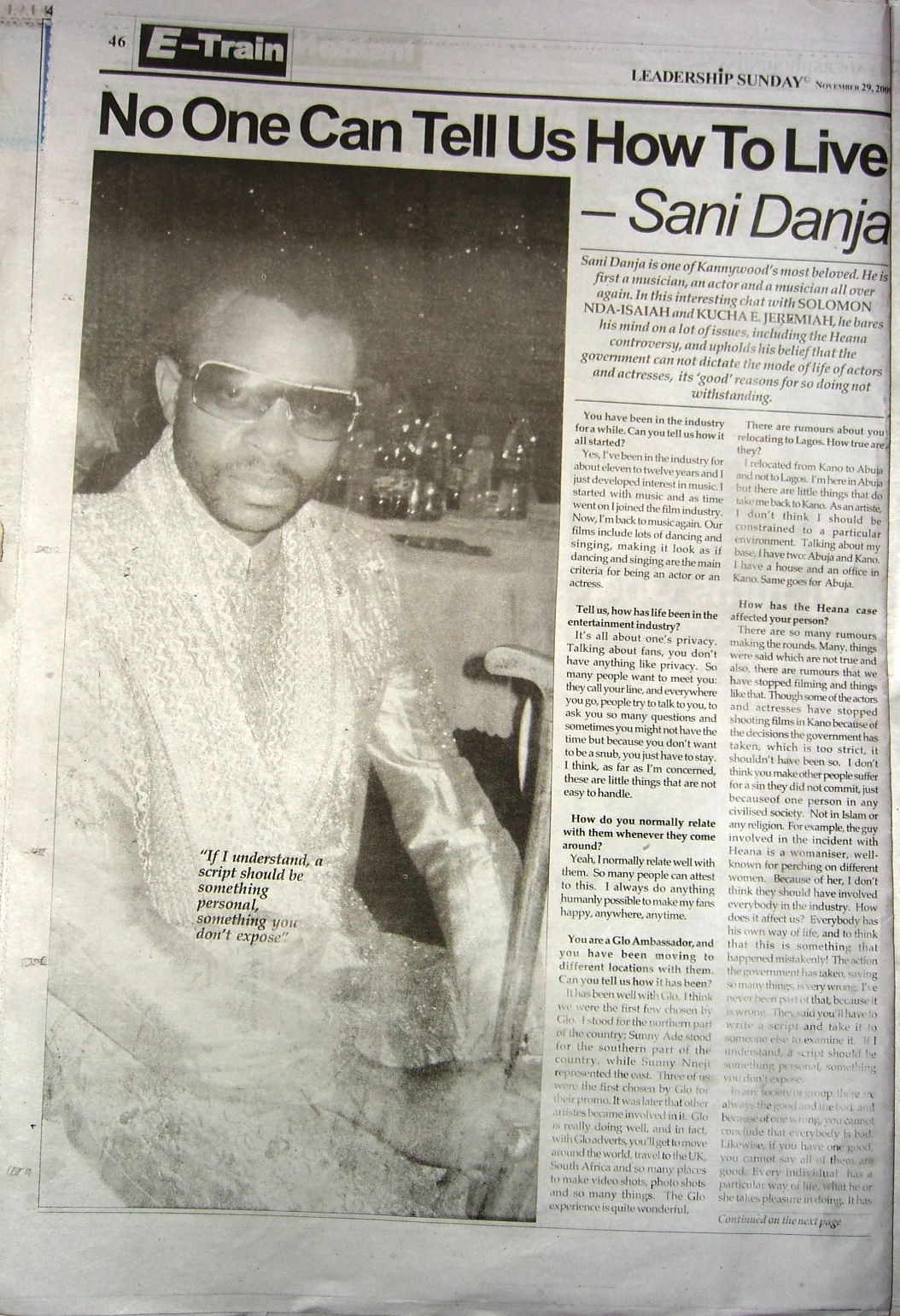
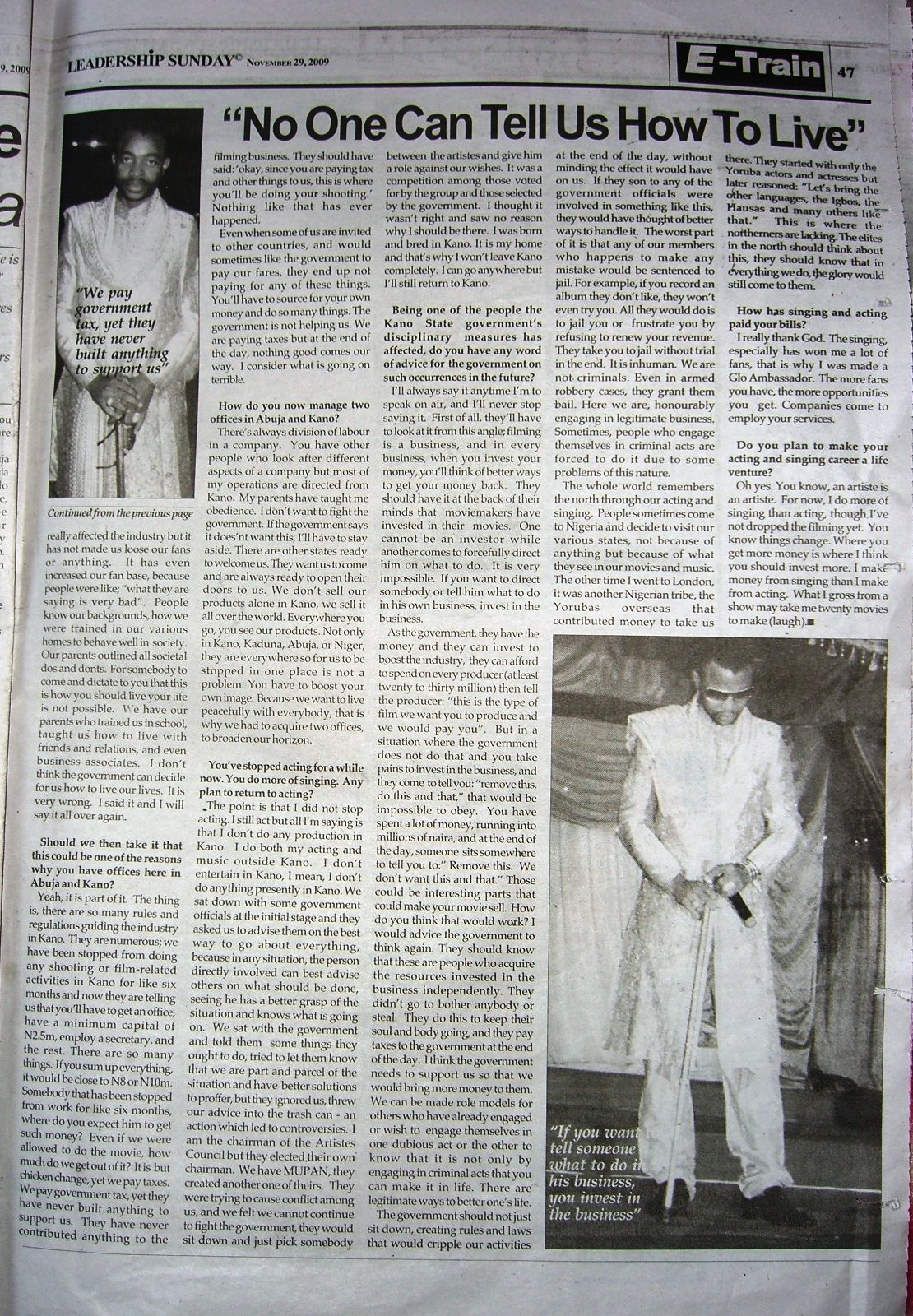
“No One Can Tell Us How to Live”:Interview with Sani Danja in Sunday’s Leadership

There is a great interview that Solomon Nda-Isaiah and Kucha E. Jeremiah did with Hausa film and music star Sani Danja in this week’s Sunday Leadership. Since I can’t find the online version of the article, I will post a photo of the hard copy here and a few excerpts from the interview. This article comes from Leadership Sunday, November 29, 2009. Pages 46-47. (Unfortunately, after posting I realized that the text is not big enough to read. To read, you might have to download the photo and read in a photo viewing program.)

In the article Sani Danja talks about his music and film career, his activites as a Glo ambassador, and his opinions on the recent actions of the Kano State government on Hausa filmmakers.

Here are a few excerpts. To read fully, you may have to download the photo:

When being asked about the reasons he decided to relocate to Abuja, although having offices in both Abuja and Kano, Danja says

“The thing is, there are so many rules and regulations guiding the industry in Kano. They are numerous; we have been stopped from doing any shooting or film-related activities in Kano for like six months and now they are telling us that you’ll have to get an office, have a minimum capital of N2.5m, employ a secretary, and the rest. There are so many things. If you sum up everything, it would be close to N8 or N10m. Somebody that has been stopped from work for like six months, where do you expect him to get such money? Even if we were allowed to do the movie, how much do we get out of it? It is but chicken change, yet we pay taxes. We pay government tax, yet they have never built anything to support us. They have never contributed anything to the filming business.

In response to the management of two offices in Abuja and Kano, he replies:

There’s always division of labour in a company. You have other people who look after different aspects of a company but most of my operations are directed from Kano. My parents have taught me obedience. I don’t want to fight the government. If the government says it doesn’t want this, I’ll have to stay aside. There are other states ready to welcome us. They want us to come and are always ready to open their doors to us. We don’t sell our products alone in Kano, we sell it all over the world. Everywhere you go, you see our products. Not only in Kano, Kaduna, Abuja, or Niger, they are everywhere, so for us to be stopped in one place is not a problem. You have to boost your own image. Because we want to live peacefully with everybody, that is why we had to acquire two offices, to broaden our horizons.

When asked if he had any advice for the government on disciplinary measures against filmmakers, Danja says:

First of all, they’ll have to look at it from this angle; filming is a business, and in every business, when you invest your money, you’ll think of better ways to get your money back. They should have it at the back of their minds that moviemakers have invested in their movies. One cannot be an investor while another comes to forcefully direct him on what to do. It is very impossible. If you want to direct somebody or tell him what to do in his own business, invest in the business.

As the government, they have the money and they can invest to boost the industry, they can afford to spend on every producer (at least twenty to thirty million) then tell the producer: “this is the type of film we want you to produce and we would pay you”. But in a situation where the government does not do that and you take pains to invest in the business, and they come tell you: “remove this, do this and that,” that would be impossible to obey. You have spent a lot of money, running into millions of naira, and at the end of the day, someone sits somewhere to tell you to: “Remove this. We don’t want this and that.” Those could be interesting parts that make your movie sell. How do you think that would work? I would advise the government to think again. They should know that these are people who acquire the resources invested in the business independently. They didn’t go to bother anybody or steal. They do this to keep their soul and body going, and they pay taxes to the government at the end of the day. I think the government needs to support us so that we would bring more money to them. We can be made role models for others who have already engaged or wish to engage themselves in one dubious act or the other to know that it is not only by engaging in criminal acts that you can make it in life. There are legitimate ways to better one’s life.

The government should not just sit down, creating rules and laws that would cripple our activities at the end of the day, without minding the effect it would have on us. If the son to any of the government officials were involved in something like this, they would have thought of better ways to handle it. The worst part of it is that any of our members who happens to make any mistake would be sentenced to jail. For example, if you record an album they don’t like, they won’t even try you. All they would do is to jail you or frustrate you by refusing to renew your revenue. They take you to jail without trial in the end. It is inhuman. We are not criminals. Even in armed robbery cases, they grant them bail. Here we are, honourably engaging in legitimate business. […]