In breaking news, the Hausa director and former gubernatorial candidate, Hamisu Lamido Iyan Tama has dropped his lawsuit for defamation against Abubakar Rabo Abdulkarim, the Director General of the Kano State Censorship Board in exchange for the board’s dropping of charges against him in a case that has dragged on for almost two years.
Iyan Tama at court in Kaduna, July 2010. (c) Carmen McCain
said the trial was “improper”, “incomplete”, a “mistake” and requires retrial before a more “competent magistrate”.
“I am not in support of the conviction in this trial”, said the attorney-general, “It is obvious that the trial was not completed before judgement was delivered but there and then the presiding magistrate went ahead and delivered a judgement”, he added.
The DG was dragged before the court by Iyan-Tama, who alleged that he had defamed his character in a television interview he granted DITV Kaduna earlier this year, when he allegedly stated that Iyan-Tama Multimedia was not formally registered as a moviemaking business enterprise.
Tonga continues with details of the continued court case, including that Rabo, who had previously refused court summons to lawsuits in Kaduna, finally showed up:
The court had sat twice without Rabo, before it subpoenaed him to appear in person after a request from the plaintiff’s counsel, Barrister Muhammad Sani Katu of solicitors Mamman Nasir and Co.
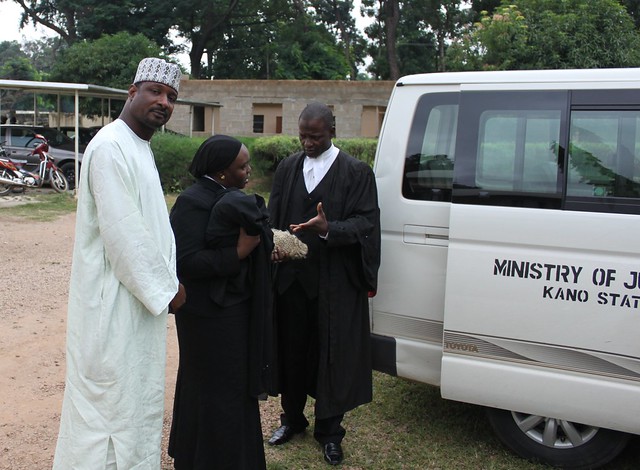
Rabo, who appeared to be limping yesterday, arrived the court at 9:05 a.m. in a Toyota bus belonging to the Kano State Ministry of Justice. He was accompanied by two state counsel, Rabi Waya and Sanusi Ma’aji, as well as the chairman of the censorship board, Malam Rabi’u.
He had never answered a court’s summons in the many legal cases filed against him by various movie practitioners in Kano and Kaduna during the past three years since he was appointed by Governor Shekarau to sanitise the film industry.
For more details of the “hot words” exchanged between the lawyers of the two parties, read the rest of Tonga’s article.
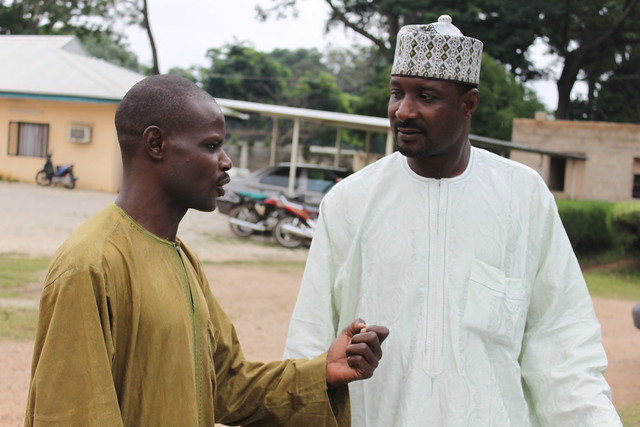
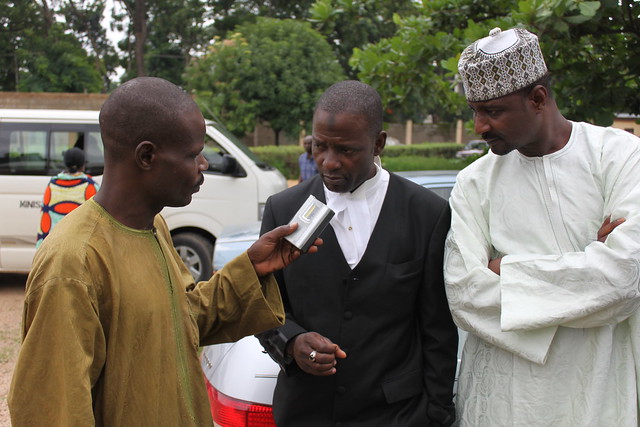
Iyan-Tama with Kano State lawyer Barrister Rabi Suleiman Waya, and Iyan-Tama's lawyer Barrister Sani Muhammad Katu outside of a Kaduna court, July 2010(c)Carmen McCain
According to the interview with Ruqayyah Yusuf Aliyu in today’s Sunday Trust, Iyan Tama said that
The resolution was reached as a result of consultations between my lawyers and that of Rabo where some terms were agreed upon. After we filed the case before a Kaduna High court over alleged defamation, claiming N10 million damages and Rabo failed to appear during the first two sittings saying his security needed to be guaranteed, my lawyer prayed to the court that it was important the defendant appeared and the court granted the plea by way of ordering that Rabo appeared while it guaranteed his security. […] My lawyer insisted that if I will have to withdraw the case, the censorship board will also have to withdraw its case against me which has been pending for quite a while at a Kano magistrate court.
According to Iyan Tama, the terms of settlement were as follows:
The first was that my company, Iyantama Multimedia was registered as a business name [… with] a certificate of registration KN/0010927 dated the 16th day of December 1997. The second term was that the defendant’s statement that led to the suit was based on a search report made at the corporate Affairs Commission for a limited liability company, and thirdly, that the parties in the suit have in pursuance of the pre-trial conference conducted on the 28th day of September, 2010 resolved to terminate the suit and the criminal case pending before Chief Magistrate Court 7, Nomans Land between the Kano State Censorship Board and Iyantama with case number KA/CMC/28/08.
Iyan Tama says that he didn’t “get anything as compensation” except for the public acknowledgment that he
was not operating illegally. I am happy that the world now knows that Iyantama has been operating legally since inception in 1997.
Hausa filmmaker and politician Hamisu Lamido Iyan Tama (photo courtesy of Iyan Tama)
Iyan Tama also talked extensively on the events leading to his imprisonment and his experiences in prison.
Being a filmmaker, I was amazed by every single little thing and therefore made friends with other inmates. I was more like a journalist in prison; I carried out series of interviews with the inmates from which I was able to gather dozens of ideas from which I am currently working to put into films. […] That is why I said being in prison has turned out to be a blessing to me and I never regretted it.
I was not able to find a link to the Sunday Trust article online, but I have scanned in a photo of the article on flickr. If you click on the photo below, it will take you to a version large enough to read onscreen.
"My stay in prison was a blessing--Iyantama" interview with Ruqayyah Yusuf Aliyu in the Sunday Trust, 17 October 2010
The Iyan Tama case has been one of the ones I have followed most closely on this blog, since he was imprisoned at the end of December 2008. For a list of articles and posts I have written related to the case, see the following links:
Triumph/Trust Editorial Convergences (a piece that looks at editorials written about Iyan Tama that claim that his company was not registered with CAC), 29 January 2009
A few months ago, the editor of Weekly Trust, offered me a column in the paper, and my first piece came out this past Saturday on page 31. In my column-writing rookieness, I had misunderstood the word count he had quoted me, so, once I saw it published, I was awe-inspired by my editor’s skill in cutting down a piece that had been twice the length, while still keeping most of the flow. However, I decided that since I do have this blog, I would post the longer version of the piece here, which allows for more details and context, and where I can post a few more photos to illustrate the content. I’ve gone ahead and taken a few of the suggested cuts, so this is a hybrid between what I submitted and what was published. The photos and the column title “My Thoughts Exactly” that appeared in the Weekly Trust were also the editors choice…. I copy a photo of the column as printed here (if you click on the photo, it will take you to a link with a larger version that you can read), and the original non-cut piece below. [UPDATE: 21 October 2010: The soft copy is also available on the Trust website now]
I’d love your feedback on the column and suggestions for future subjects.
Enjoy
—
"Why the beginning is the best place to start" Weekly Trust, page 31. Carmen McCain's first column
I begin this column with a slight sense of trepidation. I am an American, venturing to write a weekly column about my interaction with contemporary popular arts in Nigeria, focusing on Hausa film, music, and literature. “What does an American have to say about Nigerian, and particularly Hausa, art that is worth reading?” you may ask. So in this first piece, let me give you a background on myself and why I am so passionate about the arts in Northern Nigeria. I hope that you will come back next week for more.
Gidan Dabino Publishers, August 2005 (c) Carmen McCain
My first trip to Kano as an adult was in 2005. I had just spent nearly three months in Sokoto learning Hausa, as a part of a requirement for my U.S. based PhD programme in African Languages and Literature. A large part of that study had been reading Hausa novels and watching Hausa films, and I was newly starstruck by my meeting with Hausa novelists and filmmakers. My formal education, thus far, had been in literature, a BA in English and postgraduate work in African literature. Ever since my undergraduate days studying the Romantic movement of 19th century England, the Beat movement of 20th century America, and others, I had been fascinated by these intense creative historical movements, where writers and artists and philosophers and political activists work together and influence each other. That August, when I first heard filmmakers in intense debate at the Centre for Hausa Cultural Studies on Zoo Road or sat with Hausa writers at the office of Gidan Dabino Publishing Company and listened to them discuss the massive numbers of novels they were selling, I felt a sense of déjà vu . This was one of those rich historical arts moments I had always wanted to be a part of—and it was here in Hausa in Northern Nigeria, a place I had often heard disparaged as being full of illiterates and extremists. I knew then I had to come back. I wanted to study this movement so that other people outside the Hausa speaking world would know of it; I wanted to combat stereotypes about the Hausa speaking north; but mostly I just wanted to come back and be a part of the creative energy.
I had first come to Nigeria as a child in 1988 accompanying my parents. My father was a dreamer, and one of his dreams was to take his children to live in a place where they would be able to see beyond the privilege, materialism, and self-centredness of American life. When we first went to Port Harcourt on the invitation of a university, my parents told us we would be in Nigeria for four years. Four years turned into twenty-two and counting. After three years in Port Harcourt, our family moved to Jos in 1991, where my father became a professor in the Religious Studies Department at the University of Jos. My parents have lived in Jos ever since.
Our parents encouraged us to venture into Nigerian life beyond our international school bubble. My brother Dan, as young as he was, co-hosted a Rock and Roll show on 95.5 FM, Jos, with DBMC, the Rocking MC, foreshadowing his work in entertainment as a filmmaker. My sister Laura, once she was in high school, volunteered at Evangel Hospital, anticipating her career as a medical doctor. I was shyer, preferring to spend all my time reading fantasy and science fiction novels, daydreaming, or writing in my journal.
During one school break, my father signed up all of us children to take a two month Hausa course, where we learned the basic Hausa of greetings and market language. But, as a teenager immersed in my own world, I wasn’t interested. I was convinced, from my struggles with Spanish at school, that I couldn’t learn another language, and I didn’t see the need. We didn’t need Hausa at school. We wouldn’t need it in America, where I was going. It was interesting but not worth pouring my life into.
When I returned to the U.S. for university, I studied English literature and creative writing. I hung out with groups of writers and poets and became co-editor of my college literary magazine. I wanted to be a part of one of those significant historical moments I was studying. I wanted to write something people would read after I died. I planned to stay in the U.S. then. I imagined myself in the forests of New Hampshire or the craggy coasts of Maine, sitting in a bay window watching the snow fall and penning my poetry. But when following my graduation, I moved to New York City with my best friend from Nigeria and worked as an editor at a small children’s book publisher, my longing began to turn back towards Nigeria. Hosting old school friends, whenever they came through New York, I realized how much of Nigeria I had missed as a child, living as I had in the world of fiction and the protected atmosphere of an international school. As much as I loved New York and loved the masses of people from all over the world who co-exist in the city, I craved for Nigeria. I wanted to find out if I could belong there—me this white American girl, who had many homes but not a single one I felt I could commit to.
So in September 2001 just as the towers came down in New York and the fires raged across Jos, I returned on a Fulbright scholarship to Jos. I spent the next two years doing a little research, a little writing, a little teaching, a little editing. I sang in the community choir, took French classes at the Alliance Francaise and studied Hausa with a series of tutors. I discovered on a one month trip to Lomé, Togo, to improve my French, that I wasn’t bad at learning languages; I just needed to live in a place to be able to speak. I became involved with the small but thriving Jos branch of Association of Nigerian Authors and determined to go back to school and do a PhD on contemporary Nigerian writing.
When I began the MA to PhD programme in the Department of African Languages and Literature at the University of Wisconsin, Madison, I discovered that proficiency in an African language was a requirement of the program. And
The film club in Sokoto I frequented and where I first became interested in Hausa films (c) Carmen McCain
that’s how I found myself in Sokoto in 2005 on language study, in Kano in 2006 for pre-dissertation research on Hausa novels and films, and finally back in Kano in 2008 for dissertation research on Hausa popular arts. I have been here ever since.
When I returned to Kano in 2008, the Kannywood I had caught a glimpse of in 2005 and 2006 was gone. In 2007, a private cell phone video of a Hausa actress with a non-film industry lover had been leaked and had become the hottest viral video in Kano. Although it was a private video of an indiscrete act between individuals, the entire Hausa film industry took the heat. A new head of the Kano State Censorship Board, Abubakar Rabo Abdulkarim, was appointed; the film industry was suspended for nearly a year; and actor and musician Adam A. Zango was imprisoned for releasing his music video album without passing it through the board. I arrived back in Kano eager to re-enter the world of film, but everything had changed. Gone were the cheerful song and dance sequences shot guerilla style on the side of the road in Farm Centre. Gone was the jolly confusion of four films at a time on location at Fine Time Park and Restaurant.
On the set of Albashi 3 in the Fine Time Park and Restaurant, July 2006. There were about four other films being shot there that day. (c)Carmen McCain
Gone were the gala shows in open air theatres near Marhaba cinema. Gone was the anticipation that you might see filmmakers at any time, shooting on the side of the road. The industry seemed more spread out and scattered than I remembered. Films seemed to have become darker and more interior.
Although I had been on quite a few locations in 2006, on my return to Kano in 2008, I spent nearly a year without visiting a single set. Filmmakers were leaving the state now, to Jigawa, to Kaduna, to Katsina, to Zaria. I was being hosted by the Department of Mass Communications at Bayero University and teaching a class. I didn’t have as much freedom to go out of state to film locations, so instead I began to hang out in the studios, where editors cut together movies and singers taped jingles, recorded their albums, and sang the songs that punctuate
Golden Goose Studio: Ibrahim Chairman, Aisha Golden Goose, and Osama bin Music (c)Carmen McCain
the films. My main hang out was at Golden Goose Studio on Zoo Road, managed by the Hausa rapper Ziriums, with assistance of his brother Osama bin Music. There I grew to know the Hausa novelist and screenwriter Nazir Adam Salih, editors Sulaiman Abubakar, Yakubu, and Mohammad Abdullahi , musicians DJ Yaks, Alfazazi, Pastor Dan, Suhaima YK and Aisha; the writer, producer and director Baba Ali Yakasai, and young Ya’u, the orphan who had begged on the streets before becoming a studio hand and being sponsored to go back to school by the studio.
Filmmaker Baba Ali Yakasai and Writer Nazir Adam Salih at Golden Goose Studio (c)Carmen McCain
Large numbers of artists trooped through the studio on a weekly basis, overseeing films as they were edited, or voicing radio programmes and songs in the studio.
It was at Golden Goose that I began to think and dream in Hausa, and it was there that I began to learn much of what I know about the Hausa film industry. It was at Golden Goose that I fasted for Ramadan for the first time and broke fast with young filmmakers and musicians who would contribute chopped pineapple and watermelon, bags of kosai, bowls of koko, and newspaper wraps full of suya. When the iftar call to prayer came at sunset, and they had prayed, we would descend on the food. It would be gone within minutes. We would sit for hours laughing, planning film
Me with singer Suhaima YK
scripts, having long conversations on religion and politics and film and culture. It was here I finally felt I had found the home in Nigeria I had been seeking for so long.
That year, as my research became personal, my first infatuation for Hausa popular culture turned into a fierce love for the young people who work through the night editing and writing and singing, making a living for themselves through
Musician Ziriums, Writer Nazir Adam Salih, and Director Falalu Dorayi making music in Golden Goose Studio, (c)Carmen McCain
their creativity. And as I read newspapers and email listserves and heard discussions on the radio about films, I was disturbed by the disparities between the public discourse I heard about filmmakers, in which they were often characterized as immoral layabouts just in it for the fast money, spoiling society with shoddy films and music, and what I was seeing and hearing from the filmmakers themselves. They spoke passionately and with nuance about the films they were eager to make, the research they had done on new equipment. I would hear hours of conversation on the aesthetic and narrative features of the Lost and Prison Break series or Indian films, fervant discussions on social inequalities, the hypocrisies of the elite, and a desire to expose and correct ills in society. They frequently attempted to convert me from Christianity to Islam.
In October 2008, a few months after I began to hang out at Golden Goose, the popular comedian Ibro and his colleague Lawal Kaura were arrested and imprisoned for two months after a quick trial at a mobile court attached to the Kano Censor’s Board with no lawyer present. They were accused of having not registered a company they claimed did not exist. At the end of December 2009, pioneering Hausa filmmaker Hamisu Lamido Iyan Tama was imprisoned for three months on accusations that he had not censored his award-winning film Tsintsiya with the Kano Censor’s Board even though he had stated on the radio that the film was not for sale in Kano. But these were only the big names. Hundreds of other film industry workers were also being regularly detained and fined for obscure offenses.
Editor of Fim Magazine Aliyu Gora II and filmmaker Iyan Tama at court in Kaduna. Both were imprisoned in Goron Dutse Prison in Kano on accusations of the Kano State Censor's Board (c)Carmen McCain
Because there seemed to be so little widely available news coverage of these events, I began a blog to document alleged abuses as well as to provide a forum where I could post photos, interviews and reports of interactions I had with artists and writers. I hope this column can extend the work I first began on my blog, and plan to focus mainly on Hausa popular culture and my experience of it, though I may occasionally branch into other Naija related subjects.
Although my first encounter with Nigeria began twenty-two years ago and although I feel that I have found my family and kindred spirits here, I remain conscious of the fact that I am a foreigner. There will be places in Nigeria where I will always remain an outsider, and people to whom my opinions will always be tinged with the ignorance of the stranger. That said, I hope that my readers will take my contributions in the spirit in which they are given: the love of a foster child for her adopted country. I hope I may contribute in freshness of perspective what I lack in full understanding, and that as I write, I will transfer some of the excitement and love I have for these creative entrepreneurs to my readers. I welcome your feedback.
Last Sunday morning, September 12, I was walking to the main road on my way to church, when some of my neighbors drove by and asked me if I’d like to go to the Hauwan Nasarawa with them, the parade in which the Emir of Kano and the Hausa aristocracy parades through the Nasarawa area of Kano during Eid el-Fitr, the end of the Ramadan fast. I accepted, and I think God forgave me for skipping church (!).
Here are a few of the photos I took. You can view the entire flickr album here. My photos are licensed under a creative commons license, which allows them to be used by anyone as long as it is not for profit and I am given photo credit. If you use any of my photos, please let me know. Also, if you want to use any of them for publication in a for-profit publication, please contact me first.
(c) Carmen McCain
(c) Carmen McCain
looking on (c) Carmen McCain
(c) Carmen McCain
Kannywood actor Mudassir Haladu and friend out to watch the parade (c) Carmen McCain
Now Ziriums has released online his own album, “This is Me,” named for the track he released as a single music video about a month before. I think Ziriums may be the first Hausa hiphop musician or even contemporary Hausa musician to have released his album for sale online. (There is a sampler of other Hausa hiphop and popular music available for free at dandali.com, put together by the brilliant and prolific Hausa popular culture scholar Professor Abdalla Uba Adamu, which includes songs by Billy-O, Soultan Abdul, Abdullahi Mighty, Menne, Lakal Kaney, Neba Solo, and the “traditional” musician Dan Maraya Zamfara [actual name is Babangida Kakadawa].) Ziriums’ album, This is Me, is available for purchase (for those with credit cards) on on itunes, myspace, and amazon (UPDATE 10 September 2010, the amazon link I originally included is for the U.S., but you can also buy the album at amazon.co.uk and I imagine other national amazon sites. Just search for “Ziriums”). I bought the album from Amazon.com and it downloaded just fine (though very slowly on my internet here in Nigeria. You can also listen to a clip of and buy “Vamoose,” the song he performed with Yoye and Sunny Man from the “Take Over” mix album. It is track 10.)
When I asked Ziriums how those in Nigeria, without credit cards, could access the album, he told me he is planning to soon release it on cd in Nigeria, but hoping to make capital from the online purchases before the pirates can get a hold of it. He also told me that he released the album online, because no one could censor material online, as they had censored “Girgiza Kai” from the radio and later banned it, unless they literally blocked the website from every browser in Kano. The songs can be listened to in their entirety on Zirium’s myspace album page. (Ziriums noted that several of the songs were by other musicians, but, as he had featured in them, he had gotten their permission to include them on his album. This includes one of my favourites, track 3, “Murja Baba” by Alfazazee, featuring Ziriums, Murja Baba, and Maryam Fantimoti; the songs in Fulfulde Ziriums sang with Tasiu;the song “Muyanata” by Osama bin Music, Zirium’s younger brother, on which Ziriums featured alongside Abdullahi Mighty, Shaga, and Ontos. “Kano ta Dabo,” was sung by Ziriums, Billy-O, and Adam Zango, when they formed the group Northern Soldiers)
During a July 2009 interview with Saman Piracha and Alex Johnson, where I was also present, he talked a little bit about the album he hoped to release and his struggle with censorship in Kano . I was given permission by the filmmakers to transcribe and post on this blog what he said:
“Maybe they are going to ban it as well, but I’m sure it is going to be on internet, my myspace address, my facebook address, and it is going to be on Bluetooth […] Bluetooth is the fastest way we use to spread our message. Because they will not air our songs on their radio stations. I can remember the time I finished “Girgiza Kai, the one they banned. I took it to radio stations; they played it once, you know. From the censorship board, they wrote a letter to them, you should not play this song again, you understand? And they stopped airing it. And from that day, no one aired my song again and later now they banned it. I think Bluetooth helps us a lot because I can put it on my phone. My friend will listen to it and say oh give me and I’ll push it to him. Then through that, it will go all over, all over, not even Nigeria, not even Kano, not even Nigeria, itself. It can go anywhere. Because now if I put it in your handset you carry it to the US. […] I’m going to release my album. I’m working on it. And when I finish it, maybe probably it is going to be sold in Kano. We’ll see how I will go behind the national constitution. I’ll go there and stand and use it. Because I am a Nigerian as well. Since Timaya and P-Square can sell their album in Kano, why not I? Why? Why can’t my album be sold in Kano? I must censor it? Who said so? I will not do that? I’m looking at myself as Timaya and P-Square and any damn artist in the country. I’m looking at myself as the same thing as them. We don’t have any differences. The only difference is that they have their albums outside. People know them. You understand? They have the opportunity that we couldn’t get. If I have the opportunity or the chance they have, I could have reached or I could have passed their level. So my album is going to be sold in Kano insha Allah. With censors or without censors.
I may include more analysis of the album at a later point, but for now, so that readers can get a taste of his music, I will include Zirium’s hot new music video “This is Me,” including the lyrics and a translation, partially by me, partially by Ziriums, and partially by Professor Abdalla Uba Adamu. I will also include the complete lyrics to “Girgiza Kai” and the translation I did with Ziriums back in February 2009. Ziriums’ “twisting” in Hausa has a punch that isn’t quite comparable with anything else in contemporary Nigerian hiphop, and I suspect it will take him far.
Enjoy
[NOTE that this video is embedded in this post under Fair Use laws for review purposes.]
(Thank you to Ziriums for providing me with the lyrics in Hausa of the first two verses. He and Professor Abdalla Uba Adamu did the translation of the third. I’m also grateful to Osama bin Music, Zirium’s brother who helped me correct a few of the lines My translation is very basic and flawed, and corrections are welcome. )
[UPDATE: 26 April 2012, Ziriums has sent a few small corrections to the translations, which I have made here. It is now vetted by him.]
INTRO:
ASSALAMU ALAIKUM – ASSALAMU ALAIKUM
Peace be upon you – Peace be upon you
YARA KU FITO HIP HOP,
Kids come out to the Hiphop
MANYA KU FITO HIP HOP
Big guys come out to the hiphop
YARA KU FITO HIP HOP,
Kids come out to the Hiphop
MANYA KU FITO HIP HOP
Big guys come out to the hiphop
CHORUS:
THIS IS ME –ZIRIUMS X4
NINE NAN – ZIRIUMS X4
(This is me, Ziriums)
RAP 1:
BA’KO BABU SALLAMA MUGUNE KU BIYO SHI DA ‘KOTA,
The guest who does not greet with sallama is evil, chase him away with a stick.
NI NA AJE GARIYO DA ADDA NA DAU ‘KOTA TA MIC,
I dropped my javelin and my machet, I took up the mic (stick)
DA FARI SUNANA NAZIR
To start with my name is Nazir
BN AHMAD HAUSAWA LUNGUN KWARGWAN
Son of Ahmad Hausawa from Kwargwan neighborhood
YAYAN OSAMA BN MUSIC
Big brother of Osama bin Music
AH’ SHUGABAN TALIBAN NA HIP HOP A K-TOWN
Head of the Taliban of Hiphop in K-town
REVOLUTION ZAN NA MUSIC NA ANNABI SAY ALRIGHT (ALRIGHT x3)
It’s a music revolution. All who know the Prophet, Say Alright (Alright x3)
NINE INNOVATOR NA RAPPING DA ZAURANCE TWISTING DA HAUSA
I am the innovator of rapping with twisting in Hausa.
NINE MAI SUNA BIYAR TSOFFI SU KIRANI DA ‘DAN TALA
I am the one with the the five names, the old folks call me Dantala (a person who’s born on Tuesday)
MANYA SU KIRANI MUHAMMADU HAJIYATA TA KIRANI TACE NAZIR,
Other grown-ups call me Muhammadu, Hajiya (my mom) calls me Nazir
NIGGAS SU KIRANI DA ZIRIUMS
The Niggas call me Ziriums
SANNAN ÝAN MATAN GARI IDAN SUN GANNI SUCE NAZIRKHAN
Then the girls of the town if they see me, they say Nazir Khan
TO DUK KU KIRANI DA ZIRIUMS (ZIRIUMS. NI NE ZIRIUMS, ZIRIUMS)
TO, all of you call me Ziriums. (Ziriums. I’m Ziriums. Ziriums)
SUNCE WAI BA ZAN IYABA LA’ÁNANNU MASU HALIN TSIYA
They say I “supposedly” I can’t do it, that’s what the spiteful gossips say.
‘DARA ‘DAIRI YA ‘DIRU ‘DAIRA HATTA ZANANTU ALLAN YA HURA (BALA)
I through my kite up and up i cant even see it- it falls down (Arabic)
KOMAI NISAN JIFA ‘KASA ZAI FA’DO KAJI TIIIIIIM
Everything that goes up, will come down, you hear me (Tiiiim- a sound of falling rock)
YAU GAREKA GOBE GA SOMEBODY,MAI LAYA KIYAYI MAI ZAMANI-AH
Today it is your time, but tomorrow somebody better will come along.
CHORUS:
THIS IS ME –ZIRIUMS X4
NINE NAN – ZIRIUMS X4
(This is me, Ziriums)
CHORUS
RAP 2:
IM HUSTLING TAMKAR ‘DAN ACA’BA DARE RANA HAR SAFIYA
I’m hustling like a d’an achaba (motorcycle taxi driver), night and day, until the morning
DAMINA SANYI DA RANI DA DARI HIP HOP NI NAKE SO
In the time of the cool rains and in the hot season and in the night, it’s hiphop that I love
I WILL NEVER RETIRE NEVER GET TIRED,COS IM ROLLING LIKE A TYRE
I will never retire, never get tired, cause I’m rolling like a tyre
GABA DAI GABA DAI MAZAJE NA HIP HOP(SAI MAZAJE NA HIP HOP)
Go on go on all you hiphop guys (you hiphop guys)
DUKIYA MAI ‘KAREWACE,MULKI MAI SHU’DEWANE,HANYA MAI YANKEWACE
Wealth comes to an end, power passes away, the road is cut off
SAI MUN HA’DU CAN FILIN ‘KIYAMA ANAN NE ZAKACI ‘KWAL UBANKA
Let’s meet there in the place of Judgment, there you’ll suffer like you’ve never suffered before
BA ÝAN SANDA BA JINIYA-GA ‘DAN BANZAN GO-SLOW
No police to escort you, no siren, you’ll see a terrible go-slow
CAN GEFE GUDA WALAKIRI DA SANDA MAI ‘KAYA KAI MISTAKE YA TUMURMUSAKA
There to the side the angel of hell with a rod of thorns, if you make a mistake he’ll beat you stiff.
Then all the joints of your body, all of them will give testimony
RANAR BABU P.A DA LAWYER BALLE ÝAN BANGAR SIYASAGGA MASU
That day there will be no P.A., no laywer, much less those gangsters of politicans who
SHIGA GIDAN REDIYO SUYI ‘KARYA DAN ANBASU NAIRA,
Go into the radio house and lie to get naira (money)
INZAKA FA’DI FA’DI GASKIYA KOMAI TAKA JAMAKA KA BIYA
If you’re going to say something, tell the truth, in everything walk in the way of your forebearers
ALLAH BAIMIN KARFIN JIKIBA BALLE IN TAREKA IN MAKURE
God didn’t give me a strong body, I could have attacked your neck,
AMMA YAIMIN KAIFIN BAKINDA HAR YA WUCE REZA A KAIFI
But he gave me a sharp mouth, sharper than a razor.
YES I’M SAYING IT.
Yes, I’m saying it.
CHORUS:
THIS IS ME –ZIRIUMS X4
NINE NAN – ZIRIUMS X4
(This is me, Ziriums)
Third Verse
(translated by Professor Abdalla Uba Adamu (to the part about Dala Rock), after that it is translated by Ziriums, himself. Both Ziriums and Prof sent the translations to Alex Johnson and Saman Piracha for a documentary on Hausa hiphop, Recording a Revolution. Translations used by permission of filmmakers. I’ve made a few very small edits to both translations for a more informal feel)
CAN NA GANO FACE MAI SIFFAR LARABAWA
Then I saw a face like an Arab beauty
NA CE MATA ZO TA TAKA
I said to her, come on let’s dance
TA CE BA TA TAKU DA TAKALMI
She said she doesn’t dance with her shoes on.
SAI DAI IN TA TAKA A SANNU
But she will dance slowly
TATTAKA A SANNU
(Go ahead) dance slowly
AMMA KUMA KAR KI GIRGIZA
But don’t shake your body
DOMIN IN KI KA GIRGIZA
Because if you shake your body
RUWAN KOGI ZAI AMBALIYA
There will be a flood
SAI BARNA TA WUCE TSUNAMI
More destructive than Tsunami
HAR DUTSEN DALA YA TARWATSE
Which will destroy Dala Rock.
(From here translation by Ziriums)
TATTAKA KI TAKA RAWAR DON TAKU KI TAKE TEKU,
Dance, Dance my type of dance, so light you dance on the ocean-top
TAKE TAWA KISA MUSU TAKA TAMU AKE TAKAWA TAKA
Step like me ‘cause it’s our type of step they want to dance.
TATTASAI TANKWA DA TUMATIR ITA TASANI TONON TANA
Chilli pepper soup and tomatoes make me dig for earthworms
TATTABARU TARA NE NA TARE TUN RAN TALATA MUKE TAKAWA,
I gathered nine doves. We’ve been stepping out since Tuesday
(The following stanza is an old Hausa poem (according to R.C. Abraham’s dictionary) sung for a “children’s game of prodding heaps of sand to find things hidden there.” Zirium’s brother Osama bin Music explained that the game includes catching the hands of one on whom a twig falls. Ziriums left it untranslated, but I’ve translated the latter part, which I think I’ve understood correctly. If I haven’t please correct me!)
GARDO GARDO –GARDON BIDA
ATTASHI BIRE –KAMANIMAN
GYARAN FUSKA –DA WUYA YAKE
ZAN KAMA KA –
(I’ll catch you!)
KAMANI MAN
(Catch me, then)
KAMANI MAN
(Just catch me then)
CHORUS
THIS IS ME –ZIRIUMS X4
NINE NAN – ZIRIUMS X4
(This is me, Ziriums)
Shout outs:
Ziriums Intersection, giant beatz, Pro Okassy,Dekumzy, Solomon, Korex, Solar
In the house man You know what I’m saying?
Osama bin Music, Pastor Dan, Yo, this is Intersection,
Giant beatz K-town, baby.
Daga Kano, Bahaushe, Yeah Ziriums kar ka manta da sunan
From Kano, a Hausa, Yeah Ziriums, don’t forget the name
(This press release is currently being circulated by MOPPAN. I have copied and pasted it below exactly as it was sent to me. Please see the preceding post for background of the alleged sex scandal in which the director general of the Kano State Censors Board is accused of parking in a secluded location at 10pm with a young girl he claimed was his niece (girl’s underwear were allegedly later found in the back seat of the car); fleeing the police, when approached; hitting a motorcyclist in his flight from the siren-blaring police; apparently being beaten by commercial motorcyclist when caught and then let go when the police recognized who he was; and boarding a flight to Saudi Arabia the next day.)
MOTION PICTURE PRACTITIONERS’ ASSOCIATION OF NIGERIA
(MOPPAN)
PRESS RELEASE
31st August, 2010
CALLING ON GOV. SHEKARAU TO INVESTIGATE ALLEGATION OF SEX SCANDAL AGAINST ABUBAKAR RABO
We are aghast, as well as dismayed, by the frantic attempts of the Director-General, Kano State Censorship Board, Mallam Abubakar Rabo Abdulkareem, and some collaborators in the Kano State Government and elsewhere to trivialise the serious sex scandal that broke around him last week. We have no iota of doubt that these attempts are meant to discourage any further open discussion on the matter, portray it as an unimportant distraction in the issues of governance in the state, and then sweep it under the carpet.
But Rabo’s self-imposed position as a vanguard of morality not only in the Hausa movie industry but also in the Kano society in general makes it imperative to launch a full inquiry into what really transpired on that night of Sunday, 22nd August, 2010. Rabo and the government he represents should not imagine that covering up this matter would be in their best interest because 1) a huge chunk of the good people of Kano State and indeed the whole North have now tended to believe the stories around the incident as they presently circulate, and 2) doing so would cast a big shadow of doubt about the Shekarau government’s purported entrenchment of Shariah law in the state. Investigating the scandal, however, would bring out the truth of what actually happened. It could clear Rabo of all charges/suspicions or expose him as a hypocrite, someone who engages in secret philandering with girls old enough to be his daughters and therefore ill-fit to hold the sensitive position of DG, KNSCB.
The story going round in the public domain, as published by the Sunday Trust of 29th August and Leadership of August 30th, 2010, is that Rabo was discovered by patrolling policemen in the Sharada quarters of Kano City, in his parked car behind a building, off the road in the dark. It was around 10 p.m. When the police approached, he switched on his car and drove off in a devil-may-care speed. The patrol car pursued him. In his blind haste, he knocked down a pedestrian, seriously injuring him. The pedestrian was later discovered to be a staff member of the Kano State History and Culture Bureau. He is still on admission at the Nassarawa Hospital. Rabo was eventually apprehended by commercial motorcyclists, who had chased him hotly when he refused to stop after knocking down the pedestrian. A teenage girl, who was thoroughly frightened, was found in the car; her underwear was said to have been found in the back seat of the car.
Rabo was eventually taken by the patrolling policemen to the Sharada Divisional Police Station where he was questioned. However, he was allowed to leave with his badly damaged car and the girl that same night by the Divisional Police Officer in strange circumstances.
Both Rabo and the police authorities in Kano have confirmed this incident in their press interviews. What is being contested is what Rabo and the girl were doing at that forlorn place and in that unholy hour. The big story being spread is that Rabo was having a carnal knowledge of the girl as many unscrupulous men tend to do under similar circumstances. Rabo has, however, denied any wrongdoing, saying that the girl was the daughter of his late elder brother and that she had accompanied him to escort some relatives who had broken their fast at his house.
The government of His Excellency Governor Ibrahim Shekarau must investigate the incident in order to reassure the people of Kano about its sincerity on the implementation of its Shariah programme, about which there are millions of sceptics. And while doing so, Rabo should be ordered to go on suspension pending the outcome of the investigation.
The Motion Picture Practitioners’ Association of Nigeria (MOPPAN) hereby proposes that a powerful, independent Committee of Inquiry be set up by the Kano State Government to investigate the various claims in this saga. Some of the questions the Committee should investigate include, but not limited to, the following:
1) Who exactly was the girl in Rabo’s car on that fateful night? Was it really his niece as he claimed in his press interviews or a different person altogether? How old was she? The girl should be interviewed by the Committee;
2) Did Rabo really host his relatives to a Ramadan-breaking meal (Iftar)? Who were they? They should be made to appear before the Committee;
3) Why didn’t Rabo go with male member(s) of his family when escorting the said in-laws instead of going with the said teenager if at all she exists and was the one that went with him;
4) If indeed the girl in question was his niece, is it true that he and she were having a secret affair as is being rumoured?
5) What exactly was Rabo doing with the girl at around 10p.m. in a secluded place off the main road?
6) Why did Rabo drive away even though the police siren was said to have been blaring, urging him to stop? And why did he run away even after knocking down the unfortunate pedestrian?
7) Who were the policemen that arrested him and took him to the police station in Hotoro?
8) Exactly what did Rabo say in his first written statement to the police?
9) Why did the Divisional Police Officer (DPO), Hotoro, release Rabo and the girl, together with the damaged car, when investigations were just commencing and Rabo’s hit-and-run victim had just been taken to the hospital in a critical condition? Was that a normal police procedure?
10) Why did Rabo virtually flee to Saudi Arabia, ostensibly to perform the lesser Hajj (Umrah) a day or two after almost killing a citizen and while having a sex scandal on his hands? Why didn’t he wait to clear himself of all charges and ensure that the victim of his hit-and-run accident was in a better condition of health?
11) Did Rabo contribute any money to the family of his hit-and-run victim for his medication, which must have been costing a lot?
12) Why did some Kano State government officials try to cover up the incident by misinforming the general public that there was no girl in Rabo’s car during the incident? Obviously, they had no idea that Rabo had already confirmed that there was indeed a girl in the car. They were also said to have been urging journalists in the state and elsewhere not to break the story and or allow further discussion on it;
13) Rabo had claimed that he was aware of certain meetings held for two weeks by some film industry stakeholders or PDP stalwarts with the aim of eliminating him. This serious allegation should be investigated not only by the investigative committee but also by the security agencies; Rabo must tell them where and when those meetings took place, as well as the names of those in attendance;
14) Rabo had told the press that officials of the opposition PDP in Kano were responsible for his present ordeal. He must tell the Committee how this was possible and the names of those involved.
Finally, we wish to note that Rabo has since become a liability to the government of Malam Ibrahim Shekarau. He has attracted more negative perception to the government than any goodwill. A more dynamic and people-oriented regime would have relieved him of his post, more so as he has failed woefully in discharging his responsibilities. The good people of Kano State and the nation at large and wonder just why Governor Shekarau has been keeping him in that office even though he has contributed nothing in the direction of sanitising the industry. He has only succeeded in causing more unemployment of the youths that he prevents from earning their legitimate livelihood, encouraged the production of movies that are not censored yet are in full circulation all over Kano, and helped heat up the society.
This Rabo sex scandal is a litmus test for His Excellency Mallam Ibrahim Shekarau’s candidature for the presidency of Nigeria. Shekarau, who has announced his bid to run for president under his party the ANPP, should begin to show that he would be a responsive and responsible national leader when elected by not helping some elements in his present government to cover up this scandal. Doing so would question his motivation and commitment to the enthronement of a decent society in Nigeria.
Alhaji Abubakar Rabo Abdulkarim, DG of the Kano Censor's Board, at a conference on indigenous language literature in Damagaram, Niger, December 2009 (c) CM
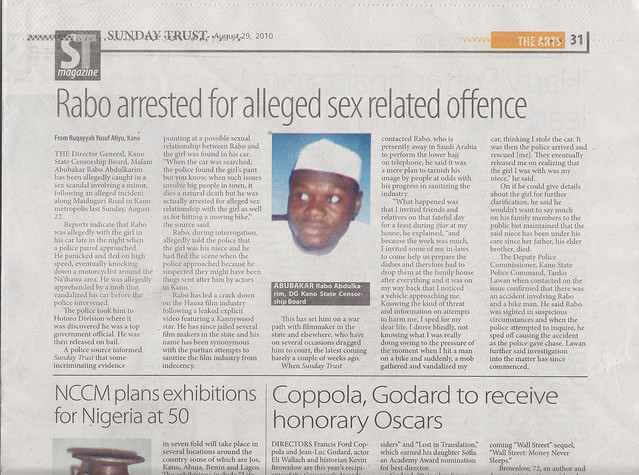
Today’s Sunday Trustreports that Alhaji Abubakar Rabo Abdulkarim, the director general of the Kano State Censorship Board, was allegedly caught last Sunday, 22 August 2010, in a compromising sexual situation with a minor and has since left the country for Saudi Arabia. According to Ruqayyah Yusuf Aliyu in Sunday Trust:
The Director General, Kano State Censorship Board, Malam Abubakar Rabo Abdulkarim has been allegedly caught in a sex scandal involving a minor, following an alleged incident along Maiduguri Road in Kano metropolis last Sunday, August 22.Reports indicate that Rabo was allegedly with the girl in his car late in the night when a police patrol approached. He panicked and fled on high speed, eventually knocking down a motorcyclist around the Na’ibawa area. He was allegedly apprehended by a mob that vandalized his car before the police intervened.
The police took him to Hotoro Division where it was discovered he was a top government official. He was then released on bail.
A police source informed Sunday Trust that some incriminating evidence pointing at a possible sexual relationship between Rabo and the girl was found in his car. “When the car was searched, the police found the girl’s pant but you know, when such issues involve big people in town, it dies a natural death but he was actually arrested for alleged sex relationship with the girl as well as for hitting a moving bike,” the source said.
Rabo, during interrogation, allegedly told the police that the girl was his niece and he had fled the scene when the police approached because he suspected they might have been thugs sent after him by actors in Kano.
"Rabo arrested for sex related offence" Breaking news article by Ruqayyah Yusuf Aliyu on director general of Kano State Censors Board in Sunday Trust, 29 January 2010, p. 31
Edwin Olofu of NEXT provides more details, including that apparently the motorcyclist Rabo knocked over was a member of the Kano State History and Culture Bureau and that Rabo was allegedly parked behind a shopping complex with the girl, he claimed was his neice:
Mr. Abdulkarim, the former Hisbah commander was trying to escape from a patrol team which had accosted him when they saw his car parked in a secluded environment – with a young girl inside – when he ran into a motorcyclist. Other members of the Okada union quickly surrounded him and he was only saved a lynching by the police who had been in pursuit of his car.
[…]
Mr Abdulkarim, who insisted that the girl he was found with was his niece, said he was not having an affair with her. But when the former enforcer of Sharia law discovered he could not convince the contingent of policemen on night patrol on the propriety of having an under-aged girl in his car at such an odd hour, he panicked. The whole thing looked even more suspicious because for some curious reason he had parked behind a shopping complex along Maiduguri Road that night.
A police source said when the patrol team attempted to arrest Mr Abdulkarim he took flight in his car.
Double trouble
While trying to escape however, he knocked down an official of the Kano History and Culture Bureau who was riding on a motorcycle. This incurred the wrath of Okada riders, who thought that he had knocked down a member of their union and promptly proceeded to give him a thorough beating.
Ironically, it was the patrol team that he had been trying to avoid that finally came to his rescue, although by then the okada riders, who saw he had a girl with him, had damaged the car and were already on the verge of beating him to death.
He was later taken to the Hotoro police division where he was made to write down a statement.
"Kano Chief Censor in Alleged Child Abuse Scandal" by Abdulaziz Abdulaziz in Leadership, 30 August 2010. p. 2
The Director-General of Kano State Censors Board, Malam Abubakar Rabo Abdulkareem, is enmeshed in a case of an alleged illicit sexual affair involving a minor whom he allegedly abused.
Though it is unclear whether the chief censor had actually penetrated the girl or not, investigations by LEADERSHIP revealed that he was trailed penultimate Sunday in Kano by patrolling policemen who saw a car parked around a bushy area along Maiduguri road by Rukayya House, in Kano around 10 p.m.
The police on patrol beamed their vehicle’s light on the parked car and the DG, who was in the car, started the car and zoomed off to escape the approaching vehicle. LEADERSHIP learnt that the police used the siren of their vehicle to alert the DG that they were trailing him but he refused to stop, engaging the police in a car race.
Rabo raced frantically through the Eastern by-pass road and through Unguwa Uku quarters with the police trailing him. This led him to ram into a motorcyclist around Unguwa Uku Shago Tara. He, however, forged ahead accelerating the vehicle.
It was learnt that the motorcyclist he ran into was wounded, as a result of which some other commercial motorcyclists joined the police in trailing the director general. They subsequently caught up with him around Filin Kashu area of Unguwa Uku.
The angry mob of motorcyclists began to beat the DG, while some aimed at the car, causing serious damages to it, before the arrival of the police who dispersed the people and arrested the driver, who turned out to be Rabo.
The director general was then taken to the Hotoro Police Station where he identified himself. On searching the car, according to a LEADERSHIP source, a young girl was found in the car, and a pant, suspected to be the girl’s. Rabo claimed that the girl was his cousin and he was coming from his family house. He was released at the time.
[…]
He also appealed to the journalists to let the matter die as exposing it amounts to ridiculing Islam.
Rabo’s argument, according to a clip of an interview with him obtained by LEADERSHIP, was that the whole drama was a set up to blackmail him by PDP stalwarts in the state who had been looking for a way to eliminate him. He said those people had been meeting for about three weeks at Shagari quarters, on how to nail him.]]
Readers may remember that Rabo, was appointed to his current position at the censorship board in 2007 where he cracked down heavily on the Hausa film, literature, and music industry, after a scandal involving a private cell phone video of a Hausa actress, popularly known as Hiyana (after her most successful film) having sex with a lover. He has long made statements of concern about the effect of Hausa films on minors, women, and Hausa culture. In the interview I conducted with him in February 2009, for example, he pointed out the reason that women in the film industry have to have permissions of their guardians to act:
A freelancer in the industry who can be a lyricist, a musician, especially the womenfolk by our culture, by our tradition, by our religion, has to be under the custody of her parents or guardian, because of what we call historical factor. They were abused. There were [cases of] domination. There were a lot of sexual abuse cases to be handled by the board. That historical factor, that nasty experience made the board to assume the social responsibility to ensure the dignity of the womenfolk is to protected in this act. So this is why we say she will be brought to us as somebody certified by her guardian, you understand, so that if we absolve her, nobody will see her as a prostitute or a harlot because they have been passing all these nasty allegations by the larger society, and we can’t stand for her even in a court of law if somebody abused her by saying she is a harlot. [….] I am referring to teenagers, 13, 14, 15 year old girls in her puberty period, during her youthfulness, during her maybe promiscuous period, people will harass her. Some of the stakeholders who are her seniors will harass her or rather will force her into forced sexual whatever, you understand. We are responsible, the government is responsible to ensure things are not done in an exploitive way sexually.
“under aged children who can easily be influenced are also involved in hawking such films along the streets without knowing the implications. He also said the ban was as well in the interest of potential customers who might not get to these children even if they found the films were bad.”:
[[UPDATE 31 August 2010: And in a piece written by Rabo and published on the Kano State Censors Board site, he further voices his concern on the “corrosive influence” of Hausa films on children:
Is civilisation synonymous with decadence? Is obscenity a buzzword for freedom? When there is freedom of expression (which covers the right to produce and circulate works of art, films and literature), does it take away the responsibility of parents and guardians to safeguard their wards and sheen them from corrosive visual influences? What gadgets or navigational instruments are at the disposal of these overwhelmed parents in the face of rapidly transforming technology of mass production and ease of viewing? The advent of video technology brought with it urgencies and tough challenges. In the past, you could physically prevent young boys and girls from going to watch a film at the cinema hall if you feared they would be exposed to immorality. With video technology the devil has been piped into the home and corruption is only a click away. Kano is a conservative Muslim Hausa society whose people are comfortable with their religion and cultural heritage. I say conservative because Kano people would love to sieve the impurities from the values being transmitted by the newest art forms.]]
Rabo is currently embroiled in several court cases, including one in which a court in Kaduna issued a warrant for his arrest for contempt of court when he refused to appear in court after a court summons in a case in which he was accused of slander. Following his arrest warrant he accused Hausa filmmakers of sending him death threats by text message (similar to his protest here that he was fleeing the police because he thought they were filmmakers). Kano State police traveled to Kaduna, where they arrested Fim Magazine editor Aliyu Gora II, and kept him in prison for nearly a week without appearing before a judge. The Kano State police were later fined N100,000 by a Kaduna High Court for not following due process.
The zealousness of the police in the case of Gora, against whom no evidence could be found in the near week that he was held in prison, is particularly ironic, considering that Rabo, who was apparently witnessed by dozens of police and okada riders in a compromising situation with a minor, as well as a hit-and-run incident, was allowed to board a plane for Saudi Arabia the next day. (Considering that, according to NEXT, Rabo was given a “thorough beating” following the hit-and-run incident, it must have been a very uncomfortable trip.)
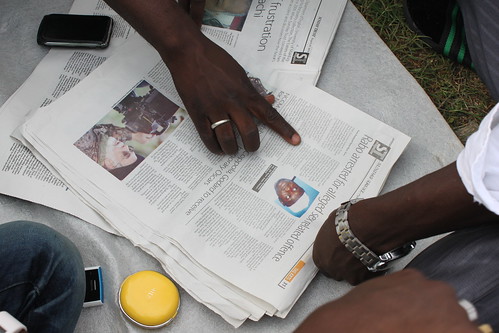
Hausa filmmakers on location gather around to read the Sunday Trust article "Rabo arrested for alleged sex related offence" (c) CM
I will post more updates on this case, as they become available. In the meantime, here are other relevant posts from this blog that provide information on the director general of the censor’s board.
I apologize to everyone concerned for this blog post which is coming about a month late; however, hopefully it is still relevant.
On July 21, I posted about the most recent lawsuit in the continuing feud between Abubakar Rabo Abdulkarim, director general of the Kano State Censorship Board, and the Kaduna Filmmaker’s Association. Twelve filmmakers, under the auspices of the Kaduna Filmmaker’s association, sued 1. Commissioner of Police, Kano State; 2. Attorney General and Commissioner of Justice, Kano State, 3. Chief Magistrate Court 25 Kano, Kano State; 4. Abubakar Rabo for violations of human rights in the arrest of Fim Magazine editor Aliyu Gora II and the ordered arrest of eleven film practitioners for supposedly sending death threats by text message. According to the August Issue of Fim Magazine, the judge ruled that the commissioner of justice, the court, and Rabo were without fault, but he did fine the Kano State Police, N100,000 for violating the 35th section of the 1999 Nigerian constitution, which states that the “personal liberties” of a person may not be violated. In this case, the police detained Gora for five days, more time than was reasonable.
Singer Abubakar Sani, one of the applicants in the lawsuit against the Kano State entities, outside the Kaduna High Court. (c) CM
The applicants plan to take the case to the Kaduna Court of Appeal to protest the judge’s decision not to charge the three other respondents with wrongdoing. In addition to details of the trial, Fim Magazine (which is on sale in most video shops and other super markets in the North) contains a detailed description of its editor’s arrest in Kaduna, travel to Kano, and five day detention in Goron Dutse Prison, where filmmakers Adam Zango, Hamisu Lamido Iyan-Tama, and Rabilu Musa (dan Ibro) and Lawal Kaura have also been imprisoned for months at a time beginning in 2007. [See this link for a background to these arrests written in January 2009.] Apparently, Gora was kept in detention, and transported to Kano even after the police had checked his phone and had found no record of the numbers from which the threats had come.
Editor of Fim Magazine, Aliyu Gora II, and Filmmaker Iyan-Tama, both former inmates of Goron Dutse Prison, exchange notes after hearing in Iyan-Tama’s lawsuit against the Abubakar Rabo Abdulkarim, 22 July 2010. (c) CM
On July 22 following the July 20th court case, I was still in Kaduna, so I also attended the latest session in the lawsuit Filmmaker Hamisu Lamido Iyan Tama is filing against Abubakar Rabo Abdulkarim. Readers may remember that during a television broadcast on 24 May 2010, Rabo accused Iyan Tama of having operated his company for fifteen years “without registration.” However, when speaking to Iyan Tama’s lawyer, Barrister Sani Muhammad, he pointed out that Iyan Tama had been duly registered with the Corporate Affairs Commission since 1997, as well as having registered with the Kano censor’s board, and other entities and had been paying his taxes. A brief foray into the “Free Iyan Tama” blog, which was created during Iyan Tama’s first arrests, shows multiple certificates of registration with the National Film and Video Censor’s Board, the Corporate Affairs Commission, the Kano State Censorship Board, and the Kano State Ministry of Commerce, Industry, and Cooperatives. Barrister Sani Muhammad also pointed out that Rabo’s on air accusation had affected Iyan Tama’s “clientele outreach, because people before now see him as a responsible person who knows what is expected of him. But soon after this interview, he started losing some of his clientele, business-wise, so he has suffered some damages.” Iyan Tama, who had moved away from Kano so as to avoid problems with the censorship board, had initially not intended to take the case to court; instead his lawyer delivered a letter to Rabo requesting a letter of retraction, asking him to withdraw his statement within ten days. Rabo did not comply with the request within the specified time.
Fim Magazine Editor Aliyu Gora II, only a few weeks after his ordeal with the Kano State police, is back at work, interviewing Iyan-Tama’s lawyer Barrister Sani Muhammad Katu on the lawsuit against Abubakar Rabo Abdulkarim. Iyan-Tama listens in. (c) CM
In court on 22 July 2010, Iyan Tama’s lawyer, Barrister Sani Muhammad, protested the fact that legal counsel from the Kano State government were representing Abubakar Rabo Abdulkarim, saying that Iyan Tama was suing Rabo in his private capacity not in his position as director of the censors’s board and that Rabo should not be making use of Kano state resources in a private matter. After the court was adjourned until September 23rd, I spoke to Barrister Rabi Suleiman Waya, the legal counsel for the Kano State government, and she told me,
“I am a state counsel, so apparently whenever a government official is sued, it is the state counsel who will come over and defend him, so he is sued as the director general of Kano State Censor’s Board, and as such it is the state counsel who will come and defend him.”
Iyan-Tama with Kano State lawyer Barrister Rabi Suleiman Waya, and Iyan-Tama’s lawyer Barrister Sani Muhammad Katu (c) CM
However, Iyan Tama’s lawyer, Barrister Sani Muhammad, countered that although the censor’s board had been on the initial summons, that was merely the address of service and was not referring to him in his official capacity:
“We are suing him in his private capacity, but he erroneously felt that because he is director of censor’s board, he now felt the best he could do was to use the government machinery […] so that government would now intervene, you understand? So that is why he now had to bring in a government lawyer. But the question of the law is very clear. If you are sued in your private capacity, that is private[…] So you have to engage a private legal practitioner.”
He pointed out that suing him in his private capacity places the plaintiff and the defendant on a more level playing ground, where Rabo does not have access to relatively unlimited government resources.
[UPDATE: 29 September 2010. Today’s Leadership reports that Rabo appeared in court yesterday, where his lawyer conceded that Iyan Tama had been registered with the proper government bodies.]
Readers may remember that Iyan Tama, who had, previous to the current Kano State censorship board administration, won awards from the Board for his positive portrayal of Hausa culture, has been arrested and jailed three times on accusations from the Board. His first arrest was on 8 May 2008, immediately on his return to Kano from the 2008 Zuma film festival after his film Tsintsiya won an award for Best Social Issue film. As can be read in more detail in Mansur Sani Malam’s Leadership article, Iyan Tama was charged with not having passed his film Tsintsiya through the Kano State Censor’s Board and operating his company without proper registration. According to his brother Dr. Ahmad Sarari and Iyan Tama himself, Iyan Tama had publically stated on the radio that his film was not for sale in Kano, and although the censor’s board claimed that he did not have a certificate to prove the renewal of his registration, Iyan Tama did have a receipt for the renewal. Apparently the censorship board had not issued anyone a certificate until after Iyan Tama’s initial arrest. Released on bail, Iyan Tama was again imprisoned when the court location for his trial was changed without informing him and he came late to court. His final arrest came in December, when he was sentenced by the mobile court attached to the censorship board to three months in prison. He served almost the entire sentence in the Goron Dutse prison, before being released in March by a judge who called for a retrial. According to Ibrahim Sheme,
“He was let out of prison this week, following a prayer to the High Court by the Kano State Attorney-General and Commissioner of Justice that the court should grant him bail and order for a retrial of the case. According to the Attorney-General, Barrister Aliyu Umar, the first trial was besmirched by irregularities. Due process was not followed in the trial that led to the conviction, he said. He used very uncomplimentary terms to describe the trial conducted by a senior magistrate, Alhaji Mukhtari Ahmed, such as “improper,” “incomplete,” “a mistake,” summing up by insisting that a “more competent magistrate” should be given the case to try again. Umar told the court presided over by Justice Tani Umar: “I am not in support of the conviction in this trial. It is obvious that the trial was not completed before judgement was delivered but there and then the presiding magistrate went ahead and delivered a judgement.”
Iyan Tama, who moved out of Kano following his release from prison hoping not to have any more run-ins with the censorshop board, was unpleasantly surprised when the director general came to Kaduna to repeat the same faulty accusations against him. Iyan Tama is now currently engaged in three different court cases: 1) the initial case brought against him by the censor’s board, which is currently under review; 2) a case in the Kaduna State Court of Appeal, where Iyan Tama is protesting the ongoing review of the case, as he had already served the sentence of three months in prison; and 3) this lawsuit against Rabo for defamation of character.
I have followed Iyan Tama’s various court cases and the activities of the censorship board fairly closely over the course of this blog. Here is a list of past posts on the Iyan-Tama case and related matters that may be of interest:
A few days I logged onto my blog and noticed that it looked pretty crappy. The font was blocky and squeezed, my flickr widget was gone, my links that had been separated into different themes was gone, as well as quite a few other changes that I began to notice over time. This morning, while trying to reinstall my flickr widget, I realized that my theme must have been somehow changed by wordpress. When I googled “WordPress changed my theme without my knowledge,” I discovered that apparently everyone using the classy pared down Cutline theme had been changed over to the unattractive Coraline because of some sort of feud with the Cutline designer, Chris Pearson. I am, to say the least, … annoyed…
Please bear with the ugly appearance of the blog, as I am going to have to be forced to make formatting changes to my blog that I wasn’t counting on in an already busy month, and it will likely take some time.
[UPDATE: Ok, after a few hours of playing around, I’ve restored the widgets. Still like the old cutline theme better, but this will have to do, I suppose….]
Still from Kim A. Snyder's documentary One Bridge to the Next, featured in American Documentary Showcase
The Public Affairs Section of the U.S. Embassy and MOPPAN are partnering to bring a mini-documentary film festival to Kano today, Monday, 2 August 2010, and Tuesday, 3 August 2010. Documentary filmmakers Kim A. Snyder and Bart Weiss will be presenting the films and leading master classes for invited filmmakers.
Monday, there will be documentary screenings open to the public from 2-4pm at Mambayya House, a simultaneous screening at the Department of Mass Communication, Bayero University, New Site from 2-4pm, and another screening at 7pm in the 1000-seater auditorium at Bayero University, New Site, at 7pm.
The lawsuit is between the applicants 1. Ashiru Sani Bazanga, 2. Mohammed Rabiu Rikadawa, 3. Aliyu Abdullahi Gora, 4. Sulaiman Sha’ani, 5. Musa Aminu, 6. Jamilu Adamu, 7. Abubakar Sani, 8. Tahir I. Tahir, 9. Tijjani Asase, 10. Yusuf Haruna, 11. Yakubu Lere, and 12. Adam Zango and the respondents 1. Commissioner of Police, Kano State; 2. Attorney General and Commissioner of Justice, Kano State, 3. Chief Magistrate Court 25 Kano, Kano State; 4. Abubakar Rabo. The applicants are seeking damages of Ten Million Naira as compensation for the “violation of the applicants fundamental human rights.”
I attended court this morning, and sat beside Tahir I. Tahir before he was called to the witness stand with the 8 other applicants who had shown up. Eventually, after the lawyer for the case, Mohammad Sanusi, presented the case, the defending lawyer had very little to say, and the case was adjourned until 27 July 2010. I took about 3 pages of illegible notes, admittedly understanding very little of the proceedings. Fortunately, afterwards I was able to have an interview with the leading lawyer for the Kaduna Filmmaker’s Association on the case, Mohammed Sanusi, and also with Yakubu Lere, President of the Kaduna Filmmaker’s Association. I will add more of the details I learned from them in a later post, along with a few photos of people who attended court today and documents of the ongoing case. My multilinks internet does not seem to work very well in Kaduna, so I might have to wait until I leave the city to upload all my photos.
In brief, the complaint of the Kaduna filmmakers is chiefly that their fundamental human rights, as Kaduna citizens, have been breached by the intimidation of Rabo and the Kano state police and court system, beginning with Rabo’s inflamatory remarks on DITV Television on the 13th and 14th of May, urging “Kaduna people to stand up against them [the filmmakers’ and make sure they send them out of Kaduna state” (as quoted from the original complaint made 28 May 2010) and continuing with the Kano state police intimidation in Kaduna state. Kano state police were sent to arrest the 12 applicants in Kaduna state, on Rabo’s accusation of having recieved death threats by text message from three phones. (At least one of the phones was traced to a woman who did not appear on the list for arrest.) However, the police came and the arrest was made without the awareness or permission of the Kaduna State Commissioner of police. Yakubu Lere narrated how the Kano police came to his house several times and intimidated his family in his absence. They apparently also visited Abubakar Sani’s office and Adam Zango’s studio, but didn’t find either of them there. They did find Aliyu Abdullahi Gora, editor of FIM Magazine, in his office, arrested him on Wednesday the 30th of June, held him overnight in a Kaduna police cell, and then took him to Kano on 1 July, Thursday, where he was put in prison. The judge did not show up to court two days in a row, so Gora was held over the weekend, until Monday, 5 July, when the judge gave him bail on the condition that a Level 17 or higher civil servant or businessman based in Kano post bail for him. He was not able to meet these conditions until 6 July 2010. In adding up those dates, you can see that he was detained by the Kano police for exactly a week. Yakubu Lere told me that although immediately after Gora’s arrest while he was still in Kaduna, the Kaduna filmmakers had obtained a stay of arrest from a Kaduna judge, the police went ahead and took him to Kano. In the photocopy I have of court order, it shows that the 12 accused filmmakers applied for a staying order on 2 July 2010, and it was approved on the 7th of July. In Yakubu Lere’s affidavit he mentions the irony
11. That some members and more particularly 1st to 6th Applicants filed complaints against the 4th Respondents for the offence of Criminal defamation of character, inciting disturbance of public peace which were all committed in Kaduna as indicated in Exhibits 2 and 3 repectively
and
18. That the 4th Respondent has recently used the 1st, 2nd and 3rd Respondents to humiliate, harass, and intimidate the Applicants to forgo their complaints.
Note that the 6 filmmakers who initially filed the complaint against Rabo for defamation of of character on 28 May 2010 (Ashiru Sani Bazanga, Moh’d Rabiu Rikadawa, Aliyu Abdullahi Gora II, Suleiman Sha’ani, Musa Aminu, and Jamila Adamu) were among those fingered by Rabo as allegedly having sent him the death threats by text message.
Stay tuned for more details, including excerpts of my interviews with the lawyer and several filmmakers involved with the case, and photos of documents. For more background information, please see my detailed post on the events leading up to this lawsuit.
[UPDATE: 30 July 2010: On 27 July 2010, the judge in Kaduna upheld the right of Abubakar Rabo Abdulkarim to make a complaint to a Kano court; however, he fined the Kano state police N100,000 for unlawful detention of Aliyu Gora)
Carmen McCain is a participant in the Amazon Services LLC Associates Program, an affiliate advertising program designed to provide a means for us to earn fees by linking to Amazon.com and affiliated sites.
If you buy on Amazon by clicking through links to on my blog through my #AmazonInfluencer store, I’ll earn some pennies.













 A Tunanina...
