FIM Magazine Editor Arrested on accusation of Abubakar Rabo Abdulkarim, DG of Kano State Censorship Board

Abubakar Rabo Abdulkarim, DG of the Kano State Censor's Board at a Hausa writers conference in Damagaram, Niger, December 2009

In yet another bizarre twist in the Kano State Censors Board vs. Kannywood saga, the editor of Fim Magazine, Malam Aliyu Abdullahi Gora II, has been arrested following a complaint by the head of the Kano State Censorship Board, Abubakar Rabo Abdulkarim, that he suspected the editor and other Kannywood stakeholders of having sent him death threats by text message. According to Ali Alkali and Abdulaziz A. Abdulaziz in their article “Editor Remanded Over Alleged Threat to Life” and Ibrahim Sheme in “Shekarau’s Hausa Movie Script” in Leadership newspaper, the police apparently came to Kaduna from Kano on Thursday, 1 July 2010, and bundled Gora into a taxi to Kano. When a judge claimed she was unable to come to court, Gora remained in prison over the weekend awaiting Monday, 5 July 2010, when he will hopefully be able to appeal for bail. [[[UPDATE MONDAY, 5 JULY 2010: One of my friends just called and told me Gora went to court today, and Magistrate Halima Nasiru said that he could be released on bail with the following condition: The person who posts bail for him, the assurity, must be a level 17 Civil servant from KANO, or alternatively a KANO businessman with a business registered with the KANO government. Remember that Gora is from Kaduna, where he lives and works, and that it will be much more difficult for him to find someone to post bail for him in Kano. In the meantime, he is approaching his 6th day in prison over a mere accusation.]]]   Moreover, according to Alkali and Abdulaziz other Kannywood figures listed for arrest are:

Yakubu Lere, Abdullahi Sani Kano, Tahir I. Tahir, Tijjani Asase, Yusuf Baban Chinedu, Ashiru Sani Bazanga, Adam A. Zango and Rabi’u Rikadawan (a.k.a. Dila) and Abubakar Sani.

They have obtained a restraining order against arrest from Kaduna High Court.

Rabo had claimed in his petition to the police that he received text messages from two GSM lines in which his life was threatened, fingering the nine industry stakeholders as suspects.

Some of the suspects had earlier sued Rabo in a Kaduna magistrate court over defamation of character and the case is still pending in the court.

This is a story I have meant to post far before this but had not found the time to compile all of the articles together. I will try to do so here, providing a list of links to a timeline of the suits and countersuits between filmmakers and the head of the censors board. In summary, the events just narrated come on the heels of an arrest warrant against Rabo for contempt of court, when he failed twice to appear in the Kaduna court, for which he had received summons. Rabo had been sued by filmmakers for defamation of character following claims he had made on air at Kano independent television station DITV that Kaduna filmmakers were making pornographic films. He also made claims during the DITV interview that Hausa film director and producer Iyan-Tama had not registered his company Iyan-Tama Multimedia. Following the order for his arrest from the Kaduna court, Rabo had obtained a restraining order from a Kano high court, to stop Kaduna police from arresting him.

Readers may remember earlier posts in June, July, and August of last year in which I described how the filmmaker’s association MOPPAN sued Rabo in a shari’a court in Fagge, Kano, for defamation of character on Radio Kano. The September 2009  issue of Fim Magazine described how Rabo failed to show up in court on multiple occasions. (Note that I have provided a link to photos of the pages of the article  in Fim describing the case: page 12, page 13, and page 14). According to Fim Magazine and sources I spoke to in MOPPAN, the state made some structural changes to the Kano State Censors Board, adding directors to provide more oversight of Rabo. Furthermore, Justice Mukhtari Ahmad, who had sent artistes Adam Zango, Iyan-Tama, Rabilu Musa (Ibro), Kaura, Aminu Ala and Bashir D’andago to prison, in quick trials with many irregularities, was moved to Wudil.  However, MOPPAN was told not to continue the case against Rabo in the shari’a court.

Rabo continued to travel out of state speaking about the need for censorship and perceived abuses of filmmaker’s against the “culture of the Hausa-Fulani.” In May, there was an uproar on the Finafinan Hausa and Dandalin Siyasa yahoo groups, when Rejato, a journalist with Radio Alternative in Niamey, Niger, claimed that Rabo had sent his supporters in Kannywood, Useini Sule Koki, Mohamed Roja, and others to Niamey to ask artistes in Niamey to register with the Kano State Censorship Board. According to Rejato, Rabo offered tohelp Nigerien artists with 10 million naira if they agreed to this arrangement. The Nigeriens responded pointing out that Niger and Nigeria were two different nations and laws in Kano did not apply to them.

In the meantime a riot nearly broke out in Kaduna on 24 May 2010 when Rabo went on DITV radio accusing filmmakers in Kaduna of making pornography.

According Abdulrahmane Tonga in Leadership on 17 May, 2010,

It was only by whiskers  and the quick arrival of  Operation Yaki policemen that saved the Director-General of Kano State  Censorship  Board, Malam Abubakar Rabo Abdukareem, from lynching by angry film makers  in Kaduna.

The incident, which occurred at the premises of Desmims Independent Television (DITV) and Alheri FM Radio on Friday,  created tension and apprehension when Rabo  participated in a live programme  where he was alleged to have made uncomplimentary remarks against Hausa film makers and called on the government and people of Kaduna State to descend on them and stop what he called “their salacious and amoral film making ventures.”

In the programme, Rabo was alleged to have even mocked the Kaduna State government when he said he  bought a pornographic film at Unguwar  Sarki, which the authorities allowed to continue unabated to the detriment of the people and their morals in the state.

In an interview, a member of the Kaduna State Film Makers Association, Alhaji Yakubu Lere, said Rabo’s pronouncement during  the  live programme was inciting, provocative and very uncomplimentary to the film makers in Kaduna State, who are doing a lot to earn a living, saying that  it was what  infuriated them.

“The arrival of Operation Yaki really assisted greatly, because some members of Kaduna Film Makers Association had attempted to go inside the studio and beat up Rabo due to his unguarded utterences against our members,” Lere said.

When the situation had calmed down, Rabo, who looked visibly traumatized, asked Lere and Alhaji Haruna Danjuma (Mutuwa Dole), another veteran dramatist, to escort him out of the station.

“Rabo was escorted out of DITV premises inside  a pick-up van belonging to Operation Yaki and taken straight to his room at Access Hotel, Barnawa, where he checked out without further delay. In fact, he did not waste time in packing his little belongings into his car, and left with the escort of Operation Yaki full of civil defence corps up to the border with Kano State”.

When Leadership contacted him on his GSM phone, Rabo said whatever he said on the TV programme was not against the law, and if anyone has doubt, the recorded programme is still in DITV, that the person  can check it out.

“It’s only an act of overzealousness of some film makers who were angry with what I said. And I have no regret whatsoever for making such remarks,” he said.

Asked whether he really bought a pornographic film in Kaduna, Rabo declined to answer, but said, “In Kano State, we have sanitized the film making industry, and it is very complementary if other states in the country, especially in the North, could take heed from what we have done, in the interest of all people.”

Al-Amin Ciroma reported the story in more detail in Leadership on 18 May 2010, including the responses of the filmmaker’s to Rabo’s accusations:

The DG, Leadership gathered, insinuated among other issues that some nude home videos, popularly known as ‘Blue-films,’ were in circulation in Kaduna metropolis, particularly in Anguwan Sarki ward by the Hausa filmmakers.

Some filmmakers expressed their dismay over what the DG said.

“We don’t know what Rabo want from us? We are Nigerians and have freedom of association and previleges. We were defaced and mutilated in Kano and subjected to all series of humiliation and as law-abiding citizens, we transfered our business back to Kaduna, with mutual understanding between us and the government of the state. Kaduna is a liberal state where sentiment is of no course. We are peacefully doing our business here and yet he is all out to fight us. For Rabo to say that we are producing nude vidoes, I think, he need to visit his psychiatric doctor,”a source within the association told LEADERSHIP.

Commenting on what they called indignity by the filmmakers, the management of the station condemned what the Kannywood practitioners did. Our correspondent authoritatively gathered that the filmmakers convaged in huge numbers into the premises of DITV, located at Sambo Close, GRA, Kaduna, at early hours of Friday, raining abuses on Malam Rabo Abdulkareem, they also threatened to burn down the station.

Salisu Umar, a.k.a Salinga, the presenter, who hosted the DG on his popular programme, “Mu Shakata” revealed that after hosting him on the programme the previous day, he felt that there was need for him to reappear again the next day to clarify some issues. According to him, Abubakar Sani, a popular playback singer, offered to appear with the DG on the programme to counter some allegations, which the presenter approved. He then made same arrangement with Rabo; a request, which the DG agreed. By that arrangement, Umar added, Rabo is to feature alongside the Kannywood singer on the programme. Suprisingly, continued Salinga, the DG called him that he had changed his mind to appear live and suggested that the programme be recorded and aired late. “Not only that, Rabo said, he prefered to record the programme in his hotel room. Without questioning him, I passed the information to Abubakar Sani and he also agreed with the arrangement. Sani, to my surprise, called me again that he has alighted Sani Musa Danja, who is the president of the newly inaugurated Nigerian Artistes In Support of Democracy (NAISOD) to come on the programme with Rabo. [See my earlier post on NAISOD-CM] I called Danja and he stated his readiness to feature alongside the DG, but on condition that the programme be hosted in the studios of DITV and not Rabo’s hotel room. Danja gave me his reasons for not wanting to go to Rabo hotel room, which I reasoned with him. As a mediator, I cajoled the DG to come to our studios, which he agreed after some hesitations. Sani Danja and some of his subjects, Isma’il Na’Abba (Afakallah), Abubakar Sani, Ubale Wanke-Wanke and others came to our office as scheduled to meet Rabo,” said Salinga.

The programme went on well with the guests, according to the presenter, “Unknown to us, some of the filmmakers kept calling their colleagues and before we knew it, our premises were surrounded by them. It took the intervention of security agents to disperse the angry artistes and whisk Malam Rabo and his entourage out of Kaduna.”

Following Rabo’s quick return to Kano, the Kaduna State Filmmakers Association took Rabo to court.  Abdulrahman Tonga reported in Leadership on 1 June, 2010, that:

Members of the Kaduna State Filmmakers Association yesterday dragged the Director-General of Kano State Censorship Board, Malam Abubakar Rabo Abdulkareem, to a magistrate court in Kaduna over alleged criminal defamation of character and inciting the public to violence.

In a complaint charge filed before Chief Magistrate Nasiru Idris Lere of Magistrate Court 1, Ibrahim Taiwo Road, Kaduna, six filmmakers argued that a television interview granted by Rabo to the DITV station in Kaduna a fortnight ago had ridiculed their image and lowered their reputation in the eyes of the public.

Rabo was quoted to have told the TV station in a live broadcast that Hausa moviemakers were now engaged in the production of pornographic films and that the people of Kaduna State should rise against them.

He reportedly claimed to have bought a copy of such pornographic movies in Unguwar Sarki area of Kaduna metropolis.

Describing the censorship board chief’s assertion as false, the plaintiffs said such statement was capable of inciting violence in the state.

“His statement that people should rise against us has made our members to live in constant apprehension for fear of being attacked by the public,” they said.

Rabo’s allegation was contrary to sections 392 and 114 of the penal code, they added.

The complainants consist of executive committee members of the Kaduna filmmakers association. They are: Ashiru Sani Bazanga, Rabi’u Mohammed Rikadawa, Aliyu Abdullahi Gora II, Sulaiman Sha’ani, Aminu Musa Carlos, and Jamilu Adamu.

LEADERSHIP learnt that the court summons, which was endorsed by a magistrate in Kaduna, was received by Rabo yesterday in his office situated within the Kano State-owned City Television in Hotoro, Kano.

The hearing comes up tomorrow in Kaduna.

However, the next day, Rabo did not show up in the Kaduna court claiming that he was “indisposed,” a move echoing his similar absence in Kano courts in August 2009. Samuel Aruwan reported in Leadership on 3 June 2010:

The case of defamation and inciting of public disturbance to violence, brought before Kaduna Magistrate Court by members of the Kaduna State Filmmakers Association against the Director-General of Kano State Censorship Board, Malam Abubakar Rabo Abdulkareem, was yesterday mentioned in the court. The magistrate, Nasiru Idris Lere, ordered that the counsel to the director-general, Mr. Gabriel Didam, must produce the respondent before the court in person.

When the case was mentioned, counsel to the director-general, Gabriel Didam, told the court that his client could not appear in court in person as a result of being indisposed, a plea the filmmakers’ counsel, Mr.A.S. Suleiman in his argument consented to the respondent’s prayer. The judge adjourned the case to June 10, 2010 with clear instruction that Rabo must appear in person before the court.

On 9 June (perhaps the earlier date of adjournment quoted was wrong?), Abdurahmane Tonga reported in Leadership (a copy of the article is posted on Ibrahim Sheme’s blog) that:

The Kaduna State police command has been ordered by a judge to arrest the Director-General of the Kano State Censorship Board, Malam Abubakar Rabo Abdulkarim, for his failure to appear before it on two occasions.

The judge, Alhaji Nasiru Idris Lere of Magistrate Court 1 in Kaduna, gave the order for Rabo’s immediate arrest by the police.

[…]

When the case opened in court last week, the Kano chief censor failed to appear, citing ill-health. His counsel sought a postponement, a plea to which the filmmakers’ counsel, A.S. Suleiman, did not object.

During yesterday’s hearing, counsel to Rabo, Mr. Gabriel Didam, told the court that his client could not appear in court in person as a result of insecurity in the state, adding that his client was also sick. He, however, apologized to the court on behalf of his client.

Counsel to the plaintiffs, Malam Sadau Garba, appealed to the court to issue a bench warrant against Rabo, pointing out that this was the second sitting in which he was not in the court. According to the lawyer, information reaching him was that the accused was determined never to come to the court.

“Justice has to be done,” he said. “The accused person had complained that he was sick, but no written document had been produced. And information reaching us is that the accused is bragging that he will never be present throughout the case and that nothing will happen. We therefore apply that this honorable court issue a arrest warrant to make him appear and take any alternative measures to bring him to the court”.

When ruling on the request, the judge said, “The accused person did not follow the proper way to channel his complaint to the court, a behaviour which may leave the other party to feel they are not treated equally.

“I will not believe him that there is insecurity in Kaduna. It’s an excuse by the accused person. And he has to tell us the names of those that thinks are after him so that court will stop them from coming to its premises.

“Since the inception of the case he has been complaining frequently, but the accused never did in the formal way. Under the section 153 of the CPC, the accused has to be in court. I am left with no option than to order his arrest under section 70 / 1A / B by the Commissioner of Police, Kaduna State.”

Hearing in the suit was adjourned till June 16, 2010.

Court order for the arrest of Abubakar Rabo Abdulkarim (given me by MOPPAN)

On 15 June 2010, Abdulaziz A. Abdulaziz reported in Leadership that Rabo had obtained a staying order from the Kano high court:

A Kano State High Court presided over by the Chief Judge of the state, Justice Shehu Atiku, has issued an order barring police from arresting or detaining the Director-General of the Kano State Censorship Board, Malam Abubakar Rabo Abdulkareem, following an order to that effect by a Kaduna magistrate court.

The applicant had filed an ex-parte motion asking the court to stop the police from carrying out an order issued to them by Chief Magistrate Nasiru Idris Lere of Chief Magistrate Court, Ibrahim Taiwo Road , Kaduna, to arrest and produce him before the court.

The motion, number K/M328/2010, dated June 11, 2010, joined the Kano and Kaduna police commissioners as first and second respondents. Others include Magistrate Lere, the Inspector-General of Police and the Assistant Inspectors-General of Police in charge of Zone 1 (Kano) and Zone 7 ( Abuja ).

A copy of the court order obtained by LEADERSHIP in Kano shows that the court hinged its decision to issue the order after considering the motion ex-parte and the accompanying affidavit sworn to by the applicant.

Part of the document reads: “The Respondent particularly the 1st and 5th Respondents (i.e. the Commissioner of police Kano State, and the AIG, Zone 1, Kano) are hereby directed to stay all actions (in particular, from arresting and detaining the Applicant) pending the hearing and determination of the substantive application.”

A Kano-based lawyer, Barrister Nuraini Jimoh, and one Mr Morgan stand as counsel to the chief censor in the case. It has been adjourned to June 25, 2010 for hearing of the substantive motion on notice.

Arrest Warrent for Abubakar Rabo Abdulkarim, 10 June 2010

On 16 June 2010, Al-Amin Ciroma reported further drama when Rabo’s attorneys claimed their ignorance of the restriction on arrest of their client :

The case, which is presided over by Chief Magistrate Nasiru Idris Lere, has yesterday end with a dramatic session as the counsel of the accuse, Barrister Gideon Didam, honourable withdrew with his team of lawyers from the case on grounds of protecting their professional integrity. “We are completely ignorant of the court order restricting the arrest of our client. We are in this vain, going to allow the judicial court to take its position, may be that is why the accused is absent today.” Said the defence counsel.
Similarly, the counsel to the complainants, Barrister Sadau Garba, represented by Barrister Mohammad Sunusi, argued that the said order from the Kano high court seems not authentic as the document was a photocopy instead of original. Sighting technical inferiorities, Barrister Sunusi disputed the order under section 158/D&E of CPC. He urged the court to continue the proceeding.
The Chief Magistrate, in his ruling said the court will ignore the matter to avoid judicial rascality. Adding that the registrar of the court will forward the said order to the Kaduna State Anthony general for verification and further directives. Meanwhile, June 28, 2010 was fixed for further hearing on the case.

The latest reports return to where I started this post. I have not yet found information regarding the 28 June court date. The news is taken over by Rabo’s accusations of receiving death threats from the very people who sued him to court, the arrest warrents from Kano courts, the continued imprisonment without bail or trial of Fim magazine editor Aliyu Abdullahi Gora II.

On 2 July 2010, an opinion piece was published in the Kano state government newspaper Triumph by an Asabe Murtala mysteriously titled “Is Rabo a Melting Pot.” In the piece, Asabe Murtala vociferously defends Rabo in a tone and language that sounds very much Rabo’s own, as can be read on the “Censorship Board in the News” section of the Kano State Censor’s Board website. Asabe Murtala waxes lyrical over the DG of KSCB:

To many people, Rabo’s name alone sounds musical to ears. While the same name sends shivers and is persistently jittery that shocks the very foundation of the ill-conceived and perturbed thinking of some handful few in the Hausa film making industry. You can call it Kannywood, Shaidanwood or any other wood you want to attach it to.

With regard to the programme aired on DSTV that is inspiring so many lawsuits, she says:

In the programme Mallam Rabo was so stressed for the need that there was a need for the people of Kaduna State, both muslims and non-muslims, to stand up against any film making that is in collusion with our societal norms, value and culture. And he was so disturbed that while we are in the 21st century, some film makers are still behaving as if we are in the uncivilized world.

[….]

There were five callers during the second live programme. They are Abdullahi, Ladidi, Hudu, Mamman and Maman Fadhlu. They all praised the presentation as apt, focused and enlightened. Most of the callers confessed that they didn’t like Rabo’s style of operation before. But with the discussion that was taking place, they came to understand what Rabo stands for. This is a deadly blow on the faces of the film makers. Instead of them to calculate and strategize well, they challenged Rabo to be a co-host with one other person from their part. Which he happily responded in the affirmative. It never occurred to them that an encounter with Rabo could not be a Pancake-race. The encounter turned out to be a Pandora’s box! Because they were panic-striken, Mallam Rabo had to be escorted out of theDITV premises with the help of security operatives, that were armed-to-teeth.

What followed then was, as I heard from some reliable sources, Rabo received many text messages threatening his life. As a law abiding citizen, he officially wrote a letter to the Commissioner of Police, Kano Command, titled ‘Threat to My Llife.’The letter was sent on the May18, 2010. In the letter Mallam Rabo cited some text messages as samples, together with the phone numbers. To tell you that Rabo is security conscious, by sending the texts with the phone numbers. He knew the vital role those numbers could play during investigation. Though, the numbers could be purchased for that hatchet job alone.

Threatening his life was not enough to them, for the fact that they realized that he was waxing stronger in Kaduna State and other neighboring states. They resorted to court action and media campaign against this gentleman.

Least I forgot, during the third programme, DITV Radio Alheri hosted Mallam Rabo, Sani Danja and Isma’ila Na-Abba. Rabo as usual dressed them down. So the film people floated over an ocean immediately after the Titanic ship rocked. It was terribly embarrassing!

Mallam Rabo was summoned by the Chief Magistrate Nasiru Idris Lere, of the Kaduna Magistrate Court. Mallam Abubakar Rabo could not go to the court on health ground. And could not also attend the second sitting because he got no assurance from the court of his security. He was receiving text messages threatening his life, so it was mentioned to the court through his lawyers.

The article continues on for some time in this vein. Readers may remember that this very same Asabe Murtala or Asabe Muktar (the same article was published in Triumph and Daily Trust under these two different names) was accused by Ibrahim Sheme on the Finafinan Hausa listserve of being none other than a pseudonym  for Rabo himself. While this may be a baseless accusation, it does seem curious that, though she claims to be a Kannywood stakeholder no one seems to have ever met her (I once received an email from her forwarding one of her article, but when I wrote back asking if we could meet, I never heard back from her) and that she (with variations on her name) only seems to surface as a writing persona, publishing articles in defence of Rabo and the Kano State Censorship Board.

Meanwhile Bashir Yahuza Malumfashi reported in the Hausa weekly, Aminiya, on 2 July, and Ruqayya Yusuf Aliyu reported in Sunday Trust on 4 July, that filmmaker Alhaji Hamisu Lamid’o Iyan-Tama has filed another seperate lawsuit against the DG of the Kano Censor’s Board Abubakar Rabo Abdulkarim for 10 million naira claiming defamation during Rabo’s 24 May 2010 interview at DITV.  Ruqayya Yusuf Aliyu writes:

According to the statement of claims signed by the counsel to the plaintiff, Barrister Mohammed Sani Katu, the plaintiff is also demanding a public apology and retraction of the alleged defamatory statement made.

The statement of claims also stated that during the said interview, the defendant specifically mentioned that the plaintiff did not register his company, Iyantama Multimedia, which has been in operation for over 15 years with the Corporate Affairs Commission.

The plaintiff further alleges that the defamatory statement has caused him embarrassment before his associates and the public saying he has received a number of calls whereby the callers expressed their disappointment over the said non registration of his company.

The statement of claims also said since the programme was aired, the revenue he generates from the company has significantly reduced among other things.

Readers may recall, that Iyan-Tama spent three months in prison last year after a trial in the court of Magistrate Judge Mukhtari Ahmed, which the Kano attorney general eventually called (as reported by Ibrahim Sheme)  ““improper,” “incomplete,” “a mistake,” […] insisting that a “more competent magistrate” should be given the case to try again.” As noted earlier, Mukhtari Ahmed was relocated in August from the Kano airport court, where he had tried and sentenced so many film stakeholders, to Wudil.

Here is a list of links to newspaper articles describing the progression of events:

My three blog posts in June, July, and August 2009 describing the events leading to the shari’a court case of slander against Rabo, as well as two newspaper articles on the case and a piece from Fim Magazine. I’ve also provided a link to an interview I did with Rabo in February 2009:

Timeline of the most recent lawsuits and counterlawsuits from May to July 2010:

Photos of Peace Rally in Jos

Youth from Kanem say “We Love Peace” (c) CM

I was hoping to post a longer article on the Young Ambassador’s Peace Rally that took place in Jos on 1 July, but I’m in the middle of a hundred different things, trying to write a conference paper and also hoping to write another blog post on the most recent arrests ordered by Rabo Abdulkarim, head of Kano State Censorship Board, who is himself avoiding arrest in Kaduna (For a quick summary of what is going on see Ibrahim Sheme’s opinion piece in today’s Leadership.)  So for now I will just post a link to my photos of the event on Flickr. The Young Ambassadors for Community Peace and Interfaith were hoping to have a bigger rally but because they had a hard time finding funding, they changed their plan and had representatives of different communities from all over the state come instead. (Note, all of the photos here are copyright to me.)

Programme for the Jos Peace Rally, 1 July 2010 (c) CM

The organizers of the programme Young Ambassadors for Community Peace and Interfaith foundation describe their “journey so far in the event programme:

YACPIF registered 23 Young Ambassadors before the Jos crisis within the Jos City around the Assemblies of God Church and Central Mosque in Kwararafa, Jos. The Muslim Young Peace Ambassadors protected the church from being burnt by some Muslims during the crises.

YACPI Foundation holds the belief that there can never be any meaningful Development in a community where there is war and injustice. Jos  is a city in desperate need of peace. YACPI Foundation has chosen Jos city amongst other cities in the Northern part of Nigeria to kick start her project. From here we will move to other places like Bauchi, Gombe, Kaduna, Kano, Borno, etc, cities that have a history of religious strife in Nigeria.

To carry out these initiatives we carefully identify youths most interested in promoting peace. Our desire is to work with them to channel the message of peace aimed at stopping religious and ethnic wars, promote peace building, and other challenges confronting our young people today in Nigeria. Very soon we hope we can organize a football tournament between youths of different people groups in Jos, first and then later Plateau State. Sports sometimes can be a powerful balm when there are festering wounds.

Peace Rallies held to date from March 22nd, Kwararafa, Bukuru, Dadin Kowa, Nasarawa/Congo Russian, Rayfield, Riyom Local Government, Tudun Wada and Zaria Road.

Today we are witnessing a State-wide peace rally. The journey for peace on the Plateau has begun in earnest. By God’s grace we will reach our destination

The programme included short speeches from the founder of the Young Ambassadors Rev. Yakubu Pam (who made a point of saying that the rally had not received financial support from the government), trustee Senator Ahmed Mohammed Makarfi, former governor of Kaduna State, Women’s Representative Ngo Naomi Jugu, among others, as well as youth leaders from Miyati Allah, JNI, CAN, SUG, Plateau Youth Council, and representatives from the Yoruba, Igbo, and South South communities. The best part of the event was seeing young people passionate about promoting peace and fellowship in the state parade past with their placards.

But, I was thinking as I sat there, that I hope that in the future YACPI can partner with Nigerian musicians to bring together more youth, perhaps with no speeches by politicians and elders–just youth, just the next generation, who can commit to change. As one of the speakers noted, it is the youth who inherit the bad decisions of their elders.

The Police Band played for the event, and the BBC Berom cultural troupe performed very danceable traditional music at the Peace Rally, but I thought it was telling that everyone (including the cultural troupe) started dancing when contemporary Naija Jams started piping through the sound system.  There have been so many artists and musicians who are from or who have spent large amounts of time in Jos: M.I., Jesse Jagz, 2Face Idibia, Jeremiah Gyang, P-Square, Ice Prince Zamani, Ali Nuhu, Abbas Sadiq, DJ Yaks,etc, etc, etc. A recent article from Nigerian Entertainment Today describes how artists condemned the crisis, saying they were “keen to be of help and rally colleagues to ‘do something positive’.” It would be fantastic if this group could reproduce the kind of peace concert that took place in Port Harcourt last year, rallying the youth of Jos for peace with their music. And, indeed, one of the objectives of YACPI is “to solicit the support of Local and International Artists to license a positive song for our compilation CD that will inspire listeners to end war, crime, and violence in our country, communities and schools.” One would hope, we could have more songs like Eldee’s “One Day” and Sound Sultan’s “Let There Be Light,” which includes a very poignant tribute to “to the lost souls in Jos.”

Here are the photos I took of the rally on July 1. For those who were there and would like to download photos, click on the “All sizes” icon directly above the photo you would like to download and select either small, medium, large, or original, and you will be able to download it onto your computer or a disk. You are free to use these photos in other publications, as long as proper attribution is given to me and you send me a link to the article. Thanks.

A Representative of ACTS sells “My Brother’s Keeper” by Ruth Beattie (c) CM

A Representative of ACTS (African Christian Textbooks) sells at cost copies of Ruth Beattie’s book, My Brother’s Keeper: Stories of Grace from the Jos Plateau. Ruth Beattie is from Northern Ireland and brings insights growing up during times of conflict to her descriptions of Muslims and Christians helping those of different faiths during the Jos crisis.

Youth of Jos North march for peace

Youth of Jos North march for peace (c) CM

Jos North looked like it had the largest delegation there.

Yan Zaman Lafiya: “Those who live at Peace” (c) CM

Yan Zaman Lafiya

Pankshin Ngas for Peace (c) CM

Youth march for peace in Jos (c) CM

The Youth of Shendam say “Give Peace a Chance” (c) CM

Youth March for Peace in Jos (c) CM

Youth March for Peace in Jos (c) CM

Peace Advocates from University of Jos, including students from the Niger Delta (c) CM

Peace 4Ever say the youth of Jos North (c) CM

Senator Ahmed Mohammad Makarfi, former governor of Kaduna State, is a guest speaker (c) CM

Rev. Yakubu Pam, founder of Young Ambassadors for Community, Peace, and Interfaith organization, looks on. (c) CM

People interact after the main events of the Peace Rally (c) CM

Youth hang out in the bleachers after the peace rally (c) CM

Magaji Sule, Young Ambassador for Peace and youth leader in Bukuru (c) CM

Magaji Sule, the leader of Muslim youth in Bukuru, helped avert a crisis between rival groups in March 2010.

Young People for Peace in Plateau State (c) CM

Young people gather for peace in Jos (c) CM

Young people gather for peace in Jos (c) CM

Soldiers want peace too. (c) CM

Police want peace too. (c) CM

Ruth Beattie, author of My Brother’s Keeper: Stories of Grace from the Jos Plateau. (c) CM

Ruth Beattie, an “indigene” of Northern Ireland grew up during, what she calls in her book, “the troubles” of Northern Ireland, the sectarian crisis between Protestants and Catholics. With this perspective, she approaches the crises in Jos 2008, which she experienced, with particular sensitivity, telling true stories about both Muslims and Christians, who helped neighbors and strangers of different faiths from their own, during the crisis.

Goro Seller: the next generation (c) CM

Boy with pure water. (c) CM

These children are the next generation. May they see peace.

Youth Peace Rally, Jos, Rwang Pam Stadium, Thursday, 1 July, 10am

A youth peace rally is planned in Jos for Thursday, 1 July 2o1o, 10am. The rally will be held in the Jos Rwang Pam Stadium along Tafawa Balewa road. The rally anticipates between 20,000 and 40,000 participants.

Young Ambassadors from Jos East at the YAPCI Peace Rally, July 1, 2010 (c) CM

The organizers of the event, an NGO the Young Ambassadors for Community Peace and Interfaith Foundation, which includes a nearly equal representation of Christians and Muslims, has planned eight other events in Plateau State in the past few months. According to Yakubu Pam, the executive director of the foundation, whom I spoke to on the phone, the first event was was held at Kwarafa Cinema, Jos, and had several thousands in attendance, the second was in Bukuru and again had over a thousand in attendence. The rest, held in smaller communities, were as follows:

3. Dadin Kowa, over three hundred participants,

4. Rayfield, over three hundred participants

5. Tudan Wada Stadium, over two hundred participants

6. Nassarawa Gwang, over two hundred participants,

7. Riyom LGA, over one thousand participants,

8. Nepa (sp?) community in Jos, over one hundred participants.

The rally planned for Thursday is a private initiative and is not sponsored by the Plateau State Government. It hopes to bring together young people from Plateau State and surrounding states to make a commitment for peace.

The Daily Independent, in it’s coverage of the Bukuru event on 1 April 2010, quotes Yakubu Pam on his vision for grassroots level youth talks:

“When I look at other peace conferences that had taken place in Jos and other places in respect of this Jos crisis and discovered that only select group of people were called to come and discuss in the peace talks, yet nothing happens at the grassroots because they were not made to be part of the peace process and that is why my foundation target audience is the grassroots,” Pam stressed.

Pam said the youths were the active participants in the recurring crisis in Jos and other parts of the state and must be taken into consideration by the government in its quest to seek for lasting peace in the state.

He pointed out that his foundation has engaged youths, which cuts across Christians and Muslims in the state and the result of this, he said, was the bringing them together to discuss and chart a new course towards getting out of the recent crisis that rocked Jos and Bukuru metropolis and the councils in Northern part of the state.

“Due to our contacts with these youths before now, we were able to have acted swiftly last week Wednesday to avert another crisis that was looming at Bukuru community in Jos South. We called on the warring Gyel youths and Hausas to lay down their arms and return to their respective homes without hurting each other. We know them and they give us their listening ears,” he said.

Pam challenged Plateau State government and the Presidency to change their approach towards finding lasting peace in the state from selecting only few privileged ones on the Plateau to be engaged in peace talks on behalf on the people; rather the youths should be engaged directly so that government could know what are their problems and find a way of solving them to put an end to youth restiveness in the state.

My father, Professor Danny McCain, who was a participant at the 1 April Bukuru event, described in his journal (I’ve quoted with his permission) how the 1 April community event in Bukuru was called following an averted crisis the week before. Apparently, as Pam described above, Christian and Muslim youth leaders had been able to disperse angry mobs of youth who were about to start fighting. My father writes:

Pam […] explained that the organization was providing special recognition for the two people who had helped to avert that serious crisis. He then pulled out our certificates and called Magaji Sule, the Muslim youth leader forward. Later, Ishaya Bot, the Christian leader came forward. The chairman presented the certificates to them with a strong exhortation to be peace makers. He then had them raise their right hands and repeat after him phrase by phrase a spontaneous pledge that went something like this: “As a leader of the youth, I commit myself to be a peace maker. I will not allow the peace to be broken again. When I learn of trouble, I will go there and intervene. I will encourage others to be peace makers until peace is restored to Plateau. So help me God.” […] One of the most moving moments of the whole event was when these two youth leaders came together and embraced each other enthusiastically, with big smiles on their faces. What a powerful statement that made to their followers! Both were very happy—genuinely happy for the recognition and for the hope of peace. The crowd was happy as well. Before they had hardly received the certificates, people were already shouting, “Take care. You need to get those laminated.”

Here are a few articles about the other events planned by the Young Ambassadors for Community Peace and Interfaith Foundation

“Dialogue with Plateau Youths, CAN advises Govt” from the Daily Independent, 13 April 2010

“Fulani, Berom Leaders Resolve to Embrace Peace” from the Vanguard, 2 June 2010

“Tension Brews in Jos” from the Daily Champion, 6 June 2010

The website for the organization is still under construction, but you can view what there is of it here.

Congratulations to Abba El’Mustapha and Fatima M. Shuwa on their wedding celebration

I am perpetually late on time-sensitive issues for this blog, but since this was just last week, let me congratulate Kannywood star Abba El’Mustapha and Fatima M. Shuwa on their marriage this weekend. I took these photos at the “Mother’s Night” on Saturday, 12 June, and  “White Night,” Sunday, 13 June.

Abba El-Mustapha and Fatima Shuwa on Mother's Night of their marriage celebration, 12 June 2010 (c) CM

Abba El'Mustapha and Fatima Shuwa during the "White Night" of their marriage celebration, 13 June 2010 (c) CM


Riots in Jos as okada ban is enforced

I’m in Jos for a few days to rest my (once again) worn down mura-filled head and to do a little research in the Unijos library. Unfortunately, Jos, whose license plates are still inscribed with the now ironic “Home of Peace and Tourism,” yesterday experienced more tension, as commercial motorcyclists protested when a special task force attempted to enforce a ban on their activities. Back in April the Plateau State government passed a ban on okadas, motorcycle taxis, but apparently the ban was not enforced until yesterday.

According to Daily Trust,

Jos — At least four persons were killed while two others were seriously injured in Jos yesterday when commercial motorcycle riders known as okada clashed with men of the task force to enforce the ban on commercial motorcycle operations. The task force had tried to enforce the ban earlier imposed by the Plateau State Government.

State governor Jonah Jang had in April signed into law the bill banning commercial motorcycle operations in Jos-Bukuru metropolis, but the law was not enforced until yesterday.

The special task force drafted to ensure compliance with the ban comprises the police, its mobile unit, men of the federal road safety corps, and the Nigeria Civil Defense Corps.

Men of the task force moved to the Terminus area around 11o’clock in the morning and started apprehending the cyclists. When news got round the city that the security agencies were clamping down on them, the cyclists mobilized and put up resistance.

The okada operators threw stones at men of the task force, who in turn responded by shooting into the air, which added to the commotion as people all around took to their heels while shops and offices around Terminus and Massalacin Juma’a Street were closed down.

Tension mounted as the police used tear gas to disperse the rioting Okada riders, who retreated but later regrouped at different junctions and set up bonfires. Four corpses all with bullet wounds were brought to the Jos Central Mosque around 4 pm yesterday.

Leadership identifies the civilians killed:

The deceased are Hamisu Awwal of Yandoka Street Jos, Sulaiman Usaini of Masallacin Jumma’a Street, Salisu Tela from Toro Local Government, Bauchi State, and Abdullahi Danladi of Audi Line, Jos, a tailor, who was reportedly killed at his home.

Those injured were Muhammad Kabir Abdullahi Gwandu of Kosai Uku. A bullet pierced his chest and came out through his back.One Abdullahi Muhammad sustained a fracture on his upper lap.

The Punch further reports that two policemen were also killed and the palace of the Gbong Gwong, the traditional ruler of Jos, was burnt.

By the time the violence was over, two policemen had been killed, many others wounded and a part of the palace of the Gbong Gwom Jos, Da Buba Gyang, was burnt by hoodlums who hijacked a protest by the motorcyclists.

The policemen were said to have been killed along Bauchi Road while trying to enforce the law during the incident that occurred hours after one person died in a clash between herdsmen and farmers in Lapai Local Government Area of Niger State on Sunday.

The Nigerian Tribune gives more information about the burning of the palace:

Nigerian Tribune learnt that the rampaging youth, protesting the ban of commercial motorcycle in Jos and Bukuru, gained access to the palace through the back fence and threw tyres soaked with petroleum and petroleum bomb on the roof, which exploded on landing.

A source close to the palace told the Nigerian Tribune that the youth, numbering about 50, surrounded the palace and the adjacent old secretariat of Jos North Local Government Area, but were repelled by the police from ‘C’ Division, whose station  was close to the palace.

It was learnt that the prompt intervention of the fire service nearby, coupled with mobilisation from other fire service stations within the state capital subsided the inferno and restricted it from engulfing the entire edifice and the old secretariat of the council.

NAN in Next reports:

The Media Officer of the military Special Task Force (STF) on Jos crisis, Kingsley Umoh, also told journalists that the military was not involved.

“But I am sure that the police are capable of enforcing the ban,” he said.

Mr. Umoh, however, said the Army “will watch the situation and we will respond appropriately if there is breakdown of law and order.

“I am sure you know that Okada is a very popular means of transportation, so you should expect some tension when you are trying to enforce that ban. But I know we will get over it,” he said.

Leadership reports that.

The national chairman of Almalgamated Commercial Motorcycle Riders of Nigeria (ACOMORAN), Alhaji Babangida Shehu Maihula, revealed in a telephone interview with LEADERSHIP that the Plateau State government had turned deaf ears to the association’s effort to engage in dialogue .

“We advised the government to create jobs for our members which it refused to do up to this moment. These youths have no other business,” Babangida explained.

The ACOMORAN chairman further disclosed that the effect of the ban will push thousands of its members into unemployment, and that the association wanted something that will cushion the effect of the sudden unemployment or at least engage them in something temporary.

Babangida also said that the government came out yesterday without consultation with its own committee to arrest motorcyclists an action that escalated into violence because of resistance from the motorcyclists, and the general public. He explained that the hardship commuters will face will not augur well for all and sundry as it will be unbearable.

He also said that the case was before a court of law for hearing and that it was unfortunate that the government of Plateau State did not respect a case that it is in court.

This Day challenges Babangida’s perspective:

The President of the Okada Riders Association Mallam Babangida Shehu who spoke with THISDAY said government did not call them for consultation and dialogue before taking action.

But it was gathered that his claim may not be true. The state government and the state House of Assembly it was learnt, had severally warned against breaking the ban.

Temporary peace has been restored. However, residents disappeared from the streets for fear of another crisis. Military men are patrolling the streets.

For more information, see the following articles. The difference in tone between Northern and Southern-based papers is striking:

Daily Sun: 2 Cops killed as task force, motorcyclists clash in Jos

Daily Trust: “Four Killed in New Jos Trouble”

Leadership: Post-okada ban- Four die in Jos Protest

Nation: Tension in Jos over ban on commercial motorcycles

NEXT: Stampede in Jos over Okada ban

Nigerian Tribune: Jos crisis: Gbong Gwong’s palace burnt

Punch: Jos: Two Policemen killed, monarch’s palace torched

This Day: Fresh Riots erupt in Jos

As a regular patronizer of okadas (or acabas, as they are usually called in the North), which I find invaluable forms of transport since I don’t have a car, I am generally vocally against such bans.While I understand the concern over the danger of this form of transport and certain laws requiring helmets, I feel flat out bans unduly burden those who cannot afford cars or who live far from other forms of public transport. Many people who depend on okadas to reach school or their place of work will now be reduced to trekking for hours to places where they can find taxis. That said, there are certainly legitimate concerns about commercial motorcycles: ranging from the danger to okada drivers and their customers, to pollution, and the impact on traffic flow and car drivers. Bans have successfully been enforced in Port Harcourt and Abuja. And on the comments thread of the This Day article I read a comment in support of the ban from a resident of Port Harcourt, Ben Goro:

Ben Goru 06.08.2010 15:33
I thank all those who have made their comments. If there is any good thing that will happen to this Country is to ban Motor-bike (Okada) in all ramifications. When able Governor Chibuike Amaechi did it in PortHarcourt and its environs, I was then in PH and we all cried foul. But today everybody is praising him. Including the former Okada riders who are now taxi owners and others doing some other dignifying jobs. Until Okada is banned, many victims of Okada riding will not know how much potential they have in going beyond \’Poor masses\’ mentality and doing something spectacular and more honourable. There were no alternatives in PH before the ban was effected on 1st January 2009, although promises were made. You may not know what good intentions Gov Jonah Jang has for all Jos dwellers until the ban is fully effected. The initial pains may be excruciating and difficult, but the long run gains are surely worth it. I am writing from experience. Please join the Plateau Government to stop Okada. Note that Rivers was in a more delicate situation than Jos when the ban was effected. Long live Plateau, long live all residents in Jos.

From my observations of Abuja, the ban somewhat successfully protects all the car owners/drivers from having to be bothered by seeing the “less privileged” zoom past them on motorbikes.  (And, for those who can afford it, the N200-300 Abuja flat rate for a taxi drop is much more comfortable than getting on an acaba. Apparently, there are other less expensive taxi routes in Abuja, although I have not been able to figure them out.) In Abuja, you no longer have to fear the dangerous driving of okadas, just the mad speeding SUVs and drunk drivers, and the wierd dance of cars at intersections where the red lights aren’t working.

In the case of the okada ban in Jos, I am doubly perplexed by the thinking of those who passed this law. In a place, which has so recently suffered from so much violence, and where tension remains very high, I fail to understand the thought behind the passing of and enforcing such a controversial law, which will take away both jobs and transport from an already under-employed population. Unlike Abuja, which has pushed it’s “talakawa” (poor) population to the outskirts of the city, there are still quite a few people who can’t afford cars or taxi drops in Jos, although if one is willing to walk for 20-30 minutes to a main road and then take 4 different connections, maybe one might be able to get where one is going in an hour or two. But beyond this concern, there is also the worry of the impact on the hundreds, if not thousands, of young men who find employment by driving okadas. Vivien, who left a comment on one of my posts about the Jos crisis yesterday, expresses it better than I could:

Could someone find a way to commuinicate to the Plateau State Government that, the last thing we need now is a high rate of unemployed, idle able bodied individuals. this is exactly what the ban on motorcycles will create. For a state in need of peace, we have to get as many people as, is, possile busy with productive activity. Some cities have imposed the ban succesfully, there are many arguements in favour of the ban, true! however Plateau State needs to weigh its options and decide on the lesser evil-Okada-free streets or idle minds/hands coupled with reduced source of livelihood on the Plateau. Thank you.

“Nollywood: A National Cinema” Call for papers for an international workshop in Illorin, 7-10 July, and updated bibliography on Hausa film scholarship

An international workshop on the theme, “Nollywood: A National Cinema” will be held at the Kwara Hotel/Kwara State University, Malete, Ilorin, Nigeria, from 7-10 July, 2010. The deadline for registration is 15 June 2010.

Contributors are required to send e-copies of their abstracts to the guest-convener at onookome.okome@kwasu.edu.ng or ookome@ualberta.ca. Selected and refereed papers will be published in two books to be co-edited by Abiola Irele, Awam Amkpa, Onookome Okome and Abdul-Rasheed Na’Allah. Confirmed guest speakers include Prof. John McCall, University of Illinois; Professor Jon Haynes, Long Island University, New York; Mr. Afolabi Adesanyan (NFC), Mr. Emeka Mba (NFVCB); Barclays Oyakoroma(NICO);Prof. Manthia Diawara, NYU, New York, and Professor Jane Bryce, University of the West Indies, Cave Hill, Barbados.

For more details on the theme, submission of abstracts, and registration see the call for papers, posted on the Hausa Home Video Resource Centre blog.

In other academic news, I recently spent a week at Ahmadu Bello University looking through PhD and MA Theses in several departments looking for work being done on Hausa film, and I have updated the working bibliography on Hausa film scholarship also at the Hausa Home Video Resource Centre blog. If there are readers of this blog who have done academic work and would like to be listed in the bibliography or know of works that I haven’t yet listed (it is very much a work in progress and quite incomplete), please send me the details. One thing that struck me as I was looking through a lot of hand-written lists of theses in various departmental libraries (and even the main library in the Africana PhD and Ma Thesis section) was that there is some incredibly interesting work being done that is very difficult for people in other locations (whether in Nigeria or outside) to access because the bibliographic lists have not yet been digitized for online access or even typed. I hope this bibliography I’ve compiled will help make researchers aware of other work that has been done on Hausa films. So, far I have added lists from Bayero University and Ahmadu Bello University and hope to travel to other northern Nigerian universities in the near future. If anyone at other universities would like to help me compile records at their universities for posting on the website of the Hausa Home Video Resource Centre, I’d be very grateful!

Thanks.

Creative Writing Workshop with Helon Habila, Abuja, July 16-22 (and an earlier review I wrote on his Waiting for an Angel and Measuring Time)

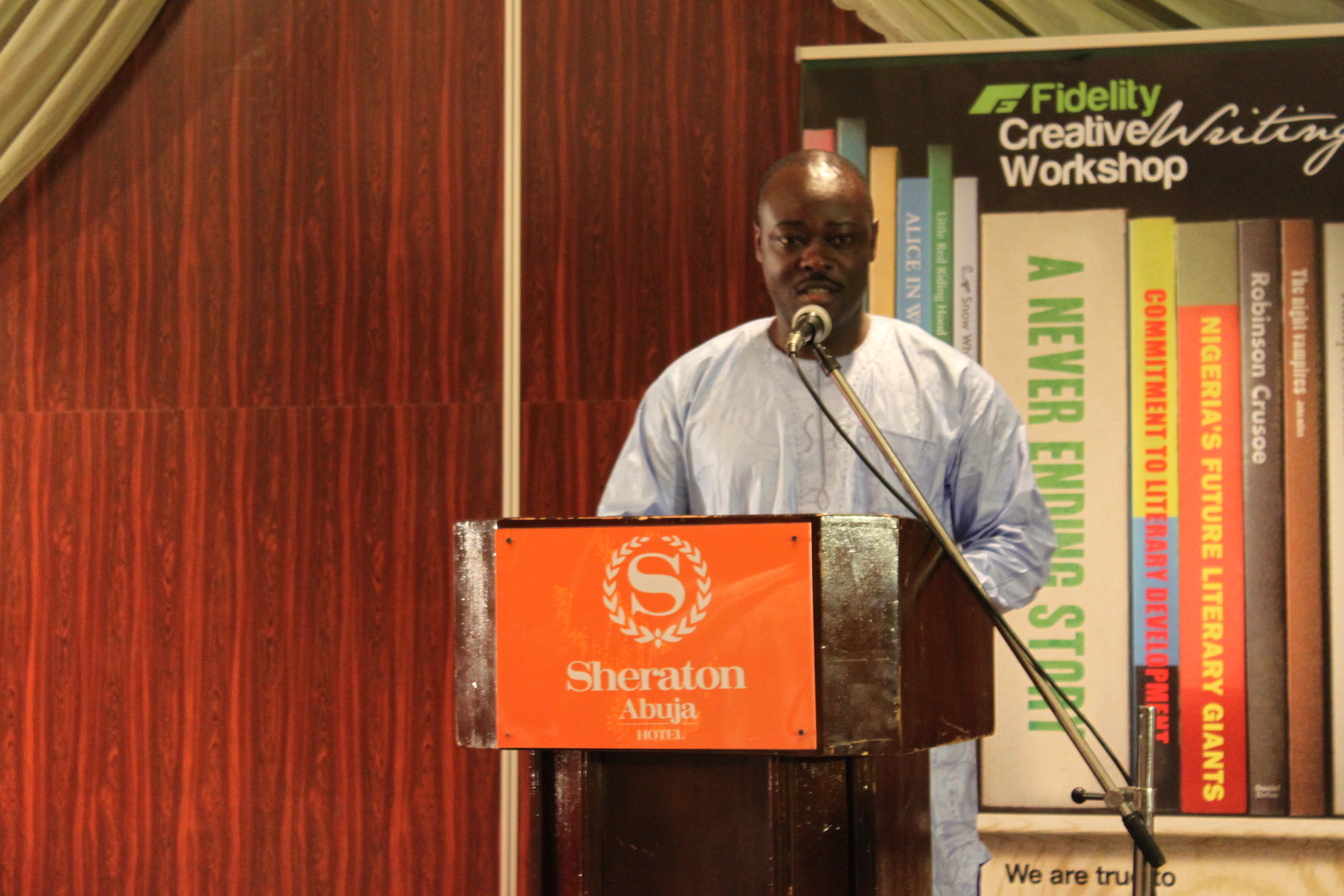
Helon Habila, author of Waiting for an Angel, Measuring Time, and his latest Oil on Water (publication date August 2010–but an excerpt from the novel published as a short story “Irekefe Island” can be read at the Virginia Quarterly Review), will be hosting a creative writing workshop in Abuja from July 16-22. For a chance to participate in the workshop, apply by June 20, 2010. The workshop is sponsored by Fidelity Bank. For more information about Habila’s workshop and other literary opportunities in Abuja, see the website of the Abuja Literary Forum. (UPDATE 21 July 2010: The final event, which is open to the public, will be held Thursday, 22 July 2010, 4pm, at the Abuja Sheraton.)

Helon Habila speaking at the closing ceremony for the Fidelity Creative Writing Workshop, Abuja, 22 July 2010 (c) Carmen McCain

Helon Habila speaking at the closing ceremony for the Fidelity Creative Writing Workshop, Abuja, 22 July 2010 (c) Carmen McCain

In my opinion, Helon Habila is one of Nigeria’s best contemporary prose stylists, although I may be biased as my (very flawed) MA thesis was an analysis of his first novel Waiting for an Angel. Elsewhere on this blog, I have posted an interview I did with him in November 2007 and my thoughts on a piece he wrote in Next questioning the actions of the Kano State Censor’s Board. In January 2008, I had also posted a review of Waiting for an Angel and Measuring Time on my personal blog, which I will re-post here:

My review of Waiting for an Angel and Measuring Time

If you’ve never read anything by the Caine and Commonwealth prize winning author Helon Habila, the first thing to know is that his use of language is exquisite. The second thing to know is that he makes generous use of irony. Although he is a clearly political writer, he questions over-easy assumptions and political binaries. In his latest novel, Measuring Time, Habila continues the project he began in his debut novel Waiting for an Angel—that is to tell history through the eyes of ordinary people.

Waiting for an Angel opens in a prison setting. The imprisoned journalist Lomba is engaged in a battle of wits with the prison superintendent who is extorting poetry from his prisoner in an attempt to impress a woman. If Lomba’s story were told in a straight line, the way it might appear in his prison file, it would be the story of a failure: a student who drops out of university, who loses friends to madness and military violence and the women he loves to other men, a writer who never finishes his novel and whose journalistic career is cut short by his arrest in the slums of Lagos. However, this is not the story that Habila tells. By breaking up and rearranging the linear story of Lomba’s life, he wrests control of the narrative away from an environment-determined fate. The novel starts at the end of the chronological sequence and then circles back to gather stories of other characters in Lomba’s Lagos: a young boy banished from his home in Jos for smoking Indian hemp, an abandoned out-of-wedlock mother, an intellectual in a tragic love affair with a former student turned prostitute, the daughter of a general whose mother is dying of cancer, a disillusioned woman who runs a neighborhood eatery, a man who defies the soldiers on the night of Abacha’s coup, an editor pursued by the police who refuses to go into exile, a legless tailor who dreams of bidding poverty goodbye.

While the form of Waiting for an Angel reflects the frenetic beat of life in Lagos, the small town setting of Habila’s second novel Measuring Time allows for a more meandering pace. Mamo and LaMamo are twins growing up in the middlebelt town of Keti, and they hate their father, a womanizing businessman with political ambitions. They hate him for breaking their mother’s heart before she died giving birth to them, and they hate him for his long absences and his neglect. The twins’ simultaneous desire for revenge and quest for fame ends in their separation. When LaMamo runs away in search of adventure as a mercenary soldier, Mamo’s sickle cell anemia forces him to stay at home, spending more and more time in his imagination. The narrative of Mamo’s day to day life in Keti is rhythmically punctuated by adventure-filled letters from LaMamo as he travels around West Africa. Mamo reimagines events in Nigerian history: the poet Christopher Okigbo did not die in Biafra but instead lay down his gun to travel around Africa with Mamo’s Uncle Haruna. LaMamo enacts Mamo’s imagined story, becoming a soldier-poet who reports from the Liberian war front, and his words capture the spiritual horror and the boredom of war as it is rarely recorded in international news. The twins long for the other: while Mamo imagines adventures beyond the borders of his small town, LaMamo constantly searches for reminders of home in foreign lands.
The narrative of Measuring Time is frequently interrupted by folktales told by Mamo’s Auntie Marina, letters from LaMamo and a professor in Uganda who becomes Mamo’s mentor, excerpts from the memoir of the first missionary in Keti, his wife’s diary, and colonial reports, and the oral histories told by other characters. One of the most remarkable aspects of Habila’s prose is this inclusion of multiple genres alongside a continuous pattern of tributes to preexisting literary works. In Waiting for an Angel, he borrows the character of the prison superintendent from Wole Soyinka’s The Man Died and gives him some of the associations of the folkloric dodo, a dim-witted monster who is often outwitted by the youth he kidnaps. Throughout the rest of Waiting for an Angel he references writers as varied as Ayi Kwei Armah, Ousmane Sembene, Ngugi wa Thiong’o, Franz Kafka, John Donne, and Sappho. Similarly in Measuring Time, he bundles together Plutarch, Christopher Okigbo, William Shakespeare, Wole Soyinka, Alex La Guma, the Arabian Nights and Faust legends, as well as references to oral tales and Nigerian video films. The effect of these competing voices is to open up the boundaries between his fiction and other fictions and historical accounts that lie outside the novel. The illusion of a smooth, progressive, and abbreviated history, such as the Brief History of West Africa that is brought to Lomba in prison (as the Letters of Queen Victoria had been brought to Soyinka in prison) is a false one. Habila’s fictional histories play a function similar to the colonial history the Pacification of the Primitive Tribes of the Lower Niger in Chinua Achebe’s Things Fall Apart in which the district commissioner writes only a paragraph on a man who has been the subject of Achebe’s entire novel. Habila parallels Achebe’s fictional colonial text in Measuring Time with the missionary text A Brief History of the People’s of Keti by Reverend Drinkwater.

It is with these “brief histories” that Habila’s project in both Waiting for an Angel and Measuring Time becomes clear. Mamo is determined to write a history that does not “cut details” as the colonial histories had—a history that tells the stories of “individuals, ordinary people who toil and dream and suffer” (MT 180). The traditional ruler’s story he has been hired to write, Mamo states, is “simply a part of the other biographies…. [that he would] eventually compile to form a biographical history of Keti. That’s what history really is, people and their lives, no matter how we try to manipulate it. It is the story of real people with real weaknesses and strengths and… not about some founding fathers and … even if we want to write about the founding fathers we shouldn’t privilege them, we should place them on par with other ordinary folks…” (225). In Mamo’s subsequent “biographical history,” he writes of his father the failed politician, and his aunt the divorced wife, placing their stories alongside the less than glorious history of the mai, the traditional ruler, of Keti. Every story has its own place alongside the others. When LaMamo returns with a revolutionary fervour reminiscent of Ngugi’s Matigari, the separate lives of the twins blend and become one—LaMamo’s panAfrican experience and his soon to be born child are given into Mamo’s safekeeping and for recording into Mamo’s history of Keti.

Such a history is not merely a radical rewrite of racist colonial histories but an empathetic window into the lives of even the unpleasant characters. The characterization of the prison superintendent in Waiting for an Angel follows Soyinka’s original caricature, but the man is given a more complex psychology. He is a man grieving for his dead wife, a father of a young son. As Lomba realizes when he meets the superintendent’s girlfriend, “The superintendent had a name, and a history, maybe even a soul” (WfA 37). While in Measuring Time, the sleepy-eyed traditional ruler of Keti and his evil vizier take on the typed characteristics of folktale or a video film, most of the characters in Measuring Time are treated with complexity and compassion. When LaMamo calls the old widows who had pursued their father all his life “shameless old women,” Mamo reminds him that “they weren’t so bad… People are just people” (MT 343). And although the missionary Reverend Drinkwater may have misrepresented the history of Keti, his family has become a part of the history of the town. The missionary’s daughters, now old women, live in Keti, tending their parents’ graves. Although they are not Nigerian, they belong in Keti. It is the only life they have ever known.

This concern with multiple perspectives on history is behind what at first glance might seem to be an editorial flaw in Habila’s two novels. When reconstructed in both novels, time doesn’t quite add up. According to the chronology given in “Mamo’s notes toward a biography of the Mai,” the number of years between the installation of the first mai by the British and the current mai should be about thirty two or three years, yet the time period is stretched from 1918 up to the 1980s (MT 238-240). The year-long planning period for the celebration of the mai’s tenth anniversary seems to turn into three. Similarly in Waiting for an Angel, the time between Lomba’s stay at the university and his imprisonment seem much longer than the actual historical tenure of Abacha’s regime. He supposedly meets and falls back in love with an old girlfriend some time after he becomes a journalist. Yet, two weeks before he is arrested (after he has worked at the Dial for two years), another girlfriend, with whom he has lived for a year, leaves him. The times between the two love affairs don’t quite seem to add up.

Placing the novels side by side gives a hint to what Habila is doing here. In Waiting for an Angel, Habila gathers up historical events that happened along a spectrum of ten years and bundles them into the space of a week. Although Nigeria is kicked out of the Commonwealth in November 1995, in the novel, a week after this event, Dele Giwa, the editor of Newswatch Magazine, is assassinated by a parcel bomb on the same day that Kudirat Abiola is assassinated by gunmen. Of course, historically, the two activists were killed ten years apart: Dele Giwa during the Babangida regime in October 1986 and Kudirat Abiola during the Abacha regime in June 1996. The quickening rhythm of disaster in this chapter of Waiting for an Angel parallels the last quarter of the Measuring Time in which Mamo falls into the hard-partying lifestyle of corrupt politicians, religious riots break out, and the quiet town of Keti goes up in flames. Time here is not a mathematical iambic pentameter that can be measured with a clock, but a living fluctuating force that lags behind and loops around to find the stories of multiple characters. It reminds me of the way time acts in Gabriel Garcia Marquez’s One Hundred Years of Solitude or in oral tales and epics. It cannot be diagramed into a dry progression of events such as those found in A Brief History of West Africa or A Brief History of the Peoples of Keti but instead can only be mediated through the memories of those who experienced it. In his afterward to Waiting for an Angel, Habila acknowledges the liberties he has taken with the chronological order of events, “[N]ot all of the above events are represented with strict regard to time and place—I did not feel obliged to do that; that would be mere historicity. My concern was for the story, that above everything else” (WfA 229).

Mamo’s story of Keti, like the story of Lomba in Waiting for an Angel, becomes in miniature the story of Nigeria—not that it can represent all the complex and multi-faceted stories of the nation, but that it offers an example of what can be written: the individual stories of ordinary people living in extraordinary times. Habila layers his work onto that of older writers such as Achebe and Ngugi who rewrote colonial history in their early works, and joins other contemporary Nigerian writers like Chimamanda Ngozi Adichie and Teju Cole whose writing seems similarly concerned with providing entry points into historical events as lived by ordinary people. Measuring Time ends with the performance of a play by church women’s group, both celebrating and mocking the appearance of the missionary Reverend Drinkwater into Keti history. Mamo realizes that through their caricatured performance, they are telling the story on their own terms, invoking a way of life much older than the colonial encounter: “They were celebrating because they had had the good sense to take whatever was good from another culture and add it to whatever was good in theirs: they had done this before when they first met the Komda, and many times before that in their travels and migrations, in times earlier than even the oldest among them could remember. This was their wisdom, the secret of their survival. This was why they were still able to laugh… each generation would bring to this play its own interpretation” (MT 382). This at root is the power of Habila’s work—the ability of humanity to laugh in the face of tragedy—the ability to undermine stories that have been told for you by telling them yourself.

Plagiarism (of me) in the Vanguard and the DG of Kano State Censor’s Board speaks out.

I’m still backlogged on a lot of blog posts, bear with me. I will post soon on the Zuma Film Festival, the Savannah International Movie Awards, and the NAISOD press conference.  But this morning, when I opened up this Vanguard article by Benjamin Njoku, “Our Grouse with Kannywood – DG, Kano Censorship Board,” (also found here on AllAfrica.com) it sounded curiously familiar.  While most of the article is an original piece outlining the director general of the Kano State Censorship Board’s “grouse with Kannywood,” the first three paragraphs are directly plagiarized from a piece I wrote (with the help of Nazir Hausawa and Ahmad Alkanawy) back in January 2009 and published first on my blog, then republished in NEXT, at Chimurenga Online, and at Pambazuka News. I thought I’d post immediately, half out of pique, half because the article is actually relevant to my research.

Here are the first four paragraphs of Njoku’s article:

Until three years ago, Kano used to be the home of a thriving film industry in the Hausa language. Hausa language ‘video-films’ are similar to the larger ‘Nollywood’ film industry but are stylistically different from their southern counterparts, with most films including song and dance sequences influenced by Indian films and hip-hop music videos.

A sex scandal in 2007 involving a leaked cell phone video of a Hausa film actress, Maryam ‘Hiyana’ Usman, having sex with her boyfriend Usman Bobo, instigated a change in the leadership of the Kano State Censorship Board. The board had been instituted in 2001 after the implementation of Islamic Sharia law as a compromise measure between the film makers and the government.

The censorship board enabled the films to continue being made but with some restrictions on dress and interaction between male and female actors.

Following the sex scandal, the incumbent director general of the Kano State Censorship Board, Abubakar Rabo Abdulkareem, formerly commandant of the hisbah, was appointed in August, 2007, to arrest the ugly trend. Since this administrative change, controversy has continued to trail the industry as there have been alleged multiple arrests and acts of intimidation against the film industry and related entertainment businesses in Kano.

Now here are the first three paragraphs  of my piece, as quoted from NEXT:

Nigeria’s northern city of Kano was until last year the home of a thriving film industry in the Hausa language. Hausa language “video-films” are similar to the larger “Nollywood” Nigerian film industry but are stylistically different from their southern cousins, with most films including song and dance sequences influenced by Indian films and hip-hop music videos.

In August 2007, a sex scandal involving a leaked cell phone video of a Hausa film actress Maryam “Hiyana” Usman having sex with her boyfriend Usman Bobo instigated a change in the leadership of the Kano State Censorship Board. The board had been instituted in 2001 after the implementation of Islamic Shari’ a law as a compromise measure between the filmmakers and the government.

The censorship board enabled the films to continue being made but with some restrictions on dress and interaction between male and female actors. (The Kano State Censorship Board is a separate entity from the National Film and Video Censor’s Board which files and gives ratings to all films made in Nigeria. Hausa filmmakers are required to submit their films to both bodies if they want to sell their films in Kano State.)

[….] [Paragraph four deleted in Njoku’s piece, he continues on to paragraph five.]

Following the sex scandal, a new director general of the Kano State Censorship Board Abubakar Rabo Abdulkarim, formerly commandant of the hisbah, was appointed in August 2007. Since the administrative change, there have been multiple arrests and acts of intimidation against the film industry and related entertainment businesses in Kano.

This is not the first time I have been plagiarized. A piece I wrote under a pseudonym was rather humorously mangled in a local government-funded paper (I didn’t make any public noise about it because I had written under a pseudonym) and several other pieces were taken without attribution on ModernGhanaNews.com and other such sites. Similarly, my photos posted on this blog, on flickr, and other internet forums are regularly published without attribution. But this is the first time, I have been plagiarized in such a respectable paper by an entertainment journalist I have, myself, quoted (with attribution) in my academic work. I am flattered that my piece I wrote a year and a half ago is still felt to be well written and relevant enough to open a new article (with a few edits and moving around of phrases), but, as most writers are, I am also irritated at having my words taken with no attribution and at the subtle changes made to the text to imply that the “ugly trend” of being arrested is somehow the fault of the filmmakers and separate from the authority of the Kano State Censor’s Board.

And, of course, what I am experiencing is common to many other journalists. I have several journalist friends who have complained about their words being stolen and used without attribution on online publications, and I daily read newspapers with “culled” stories from international news sites, some with attribution, some with none.

My grouse on having my words plagiarized being stated, if you’d like to hear more of DG Rabo Abdulkarim’s “grouse on Kannywood,” read on to the “original material” in the article, with the usual accusations against Kannywood (amongst many others) that

five percent of their immediate concern is to copy other people’s works at a cheap rate.

yeah, that’s apparently not too unusual in other media either…

In other recent news on the Head of the Kano State Censorship board, apparently Rabo Abdulkarim was involved in an altercations with filmmakers in Kaduna after he made accusations on Radio DITV in Kaduna about Hausa filmmakers making blue films. For more information on the gathering of filmmakers who challenged the head censor on the premises of DITV, read Al-Amin Ciroma’s article “Showdown with a Censor” published in Leadership on 18 May 2010.

11am Press Conference for Sani Danja’s new organization NIGERIAN ARTISTES IN SUPPORT OF DEMOCRACY, Bolingo Hotel, Abuja, TODAY

I’ve been travelling and I’m backlogged on posts for about a month (including posts on the Savannah International Movie Awards and the Zuma Film Festival), so I’m going to start with the latest first and work my way back:

Kannywood star and founder of NAISOD Sani Danja at the NAISOD Press Conference, 10 May 2010 (c) Carmen McCain

11am Press Conference for Sani Danja’s new organization NIGERIAN ARTISTES IN SUPPORT OF DEMOCRACY, Bolingo Hotel, Abuja, TODAY

Last week while hanging out with Kannywood artistes who had come to Abuja for the Zuma film festival, I went with some of them to meet up with Kannywood superstar Sani Danja. While there, he told me about an initiative I’ve heard rumours of for some time but which I had heard no details on until this point. Sani Danja told me that the political conflict in Kano between the film industry and the government has instigated him and other artistes from Kannywood and other parts of Nigeria to become more politically involved, resulting in the formation of an organization, Nigerian Artistes in Support of Democracy (NAISOD). His vision is to create a platform under which artistes from all over the country, not just the north, can 1) advocate for themselves and protest the sort of arrests etc going on in Kano, 2) more generally support democracy a) through non-partisan support of candidates (from any party) they think will support democracy in the upcoming elections, b) through creating awareness, internally (rather than externally through NGO’s etc) motivated, about other social issues such as HIV awareness or peace building. Danja felt that with the influence artistes have through their large fan base, that it was their duty to become involved in more creating social awareness. For more information on the organization, see their website: www.naisop.org

Sani Danja and other artistes in the organization are holding a press conference today, Monday, 10 May, at 11am at the Bolingo Hotel, Abuja, close to the Ship House/U.S. Embassy. I am not involved with the organization, but, as researcher/freelance journalist thought that the idea of artistes forming organizations to be vocal about political and social issues both an interesting and a potentially quite positive development. Of course, there are concerns here: How will the organization keep itself accountable from supporting the highest bidder? Is it possible/positive for an organization made up of many artists to speak with one voice in support of political figures? What criteria will they use for support of their candidates? Must every artiste involved in the organization be in support of a single candidate? There is a certain amount of fuzziness in the goals, which could make it difficult for them to take bold action.  However, democracy in general is a work in progress, as is any fledgling organization. I am generally quite skeptical and cynical about celebrities and their social causes, especially as regards Hollywood celebrity’s obsessions with Africa. But in the case of Nollywood and Kannywood, I think such indications of social awareness and feelings of social responsibility from within is actually a positive development. NAISOD may not end up being the most influential organization, and there may be others that come up, but artistes, whether we as critics like it or not, actually have a huge fan base and a great amount of power to speak to that fan base. More than anyone else, filmmakers and musicians probably have the power to propel the “masses” into action. As such, I think that it is useful to publicize ventures like this, as well as to give constructive criticism that will help artistes become more precise and effective in their goals.

I will try to put up more information after the press conference today.

Phone dead, Friends, please send me your numbers…

[UPDATE 2 MAY 2010: A computer whiz on Zoo Road was able to help me retrieve my contacts from a virusy phone. The messages are still stuck there, but with my contacts I’m all good. Thanks to those of you who sent numbers and added contacts that I didn’t even have before!]

This morning my phone woke up, decided life wasn’t worth living, and committed suicide (ie. turning itself off and refusing to allow itself to be turned back on), taking with it all 400+ of my contacts and 1000+ text messages. Not a single number or message remained on my SIM card when I put it into my new (as of this evening) phone. For those of you who know me in real life and have my phone number, please send me a text with your name so that I can save it in my phone, or if you don’t have my phone number but want me to have your contact info, you can send me an email or write a comment in the comments section, which I will not publish (if you have commented before don’t do this, because wordpress automatically publishes people it recognizes as having commented before). I’m hoping that the numbers will be able to be retrieved from my old phone, but, since there are none on my sim card, I’m not optimistic.

Thanks.