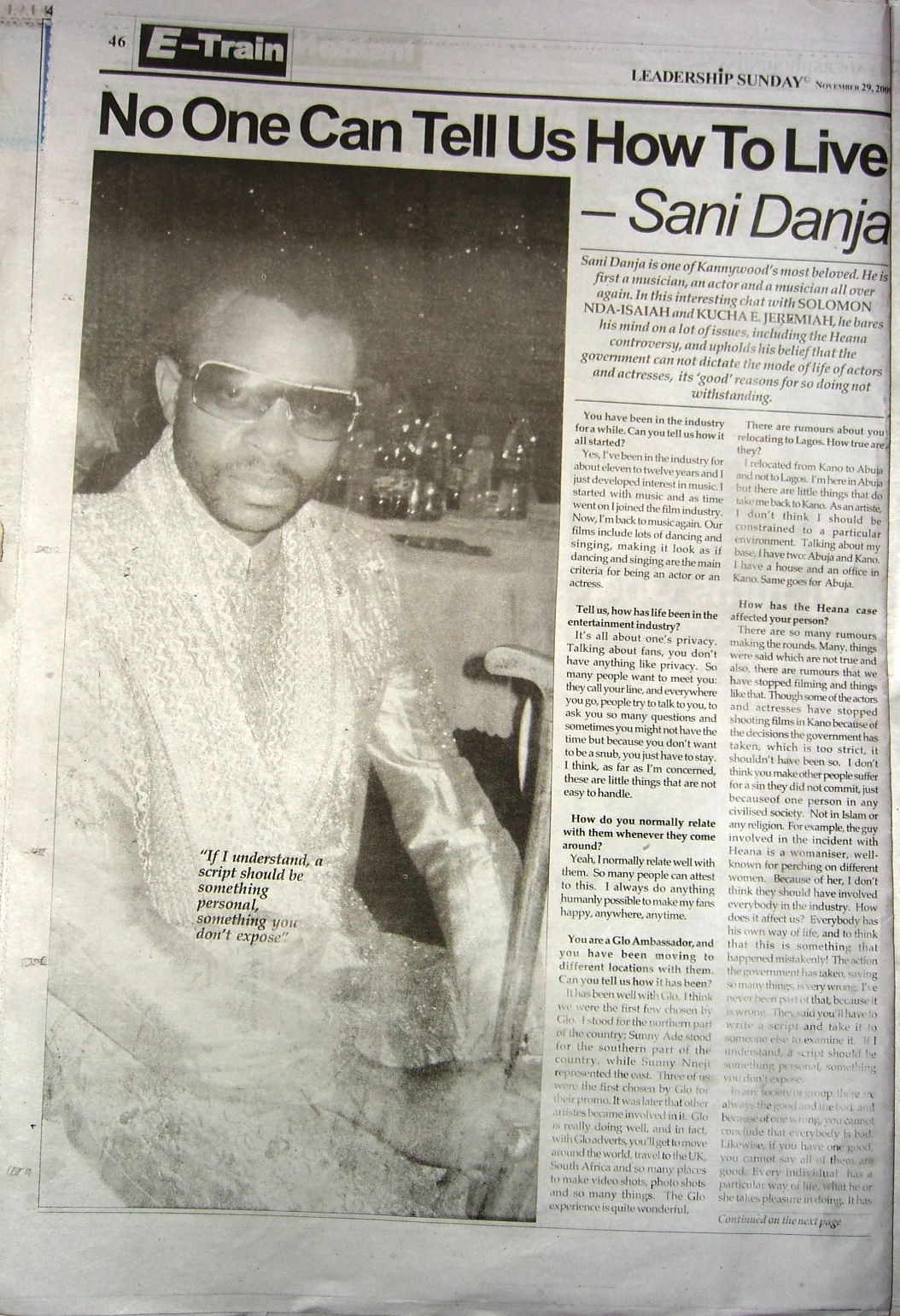
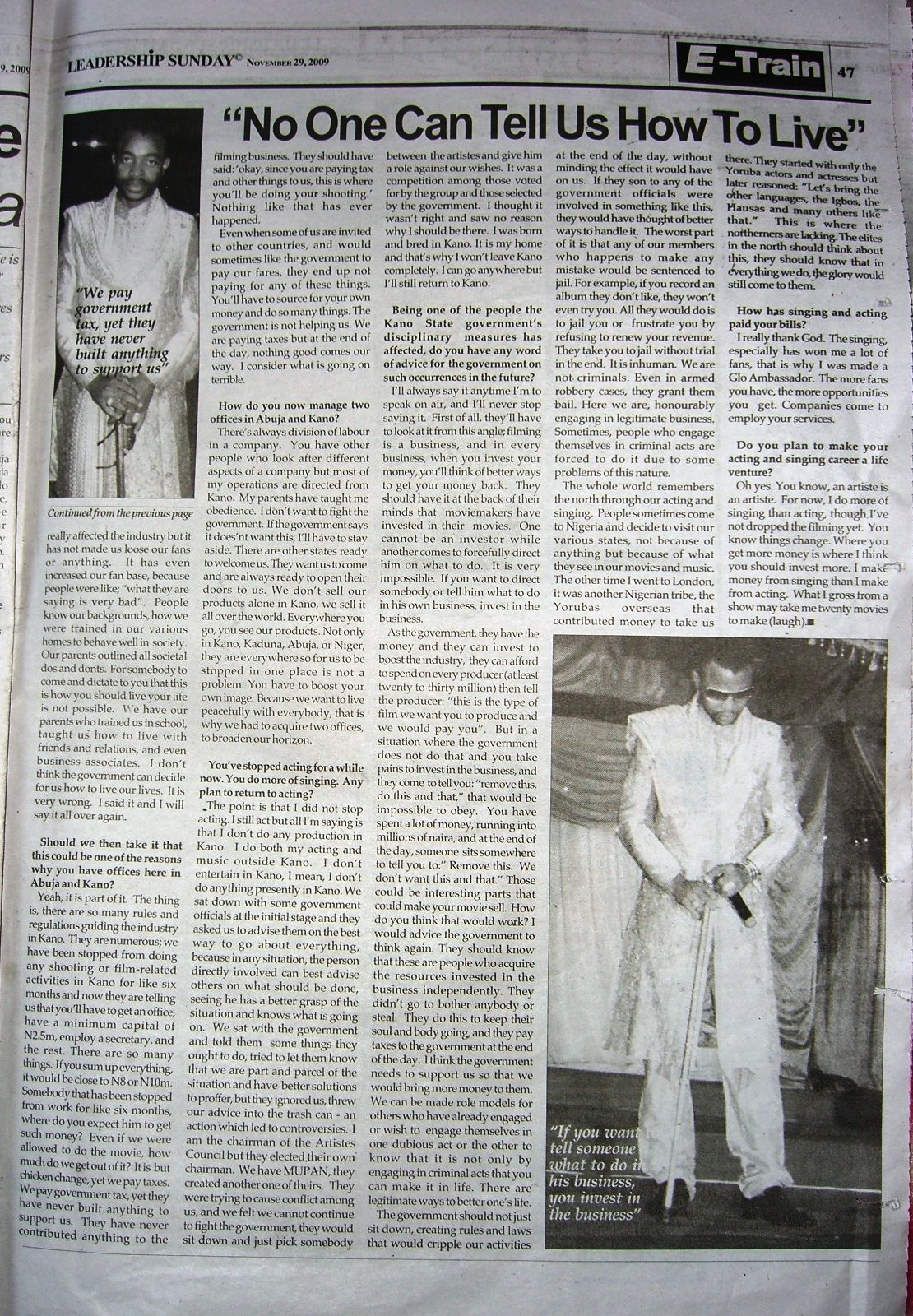
There is a great interview that Solomon Nda-Isaiah and Kucha E. Jeremiah did with Hausa film and music star Sani Danja in this week’s Sunday Leadership. Since I can’t find the online version of the article, I will post a photo of the hard copy here and a few excerpts from the interview. This article comes from Leadership Sunday, November 29, 2009. Pages 46-47. (Unfortunately, after posting I realized that the text is not big enough to read. To read, you might have to download the photo and read in a photo viewing program.)
In the article Sani Danja talks about his music and film career, his activites as a Glo ambassador, and his opinions on the recent actions of the Kano State government on Hausa filmmakers.
Here are a few excerpts. To read fully, you may have to download the photo:
When being asked about the reasons he decided to relocate to Abuja, although having offices in both Abuja and Kano, Danja says
“The thing is, there are so many rules and regulations guiding the industry in Kano. They are numerous; we have been stopped from doing any shooting or film-related activities in Kano for like six months and now they are telling us that you’ll have to get an office, have a minimum capital of N2.5m, employ a secretary, and the rest. There are so many things. If you sum up everything, it would be close to N8 or N10m. Somebody that has been stopped from work for like six months, where do you expect him to get such money? Even if we were allowed to do the movie, how much do we get out of it? It is but chicken change, yet we pay taxes. We pay government tax, yet they have never built anything to support us. They have never contributed anything to the filming business.
In response to the management of two offices in Abuja and Kano, he replies:
There’s always division of labour in a company. You have other people who look after different aspects of a company but most of my operations are directed from Kano. My parents have taught me obedience. I don’t want to fight the government. If the government says it doesn’t want this, I’ll have to stay aside. There are other states ready to welcome us. They want us to come and are always ready to open their doors to us. We don’t sell our products alone in Kano, we sell it all over the world. Everywhere you go, you see our products. Not only in Kano, Kaduna, Abuja, or Niger, they are everywhere, so for us to be stopped in one place is not a problem. You have to boost your own image. Because we want to live peacefully with everybody, that is why we had to acquire two offices, to broaden our horizons.
When asked if he had any advice for the government on disciplinary measures against filmmakers, Danja says:
First of all, they’ll have to look at it from this angle; filming is a business, and in every business, when you invest your money, you’ll think of better ways to get your money back. They should have it at the back of their minds that moviemakers have invested in their movies. One cannot be an investor while another comes to forcefully direct him on what to do. It is very impossible. If you want to direct somebody or tell him what to do in his own business, invest in the business.
As the government, they have the money and they can invest to boost the industry, they can afford to spend on every producer (at least twenty to thirty million) then tell the producer: “this is the type of film we want you to produce and we would pay you”. But in a situation where the government does not do that and you take pains to invest in the business, and they come tell you: “remove this, do this and that,” that would be impossible to obey. You have spent a lot of money, running into millions of naira, and at the end of the day, someone sits somewhere to tell you to: “Remove this. We don’t want this and that.” Those could be interesting parts that make your movie sell. How do you think that would work? I would advise the government to think again. They should know that these are people who acquire the resources invested in the business independently. They didn’t go to bother anybody or steal. They do this to keep their soul and body going, and they pay taxes to the government at the end of the day. I think the government needs to support us so that we would bring more money to them. We can be made role models for others who have already engaged or wish to engage themselves in one dubious act or the other to know that it is not only by engaging in criminal acts that you can make it in life. There are legitimate ways to better one’s life.
The government should not just sit down, creating rules and laws that would cripple our activities at the end of the day, without minding the effect it would have on us. If the son to any of the government officials were involved in something like this, they would have thought of better ways to handle it. The worst part of it is that any of our members who happens to make any mistake would be sentenced to jail. For example, if you record an album they don’t like, they won’t even try you. All they would do is to jail you or frustrate you by refusing to renew your revenue. They take you to jail without trial in the end. It is inhuman. We are not criminals. Even in armed robbery cases, they grant them bail. Here we are, honourably engaging in legitimate business. […]
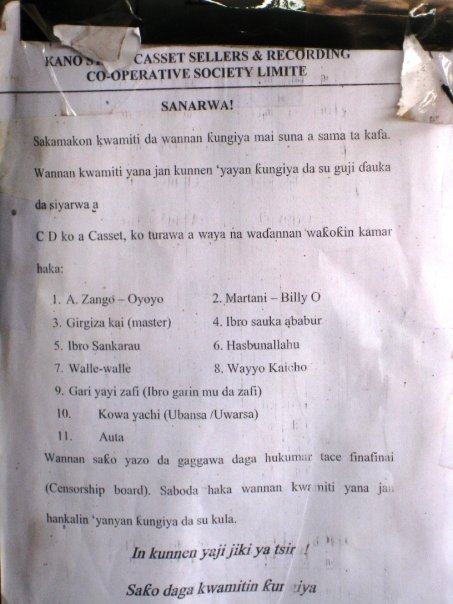
11 Songs banned by the Kano State Censorship Board. Photo (c) Alex Johnson
The third on the list of songs that were banned was “Girgiza Kai” (“Shake your head”) by Hausa rapper Ziriums, which was not officially released but uploaded to his myspace page. In “Girgiza Kai,” Ziriums, warns those who hear his song,
“Kai karku taka kun san an hana.
Hey, don’t dance, you know they banned it. ….
.. ..
Gwamnan garinmu ran nan. Shi ne ya hana.
The governor of our city here. He banned it…..”
Instead you should just
“Girgiza kai.”
“Shake your head.”
He also satirically uses the proverb “Mai dokar bacci, ya bige da gyangyed’i.” “The one who says sleep is against the law is the one nodding off…” to critique
“Wanda duk ya hana mu sana’a”
“Anyone who keeps us from working….”
(You can listen to the song on Zirium’s Myspace page, and read the lyrics and an English translation here.).. Already having left Kano for Abuja when the song was banned, Ziriums has hooked up with other Abuja-based musicians, Supreme Solar and T-Rex, to continue his controversial rapping on a larger national scale. Intersection Entertainment has recently released S. Solar’s “Government Money”, (featuring T-Rex and Ziriums), a hilarious take-off on Busta Rhymes’ and Ron Browz’s notorious “hit”: “Arab Money.”
You can view “Government Money” here. Please note that all the videos embedded in this blog post are being done so under FAIR USE laws for review purposes:
Both the original “Arab Money,” and remake of the Busta Rhymes’ tune contain wildly offensive portrayals of Arabs and Islam. (The remix featuring Lil Wayne, P. Diddy and even self-proclaimed Muslim Akon, is even worse, and uses actual verses from the Qur’an as the chorus.) The Wikipedia article written about the remix of the song notes that the chorus is “Bismillāhi r-raḥmāni r-raḥīm. Al ḥamdu lillāhi rabbi l-‘ālamīn”; “In the name of Allah (The God), most Gracious most Merciful. All Praise is due to Allah, Lord of the worlds.” This chorus is intoned behind the American rappers making dramatic poses , flipping bling, and rhyming about their wealth. The Wikipedia article continues to point out that Busta Rhymes uses the Islamic greeting “As-Salamu Alaykum Warahmatullah Wa Barakatu.” “May Peace and blessings of Allah(The God)be upon you” (A Greeting), to rhyme with “While I stack another billion and give it to the block fool.” Similarly Diddy says ““Al hamdu lillah” ( “All Praises to Allah”) to rhyme with: “With my billions pilin'”
Watch the original “Arab Money” here:
And the remix here:
Obviously, while self-consciously funny, the song is sacrilegious and insulting to most Muslims (though if you read through the comments on youtube or various lyrics websites there are occasional self-proclaimed “Arabs” who take pride in it). I could focus my whole blog post on this issue; however, since this has already been done multiple times (here, here, here, here, here, and here) and since I’m more interested in how S. Solar, T-Rex, and Ziriums rewrite the song in the Nigerian context, I’d like to look more at what seems to be Busta Rhyme’s conscious intention, which seems to be a celebration of bling—exemplified in what, with blinding cultural chauvinism, he calls “Arab money.” He and his fellow musicians are not affected by the recession, he implies, they just move on to the “Arab money,” which “Arabs” know how to respect:
Indeed, in an MTV article, Busta defends himself by describing the way the song was recorded:
[Ron] picked up the phone, and I was like, ‘What are you saying on this joint?[…]
When Browz explained to Busta that he was, in fact, saying “Arab,” Busta was elated.
“I was like, ‘This is genius,’ ” he said. “Just the timing of this. The fact that the recession was crazy. Fortune 500 companies left and right are needing bailouts. I was like, ‘You ain’t hearing none of that going on with none of the people in the Arab community or Arab culture. None of that.’ I was like, ‘You know something? This is a great record to inspire people to incorporate wealth in their vocabulary[my emphasis], because rich has become the new broke.’ ‘Arab Money’ — it felt right. Let’s take something from a culture that has exemplified the rich qualities of spirituality and economic and financial stability for thousands of years. They’ve instilled that in their kids for thousands of years.”
Busta ostensibly praises the “rich Arab culture,” yet the “culture” he claims to admire is an Orientalist fantasy of gold-glittering caves and harems of nymphomaniacs, tied to earlier colonial grabs for land, wealth, and power. At time code 1:54 in the first video he brags that he is
sitting in casinos while I’m gambling with Arafat,
money long now, watch me purchase pieces of the almanac.
Both versions entwine exoticized presentations of supposedly “Arab” moneyed lifestyles with the standard hiphop hymn to wealth, materialism, money, and women—clichés exemplified in 50 Cent’s “I Get Money,” among many others.
These clichés have been adopted (with more or less irony) in Nigerian pop music. (Examples feature Nollywood-like Lagos settings with plush leather couches, sleek clubs, wine glasses, expensive cars, and scantily clad (often light-skinned) women. See Faze’s Need Somebody, P-Square’s “Do Me, I Do You,” Dbanj’s “Booty Call,” or Style Plus’s “Call my Name.”) These popular songs exemplify the “Nigerian dream” of making it big and partaking in the glamourous party-world of Ikoyi, Victoria Island, Maitama, or abroad. In fact, before Intersection’s “Government Money,” Olu Maintain had come out with a track named “Arab Money,” as well, likely inspired by the Busta Rhymes video although he doesn’t seem to have shot a video for it yet. The chorus involved the repeated phrase “I go spend Arab Money, just spend Arab money,” alongside wistful tracks about going “to Abu Dhabi, where we can walk freely.” In this track, there does seem to be more self consciousness about the representation of wealth than much other Naija-pop, as can be seen in the observation that in Dubai “recession no dey there” and in this exchange at timecode 3:04 between Olu Maintain and Bondo Krazzy:
Olu Maintain: On second thought, there are some things money can’t buy [….] You know what I’m talking about?
Bond Krazzy: Hei, Mr. Olu, money can never buy love, Mr. Olu.
The Nigerian music/music videos I find most compelling play with a more self conscious reference to wealth as it is related to corruption and give ironic nods to the particularly Nigerian innovations in 419, from the celebration of the yahoo yahoo boys in Olu Maintain’s Yahoozee, which features row upon row of big hummers to the more self-consciously satirical “I Go Chop your Dollar” by comedian Nkem Owoh (who in a twist of fate was recently kidnapped by entrepreneurial criminals in what has become the hottest new way to “chop money” Apparently, Owoh was released when his family forked over N1.4 billion.)
Watch Yahoozee here:
Watch, “I go Chop your Dollar” here:
With “Government Money,” Intersection musicians Supreme Solar, T-Rex, and Ziriums follow in this satirical tradition: Rewriting Busta Rhyme’s hymn to moola, these Abuja-based musicians echo the “celebration” of money, but with an ironic edge—rapping not of the wealthy lifestyle attainable to them as musicians but to those Abuja Big Boys who are eating “Government money.”
In the tradition of “Yahoozee” and other videos where flashy cars become symbols of power, sexual prowess, and wealth, Supreme Solar raps about his “new Range Rover” leaning against the glossy side of the jeep. The camera zooms out to focus on the license plate, which says FG Kudi, (for Federal Government Money). The use of “Abuja” here is a metonym for government, politics, and all the “promise”of money that Abuja offers those who come to Nigeria’s airbrushed capitol where the poor (or even the simply “middle class”) are swept out to the crowded outskirts of the city. To participate in the lifestyle, then as T-Rex says
What’s the access here?
We aint makin bucks in excess
Having stocks and investments
But to me it doesn’t’ make sense
To make the excessive “Abuja-style” money, one must go a bit further than stocks and investments, “Duping NGO’s for Virgin dough” and other shady transactions.
What most creates tension between “Government Money” and the original “Arab Money,” taking the tune beyond the “Yahoozee” genre (pushing it more in the direction of Eedris Abdulkareem’s funny but incisively critical “Mr. Lecturer”), is the inclusion of Ziriums, a Northern Muslim from Kano state, with his Hausa chorus “Mu ci kudin Abuja, Mu ci kudin gwamnati” (Let’s eat/spend Abuja Money, let’s eat/spend government money”) and his fierce spoken commentary at the end of the song. Interestingly (even uncomfortably), Ziriums’ chorus in Hausa is used where in the “Arab Money” remix the Qur’anic verses are used, layering on popular Nigerian conflations of Arab/Muslim culture with the Hausa-speaking north, both imagined and real. By the second day the video had been posted, there was already a comment by user “injustice2mankind” saying, “That fool Ziriums is killing me with his attire…note the arab neck scarf on his agbada….so funny.”
Ziriums featured in “Government Money” by Supreme Solar
Where in the American version, there is a blasphemous use of the Qur’an to rhyme with verses about the love of mammon, in this version, Ziriums’ chorus takes the “Arabic” sound and turns it to a satirical first person boast about “devouring government money.” Here, he subversively links Busta Rhymes et al, and their blasphemous use of Islamic creed to support debauchery, with those “Big Men” who use religion (whether Christianity or Islam) as a cover to justify their scramble for the “national cake.” That is, the very elite who tend to self-righteously decry the “immorality” and “cultural imperialism” of hiphop as a genre are the very ones whose personal habits tend have the most in common with the gold-plated lifestyles of those American artists. Dressed in a Big Man’s babban riga, Ziriums and the other two artists take on the personas of government contractors and professional fraudsters, blurring the boundary between the two.
“Cin kudi” (literally “eating money”), the Hausa phrase that parallels the pidgin phrase “chopping money,” reflects both the everyday language of Nigerians when they speak of corruption and the concept in popular culture that corrupt leaders are both metaphorically and literally consuming the wealth of the nation: taking “a chunk of the national cake,” “duping NGOs,” taking their “contracts’ tax”. These conquests make T-Rex “hungrier than ever,” invoking images seen in political cartoons of monstrous fat bellied leaders who as in Ngugi wa Thiong’o’s novel Devil on the Crossare in a competition to see who is the greatest thief and robber. If T-Rex’s stomach is burning and hungry,” and “grumbling funny” in hunger for more assets, at the end Ziriums goes into a fierce tirade: “Yunwa, Talauci, […] Don haka, dole mu ci kudin gwamnati, kudin Abuja, dole mu kwashe .” “Hunger, poverty.[…] This is why we must consume government money, Abuja money, we must spend it.” On one hand, he echoes Nkem Owoh’s narrative in “I Go Chop your Dollar,”
“I done suffer no be small. Upon say I get sense Poverty no good at all, no Na im make I join this business 419 no be thief, it’s just a game .”
On the other hand, Ziriums points out that Abuja money and government money, in fact, belongs to everyone in the country—If there is hunger and poverty, then ordinary people must also have access to the nation’s wealth.
Nigerian hiphop is often criticized for merely mindlessly copying American rap. I have no doubt that some may point to the Intersection’s ripping of the production and “sound” of Busta Rhymes “Arab Money” as an illustration of such “unoriginality.” However, the transfer, at least in this case, profoundly changes the song: adding to, subverting, and commenting on the original. “Government Money” ends up being not just a critique of corruption among Nigeria’s wealthy elite, but also a parody/critique of the mindlessly obscene celebration of bling in “Arab Money”—and of the exoticizing colonization of other parts of the world in the Busta Rhymes tune and so often found in American hiphop. (See for example: Ludacris’s “Pimpin All Over the World,” countless beach scenes in the Caribbean, or Nigerian rapper Eedris Abdulkareem’s beef with 50 Cent over a seat on an airplane, about whom he said “You cannot treat me as a second and or third class citizen in my own country, I will not take it from anybody.”) When to a background of the chanted Qur’an, P. Diddy [wearing two cross chains] raps “Fuck the recession. I’m still investin, I’m about to buy Dubai, and swim in the shark section,” P. Diddy seems far more akin to the arrogant Swiss-bank account holding government swindlers of Nigeria than these young, upcoming but still moneyless Nigerian musicians.Thus, “Government Money” blends the ferocious critiques of oppressive society found in politically conscious rap with a parody of the glossy sexed-up materialistic hits most popular on MTV.
There are a few things to work on, here. The video is busy with graphics and, while featuring other artists who are not actually participating in the music is in keeping with the original “Arab Money” mix, here it is just confusing. If the song becomes popular enough, it would be great to have a re-mix video. But it is fresh, funny, and this talent is real. The “Unassailable” S. Solar, the “Extraordinary” T-Rex, and the “Revolutionary” Ziriums, as the video titles them, are musicians to keep an eye on.
And to watch again without having to scroll back up:
Here are the lyrics. Thank you to Korex of Intersection who provided me with the complete corrected lyrics of the verses in English and to Ziriums who corrected my Hausa transcription of the chorus before I posted. (Correction to English made 25 November 2009–and with access to the full lyrics some of the analysis may change… stay tuned… lol)
Lyrics:
The Goose, da goose, is loose in the building.
T-Rex,
Ziriums,
Haha
S. Solar
Chorus (Ziriums):
Naira zamu kashe, mun fito
(We are out to splurge on Naira)
Mu mun fito, mu kashe ‘yan kud’i,
(We’re out to splurge a little money.)
Muci kudin Abuja, muci kudin gwamnati
(Let’s spend Abuja money, let’s spend government money)
Repeat once
Supreme Solar
Verse 1: I appear anywhere with the new range rover
Check the Tints so intense, FG plate number
Can’t stop, coming like a rain, lots of digits in my company name hey, money ain’t a thing
So much money that the bank can’t hold
Too many properties that we can’t disclose
What’s your bank’s name, i’ll call the CEO
When my NGO’ll holler back and make the black case close!
Chorus: Ziriums
T-Rex
Verse 2: More than a slice, I’ll take a chunk of the national cake
Get the ration and break.
Before you know that the transaction is fake
i’ll be in another state
Hooking up another bait, Duping NGO’s for Virgin dough
Cop a lotta paper
Breaking contacts and contracts
It’s a strong task. If there’s a window of opportunity
[Crack]
I’ll make the walls crack, give the guns back
And I’m hungrier than ever, get the cheddar, tell rihanna to get that ugly ass umbrella.
I’m loving the weather, and its Government Money.
I’ve gotta vendetta, I’m gonna be robbin them, sonny.
There’s no time for fumbling,
I’m burning and hungry, feel the mic on my belly
You hear it rumbling funny?
Chorus: Ziriums
T-Rex
Verse 3:What’s the access here?
We aint makin bucks in excess
Having stocks and investments
But to me it doesn’t make sense.
S. Solar:
Yeah, like Solar, calls it out of the PH [Port-Harcourt]
3 series Beemer, cruising back to the ‘A’ [Abuja]
Bankin on them papers that we packed in the case
Cause that’s how we get the papers that we stashed with the Feds
T-Rex:
I see them crackin the safe with skills can wait
Musta chills and chase still…
lock up the bills than Gates S. Solar:
Go through a couple of milli? no we be down with a Billi
Like a billy a billion… nigga for real, no really we get it
T-Rex:
Too bad we get the credit unrated, then set it(….)
All you you relics are heading for debit
And that is your verdict S. Solar
Bam
Baby pick up the bags and clothes, lets make a final break before the black case close.
Chorus: (Ziriums):
Naira zamu kashe, mun fito
(We are out to splurge on Naira)
Mu mun fito, mu kashe ‘yan kud’i,
(We’re out to splurge a little money.)
Muci kudin Abuja, muci kudin gwamnati
(Let’s spend Abuja money, let’s spend government money)
Repeat once
Ziriums speaks over the chorus: Ziriums, T-Rex, Solar, Korex….Dole mu (….) kudin Abuja, wallahi tallahi, yunwa, talauci,yaudara (?) mutane, Don haka, dole mu ci kudin gwamnati, kudin Abuja, dole mu kwashe…Mu saye gidaje musu, Mu saye motoci, Mu aure mata yan gwamnati. Kawai abin da zamu yi. Habba… Intersection… Ba wani kudin waye waye…Ni kwarai, (….) Kudin gwamnatu, masu gidan rana ehheh
(I haven’t finished transcribing/translating Zirium’s monologue at the end, so if anyone hears the rest of it, I’d appreciate the help. Thanks!)
In my recent interview with VOA, I mentioned that one of the things that first drew me to Hausa films is the singing and dancing. Let me explain a little bit more. I love the singing and dancing in the films because it is both an enjoyable break from the storyline with a bit of spectacle and, often, an important moment in commenting on the overall storyline (whether foreshadowing, summarizing, or sermonizing upon the larger events of the film.) The singing and dancing is pleasurable to watch and also tends to be more tightly edited and choreographed than the rest of the film.
While I know many critics who don’t like the songs and dances and also know quite a few filmmakers who tell me they want to make films without singing and dancing, I hate to see this aspect of Kannywood films be dismissed without thought. The song and dance sequences are what distinguish Hausa films from their Nollywood neighbors and, when well done, add a great deal of pleasure to the experience of watching the films.
In the interview I mentioned a few videos, which I will insert here. [Please note that the videos embedded here are being used under FAIR USE laws, for review purposes.] The first is Jamila Chassis with Sani Danja and Mansura Isa (who later married in real life). I have actually only seen the song and dance on YouTube and have not watched the entire film. But it is one of the most delightful Kannywood song and dances I have ever seen, both for the catchy song but also because of the goofy flirtatious dancing. While I know many are concerned about the objectification of women in these dances, the dancing here is playful rather than sexual–and milder than most dancing I’ve seen at wedding bikis in Kano.
I also mentioned the song “Zazzabi,” again with Sani Danja and Mansura Isa, although this time the main characters are not dancing. The cinematography here is a bit grey, static and unimpressive, but I think the editing to the music is well done. Most impressive are the lyrics, sung by Sadiq Zazzabi, and the way in which the song edited together with shots of the main characters metaphorically encapsulates the story of the film. I will not elaborate here because I don’t want to ruin the twists and turns the story takes. However, the song interacts with the larger story brilliantly. [UPDATE. 27 December 2013: In a later post, I translate the lyrics of “Zazzabi.”]
Finally, I mentioned the choreography in Albashi 2 (starring Abbas Sadiq, Zainab Idris, and Adam A. Zango), which I think is quite well done. I also love the costumes and the attention to colour here. I have here a trailer for Albashi 2 rather than a selection of the entire song (the genre of the trailer for Hausa films is worthy of a post in and of itself), but I think it illustrates what I mean. The pleasure, at least for me, is not in the “shaking body” of the female dancer (as is sometimes asserted in critiques of the dancing in films) but in the choreography and colour of the piece. Start watching at 1:08.
There are other examples I will elaborate on this blog another time, but let me share one last delightful example from the trailer for Shugabanci. Start at timecode 1:37. How can you not love a dancing “Nigeria”?!!
Please note that these videos are used according to Fair Use policies for review purposes.
Authors Ado Ahmad Gidan Dabino and Ibrahim Sheme on the Finafinan_Hausa listserve both report that Aminu Ala was released yesterday, July 9, 2009, on bail, but on the condition that he does not speak with local or international media. The case was adjourned until 20 July 2009.
But there’s a caveat. Ala was barred from granting interviews to local and international media – clearly a desperate attempt to muzzle his freedom of expression and the freedom of the press on the issue. The court ruled that his bail would be thwarted if he does so.
Ado Ahmad Gidan Dabino gives a detailed summary in Hausa of the court case on July 9, which I will copy below. He reports that despite the large rainstorm of the night before and the water on the roads, the court was completely full at 10am when the case was scheduled to begin, including even “girls and married women who had heard the news of the case on the radio.” The judge did not show up, and they were told to wait or come back at 1pm. At 1:45pm, the judge finally showed up, and gave Ala bail until the court meets again on 20 July, except that (Gidan Dabino puts this in all caps) “THE COURT PROHIBITED HIM FROM TALKING WITH DOMESTIC OR FOREIGN JOURNALISTS.” He continues “We and those from outside will continue talk.” In the meantime the Kano branch of the Association of Nigerian Authors came out with a press release on 8 July 2009, which I will copy in it’s entirety after the report in Hausa by Gidan Dabino.
KOTU TA BA DA BELIN ALA
Barka da warhaka ‘yan’uwa, kamar yadda na bayar da bayanin yadda aka ce an daga zaman kotu sai 14 ga wata, baya ta haihu, domin an sami kuskure wajen rubutun da ma’aikatan kotun suka yi, amma bayan kai kawo da aka yi aka gano kuskuren ma’aikatan koton don sun rubuta kwanan watan da ba daidai ba, bayan kai kawo da ka yi an dawo da zama kotun yau kamar yadda aka ambata a baya.
Yau da misalin karfe 10 na safe jama’a sun yi dafifi sun cika kotu, cikar kwari kotun ta yi, duk da ruwan sama da ake yi, yau kotun har da matan aure da ‘yan mata da zaurawa da suka ji labari a rediyo, sun sami hallara. Amma mai shari’a bai fito ba, ya ce sai karfe 1, nan ma bai zauna ba sai 1.45 sannan ya zauna kuma Alkalin kotun ya yarda ya bayar da belin Ala, sannan za a ci gaba da shari’a ranar 20/ga wannan wata.
Sai dai KOTUN TA HANA SHI MAGANA DA ‘YAN JARIDU NA GIDA DA WAJE.
Allah sarki! Mu da muke waje za mu yi hirar. Ai gari da mutane maye ba zai ci kansa ba!
At an emergency meeting held at the Bayero University Kano, today, July 8, 2009, the Association of Nigerian Authors Kano State Branch, frowns at the arrest of one of its members Alhaji Aminuddeen Ladan Abubakar (ALA) over the alleged release of a song that has not been censored by the Kano State Censorship Board.
The Association is seriously looking at the implication of the arrest which is seen as an attack on liberty and freedom of expression. The Association has observed that the authorities in Kano are hostile to art and literature. This action and other past actions of the authorities are seriously undermining the position of Kano State as the leading centre of learning, art and literature.
The Association wishes to advise the authority to be cautious on the way it handles the matters of authors and other producers of art. Art and literature are part and parcel of every
6pm, I am at an internet cafe, not on my own computer, so I will post a quick update and then keep working on the report of Ala’s court case today at the Airport Magistrate court, Kano, the so-called mobile court attached to the Kano State Censorship Board. He was charged with releasing his song “Hasbunallahu,” a song which requests Allah to punish those who keep them from practicing their profession but which mentions no names, without passing it through the Kano State Censorship Board. He pleaded not guilty. The judge in the case is Mukhtar Ahmad, who had been found “incompetent” by the Kano State attorney general, in the earlier case with Iyan-Tama (who serve three months in prison before the state declared a mis-trial). Today, Justice Ahmad denied Ala bail and posted the next hearing this Thursday. A prison vehicle had been waiting for Ala before the court even started and whisked him off to jail by around 2:30pm this afternoon. Readers will remember that Ala has been a long time supporter of the present Kano State administration but recently fell out with the Censor’s Board after his song “Hasbunallahu” started making the rounds on bluetooth. The song was banned around two weeks ago.
You know those dangerous singers. If you let them go free two days, no telling WHAT they might sing….
Stay posted (hopefully in th next 45 minutes) for a full report of what happened. In the meantime google yesterday’s Leadership, the article by Abdulaziz A. Abdulaziz titled “Aminu Ala Arrested, Released on Bail,” for the details of Ala’s initial arrest last Saturday.
In the most recent news from Kano, singer Aminu Ala was arrested Saturday. Ala has long been known as a strong supporter of the current Kano state administration, but has recently been “on the run” since his song “Hasubanallahu” was banned by a mobile court judge linked to the censorship board. When I spoke to his contacts today about the arrest, they lamented that the song, which is written in the form of a prayer that God should punish those keeping singers from doing their work, has no bad language in it and mentions no names. According to an anonymous source, he was arrested by “workers from the Kano State Censorship Board” and detained in a police station in Sabon Gari. Eventually the same day the police were told by a superior to let him go. However, while Ala is no longer in detention, the event has increased the tension between the Kano State Censor’s Board and the entertainment industry. [UPDATE 8 July 2009: Actually what happened is that he was released on Saturday but told to show up at the Mobile Court attached to the Kano State Censorship Board at at 10am on Monday. When he did, they told him to come back at 10am Tuesday. When he and 60 other friends, supporters, and journalists showed up at 10am Tuesday, 7 July 2009, they were all told to come back at 2pm. When we came back at 2pm, he was finally read his charges–supposedly releasing his song without the approval of the censorship board. He said the charges were not true, and the prosecutor asked to reconvene on Thursday. He was denied bail until Thursday and taken to jail in a police vehicle… On Thursday he was granted bail but on the condition that he not speak to the media. See the more recent posts for the details.]
Page one of Kano State Censorship Board Press Release 3 July 2009
KSCB Press Release--3 July 2009--page 2
In the past week there has been a small war of representation going on between the DG of the Kano State Censor’s Board and the Motion Picture Practitioner’s Association of Nigeria. The DG Alhaji Abubakar Rabo Abdulkareem continues to claim that film practitioners were indisciplined and had decadent personal lives before he was appointed to lead the Censor’s Board. MOPPAN claims that Rabo’s statements are tantamount to slander of the industry, and threaten they will take him to the Islamic courts if he does not withdraw and apologize for the accusations.
Note that these accusations against the film, music, and popular literature industry are regularly made by its detractors in local media on the state radio, as well as in state-run newspapers. A few months ago there was an ad from the Kano State Censor’s Board played on state-run Radio Kano that told parents not to let their children read Hausa novels because they were spoiling their education and upbringing. I have often heard writers, filmmakers and singers lament that they do not have the resources to combat what they call “government propaganda.”
I will post below the statements that were exchanged in the past.
(Please note that these translations were done quickly and are not necessarily translated word for word, although it has been checked for accuracy by a native speaker. I take responsibility for any errors in the transcription or translation of the radio piece; however, the letters and press releases have been reproduced as released.)
On 29 June, 2009, the following short piece was broadcast on the state owned radio station, Radio Kano, in the programme, “Labarai da Rahotanni” [News and Reports]
Radio Presenter:
Ustaz Abubakar Rabo Abdulkareem yace sun sami yan fim din Hausa a zama karazube marasa tsafta. Su kuma suka ga lallai ne sai an shigar da tarbiyya da tsafta a cikin sana’ar domin ka da a lalata tarbiyya al’umar jihar nan …
Ustaz Abubakar Rabo Abdulkareem said they had found stakeholders in the Hausa film industry to be disorderly and indecent. And they [the Censor’s Board] saw the need to bring sanity and decency to the industry that is spoiling the cultural orientation of this state.
Rabo’s voice:
Mun zo mun samu bayin Allah nan, a tsari na taci barkatai. Kowa shaida ne, al’umma shaida ne. Suna cin dunduniyar juna, suna tona asirin juna, suna fada da juna, babu shugabanci, babu [bin] na gaba, babu tsari, babu doka, babu order, kai da gindi suke zaune, zaman yan marina kowa da inda ya sa gabansa. Hassali ma waccan fitana da baiwar Allan can da aka samu kowa ya gani, su suka tonawa kansu asiri a tsakaninsu mujallun da suke yi da sunan finafinan Hausa kowa in ya karanta zai ga yadda suke bayyana maganganu tsirara. Babu kara babu kawaici duk badakallar da ke tsakanin su ta shaye shayen miyagun kwayoyi suna ta neman juna maza da maza, mata da mata, za’a dauki yarinya a yi fim da ita da iznin iyayenta ba iznin iyayenta, za’a dau matar aure a shiga da ita fim ba tare da maigidanta ya sani ba sai dai in ya ganta a hoton fim irin wannan badakalar barnar da take ciki yau da muka shigo muka ce an taka birki, an hana.
We came and found that the industry was indisciplined. The evidence is everywhere. They were backbiting each other, exposing each other’s secrets, fighting with each other, no leadership, no progress, no system, no law, no order. They were self-absorbed, everyone doing what was right in their own eyes. They were exposing each other’s secrets between themselves in the Hausa film magazines. Anyone can read and see how they were directly speaking about it. No respect, no manners, taking dangerous drugs, having sex with each other, men with men, women with women. They would use a girl in a film with or without her parent’s permission, they would take a married woman and make a film with her without her husband knowing unless he saw her in the film. All of this type of spoiled and disorderly behaviour, we have arrived and we say it is prohibited, it is ended.
Radio Presenter:
Babban daraktan hukumar tace finafinan ya ce wannan ce ta sa wasu tsiraru daga cikin masu amfani da wannan mummunar hanya su nemi kudi, suke yin fada da hukumar.
The Director General of the Censor’s board said that it is because of the Borad’s actions that the minority in the industry, whose goal is only to make money, is fighting with the board.
Rabo’s voice:
Wanda yake fakewa da wannan tsari na ci barkatai yake cutar ‘ya’yan mutane ko yake samun alfanu, yau an zo an taka mar birki, me taka birkinnan ka ce Zai gan shi da haske, ka ce zai rungume shi a matsayin abokin cigaba? Ai bata taso ba.
For those who are hiding behind this indisciplined industry and are spoiling children or are profiting from it, the day has come when [these abuses] have been brought to an end. And you expect that person who has been frustrated to embrace the one who has frustrated him? Ai, that doesn’t even arise.
Radio Presenter:
Ustaz Abubakar Rabo Abdulkareem yace babu gudu babu ja da baya, hukumar za ta ci gaba da hukunta duk wani mai kunnen kashi ciki har da masu tallar magunguna mai dauke da hotunan yadda ake aikata alfasha a bainar jama’a.
Dayyabu Umar me mai rano ke dauke da Rahotan.
Ustaz Abubakar Rabo Abdulkareem says no running away, no going back, the board will continue to punish everyone who is at fault, even to those who sell medicine with pictures that will bring depravity to the community.
Dayyabu Umar brought this report.
The subsequent letter and press release from the Motion Pictures Practitioner’s Association of Nigeria [given to me in soft copy on 3 July 2009 by a member of MOPPAN. Note that I have inserted my own translation into the body of the press release, which was issued in Hausa. The letter was issued in English]:
June 30th 2009
The Director General,
Kano State Censorship Board,
Kano.
DEREGATORY RADIO STATEMENT BY DIRECTOR GENERAL, KANO STATE CENSORSHIP BOARD.
Following your radio programme titled “Labarai da Rahotanni” On the 29th day of June 2009 at Radio Kano where you defame the characters of our industry operators labelling us as lesbians and homosexuals: “Suna zama mara tsafta suna neman juna maza da maza, mata da mata.” ;a statement that no responsible government officer will dare make. We wish to draw your attention that making such derogatory and degrading remarks will not only damage the image of the film industry and its members but will also tarnish the good image of the people of Kano State at large.
2. It is against this that we demand you to withdraw your statement and apologize to the industry and its members within 48 hours otherwise we take legal action against you in accordance with the shari’a.
Mal. Sani Mu’azu
National President
cc: The Commissioner of Police,
Kano Police Command,
Bompai Kano
The Director
SSS
Kano
The Attorney General,
Commissioner of Justice,
Ministry of Justice,
Kano.
The Director
State Security Service
Kano
The Chairman,
Sharia Commission,
Kano.
The Director General
Societal Re-orientation
Kano State
The Commander General
Hisbah Board
Kano.
The Secretary
Kano Emirate Council
Kano
The Chairman
Council of Ulama
Kano
Above for your information and further necessary intervention, please.
Mal. Sani Mu’azu
National President
Press Release [from MOPPAN]
Kungiyar masu shirya finafinai ta kasa na kara bayyana damuwarta bisa kalmomin
batanci da Darakta Janar na hukumar tace finafinai da dab’i na jhar kano ke yiwa ‘ya’yanta.
[MY TRANSLATION OF PRESS RELEASE IN HAUSA]
The Motion Pictures Practitioners Association of Nigeria (MOPPAN) would like to express its dismay at the slanderous accusations against her members made by the Director General of the Kano State Censor’s Board.
Wannan ya biyo bayan hirar da aka yi da Darakta Janar a wata kafar yada labarai mallakar gwamnatin jiha a ranar litinin 29-Yuni-2009, inda ya shaidawa duniya cewa yana da tabbas bisa dabi’ar fasikanci da wai wasu masu sana’ar shirya finafinai ke aikatawa wanda ya hada da zinace-zinace da madigo da luwadi a tsakaninsu.
This follows after the interview conducted with the Director General by one of the media houses of the state government on Monday, 29 June 2009, in which he claimed to the world that stakeholders in the filmmaking profession have involved themselves into immorality such as lesbianism and homosexuality.
Sakamakon haka kungiyar na kira ga Babban Daraktan da ya janye wannan kalami na sa kana ya nemi afuwar wannan masana’anta nan da awanni 48. Rashin yin haka zai sa wannan kungiya ta kai kara gaban kotun shari’ar musulumci
Kungiyar na kuma kira gare shi da ya dubi darajar sunnan Annabi ya daina shigar da maganar Hiyana cikin maganganunsa kasancewarta yanzu matar aure ce. Wanda hakan ka iya cutar da mijinta na auren sunna.
As a result of this, the Association calls on the Director General to rescind and apologize, in the next 48 hours, for his slander against this profession. If he does not do this, this association will be forced to take him before the shari’a court. The association also calls on him to value the teachings of the Prophet and resist from involving discussions of Hiyana in his speeches since she is now a married woman. Talking thus may harm her husband and the reputation of their marriage.
Har ila yau muna kara kira ga hukumomin shari’a da hisbah na jihar kano da su jawo hankalin babban daraktan da ya kiyaye harshensa yayin da yake magana kamar yadda shari’ar musulunci ta yi umarni.
Finally, we call on the shari’a implementation agencies in Kano state to hold the Director General accountable for making sure his language is in keeping with the guidelines as established by shari’a.
Sani Mu’azu
President
(End letter and press release)
In response to the letter and press release issued by MOPPAN, the Director General of the Kano State Censorship Board issued the following response on 3 July 2009. [I re-typed the press release issued by the Kano State Censorship Board, leaving in any spelling/grammatical errors made in the original. To view the original, see the posted photographs of the press release. NOTE, THE PHOTOS APPEAR NEAR THE TOP OF THE POST–I WAS HAVING TROUBLE GETTING WORDPRESS TO PLACE THEM WHERE I WANTED THEM IN THE TEXT–CM]
PRESS RELEASE-DELIVERED BY THE DIRECTOR GENERAL KANO STATE CENSORSHIP BOARD MAL. ABUBAKAR RABO ABDULKAREEM ON 03/07/2009 AT HIS OFFICE
Distinguished ladies and Gentlemen of the press
‘EMPTY THREAT’ IS HEREBY EMTED
In the name of Allah most gracious most merciful, may Allah’s mercies and blessing be upon the exalted prophet of Islam, prophet Muhammad peace be upon him his household and his companion till the dooms day.
Background: early this week in my interview with the Kano state Radio, series of issues were addressed particularly the achievements of this administration in the sanitization and standardisation of the Hausa home video practices of which some known and repeatedly historic problems of the industry were revisited for comparison but unfortunately some few questionable elements of the film makers un-equivocally and negatively lauded a particular matter just to open a new chapter for disharmony with mischieves in order to bring back the forgone battle of words between the state with its citizenry in one side and the film practioners on the other.
This address is a by product of the pressing need of the media to balance their stories and the board to have a fair right to reply on the ‘empty threat’ of those practitioners who’s future is endangered or eroded due to our sustainable sanitization exercises. These miscreants are enemies to the present peaceful atmosphere and the cotemporary achievements of the Board because they are the beneficiaries of the old age. The age of un coordinated and un-professionalized Kannywood industry.
Hitherto, this nasty development will not in any way deter the Board on its commitment to safeguard the Kano State ideals in addition to societal values because our statutory legal undertakings are not only the promulgation of state legislation but also constitutional above all holy and sacred.
Specifically, Dear press and I want remind you about an interview granted by a re-known actress and aired in the Ray Power Radio station, Kano on 18th May, 2007, where such social ills bedevilling Kannywood where addressed by the actress i.e. Farida Jalal. The interview has now become a reference not only to me only but also to the general public (find attach 15 mins oral interview of the said actress).
Moreso, additional doziers at our disposal will not in any way help the film stakeholders when released to public especially in this period where some further negative developments are continuously unveiling and circulating.
Notwithstanding continuation of the referred interview where actresses and actors revelled atrocities of their colleagues as relate to the film business. There are equally more stronger evidences, like Gwanja-Danja panel report, assorted copies of film magazines particularly those published in vernacular among others.
Furthermore, let me use this opportunities to re-iterate one of the fundamentals of this administration which is the rule of law where equality before law is necessary. Therefore, the Board is happy that constituted measures like threat to sue organisation or person(s) is welcome by our style of leadership. Even though the Board will not hesitate to table publically at the right time and at the right place all at its possession out of social responsibilities and trust but with no meaning to join issues or make filmmakers vulnerable. Let me at this juncture warn that: “Kada Dan Akuya yaje Barbara ya dawo da ciki”. [MY TRANSLATION—CM: A male goat should not go to a female goat and return pregnant…]
In conclusion, the Board is appealing to the general public to please keep watch of their wards as relates to film industry and the rest of the popular cultural creative industries and make very good sense of judgement not only in the area of film categorisation and timing but in its entirety.
Finally, the Board is using this medium to invite you members of the media to attend the opening ceremony of a six days training-workshop on Monday 6th July, 2009 by 10:00 am at APCON lecture theatre along Kano Eastern by pass.
A notice about the 11 banned songs in a shop . Photo courtesy of documentary filmmaker Alex Johnson.
Last week Mukhtar Ahmed, the magistrate of the mobile court attached to the censorship board, banned 11 Hausa songs. According the the article by Abdulaziz Ahmad Abdulaziz (originally published in Leadership newspaper, but also published on his blog, here,) the justice has “banned listening, sale and circulation of 11 Hausa songs, describing the songs as obscene, confrontational and amoral.” Included in the ban, apparently is
“selling the songs, playing them, and downloading them by any means. He said the order was issued by the court in accordance with section 97 of the state Censorship Board Law 2001 Cinematography and Licensing Regulation of the same year. Ahmed explained that by the provision of the said sections of the law, any person who for the purpose of or by way of trade, makes produces or has in his possession blasphemous, pornographic or obscene writing or object that will corrupt public morale can be charged under the law, among others.
I was also just forwarded an email from a listserve, that apparently re-posted from a Daily Triumph article (which I have not been able to find via google yet–my internet is very slow), from 4 June 2009, the following:
kano State Film censorship mobile court has banned the sales of some 11
hausa songs it describe as obscene in the state.
Announcing the ban order, the presiding judge at the court, chief magistrate
mukhtar ahmad, said the songs include:
According to him, the court is going to prosecute anyone found selling the
songs, playing it, downloading it by anymeans in accordance with section 97
of the state censorship board law 2001 cinematography and licensing
regulation of the same year.
he added that the law in the section states that any person who for the
purpose of or by way of trade, make products or has in his possession
blasphemous,pornographic,or obscene writing, or object that will corrupt
public morale, can be charged under the law,among others.
the triumph
jumadal thani 9/1430AH
thursday,june4, 2009
It is interesting to me that most of these songs (most of which I have heard) are subtly or directly critiquing the censorship board and/or Kano State government, many of them based on the experiences of the musicians. For example Adam Zango’s “Oyoyo” critiques the government of Kano State for imprisoning him. See, for example, Abdulaziz A. Abdulaziz’s analysis (published several months before this ban) of said “confrontational” song here. d’an Ibro’s “Sankarau” similarly uses metaphoric language to skewer the Kano State government for imprisoning him. In a conversation I had with Nazir Hausawa about his song “Girgiza Kai” back in February, he explained to me that his purpose in the song was to point out the hypocrisy of critics by juxtaposing the “work” musicians are doing with “real social ills.” Particularly interesting is his use of the proverb at the very beginning of his song: Mai dokar bacci, ya bige da gyangyed’i. The one who says sleep is against the law is the one nodding off…….
I might add to this that it is fascinating that Justice Mukhtar Ahmed is responsible for proclaiming bans on these political songs in Kano State, when he was only a few months ago found by Kano State Attorney General Barrister Aliyu Umar to have not followed “due process” in the trial of filmmaker and former gubernatorial candidate Hamisu Lamido Iyan Tama. I quote again from Adbulaziz A. Abdulaziz’s 12 March 2009 article in Leadership:
The Kano State Attorney General and Commissioner of Justice, Barrister Aliyu Umar, has cast aspersions on a Senior Magistrate, Muhtari Ahmad, for convicting a renowned filmmaker, Alhaji Hamisu Lamido Iyan-Tama, saying due process was not followed in the trial that led to the sentence of the movie practitioner.
The AG told a Kano State high court presided over by Justice Tani Umar and Justice Soron Dinki yesterday that the magistrate rushed to deliver the judgement before completing hearing on the case brought before him in which Iyan-Tama was accused of violating Kano State censorship laws.
The senior state counsel, who led a delegation consisting of the Director of Public Prosecution, Barrister Shu’aibu Sule, and the Assistant Director, Binta Ahmed, literally stripped the judge naked in the marketplace. He said the trial was “improper”, “incomplete”, a “mistake” and requires retrial before a more “competent magistrate”.
“I am not in support of the conviction in this trial”, said the attorney-general, “It is obvious that the trial was not completed before judgement was delivered but there and then the presiding magistrate went ahead and delivered a judgement”, he added.
The fact that musicians see their music as a form of “self-defence” is also interesting to me because I also just read in an article “Islamization of the Mass Media” published by Dr. Bala Abdullahi Muhammad, the Director General of A Daidaita Sahu (The Societal Reorientation Board) in the Bayero Beacon (May 2009, p. 28), that the Quran says “God does not like any evil to be mentioned openly, unless it be by him who has been wronged thereby” (S4:158). Another article in this issue of the Bayero Beacon ,”Journalism in Islam” by Idris Zakariya (p. 19), quotes another verse: “God does not love the public utterance of hurtful speech, unless one has been wronged and God is hearing, knowing… (S 44:148-149).” Now I am certainly no Islamic scholar and I would welcome readers who are to enlighten me on the contextual meaning of these short verses, but it would seem to me that these songs (and indeed others by musicians talking about censorship laws which directly affect them) are speaking publically about events which they have been “wronged by.” [If I am taking these verses out of context, please correct me.] In this way, the statement by the mobile court judge is right on at least one thing. The songs are “confrontational.” But is confrontation wrong in every situation? And if the problem is obscenity, why is not the “Zagin A. Zango” by K-Boys included (perhaps it is and the name is different?)? In this song, the K-boys attack Adam Zango (whose song “Oyoyo” was on the list), calling him a bastard, d’an daudu, and other names. It is certainly one of the most “obscene” and slanderous Hausa songs I’ve heard. And it is not as if it has not recieved publicity either, as it was featured in Fim Magazine in November or December of last year.
Also, I’m certainly no legal scholar, but could anyone who knows the answer to this question let me know in the “comments section”: Is it actually legal to ban listening to something in the privacy of one’s own home, as long as one does not distribute or sell it? Constitutionally or under shari’a law?
The question arises, because I was just this weekend reading an article on the developments of the hisba in Kano state “The Search for Security in Muslim Northern Nigeria” by Murray Last and published in Africa 78 (1) 2008 (p.41-62). A few paragraphs from the article [all bold emphasis is mine]:
Only three domains are seriously affected [by hisba sharia enforcers]: women in public (their dress, their proximity to unrelated men–in conversation, for example, or in public transport); alcohol and non-military music and singing. This last affects praise singing at weddings for example (where dancing may also occur), or at sports such as boxing or wrestling, as well as songs used for spirit possession whether done in ‘play’ or in divination and diagnosis. Technically no shari’a enforcer can enter a private house, nor can he act upon suspicion or rumour. (p. 51)
[…]
The Hausa text which is widely distributed in the shari’a states to explain the rules governing hisba goes back to 1788 AD, well before there was public transport to worry about. The text is a short book written originally in Arabic by ‘Abdullahi dan Fodio, the younger brother of Shaikh ‘Uthman dan Fodio, before their great jihad was successful. He wrote it, it seems, in Zamfara where the Shaikh was successfully preaching and teaching; as a result, new Muslim communities were setting up properly Islamic administrations there. Once the Caliphate was established, some twenty years later, so too was the institution of hisba: we know the name of the first muhtasib, the judge responsible for enforcing proper observance of shari’a in public spaces, but nothing of his actual work is recorded. It was clearly different from the ‘police’ (shurta) and from the role of gaoler (yari). But eyewitness accounts from visitors to Kano and Sokoto in the 1820s suggest that the muhtasib overlooked much improper behaviour taking place in areas of town where transport workers and off-duty servants or slaves found their relaxation. There is no suggestion there was a public hisba force out on the streets day or night looking for miscreants. Instead it was, I suspect, retainers from the major political houses who acted as peacekeepers in town as, when and where required.
I am posing these observations as questions because I actually would like feedback from Islamic and legal scholars who are better versed in the interpretation of Islam and of Nigerian constitutional law than I am. I think a conversation in the comments section of this post could prove quite fruitful.
Carmen McCain is a participant in the Amazon Services LLC Associates Program, an affiliate advertising program designed to provide a means for us to earn fees by linking to Amazon.com and affiliated sites.
If you buy on Amazon by clicking through links to on my blog through my #AmazonInfluencer store, I’ll earn some pennies.





 A Tunanina...
“Government Money” a remix of “Arab Money” by Supreme Solar, T-Rex, and Ziriums
A few months ago I wrote a post on 11 songs that had been banned by the Kano State Censorship Board in Kano. This memo prohibiting the sale of the songs, photographed by documentary filmmaker Alex Johnson, was posted at the market where cds are sold.
11 Songs banned by the Kano State Censorship Board. Photo (c) Alex Johnson
The third on the list of songs that were banned was “Girgiza Kai” (“Shake your head”) by Hausa rapper Ziriums, which was not officially released but uploaded to his myspace page. In “Girgiza Kai,” Ziriums, warns those who hear his song,
“Kai karku taka kun san an hana.
Hey, don’t dance, you know they banned it. ….
.. ..
Gwamnan garinmu ran nan. Shi ne ya hana.
The governor of our city here. He banned it…..”
Instead you should just
“Girgiza kai.”
“Shake your head.”
He also satirically uses the proverb “Mai dokar bacci, ya bige da gyangyed’i.” “The one who says sleep is against the law is the one nodding off…” to critique
“Wanda duk ya hana mu sana’a”
“Anyone who keeps us from working….”
(You can listen to the song on Zirium’s Myspace page, and read the lyrics and an English translation here.).. Already having left Kano for Abuja when the song was banned, Ziriums has hooked up with other Abuja-based musicians, Supreme Solar and T-Rex, to continue his controversial rapping on a larger national scale. Intersection Entertainment has recently released S. Solar’s “Government Money”, (featuring T-Rex and Ziriums), a hilarious take-off on Busta Rhymes’ and Ron Browz’s notorious “hit”: “Arab Money.”
You can view “Government Money” here. Please note that all the videos embedded in this blog post are being done so under FAIR USE laws for review purposes:
Both the original “Arab Money,” and remake of the Busta Rhymes’ tune contain wildly offensive portrayals of Arabs and Islam. (The remix featuring Lil Wayne, P. Diddy and even self-proclaimed Muslim Akon, is even worse, and uses actual verses from the Qur’an as the chorus.) The Wikipedia article written about the remix of the song notes that the chorus is “Bismillāhi r-raḥmāni r-raḥīm. Al ḥamdu lillāhi rabbi l-‘ālamīn”; “In the name of Allah (The God), most Gracious most Merciful. All Praise is due to Allah, Lord of the worlds.” This chorus is intoned behind the American rappers making dramatic poses , flipping bling, and rhyming about their wealth. The Wikipedia article continues to point out that Busta Rhymes uses the Islamic greeting “As-Salamu Alaykum Warahmatullah Wa Barakatu.” “May Peace and blessings of Allah(The God)be upon you” (A Greeting), to rhyme with “While I stack another billion and give it to the block fool.” Similarly Diddy says ““Al hamdu lillah” ( “All Praises to Allah”) to rhyme with: “With my billions pilin'”
Watch the original “Arab Money” here:
And the remix here:
Obviously, while self-consciously funny, the song is sacrilegious and insulting to most Muslims (though if you read through the comments on youtube or various lyrics websites there are occasional self-proclaimed “Arabs” who take pride in it). I could focus my whole blog post on this issue; however, since this has already been done multiple times (here, here, here, here, here, and here) and since I’m more interested in how S. Solar, T-Rex, and Ziriums rewrite the song in the Nigerian context, I’d like to look more at what seems to be Busta Rhyme’s conscious intention, which seems to be a celebration of bling—exemplified in what, with blinding cultural chauvinism, he calls “Arab money.” He and his fellow musicians are not affected by the recession, he implies, they just move on to the “Arab money,” which “Arabs” know how to respect:
Indeed, in an MTV article, Busta defends himself by describing the way the song was recorded:
Busta ostensibly praises the “rich Arab culture,” yet the “culture” he claims to admire is an Orientalist fantasy of gold-glittering caves and harems of nymphomaniacs, tied to earlier colonial grabs for land, wealth, and power. At time code 1:54 in the first video he brags that he is
Both versions entwine exoticized presentations of supposedly “Arab” moneyed lifestyles with the standard hiphop hymn to wealth, materialism, money, and women—clichés exemplified in 50 Cent’s “I Get Money,” among many others.
These clichés have been adopted (with more or less irony) in Nigerian pop music. (Examples feature Nollywood-like Lagos settings with plush leather couches, sleek clubs, wine glasses, expensive cars, and scantily clad (often light-skinned) women. See Faze’s Need Somebody, P-Square’s “Do Me, I Do You,” Dbanj’s “Booty Call,” or Style Plus’s “Call my Name.”) These popular songs exemplify the “Nigerian dream” of making it big and partaking in the glamourous party-world of Ikoyi, Victoria Island, Maitama, or abroad. In fact, before Intersection’s “Government Money,” Olu Maintain had come out with a track named “Arab Money,” as well, likely inspired by the Busta Rhymes video although he doesn’t seem to have shot a video for it yet. The chorus involved the repeated phrase “I go spend Arab Money, just spend Arab money,” alongside wistful tracks about going “to Abu Dhabi, where we can walk freely.” In this track, there does seem to be more self consciousness about the representation of wealth than much other Naija-pop, as can be seen in the observation that in Dubai “recession no dey there” and in this exchange at timecode 3:04 between Olu Maintain and Bondo Krazzy:
The Nigerian music/music videos I find most compelling play with a more self conscious reference to wealth as it is related to corruption and give ironic nods to the particularly Nigerian innovations in 419, from the celebration of the yahoo yahoo boys in Olu Maintain’s Yahoozee, which features row upon row of big hummers to the more self-consciously satirical “I Go Chop your Dollar” by comedian Nkem Owoh (who in a twist of fate was recently kidnapped by entrepreneurial criminals in what has become the hottest new way to “chop money” Apparently, Owoh was released when his family forked over N1.4 billion.)Watch Yahoozee here:
Watch, “I go Chop your Dollar” here:
With “Government Money,” Intersection musicians Supreme Solar, T-Rex, and Ziriums follow in this satirical tradition: Rewriting Busta Rhyme’s hymn to moola, these Abuja-based musicians echo the “celebration” of money, but with an ironic edge—rapping not of the wealthy lifestyle attainable to them as musicians but to those Abuja Big Boys who are eating “Government money.”
In the tradition of “Yahoozee” and other videos where flashy cars become symbols of power, sexual prowess, and wealth, Supreme Solar raps about his “new Range Rover” leaning against the glossy side of the jeep. The camera zooms out to focus on the license plate, which says FG Kudi, (for Federal Government Money). The use of “Abuja” here is a metonym for government, politics, and all the “promise”of money that Abuja offers those who come to Nigeria’s airbrushed capitol where the poor (or even the simply “middle class”) are swept out to the crowded outskirts of the city. To participate in the lifestyle, then as T-Rex says
What’s the access here?
We aint makin bucks in excess
Having stocks and investments
But to me it doesn’t’ make sense
To make the excessive “Abuja-style” money, one must go a bit further than stocks and investments, “Duping NGO’s for Virgin dough” and other shady transactions.
What most creates tension between “Government Money” and the original “Arab Money,” taking the tune beyond the “Yahoozee” genre (pushing it more in the direction of Eedris Abdulkareem’s funny but incisively critical “Mr. Lecturer”), is the inclusion of Ziriums, a Northern Muslim from Kano state, with his Hausa chorus “Mu ci kudin Abuja, Mu ci kudin gwamnati” (Let’s eat/spend Abuja Money, let’s eat/spend government money”) and his fierce spoken commentary at the end of the song. Interestingly (even uncomfortably), Ziriums’ chorus in Hausa is used where in the “Arab Money” remix the Qur’anic verses are used, layering on popular Nigerian conflations of Arab/Muslim culture with the Hausa-speaking north, both imagined and real. By the second day the video had been posted, there was already a comment by user “injustice2mankind” saying, “That fool Ziriums is killing me with his attire…note the arab neck scarf on his agbada….so funny.”
Ziriums featured in “Government Money” by Supreme Solar
Where in the American version, there is a blasphemous use of the Qur’an to rhyme with verses about the love of mammon, in this version, Ziriums’ chorus takes the “Arabic” sound and turns it to a satirical first person boast about “devouring government money.” Here, he subversively links Busta Rhymes et al, and their blasphemous use of Islamic creed to support debauchery, with those “Big Men” who use religion (whether Christianity or Islam) as a cover to justify their scramble for the “national cake.” That is, the very elite who tend to self-righteously decry the “immorality” and “cultural imperialism” of hiphop as a genre are the very ones whose personal habits tend have the most in common with the gold-plated lifestyles of those American artists. Dressed in a Big Man’s babban riga, Ziriums and the other two artists take on the personas of government contractors and professional fraudsters, blurring the boundary between the two.
“Cin kudi” (literally “eating money”), the Hausa phrase that parallels the pidgin phrase “chopping money,” reflects both the everyday language of Nigerians when they speak of corruption and the concept in popular culture that corrupt leaders are both metaphorically and literally consuming the wealth of the nation: taking “a chunk of the national cake,” “duping NGOs,” taking their “contracts’ tax”. These conquests make T-Rex “hungrier than ever,” invoking images seen in political cartoons of monstrous fat bellied leaders who as in Ngugi wa Thiong’o’s novel Devil on the Cross are in a competition to see who is the greatest thief and robber. If T-Rex’s stomach is burning and hungry,” and “grumbling funny” in hunger for more assets, at the end Ziriums goes into a fierce tirade: “Yunwa, Talauci, […] Don haka, dole mu ci kudin gwamnati, kudin Abuja, dole mu kwashe .” “Hunger, poverty.[…] This is why we must consume government money, Abuja money, we must spend it.” On one hand, he echoes Nkem Owoh’s narrative in “I Go Chop your Dollar,”
On the other hand, Ziriums points out that Abuja money and government money, in fact, belongs to everyone in the country—If there is hunger and poverty, then ordinary people must also have access to the nation’s wealth.
Nigerian hiphop is often criticized for merely mindlessly copying American rap. I have no doubt that some may point to the Intersection’s ripping of the production and “sound” of Busta Rhymes “Arab Money” as an illustration of such “unoriginality.” However, the transfer, at least in this case, profoundly changes the song: adding to, subverting, and commenting on the original. “Government Money” ends up being not just a critique of corruption among Nigeria’s wealthy elite, but also a parody/critique of the mindlessly obscene celebration of bling in “Arab Money”—and of the exoticizing colonization of other parts of the world in the Busta Rhymes tune and so often found in American hiphop. (See for example: Ludacris’s “Pimpin All Over the World,” countless beach scenes in the Caribbean, or Nigerian rapper Eedris Abdulkareem’s beef with 50 Cent over a seat on an airplane, about whom he said “You cannot treat me as a second and or third class citizen in my own country, I will not take it from anybody.”) When to a background of the chanted Qur’an, P. Diddy [wearing two cross chains] raps “Fuck the recession. I’m still investin, I’m about to buy Dubai, and swim in the shark section,” P. Diddy seems far more akin to the arrogant Swiss-bank account holding government swindlers of Nigeria than these young, upcoming but still moneyless Nigerian musicians.Thus, “Government Money” blends the ferocious critiques of oppressive society found in politically conscious rap with a parody of the glossy sexed-up materialistic hits most popular on MTV.
There are a few things to work on, here. The video is busy with graphics and, while featuring other artists who are not actually participating in the music is in keeping with the original “Arab Money” mix, here it is just confusing. If the song becomes popular enough, it would be great to have a re-mix video. But it is fresh, funny, and this talent is real. The “Unassailable” S. Solar, the “Extraordinary” T-Rex, and the “Revolutionary” Ziriums, as the video titles them, are musicians to keep an eye on.
And to watch again without having to scroll back up:
Here are the lyrics. Thank you to Korex of Intersection who provided me with the complete corrected lyrics of the verses in English and to Ziriums who corrected my Hausa transcription of the chorus before I posted. (Correction to English made 25 November 2009–and with access to the full lyrics some of the analysis may change… stay tuned… lol)
Lyrics:
The Goose, da goose, is loose in the building.
T-Rex,
Ziriums,
Haha
S. Solar
Chorus (Ziriums):
Naira zamu kashe, mun fito
(We are out to splurge on Naira)
Mu mun fito, mu kashe ‘yan kud’i,
(We’re out to splurge a little money.)
Muci kudin Abuja, muci kudin gwamnati
(Let’s spend Abuja money, let’s spend government money)
Repeat once
Supreme Solar
Verse 1: I appear anywhere with the new range rover
Check the Tints so intense, FG plate number
Can’t stop, coming like a rain, lots of digits in my company name hey, money ain’t a thing
So much money that the bank can’t hold
Too many properties that we can’t disclose
What’s your bank’s name, i’ll call the CEO
When my NGO’ll holler back and make the black case close!
Chorus: Ziriums
T-Rex
Verse 2: More than a slice, I’ll take a chunk of the national cake
Get the ration and break.
Before you know that the transaction is fake
i’ll be in another state
Hooking up another bait, Duping NGO’s for Virgin dough
Cop a lotta paper
Breaking contacts and contracts
It’s a strong task. If there’s a window of opportunity
[Crack]
I’ll make the walls crack, give the guns back
And I’m hungrier than ever, get the cheddar, tell rihanna to get that ugly ass umbrella.
I’m loving the weather, and its Government Money.
I’ve gotta vendetta, I’m gonna be robbin them, sonny.
There’s no time for fumbling,
I’m burning and hungry, feel the mic on my belly
You hear it rumbling funny?
Chorus: Ziriums
T-Rex
Verse 3:What’s the access here?
We aint makin bucks in excess
Having stocks and investments
But to me it doesn’t make sense.
S. Solar:
Yeah, like Solar, calls it out of the PH [Port-Harcourt]
3 series Beemer, cruising back to the ‘A’ [Abuja]
Bankin on them papers that we packed in the case
Cause that’s how we get the papers that we stashed with the Feds
T-Rex:
I see them crackin the safe with skills can wait
Musta chills and chase still…
lock up the bills than Gates
S. Solar:
Go through a couple of milli? no we be down with a Billi
Like a billy a billion… nigga for real, no really we get it
T-Rex:
Too bad we get the credit unrated, then set it(….)
All you you relics are heading for debit
And that is your verdict
S. Solar
Bam
Baby pick up the bags and clothes, lets make a final break before the black case close.
Chorus: (Ziriums):
Naira zamu kashe, mun fito
(We are out to splurge on Naira)
Mu mun fito, mu kashe ‘yan kud’i,
(We’re out to splurge a little money.)
Muci kudin Abuja, muci kudin gwamnati
(Let’s spend Abuja money, let’s spend government money)
Repeat once
Ziriums speaks over the chorus: Ziriums, T-Rex, Solar, Korex….Dole mu (….) kudin Abuja, wallahi tallahi, yunwa, talauci,yaudara (?) mutane, Don haka, dole mu ci kudin gwamnati, kudin Abuja, dole mu kwashe…Mu saye gidaje musu, Mu saye motoci, Mu aure mata yan gwamnati. Kawai abin da zamu yi. Habba… Intersection… Ba wani kudin waye waye…Ni kwarai, (….) Kudin gwamnatu, masu gidan rana ehheh
(I haven’t finished transcribing/translating Zirium’s monologue at the end, so if anyone hears the rest of it, I’d appreciate the help. Thanks!)
Share this:
8 Comments
Posted in Nigerian Music
Tagged "Arab Money", "Government Money", 419, Abuja music, Busta Rhymes, Hausa hiphop, Hausa music, hiphop, I Go Chop your Dollar, Intersection Entertainment, Kano State Censorship Board, music video, Naija music, Nazir Hausawa, Nigeria, Nigerian hiphop, Nigerian music, Nkem Owoh, Olu Maintain, Ron Browz, social commentary, Supreme Solar, T-Rex, Yahoozee, Ziriums