Category Archives: Nigerian film

Interview with me in last week’s Aminiya

Here is an interview Bashir Yahuza Malumfashi of the Hausa language weekly Aminiya did with me in December while at the Indigenous Language Literature conference in Damagaram, Niger, December 2009. It was published in last week’s Aminiya, 5-11 February, on pages 20-21. Despite the awful pictures of me, I was quite pleased with how the interview turned out (and pleased with how he edited and corrected my Hausa!). To read the interview, you will probably have to download the photos and open them at 100%. (If the photos are showing up too big to read, try clicking on my home page link. It should allow you to access beyond the margins. UPDATE: 13 February 2010: Actually probably the best way to read the article(as pointed out by Desertgills) is to click on the photos–that should take you to my flickr page. After that click on the All sizes icon at the top of the photo and pick “original size”–that should make it big enough to read… UPDATE 7 April 2010, I actually just found an online version of the interview, so no need to go to all the trouble clicking on photos.)

There were several funny things I thought I should note. First of all, the headline on the front page of Aminiya is “Ta Karya Hannun Mijinta kan Kud’in Cefane”/”She broke her husband’s arm over cooking money.” Aminiya typically features sensational tabloid-style headlines to human interest stories like this. I laughed when I saw it though, because of all the photos on the front of the paper, mine is the only one of a woman. So, naturally, the reader might think that there is this crazy baturiya who broke her husband’s arm….

from Aminiya 5-11 February 2010, pages 20-21

The second cringe moment comes on the second page (page 21) when I am talking about 19th century writers who were writing about “love” in addition to other social issues. I was making a point about the dangers of judging novels as “merely” romance novels because they include elements of romance, and also pointing out that Jane Austen, the Bronte sisters, and other literary icons of the early 19th century were writing in a reading culture that was filled with the popular “Gothic romances,”  often called “trash” in their day. Jane Austen mocked these novels in her satirical Northanger Abbey, while Charlotte and Emily Bronte took the tropes of the Gothic Romance to the next level in Jane Eyre and Wuthering Heights. My point was that these writers were reacting to and building on this popular literature and a reading culture that is necessary for the emergence of any literature. I remember in the interview, talking about “Jane Austen” and the “Charlotte Bronte.” Unfortunately, that somehow got transcribed as “Jeane Austin” and “Sheldon.” Please note, that while Sidney Sheldon is a popular writer, he was not writing in the 1800s, and he was not whom I was referring to…

Here is a summary of the interview in English.

Malam Bashir asks me how I started to become interested in Hausa.

I tell him that I grew up in Jos, where my father is a professor at the University of Jos, and I started learning Hausa there. But when I started my MA degree at the University of Wisconsin, Madison, I was required to learn an African language and decided to continue with Hausa. I went to Sokoto, where my teacher Dr. Malami Buba brought me Hausa novels and films.  I had been planning to base my research on English language Nigerian literature, but when I started watching Hausa films and reading Hausa novels, I realized that there were a lot of people outside of Hausa speaking areas who had no idea it existed, even to the point where people often complain about the lack of reading culture in Nigeria. But I saw it was not the case in the North where people were reading Hausa.

He asked me what I could say about Hausa writers and filmmakers.

I said that they really impressed me. I said I had always been interested in writer’s movements and the history of literature [such as the Romantic poets etc]. When I came to Hausaland, I realized that the sort of literary/art movement I had always been interested in was happening here in Hausa. I said that I was impressed by how writers and filmmakers and singers often worked together. I mentioned Ibrahim Sheme’s novel ‘Yar Tsana as particularly impressive and said I also loved the novels of Balaraba Ramat Yakubu, Ado Ahmad Gidan Dabino, Nazir Adam Salih, etc.

He asked me about which films most impressed me. This was the most embarrassing part of the interview because there were films I wanted to talk about but I couldn’t remember their names. I mentioned Sani Mu’azu’s film Hafsat and the film Zazzab’i.

He asked me about the importance of the Hausa language in the world.

I said it was one of the most important languages in Africa, that some statistics show it has more speakers than Swahili, which means it is the largest language spoken in Africa after perhaps Arabic. I also thought that the proliferation of Hausa films and novels was helping the development of Hausa. I gave the example of those who were not of Hausa ethnicity but who enjoyed the films. I mentioned also that when visiting the office of VOA-Hausa earlier that year, one of the reporters showed me some Ghanaian Hausa films made in Accra.  I further mentioned the writer Ngugi wa Thiong’o who is always talking about the importance of writing in African languages. Also if we look at the history of literature in English, if writers like Shakespeare [Chaucer] etc had not chosen to write in their own languages, although English was not yet the language of power at the time, English would be a much poorer language and we would not have these great literary works with us.

He asked me if I was thinking about writing a book in Hausa.

I said that there were certainly writers who wrote in languages of their adopted countries, like the Polish-British writer Joseph Conrad and the Russian-American writer [Vladimir Nabokov]. However, I said that my Hausa was not strong enough to write a book yet, but maybe if I lived in Northern Nigeria for the next fifty years, my Hausa would be good enough to write creatively in it. Right now I write in English.

I’ll skip the next question and move on to the first question on page 21, where he asked me what I think about what happened between filmmakers, writers, and the Kano State Censorship Board.

I said that I had much to say about this but I would focus my comments on my own area of expertise. Since I know about literature and the history of literature in English, I would talk about the parallels between what I saw here and what happened then. I said that Jane Austen and the Bronte sisters [which somehow got transcribed as “Jean Austin and Sheldon”] were writing in England during the 1800s, and they were writing about love. They were writing during a time when there were lots of books floating around [Gothic romances etc] that people said were not great literature, that these novels were spoiling the upbringing of young girls etc (the same things that are being said now about Hausa literature). But I said that though the novels of Austin and the Brontes talked about love, they also talked about other social issues of the time, poverty, and class and injustice.  I said that we could draw a parallel between this English literature and contemporary Hausa literature. Although there are films and novels that focus on love, there are also a lot of other social issues that are caught up in these stories. During the conference in Niger, Malam Rabo (the head of the Kano State Censorship board) proclaimed that he would not read any more love stories for a year [he said that writers should focus on more “important” social problems like declaiming drug use, etc]. But I would ask him, if he says he will ban love stories, what will that do to Hausa literature and films? There is danger if there is someone sitting in the government saying that writers and filmmakers must write or make films about certain prescribed issues and not about others. There should be some amount of distance between creative artists and the government, because the writers and filmmakers are the voice of the ordinary people. They have the power to present problems that ordinary people suffer, so they shouldn’t be prevented from bringing these things out. Also, if Malam Rabo says that for a year he will refuse to read love stories at the censorship board, this is a way of suppressing the voice of women, because many of the stories classified as “littattafan soyayya”/love stories are those novels written by women. Also, these books might deal with romantic love but they are also about problems of the household and the relationships between husbands and wives. If you say that writers must write about the problems of drugs etc., it seems that you are saying that the problems on the street are more important than the problems of the household or the family. I believe it is very dangerous to say you are going to ban an entire theme in literature and only allow the themes you are interested in. Each writer should be allowed to write on those things that he or she wants to write about. If you want to send a message to the readers, then you can write your own book. If the readers like it, then they can read your book and leave behind the love stories, but one mustn’t prevent writers from writing about their lives. There are a lot of complaints about writers writing on adult themes that spoil the upbringing of children, but there are other avenues to address this beside issuing bans. For example, there could be a law passed [like that of the National Film and Video Censors Board] that books with adult themes cannot be sold to children–there can be a differentiation between books written for children and those written for adults.

Bashir Yahuza Malumfashi asks me about what I think about Malam Rabo’s statement at the writer’s conference about how the foreigners and Europeans who said they were interested in Hausa language and culture were not really interested  in it–that they were just tricking and deceiving people for ulterior motives.

I say that I can only talk about myself–that there is no way that I can know about the motivations of every other European or foreigner who comes here. But I said that I truly do love Hausa language, literature, and culture. I came here to this country to do research and I would love to stay and live here and continue to raise the interest of those outside in Hausa language and culture. I am certainly not lying about this. I truly love Hausa and Hausa people.

He finally asks me about my marital status and whether I could marry a Hausa man and live here.

I said that marriage is according to God’s will, and that I will follow whatever God has prepared for me.

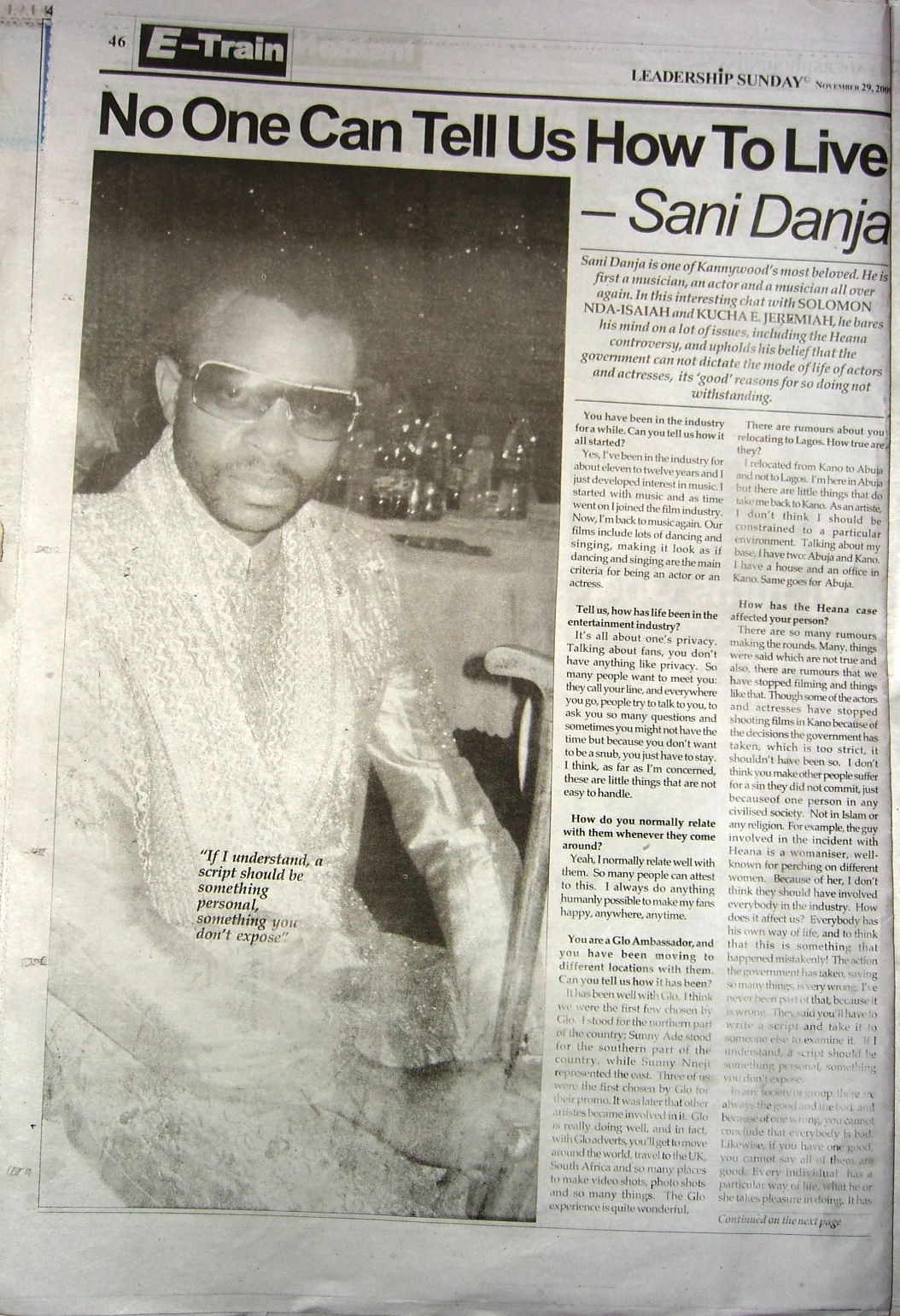
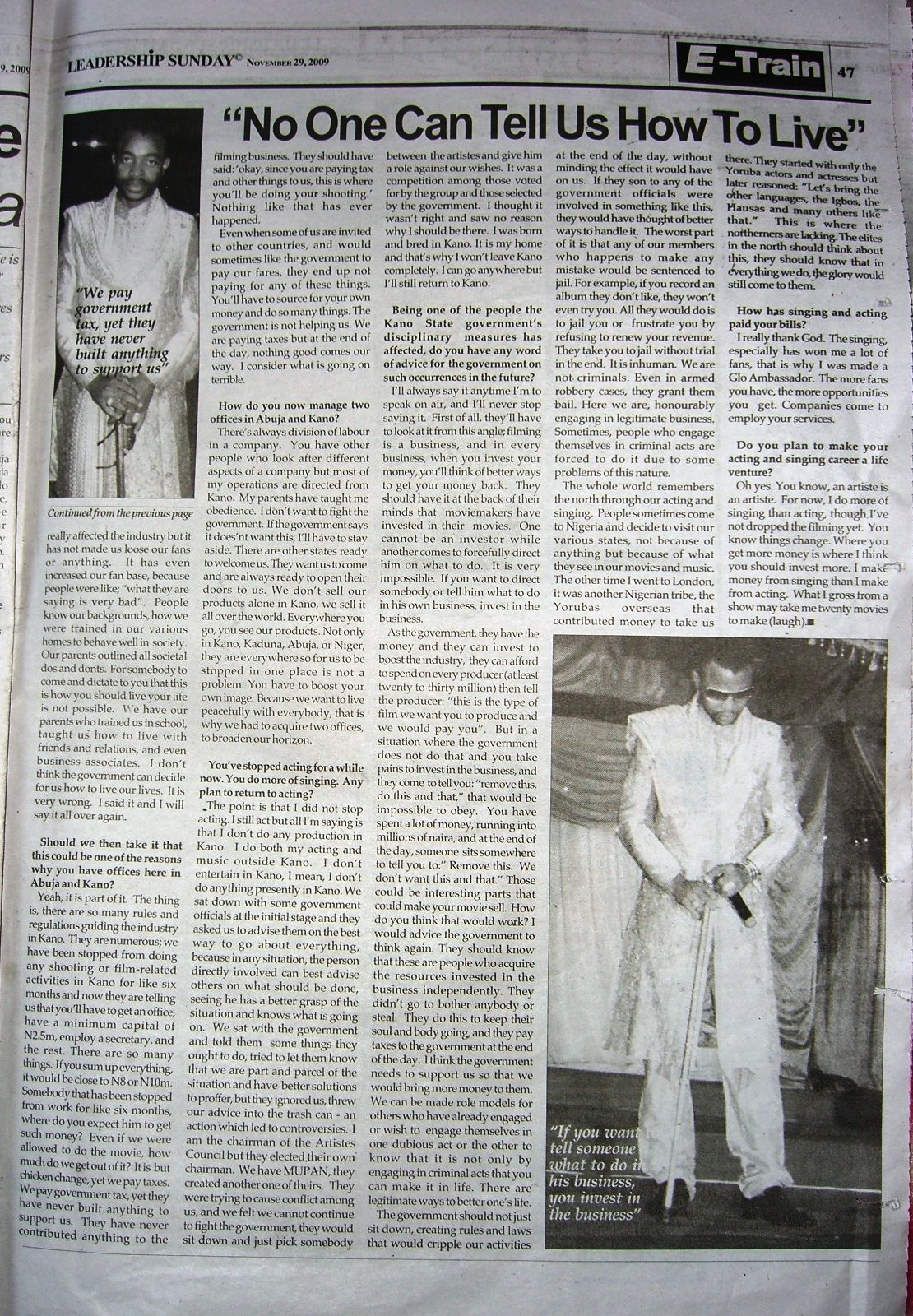
“No One Can Tell Us How to Live”:Interview with Sani Danja in Sunday’s Leadership

There is a great interview that Solomon Nda-Isaiah and Kucha E. Jeremiah did with Hausa film and music star Sani Danja in this week’s Sunday Leadership. Since I can’t find the online version of the article, I will post a photo of the hard copy here and a few excerpts from the interview. This article comes from Leadership Sunday, November 29, 2009. Pages 46-47. (Unfortunately, after posting I realized that the text is not big enough to read. To read, you might have to download the photo and read in a photo viewing program.)

In the article Sani Danja talks about his music and film career, his activites as a Glo ambassador, and his opinions on the recent actions of the Kano State government on Hausa filmmakers.

Here are a few excerpts. To read fully, you may have to download the photo:

When being asked about the reasons he decided to relocate to Abuja, although having offices in both Abuja and Kano, Danja says

“The thing is, there are so many rules and regulations guiding the industry in Kano. They are numerous; we have been stopped from doing any shooting or film-related activities in Kano for like six months and now they are telling us that you’ll have to get an office, have a minimum capital of N2.5m, employ a secretary, and the rest. There are so many things. If you sum up everything, it would be close to N8 or N10m. Somebody that has been stopped from work for like six months, where do you expect him to get such money? Even if we were allowed to do the movie, how much do we get out of it? It is but chicken change, yet we pay taxes. We pay government tax, yet they have never built anything to support us. They have never contributed anything to the filming business.

In response to the management of two offices in Abuja and Kano, he replies:

There’s always division of labour in a company. You have other people who look after different aspects of a company but most of my operations are directed from Kano. My parents have taught me obedience. I don’t want to fight the government. If the government says it doesn’t want this, I’ll have to stay aside. There are other states ready to welcome us. They want us to come and are always ready to open their doors to us. We don’t sell our products alone in Kano, we sell it all over the world. Everywhere you go, you see our products. Not only in Kano, Kaduna, Abuja, or Niger, they are everywhere, so for us to be stopped in one place is not a problem. You have to boost your own image. Because we want to live peacefully with everybody, that is why we had to acquire two offices, to broaden our horizons.

When asked if he had any advice for the government on disciplinary measures against filmmakers, Danja says:

First of all, they’ll have to look at it from this angle; filming is a business, and in every business, when you invest your money, you’ll think of better ways to get your money back. They should have it at the back of their minds that moviemakers have invested in their movies. One cannot be an investor while another comes to forcefully direct him on what to do. It is very impossible. If you want to direct somebody or tell him what to do in his own business, invest in the business.

As the government, they have the money and they can invest to boost the industry, they can afford to spend on every producer (at least twenty to thirty million) then tell the producer: “this is the type of film we want you to produce and we would pay you”. But in a situation where the government does not do that and you take pains to invest in the business, and they come tell you: “remove this, do this and that,” that would be impossible to obey. You have spent a lot of money, running into millions of naira, and at the end of the day, someone sits somewhere to tell you to: “Remove this. We don’t want this and that.” Those could be interesting parts that make your movie sell. How do you think that would work? I would advise the government to think again. They should know that these are people who acquire the resources invested in the business independently. They didn’t go to bother anybody or steal. They do this to keep their soul and body going, and they pay taxes to the government at the end of the day. I think the government needs to support us so that we would bring more money to them. We can be made role models for others who have already engaged or wish to engage themselves in one dubious act or the other to know that it is not only by engaging in criminal acts that you can make it in life. There are legitimate ways to better one’s life.

The government should not just sit down, creating rules and laws that would cripple our activities at the end of the day, without minding the effect it would have on us. If the son to any of the government officials were involved in something like this, they would have thought of better ways to handle it. The worst part of it is that any of our members who happens to make any mistake would be sentenced to jail. For example, if you record an album they don’t like, they won’t even try you. All they would do is to jail you or frustrate you by refusing to renew your revenue. They take you to jail without trial in the end. It is inhuman. We are not criminals. Even in armed robbery cases, they grant them bail. Here we are, honourably engaging in legitimate business. […]

Rawa da waka a finafinan Hausa/Singing and Dancing in Hausa films

In my recent interview with VOA, I mentioned that one of the things that first drew me to Hausa films is the singing and dancing.  Let me explain a little bit more. I love the singing and dancing in the films because it is both an enjoyable break from the storyline with a bit of spectacle and, often, an important moment in commenting on the overall storyline (whether foreshadowing, summarizing, or sermonizing upon the larger events of the film.) The singing and dancing is pleasurable to watch and  also tends to be more tightly edited and choreographed than the rest of the film.

While I know many critics who don’t like the songs and dances and also know quite a few filmmakers who tell me they want to make films without singing and dancing, I hate to see this aspect of Kannywood films be dismissed without thought.  The song and dance sequences are what distinguish Hausa films from their Nollywood neighbors and, when well done, add a great deal of pleasure to the experience of watching the films.

In the interview I mentioned a few videos, which I will insert here.  [Please note that the videos embedded here are being used under FAIR USE laws, for review purposes.] The first is Jamila Chassis with Sani Danja and Mansura Isa (who later married in real life). I have actually only seen the song and dance on YouTube and have not watched the entire film. But it is one of the most delightful Kannywood song and dances I have ever seen, both for the catchy song but also because of the goofy flirtatious dancing. While I know many are concerned about the objectification of women in these dances, the dancing here is playful rather than sexual–and milder than most dancing I’ve seen at wedding bikis in Kano.

I also mentioned the song “Zazzabi,” again with Sani Danja and Mansura Isa, although this time the main characters are not dancing. The cinematography here is a bit grey, static and unimpressive, but I think the editing to the music is well done. Most impressive are the lyrics, sung by Sadiq Zazzabi, and the way in which the song edited together with shots of the main characters metaphorically encapsulates the story of the film.  I will not elaborate here because I don’t want to ruin the twists and turns the story takes. However, the song interacts with the larger story brilliantly. [UPDATE. 27 December 2013: In a later post, I translate the lyrics of “Zazzabi.”]

Finally, I mentioned the choreography in Albashi 2 (starring Abbas Sadiq, Zainab Idris, and Adam A. Zango), which I think is quite well done. I also love the costumes and the attention to colour here. I have here a trailer for Albashi 2 rather than a selection of the entire song (the genre of the trailer for Hausa films is worthy of a post in and of itself), but I think it illustrates what I mean. The pleasure, at least for me, is not in the “shaking body” of the female dancer (as is sometimes asserted in critiques of the dancing in films) but in the choreography and colour of the piece. Start watching at 1:08.

There are other examples I will elaborate on this blog another time, but let me share one last delightful example from the trailer for Shugabanci. Start at timecode 1:37. How can you not love a dancing “Nigeria”?!!

Please note that these videos are used according to Fair Use policies for review purposes.

UPDATE

For other happy posts on Kannywood, see

Congratulations to Abba El Mustapha and Fatima M. Shuwa on their wedding celebration.” 19 June 2010

“The ‘second coming’ of Kannywood.” 26 June 2011

Congratulations to Kannywood actress Sakna Gadaza and Musa Bello on their wedding 9 July 2011.” 5 August 2011

“Translating (and Transcribing) the Hausa film song Zazzabi [Fever].” 8 November 2013

“Kannywood Award 2013.” 22 November 2013

The latest on the Iyan-Tama case from Nigerian News Service, plus new fees from the National Film and Video Censor’s Board

In a 29 September 2009 article “Iyan Tama: Matters Arising” on the Nigerian News Service, Bolaji Oluwaseun reports that when Iyan-Tama’s counsel went to the Federal High Court of Appeal in Kaduna “to file a motion to stop the retrial”:

The judge assigned to the case ordered Iyan-tama’s counsel to go back to Kano to the magistrate that was assigned the case initially to file the motion to stop the retrial (the same court that sent him to jail for over 3months over false allegations), and that if they refuse to grant the motion then they should then come back to Federal High Court of Appeal in Kaduna to re-file the motion to stop the re-trial.

For those not familiar with the case Oluwaseun gives a summary of the case, pointing out:

After spending over 3 months in jail, Iyan-Tama was granted bail  and a retrial was ordered following a review of the case by the Kano State Attorney-General and Commissioner of Justice. According to the Attorney-General, Barrister Aliyu Umar, the first trial was besmirched by irregularities. Due process was not followed in the trial that led to the conviction, he said. He used very uncomplimentary terms to describe the trial conducted by a senior magistrate, Alhaji Mukhtari Ahmed, such as “improper,” “incomplete,” “a mistake,” summing up by insisting that a “more competent magistrate” should be given the case to try again.

But yet after having committed an injustice that can be successfully argued even by a baby lawyer to be a travesty of justice, the said senior magistrate, Alhaji Mukhtari Ahmed still works in the court houses of Kano State.

And after all Iyan-Tama went through he was not compensated for his illegal imprisonment by the Kano State Government.

Olawuseun continues with more opinions about the case and provides about 6 scanned in copies of documentation that allegedly support Iyan-Tama’s case at the end of the article. To read the entire article, see this link. [UPDATE 13 Oct 09. For more recent news about how Iyan-Tama was invited to the Toronto Film festival, and a clip from his banned film Tsintsiya, see this 23 September article from the Nigerian News Service.]

In more general news concerning the National Film and Video Censor’s Board of Nigeria (not the same body as the Kano State Censorship Board), Al-Amin Ciroma in today’s Leadership (“Censor’s Board increases Fees”) writes that the NFVCB is increasing their fees for previewing a film by 30%:

The review, the board said in a release signed by the corporations Assistant Director, Corporate Affairs, Yunusa Mohammed Tanko, is in line with its efforts to offer premium service to its stakeholders.

With the acquisition and installation of modern cinema style preview theatres at our Lagos office, which is capable of handling 35mm celluloid video, as well as a digital lounge for clients, the present fees charged for preview of films and movies, musical videos and others are no more realistic. The sustainability of this heavy resource base is a prerequisite in the effort to offer global best practices in the Nigerian movie industry.

He said the new equipment would enhance and facilitate online preview of films and movies within the minimum time possible. It will also afford owners of the movies the opportunity to follow and track the progress of the preview in a seamless manner without being present physically.

New costs will be as follows:

The review, The corporation’s Assistant Director, Corporate Affairs, Yunusa Mohammed Tanko, said for local films made in Nigerian languages (of 0-15 minutes) will be N10,000, while a Nigerian film in foreign language such as English language will be charged N20,00, while a film meant for exhibition will be charged N25,000.00. In a general perspective, NFVCB has made 30% increment of the applicable fees.

To read the rest of the article, see Al-Amin Ciroma’s blog.

Image of the letter from the NFVCB to Iyan Tama from Nigerian News Service:

Iyan Tamas letter from the National Film and Video Censors Board--see link for more images

Iyan Tama’s letter from the National Film and Video Censor’s Board–see link for more images

DG of Kano Censor’s Board taken before shari’a court

In a fascinating turn of events, Alhaji Abubakar Rabo Abdulkarim, the Director-General of the Kano State Censorship Board, has been arrested by the police and taken before the shari’a court by the Kano State Filmmaker’s association.

Here is the article “Police Arrest DG Kano Censors Board” by Nasir Gwangwazo published yesterday, 4 August, in Leadership. Ibrahim Sheme has also republished the article on his blog.

Director-General of the Kano State Censorship Board, Malam Abubakar Rabo Abdulkareem, was yesterday arrested by the police over a complaint filed against him by the Kano State Filmmakers Association.

A reliable source told LEADERSHIP last night that Rabo had been dragged to a Sharia Court in Sabon Gari, Kano, by members of the association over an allegation credited to him, in which he was said to have described movie makers as a bunch of homosexuals and lesbians during an interview he granted Radio Kano recently.In the interview, a copy of which was made available to LEADERSHIP, Rabo stated that he had proof that many of the filmmakers were gay, saying his intervention in the industry had helped sanitise the situation.

The statement incensed the filmmakers, and they wrote him a letter demanding a retraction and an apology within 48 hours.But at a follow-up press conference recently in Kano, the director-general repeated his claim, warning that he would publish more damning reports about the alleged immorality in the industry if pressed further.The association went ahead with its threat, suing him before the Sharia court, which was said to have advised the association to report the matter to the police first. >p>According to a member of the association and the immediate former chairman of the state chapter of Association of Nigerian Authors (ANA), Malam Ado Ahmad Gidan Dabino, Rabo was picked up yesterday by two plain-clothes policemen at about 4pm and taken to the Metro police station located on Bank Road in the city, following a complaint by the filmmakers.At the police station, three leaders of the moviemaking association – Nura Hussain, Ahmad Alkanawy and Isma’ila Afakalla – endorsed the association’s formal complaint, which Rabo reportedly denied. According to Gidan Dabino, the case is due for hearing at the Sharia Court, Fagge, today. When our correspondent contacted Rabo on phone last night, however, he denied knowledge of the issue, saying he was in a meeting and promptly switched off.

Following the arrest, there has been much discussion, on the Finafinan Hausa yahoo group. Ibrahim Sheme has posted one of his responses on the internet group on his blog, saying that Rabo’s intention has never had the interests of the filmmaking in Kano at heart.

According to people who have written me about this (this is unverified rumour), Rabo was given bail, but apparently left his car and driver and went away on an acaba.  He is being charged in a shari’a court for “kazafi (invented lies to assinate character).” If convicted, the punishment is 80 lashes with a whip.

Readers will remember that this latest event was precipitated by accusations Rabo made on the radio, saying that filmmakers were homosexuals and lesbians. The filmmaker’s association responded with a letter asking him to withdraw and apologize for the remarks in the next 48 hours or face legal action in a shari’a court.  Rabo responded several days later with a press release, threatening to release more evidence saying, among other things:

This address is a by product of the pressing need of the media to balance their stories and the board to have a fair right to reply on the ‘empty threat’ of those practitioners who’s future is endangered or eroded due to our sustainable sanitization exercises. These miscreants are enemies to the present peaceful atmosphere and the cotemporary achievements of the Board because they are the beneficiaries of the old age. The age of un coordinated and un-professionalized Kannywood industry.

Hitherto, this nasty development will not in any way deter the Board on its commitment to safeguard the Kano State ideals in addition to societal values because our statutory legal undertakings are not only the promulgation of state legislation but also constitutional above all holy and sacred.

[…]

Moreso, additional doziers at our disposal will not in any way help the film stakeholders when released to public especially in this period where some further negative developments are continuously unveiling and circulating.

[…]

Furthermore, let me use this opportunities to re-iterate one of the fundamentals of this administration which is the rule of law where equality before law is necessary. Therefore, the Board is happy that constituted measures like threat to sue organisation or person(s) is welcome by our style of leadership. Even though the Board will not hesitate to table publically at the right time and at the right place all at its possession out of social responsibilities and trust but with no meaning to join issues or make filmmakers vulnerable. Let me at this juncture warn that: “Kada Dan Akuya yaje Barbara ya dawo da ciki”. [MY TRANSLATION—CM: A male goat should not go to a female goat and return pregnant…]

For the post on this blog that includes a transcript of Rabo’s statements on the radio, the  letter and press release from MOPPAN and the subsequent entire press release from Rabo, see this link.

Recent news on the activities of the Director General of the Kano State Censorship Board

 Recently the Director General/Executive Secretary of the Kano State Censorship Board, Abubakar Rabo Abdulkarim has been receiving quite a bit of publicity from the local press about recent actions taken to control creative expression in Northern Nigeria.

Several news sources have reported that Alhaji Rabo has been on a campaign around northern Nigeria encouraging other states to implement censorship boards. Nigerianfilms.com (likely plagiarizing from another unlisted sources, as is their tendency—I’ve had my own experience with that…) reports  on May 14 2009 that he visited the Borno Commisioner for Information, Dr. Bukar Usman, saying, `

`We are in Borno to seek for collaborative efforts to tackle a menace that is ravaging the entire Northern states. I am talking about the Hausa Video Film Industry.” […]

He said the film makers had deliberately changed the original concept of Hausa culture by introducing elements from Indian films. 

“The characteristic of the Hausa film today is that of `sing and dance’ adopted from the Indian culture. 
“This no doubt has poisoned and adulterated the rich cultural heritage of the Hausa man which is cherished all over the world,” he said. 
He said the practice was a violation of professional ethics by the actors as it was not in consonance with the provision of the Nigerian constitution. 

[NOTE: Could someone please explain to me how singing and dancing is a violation of professional ethics or of the Nigerian constitution?]

“We have been misrepresented by the actors as a group of unserious individuals who have nothing to show but sing and dance. 
“This must stop now, because we are duty bound to ensure that the situation is rectified without delay,’’ he said. 
He said that the state government had taken drastic action to arrest the situation. 
“But most of the actors have shifted base to neighboring states such as Kaduna, Kastina and Borno. 

The Commissioner of Information from Borno state said in response that

“We are ready to team up with you to achieve the desired goal.’’

  Ibrahim Sidi Muh’d of Leadership of 9 June notes that the Zamfara State Commissioner of Information, Alhaji Ibrahim Danmaliki

described the efforts applied by the Kano censorship board as commendable and worthy of emulation by all Muslims,” urging for the “Federal Government to ban all pornographic satellite stations managed by some western countries.” 

[NOTE: Interestingly many of the people in the North I know who have satellite, have Nile-Sat, a satellite company based in Egypt, but which nonetheless includes  Western stations like Fox Movies and MTV in their satellite lists.]

Leadership of 22 June 2009 reports that in a paper presented at Ahmadu Bello University’s Centre for Islamic Studies, Zaria,  

 “Alhaji Abubakar Rabo Abdulkarim, yesterday reiterated that the Kano State government will not allow Hausa film producers to destroy the rich norms, culture and religious standing of the people.”

 Jaafar Jaafar in the Sunday Trust 21 June 2009, p. 42, [I typed this from a hard copy so sorry there’s no link]  reports that the

“Kano State branch of Books, Stationary and Sports Dealers Association (BSSDA) has accused the Kano State Film Censorship Board of intimidation saying its members are being made to pay ‘illegal registration fees.’”

The chairman of the association Chief Victor Okonkwo says,

“We got a copy of the law from the Kano State House of Assembly and it clearly shows that their main area is film and cinema, as well as pornographic publications. I find it difficult to reconcile their position of wanting us to register with them. We deal in textbooks and exercise books for primary and secondary schools; we believe the books have been censored already by their publishers.”

Okonkwo said that “after all the payments to the local government and the ministry of commerce for sundry taxations” he said the court should “take the association to court for a better interpretation of the law.”

[Update 27 June 2009. This story was also carried in The Guardian on 14 June 2009. According to 

Adamu Abuh of the Guardian

Okonkwo who addressed journalists in kano yesterday disclosed that dozens of his members have been hounded and manhandled by officials of the board and the police without recourse to laid down rules.

Brandishing a copy of the law establishing the censorship board in 2001, Okonkwo described the imposition of registration fee of N5, 000 on the association as well as payment of N3000 per each of his member annually as unacceptable.

[…]

Reacting, the Director General of the Censorship Board, Alhaji Abubakar Rabo Abdulkarim faulted Okonkwo’s claim saying that officials of his board have not breached the provisions of the laws

He disclosed that his board is empowered by law to exercise oversight function on published works, vendors and distributors academic or non academic publications.

He said: “We are mandated by the law to make sure these practitioners are operating within the confines of the law which requires that they are registered and once they have been registered, we are required to issue them license to operate.

“it is in respect to that that we have been operating and we have been so magnanimous by trying to bring all stakeholders on board by the implementation of the law taking cognizance of the latitude that we should be humane ordinarily it is a popular saying that ignorance is not an excuse in the eyes of the law.”

Rabo waved aside the threat of any court action against his board adding that arrangement have been concluded to ensure that those who contravene the provisions of the law establishing the film and censors are made to face the wrath of the law.)

 The most dramatic news, however, was the ban by the censorship board through the “mobile court” attached to it on “listening, sale and circulation ” of 11 Hausa songs which directly or indirectly critique those who “prevent us from doing our work.” Here are the articles from Leadership (republished on Abdulaziz A. Abdulaziz’s blog) and the Kano-state government owned Daily Triumph.


Rabo has recently given a few interviews related to these activities to Al-Amin Ciroma in Leadership Hausa, and to Salisu Ahmed Koki, who released the interview on the listserves “writersforumkano@yahoogroups.com” and nurul-islam@yahoogroups.com. Publisher of Fim Magazine and Editor of Leadership newspaper, Ibrahim Sheme, re-published the interview on his personal blog:

 In the preface to the Hausa Leadership interview “Manyan Fulogan Shekarau Biyu na Neman Fesa wa Juna Tartsatsin Wuta,” roughly translated as “[Governor] Shekarau’s administration fight among themselves” (sorry, I’ve lost the poetry of the original), Ciroma describes some of the songs recently banned by the board. He points out [as I did a few posts back] that after Adam Zango’s song “Oyoyo” was released was poking fun at the government for imprisoning him and only increasing his popularity, a song was released by the K-Boyz threatening and insulting Zango. [NOTE: The song repeated many of the critiques by government employees and other elite against the film and entertainment industry, albeit with more “batsa”—“obscene” language. For more information about the song and its relation to other of the songs that are now banned, see Professor Abdalla Uba Adamu’s analysis here.] According to Al-Amin Ciroma, the rumour was that the director of the Kano State Pilgrim’s welfare board, Sani Lawal Kofar Mata, a Shekarau supporter and stakeholder in the film industry who is vying for governorship in 2011,  had sponsored the K-Boyz song, in defence of  Shekarau. He is also rumoured to have sponsored Ala, whose song Hasbunallah, which asks God to curse with ill-health those who are persecuting artists, is also on the banned list. 

In the interview [Please note that this was all in Hausa, so I am here writing my own translations/summaries of the conversation. If anyone notices any mistakes, please correct me. Also, as I perfect my translation of the interview, I will try to add more/make corrections to this document], Rabo tells Ciroma that The Censorship board is looking for any offensive song which has made its way to the public without permission of the censorship board. He says these songs spoil culture, such as the translation of the English obsenity “mother fucker”  which “Europeans without proper upbringings use.”  He said that these were the types of songs that were being used to insult leaders, or even culture or religion.  He also gave the examples of songs that “lie to the masses” by “spoiling the reputation of the government” or “telling lies about the governor.” “These songs have been released without permission.” Rabo, however, stated that the court had banned the songs while he was out of town, even exceeding the total number of songs the board had planned to ban.

When Ciroma asked if the Board had a law preventing music without permission, Rabo said that “Our law shows that anyone in the entertainment profession whether praisesinging or film or books or singing has a duty, before he releases it to bring it to be vetted, and to have removed anything that could spoil religion, culture, customs or the reputation of tradition. But this doesn’t prevent those who feel like they can break the law—that is those who complain… that the laws of the people of Kano don’t do for them, so they can spoil the reputation of Kano people. For them nothing will do except a law that says they should continue to maliciously injure the reputation of Kano.[…]”

 Rabo said that “anyone who dreamed that he was too big to follow the law,” would be caught out.

 Ciroma pointed out that there are those who can say that those who sang to spoil the reputation of Adam Zango were not punished by the board but now that someone has done a song with Ibro’s voice saying that the government had harmed him, that’s when the board will move to ban the song.

Rabo answered that any song, even if it takes the perspective of the government, is banned if it uses obscene language. He said that particular song had been released while he was in Saudiya Arabia.

When asked about how Kofar Mata had hired the singer Ala to sing a political song on CTV (state television), and who then had his production company office “visited” by censorship board officials, Rabo replied that those who under the censorship board’s jurisdiction should expect the board to visit at anytime to make sure they are doing things correctly.


The  second interview with Rabo by Salisu Ahmed Koki and published on the internet site groups, can be found here.

Salisu Ahmed Koki prefaces the interview with an essay on the history of the Hausa film industry, starting out with a celebratory tone:

 “And just like the tiny and equally soullessly-wrapped up pupae growing into a beautifully designed and flip-flying butterfly that can fly to various destinations at will, the Hausa popular drama has transmogrified into Home Videos that evenly instigates cultural fusion and diffusion whose implications and impact on the Hausa culture critics posits is an area yet to be fully appreciated by researchers.”


The essay then moves to record the many complaints that have been made against “Kannywood.”

“They are said to be employing unorthodox, unprofessional and fluke-characterized techniques and methodologies in writing, acting and shooting their now widely condemned movies.”


Similarly,


“Most of the Hausa film makers are accused of distorting the closely guarded Hausa culture which by all indications served as the sole excuse ceased by the present administration in Kano State to take stringent majors in curbing the excesses of this so-called rogue Hausa film makers.”


Part of what was seen as the “cultural destruction” via the film industry were the sensational reports of a polygamous lesbian wedding apparently involving one or two film actresses:


Part of the symptoms of the alleged excesses of the present crop of Hausa filmmakers is said to be the almost uncontrollable pollution of the closely guarded and respected Hausa culture that leads to some female admirers of Hausa Filmmakers to publicly showcase their sexual orientation, meaning that some women did publicly declare that they are going to emulate Californians by getting married to each other publicly and fearlessly, an action viewed by many as a taboo. It is a story of awe and confusion and it is what can rightly be described as the most demeaning abuse of fame ever to bear its ugly head out of the now allegedly promiscuous Hausa film industry; a rare show of feminine crudity and a terrifying tale of rumpus manifestation of prevalent lesbianism that is eating deep into the fabrics of Kanywood.


(NOTE that in an interview with BBC, the supposed “groom” of the occasion, Aunty Maidugari, disputed the allegations, denying that the occasion was a wedding or involved lesbians. The BBC article reports that:

She said the elaborate wedding celebration held on Sunday was actually a ceremony to raise money for the women’s weddings to men.

She said: “One of them gets a husband to marry so I organised in order to get something sorted.”

The theatre where the ceremony took place has since been demolished by Kano city’s authorities.

Eyewitnesses said there was a large turnout and guests were given leaflets as a souvenir showing Aunty Maiduguri surrounded by her “brides”.

But she said the words on the pamphlets meant “love and understanding”.

“They are my sisters, what will I put apart from love and understanding or love and kindness?”


These allegations of “feminine crudity,”  “uncontrollable pollution,” and “alleged promiscuousness” of Kannywood stakeholders  indicate that one of the greatest fears about Kannywood, as indicated by popular imagination and in media propaganda, is an anxiety about women’s bodies and women acting independently of  male regulation. )

 Salisu Koki’s essay continues:

 “Soon followed an announcement that the government has sternly banned all forms of Gala and stage plays to be performed by men and women of the Hausa film industry, indefinitely!”


The essay that has gone from a celebration to the history of the Hausa film to a litany of current condemnations, transitions into an interview with Abubakar Rabo Abdulkarim, the self-identified Director General of the Kano State Film and Video Censor’s Board (although the law instituting the censor’s board makes mention only of an “executive secretary”) and also formerly Deputy Commandant of the Kano State Hisbah Board.  (To see  the interview I carried out with Alhaji Rabo in January of this year, click here).


In both the interview with Salisu Koki and myself, Rabo emphasized that the Kano State Censorship Board is not unique.


“it is because of the need in every responsible society or community to have moral values been upheld and things done the right way to the taste of the uniqueness of the individual community or society that censorship is accorded a unique priority in the history of mankind, this is why you see Censorship Board in the history of the Greeks, you see it in the history of the Persian Empire, in that of Europe, and in that of the United States America in particular which emanates from the need to build a ‘hays code’.”


[NOTE: For more information on the Hays Code, Rabo often cites, see this wikipedia article. The code was abandoned in 1968 for the MPAA Rating System.] Later on in the interview when asked about the court cases between the KSCB and the filmmakers, he raises this topic again:


I hope our stakeholders are not mistaking by seeing the KFCB as a home of punitive measures, as if we are the only one. Punitive measures taken by a censorship board globally is the tradition, even NFCVB use to take defaulters before a court of law, High Court of justice for that matter; our is ordinary Magistrate Courts where the provision of the law is very light and mild.

[NOTE: Readers may recall that film stakeholders Adam Zango, Rabilu Musa (AKA Dan Ibro) and Hamisu  Lamido Iyan-Tama were given the “light and mild” punishments of three months, two months, and three months in prison respectively, for varying percieved offences.]

  Now what I will like people to appreciate our own measures as excellent nd is better than that which is obtainable in the US for instance; the logic is this, employment preventive measures is far better than curative, because it is our tradition, it’s our religion to guide stakeholders, preventing him/her from defaulting or erring. Now, what we are doing is before you are allowed to go ahead and kick start the shooting you are required to first of all submit to consultants the proposed script for the film for their vetting, so after been vetted by the consultant, tell me who will complain on it on merit? Unlike allowing somebody accomplished the project, and allowing him to release it into the market and then when some foul are found in it, you then effect an arrest or ban order, is this wise? And believe me that’s what is obtainable in the US, that’s their version of censoring. Our preventive measures can be regarded as Shari’ah and also the tradition of the Hausa Fulani.


Rabo relates that the need for censorship in Kano State was precipitated by the


“confusion, or rather mix-up of cultural values which was largely attributed to foreign influence and the weird culture of blind copy-cating of foreign cultures by most of the Hausa filmmakers which results to public outcry in the 1999-2000 of then Kano”


He reinforces that the establishment of the Kano State Censor’s Board is constitutional:


And the interesting thing was the power giving to the state governments in the 1999 Constitution of the Federal Republic of Nigeria whereby state governments are regarded or rather are given the leverage to go ahead and establish their respective state Censorship Bodies on film making and other thearitical activities and section 16 of the 1999 constitution of the concurrent legislative list is the main bedrock which result to this very kind of state Censorship Board Law, meaning that what we are doing is in consonant with the constitution of the federal republic


 [NOTE: The constitutionality of the board is, however, being challenged in a lawsuit by the Motion Pictures Practitioners Association of Nigeria against the Kano State Censorship Board and other bodies in a Federal High Court. In the most recent hearing, the high court judge threw out the objections to the lawsuit brought by the Kano State Censor’s Board)


In discussing filmmaking, Rabo says that professional education is necessary:


Considering film making as a profession just like journalism and accountancy, we don’t want to believe that illiteracy can bring the needed security into the filmmaking fold, rather the skill, and the knowledge. We are emphasizing on skill acquisition, this is our primary responsibility, and this is why all professional crew are mandated to have the basic training, to have the basic knowledge of filmmaking before they are certified to either direct, to produce, or act a professional role in a film. Of course there are artists that have abundant talent, and some can be special artistes, but notwithstanding how talented somebody is or gifted by the Almighty if he is taken to a film school where he will be groomed, if he is well shaped by the professionales that knows the film business bette, he will fare better in the film making business compared to when he or she is on her own.  


He also seems to see a certain amount of civil servicization of the film industry a way to move it forward:


“Also, the issue of a production firm to have the basic office accommodation where at least a computer system is there with a Secretary ought to be considered and checkmated. Most of the companies before we are here are nominal, nominal in the sense that they are nowhere to be found. Most of the so-called production companies believe you me, are mobile and they are not there. Believe you me, we would by God’s grace try to standardize things, and we can only do that with the cooperation and understanding of the stakeholders, that we are out for their betterment, and if they cannot appreciate that, then that’s their problem. Most of them exist without the knowledge of their local authorities; their respective local government authorities don’t even know them, because they don’t have office accommodation. What we are now insisting on is that, you must go back to the local government where you are located, be registered, and be introduced to us by your local government authority before we register you, that’s the best way for us to help the government fetch the required tax from the companies and that’s why we are saying that a tax clearance certificate must accompany your application, and the most astonishing thing to us is that all these to them are stringents, they consider every measure to sanitize and breed order to the system, a stringent measure. That’s why they complain and I don’t think we will compromise on this.

With regard to popular opinion about the actions of the KSBC as being a “personal” or “political” mission, Rabo claims that:


“We are on a professional and legal mission, not on political or related issues; I can assure you here and now that there is no any sentiment attached to our activities.”


Rabo also claims that with regard to problems faced by the board:


“ The problem of non-confidence by the general public in the products churned out by our crops of filmmakers is a central problem, and if confidence is lost, everything is lost, and that confidence is what we are assiduously working towards restoring. The crux of the matter is and will be the pursuit of excellence and professionalism in film making and that’s why we are all out to see to it that we will not leave stakeholders that are fond of dishing out all rubbish for the viewership of the teeming public unturned or alone, we will touch you, the way you molest the law; we will deal with you, the way you negatively dealt with the law;”

Helon Habila speaks on censorship in Kano

Helon Habila liest, P02

Helon Habila liest, P02 (Photo credit: lutzland)

(a post in which I meditate on my research obsessions and recommend a recent opinion piece on “Art and Censorship in Kano” by multiple award-winning Nigerian novelist Helon Habila)

In Helon Habila’s first novel Waiting for an Angel, which was the subject of my MA thesis, he blurs the boundaries between his characters’ fictions and the reality of the world they live in. Originally self-published as a collection of short stories Prison Stories, the novel is fractured into stories told from multiple perspectives about “ordinary” people living out their lives in the “prison state” of Nigeria under the Abacha regime. The artist, Habila implies, provides a challenge to oppressive structures by gathering up the voices of poor ordinary people, so often lost in official propaganda, and putting them into print. The novel is not merely a litany of hopelessness, although the hardship of poverty is illustrated, but also captures the loud irreverent conversations in a Lagos “Mama Put” joint on Morgan street, which has been re-named “Poverty Street” by its inhabitants and the vivid dreams of ordinary people for a better life.

One striking scene shows the main character Lomba, a journalist and aspiring novelist, watch a fictional scene he had written for his paper come to life. Lomba’s characters reflect what his editor James tells him to capture: the “general disillusionment, the lethargy” of being trapped into a story where “One general goes, another one comes, but the people remain stuck in the same vicious groove. Nothing ever changes for them except the particular details of their wretchedness. They’ve lost all faith in the government’s unending transition programmes. Write on that”  (113). The story that Lomba writes is filled with “ubiquitous gun and whip-toting soldiers,”  “potbellied, glaucomatous kids” playing in gutters alongside the carcasses of “mongrel dogs worried by vultures” (118). This story does, indeed, seem to reflect the despair of life in a prison until the end of the story where he writes of “the kerosene-starved house-wives of Morgan Street. I make them rampage the streets, tearing down wooden signboards and billboards and hauling them away to their kitchens to use as firewood” (118). This moment suggests both the extremity of the environment, which has forced the people of Morgan street against the wall, as well as the agency of the women who take their futures into their own hands. And although James removes the celebratory conclusion before publication, telling Lomba he is “laying it on a bit too thick,” on his way home, Lomba sees an angry mob of women who “set to hacking and sawing” at a large billboard advertising condoms. It is Lomba’s knowledge of the script that allows him to tell the man next to him that “‘They are not crazy. They are just gathering firewood’ I explained to him. It was my writing acting itself out. And James thought I had had laid it on too thick. I wish he were here to see reality mocking his words.”

Although Lomba’s first reaction is one of hopelessness that “we are only characters in a story and our horizon is so narrow and so dark[,]” this episode is a revolutionary moment in the text (119). While Lomba, as well as the women outside the window of the Molue, may be characters in a story, this moment marks a remarkable departure from the prophecies of prison and death foretold by a marabout in another “story” in the novel. The porous borders between Lomba’s fiction and his reality that allow his writing to act itself out indicate the possibilities of the imagination—the possibility that while caught in a the literary metaphor of a prison, the “prisoners” might turn around and revolt. Lomba, and subsequently the mob of women, take the text into their own hands and appropriate the property of the state to sustain their own needs

In recently thinking about my research interests on Nigerian films and  “meta-fictions,” I realize that what obsessed me about Waiting for an Angel is also what obsesses me about Nigerian and particularly Hausa films, both in the reflection of the stories of “ordinary people” so often seen in these films and in a projective imagination that often (although certainly not always) challenges injustices by acting as what Kenyan novelist Ngugi wa Thiong’o mentions as a crucial aspect of art, that of a mirror, which “reflects whatever is before it—beauty spots, warts, and all” (1998, 21). People are rarely passive in these films. Beloved comedians like ‘dan Ibro often skewer the rich and powerful in their satirical stories.

I’ve heard people complain that there is too much “shouting” in Nigerian films, yet to me this “shouting” becomes a powerful metaphor for what Nigerian films have done for the “voiceless.” Gayatri Spivak has asked if the “subaltern can speak”? While I want to be over-cautious about over-romanticizing Nigerian films, which often do reproduce Nigerian society’s worst stereotypes of women and offer alarmingly unhealthy “solutions” to problems, I think one of the reasons I love the films so much is because they do seem to allow the “subaltern” to speak, both literally (in that so many of the film participants come from poor backgrounds) and metaphorically.

Attempts to suppress these films, therefore, seem like the attempts of the prison superintendent in Waiting for an Angel to suppress and co-opt the voice of the writer Lomba. The writer is imprisoned, seemingly muzzled, but attempts to suppress his voice ultimately prove to be impossible. Lomba smuggles stories about his “life in prison” through metaphoric language in his “love poems” commissioned by the prison superintendent for the woman he is woo-ing.

Hausa films are often dismissed for being “just love stories.” But stories of love can be powerful. There is often more going on than the reader of surfaces will find.

I was thrilled, therefore, this morning to find that Helon Habila has recently brought together my two research obsessions in a recent article in one of my favourite new publications, NEXT: “Art and Censorship in Kano.”  In the article, he both challenges simplistic critiques of Nigerian films and meditates on the “politics” of censorship. As Habila points out, while Nigerian films are not always polished “cinema” pieces, they have “made movie making a grass roots experience.”

[UPDATE: 19 October 2013. While I was doing a little blog maintenance, I was afraid I had lost access to this article because NEXT went out of business a few years ago and took all their content with them. Fortunately, Sola at Naija Rules had copied the article over on her site. I’ve previously been irked when Nigerianfilms.com and other such sites have copied my blog content without permission, but I am beginning to be grateful for these sites that make articles available long after the original sites have gone down. I am re-copying Helon Habila’s article here for archival purposes.]

Art and censorship in Kano

By Helon Habila

It is so easy to underestimate the achievement of the Nigerian film industry, and this is because we always measure such achievements using false parameters—we compare Nollywood to Bollywood and Hollywood.

Whenever we do that, Nollywood will always come short of our unreasonable expectations. How long has it been in existence? Ten, maybe 20 years? What of Hollywood, over a hundred years? And Bollywood, when was Sholay made, 1960?

The extent of what our film makers have achieved in the short time they have been here was pointed out to me by a Nigerian/South African director friend.

When I asked him to compare the two film industries, he said, South Africa has all the right tools and techniques, they make movies on celluloid and with multiple cameras and have the right post-production requirements, but Nigeria doesn’t have all that, yet South Africans can’t get people to watch their movies whereas the Nigerian movies are practically jumping off the shelves.

It is true South Africa makes great movies, like Tsotsi, every once in a long while, but Nigeria has made movie making a grass roots experience. That is the paradox: whereas movie making in Nollywood is nondemocratic and cliquey, yet the consciousness towards it, and the patronage, is widespread.

This mass patronage and consciousness is indispensable if any nation is going to have a viable film industry. And we are achieving all this without government participation, or should I say, in spite of government participation.

And government participation is what brings me to Kano. The industry here is called Kannywood (what else?) Most people outside the Hausa speaking world aren’t really aware of it, but it has been going on for a while. Just as Nollywood’s progenitors are the early Nigerian soap operas like “Behind the Clouds”, “After the Storm”, etc, Kannywood also grew on the back of popular Hausa TV ‘dramas’ like “Samanja”, “Karkuzu”, and of course “Kasimu Yero’s Gagarau”.

Other unmistakable influences are Bollywood movies. The Indian influence on Hausa films can at best be described as odd, at worst weird—here I am not only talking about the excessively romantic nature of Hausa movies, the love theme could easily have come from Hausa literature, but I am talking about the song and dance numbers. It seems each film has about three songs and dances.

I remember the first time I saw a Hausa film, nobody had warned me that there was going to be singing and dancing, and so when it came I was taken totally unawares, and yes, I was disconcerted to watch these Nigerians singing and dancing on the streets of Kano.

That was the first impression. The second impression was: Well, the songs are really not that bad, if you are a song and dance kind of person. All in all one wished the songs would end quickly so the movie would resume.

But this piece is not really about aesthetics, it is about art and politics.

These actors would have gone on singing and dancing in peace, and mostly unnoticed by most Nigerians outside the Hausa speaking world if not for what has come to be dubbed the “Hausa Film Porn Scandal”. It seems in August 2007, a popular Hausa film actress, Maryam Hiyana, was filmed making love to her boyfriend, by the said boyfriend. In their defence they said it wasn’t for commercial purposes, so that technically means it is not porn, but somehow the eight-minute clip was leaked to the public and this began a series of what can only be described as a siege on the film industry by the Kano State government. And to quote a source, “So far, according to Ahmed Alkanawy, director of the Centre for Hausa Cultural Studies, over 1000 youth involved in the film industry and related entertainment industries ‘have been arrested in the name of shari’ah and sanitization.’ … However, although shari’ah law is invoked, most ‘censorship’-related cases are being tried in a state magistrate court, a mobile court on Airport Road presided over by magistrate Mukhtar Ahmed.

Defendants are often arrested and convicted within an hour, without the benefit of legal representation. Some are given prison sentences while others are given the option of paying a fine.”

A popular actor, Rabilu Musa (Dan Ibro), was arrested for “indecent dancing”!

What I find most chilling is a book-burning ceremony staged in a girls’ school. Book burning, in a school! The government may as well close down the school, for by burning books in front of students, the whole aim of educating them is defeated.

Even individual writers were required to register before writing!

The most recent case is the arrest of a former gubernatorial candidate Hamisu Lamido Iyan Tama—a film maker whose film, “Tsintsiya”, is an adaptation of the Hollywood classic, “Westside Story”. He was first arrested in May 2008 for three months and fined 2,500 naira, then in January 2009 he was sentenced to 15 months with a fine of N300,000. It seems in the movie, he acted the role of a governor and carried out an investigation into the causes of sectarian violence.

Here, at last, the government is showing its hand. Whenever an art form begins to go beyond entertainment and to appeal to people’s political consciousness, the people in power become scared. That seems to be the case with Kano.

The question to ask is, are the censors working in the interest of the people, or are they using religion for political ends as we have seen so often in the shari’ah states? Any society that seeks to silence the artist is attacking the people, for often it is only the artist that can articulate the secret hopes and yearnings of the people.

NEXT


Federal High Court strikes down Kano State Censorship Board’s objections; MOPPAN’s Lawsuit will go on

Excuse me if I do not use the correct legal terminology in this post. I’m new to the court scene and slowly learning…

Yesterday, the Federal High Court struck down the objections filed by the defence in MOPPAN’s lawsuit against the Kano State Censorship Board, the Executive Director/Director General of the KSCB Abubakar Rabo Abdulkarim, and the Kano State House of Assembly,  (I’m not sure if the National Film and Video Censors Board is still being included in the lawsuit, since there were attourneys representing only three of the bodies) meaning that the lawsuit will continue. The court will meet again regarding this on May 20.

This is the first court proceedings I have attended for this particular lawsuit, so I’m not as familiar with the case as I was the Iyan-Tama case. However, according to my January 27, 2009  interview with Dr. Ahmad Sarari , Vice President of MOPPAN,  the motivation for the lawsuit was as follows:

What principally we needed was an injunction restraining Kano State Censors Board from attacking, harassing, humiliating and imprisoning our members. We dragged four bodies to the court.  One is National Film and Video Censor’s Board for issuing a license to our members which gives them the right to exhibit, to sell, and show their films throughout Nigeria, yet a particular state attacks or arrests them for doing that, and they have not come out and said anything. Is the registration they issue our members fake or does it not have jurisdiction in Kano? So here I’m saying there’s a clash between the national and the state jurisdiction of two boards. What we understand in accordance with discussion with our lawyers is that when there is a clash between state and federal law, the federal law takes precedence, so does the interpretation of that in the court. We dragged the Kano State Censors Board to court for its action. We dragged the DG of the Kano State Censor’s Board for the guidelines he issued out which we believe are quite unconstitutional. They contradict some fundamental human rights because the guidelines are too stringent and are quite unbearable. And we dragged the speaker, Kano State House of Assembly for allowing the section of the law establishing the board which contradicts national law. We need them to review the law. We have to look at the laws establishing the board because most of them contradict national laws.  That’s why we dragged the four of them to the court.


The case was going fine in the court. We brought our evidence. They said we had to exclude the DG of the censor’s board out of the case. Our lawyer vehemently defended that he had to be in. They said we had to include the Kano State government. We said we sued Censor’s Board and the state house of assembly, because the state assembly are the lawmakers, so Kano State Government is automatically included in the case. He slated 26 of October for the final ruling of the case, and unfortunately [Sarari laughs]… there was this strike [of court workers]. They just resumed this month. So we are just urging our lawyer to find which date are they going to give, and we are very much hoping that the ruling is going to go in our favour.


Yesterday, 26 March 2009,I arrived in the court a bit later than noon, but there was another case in process: a series of rather pitiful looking men in frayed clothing accused of being “Indian hemp” dealers, including a very, very old man with a white beard and blind in one eye who was the only one among them who seemed to speak English. (There was a translator for the rest.) “I am guilty, your worship,” he said, after the charges were read. The judge spoke up, “This is an appeal case,” the judge says. “You can plead not guilty.” “I’m guilty” he maintained several times, until the judge told him he could sit down.  I probably looked quite sympathetic to them, so during a break in the proceedings, the old man who I was sitting quite close to asked me if I were from the BBC and asked me for money. I felt bad, but said sorry, and moved over to the side of the room where the Kannywood folk were seated.


The MOPPAN case started around 1:30pm. The judge read a summary of the previous accusations and appeals (sorry, I know I don’t have the legal terminology down). Apparently, the defense had objected to the individual inclusion of the director general/executive director of the Kano State censorship board in the lawsuit. Since I was at the back of the courtroom and there was no mic, I couldn’t quite follow everything the judge was saying, but it seems that there was some confusion over the terminology used for Rabo in the lawsuit/defense. Apparently, the censorship law makes provision for an “executive director,” while Rabo calls himself the “director general.”  The judge said that regardless of which terminology was used, it was clear that MOPPAN was intending to sue the author of the “guidelines.”


Another objection was apparently that MOPPAN had not obtained leave to sue one of the bodies. The judge said he cannot strike it out just because they did not obtain leave.


Another objection was that they should include the Kano State government in the lawsuit. The judge said that no one can be forced to sue a body they do not wish to sue.  


My description is quite sketchy since this is my first time attending one of the proceedings; however, the basic gist is that the judge struck down the objections of the defendants and said that the lawsuit would continue. The mood after dismissal was bouyant. Among the surprisingly large number Kannywood stakeholders who had come to court in support of MOPPAN, there were grins, handshakes, and congratulations all around.

Raids on a film set last weekend and other developments in “Kano State Censor’s Board vs. Kannywood”

[NOTE: 25 March 2009: This is a corrected version of an earlier post.]

Kannywood filmmakers have only recently begun shooting their films in Kano again. For the past several months, more and more stakeholders have gone ahead and registered individually with the Kano State Censorship Board, so that they will be able to work in Kano State instead of travelling outside to surrounding northern states. (Such travel is not ideal for filmmakers who live in Kano: several stakeholders have been killed in road accidents going to and from location, and the cost of production goes up when everyone is staying in hotels.) However, the registration process involves both the payment of a registration fee and an interview with the censorship board before an id card will be issued that gives the holder permission to work in Kano. Those I talked to about registering a month ago had a resigned air. “We have to work,” I was told over and over again. Baba Karami, producer, actor, and marketer, told me he had a family he was trying to support and he would follow the law. Another director and actor told me that although he was not going to register as a director in the state (he would keep shooting his own films outside of Kano), it would not be fair to the producers of other films he appeared in as an actor if he did not register as an actor. Apparently the Kano State Censorship Board will not allow any film in which an actor who is not registered individually with the censorship board appears to be released in Kano State. Among those I ‘ve spoken to over the last few months, there has been the feeling that registering with the Censorship Board–“following the law”–would provide them with some modicum of security from being included in the sweeping arrests of Kano film industry stake holders. A few even told me they thought the Kano State Censorship Board was trying to improve filmmaking in Kano.  However, the stakeholders I talked to yesterday–the same ones who had been resigned to registration–were angry.

According to several crew members I spoke to yesterday, last Saturday, 21 March, a film set on the outskirts of Kano State was raided by police. According to my sources, every one on the location was registered with the Kano State Censorship Board and the necessary paperwork to shoot the film in Kano had been completed. Two police vehicles showed up and police asked the director to show proof that he had registered the production with the censorship board. The director produced it. Then they began to call out crew members randomly to check if they had their Kano State censorship board identification with them. About three actors had forgotten their id cards at home. The police served them with a “court summons,” but the summons said that rather than going to the mobile court they should go to the censorship board to present their identification.(Readers, please correct me if I’ve made errors on this.) 

The feeling among those I spoke to was that with such raids on film locations the Kano State Censorship Board was not merely trying to “sanitize” the industry but “destroy” it. One  actor told me that he paid the fee to register with the censorship board three months ago, but he is yet to be called in for the interview that is necessary before he is given his registration. As seen in the Iyan-Tama case (for more explanation in the words of the director general of the censor’s board, see this interview), the magistrate court attached to the censorship board does not find proof of payment for registration acceptable proof for registration. In the case of this actor, he has tried his best to complete the paperwork and the delay in completing it is from the board. If this actor works in state, he is at risk being arrested and fined by the censorship board. There are directors who have asked him to appear in their Kano productions but he has had to turn down the work because he does not want to be arrested for not having completed his registration.

In other news, there has been a radio announcement on the government radio station, Radio Kano, that actor/director Adam Zango (who currently resides in Kaduna and was among the first to be jailed by the mobile court attached to the censorship board after the Hiyana scandel) is “wanted” by the magistrate court in Kano and that he should be brought from anywhere in the country back to Kano to pay a fine of N100,000 and continue the prison sentence he had not completed in Kano. I spoke with Zango’s manager Falalu Dorayi yesterday, who told me that an appeal has been made to the high court and Adam Zango had been given bail. He also told me that their lawyer had said they have no business with the magistrate court in Kano, since they are on appeal at the high court. According to Dorayi, the magistrate court has no authority to make such an announcement, but the announcement has succeeded in causing extra worry/danger to the “wanted” actor/director/musician and his colleagues.

I am trying to transcribe and translate the interviews I did with Dorayi and with the crew member of the film whose registered colleagues were arrested. If I complete them, I will post them on this blog.

Today I also went to the latest court case in MOPPAN’s (Motion Picture Practitioner’s Association of Nigeria) lawsuit against the Kano State Censor’s Board. I arrived late because I went with my neighbor to pay a “get well” visit to a friend, and discovered via the lawyers who were chatting outside that it has been adjourned until Thursday at noon, at the federal high court, Court Road.

For more information about the ongoing censorship crisis in Kano, see other posts:

From/On Censor’s/Critic’s perspective:

My interview with the Director General of the Censorship Board, Alhaji Abubakar Rabo Abdulkarim

Kano State Censorship Board Opens a Website

The Mysterious Asabe Murtala/Muktar Writes Again

Triumph/Trust Editorial Convergences

On/From Filmmakers:

My interview with arrested editor Sulaiman Abubakar in NEXT

My Interview with Vice President of MOPPAN Dr. Ahmad Sarari

My interview with Sani Mu’azu, President of MOPPAN

On the current censorship crisis in Kano

Outside links:

Hard Times in Kannywood from NEXT

Award-winning film Lands Director in Jail from IPS

The Kano State Censorship Board opens a website

[UPDATE 19 October 2013. Doing a little blog maintenance here. Unfortunately the KSCB website was taken down shortly after the Shekarau government left power in 2010. I saved the pages to my computer before it was taken down, but it is no longer available online.]

On the 18th of March I attended the Mambayya House premier of the film Yancina made under the auspices of “Promoting Women’s Rights through Shari’ah.” While chatting with Professor Abdalla Uba Adamu at the event, he informed me that the Kano State Censorship Board website, which was under construction last time I checked has finally opened.

The site is a really fantastic resource for researchers and filmmakers alike. The homepage includes an essay, which appears to be written by the director general of the board Alhaji Abubakar Rabo Abdulkarim (whom I interviewed at the end of January), laying out the purposes and philosophy of the censorship board.

Also on the blog are links to the state censorship board publications including the law of 2001 and subsequent guidelines, press releases, lists of registered stakeholders, a list of registered production companies, a list of registered cinemas,  a list of registered soccer viewing centres, a list of censored books, and a list of films censored in 2004, 2005, 2007, and 2008. (Noticeably absent is 2006). Another link on the website is to “articles on the Censorship board.” So far there is one article with no byline, titled “Kano Censorship and the Burden of Moral Defense.” Here are some exerpts from the article:

But when the charismatic Mal. Rabo Abdulkareem was wisely appointed as the executive secretary (110w Director General) by Mallam as a result of the infamous Hiyana saga, the name of the Kano state censorship Board became a household name.

[…]

Tasked with the burden of control and supervision of the information and ideas that are circulated in the society, the activities of the Kano state Censorship Board have already started impacting favorably and this is appreciated by the public All of a sudden tile public happily realized that the previously otiose board can now really defend their helplessly invaded morality.

The hitherto unprecedented expansion and circulation of immorality via the activities of the so called Kannywood or Hausa filmmakers was perfectly checked and stopped by the Rabo led censorship to the admiration and pleasure of the public.

The shameless and destructive activities of the filmmakers were thriving to the chagrin of’ the society to the extent that some pessimists have given up. All the pleas, calls and sermons by different groups of people to the filmmakers to effect corrections in their activities as well as their films were sternly’ rebuffed by the filmmakers. This is the reason for the euphoria that trailed Rabo’s bold move to tackle the disturbing activities of the filmmakers which was timely successful.

[…]

It is quite surprising the way some of the writers chose to confront the board in a Kannywood like manner. Even the hitherto respected among them inanely wrote many things that put their integrity to question. They sound and behave as worst as any lawless uneducated could. While the board is saying that all forms of obscenity should be stopped and that the books should conform with the culture and religion of the targeted audience in addition to the registration of the writers with the board among other things, these people are busy writing different sorts of bunkum in order to blackmail the board. All their arguments were based on subauditions, or more correctly, assumptions, and nothing more. Some of them were even proposing to take the matter up to their masters i.e. the international community in order to come to their aid, just as the Kannywood cohorts tried, as if the so called international community is that rotten.

I will likely do more analysis of the site later on this blog or in my own academic work, but I note a few interesting things:

1) On the homepage of the Censorship Board are a list of “useful links”. They include A Daidaita Sahu (the government agency for “societal reorientation”), the Sharia Commission, Gamji (a news website that focuses on northern Nigerian news), the National Film and Video Censors Board, and two newspapers, the Kano-state government owned Triumph Newspaper,  which regularly publishes pro-censorship and anti-Hausa film opinion pieces, and the Abuja-based Daily Trust, which has several times re-printed the said opinion pieces from the Triumph [as I have noted elsewhere]. Noticeably absent is the newspaper, Leadership, which most often publishes news about Kannywood and opinion pieces critical of the censorship board.  Of course, this isn’t surprising, but I do find it interesting that Triumph and Trust were the two papers chosen to be included on the list.

2) A related observation: in the “Censorship Board in the News” link, the only two articles posted (as of today) were the Open Letter to the American Embassy in Nigeria, by Asabe Murtala (later published in Trust under the name Asabe Muktar, as I point out in an earlier post), and the director general’s response to a critique of the board published in This Day.

3) I love it that the Censorship Board is making all of this information available to the public. Open access to the 2001 censorship law and related publications is especially encouraging. However, I wonder how frequently the website will be updated and how that might impact arguments the board makes in individual cases with “erring” stakeholders. For example, will the list of registered stakeholder, production companies, and censored books be updated every time a new stakeholder or production company registers and a new book is censored?  Will each company and stakeholder be removed from the list at the beginning of each year and be added back when they have paid their renewal fee for each new year?

On the whole, I find this an extremely positive development. I am encouraged by the open access to information, but also cautious about the “spin” placed on that information by the board. Of course, as I note of my own blog, it is their website, so “spin”  that presents “their” side of the story is certainly their prerogative. It’s certainly a rich resource for my own research.