Kano State Censors Board bans films on the history of Islam and the prophets and shuts down 15 shops

"Kano films censors board shuts 15 shops," Sunday Trust, 14 February 2010, p. 33

Two days ago (my internet has been down for a day and a half–thus the delay in posting this), I read in the Sunday Trust and the Hausa language weekly Aminiya a story I had heard from filmmakers a week and a half ago before my trip to Abuja. I hadn’t blogged about it because I had only heard ji-ta-ji-ta (rumours) about it, but the newspapers confirm the story.

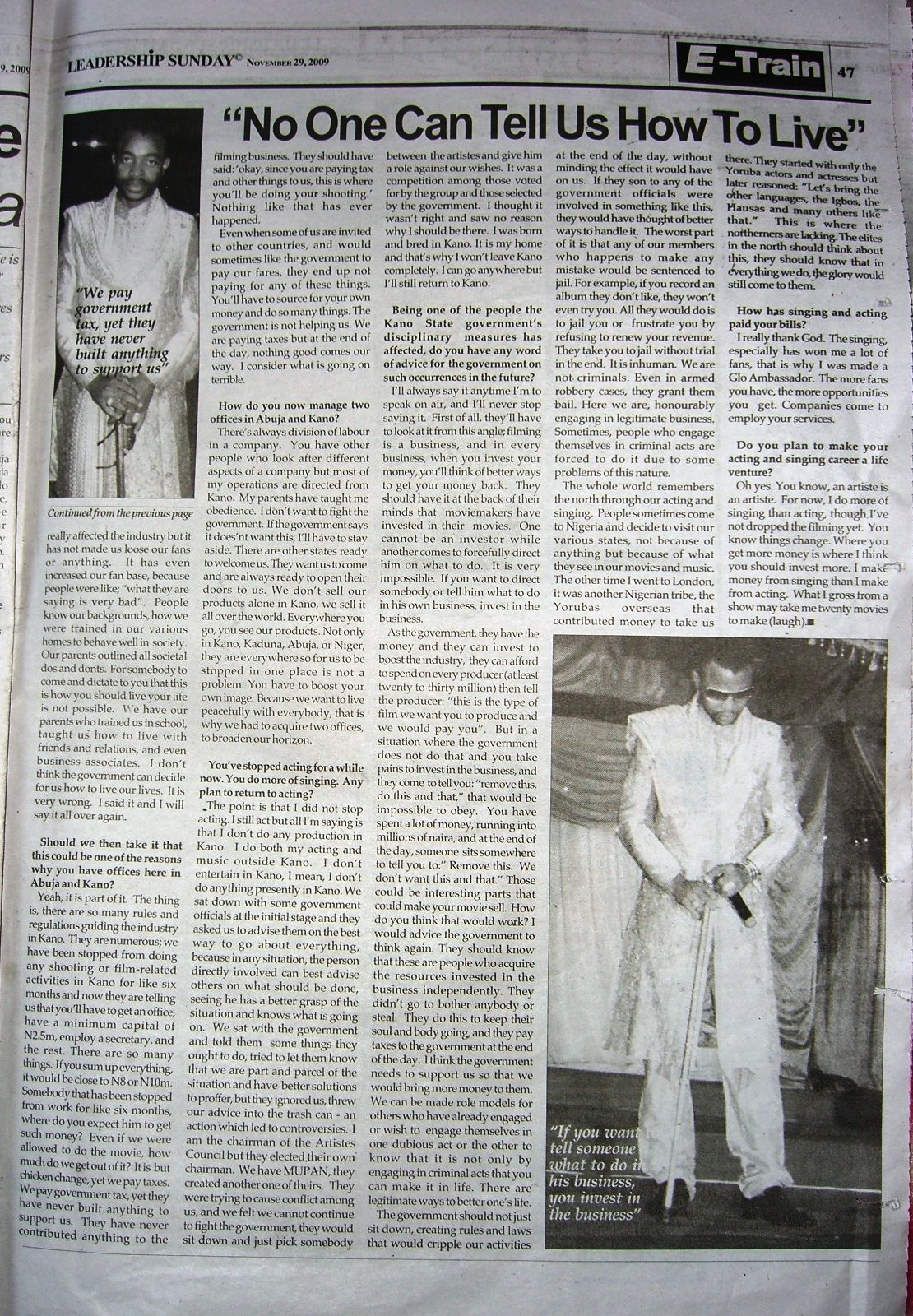
Apparently, according to Ruqayyah Yusuf Aliyu in the Sunday Trust, 14 February 2010, page 33, “Kano films censors board shuts 15 shops,” the Kano State Censorship Board closed 15 video shops over “selling tapes of the history of Prophet Yusuf.” (Unfortunately, I have not been able to find the link to the article online. If I find it, I will link to it here. In the meantime, here is a photograph of the article.)

The Director General of the Kano State Censorship Board, Abubakar Rabo Abdulkarim, “said in an interview in Kano that

“banning the sales of such films has become necessary as it is against the teachings of Islam and therefore will not be allowed in the state.”

Rabo also mentions that

“under aged children who can easily be influenced are also involved in hawking such films along the streets without knowing the implications. He also said the ban was as well in the interest of potential customers who might not get to these children even if they found the films were bad.”

In response,

[S]ecretary of the Kano film sellers association, Malam Isa, described shutting down the shops by the censorship board as unfortunate as the director general of the board did not keep to the promise of briefing them on what stand it is taking on the sales of the film before acting.

“I can recall that the DG sometimes in October last year invited us for a meeting at A Dai Daita Sahu and during the meeting, one Islamic scholar, Malam Aminu Daurawa, mentioned that watching the film was not appropriate and after the meeting, we met the DG at his office on the matter and he told us that was just a dialogue among scholars which does not involve us. He then promised that he was going to inform us on any development thereafter but unfortunately he didn’t. The next thing we saw was the closure of the shops” he said.

Malam Isa said that the film sellers:

“have reported the case to the Emir of Kano and as Muslims we are ready to comply with the ban so long as it is Islamic scholars that will come together to prove that the film is contrary to the teachings of Islam.”

He also lamented the loss of business this was causing to the shop owners saying:

“business has been their major source of livelihood and now that the board has closed the shops, these people are finding it hard to survive.”

The Hausa weekly Aminiya, 12 February 2010, provides more details. I will provide a summary of the article in English here—please note that this is NOT a direct translation but a summary in my own words.

Bashir Yahuza Malumfashi writes in “Hukuma ta haramta sayar da fina-finan tarihin Musulunci a Kano” (p. 21) (“The [Censor’s ]Board bans selling films on the history of Islam in Kano”) that the director of the censors Board Malam Abubakar Rabo went to the Kofar Wambai market and closed four shops where they were selling films on the history of Islam, specifically the film on the history of the Prophet Yusuf [Joseph] and the film The Message.

In a radio program on Radio Kano, DG Abubakar Rabo said that “the censors board had closed 15 shops in Kano and he warned others who were selling the films.”

Aminiya reporters went to the Kofar Wambai market to see the shops that had been closed, and one of the film marketers, Musa Abdullahi Sanka who started selling film cassettes in 1976, said that the story was true. The Censors board had come and closed shops selling films on the history of the Prophet Yusuf and the history of Islam, The Message.

When Aminya asked Abdullahi Sanka what reason the Censors Board had given for closing the shops, he said that the censors said that they should stop selling the film because apparently there were some Islamic scholars who had issued a fatwa on selling films on the history of the prophets, saying such films were not appropriate.

The marketer responded saying that the businessmen wanted the well-respected Islamic scholars in Kano to come together and say whether the films were appropriate or not. If they said they were not appropriate, then how could they correct them? If they gave very strong reasons for banning the films, then the marketers would stop selling them.

The marketer told Aminiya that four shops in Kofar Wambai had been closed: that of Alhaji Salisu, that of Ahmadu Hussaini, that of Anas, and another Igbo marketer whose name he did not give.

He said that the film sellers got the films from Misira, others from Lagos, others were brought from Arab countries. He said that he had heard that the film on the Prophet Yusuf (Joseph) was made by Shi’a in Iran, and that is why the Censorship Board had cooperated with the fatwa of an Izala scholar against the film.

When he was asked if he had seen the film and if it seemed to be appropriate, he said that he hadn’t seen the entire film but that he remembered how when he had been fifteen years old, the late Islamic Scholar Sheikh Nasiru Kabara had told the history of the Prophet Yusuf, and what he had seen of the film followed exactly what the scholar had told them.

The Secretary of the Film sellers association of Kofar Wambai Market, Malam L. Isa said that the discussion with the Censors board had started last year. The Censors Board had invited them to a meeting organized by A Dai Daita Sahu (the government sponsored Societal Reorientation Directorate) on 24 October, where it was said that Sheikh Aminu Daurawa had preached a sermon in which he said that it was not right to watch this type of film on the history of the Prophet Yusuf. “When we heard this, we asked the director of the Kano State Censorship board about this. He told us we shouldn’t worry that it would not affect us. But we were surprised that day, without notice, without letting us know, people came to the market and closed shops belonging to those in our association.”

He said that after the shops were closed, they complained to Malam Rabo who did not listen patiently to them. This is why they went with their complaint to the Emir of Kano. “What is happening with us right now. We went to Director Malam Rabo, but he didn’t listen to us or give us any good answer. He even kicked us out, so we got up and we went to our father, the emir of Kano, and carried our complaint to him. Since there are big men in power, we should let them know what is going on with us—If they don’t know what has been happening, they will now know.”

The Secretary continued,” We called on the emir to negotiate between us and Malam Rabo because we have been obeying the government and the censors board, but now there is no understanding between us. People were sent from the board to us without anyone letting us know there was  such a law.”

Another marketer Alhaji Nasiru Ibrahim K’ok’i, better known as Palasd’inawa, also expressed his unhappiness at the actions of the Censor’s Board. He said that they had been watching films on the lives of the prophets since they had been children. On Muslim holidays, the Kano state television station used to play them.

“It shouldn’t be that the judgment of a single Islamic scholar becomes the basis of the entire Muslim culture. Now Malam Rabo should tell us what kinds of films that we should be watching, because they have banned Hausa films saying that they are spoiling women and children. So now why are they banning films on Islamic history, since no one can say they are spoiling culture?’

The director of the Kano State Censors Board, Malam Abubakar Rabo Abdulkarim explained the reason for the ban. He said that it is in accordance with the culture and the findings of Islamic scholars who said that such films were not fitting as they were not respectful to the prophets.

The gist of Malam Rabo’s statement was that the Kano State Censors Board was created keeping in mind Islam and the judgments of Islamic scholars who guide the community. The board had heard from the association of Islamic scholars and other religious organizations that people were trying to make money on offensive films made about the lives of the messengers of God. He also noted that they had called a meeting through a Dai Daita Sahu (Societal Reorientation Directorate) where one of the Islamic scholars had shown the danger of these types of films that were insulting to the Messengers of God and culture.

Malam Rabo said that this is the reason the Censor’s board said that the selling of these types of films must stop because it was not fitting to show another man in the film claiming to be the Messenger of God. He further said that the Board would continue to hunt down those who brokered and spread films in Kano state, especially, he emphasized, those who were selling films on the sides of the roads because this is illegal.

To read the article in Hausa, see the photo of the article here:

Board bans selling films on the history of Islam in Kano”], Aminiya, 12 February 2010, p. 21″]

Interview with me in last week’s Aminiya

Here is an interview Bashir Yahuza Malumfashi of the Hausa language weekly Aminiya did with me in December while at the Indigenous Language Literature conference in Damagaram, Niger, December 2009. It was published in last week’s Aminiya, 5-11 February, on pages 20-21. Despite the awful pictures of me, I was quite pleased with how the interview turned out (and pleased with how he edited and corrected my Hausa!). To read the interview, you will probably have to download the photos and open them at 100%. (If the photos are showing up too big to read, try clicking on my home page link. It should allow you to access beyond the margins. UPDATE: 13 February 2010: Actually probably the best way to read the article(as pointed out by Desertgills) is to click on the photos–that should take you to my flickr page. After that click on the All sizes icon at the top of the photo and pick “original size”–that should make it big enough to read… UPDATE 7 April 2010, I actually just found an online version of the interview, so no need to go to all the trouble clicking on photos.)

There were several funny things I thought I should note. First of all, the headline on the front page of Aminiya is “Ta Karya Hannun Mijinta kan Kud’in Cefane”/”She broke her husband’s arm over cooking money.” Aminiya typically features sensational tabloid-style headlines to human interest stories like this. I laughed when I saw it though, because of all the photos on the front of the paper, mine is the only one of a woman. So, naturally, the reader might think that there is this crazy baturiya who broke her husband’s arm….

from Aminiya 5-11 February 2010, pages 20-21

The second cringe moment comes on the second page (page 21) when I am talking about 19th century writers who were writing about “love” in addition to other social issues. I was making a point about the dangers of judging novels as “merely” romance novels because they include elements of romance, and also pointing out that Jane Austen, the Bronte sisters, and other literary icons of the early 19th century were writing in a reading culture that was filled with the popular “Gothic romances,”  often called “trash” in their day. Jane Austen mocked these novels in her satirical Northanger Abbey, while Charlotte and Emily Bronte took the tropes of the Gothic Romance to the next level in Jane Eyre and Wuthering Heights. My point was that these writers were reacting to and building on this popular literature and a reading culture that is necessary for the emergence of any literature. I remember in the interview, talking about “Jane Austen” and the “Charlotte Bronte.” Unfortunately, that somehow got transcribed as “Jeane Austin” and “Sheldon.” Please note, that while Sidney Sheldon is a popular writer, he was not writing in the 1800s, and he was not whom I was referring to…

Here is a summary of the interview in English.

Malam Bashir asks me how I started to become interested in Hausa.

I tell him that I grew up in Jos, where my father is a professor at the University of Jos, and I started learning Hausa there. But when I started my MA degree at the University of Wisconsin, Madison, I was required to learn an African language and decided to continue with Hausa. I went to Sokoto, where my teacher Dr. Malami Buba brought me Hausa novels and films.  I had been planning to base my research on English language Nigerian literature, but when I started watching Hausa films and reading Hausa novels, I realized that there were a lot of people outside of Hausa speaking areas who had no idea it existed, even to the point where people often complain about the lack of reading culture in Nigeria. But I saw it was not the case in the North where people were reading Hausa.

He asked me what I could say about Hausa writers and filmmakers.

I said that they really impressed me. I said I had always been interested in writer’s movements and the history of literature [such as the Romantic poets etc]. When I came to Hausaland, I realized that the sort of literary/art movement I had always been interested in was happening here in Hausa. I said that I was impressed by how writers and filmmakers and singers often worked together. I mentioned Ibrahim Sheme’s novel ‘Yar Tsana as particularly impressive and said I also loved the novels of Balaraba Ramat Yakubu, Ado Ahmad Gidan Dabino, Nazir Adam Salih, etc.

He asked me about which films most impressed me. This was the most embarrassing part of the interview because there were films I wanted to talk about but I couldn’t remember their names. I mentioned Sani Mu’azu’s film Hafsat and the film Zazzab’i.

He asked me about the importance of the Hausa language in the world.

I said it was one of the most important languages in Africa, that some statistics show it has more speakers than Swahili, which means it is the largest language spoken in Africa after perhaps Arabic. I also thought that the proliferation of Hausa films and novels was helping the development of Hausa. I gave the example of those who were not of Hausa ethnicity but who enjoyed the films. I mentioned also that when visiting the office of VOA-Hausa earlier that year, one of the reporters showed me some Ghanaian Hausa films made in Accra.  I further mentioned the writer Ngugi wa Thiong’o who is always talking about the importance of writing in African languages. Also if we look at the history of literature in English, if writers like Shakespeare [Chaucer] etc had not chosen to write in their own languages, although English was not yet the language of power at the time, English would be a much poorer language and we would not have these great literary works with us.

He asked me if I was thinking about writing a book in Hausa.

I said that there were certainly writers who wrote in languages of their adopted countries, like the Polish-British writer Joseph Conrad and the Russian-American writer [Vladimir Nabokov]. However, I said that my Hausa was not strong enough to write a book yet, but maybe if I lived in Northern Nigeria for the next fifty years, my Hausa would be good enough to write creatively in it. Right now I write in English.

I’ll skip the next question and move on to the first question on page 21, where he asked me what I think about what happened between filmmakers, writers, and the Kano State Censorship Board.

I said that I had much to say about this but I would focus my comments on my own area of expertise. Since I know about literature and the history of literature in English, I would talk about the parallels between what I saw here and what happened then. I said that Jane Austen and the Bronte sisters [which somehow got transcribed as “Jean Austin and Sheldon”] were writing in England during the 1800s, and they were writing about love. They were writing during a time when there were lots of books floating around [Gothic romances etc] that people said were not great literature, that these novels were spoiling the upbringing of young girls etc (the same things that are being said now about Hausa literature). But I said that though the novels of Austin and the Brontes talked about love, they also talked about other social issues of the time, poverty, and class and injustice.  I said that we could draw a parallel between this English literature and contemporary Hausa literature. Although there are films and novels that focus on love, there are also a lot of other social issues that are caught up in these stories. During the conference in Niger, Malam Rabo (the head of the Kano State Censorship board) proclaimed that he would not read any more love stories for a year [he said that writers should focus on more “important” social problems like declaiming drug use, etc]. But I would ask him, if he says he will ban love stories, what will that do to Hausa literature and films? There is danger if there is someone sitting in the government saying that writers and filmmakers must write or make films about certain prescribed issues and not about others. There should be some amount of distance between creative artists and the government, because the writers and filmmakers are the voice of the ordinary people. They have the power to present problems that ordinary people suffer, so they shouldn’t be prevented from bringing these things out. Also, if Malam Rabo says that for a year he will refuse to read love stories at the censorship board, this is a way of suppressing the voice of women, because many of the stories classified as “littattafan soyayya”/love stories are those novels written by women. Also, these books might deal with romantic love but they are also about problems of the household and the relationships between husbands and wives. If you say that writers must write about the problems of drugs etc., it seems that you are saying that the problems on the street are more important than the problems of the household or the family. I believe it is very dangerous to say you are going to ban an entire theme in literature and only allow the themes you are interested in. Each writer should be allowed to write on those things that he or she wants to write about. If you want to send a message to the readers, then you can write your own book. If the readers like it, then they can read your book and leave behind the love stories, but one mustn’t prevent writers from writing about their lives. There are a lot of complaints about writers writing on adult themes that spoil the upbringing of children, but there are other avenues to address this beside issuing bans. For example, there could be a law passed [like that of the National Film and Video Censors Board] that books with adult themes cannot be sold to children–there can be a differentiation between books written for children and those written for adults.

Bashir Yahuza Malumfashi asks me about what I think about Malam Rabo’s statement at the writer’s conference about how the foreigners and Europeans who said they were interested in Hausa language and culture were not really interested  in it–that they were just tricking and deceiving people for ulterior motives.

I say that I can only talk about myself–that there is no way that I can know about the motivations of every other European or foreigner who comes here. But I said that I truly do love Hausa language, literature, and culture. I came here to this country to do research and I would love to stay and live here and continue to raise the interest of those outside in Hausa language and culture. I am certainly not lying about this. I truly love Hausa and Hausa people.

He finally asks me about my marital status and whether I could marry a Hausa man and live here.

I said that marriage is according to God’s will, and that I will follow whatever God has prepared for me.

Presenting in Abuja today on the importance of contemporary Hausa literature

For those in Abuja, I will be presenting today on the importance of contemporary Hausa literature to national and world literature.  You are welcome to come heckle me. Greenlines Restaurant, 11 Aba close off Ogbomosho Street, Area 8, Garki. 5pm. Friday.

(Update 7 February 2010, Sunday: Another related event tonight, 6pm, GAP, Play bar and lounge, close to Pennial Apartments, Maitama, Abuja. I will be talking informally about Hausa literature and film.)

AN ELLITERATE INITIATIVE POWERED BY THE NATIONAL FILM AND VIDEO CENSORS BOARD, G.A.P

UPDATE 8 February 2010, since my presentations I have received questions about the details of the publication, etc, and I compiled this list of links. There are far more, but this is a good introduction:
Interview with Hausa novelist Sa’adatu Baba:http://ipsnews.net/africa/nota.asp?idnews=43816

Interview with bestselling author Bilkisu Funtua:
http://ibrahim-sheme.blogspot.com/2007/04/bilkisu-funtuwa-interview.html

Interview with groundbreaking author Balaraba Ramat Yakubu:
http://www.nigeriafilms.com/content.asp?contentid=2774&ContentTypeID=2

Interview with the first female novelist who wrote in Hausa Hafsat Abdulwahid: http://234next.com/csp/cms/sites/Next/ArtsandCulture/5501274-147/story.csp

Another interview with Hafsat Abdulwahid:
http://www.africanwriter.com/articles/310/1/Interview-with-Hafsatu-Ahmed-Abdulwahid/Page1.html

Info on the current censorship crisis in Kano:
http://ipsnews.net/africa/nota.asp?idnews=43857

Hausa Popular Literature Database at SOAS, London:http://hausa.soas.ac.uk/

“Hausa literary movement and the 21st century” by Yusuf Adamu: http://www.kanoonline.com/publications/pr_articles_hausa_literary_movement.html

“Between the word and the screen: A historical perspective on the Hausa Literary movement and the Home video invastion” academic article by Yusuf Adamu

“Hausa popular literature and the video film” academic article by Graham Furniss: http://www.ifeas.uni-mainz.de/workingpapers/FurnissHausa.pdf

“Loud Bubbles from a Silent Brook: Trends and Tendencies in Contemporary Hausa Prose Writing” academic article by Abdalla Uba Adamu
http://inscribe.iupress.org/doi/abs/10.2979/RAL.2006.37.3.133

“Islamic-Hausa Feminism Meets Northern Nigerian Romance: The Cautious Rebellion of Bilkisu Funtuwa” academic article by Novian Whitsitt
http://findarticles.com/p/articles/mi_qa4106/is_200304/ai_n9219184/

“Parallel Worlds: Reflective Womanism in Balaraba Ramat Yakubu’s Ina son sa haka” academic article by Prof Abdalla Uba Adamu
http://www.africaresource.com/jenda/issue4/adamu.html

Hausa writer’s database (in hausa):
http://marubutanhausa.blogspot.com/

My blog post on a Hausa writer’s conference in Niger:https://carmenmccain.wordpress.com/2009/12/16/a-hausa-literary-expedition-to-damagaram-zinder-niger/

etc, etc, etc….

Taking Sides

One thing that has particularly troubled me in the aftermath of the Jos crisis has been hearing both Christians and Muslims (and all other combinations of this: Hausa/Berom/idigene/settler/outsider/insider) blaming the other “side,” without taking any responsibility for actions committed by their own “side.” I am also troubled by how international mission groups/churches have seemed to use the crisis as a way to further an agenda to “prove” that Muslims are fanatical and hateful and violent, even if this means ignoring the fact that so-called Christians have also been fanatical hateful and violent.  In fact, some of these Christian websites go so far as to deny that Christians took part in the violence and claim that Muslims are inflating the numbers of their own losses, without recognizing that they might be doing the exact same thing.  Even Craig Keener, a family friend and world renowned biblical theologian who has previously written books on peace and conflict resolution and whom I admire a great deal, in an article in Christianity Today ironically titled “The Truth about the Religious Violence in Jos, Nigeria” presented only the “Christian” side of the story he had heard from friends in Jos without doing much investigation on how the other side might view it. Many of the comments on the Christianity Today articles about the crisis from various Christian readers are cringeworthy.

One of the best analyses I have yet seen on the crisis from the R.E.A.L. Organization (Responsibility for Equality and Liberty) takes to task the international faith communities for not doing more to denounce the atrocities committed by their faith communities, pointing out:

But the obvious point to any people of faith who respect each other and respect our universal human rightsis that it really does not matter who “started” the latest conflict. The reports of burned houses of worship, rioters murdering with machetes, gunfire in the street, dead bodies thrown in wells, axes used on little children, warrant shame and international condemnation from both sides and a unequivocal renunciation of religious hate. The Jos riots are a horror story of human beings’ inhumanity to one another, driven by nothing less than blind, unreasoning hatred.

Let me be clear: I am a Christian. As I have mentioned in the past few posts, I know Christians who have lost homes, family members, and churches in these ongoing crises in Jos. In the 2008 crisis, I spent almost a week with Christians in a refugee camp at my parents house. I have the deepest sympathy for them and agree that the international community should pray for and support financially those who have lost so much. But perhaps the international Christian community should expand their compassion to include the many, many Muslims who have suffered as well.

Let me also be clear that, living in Kano and having many Muslim friends, I have heard similar claims by Muslims to the complete innocence of the Hausa community and complete blame against the “vicious and warring local tribesman” (that is a direct quote) of Plateau State. I recently read a poem by a Hausa Muslim acquaintance that I found very disturbing, that cast the settlers as peace-loving civilized people and the indigenes basically as bloodthirsty savages who pass the time by murdering other people. Now, it’s clear that both sides see the other side as having started the crisis and being at fault in it. Both sides dehumanize the other. And this kind of rhetoric, on both sides, will only feed the fires.

I intend my critique to be against all of those who look at only their own side of the story–both Christians and Muslims. However, since I am a Christian, I feel I have a particular responsibility to take my own faith community to task for what seems to be a lack of compassion and a refusal to try to see through the eyes of the “other,” of using the tragic deaths of both Christians and Muslims to further an agenda to demonize Islam. And to those who claim Christians are completely innocent, let me say that for the past year and a half that I have been back in Nigeria, I have heard Christian friends in Jos say poisonous, toxic, hateful things about Hausas and Muslims. I have heard Christian friends rejoicing over the destruction of Muslim property, even over the burned hull of a primary school owned by a Muslim. When I protested, I was told that I didn’t know what I was talking about. (In fact, my mother just told me the story of a Christian non-Berom friend whose shop was burned by Christians–he rents from a Muslim) So let me protest on a more public forum, and those who disagree with me are free to answer me in the comments section of this blog. I have no doubt that there is much similar rhetoric on the Muslim side of the divide that I do not hear because few people would say such things in front of me, but whether there is or not, does not excuse Christians for hate. As Jesus said, “43“You have heard that it was said, ‘Love your neighbor[h] and hate your enemy.’ 44But I tell you: Love your enemies[i] and pray for those who persecute you, 45that you may be sons of your Father in heaven.” Matthew 5: 43-45

I will provide links to two articles on Christian websites here. There are many more, but these are the two that I wrote comments on, trying to point their readers to Human Rights Watch articles that would provide a more complex picture of the situation. My comments, which I posted over a week ago, were never approved and made visible on these websites. I’m sure the people who posted these stories are good people, who have the best intentions to help their Christian brothers and sisters in Nigeria, but in not posting the comments of someone who tried to bring some amount of balance and context to the story, they are not doing our faith any favours. In fact, by ignoring my contribution in favour of  their own preferred sources, one could even say they are complicit in the spread of hatred.

But let me give them the benefit of the doubt. Perhaps they have not seen my comments. Perhaps the internet ate my posts. If this is the case, I welcome them to contact me when they receive the pingback  from my link.

The first one, “Jos is Burning,” is from the CMS mission on January 20, 2010. I read the article because someone posted a link to it on Facebook. The article correctly reports on deaths and losses of property from Christians. It also reports several rumours and allegations about “Muslim” soldiers targeting Christians:

A statement from the Anglican Diocese of Jos said that over the last two months, there has been concern over widespread rumours of plans to bomb the homes of Christian leaders and to kill senior members of Christian churches.

[…]

There are worries that the military, brought in to contain the violence, seems to be splintering along religious lines with claims that Muslim troops are allegedly firing on Christians and armoured vehicles are opening fire on Christian civilians.  CSW reports that one eyewitness saw a Christian youth singled out in a crowd by a soldier, who forced him to kneel and executed him.

It finally lists a number of admirable prayer requests, including that “For Christian leaders in Jos, especially the Anglican Archbishop Benjamin Kwashi: for safety, courage, wisdom and opportunities to make connections across the Christian-Muslim divide.”

On January 20, I attempted to post the following comment,

While we should rightly be very concerned about violence against
Christians in Jos and elsewhere, I think we also need to be careful
not to focus so completely on our “own” side as to miss the violence
and hateful rhetoric carried out by Christians against Muslims as
well.

I am a Christian who spent a good part of my adolescence in Jos. I now
live in Kano and have many Hausa Muslim friends. At least two or three
of my personal acquaintances (Hausa Muslims–Jasawa) from Jos but who
now live in Kano have had their family homes burned and relatives
wounded and killed. One acquaintance lost her grandmother and many
other family members. And if Muslim soldiers have been targeting
Christians, the same is happening with Christian soldiers targeting
Muslims. If churches have been burnt, mosques also have been burnt.

In fact, in one report, almost all of the Muslim homes in the village
of Kuru Jenta were burned and many Muslims”rounded up and killed:”
http://naijablog.blogspot.com/2010/01/tragic-news-from-norma-in-jos.html

For another side of the story about the beginning of this conflict,
see this article from a Northern newspaper. It presents one side of
the story, but it may provide some explanation of the context behind
the church being attacked:
http://allafrica.com/stories/201001190555.html

Similarly, for those who are not familiar with Jos, to make this a
story about persecuted Christians without mentioning the complex
politics behind it oversimplifies the story:

For more detailed information on the specific context of this
conflict, see these links:

Recent academic article by shari’a-in-Nigeria scholar Philip Ostien on
the 2008 Jos crisis
http://www.sharia-in-africa.net/pages/publications/jonah-jang-and-the-jasawa-ethno-religious-conflict-in-jos-nigeria.php

Human Rights Watch report on the Settler/Indigene politics in Nigeria,
with about 5 case studies from different parts of the country,
including the plateau
http://www.hrw.org/en/node/11354/section/2

Human Rights Watch report on Military abuses in the 2008 Jos crisis:
http://www.hrw.org/en/node/84005/section/4

Have Christians been killed? Yes. Have churches been burnt? Yes. I was
in Jos during the 2008 crisis and we had a refugee camp at our house
made up of mostly members from Emmanuel Baptist church, which had been
burnt for the 3rd time. (Hopefully, it has not been burnt again in
this crisis.) There is very much a need for prayer for Jos. But, let’s
please not focus so much on the Christian side that we forget that
Muslims are suffering and dying, as well, often at the hands of those
who claim to be Christians.

thank you

To date, it has still not been posted. Perhaps the internet ate it.

The second post on the 2008 Jos crisis I found because it is the automatically wordpress generated “suggested link” after my blog post on the Jos crisis. This article,“Nigerian Christians Murdered Left Homeless by Organized Muslim Attack”, posted by a Pastor Chuck and Arlyn on a site called “Urgent Prayer Chain” was a bit more sensational.

Pastor Chuck and Arlyn say:

The following report was received by Christian Aid from a native missionary living in Jos, Nigeria. Most reports of this situation by secular media contain skewed information, received directly from the Nigerian government. This information includes false claims that Christians attacked and killed Muslims, and vastly underestimates the damage done to Christian lives and property. In reality, Muslims plotted an attack on Jos Christians days before the election results were announced.

Now, I remember, at the time, as we sat through the crisis with hundreds of Christian refugees in and around our house, thinking that the international media reports did seem somewhat skewed and biased. However, for Pastor Chuck and Arlyn who were not actually in Jos or Nigeria at the time and who were relying on their information from one source, to claim that reports of Christians attacking and killing Muslims were “false claims” or that “in reality, Muslims plotted” the attack seems unwise and in fact quite dangerous.

I posted the following response, which I know was received, because on my google chrome browser, which I was using when I wrote and posted it,  it shows my comment and says “awaiting moderation.” On Internet Explorer, it shows no comment. This was my response:

carmenmccain said

Your comment is awaiting moderation.
January 23, 2010 @ 8:48 pm

As a Christian who was in Jos during the November 2008 crisis and had a refugee camp from three different churches at my family home, I appreciate the attempt to raise awareness about the sectarian crises in jos. However, I think we as Christians also need to be a little bit careful about skewing the story to “our” side so much as to not recognize that Muslims, many of whom I know personally, also suffered a great deal in this crisis, many times at the hands of those who call themselves Christians. While you say that “secular media […] includes false claims that Christians attacked and killed Muslims,” it is actually very well known in Jos that so-called Christians did engage in serious reprisal attacks. While we can say that people who kill others are not truly Christians, I have, with my own ears, heard Jos-based pastors advocating violence against Muslims (as well as some very admirable pastors who stress non-violence and forgiveness.)

You say that the “original” inhabitants of the land are Christian, but that “but the green farmland pastures have attracted Muslim Hausa and Fulani people from the north.” This is a bit of an over simplification. The Muslim Hausa community, also known as the Jasawa, has been in Jos for over 100 years, and has until recently lived fairly peacefully with the Christian “indigenes.” Many commentators who have researched this feel that these crises are actually political and have much to do with Nigeria’s policies about granting certain rights only to “indigenes” of the land, which often means that three or four generations of a family may have lived in one place but still not be considered “indigine.” The Jasawa community is denied rights such as reduced tuition at the university, opportunities to be employed in the civil service, and political representation. This does not excuse violence but places the crisis in more context. Just as many Christian “indigenes” feel that the violence is orchestrated by outside Hausa Muslim forces, many Hausas also feel that the violence is orchestrated by local “Christian” “indigene” politicians who are using ethnic chauvinism to reclaim land that has been bought and lived on for years by the Jasawa.

For more detailed information, please see the following articles: “Jonah Jang and the Jasawa: Ethno-Religious Conflict in Jos, Nigeria” by sharia-in-Nigeria scholar Philip Ostien ; a Human Rights Watch report on the politics of “Settler/indigene” in Nigeria , with a section on Plateau State , and the Human Rights Watch report on the Military abuses during the 2008 crisis, which have no doubt been continued during this most recent 2010 crisis .

For an example of why it is so dangerous to talk about only one side of the story, see these reports of a massacre of a Muslim community that took place only a few days ago in Jos:

http://www.hrw.org/en/news/2010/01/22/nigeria-protect-survivors-fully-investigate-massacre-reports

http://english.aljazeera.net/news/africa/2010/01/201012333947758520.html

I say all of this as a Christian who knows Christians who have been killed in these conflicts, Christians who have lost their homes, and Christians who have seen their churches burned. I am not trying to downplay the amount that Christians have suffered, but to urge us not to open our eyes wider to the complexity of these crises and to reach out in love to our Muslim neighbors who have suffered much as well. This is the only hope we have that these crises will stop.

carmenmccain said

Your comment is awaiting moderation.
January 23, 2010 @ 8:52 pm

For some reason, the links I posted above did not come through.

The link to the “Jonah Jang and the Jasawa” article is here:

http://www.sharia-in-africa.net/pages/publications/jonah-jang-and-the-jasawa-ethno-religious-conflict-in-jos-nigeria.php

The link to the human rights watch report on the “Indigene/Settler” policy in Nigeria is here:

http://www.hrw.org/en/node/11354/section/2

The link to the specific details on Plateau State is here;

http://www.hrw.org/en/node/11354/section/8

The link to the Human Rights Watch report on Extrajudicial killings in the 2008 Jos crisis is here:

http://www.hrw.org/en/reports/2009/07/20/arbitrary-killings-security-forces

I’m sorry that neither of my comments were posted, as I think those posts, without any sort of caveats, will merely further global misunderstandings about what is going on and will further solidify an “us against them” mentality among Christians and Muslims around the world. [UPDATE 4 February 2009: to be fair, the urgent prayer chain blog has now posted my comment.) As the R.E.A.L. organization notes:

You cannot promote religious love, if you won’t recognize and reject religious hate – especially when it comes from members of your religion.  Our shared rights to exchange ideas and expect dignity for our religious beliefs comes with the shared responsibility to never allow our religious beliefs to be used to rationalize hate.  Surely the thousands that have died in Nigeria over religious hate deserve more than a determined denial over why they died.

[…]

The widespread silence by responsible, international Christian leaders and Muslim leaders (outside of the anti-freedom OIC and Muslim Brotherhood groups) to recognize and condemn such religious hatred by both those Christian and Muslim rioters in Jos will certainly ensure that the Jos riots will be used by those who perceive a global Christian “war on Islam,” which remains a motivator for violent jihadists around the world.

Ultimately, I am not interested in “who started it” so much as “how will we now respond.” How will Christians and Muslims in Jos respond? How will Christians and Muslims in the rest of Nigeria respond? How will Christians and Muslims around the world respond? Certainly justice must be done, and the organizers of such violence must be found, prosecuted, and punished. But if we wait for  justice before we begin to reach out to the other, before we begin to forgive and try to heal broken communities, I fear that as Dr. Martin Luther King observed: The “Hate [will multiply] hate, violence [will multiply] violence, and toughness [will multiply] toughness in a descending spiral of destruction.”

Massacre at Kuru Jenta/Kuru Karama

Today Al-Jazeera picked up on a horrifying story that I have been hearing rumours of since Tuesday. On Tuesday, a friend posted on Facebook and on his blog the following email plea from a farm owner based in Plateau State on the outskirts of Jos:

We are receiving terrible news from the village where Zamani Farms is located, called Kuru Jenta, on the way to Jos Airport Evidently the village has been set on fire and the Muslims in the village, including our workers some of whom are Muslims, have been surrounded and fear they are about to be executed. We have tried unsuccessfully to reach army and police authorities in Jos. Please, if any of you in Abuja have access to any authorities who can help stop this situation we would very much appreciate it.

The post was followed a few hours with an defeated sounding email post saying:

First of all, thanks to all of you who tried to help me rescue some of our staff and others in Kuru Jenta. I want to state that I have not yet been able to go to the farm to see for myself what is the situation, but have been in touch with some individuals by phone. According to reports, all of the Muslim houses in Kuru were burnt, and most of the Muslims were killed. Only a few are still alive. Although the person I spoke with (one of our farm staff) was naturally upset and a bit confused, he told me that he believed that except for himself, the other Muslim members of staff of the farm were all killed, along with many other inhabitants of the village.He along with his wife and children were injured but managed to escape, and at that point (this evening) he was attempting to walk through the bush to get to the Police Staff College, which he felt was the nearest place of refuge where they could be safe.

At Kuru, there was not a fight between groups, as had been the case in Jos. Muslim inhabitants were rounded up and shot or burnt in their houses. As I said, I have yet to see for myself, but I received the same report from both Muslim and Christian staff and have no reason to doubt its veracity. Only that I am not sure of the details of the exact number killed

A Human Rights Watch call for investigation posted today gives more details. All of the reports I have heard so far seem to indicate that the killings were carried out by armed invaders:

Witnesses interviewed by Human Rights Watch said that groups of armed men attacked the largely Muslim population of Kuru Karama around 10 a.m. on January 19, 2010. After surrounding the town, they hunted down and attacked Muslim residents, some of whom had sought refuge in homes and a local mosque, killing many as they tried to flee and burning many others alive. The witnesses said they believed members of the armed groups to be Christians.

Community leaders from Jos and journalists who visited the town under military escort later in the week told Human Rights Watch that they saw bodies, including several charred corpses of young children and babies, strewn around town, including dozens stuffed down wells or in sewage pits. According to a Muslim official who visited the town to arrange for burial of the bodies, 121 have been recovered so far, including the bodies of 22 young children. The official told Human Rights Watch that corpses are still lodged in 16 wells. Journalists and community leaders who visited the town said that nearly all of the homes and the three main mosques were burned and destroyed.

One of the town’s Muslim imams wounded in the attack told Human Rights Watch that a Christian pastor tried to stop the attack but was beaten by the armed mob. There are conflicting reports of the police response. One witness reported that at least one police officer participated in the attack, while another said the police abandoned their post shortly before the violence began. Witnesses said the killings took place throughout the day, without police intervention to stop the violence, despite repeated calls to the police.

Human Rights Watch publishes eye witness reports from two witnesses:

A 32-year-old resident of Kuru Karama, described to Human Rights Watch what happened:

“Kuru is an old mining town. There are over 3,000 people who live in the community. When we heard that there was crisis in Jos [on Sunday], we went to the [local] Berom chief on Sunday and Monday, he said we should go back home, and go in peace. We went home and relaxed. On Tuesday [January 19] we sat down in the police station and [all] agreed that nothing would happen in the community. The three Muslim leaders were there; the three pastors were there; the chiefs of the Berom and Hausa were there. We then went home. After 15-20 minutes we saw people dropping [entering the town] from the mountains. They were Berom – the tribe of the governor. They were armed with cutlasses, guns, sticks, and bags of stones. It was not the Christians from our community but those from outside who came. Before they reached the area, we called the pastors who said it was none of their business.

I saw one policeman kill more than three people. This is not what I heard from people; I saw it with my own eyes. We were running away, and we met the policeman. He shot a small boy who fell on the ground, and we hid. We had only stones in our hands. He also killed a woman with a baby.

The children were running helter-skelter. The men were trying to protect the women. People who ran to the bush were killed. Some were burned in the mosque, and some went to the houses and were burned. We think 250-300 have been killed, including babies and children. My brother lost four of his children. I personally saw more than 20-30 bodies of children. Some were sliced into two from the head downward; others were burned; others were amputated. I saw a mother lying down and the baby lying next to her.

I am married with two children and one wife. I was waiting for her [my wife], I could not see her. I left Kuru after 12 midnight [early Wednesday morning]. I ran to neighboring villages. The next evening I saw her. She was wounded badly. The 11-month-old girl, they [the mobs] used an axe and cut her. They are both at the hospital.

I came back on Wednesday evening escorted by the military. I saw dead bodies everywhere. The corpses were there, but now you can just see the blood on the ground. None of the houses are standing. All the mosques were liquidated.”

A community leader who was in Kuru Karama the day of the massacre described to Human Rights Watch what he saw:

“Around 10 a.m. we started seeing people coming around and surrounding us. They said they will take our land, saying we are the non-indigenes. They started throwing stones, shooting bows and arrows, shooting guns; we tried to defend ourselves, but we had nothing.

After they started beating us and we ran back to the village, we started to gather our wives and children and put them in the central mosque because anyone who knows religion knows the mosque and church are safe places. We left a few people in the mosque and then went back to defend ourselves, but we couldn’t make it because we didn’t have anything to protect ourselves with, and we couldn’t run because they had surrounded us. So we had to just try to defend ourselves before they killed us. So along the way they were killing us. They were shooting us, hitting us with knives, burning us. They followed us; we went to another place, and they killed us. We were going round, and round, and round.

I saw what happened in the central mosque. They pursued us. They burned the mosque. They killed people in our presence. They burned the mosque with the women and children in it. There were over 100 bodies in the mosque – women and children. We couldn’t run away. All of us were wounded. They burned the whole village. There are 200-500 Muslim houses and they burned them all. The central mosque is a big mosque and was destroyed. They have killed almost 500 people. Some people ran to the bush and were killed. The dead bodies are in the wells, some in the soakaways. The fighting went on from 10 a.m. until 10 p.m. They [the mobs] ran away and left at night.

I have three wives and four children. I saw the dead body of one wife; they had burned half of her. The remaining wives and my four children, I have not seen them. There are those who are burned to ashes, and you don’t know who is who.”

Other reports and reactions to this massacre can be found here:

IRIN: Nigeria: “Our Lives will Never be the same again”

Vanguard: Religious Renegades

Daily Trust: Norma farms proprietor sends distress message

Next: Jonathan orders troops to Jos religious crisis

BBC: Nigeria Religious Riots Bodies found in village wells

Yahoo News: ‘150 Bodies found in Wells’ After Nigerian Massacre

AFP: Clashes Bring Horror to Nigerian Village

Reuters: Bodies Pulled from Wells after Nigeria Clashes

CNN: Christian-Muslim violence warrants probe rights group says

Sunday Trust (24 Jan ’10): Jos Crisis: 150 bodies stuffed in wells in a village

[UPDATE 24 January 2009: Let me just note at this point, that, as a Christian, I find this an excrutiatingly painful thing–to see those who claim to be Christians carrying out massacres against fellow human beings created in God’s image. Anyone who knows the scriptures and words of Jesus, who even as one of his disciples tried to protect him against arrest by cutting off a man’s ear healed the wounded man and said: “Put your sword back in its place […] for all who draw the sword will die by the sword” (Matthew 26:52), will know that this sort of violence is blasphemy. This is a political/ethnic crisis that has much more to do with resources, identity, and belonging, than it does to do with religion, as this Human Rights Watch report case study on the indigene/settler politics in Nigeria might help explain. That said, I find very troubling the trend on other Christian websites I have seen spinning the story as one of “persecution” against Christians without acknowledging the other side of the story or admitting that there are those who claim to be Christians who are murdering, killing, and destroying. Rather than attempting to excuse reprisals against “those who started it,” we also must acknowledge, both as Christians and Muslims, that there are those who are using the names of our God to commit atrocities, and we must denounce them in the strongest possible terms. So I say: To those who kill and loot and politic and conspire and corrupt youth in God’s name, may He judge you with the same fire you used to burn the houses and bodies of innocent people. To those who preach hatred and prejudice and violence in God’s name, listen to the words of Jesus, who is venerated in both Christianity and Islam: Luke 17: 1-4Matthew 7:15-23Matthew 26:52,Matthew 23:13-39John 3:19-21. For those who excuse attacks on those who are of a different religion or ethnicity because you think if you don’t strike first, they will persecute you: Matthew 18:21-22, Matthew 5:38-45Luke 6:27-31Matthew 10:24-31John 13: 34-35,John 14:27. These are just a few selections of many more passages from the New Testament, which reflect a focus on the “fruits of the spirit”: love, joy, peace, patience, kindness, goodness, and self-control. To kill one’s neighbor in the name of Christ is a complete opposition to the whole meaning of Christianity [and although, as a Christian,  I speak more knowledgeably about Christianity than Islam, and am here specifically talking about the atrocities committed by so-called “Christians”, here are a few links to sites about peace and love in Islam as well: Islamforpeace.org, Islam and World Peace: Explanations of a Sufi, A Book of God’s Love The Necessity of Interfaith Dialogue: A Muslim Perspective, etc] , and to those who selectively defend an ideology of hate out of a few passages taken out of context, I think Jesus’s words in John 8:44 are appropriate: “You belong to your father, the devil, and you want to carry out your father’s desire. He was a murderer from the beginning, not holding to the truth, for there is no truth in him. When he lies, he speaks his native language, for he is a liar and the father of lies.”  ]

On the latest Jos crisis

Taken during the Jos Crisis 2008 (c) Carmen McCain

I have been a little too overwhelmed to post recently since the beginning of third  (large-scale) Jos crisis this decade.  I arrived in Nigeria for two years two weeks after the Jos 2001 crisis, I was in Jos during the 2008 crisis, and I had just left Jos last Thursday, before this most recent crisis started on Sunday. My parents, however, have been there for all three.

They are fine, but many loved ones of neighbors and friends have been killed—Christians and Muslims.

In the last two crises, I have found myself in the disorienting position of being in between the two “sides.” After the crisis in 2008, I came from a beleaguered Jos and a community of aggrieved Christians who had been driven from their homes, seen their churches burned, and family members wounded back to Kano, where I heard stories of entire Muslim families being wiped out. On my return to Jos for Christmas in a taxi full of Hausa Muslims, I saw the blackened Islamic school for Higher education, the knocked down mosques, the utter destruction on the North part of Jos.

I attended secondary school in Jos living in an almost completely Christian community.  Most of my neighbors and friends in Jos are Christians, and when my family had a refugee camp at our house in 2008, almost all of the refugees were members of a Baptist church, Catholic Church, or COCIN church close to the university community where my family lives. The Baptist church had been burnt for the third time. For this reason, I have experienced the “Christian” side of the crisis—and have heard many bitter complaints about how the “Muslims want to take over everything”—perceptions that the Plateau is being besieged by large “sinister” forces that wish to “take over Nigeria.” At the same time my life right now is centred around my community of friends in Kano, most of whom are Hausa and Muslim—many of whom are also “Jasawa,” Hausas/Muslims from Jos. Their families have been in Jos for several generations, if not much longer, and until recently had fine relationships with their Christian “indigene” neighbors.  They believe that churches are preaching violence and that the ‘yan kasa—Jos “indigenes” have political agendas in attempting to reclaim land lived on for generations by Hausa “settlers.” They feel like the “indigenes” refuse to live in peace with them and many fear returning to their childhood homes.

This Sunday, I was staying with a Christian family in Kaduna when the first rumours of the crisis came in—again, there were the murmurings, this time from Christians, about how “Muslims refuse to live in peace.” I came back to Kano, where Muslim friends told me about family homes burned down and brothers slashed and wounded. On Facebook, one girl  weeps onto another friend’s post that she has lost many family members, including her grandmother to the violence.

My parents tell me about a long-term neighbor who recently moved to a new home. He had a gun and had saved some university students from a mob. Going back home with his gun, he was accosted by soldiers, shot, and killed. Other Christian friends have lost family members to mobs or soldiers. My mother tells me the gut-wrenching story of the brutal murder of four youth corpers. Sunday Dare, the former head of the Hausa VOA service, in a piece that reflects the perspective of a Christian indigene, tells a heart breaking story about how his elder brother, not long after returning home from church,  “was hacked down with knives and machete and left to burn with the house. Even as I write, his charred body lies on the ground around the house because it is impossible to recover his body due to a breakdown of security”. [UPDATE 25 January 2010, today I receive an email which describes great devastation in “Christian” areas of Bukuru, stories of old men killed by mobs, and family homes burned. The Bukuru market has apparently been completely razed.]

The losses have been great on both sides. However, at least according to the numbers being reported to the media, the losses have been the greatest among the Jasawa/Muslims. Although, the New York Times quotes the Plateau State police commissioner as saying only twenty-three people have been killed, BBC  reports:

Religious officials said at least 265 people had died since Sunday.

Among the dead were said to be 65 Christians and 200 Muslims.

Muhammad Tanko Shittu, a senior mosque official organising mass burials, gave a much higher death toll – telling Reuters news agency more than 350 Muslims had died.

According to one report, as posted on Naijablog, the Muslim community in the village of Kura Jenta on the airport road in Jos was almost wiped out, with almost all of the homes of Muslims being burned and many Muslims rounded up and killed.

[UPDATE: 23 January 2009: Al-Jazeera has now picked up this horrifying story, reporting that around 150 people, mostly Hausa Muslims, were killed in the village.

Reports on Saturday said that about 150 bodies had been recovered from wells in Kuru Jantar, near the city of Jos, where clashes began last week before spreading to nearby villages.

Locals in Kuru Jantar, also known as Kuru Karama, told Andrew Simmons, Al Jazeera’s Africa editor, that a massacre had taken place in the village.

They said armed men had surrounded and attacked the village on Tuesday.

Al Jazeera saw the bodies recovered from wells, as well as the burnt bodies of children recovered from ransacked houses.

Up to 18,000 people in the area are thought to have been left homeless by the clashes in Nigeria’s Plateau State.]

Reports of how the crisis started will also vary on who is spoken to, as is noted in this Reuter’s article. Most Christian sources refer to an unprovoked attack by Muslim youth on a Catholic church as worshippers were leaving the building, while my Kano sources talk about a Muslim trying to rebuild his house burnt in the last crisis, who was attacked by Christian youths saying a Muslim could not stay in their community. Perhaps there is a meeting point in the two stories. My parents tell me a pastor friend of theirs told them that the church was right beside the house that was being rebuilt. According to him, the construction workers were disturbing the service and church members went out to ask them to halt their work until after the service. Apparently, the workers continued with the construction and then people were attacked as they were coming out of the service and the church was burnt. On the other hand as told to the Daily Trust (a Northern regional paper), according to the man who was trying to rebuild his house, he was confronted by a gang of Christian youth who said he could not rebuild in the area and told to stop construction. After some intervention by soldiers, he attempted to stop the workers, who refused to stop because they had already mixed the cement. Supposedly they were then confronted by a Christian mob. I imagine something close to the truth lies somewhere between these two accounts, with opposing gangs getting out of control on both sides.

While the crises have certainly taken on religious dimensions—especially when symbols like churches and mosques are the most obvious markers of identity—I have seen many discussions on the internet, whether in the comments sections of articles or on Facebook, which oversimplify the conflict as a mostly religious one. I think this is a mistake and a serious one, as it is exactly this over-easy identification of the religious symbols as representative of a group which makes churches and mosques the most popular targets in a conflict that is primarily over politics, land, identity, belonging, ethnicity, and retaliation. (An Islamonline.net post makes a useful contribution to this perspective.)

I have gone into much detail on other forums in the last few days to try to explain the identity politics and complexities of the Plateau–at least what I understand of them. I’m so tired by this time that I will just recommend that anyone interested, read these documents: a recently published article by shari’a-in-Nigeria scholar Philip Ostien on the events leading up the the 2008 crisis “Jonah Jang and the Jasawa”; a Human Rights Watch report on the politics of “Settler/indigene” in Nigeria, with a section on Plateau State, and the Human Rights Watch report on the Military abuses during the 2008 crisis, which have no doubt been continued during this crisis.

The situation is particularly complex because the minority groups in the Plateau do have legitimate fears about being dominated by political and cultural forces further north. From what I have seen in Kano, there is much ongoing rhetoric about what sorts of behaviours should be allowed in a shari’a state–which often leads to discrimination against those who do not fit the conservative ideal. I have heard stories from my minority Christian friends here in Kano on how they have been actively discriminated against–one girl not being allowed to take an exam at a College of Education because she was not wearing a hijab. Another on how she heard a preacher on campus attacking Christians (an experience that could be easily reversed further south). A whole group of friends whose church was looted and torn down by neighbors. Muslims, as well, whose lifestyles do not fit conservative notions of those in power, have suffered, as can be seen in the ongoing conflict between the Kano State Censorship Board and writers, filmmakers, and singers.  These are things that have happened, and they are the sorts of things that worry Christians further south. But unfortunately, legitimate desires by Plateau “indigenes” to maintain their culture and heritage have turned into a particularly toxic ethnic/”religious” chauvinism accompanied by violent rhetoric and a disregard/lack of human sympathy for Hausa neighbors with whom they have lived in peace for generations. Ironically, Hausas from Jos who are engaged in the film industry in Kano are often accused of bringing foreign and corrupting influences into Hausa culture; when they go back to Jos, they are told they do not belong there either.  (Of course, although the harshest voices tend to be the loudest, there is also an intense creative engagement with these events by Northern and middlebelt artists. Interestingly, in the past two years, I have read novel drafts by three writer friends of mine from the middlebelt. All three of their novels deal with issues of political/ethnic/religious crisis in the middle belt and the north, engaging and challenging the rhetoric used on both sides. The actors, writers, and singers I know in Kano are full of lamenting songs and calls for mutual cooperation across ethnic and religious lines.)

Monday when I returned to Kano, I signed onto Facebook and realized that it was Martin Luther King day when I read part of this quote posted by one of my friends

Returning hate for hate multiplies hate, adding deeper darkness to a night already devoid of stars. Darkness cannot drive out darkness; only light can do that. Hate cannot drive out hate; only love can do that. Hate multiplies hate, violence multiplies violence, and toughness multiplies toughness in a descending spiral of destruction.

The excerpt comes from Martin Luther King Jr.s 1957 sermon “Loving Your Enemies.” [Update 20 February 2010, I later discovered that the original link I had posted to the sermon seems to have been abridged. Here is the link to the sermon on mlkonline.net. ]It seems to me that it is exactly this sort of insight we need right now. While the 2008 crisis was kickstarted by politics, it seems, at the moment, as if this latest crisis is the results of simmering resentments and a desire for revenge. If neighborhoods continue to split apart and separate into more and more homogenous groupings so that Christians no longer know and interact and visit Muslims and Hausas no longer know and interact and visit Burims, I fear for Jos. I fear for Nigeria.

But where I see hope, I see it in these young artists I speak with. Nigeria is teeming with youth, and perhaps the majority are guided by the mistakes of their elders. But if the artists can somehow inspire a passion for change, for cooperation, for alternative kinds of employment, for a love of country based on new values, love and forgiveness among youth of various faiths who have grown up together… there must be hope somewhere here.  Surely…

Allah ya jikan Hauwa Ali Dodo…


The late Hausa Actress Hauwa Ali Dodo “Biba Problem,” courtesy of Ibrahim Sheme at Bahaushe Mai Ban Haushi

Forgive me for not posting this story earlier. I have not been well, and to be honest, I found this story so depressing, I couldn’t bear to post it earlier–also part of the reason I didn’t post last April about the death of Jamila Haruna, who I had seen and asked for an interview only weeks earlier.

Last week on New Years Day, I was with my friend Hausa novelist and poet Sa’adatu Baba as she was preparing for her wedding party. Ibrahim Sheme, editor of Leadership newspaper and publisher of Fim Magazine, called to congratulate her, but when she passed the phone to me so that I could greet him, he told me some more sobering news. Hausa film star Hauwa Ali Dodo, also known as Biba Problem after the character she played in one of her earliest films Ki Yarda da Ni (a film adaptation of the popular novel of the same name by Bilkisu Funtua) had been killed in a road accident a few hours before on the road from Jos to Kaduna, one of the latest in a series of Hausa film industry deaths on Nigerian roads.

Hauwa Ali Dodo was an actress with one of the longest acting careers in Kannywood. In a 14 March 2008 Nigerianfilms.com article, “Top 10 Northern Actresses,” posted on ModernGhana.com (likely lifted from another location that I could not find with a google search. Modern Ghana News and Nigerianfilms.com regularly lift articles from other sites without citation, as I have been told by other disgruntled journalists and discovered personally when they lifted my interview with Sani Muazu from this blog–in my case they eventually DID cite me when I sent the administrators enough complaints!), she is described as one of the top ten actresses in Kannywood and as:

the longest surviving actress in the hausa movie industry after becoming popular with the villain role she played in KI YARDA DA NI. She is gifted with spontanous acting skills and has to her credit three hits out of the highest selling movies in the hausa movie scene. These hits include KIYARDA DA NI, SANGAYA and DASKIN DA RIDI.

Ruqayyah Yusuf Aliyu gives a more extensive biography, in her personal remembrance of the actress: “Biba Problem: Sunset for Kannywood’s Star” in Sunday Trust 3 January 2009.

Born some 35 years ago, the late Hauwa was the longest serving actress in the industry. Since her debut in the film, Ki Yarda Dani, she never looked back. She was gifted with spontaneous acting skills, and had to her credit a number of hits in top selling Hausa films. These hits include Kiyarda Da Ni, Sangaya, Daskin Da Ridi, Buri, Gaskya Dokin Karfe and Na Gari to mention a few. Her spectacular and extra ordinary acting skills won her a number of awards while she was a nominee for both local and international awards on several occasions.

Among her awards were best actress in the Yahoo, Majalisar Finanfinai awards in 2002 and 2005, Yahoo Group Movie Award in 2007, Stars in the Movie Award (SIMA) for Best Actress in 2008, among others.

Here are links to a few other articles about the loss of Hauwa Ali Dodo.

Kannywood news online article posted on January 1. Kannywood News Online also has an interview with Kannywood superstar Ali Nuhu

An anecdotal Weekend Triumph article “Biba Problem is Dead” published on 2 January.

A short article from Vanguard “Hausa Film Star Dies in Road Accident” published on 2 January

An article from the Saturday Tribune on 2 January that combines the story of her death and another unrelated accident related death in “New Year Tragedy: Hausa Movie Star, Teenager die in Car Accidents.”

A People’s Daily Online piece, “Kannywood/Nollywood actors, friends, family mourn Hauwa Ali Dodo,” with short statements about Hauwa from family and friends.

The death of the Hausa film actress is the latest in series of high profile Kannywood deaths on the road. As work in Hausa films involves much travel (as well as publicity-related and personal travel–Hauwa Ali Dodo was coming back from attending a polo match in Jos. Veteran actress Jamila Haruna, one of the most recognizeable “mother” actors in Hausa films, was killed in April 2009 on the Abuja-Kaduna road, coming back from the PDP national convention), the  “hungry road” Wole Soyinka has so often written about has claimed some of the most talented and well-known members of Kannywood. The death of Hauwa Ali Dodo on New Years Day in particular brings back sad memories of the death of Kannywood leading man Ahmad S. Nuhu on the Kano-Azare road three years ago on New Years Day 2007. In June of last year,  Newspage Weekly published a feature,  “How Top Stars Perish on Nigerian Roads” listing at least 19 Kannywood road fatalities.

1. Balaraba Mohammed
2. Ahmed S. Nuhu
3. Hajiya Jamila Haruna
4. Hussaina Gombe (Tsigai)
5. Shuaibu Dan Wanzam
6. Malam Kasim
7. Nura Mohammed
8. Ali Bala
9. Maijidda Mohammed
10. Hamza Jos
11. Tijjani Ibrahim
12. Umar Katakore
13. Shuaibu Kulu
14. Baffa Yautai
15. Hajiya Hassana
16. Aisha Kaduna (Shamsiyya)
17. Rabiu Maji Magani
18. Hajiya Karima
19. Kabiru Kabuya

The facebook status of a one of my friends, a Kannywood actor, shortly after the news of Hauwa’s death broke read “Allah ya jikanmu.” “May God forgive us.” It is the phrase, more commonly “Allah ya jikansa” or “Allah ya jikanta” (May God forgive him/May God forgive her) used when someone dies.  For those in Kannywood and all of us travelling so often on these hungry roads, death lurks close by.

“Allah ya jikanmu duka”

UPDATE

To read other tributes I’ve written for Hausa actors and filmmakers gone before their time, see my posts on

Director Zilkiflu Muhammed (Zik), who died 18 February 2010,

Actress Safiya Ahmed, who died on 26 February 2010,

Actress Amina Garba, who died on 21 November 2010,

Comedian and director Lawal Kaura, who died on 13 December 2011,

Actress Maryam Umar Aliyu, who died on 12 April 2011,

Director Muhammadu Balarabe Sango, who died on 1 December 2012

Happy Islamic New Year 1431!

Happy New Year to all of my Muslim friends in commemorating the 1431st year since the Prophet’s Hijra. Allah ya ba da zaman lafiya.

And in other topics, here is my song obsession for the day. Nazifi Asananic’s “Dawo Dawo” (“Come back, Come back”) as featured in the Hausa film Garinmu da Zafi. (Forgive me for not italicizing. My laptop mouse is broken and I have a hard time highlighting things anymore…)

A Hausa Literary Expedition to Damagaram, Zinder, Niger

IMG_1029

Hausa writers Maryam Ali, Zainab Auta, Hafsat M.A. Abdulwahid, and Rabi’a Talle in Damagaram, Niger, 10 December 2009 (c) Carmen McCain

Last week I attended a conference on “The Importance of Indigenous Languages to Economic, Social, and Cultural Development (a rough translation of the conference name in French “Interet et Importance des Langues Nationales dans le Processus du Developpement Economique Social Culturel et Politique” and Hausa “Mahimmancin Harsunan Gida ta Hanyar Rubutu Don Ci Gaban Tattalin Arziki Al’Adu da Kyautata Rayuwa da Siyasa”), held in Damagaram, Niger, from 8-10 December 2009. From the papers presented, (all of which were in Hausa on matters related to Hausa language, literature, and culture) and the participants, involved, it mostly turned out to be a conference on the importance of Hausa, with the significant exception of the participation of Alhassane Hamed-Ittyoube, a Nigerien writer, translator, and illustrator of Tuareg heritage, with some beautiful looking books in the Tamajaq language using the Tifinar script he passed around for us to look at. Although his primary languages are Tamajaq and French, he speaks some Hausa and interacted well with the mostly Hausa literary crowd that arrived from Nigeria and other parts of Niger. Unfortunately, for some reason I can’t quite understand, he was stopped from reading an excerpt from one of his rewritings of Tamajaq oral literature at one of the open-mic events. He was reading a translation in French, which another Nigerien writer was translating into Hausa. He was about two minutes into his reading, and we were all enjoying the piece, when there was some discussion I couldn’t hear, and he was not able to finish. I was sorry about that because his involvement in the conference seemed very important in providing a voice for minority-language literatures in a conference that was ostensibly about indigenous language[S] rather than just Hausa. I will try to write a separate post on his work and the interaction we had during the conference.

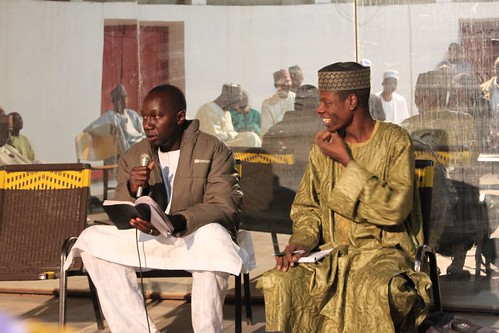
With that aside, it was very enjoyable to be on an expedition with so many Hausa writers (including novelists, poets, journalists, and academics), and to be able to be a part of the two evenings of open-mic events, in which authors read poems/short stories/excerpts of novels and received much critical feedback from fellow writers. The atmosphere was relaxed, friendly, and full of jokes, especially when novelist/screenwriter/poet Nazir Adam Salih sang a love-song, with a full sing-along chorus, to an unknown lady and was mercilessly teased with spur-of-the-moment response songs for the rest of the trip.

Hausa novelists Nazir Adam Salih and Ado Ahmad Gidan Dabino at a reading in Damagaram, Zinder, Niger, 8 December 2009 (c) Carmen McCain

There is much to say about the week, and I will likely split this post up into several smaller ones on specific themes. So watch out for further posts throughout the week.

The events of the week included arrival on Monday evening; an opening ceremony on Tuesday and an open-mic Tuesday night; paper presentations on Wednesday morning and afternoon and another open-mic Wednesday evening, a closing ceremony Thursday afternoon with visits to the museum and the Emir’s palace (or the Sultanate of Damagaram). About six of us women also took a trip to the market on Thursday evening.

Tamajaq writer Alhassane Hamed Ittyoube and Hausa writers at the museum in Damagaram, Zinder, Niger 10 December 2009 (c) Carmen McCain

Friday morning, about seven of those of us who were heading back to Kano trekked, dragging rolling suitcases, laptop cases, and market bags of tapioca, to the Damagaram public transport depot. There was much haggling over pricing and space. We nearly left in a small bus, but when the driver attempted to cram more passengers in, though we had settled on a price for a certain number of seats, we disembarked and left the park to arrange for a vehicle elsewhere. I will tell the story of our rather dramatic border crossing in another post.

The most personally disconcerting part of the trip (other than the dramatic border crossing that I will write about later!) was being in Niger with no money!! I went to Niger in public transport with several writers from Kano. At the border, we decided to wait to change money until we got to Damagaram, assuming there would be a better rate there, but once there we were met at the public transport depot by one of our Nigerien hosts and never actually got to a place to change our naira to CFAs. So, many of us went for about three days without having any money. Fortunately, our hosts were generous enough to feed and house us, so it wasn’t a major hardship, but it was a little disorienting to not even have the money to buy a sachet of pure water or a bundle of tissue. On the last evening, some of us women took a trip to the market and were able to find a trader to change a little naira. I immediately went in search of pure water having not had anything to drink since early in the morning! That said, it is amazing that we were taken care of so well that we were not too pinched without our cash!

Overall, it was an excellent experience. There were a few grumblings about accommodations and organization, but that seems typical of most conferences. I did feel badly that Hajiya Hafsat M.A. Abdulwahid, an important writer, the first female novelist in Hausa and winner of the 1979 NNPC writing competition for her novel So Aljannar Duniya, was not given better accommodations. She graciously shared a room with me, but a person of her status should have been given something a little better.

More details later.

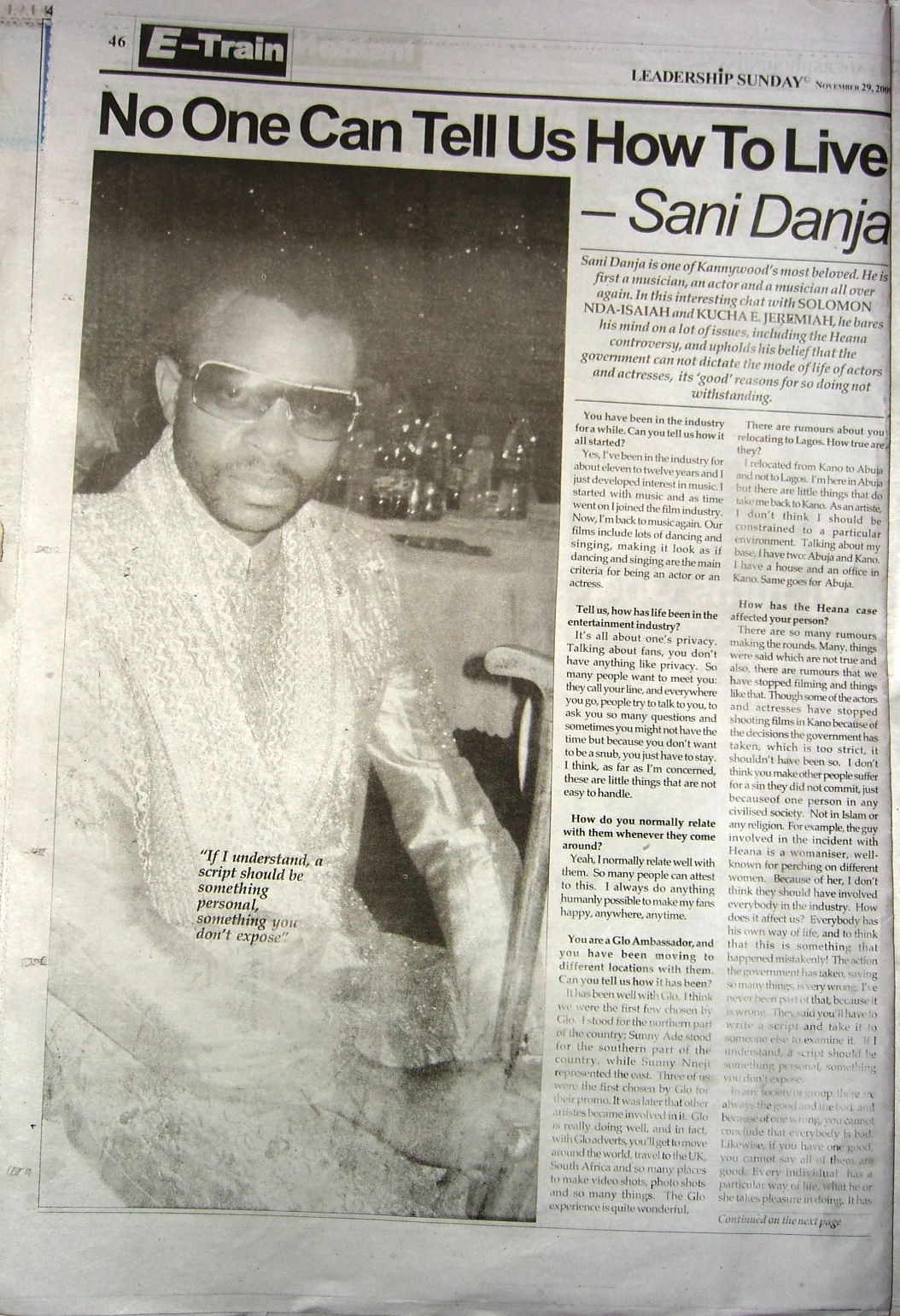
“No One Can Tell Us How to Live”:Interview with Sani Danja in Sunday’s Leadership

There is a great interview that Solomon Nda-Isaiah and Kucha E. Jeremiah did with Hausa film and music star Sani Danja in this week’s Sunday Leadership. Since I can’t find the online version of the article, I will post a photo of the hard copy here and a few excerpts from the interview. This article comes from Leadership Sunday, November 29, 2009. Pages 46-47. (Unfortunately, after posting I realized that the text is not big enough to read. To read, you might have to download the photo and read in a photo viewing program.)

In the article Sani Danja talks about his music and film career, his activites as a Glo ambassador, and his opinions on the recent actions of the Kano State government on Hausa filmmakers.

Here are a few excerpts. To read fully, you may have to download the photo:

When being asked about the reasons he decided to relocate to Abuja, although having offices in both Abuja and Kano, Danja says

“The thing is, there are so many rules and regulations guiding the industry in Kano. They are numerous; we have been stopped from doing any shooting or film-related activities in Kano for like six months and now they are telling us that you’ll have to get an office, have a minimum capital of N2.5m, employ a secretary, and the rest. There are so many things. If you sum up everything, it would be close to N8 or N10m. Somebody that has been stopped from work for like six months, where do you expect him to get such money? Even if we were allowed to do the movie, how much do we get out of it? It is but chicken change, yet we pay taxes. We pay government tax, yet they have never built anything to support us. They have never contributed anything to the filming business.

In response to the management of two offices in Abuja and Kano, he replies:

There’s always division of labour in a company. You have other people who look after different aspects of a company but most of my operations are directed from Kano. My parents have taught me obedience. I don’t want to fight the government. If the government says it doesn’t want this, I’ll have to stay aside. There are other states ready to welcome us. They want us to come and are always ready to open their doors to us. We don’t sell our products alone in Kano, we sell it all over the world. Everywhere you go, you see our products. Not only in Kano, Kaduna, Abuja, or Niger, they are everywhere, so for us to be stopped in one place is not a problem. You have to boost your own image. Because we want to live peacefully with everybody, that is why we had to acquire two offices, to broaden our horizons.

When asked if he had any advice for the government on disciplinary measures against filmmakers, Danja says:

First of all, they’ll have to look at it from this angle; filming is a business, and in every business, when you invest your money, you’ll think of better ways to get your money back. They should have it at the back of their minds that moviemakers have invested in their movies. One cannot be an investor while another comes to forcefully direct him on what to do. It is very impossible. If you want to direct somebody or tell him what to do in his own business, invest in the business.

As the government, they have the money and they can invest to boost the industry, they can afford to spend on every producer (at least twenty to thirty million) then tell the producer: “this is the type of film we want you to produce and we would pay you”. But in a situation where the government does not do that and you take pains to invest in the business, and they come tell you: “remove this, do this and that,” that would be impossible to obey. You have spent a lot of money, running into millions of naira, and at the end of the day, someone sits somewhere to tell you to: “Remove this. We don’t want this and that.” Those could be interesting parts that make your movie sell. How do you think that would work? I would advise the government to think again. They should know that these are people who acquire the resources invested in the business independently. They didn’t go to bother anybody or steal. They do this to keep their soul and body going, and they pay taxes to the government at the end of the day. I think the government needs to support us so that we would bring more money to them. We can be made role models for others who have already engaged or wish to engage themselves in one dubious act or the other to know that it is not only by engaging in criminal acts that you can make it in life. There are legitimate ways to better one’s life.

The government should not just sit down, creating rules and laws that would cripple our activities at the end of the day, without minding the effect it would have on us. If the son to any of the government officials were involved in something like this, they would have thought of better ways to handle it. The worst part of it is that any of our members who happens to make any mistake would be sentenced to jail. For example, if you record an album they don’t like, they won’t even try you. All they would do is to jail you or frustrate you by refusing to renew your revenue. They take you to jail without trial in the end. It is inhuman. We are not criminals. Even in armed robbery cases, they grant them bail. Here we are, honourably engaging in legitimate business. […]