Lecture and Exhibition on Alternative Energy today at Goethe Institut, Kano, the first place in Kano to go “off grid” with a solar-tracking system

The topic of renewable energy, as an environmentally friendly option, has always interested me, even as a young child, but I think growing up in Nigeria, where the power supply is unstable, made me even more passionate about the topic. Renewable energy is more than just a way to be “green;” it is a way to survive, and I am shamelessly evangelistic in my promotion of renewable energy as the best option for Nigeria. We have some of the best sun in the world, as well as excellent wind and hydro resources. We could also do very well with (my current favourite option) gasification of organic waste products. In fact, a family friend who works in renewable energy told me that agricultural factories could basically run themselves and staff housing on the energy produced from waste materials such as husks and corn stalks. Estates could potentially go grid-free as well as enjoying a tidy environment by gasifying their trash or sewer systems.

After spending nearly two and a half years suffering the vagaries of NEPA and refusing, out of principle (and also, I admit, fear) to get a generator, I finally invested in an inverter and battery system. Until a few minutes ago when NEPA came back on, I was working on a power supply from my battery system, without which I would not be able to do my work. The battery charges when I have electricity and supplies me with power to run my laptop, inkjet printer, tv, dvd player, and DSTV device, as well as recharge phones and recharge a battery lamp and phone (You would need a much larger battery and inverter system to run a refrigerator, heating element, or airconditioner). My battery needs about three hours of electricity for a full charge, and when fully charged can provide up to 10 hours of electricity. I use mine very lightly, unplugging printer and TV when not in use, and turning it off when I sleep or go out, and since I purchased it in around February, I have not had my battery run out even once. Although the initial investment is pricier than a generator, it is completely worth it to me. There is very little noise (just a light hum), no unpleasant fumes, and no having to go out and waste time in queues for petrol or having to handle petrol. I bought my system from the Indian company Su-Kam on Ibrahim Taiwo Road, but there are also other suppliers in Kano, such as Dahiru Solar Technical Services Ltd (which built the solar-tracking system for the German cultural liason, Goethe Institut, Kano office) on Zaria Road. My goal, once I am done with my PhD and actually earning a reasonable income (!) is to someday invest in solar and be free of NEPA altogether.

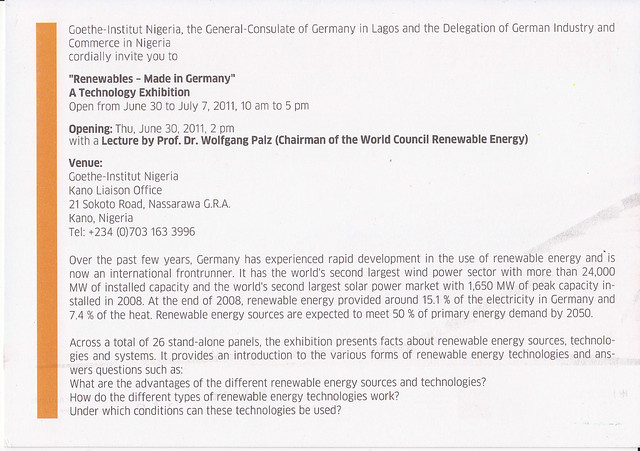
Therefore, I am particularly excited about a lecture and exhibition on renewable energy that is opening today at the Goethe Institut-Nigeria, Kano liason office, co-sponsored by the General-Consulate of Germany in Lagos and the Delegation of German Industry and Commerce in Nigeria. I wanted to get this up a bit sooner, but have been insane with writing deadlines. For those in Kano, seeing this before 2pm, Thursday, there will be  a lecture at that time on renewable energy, given by Prof. Dr. Wolfgang Palz, the Chairman of the World Council Renewable Energy.

Venue: Goethe Institut Nigeria, Kano Liason Office, 21 Sokoto Road, Nassarawa GRA, Kano.

Time: 2pm, Thursday, 30 June 2011

The lecture will open a one week exhibition at the Goethe Institut, Kano on “Renewables-Made in Germany” on “renewable energy sources, technologies and systems,” which has recently been on display at the Goethe, Institut, Lagos. On July 11-15 it will move to Abuja and be displayed at the Hilton Hotel. The exhibition is open from 30 July to 7 July, 10am to 5pm and entrance is free.

The exhibition features German renewable energy technology and “answers questions such as:

What are the advantages of the different renewable energy sources and technologies?

How do the different type of renewable energy technologies work?

Under what conditions can these technologies be used?

The Goethe Institut, Kano, is a particularly appropriate venue to hold the exhibition since the Goethe Institut, which is housed in the old Gidan bi Minsta, parts of which were built back in the 16th century, is the first building in Kano state, and the third in the nation, to be powered by a solar tracking system, a mechanized system which follows the sun for optimum solar power absorption. Although I am generally a bit suspicious of agendas of cultural agencies, I have been very impressed with the Goethe Institut’s programming and support of Kannywood, and have written about it elsewhere in my column.

A few weeks ago I interviewed Frank Roger, the director of the Kano liason office for Goethe-Institut, Nigeria, about the solar energy project he initiated. Click on the photo below to read in hard copy, or scroll below the photo for the text.

In Kano, Goethe Institut goes off-grid with solar power

Saturday, 18 June 2011 00:00 Carmen McCain

When I visited Germany a few years ago, one of the things that most impressed me was that nation’s visible commitment to renewable energy sources. Driving through the countryside, I saw windmills to capture and convert the wind into energy; neighborhoods full of “passive houses”  built and insulated to need very little energy for heating during the cold winter season; and solar panels for conversion of sunlight into electricity on many houses. Why aren’t we doing more of this in Nigeria? I thought. Nigeria is much more blessed with sun than Germany and much more in need of alternate electricity sources. I was particularly excited when I heard that the Goethe-Institut, the German cultural centre established in Kano in 2008, had gone “off-grid” and was now run completely on solar power. In April when the Goethe-Institut hosted the one-day Kannywood FESPACO symposium, the lights were on, the computers were running in the offices. The sound speakers and the digital projector worked without a blink. There was no noisy generator filling the compound with fumes, just a large mechanized frame of solar panels to capture the sun.

I asked Frank Roger, the director of the Goethe-Institute, Kano, about their energy supply, and I’ve included parts of our conversation below. He gave me a little background about German energy politics, the Goethe-Institut, and their solar energy project, highlighting the wisdom of traditional architecture and the great possibilities of solar power to transform the way electricity is experienced in Nigeria and the world. The Goethe-Institut, which has been in Lagos since 1962, focuses on “intercultural exchange and the promotion of various fields of the arts.” When they established a liason office in Kano in 2008, they were invited by the Kano State History and Culture Bureau to move into the old adobe Gidan bi Minista building, the upper floor of which was constructed in 1909. The History and Culture Bureau believes that “the basic structure of the ground floor has been around since the 16th century. It was [first] used by title holders of the emir. In 1903 when the British came to Kano, the first British minister, who was called Frederick bi Minista, resided here. He established the first arts and crafts school in Kano here, so this building has a real history of cultural activities. Later on MOPPAN [Motion Picture Practitioners Association of Nigeria] offices were here, then the copyright commission. When I came in 2008, the house was basically not used.”

“The Goethe-Institut does not pay rent but maintains the building. We renovated the whole building, the plastering, you have to do quite often, checking it after rainy season.  We reconnected water supply and put on a new roof, but there was still the problem of energy supply. Even though this is not far from the government house, still the [electric] supply was very unreliable.

“The easiest way would be to buy a generator and just do it that way. But then the idea [of solar power] came up. There’s one thing about this building and the architecture. It has natural ventilation. It’s quite cool inside so you don’t really need air conditioning. Even though it’s April, it’s very comfortable inside. If you have these modern concrete buildings, you definitely need air conditioning for an office, and then it’s a bit costly when it comes to solar power. If you want to invest in solar, you first have to do a power load survey. You have to know how much you need for consumption, and according to that, then solar company will design you the system you need. That’s why you cannot just say in general what is the size or cost of a solar power system. It is individually designed according to your needs. So the idea was instead of following this generator mainstream that we look for an alternative, and since solar has a big boom in Germany, we said ‘why not?’ Kano is much more exposed to the sun than our belt in Germany with its bad weather and short days in winter. In Kano you have hours of daily sunlight. In August in the rainy season, you can expect 5-6 hours. And in March-April, up to 11 hours of sunlight, so it’s really obvious to use it.  The system we have was installed by Baba Dahiru [of Dahiru Solar Technical Services Ltd], a Kano businessman. And what he always says is that solar is free, and it is true. The energy from the sun comes for free, everyday newly. Of course, first you have quite high investment costs. If you want light at night, you also have to invest in batteries, which are not so cheap. But normally it pays off after about three years.

“We cancelled our NEPA account. Basically with our solar system, we run everything in this office now. We are off grid [disconnected from PHCN], and we have a fridge, our computers, the sound system, printer, copy machine, lights, lighting for exhibition, security lights at night that all run without any problem. We did the official opening in December, but had the test run since August, and it has run [from that time] without problems. You don’t really have maintenance costs. They come from time to time to make sure the screws are still tight. The lifespan of batteries is comparable to that of a generator, so after 6-7 years they have to be renewed. But the PV, photovoltaic panels [which capture the energy from the sun] run with 90% guarantee for 10-15 years, and at 80% rate of performance from 20-25 years, which is a really long term investment.

In addition to reliable electricity, using solar energy has other benefits. “There is no pollution. We don’t contribute to global warming now. There is no noise, which is important for our programmes.  Here you feel it’s a little paradise because it’s so quiet and peaceful. We have installed solar panels not only as our energy supply system but also looked at it as an educational project to spread the idea of alternatives to the oil, coal gas, fossil fuels. Even though Nigeria is at an oil peak now, there will be a time when the oil worldwide will be finished. So, it is a good idea now while you have a lot of revenue from the oil industry to look ahead and invest in future technologies.”

“There’s a lot of investment in renewable energy in Germany now. Wind power is the first, also offshore wind power stations on the North Sea, even solar, though we have bad sunlight, also hydro power, some geotherm, and biological waste.”

After the Fukushima nuclear tragedy following the earthquakes and tsunami in Japan, “it was quite a big debate in Germany. We have something like 17 nuclear power plants in Germany. The majority want to get rid of this risky technology. The people in the renewable energy industry said by 2020 they will completely replace nuclear power in Germany with renewable resources, solar, hydropower. That is like nine years from now.”
The ‘second coming’ of Kannywood

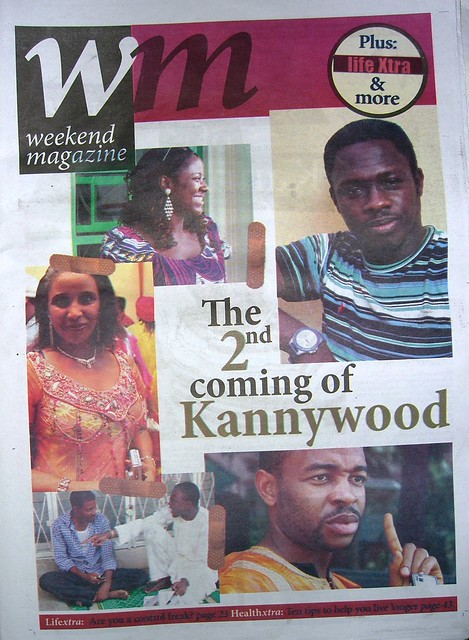
Still catching up on posts I am behind on. This feature piece  “The ‘second coming’ of Kannywood” was published over a month ago now in the Weekend Magazine of Weekly Trust on 21 May 2011, but gives a good summary of the challenges faced by the Kano film industry during the tenure of former ANPP Governor Ibrahim Shekarau, and the “director general” of the Kano State Censorship Board he appointed, Abubakar Rabo Abdulkarim. I also interviewed film practitioners about their hopes as PDP’s Rabi’u Musa Kwankwaso, who had been governor of Kano State from 1999-2003, returns to take up another four year term, aided in his political campaign by the Motion Picture Practitioners Association of Nigeria and Kannywood stars like Sani Danja and D’an Ibro. As usual, to read the hard copy of the article, click on the photos below, or scroll down to read the text I’ve copied here.

The ‘second coming’of Kannywood

Saturday, 21 May 2011 01:42 Carmen McCain

Wednesday evening, April 27, 2011, Zoo Road in Kano, the street lined with Kannywood studios, exploded into celebration. Young men pulled dramatic stunts with motorbikes and shouted their congratulations to Hausa filmmakers. “Welcome back home, brothers. Welcome back from Kaduna,” directors Falalu Dorayi and Ahmad Biffa recall them saying. “We embrace you ‘Yan fim.’ We are together with you. We are happy that he has returned.”The win of PDP

Governor Rabi’u Musa Kwankwaso, incoming governor of Kano State, and also governor from 1999 to 2003 (Photo Credit: Nigerian Best Forum)

candidate Dr. Rabiu Musa Kwankwaso as governor of Kano, his second tenure after a four-year term from 1999-2003, had just been announced.  INEC figures listed PDP as winning 46% of the vote with 1,108,345 votes, closely followed by Alhaji Salihu Sagir of ANPP with 43.5% of the vote with 1,048,317 votes.  To anyone familiar with the Hausa film industry, which according to recent National Film and Video Censor’s Board figures makes up over 30% of  the Nigerian film industry, this association of a political win with film was no surprise. Some of the most visible Hausa filmmakers have become increasingly politically active following a crackdown by the Kano State Censor’s Board, during which many practitioners and marketers of Hausa films had been fined, imprisoned, and harassed. While many of those associated with the film industry supported CPC and Buhari for president, the feeling among many filmmakers in Kano was that for governor any of the candidates would be better than ANPP. The two term ANPP governor and presidential candidate Ibrahim Shekarau, who had initially been passionately supported by

CIMG2970

Former Governor Ibrahim Shekarau, governor of Kano State fro 2003-2011, and ANPP presidential candidate in 2011. (I took this photo during his trip to Madison, Wisconsin in 2007)  (Photo credit: talatu-carmen)

at least some of Kano’s writers and artists, was now deeply disliked by most film practitioners, in part, for appointing Abubakar Rabo Abdulkarim former deputy commandant of the shari’a enforcement group hisbah as director general of the Kano State Censor’s Board. Malam Rabo, as he was known, regularly went onto the radio to denounce film practitioners for ostensible moral defects and had overseen a board which often arrested filmmakers.

After surveying candidates in the gubernatorial race for how they would support film, the Motion Pictures Practitioners Association of Nigeria (MOPPAN), as the association’s president Sani Muazu reported, publically campaigned for Kwankwaso. Movie star,

Comedian Klint de Drunk, with Kannywood stars Sani Danja and Baban Chinedu at an Abuja press conference for NAISOD, 2010. (c) Carmen McCain

producer, director, and musician Sani Danja, who founded Nigerian Artists in Support of Democracy (NAISOD), and comedians Rabilu Musa dan Ibro and Baban Chinedu were among those who lent their star power to the new  governor’s campaign. This public support for PDP among some of the most visible film practitioners had put Kano based filmmakers in danger the week before. Angry about the announcement of PDP’s Goodluck Jonathan as winner of the presidential election, area boys hunted for Sani Danja, threatened other recognizable actors and vandalized studios and shops owned by Kannywood stakeholders. (For this reason, while some filmmakers have come out publicly in support of candidates, there are others who are reluctant to speak openly about politics. The Dandalin Finafinan Hausa on Facebook has banned discussion of politics on its wall, requesting members to focus on discussions of film.) By the next week, however, as Falalu Dorayi relates, the same area boys who had been hunting Sani Danja were now celebrating him.

Producer and makeup artist Tahir S. Tahir with Director Falalu Dorayi celebrating Kwankwaso’s win. April 2011 (c) Carmen McCain

While Governor-elect Rabiu Musa Kwankwaso was seen as the champion of the filmmakers during the 2011 election cycle, it was under Kwankwaso, who first served as governor of Kano from 1999-2003, that the first ban on Hausa films was announced and that the Kano State Censor’s Board was created. Abdulkareem Mohammad, the pioneering president of MOPPAN from 2000 to 2007, narrated how in December 2000, the Kano State Government pronounced a prohibition on the sale, production and exhibition of films in Kano state because of the introduction of sharia. MOPPAN  organized and “assembled industry operators in associations like the Kano State Filmmakers association, Kano state artist’s guilds, the musicians and the cinema theatre owners, cassette sellers association” to petition the government to either allow them to continue making films or provide them with new livelihoods. It was the filmmakers themselves under MOPPAN who suggested a local state censorship board, which would ensure that film practitioners were able to continue their careers, while also allowing oversight to ensure that their films did not violate shari’a law. The censorship board was ultimately meant as a protection for the filmmakers to allow them to continue their work.

Outgoing President of MOPPAN, Sani Muazu points out that MOPPAN’s support of Kwankwaso was because he had promised re-establish the original intent for the censorship board, with a Kannywood stakeholder in the position as head of the Kano State Censorship Board, rather than an outsider who did not know the industry. Most Hausa filmmakers speak of the censorship board as a compromise between the film industry, the community and the government. Director Salisu T. Balarabe believes then Governor Kwankwaso was trying to follow the demands of those who voted for him, “If the government wants to have a good relationship with people it has to do what the people want.” Kannywood/Nollywood star Ali Nuhu said, “I won’t forget how in those three or four months [during the ban], they sat with our leaders at the time of Tijjani Ibrahim, Abdulkareem Muhammad, Hajiya Balaraba and the others.  They reached a consensus, they understood the problems that they wanted us to fix and the plan they wanted us to follow.”
Nollywood/Kannywood star Ali Nuhu on set of Armala with Executive Producer Aisha Halilu. April 2011 (c) Carmen McCain

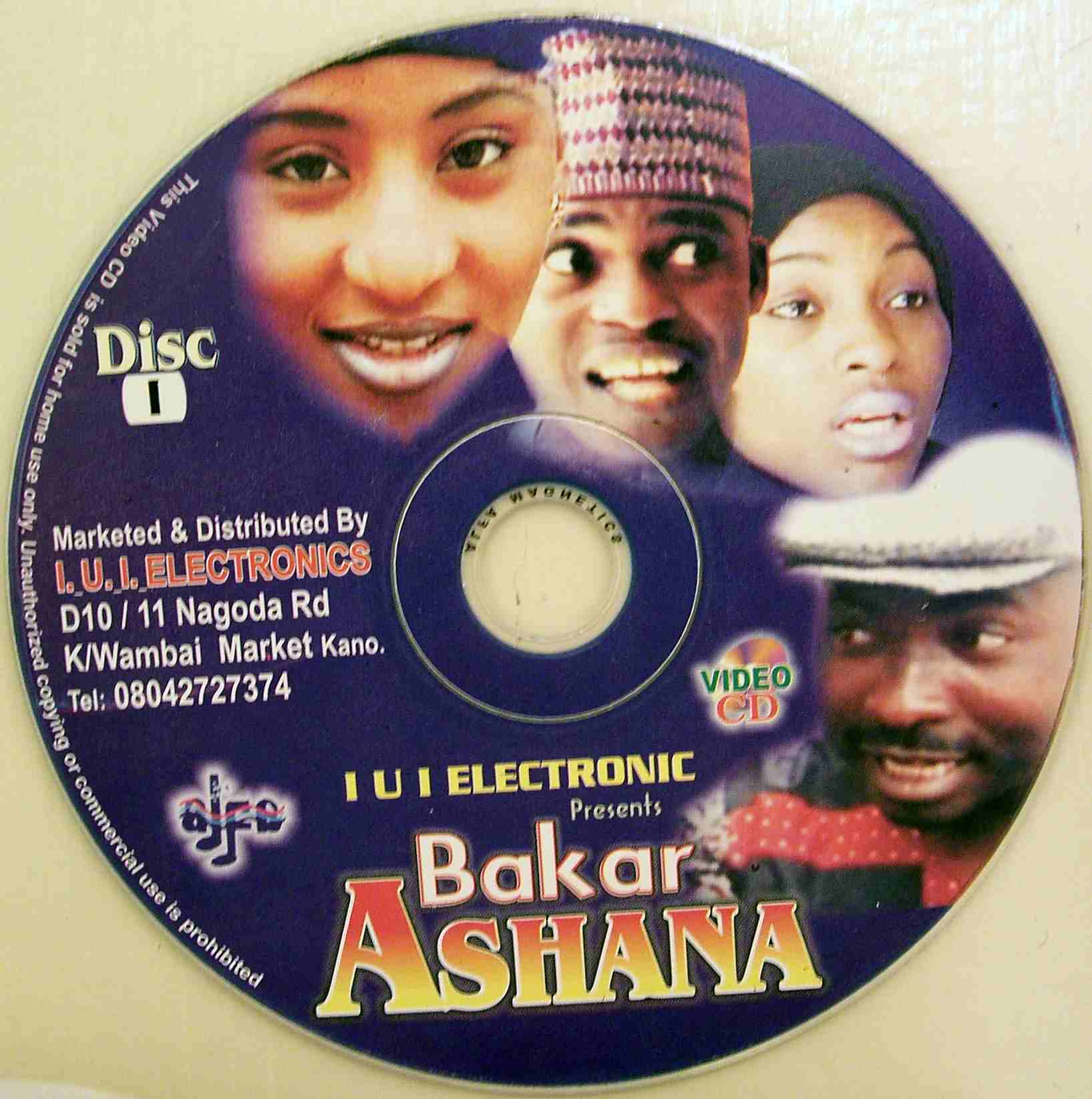
Although the censors board had banned several films, such as Aminu Bala’s 2004 cinema verite style film Bakar Ashana, which explored the moral complexities of the world of prostitution, and enforced rules on censorship

Aminu Bala’s film Bakar Ashana that was banned by the Kano State Censor’s Board in 2004.

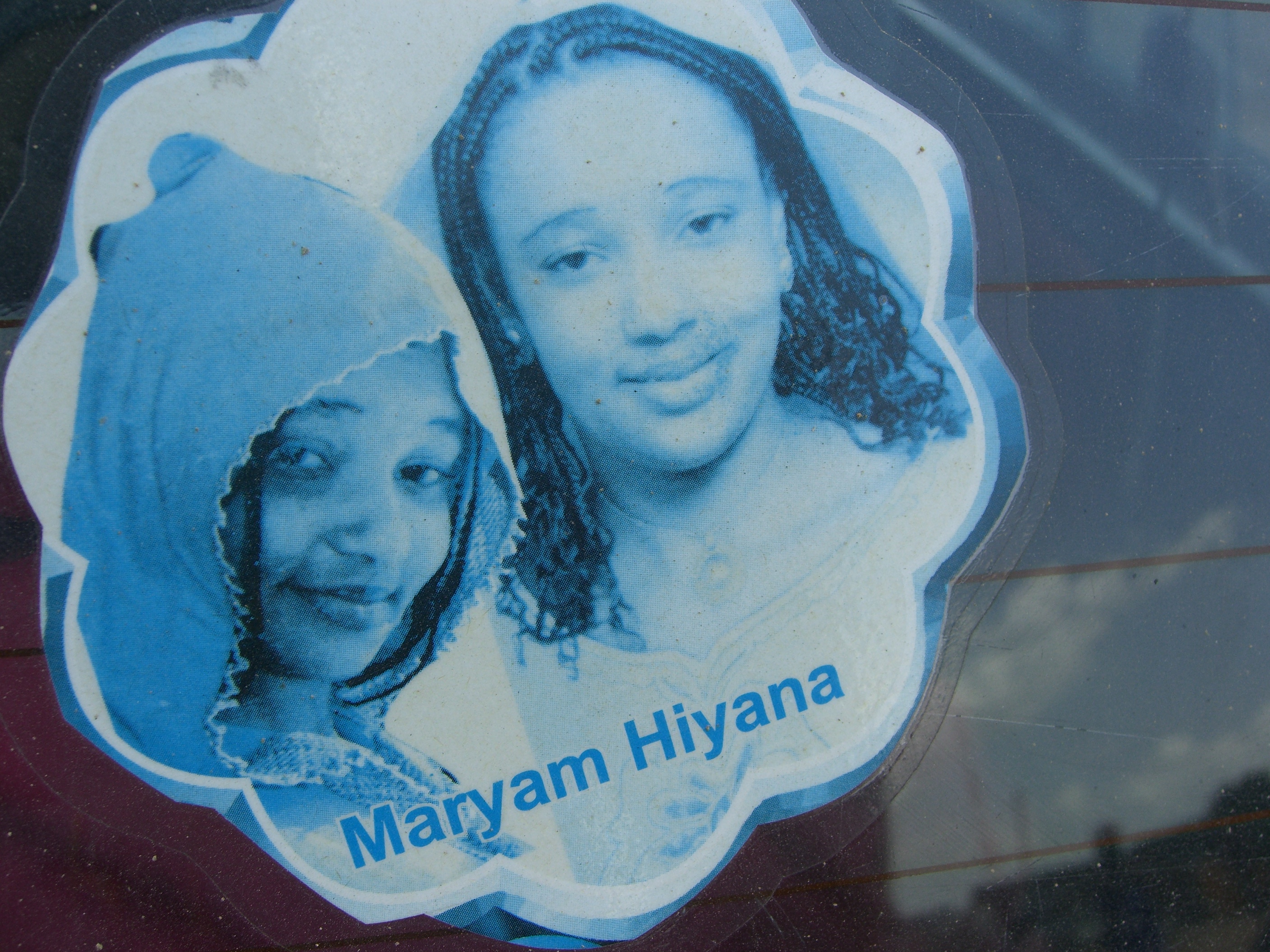
before marketing, filmmakers for the most part did not seem to have major problems with censorship until August 2007, when a sex scandal broke out in Kannywood. A privately made phone video of sexual activity between the actress known as Maryam “Hiyana” and a non-film industry lover Usman Bobo was leaked and became one of the most popular downloads in Kano. Alarmed by what some were calling the “first Hausa blue film,” although the clip was a private affair and had nothing to do with other Hausa filmmakers, critics called for serious measures to be taken. A new executive secretary Abubakar Rabo Abdulkarim (his position soon

Maryam Hiyana, who was seen as a victim in the scandel, became an unlikely folk hero with stickers of her likeness on public transport all over Northern Nigeria. (c) Carmen McCain, 2008

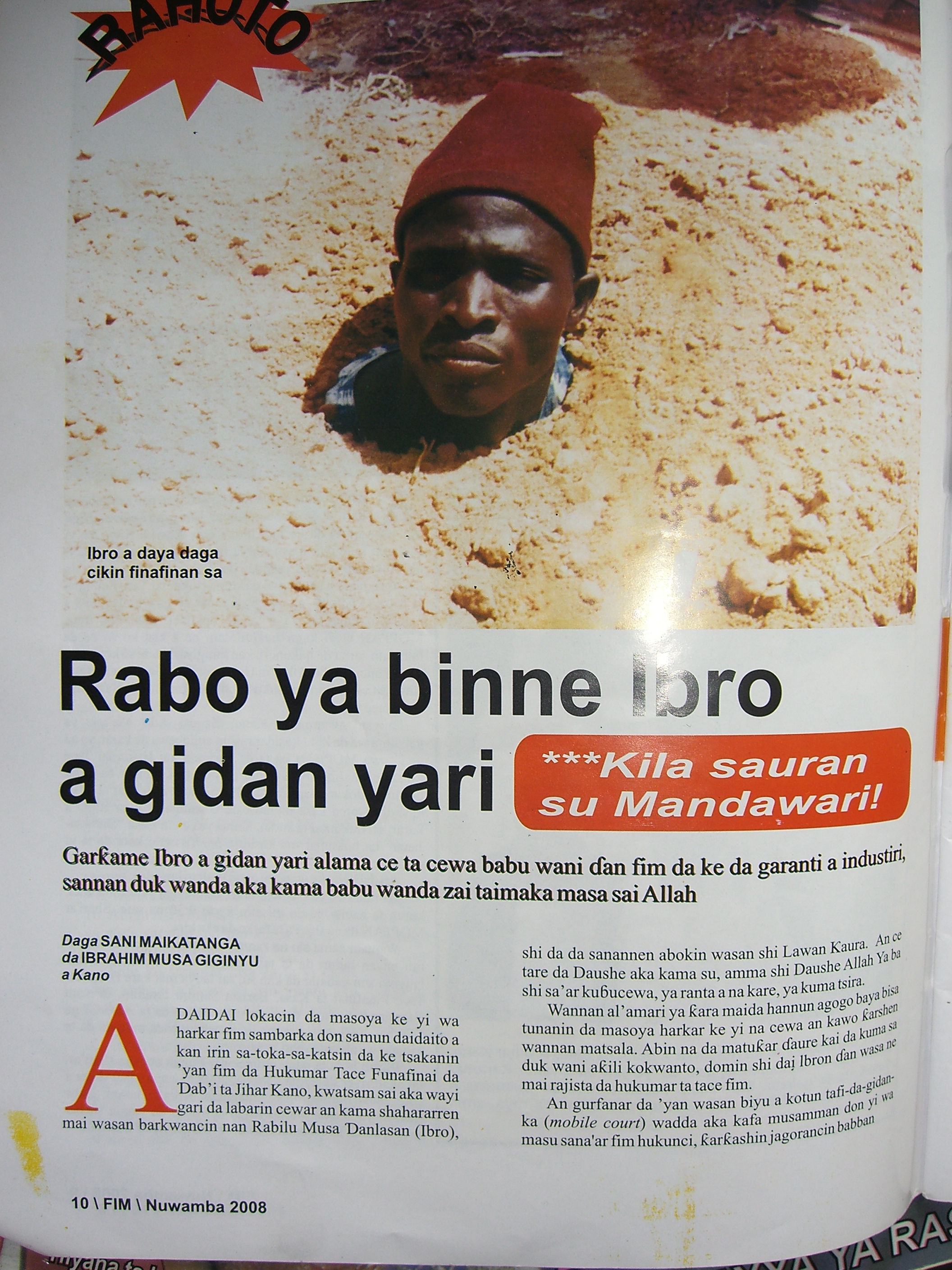
inflated to the title of director general) was appointed by Governor Shekarau to head the Kano State Censor’s Board. He required each film practitioner to register individually with the board, an action he defended as being provided for in the original censorship law. Not long after Rabo was appointed, actor and musician Adam Zango was arrested and sentenced to three months in prison for releasing his music video album Bahaushiya without passing it through the Kano State Censor’s Board. He was the first in a series of Hausa filmmakers to spend time in prison. Former Kano state gubernatorial candidate and Kannywood director Hamisu Lamido Iyan-Tama was arrested in May 2008 on his return to Kano from Abuja’s Zuma Film Festival where his film Tsintsiya, an inter-ethnic/religious romance made to promote peace, had won best social issue film. He was accused of releasing the film in Kano without censorship board approval.  Although Iyan-Tama served three months in prison, all charges were recently dropped against the filmmaker and his record cleared. Popular comedians dan Ibro and Lawal Kaura [both of whom are now late, see my memories of both Rabilu Musa and Lawal Kaura] also spent two months in prison after a hasty trial without a lawyer. Lawal Kaura claims that although they had insisted on their innocence, court workers advised them to plead guilty of having a production company not registered with the

FIM Magazine feature on Ibro’s time in prison, November 2008.

censorship board so that the judge “would have mercy” on them. These were only the most popular names. Others who made their livelihoods from the film industry, from editors to singers to marketers, spent the night in jail, paid large fines, and/or had their equipment seized by enforcers attached to the censorship board.

Although Governor Shekarau in a presidential debate organized by DSTV station NN24 had claimed that “the hisbah has nothing to do with censorship,” Director of Photography Felix Ebony of King Zuby International recounted how hisbah had come to a location he was working on and impounded four speakers and one camera, telling them they had not sought permission to shoot. Other filmmakers complained that there was confusion about under what jurisdiction arrests were being made. Although in a February 2009 interview with me, Rabo

Felix Ebony, director of photography with King Zuby International. (c) Carmen Mccain

also claimed that the censorship law was a “purely constitutional and literary law […] on the ground before the shari’a agitations,” the public perception seemed to be that the board was operating under shari’a law, perhaps because of Rabo’s frequent radio appearances where he spoke of the censorship board’s importance in protecting the religious and cultural mores of the society. Director Ahmad Bifa argued, “They were invoking shari’a, arresting under shari’a. If they caught us, we all knew, that they had never taken us to a shari’a court. They would take us to a mobile court […] But since it was being advertised that we were being caught for an offense against religion, we should be taken to a religious Islamic court, and let us be judged there not at a mobile court.”

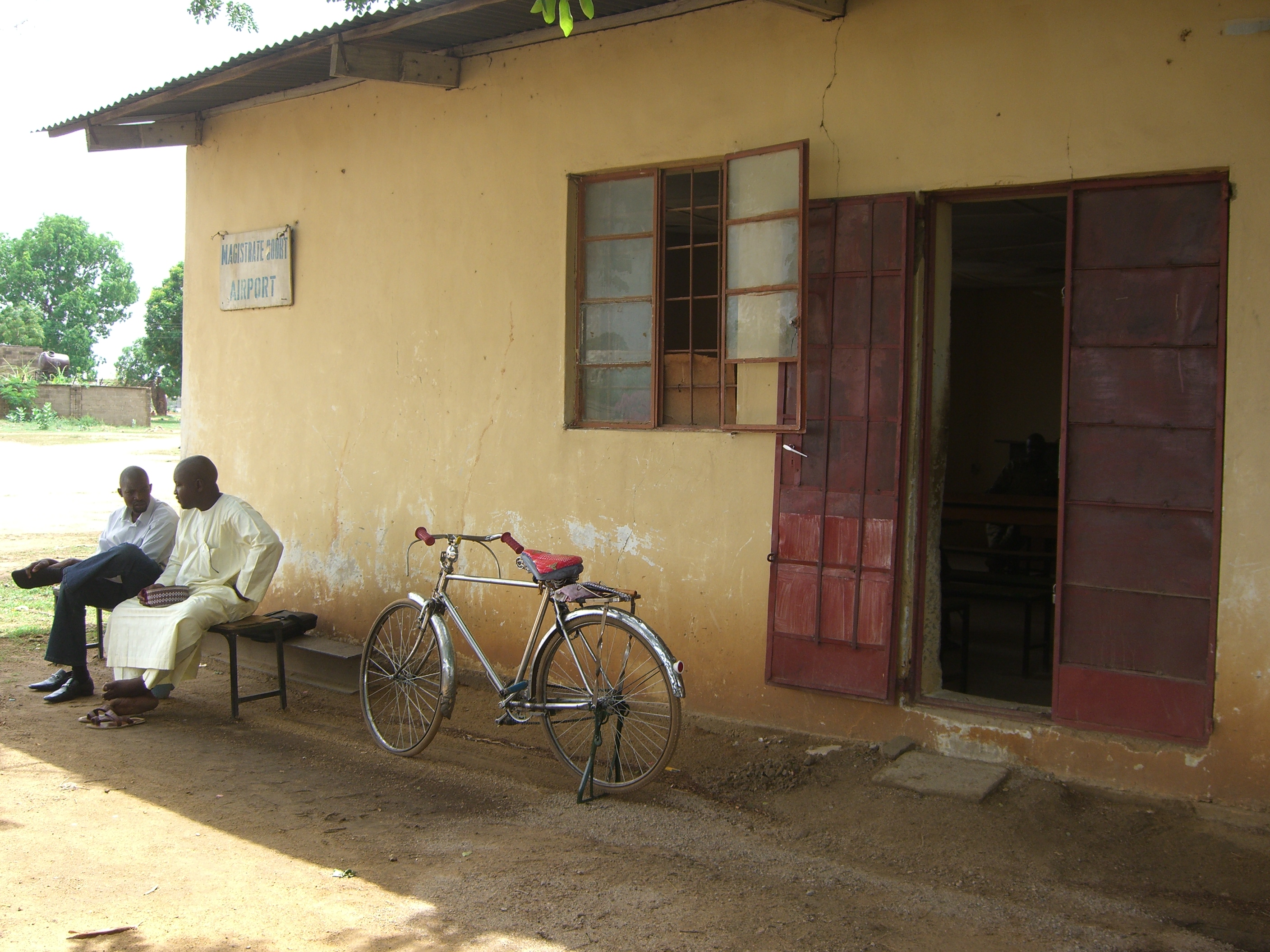
The ‘Mobile’ Magistrate Court at the Kano Airport where Censorship Board Cases were tried. This photo was taken in July 2009 during the trial of popular singer Aminu Ala. (c) Carmen McCain

The mobile court Biffa referred to seemed to be attached to the censorship board and was presided over by Justice Mukhtar Ahmed at the Kano airport. After the Iyan-Tama case came under review, the Kano State attourney general found the judge’s ruling to be ““improper”, “incomplete”, a “mistake” and requiring a retrial before a more “competent magistrate.” Justice Ahmed was transferred to Wudil in August 2009; however, censorship cases continued to be taken to him. In January 2011, popular traditional musician Sani dan Indo was arrested and taken to Mukhtar Ahmad’s court, where he was given the option of a six month prison sentence or paying a fine of twenty-thousand naira.  The decisions made by the board and the mobile court often seemed of ambiguous motivation. In 2009, Justice Mukhtar Ahmed banned “listening, sale, and circulation” of eleven Hausa songs, citing obscenity, but obscenity was rarely as easily identified as the cutting political critiques in them.

11 Songs banned by Justice Mukhtar Ahmed. (c) Alex Johnson

The effect of these actions was to relocate the centre of the Hausa film industry away from the flourishing Kano market, to Kaduna. Many filmmakers began to claim their rights as national Nigerian filmmakers, taking their films only to the National Film and Video Censor’s Board, bypassing the Kano State Censorship Board altogether. Such films were often marked “not for sale in Kano” and if found in Kano state were known as “cocaine,” a dangerous product that could, as Iyan-Tama discovered, mean imprisonment for a filmmaker, even if filmmaker had advertised, as Iyan-Tama had, that the film was not for sale in Kano State. Another side effect of these actions was the loss of jobs among Kano youth. Ahmad Bifa pointed out that “the Hausa film industry helped reorient youth from being drug-users and area boys to finding jobs in the film profession. Sometimes if we needed production assistants we would take them and give them money. I can count many that the Hausa film industry helped become relevant people to society. But Abubakar Rabo made us go to Kaduna to do our shooting. So the young people of Kano lost the benefit of film in Kano, […] That’s why there are a lot of kids on Zoo Road who went back to being thugs because of lack of job opportunity.”

Ahmad Bifa, on set of the Aisha Halilu movie Armala, April 2011. (c) Carmen McCain

Although the impact of censorship on film was the most well known, the flourishing Hausa literary scene was also affected, with the director general initially requiring all writers to register individually with the censor’s board. With the intervention of the national president of the Association of Nigerian Authors, writers found some relief when Abubakar Rabo agreed to deal with the writer’s associations rather than with individual writers; however, there still seemed to be a requirement, at times ambiguous, that all Hausa novels sold in the state must be passed through the board. Rabo continued to make often seemingly arbitrary pronouncements about what he considered acceptable literature. In December 2009, for example, at a conference on indigenous literature in Damagaram, Niger, Rabo proclaimed that the board would not look at any more romantic novels for a year.

Abubakar Rabo Abdulkarim, DG of the Kano State Censor’s Board 2007-2011, proclaimed that he would not accept romantic novels for a year. International Conference on Authors and Researchers in Indigenous Languages, Damagaram, Niger, December 2009. (c) Carmen McCain

Those who protest the actions of the board do not have a problem with censorship so much as how censorship has been carried out. The original MOPPAN president Abdulkareem Mohammad argued that the intention of creating the censorship board had been one that would allow filmmakers to continue doing their work, “We really were doing things in good faith to ensure that things do work and eventually it is for the betterment of the majority.” He acknowledged wryly that there were flaws in the law that allowed for it to be abused, “I think that on insight, I would have done it differently.” Current president Sani Muazu continued in this vein saying that although the board had been meant to protect artists it had “become a weapon against artists.”  Director Salisu T. Balarabe says, “There was nothing wrong with making the censorship board but those put in charge of directing the board, sometimes put a personal interest into it.” Novelist and scriptwriter Nazir Adam Salih acknowledged “We have our faults. This is true. But the censor’s board was much harsher than it

Novelist and script writer Nazir Adam Salih passionately responds to Abubakar Rabo Abdulkarim, at the conference in Damagaram, Niger. December 2009. (c) Carmen McCain

needed to be. They put someone in power who didn’t know anything about the film industry, Malam Abubakar Rabo, who slandered and disrespected us.” It was this disrespect and the accompanying arrests that most seemed to upset film practitioners. Danjuma Salisu, who is involved in acting, lighting, and assisting production argued that Rabo’s actions were insulting to those whose careers in film “feed our children and parents and families.” Makeup artist Husseini Tupac argued passionately, “Film is a profession. It is a career.  In the same way a normal person will go to the office everyday, we will go the office, we do our work and get paid. When the honourable Dr. Rabiu Musa Kwankwaso was governor nobody ever came out on the radio and said that actresses were prostitutes, that we were making blue films, that we were rogues. No one came and arrested us.” Producer and director Salisu Umar Santa shared a similar sentiment, saying that he and other

Director Salisu Umar Santa with Dawwayya Productions, April 2011. (c) Carmen McCain

professionals he worked with, like Rukkaya Dawayya and Sadiyya Gyale, had registered and done everything the board required for working in Kano State and yet Abubakar Rabo continued to say that filmmakers were not decent members of society. Producer and Director of Photography Umar Gotip said that he felt like a refugee having to leave Kano. “You are practicing your profession, to the extent that some people even have a degree in it, but they say you are just rogues and rascals. We had no human rights.” Director Falalu Dorayi, claiming that the Kano State Censorship board regularly demanded bribes, asked “How can the one who collects a bribe say he will reform culture.” Cameraman, editor, and director Ahmad Gulu put it this way: “You should fix the leaky roof before you try to repair the floor.”

Despite his ostensible position as enforcer of public morality, Rabo himself came under suspicion of wrongdoing on several occasions. In August 2009, he was taken before a shari’a court by the Kano State Filmmakers Association and accused of slander for statements he had made about the film community on the radio. In May 2010, he was also sued in by Kaduna Filmmakers Association for accusations he had made on radio and television in Kaduna.  In a strange twist, he accused twelve filmmakers, several of whom were involved the lawsuit, of sending him death threats by text message. Police from Kano came to Kaduna, arresting the one person on the list they could locate—Aliyu Gora II, the editor

Editor of Fim Magazine, Aliyu Gora II, and Filmmaker Iyan-Tama, both former inmates of Goron Dutse Prison, after a hearing in Iyan-Tama’s lawsuit against the Abubakar Rabo Abdulkarim, 22 July 2010. (c) Carmen McCain

of Fim Magazine, who was held for a week without trial at Goron Dutse Prison in Kano.  In an even more bizarre twist, in September 2010, Trust and other papers reported that Rabo, after being observed late at night by police in suspicious circumstances with a young girl in his car, fled from police. In the car chase he was also reportedly involved in a hit and run incident with a motorcyclist. After he was eventually arrested and released by the police, Governor Shekarau promised to open an inquiry into the

Filmmakers on location in Northern Nigeria on Sunday, 29 August 2009, read the breaking news Sunday Trust article: “Rabo arrested for alleged sex related offence” (c) Carmen McCain

case [as requested by MOPPAN], but Rabo continued as director general of the censor’s board and filmmakers heard nothing more of the inquiry.

The treatment of filmmakers had the perhaps unintentional effect of politicizing the artists and those close to them. Sani Danja told me he had never been interested in politics until he saw the need to challenge what was going on in Kano State. A musician told me his mother never voted in elections but that she had gone out to stand in line for Kwankwaso as a protest at how her children were being treated. Filmmakers used fulsome praises to describe their delight at Kwankwaso’s

Kannywood star Sani Danja prepares for his the first press conference of his organization: Nigerian Artists in Support of Democracy (c) Carmen McCain

return. Director Falalu Dorayi said “It is as if your mother or father went on a journey and has returned with a gift for you.” Producer and director of photography Umar Gotip said Kwankwaso’s coming was “like that of an angel, bringing blessing for all those who love film.” Even those who are not fans of PDP told me they wished Kwankwaso well, were optimistic about change, and expected him to fulfill his promises in several areas: First, most of them expected that he would relieve Rabo of his post and replace him an actual filmmaker, who as Falalu Dorayi put it “knows what film is.” Secondly, several of them anticipated actual investments into the film industry “like Fashola has done for Lagos filmmakers,” as director and producer Salisu Umar Santa put it, possibly in the form of a film village. And most Kano-based filmmakers I spoke to mentioned their hopes that others who had gone into exile would come back home to Kano. Producer Zainab Ahmed Gusau, who is currently based in Abuja wrote that, “My thought is to go back to Kano, knowing there will be justice for all.We thank God for bringing Kwankwaso back to lead us.”

Hausa film producer Zainab Ahmad Gusai at the Savannah International Movie Awards, Abuja, 2010. (c) Carmen McCain

Other filmmakers saw it as a time for reflection on how they can improve the field. Director Salisu T. Balarabe mused “If you keep obsessing over what happened, the time will come and pass and you won’t have accomplished

Hausa film Director Salisu T. Balarabe on Zoo Road in the days following Kwankwaso’s win. April 2011. (c) Carmen McCain

anything. We should put aside what happened before and look for a way to move forward.”  Hamisu Lamido Iyan-Tama, the politician and filmmaker who was imprisoned for three months, focused on the positive, calling on filmmakers to continue making films that would have meaning and would build up the community.

Many also looked beyond the own interests of film to the entire community.

Ahmad Gulu, Kannywood cameraman, editor, and director, on Zoo Road in the days following Kwankwaso’s win. April 2011. (c) Carmen McCain

Ahmad Gulu, cameraman, editor, and director said “The change has not come to film practitioners alone. It has come to the whole state of Kano. Back then people would accept politicians who would put something in their pockets but now things have been exposed.” Star actor, director, and producer Ali Nuhu similarly pointed out that progress was not receiving money from politicians, saying that one of the most important changes Kwankwaso could bring would be a focus on electricity, drinking water, and children’s education. Writer Nazir Adam Salih said that if Kwankwaso could simply fulfill the promises politicians and leaders had been making for the past thirty years to provide electricity and water, he will have done his job. And finally two directors of photography Umar Gotip and Felix Ebony pointed to the need for peace and unity in the state. “He should try to bring people together,” said Umar Gotip. “This kind of fighting that has arisen between Muslims and Christians is not right. We should live together as one.”

Producer Bello A. Baffancy shows off his Kwankwaso support, Zoo Road, April 2011. (c) Carmen McCain

‘Yan Fim on Zoo Road following Kwankwaso’s win, April 2011. (c) Carmen McCain

The Danger of a Single Story and the Good Samaritans of Arewa

I don’t think I’ve ever been so behind on this blog as I have been this time, going for nearly two months without posting anything. Forgive me. I have been overwhelmed by several other writing projects and much too much travel. I’ll try to catch up on links to a few of my pieces in Weekly Trust in the next few days, but I thought that last post should be followed by the column that came right after it.

To read the hard copy, click on this link to be taken to a flickr page where you can read it online. Otherwise, scroll below the photo and read the text as copied below (I’ve made a few small edits and added links for this blog).

The danger of a single story and the Good Samaritans of Arewa

Saturday, 30 April 2011 00:00 Carmen McCain

In a crisis such as we had last week, one comes out of it shell-shocked, horrified by the acts of inhumanity human beings are capable of. How can a human being cut another human being’s throat, send them hurtling into flames? What reason is there behind the destruction of property, the burning of churches, and mosques, the killing of youth corpers, the massacre of villagers? The killing of youth corpers in Bauchi has understandably led to rage around the country. Facebook pages have been created in their honour and linked back in particular to the page of Ukeoma Ikechukwu, whose last status update as was how he was nearly killed forresisting election malpractice was tragically prescient.  The murder of these young people on the cusp of their lives is horrifying and must be appropriately responded to by reforms to a system which too often leaves corpers insufficiently protected. Yet, I am also appalled by the irrational mob-mentality, the backlash of hatred I’ve seen on the internet, directed not just against the murderers of the youth corpers but against the entire ambiguous region of the north, lashing out often as much against other victims of violence as against the perpetrators of it. As I wrote this article, I got into a surreal and sickening online argument with someone passionately calling for innocent people from the north to be murdered in retaliation for the deaths of her fellow youth corpers.

Much of this rhetoric comes from people who have never been further north than Abuja and who stereotype an entire region the way Africa is stereotyped by ignorant outsiders, but some of it is furthered by those who have lived briefly in the “north” and have had traumatic experiences. One woman, who schooled in Jos, recounted how her own neighbors turned against her in a crisis and would have, she presumed, killed her “had not a good Samaritan intervened.” What is glaring to me in this story is that she focuses on the betrayal and treachery of those who attacked her to denounce the entire “north”, while mentioning the acts of the “good Samaritan” as only a postscript. While this is certainly an understandable response to a terrible experience, it is also only one side of the story. In “The Danger of A Single Story,” author Chimamanda Ngozi Adichie has spoken of how the insistence on “only negative stories” creates “stereotypes. And the problem with stereotypes is not that they are untrue, but that they are incomplete. They make one story become the only story.”

In these times of crisis, it is the horrifying stories that make the headlines, the betrayal, the treachery, the youth corpers murdered, the children trampled by mobs, the places of worship burned. Far less heard are the stories of ordinary human beings behaving with decency, treating their neighbors as they themselves would want to be treated, yet I argue that these people are far more numerous than the extremists and rogues who pillage and kill. It is not that there are not many stories of violence, abuse, and injustice against minorities in the north, for there are, and they must be addressed, but it is that these experiences are only a small part of the larger story. Adichie asserts that “I’ve always felt that it is impossible to engage properly with a place or a person without engaging with all of the stories of that place and that person. The consequence of the single story is this: It robs people of dignity. It makes our recognition of our equal humanity difficult. It emphasizes how we are different rather than how we are similar.”

Last week I told the story of Pastor Habila Sunday, who was defended in Kano by a Muslim man who told his attacker “before you kill him, you’ll have to kill me.” An article in NEXT of 24 April, recounts the story of Adamu Bologi, a Muslim librarian in Minna, who risked his life multiple times to help several Christian families to safety. There are many other stories of this sort, less heard because they are less dramatic, but which illustrate people acting out true neighborliness. Last week, I thought I had lost a close friend of mine–a Christian–to the violence in Kano. I called her dozens of times but both of her phones were switched off for days. When I finally heard from her, she recounted a harrowing story. As the tension mounted that Monday, April 18, her manager at work suggested she leave her car in the office. He thought she would be safer if he gave her a ride home. However, around Unguwa Uku, they ran into a roadblock of burning tires manned by rioters. “There was no way we could pass, so we slowed down.” Hoodlums began beating the car and breaking the glass of the windows. One of them reached through the window and snatched her handbag which held her phones and her keys. “When they saw me with my hair open, they said, ‘She’s a pagan, bring her out.’” Her manager protested “I’m a Muslim, I’m a Muslim,” but as he saw that these thugs, who appeared drugged up and high, wanted to injure her anyway, he accelerated and sped through the block, driving through fire, to get to the other side. Seeing that it would be too risky to continue on to her house, he dropped her at a police station. She eventually was able to call a friend, who came with her husband a few hours later to take her home with them. She stayed with this Muslim family for another week until she felt safe enough to go to her own home.

Another young man, Suleiman Garba Sule who teaches part time at a school while waiting for NYSC to place him, told me how when the news of the violence in Kaduna and Kano reached them, two Christian members of the staff, originally from Kaduna, were terrified. Their Muslim colleagues advised that they stay on the school premises until the roads became safe, and they ended up staying overnight in the school management house, until Suleiman called and told them it would be safe to leave. Dangiwa Onisemus wrote me that his aunties and cousins were protected by the “Muslim community in Malali technical school, Kaduna. Even as I speak, the Christian faithfuls are still staying there…. The Muslim community stood firm to see that the Christians are not touched.”

My friend, Dr. K. Korb  in Jos wrote me of a family friend, a Fulani Muslim, who had only recently finished building his house on a plot of land that happened to be in a majority Christian neighborhood. “During the post-election violence, the Christian youths came to attack his brand new home. His Christian neighbors, including a number of youths and old men, confronted the angry crowd. Pointing in the direction of his own home, a Christian neighbor told the youths, “See over there? That is my house. If you are going to burn down this house, you must burn my house down first.” The angry youths relented and moved on.” Our friend “was thankful … but he feared for his family’s safety so he moved them back into his brother’s house in the Muslim part of town. Shortly thereafter, the Muslim youths came to attack the house next to our friend’s brother that happened to belong to a Christian. Our friend and his brother quickly moved the Christian family into the brother’s house to protect them. Once the family was safely inside, our friend and his brother confronted the angry crowd and told the youths that they would not burn down that Christian house. The angry youths relented and moved on.”

These stories do not all contain  great heroic feats, just accounts of human decency, of neighborliness and friendship that show how interconnected communities actually are. These are the stories that are not often heard but which are the most common in times of crisis. And it is these stories that are the most helpful in pursuing justice, for it is only when we see those who are different from us as our neighbors and our brothers that we will be able to work together to change corrupt systems which perpetuate such violence.

Threat of hate, hope of Love: Thoughts on the post-election crisis April 2011 (Also looking for stories of Christians and Muslims protecting each other)

Broken glass along Zoo Road on 19 April 2011 following the post-election violence in Kano, 18 April 2011. (c) Carmen McCain

I had a really hard time writing my column last week. I felt mute. The post-election crisis was something I felt that poetry could address better than any sort of attempt to make sense of it in prose, which is why I have gone a week on this blog without posting anything about the violence that followed the presidential elections, other than Edvard Munch’s painting “The Scream,” which expresses about how I felt last week, and a quickly composed poem that I wrote to go along with the painting. But because I have a weekly column to write, I pushed this out, with many misgivings, to my editor later than I’ve ever turned anything in. Bless his good heart, he did a great job of editing what I sent him. I’ve made 2 small last minute changes in the text I copy below.

In the column I mentioned one story of a pastor who was protected by a Muslim brother at a car park here in Kano. This morning, I read this very touching article in NEXT, about a Muslim man in Minna who risked his life to save several Christian families. He told Next reporters that he took inspiration from the life of the Prophet Muhammad (who had also in a charter of privileges given to St. Catherine’s monestary in Egypt said: “Verily I, the servants, the helpers, and my followers defend them, because Christians are my citizens; and by Allah! I hold out against anything that displeases them.”):

“I kept thinking of the prophet,” he said. “One day some men came to kill him and failed. As they fled, the prophet noticed that they were going in the direction of his more militant supporters, Saidi na Ali and such. So, he told them not to go that way, to avoid the route because they might get themselves killed. He helped them make good their escape. That is my example. That should be our example as Muslims.”

I would like to focus on these stories (less heard but very common) of Muslims protecting Christians and Christians protecting Muslims in time of crisis (especially the most recent crisis) in my column for this week. If anyone has such a personal story or knows someone who does, could you please email me by Tuesday night at carmenmccain @ yahoo.com with the story and phone numbers for verification purposes.

Here is this week’s column. To read the original as published, click on the link here to read it on the Weekly Trust website or on the photo below to read a hard copy. Otherwise, read on below the photo.

Threat of hate, hope of love

Saturday, 23 April 2011 00:00 Carmen McCain

Monday morning, 18 April, I heard the roar of a mob and gunshots on the street outside of the compound where I stay in Kano. I stayed at home, checking Facebook and Google news, making calls to friends to make sure they were OK.

As the rioting on the streets quieted to an uneasy calm, the fighting continued in Kaduna and elsewhere. Violence in the streets unleashed violent words on social networks in cyber space. Regional, political, and religious biases began to crack through the net, with friends and strangers calling each other barbarians and beasts, fools and hypocrites, questioning the commitment of the other to live in the state of Nigeria.

Burnt house of a leader in Kano, taken 19 April 2011 (c) Carmen McCain

Although I’ve lived through crises in Jos and I’ve read of previous crises in Kano, this was the first time I’ve experienced serious rioting in the North’s largest city. The current violence seems to have started out as political outrage against Northern leadership seen as betraying the interests of the people. Whether or not they had anything to do with the current elections, current and former leaders were targeted.  In Kano alone, the house of former speaker Ghali Umar Na’abba; the house of former ANPP presidential candidate Alhaji Bashir Tofa; the residence of the Galadima of Kano, and others were set afire. Even the emir of Kano was not exempt from the rage, as his Dorayi palace was attacked and burnt. Government offices were also burned, including, ironically, the Kano Pension Board office where records are kept. If it had remained at that, we could perhaps describe it, somewhat simplistically, as a revolution of the northern proletariat against a resented elite, but there was something uglier here than class rage. As sympathetic as I am for the leaders who lost property to the mobs, what I find the most alarming is how politically-motivated mayhem spilled over into violence against non-elite communities stereotyped as the “other” and assumed to be “at blame” for this disenfranchisement.

Broken glass in the window above Karami CD Palace, photo taken 18 April 2011. (c) Carmen McCain

On Tuesday, I stopped by Gidan Dan Asabe on Zoo Road, which hosts a complex of studios, to check on friends. Kannywood actor Mustapha Musty and musician DJ Yaks described how a mob of young men had come searching for a well-known actor who had campaigned for PDP. Although he was not there, the mob threw stones at glass and ripped down signboards. This ‘scape-goating’, as Hausa filmmaker and Kannywood elder Aliyu Shehu Yakasai, explained to me is often less a question of ideology among the unemployed youth in the streets as an excuse to loot and steal. Political fervor was mixed with opportunism. The glass front of Karami CD Palace was knocked out and hundreds of thousands of naira worth of property looted, from VCDs to the ceiling fan to money stored in a cabinet. The internet café next door was not spared, as its glass was also smashed and some printers and computer accessories looted.

Baba Karami standing in front of Karami CD Palace with all the glass broken out of the shop front following the post-election violence in Kano 2011, photo taken 19 April 2011. Compare to photos taken in 2009, and note how all the goods have been stripped from front of shop, but business continues on. (c)Carmen McCain

Karami CD Palace 2009. (c) Carmen McCain

“Everybody has a right to vote for

Baba Karami in Karami CD Palace, 2009. (c) Carmen McCain

anyone they want,” Mustapha Musty told me. Although he thought it was best for actors not to campaign for politicians so as not to alienate fans, he told me his brother had recently been voted into the House of Assembly under the CPC. “But they didn’t care, yesterday, whether you were actually CPC or PDP,” he said. They just destroyed everything. Musician DJ Yaks described reasoning with one mob and hiding from another in a small generator room while trying to lock up an office. He told me that actors and musicians were easy targets because “people know our faces,” and that they were all assumed to behave and think the same way, when in fact many of them had the same political loyalties as their attackers.

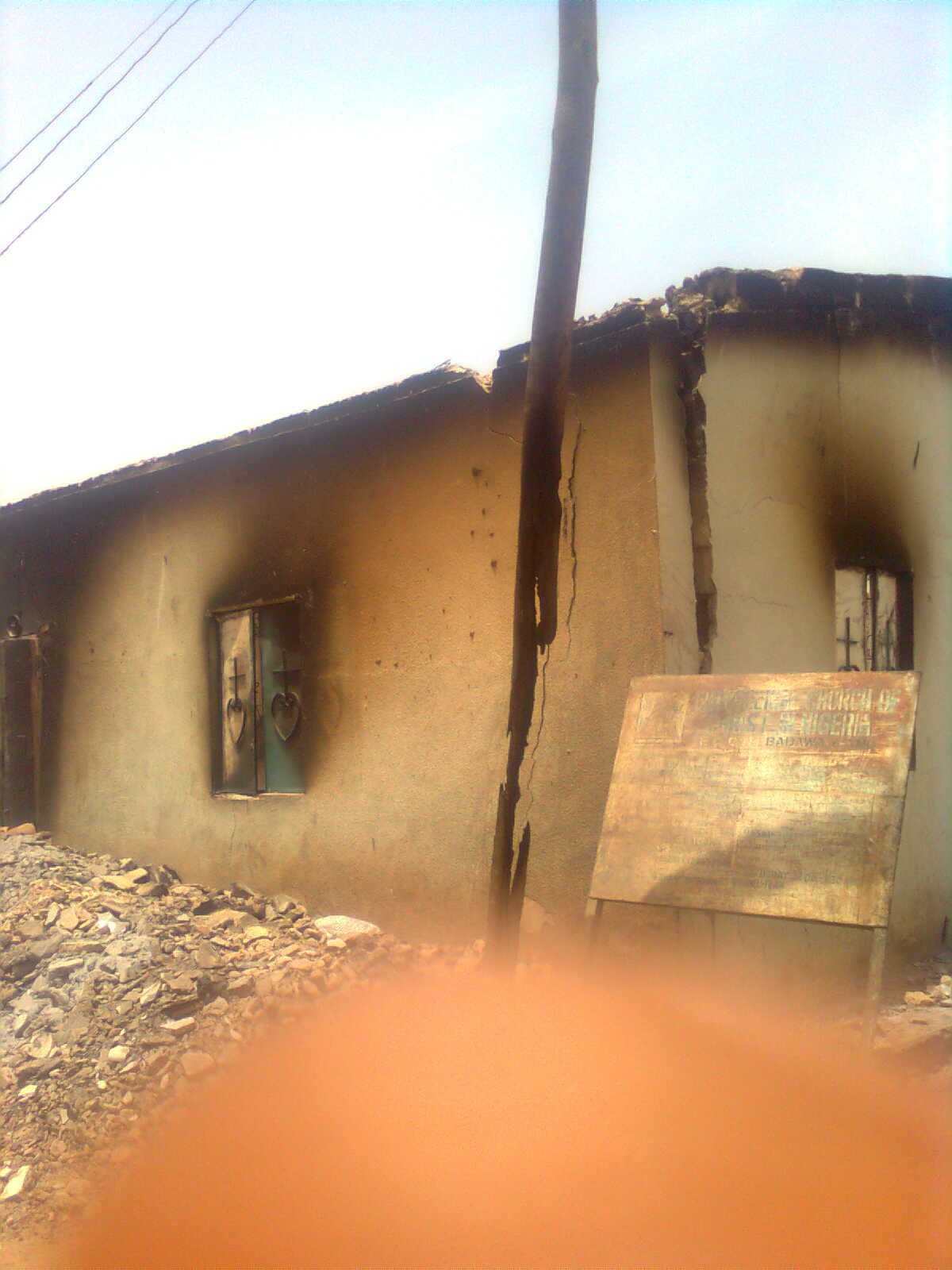
ECWA Church Badawa burnt during the 2011 post-election crisis, Kano. Sent to me by Rev. Murtala Mati. Please do not repost without permission.

The CPC presidential candidate, Mummadu Buhari has recently pointed out a far more serious issue, “it is wrong for you to allow miscreants to infiltrate your ranks[….] the mindless destruction of worship places […] is worse than rigging elections.” On 21 April, I spoke with Reverend Murtala Mati, a Kano indigene who has a weekly radio program “Ban Gaskiya Kirista” on Pyramid Radio. He had researched and put together a list of twenty-two churches burned in Kano during the rioting, seventeen in Nassarawa Local Government and six in Kumbotso Local Government. There were seventeen confirmed deaths of Christians, and fifty bodies yet to be identified. “What does this political problem have to do with Christians?” Reverend Mati asked me in an earlier meeting on 19 April. He speculated that Christians were scapegoated because of an assumption that “those who do not vote for CPC are Christians. They think PDP is a Christian party because the presidential aspirant was a Christian.”  Yet the assumption that Christians are a monolithic group voting along religious lines is not correct, he argued. “Many of our members voted CPC,” he told me, saying that Christians had the same concerns about living conditions and corruption as their Muslim neighbors. The spilling over of politics into religious identity has meant even more severe consequences for Kaduna, where Civil Rights Congress reports over two hundred from both faiths’ communities dead, and churches and mosques alike left smouldering.

As the news of violence in the North spread across the country, I saw the similar assumptions of monolithic identity applied to the entire north or to all Muslims by those who posted virulent, hate-filled rants on the internet. And while words do not literally kill, burn, or break, they fan a flame of hatred and misunderstanding that threatens to engulf Nigeria. The problem with the assumptions made by both the irrational mobs that destroy in the north and in rants of those who stereotype the entire north in conversation and media, is they make assumptions about entire communities, they group “those to blame” for their struggles as members of one whole career, one whole religion, one whole class, or one whole ethnicity, overlooking the complexity that lies within.

Hope lies in fragments, in the stories of human love and goodness that emerge out of ruins. Pastor Habila Sunday, who pastors a church in Kwanan Dangora village, Kano State, and had worn a church T-shirt to travel in on Monday, told me how at Unguwa Uku Motor Park he was threatened by a man with a knife. A Muslim man held back the man wielding the weapon, and told him “This man is one of us. He has nothing to do with politics. Before you kill him, you’ll have to kill me.” He then hid the pastor in a nearby shop and sat outside for four hours guarding the door. When a policeman they had called refused to enter the neighborhood, the man escorted the pastor on a winding path to the main road. The actions of this Good Samaritan, who risked his own life to protect a fellow Nigerian, are representative of many Muslims and Christians who protected both neighbors and strangers. These stories are less heard, but they provide hope that Nigerians are knit together more closely than the rhetoric and the terror committed by the most extreme of the society admit.

As I left DJ Yaks’ studio on Tuesday, he turned on a yet-to-be released song by Ibrahim Danko that floated out into the blackened streets and expresses wistfully what I think most of us long for at this time :

“I say, why, why, why, we dey hate each other? /I say, why, why, why, we dey fight each other? / I say, why, why, why, we dey kill each other […] One love, people together/ Nigeria…”

(c) Carmen McCain

ash

whathavewedone
toourselvestoourearthtoour
humanity?

The Scream (1893), Edvard Munch (Courtesy publicdomainclip-art.blogspot.com)


we killed
love we killed
hope

dark is heavy
empty-toned

does  light wait
beyond the blade
of time or

have we finally crushed
our source

into this dead earth?

Nigeria Votes for President Today: NN24, twitter, and the role played by new technologies

Kannywood actor Jameel Ibrahim shows off his 9 April 2011 National Assembly vote, while on location for the Aisha Halilu movie, Armala, Sunday 10 April 2011. (c) Carmen McCain

(I wrote this post between 11:30am and 1:00pm on Saturday, 16 April 2011. My internet went out shortly before I planned to post illustrating the difficulties in celebrating too unreservedly the ability of ‘new technologies’ to bring about revolutionary change–fortunately it came back in about an hour….)

As, not being a Nigerian ‘citizen’, I am not allowed to vote today, I am hunkered down in my house, doing housework and planning to do some reading and writing later in the day. But for now, NN24, Nigeria’s challenge to CNN, BBC, and Al Jazeera hosted on DSTV and one of my new favourite channels, is constantly on in the background, with analysis of the accreditation process so far and i-reports from people from around the country who are texting and sending photos and videos from their polling stations.  I love NN24. I love their energy and their youth focus, and their attention to the role new technology can play in encouraging the political process to be more transparent. For example, as with CNN, they have an application on their homepage, where ‘ordinary’ citizens (albeit those who can afford an internet-navigable phone or a laptop with a modem) can upload an i-report. They were the ones who organized the first debate between the presidential candidates, which I discussed in an earlier post. The only problem with NN24, as blogger Saratu Abiola noted in a powerfully written article posted to Nigerians Talk  ‘On Debating Nigeria’, regarding the NN24 hosted presidential debates,  is that it provides excellent content that is nevertheless limited to the viewership of those who can afford at least N2800 a month for the DSTV family subscription. Despite its idealistic goals, it limits itself, through its subscription status, to a wealthy elite. Yesterday, for example, there were three short ‘development’ films, ‘Vote Wisely’, an uplifting film where villagers drive away a corrupt politician trying to bribe them with rice for their votes, another ‘Too Young’ warning of the dangers of ‘unsafe pregnancies’ by showing a young girl attempting an abortion on herself, and another with a ‘northern couple’ (speaking English), where the husband refuses to let his wife, who has been in labour for two days be seen by a male doctor. The Ford-foundation sponsored Communicating for Change films shown as part of NN24’s ‘commitment to social responsibility’ were all targeted to ‘the masses’ (other than perhaps the one about the girl with the unwanted pregnancy),  yet who among the masses are going to be watching NN24? How effective will English be in the North? Will someone who can pay at least N2800 a month to access NN24 and DSTV really be tempted to sell their vote for a mudu of rice or refuse to bring their wife into the hospital until she has already been in labour for two days? These ‘public service announcements’ are interspersed with ads for exclusive hotels in Lagos and Abuja and tourist ads for ‘Incredible India’ (featuring white tourists), revealing the wealthy, upper class audience who will actually be seeing these development films. (Convicting myself as I write this, I switch over to the publicly accessible NTA for a few minutes, where they are interviewing women about the lack of female politicians and cases of double voting. The tone here is much less exuberant and encouraging than NN24. I become so irritated by the stereotypical way the men on a discussion panel are discussing women politicians that I switch back to NN24 after about 5 minutes). Much more potentially powerful, I argue, are Nollywood/Kannywood films, especially those done in local languages, which incorporate political content into popular storylines. And perhaps even more powerful than those, radio content and music…

The conflict I have about NN24 is similar to the conflict I feel about celebrating how new technologies are making politics more transparent. It is commonly repeated in the media that tweeting and facebook played a large role in the Egyptian revolution and the social media also seem to be a large part of a ‘youth consciousness’ here in Nigeria. Yet, facebook and twitter and blogs are still very much limited to an upwardly mobile urban population who have the means to buy internet-accessible phones or at least browse at an internet cafe. And, passion and commitment to transparency, still cannot completely stop those who are determined to cause havoc, as we see in the increasingly worrisome trend of political terrorism throughout the country. (Two bombs have gone off in Maiduguri, one at an INEC office, and another at a police station, the latest in a series of bombs to go off around the country, including one in Suleja and Kaduna last week.)

That said, I’m an optimistic person, and I do love to see how passionate those I know are about the elections. I love how last week as I visited the set of the Aisha Halilu movie Armala, Kannywood actors engaged in good natured political debates, and how actor Jameel Ibrahim showed me the photos he had taken with his phone of his vote. ‘This is my record,’ he told me. ‘This is my vote. I want everyone to know how I voted.’ I love how friends on twitter re-tweet instructions from INEC about the rules for accreditation and voting, and how others campaign for their chosen candidates on facebook. I love to see the i-reports sent to NN24 by young people from their phones and the democratizing role these new technologies seem to be playing in these elections–the tweet, for example, sent in by a voter just reported by NN24 on how voters pounced on thugs sent by a politician and sent them running (a seeming replay of the ‘Vote Wisely’ skit aired on NN24) .

And beyond the technology available to those of means, I love how the young man I saw interviewed on Al Jazeera last week, said he was staying around for the rest of the day to make sure his vote was counted. I love that the elections (so far) seem to be one of the ‘free-est and fairest’ Nigeria has ever had, the determination of those I know to get out and vote, the civic-mindedness of those standing outside in the sun all day to make sure their voices are heard.  Last week a young Kano-based musician Osama bin Music told me how in the last vote, he and his friends went to be accredited and then helped organize the crowds, trying to push through the small door of the school where the elections were taking place, into lines for men and women.

Osama bin Music (c) Carmen McCain

There may be young thugs hired by politicians, a trope that has become a stereotypical part of the Nigerian political landscape, but there are far more youth who want the voting process to work. They are there queuing in the sun. They want to make a difference. They want their votes to count. And it is in these youth that the hope for Nigeria lies.

The question, of course, is will the politicians who will be voted into power respect the faith the youth are placing in their votes? Or will they, despite the ‘free and fair’ vote, continue on with business as usual? And if that case, will new technologies make any difference in encouraging the youth to challenge the political culture in Nigeria in a more radical way or will it just comfort an elite that ‘their voices are being heard’?

Allah ya jikan Hausa film actress Maryam Umar Aliyu

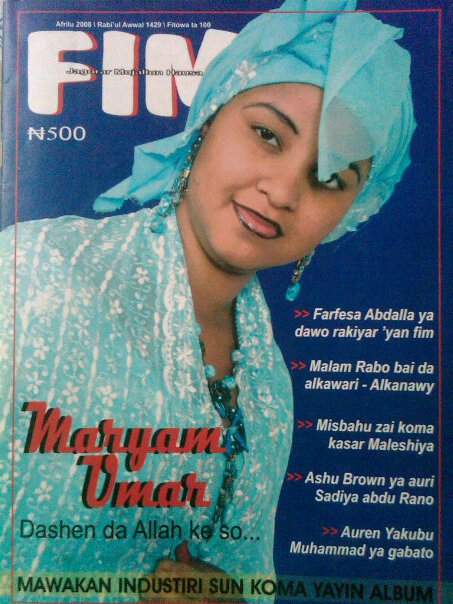
FIM Magazine Cover featuring Maryam Umar Aliyu

Inna lillahi wa inna ilaihirraji’un.

I’m always reluctant to post news like this. It’s bad news, and I don’t like to bear it. The Hausa film star, Maryam Umar Aliyu, who retired from acting  after she married actor and musician Misbahu M. Ahmed in December 2009, died yesterday in Kano. This is one in a long string of Kannywood deaths in the last few years, including actress Hauwa Ali Dodo (Biba Problem) in January 2010,  Safiya Ahmed and director/actor Zilkiflu Mohammed in February 2010, actress Amina Garba (Mama Dumba) in November 2010, and just last month Baballe Costume, a film costumier.

I did not know Maryam well, but I had met her on enough occasions to be completely shocked when I first found out on facebook yesterday of her death. I first met her in 2006, and the film I first remember her in is Dan Zaki. The most recent film of hers that sticks out in my mind is Sai Na Dawo. The image of her that stays with me was sometime in 2008, she came into Golden Goose Studio studio wearing long dangly earrings and a beautiful outfit–a mixture of glamour and good natured sweetness. She sat on the floor with the rest of us, laughing and talking.

According to the Leadership article I will post below, she died yesterday from lingering complications of childbirth three months ago. She was still very young. Allah ya jikanta, ya rahama mata kuma allah ya sa Aljanna makoma ita. Allah ya ba mu hakuri.

If any readers would like to leave comments about memories they have of her or of their favourite films that Maryam featured in, I will consider including comments left by tonight (my deadline) in my column published on Saturday in the Weekly Trust.I will update this post as other news comes along, but to begin with I’ll post the short Leadership article by Abdulaziz A. Abdulaziz that came out today. To read on the Leadership website, click here:

Ex-Hausa Film Star, Maryam ‘Kumurci’, Dies

WEDNESDAY, 13 APRIL 2011 11:14 ABDULAZIZ ABDULAZIZ, KANO

A prominent ex-Hausa film actress, Maryam Umar Aliyu (aka Maryam Kumurci), has died. The actress died yesterday afternoon in Kano after a protected illness.Until her death, She was the wife of renown playback singer, Musbahu M Ahmed.

LEADERSHIP also gathered that she died at a private hospital in Kano where she had been battling with complications arising from childbirth. She was said to have delivered of a stillborn baby three months ago.

Burial rites for the deceased was conducted at her family’s residence located at Gwammaja quarters. Just as she was later  buried according to Islamic rites at Kofar Mazugal cemetery.

The late Maryam began her filmmaking career in early 2000s and rose to stardom by 2005. She featured in several Hausa home videos including Khudsiyya and Jani.

She later got married to an actor, Sha’aibu Lawal (alias Kumurci), following the death of his bride, Balaraba Mohammed. Maryam’s relationship with the actor earned her the same sobriquet  as him; kumurci.

UPDATE 16 April 2011

Here is my column for the week, in tribute to Maryam Umar Aliyu. It can be read on the Weekly Trust site, here or in its original format as published in the Weekly Trust by clicking on the photo below:

Honouring Kannywood: In Memory of Maryam Umar Aliyu

Saturday, 16 April 2011 00:00 Carmen McCain.

Kannywood received yet another blow this week when former actress Maryam Umar Aliyu died, Tuesday, April 12, after a lingering illness following a still-birth. The stylish, light-skinned actress, who was of Nigerien origin but grew up in Katsina, began acting in the early 2000s, appearing in dozens of films including Labarin ZuciyaGiwar Mata, Dan Zaki, Makauniyar Yarinya, Khudsiyya, Jani, and Sai na Dawo, among many others. She also produced one film Majiya. When a brief marriage to actor Shu’aibu Kumurci ended, she returned to acting, but retired again in December 2009 to marry actor and singer Misbahu M. Ahmad. Maryam’s death comes after a long string of losses to the Hausa film industry over the past year and a half: actresses Hauwa Ali Dodo, Safiya Ahmed, and Amina Garba, Director and actor Zilkiflu Mohammad, and producer Hamza Muhammad Danzaki all died in 2010. Last month, a costumier called Baballe Costume also died.

A fan, Khadijah Sulaiman, wrote on Facebook, that she “had never seen a film” of Maryam’s that “wasn’t good.” She most remembered her for the 2006 film Dan Zaki. Likewise, my first memory of seeing Maryam Umar Aliyu was in the Sani Danja film, Dan Zaki, with its echoes of oral literature, where she plays the role of a woman so jealous that she has a sorcerer transform the man she loves into a bird and make his wife go mad. The film had just come out when I arrived in Kano to begin my research. Maryam came to the house where I was staying to visit my hostess, and I remember thinking her quite the opposite of the character she had played in the film. She was sweet and kind and laughed a lot. I remember how, later, after my return to Kano in 2008, she came into Golden Goose Studio one day, a mixture of glamour and cheerfulness, with her dangly earrings, fashionable dress and unforgettable smile. She sat on the floor of the studio, ate kosai and fried potatoes, and chatted with everyone there.

Her laughter, patience, and kindness are what other people in the industry I spoke to remember of her as well. Aminu Sheriff (Momoh) wrote on my blog that “She was very kind and jovial person[…] May her soul rest in peace, amin.” Over the phone (any mistakes in translation from Hausa to English are mine) actress Fati Bararoji told me that Maryam was a very patient and kind person, who loved the people around her. She didn’t fight with anyone, Fati said. She’d put up with a lot. When she accepted a role in a film, she wouldn’t haggle over money but would just take what she was given. Fati remembered, in particular, Maryam’s patience and cheerfulness over a seven-day shoot in Abuja which she had been on with her, shortly before Maryam’s marriage in 2009.

Sakna Gadaz Abdullahi repeated much of what Fati had told me. “Her death is a big loss to the industry and to her family.  The day I heard of her death, I couldn’t do anything else. I was so shocked. Maryam had become like my sister. Everyone who knew her in the industry knew that she was a good and loyal friend. She wasn’t materialistic.”

Sadiyya Mohammad (Gyale) wrote me that Maryam was very nice, patient and quiet. “I really loved Maryam.” Zainab Idris simply said that she had always gotten along well with Maryam. “Her death has really affected us. But we know that God loves her even more than us, and we too are on the road to the Hereafter whether today or any other time.”

Maryam’s death comes at a time when I’ve been thinking a lot about the relationship between the Hausa film industry, the wider Nollywood industry, and the role of film in Africa as a whole. In 1998, the Malian filmmaker Abdurrahmane Sissako made a film, La Vie Sur Terre/Life on Earth, which portrays a village where the news of the world comes in through international radio broadcasts, but where no information can escape. The villagers know about the world, yet the world does not know about them. The village post office can receive telephone calls but cannot call out.

Although the Hausa-speaking world is certainly no village and has access to phones, internet, radio, and other media (including a gigantic film industry which could be its gateway to the world), there is a metaphoric parallel here. Kannywood knows about Hollywood, Bollywood, and the larger Nigerian film industry of Nollywood, but they know very little about Kannywood.  Despite Maryam Umar Aliyu’s prolific acting career, when I went online to try to find photos of her to put on my blog, I didn’t find more than three or four. It always surprises me how little you find online about Kannywood stars, whose faces, blazoned on stickers, are plastered on thousands of buses, motorcycles, and taxis all over Northern Nigeria, Niger, and surrounding countries.

Hausa is spoken by over fifty million people in Africa. The Hausa film industry is, according to the most recent National Film and Video Censor’s Board statistics, creeping to nearly thirty percent of the Nigerian film industry. Beyond death, the figures and faces of these actors and actresses will keep running and clapping, speaking and laughing, singing and dancing through our lives for as long as the plastic of the VCDs last and the television channels continue to broadcast them into our homes. They are known by millions yet strangely unknown beyond a barrier of language and class, loved by those who buy stickers and films and yet often disrespected by those with the power to write about them on an international stage.

The imbalances in what the world knows about Hausa film and society have their roots in colonialism, yes, but also tend to be continued by the attitudes of an elite who keep their television stations tuned to CNN and BBC. Despite the hundreds of singing and dancing sequences uploaded to YouTube (rarely labeled with names of composer or performer), the occasional Facebook fan page, the old FIM Magazine pages or the commendable Kannywood online fan community, the lack of information about the Hausa film industry online is a sign that it is not yet appreciated by a northern elite who have the most access to the internet. And a lack of financial and moral support from an elite means it is much more difficult for the industry to break into the international film arena, as Yoruba films are beginning to do. I often hear educated members of a Northern Nigerian elite talking about how embarrassed they are by Hausa films, and yet it was these very Hausa films (and also the novels) that attracted me to learn Hausa. I am an American here in Kano because of film. I am here because I saw Ahmed S. Nuhu and Hauwa Ali Dodo and Zilkiflu Mohammed and Maryam Umar Aliyu in stories that captivated me and made me want to let the world know about them.

I am sad that I wrote of Maryam only after she died. I should have written about her while she was alive. Every time I write a tribute to an entertainer or artist gone before their time, I feel this way. Why didn’t I write more? Why don’t we all write more, in Hausa first and then English, about the young talents who surround us, filling our radios with songs, our television screens with dramas, and our bookshelves with novels, not imported but homegrown? Let’s honour Maryam by honouring, respecting and supporting her colleagues, those hard working, cheerful, and kind members of the Hausa film industry who, insha Allah, will live and work and grow as artists for years to come. Only when we respect our entertainers, will they be able to build an industry that will make us proud.

UPDATE 25 April 2011:

Other memories of Maryam Umar Aliyu sent to me:

From Auwal Danlarabawa

ina mai mika ta’aziyya ta ga rasuwar maryam umar Allah ya gafarta mata ameen, akwai wani jarumta da tayi a lokacin da muke aikin film din kanfani a lokacin da doki ya gudu da ita amma bata ji tsoro ba ta zauna daram har diokin ya kare gudunsa ya tsaya wanda ba kowacce jaruma ce zatayi hakan ba, shine babban abinda na ke tunawa a mu’amalarmu da maryam Allah ya gafarta mata mu kuma in tamau tazo Allah yasa mu cika da imani

To read other tributes I’ve written for Hausa actors and filmmakers gone before their time, see my posts on

Actress Hauwa Ali Dodo, who died 1 January 2010,

Director Zilkiflu Muhammed (Zik), who died 18 February 2010,

Actress Safiya Ahmed, who died on 26 February 2010,

Actress Amina Garba, who died on 21 November 2010,

Comedian and director Lawal Kaura, who died on 13 December 2011,

Director Muhammadu Balarabe Sango, who died on 1 December 2012

I left banking job to direct movies – Kunle Afolayan (Weekly Trust Feature Interview)

Kunle Afolayan at FESPACO filmmaker hangout, Independance Hotel, Ouagadougou, Burkina Faso, 2 March 2011. (c) Carmen McCain

I usually post the edited versions of my articles that are published in Weekly Trust. This week, however, I’m going to post the original version of my interview with Kunle Afolayan as submitted before publication in the Weekend Magazine feature of the Weekly Trust last Saturday.

While I agree with some of the editorial cuts made for tightening purposes and take a few of them here, some of the questions I was personally the most interested in got cut in publication. I was also a little dismayed that the published version mentioned that The Figurine got ten African Movie Academy Award nominations but not that it actually won five of those. If you would like to read the published version (with the edits made), here is the link to the interview on  the Weekly Trust site. You can also click on the photos below to be taken to a large copy of each page on my flickr site. Here are the other posts I’ve written on Kunle Afolayan’s film The Figurine:

FESPACO: Politics of video and Afolayan’s The Figurine, posted on 13 March 2011

Champions of Our Time, The Figurine, and Nigeria’s Rebranding Project at FESPACO, posted on 19 March 2011

I conducted this interview the day after I met Afolayan at his first screening of The Figurine at FESPACO. Having since had more conversations with him, seen both of his feature-length films and read a lot more about the production of both, I now have deeper questions on language-use and philosophy, but this is a start. I saw Afolayan’s first feature film Irapada last night. It wasn’t as technically polished or tight as The Figurine, and I missed some of what was going on because the subtitles were too small and fast, but it was just as thought-provoking and rooted in Yoruba theatre/literature as The Figurine, if not more so. Although I disliked the synthesizer piano track, I loved the rest of the sound track which fit the mood of the film and included songs in Yoruba and Hausa, which (at least the one in Hausa) contributed ironic commentary on the story. While it may not necessarily work for a popular audience who don’t like reading subtitles, I’m a big fan of what Afolayan does with language in his films. He unapologetically switches between multiple Nigerian languages, subtitling each in English. The Figurine included Yoruba, pidgen, and standard Nigerian English. Irapada was even more ambitious in this regard with conversation in Yoruba, standard Nigerian English, Hausa, pidgen, and a short segment in Igbo. Some of this may be an influence of Afolayan’s mentor, filmmaker Tunde Kelani, whose films also make brilliant use of codeswitching. In Magun (Thunderbolt), for example, the Igbo father of Ngozi, the woman struck with the curse of magun curse, converses in Igbo with her in front of the Yoruba babalawo. (If I’m remembering correctly), Her landlady also hides her own conversation with her nephew from Ngozi by using Yoruba. There’s a dramatic irony that comes with the revelation to the audience via subtitles what is hidden through language from other characters. In Afolayan’s films, language flows in the way Nigerians actually use it. In The Figurine, Sola and Femi switch to Yoruba for intimate conversations; youth corpers use pidgen in informal situations at their NYSC camp; Sola and Mona use English at home in their mixed-ethnic marriage but make a point of teaching their son greetings in both languages. In Irapada, comic relief comes when the Yoruba-speaking mother of the main character Dewunmi attempts to communicate with a Hausa-speaking porter at a train station; or when the Igbo-speaking Amaka, Dewunmi’s wife’s best friend, overhears some mechanics planning to cheat her Hausa-speaking friend, Shehu. (See the trailer below for a clip of each). In addition to the use of language, you can also see Kelani’s  influence in other aspects of Afolayan’s of films (although some of this could be the influence of Yoruba theatre and film in general) in the questions about destiny vs independent human choices and the nods to the many cultures that make up Nigeria.

Before I paste the interview, here are trailers for Irapada and The Figurine. Enjoy.

IRAPADA (for a review from NEXT click here)

THE FIGURINE

‘Think of Nigeria First’: Kunle Afolayan on The Figurine, filmmaking, and Nollywood

Interview by Carmen McCain

Actor, producer, and director Kunle Afolayan grew up in the richly creative environment surrounding the Yoruba travelling theatre and early Nigerian cinema, of which his father, Ade Love, was one of the pioneers; however, it wasn’t until later in life, while working as a banker, that he became interested in making films himself. Mentored by one of Nigeria’s foremost filmmakers Tunde Kelani as he moved into an acting career and with training from the New York Film Academy, in 2010, Kunle Afolayan released his second film The Figurine, which earned him ten 2010 Africa Movie Academy Award nominations and five awards, including AMAA Best Picture Award, Heart of Africa Award for best film in Nigeria, Award for best actor in a leading role for Ramsey Nouah, Best Cinematography, and Best Achievement in Visual Effects. Carmen McCain spoke with him for the Weekly Trust on 2 March at FESPACO film festival.

How and when did you become interested in film-making?

I developed interest in filmmaking right from before I was an actor. All I wanted to do then was write my own story. I just felt there was a need for change in the Nigerian film industry, and I’m talking as far back as 1995. But there was no way I could achieve it because I was not a writer, I was not in any aspect of filmmaking. So, I went to Tunde Kelani, because I used to see him around when my father used to shoot film. I went to him to let my feelings be known. He said to me, “Instead of you wanting to start filming, why not start by being an actor? That might really work better.” So I said, ok, and I told him that I would like to be invited for audition, whenever they have any film. I got invited when they were going to shoot Saworoide in 1998, and I got selected to play the role. Saworoide was a blockbuster, and even up today is relevant in the Nigerian film circle. That was how I started acting.

Kunle Afolayan examines a toy camera at Independance Hotel, FESPACO. (c) Carmen McCain

Could you tell me a little bit about your father’s films? Were you ever involved in those?

I was never involved in the production. My father started as a theatre person, travelling theatre all around Nigeria and West Africa. His full name was Adeyemi Afolayan, also known as Ade Love. They started travelling theatre. He got invited to be part of a film project by Dr. Ola Balogun, who started commercial filmmaking in Nigeria in 1976. They shot a film titled Ajani Ogun, which featured my father. And thereafter, my father decided to go into filmmaking fully. So he shot his own first film, right after Ajani Ogun in 1978 or thereabout. That was how he started. He had eight celluloid films to his credit, and most of these films travelled to film festivals all over the world, especially Ajani Ogun, Ija Ominira, Kadara, and the rest of them.

Do you remember being at home and having other filmmakers around?

Well that was the memory. Cause, I grew up—sometimes I found myself on their sets. Myself and some of my sisters and brothers. We’d just go there to make noise and see how they do their things, and after some time, they’d be like ok, go home, you guys are disturbing us. I was familiar with some of the cast and crew, at that time, but I didn’t learn nothing. It was just children messing about at their father’s workplace. That was just it. So I didn’t start aspiring until the man was late.

So you started acting in 1998. How many films were you in?

They are not up to 15. Saworoide by Tunde Kelani and Agogo Eewo, which is a sequel to Saworoide, Dark Days, which is English, and some other films, but it’s not such a large number like some of my colleagues who have featured in about 1000 films. I resigned my appointment from the bank in 2005, and went to film school at New York Film Academy, studied digital filmmaking, came back, and set up Golden Effects, which is a production house.

How many films have you directed?

I’ve done two short films and two feature films. The first short film was a project in film school, and the second one was a collaboration with an American producer by the name of Catherine Sullivan. We shot with an all white cast and crew project, and I directed it. I co-directed Irapada, which is my first feature film, and soley directed The Figurine, which is the second.

Could you tell me a little bit about The Figurine, how you came up with the idea for it, and the process of producing, directing, and acting?

Ok, well, the idea came about in 2005, right after film school. For me, I think most Africans, most Nigerians, an average African is superstitious. So, I was looking around doing something that would not totally demystify the power of the gods but at the same time reveal human participation in our predicament and what happens in our lives. So that was what brought about the idea. I narrated my idea to a guy called Jovie Babs, who came up with the first draft, which we titled The Shrine, you know for like two years. We got the script ready, then Kemi Adesoye wrote this version of The Figurine. We had a script conference and did a lot of work and then we came and did the treatment and final script.

What was your biggest challenge in shooting?

One of my biggest challenges was getting the funding for the film, which took a while, but eventually we were able to. Then another major challenge was the location. Because of the time difference in the film, we had to do seven years, the first seven years, then the next seven years. There had to be a lot of make up differences, location differences. All those kind of things delayed, so we couldn’t move on to the next phase until we finished with the first seven years. So if any time we paint any scene, any shoot, it just keeps piling up, and that really slows it down. I had a bit of sound issue, because our 50K generator fell into the sea when we were trying to move to the location. So the shoot had to stop. A whole lot of things got messed up. When we eventually got smaller generators to power our stuff, the thing got burnt. I don’t know what happened. There was a spark and everything plugged to it got burnt. That set us back again. The lights, the laptop, the camera charger. The camera was pretty new, so we had to wait to order another charger.

What was the most rewarding thing for you?

The most rewarding thing for me so far is the acceptance. The film has really set a new standard, not only in Nigeria, but among the other filmmakers from other regions. Don’t forget that the film got ten nominations at the most prestigious African Movie Academy Awards and won five. And the dream of an average filmmaker is to win Best Picture category in any awards. I’m glad that the film has really travelled around to so many film festivals. And as a matter of fact, it was in competition, official selection and competition in some of them like FESPACO, Pan African Film festival, etc. Any time a festival is doing a retrospective on Nollywood, they are always inviting the film to be able to differentiate between the normal Nollywood style, and the New Nollywood, that is what I call it.

Kunle Afolayan at the 'Reading and Producing Nollywood' conference held at University of Lagos, 24 March 2011. (c) Carmen McCain

What kind of feedback have you gotten at other film festivals?

I realized after the screening, a lot of people want to wait for question and answer, to find out how we were able to do the film. Most of them seem surprised that such a high quality film could come out of Nigeria. An example is [Kenyan author] Ngugi [wa Thiong’o] when we were in Pan-African film festival. He came with his wife, and they stayed and watched the whole film and they stayed for the question and answer. And he stood up to commend the film by saying that he feels so proud to be an African, and he wrote me a letter, recommending the film to another film festival, saying he has not seen such in a long time, even as a writer, he feels so impressed. And that is like the review from every festival we’ve been. Amakula, Rotterdam,  the talent contest at Berlin, New York Africa Film Festival, Tarifa in Spain and the other ones. The same thing at FESPACO, a lot of people stayed and wanted to find out, so it has been good.

So, right now, we are actually at FESPACO, and you were put in the video category rather than the main competition. Would you like to talk about that?

Well, that’s like strange, because all the festivals we’ve been to, the film has always in the same category with every film, even films from Hollywood. Even big budget films worth 50 million dollars fall into the same category with this film. So it’s going to be the first time that there will be a segment for video and for 35 mm.  I mean, in this age and time, a lot of people would rather shoot on cheaper format but still achieve the same high quality. A good film is a good film regardless on what format it is being shot. If it looks good, it looks good. If it sounds good, it sounds good. There are no two ways to it. So I don’t think that is fair, and I don’t think that should continue. A lot of people were bitter about this, not just me. I met with other filmmakers, and a lot of them seemed to have a bit of issue with such decision.

You had also earlier talked about distribution of the film. Are you planning to release it anytime soon on video.

Yeah, we are now working on dvd release. We are discussing with the distribution company. Already we are in the middle of signing the agreement, and hopefully it should be out by April. Every copy will be encrypted, and it’s going to be well circulated. We have regional distributors, national distributors in the north, south, east, west part of Nigeria. It’s going to be all over Africa, UK, and it’s going to be online as well. So, I mean, we can rest assured that an average Nigerian will have access to the film.

To you, what are the major challenges of Nollywood, what does Nollywood need to do to go to the next level?

I think there is a lot of training [needed] within the industry, because a lot of people would rather say, we need infrastructure, we need sets and studios, and stuff like that. But what is the essence of building all those things if we don’t have people who will run them? Aside from training, there is need for a lot of support on government side. And that is why I’m glad that the president just channeled some money, two hundred million dollars toward the entertainment industry because that will help people who’ve really gotten trained and a good business plan to really benefit from such a gesture. I believe strongly that will take the industry to the next level. Especially if the money is given to the right people who can utilize it. Like, let’s say distribution, for example. There are quite a number of people who are trying to set up a proper distribution framework, from cinema to dvd and pay-tv, and all of it. So, if all those people can benefit, then content-providers as well, if they can benefit from this, I think it can change the industry. Distribution, I believe, is our major, major challenge. If we have all these benefits in place, I believe it will help change the industry.

So you suggest government set up structures that would allow people to make use of that?

The government doesn’t necessarily have to set up structures. But I mentioned the two hundred and fifty million dollars which the president has put in entertainment for people to apply for a loan. It’s not a grant, it’s a loan, but it’s only going to be subject to single-figure interest rates. So, instead of going to a bank where you have to pay 20-30 percent, this one will really help the industry.

Is there any major thing that you would like to tell other Nollywood filmmakers or young filmmakers starting out if they want to get to the place you are now.

Well, I think they should first consider starting at home. Because their primary audience are Nigerians. They should start by thinking of stories that will appeal to the average Nigerian before they start thinking of the outside audience, the international audience. When you think of Nigeria, then you think of Africa, because we reason alike, and the distribution channel that the likes of Silverbird is trying to put in place, will definitely cut across Africa. So you have platforms to distribute your films, all within Africa. And also there is need for them to really study whatever area of filmmaking that they may want to specialize. Be it scripting, be it lighting, hands-on-camera, sound, makeup, and you know the other departments, set design and all that. It’s better to get trained, so that, even if you’re getting people to do stuff for you, you’ll have a basic understanding of how things run. And also they should try to attend film festivals, even if they don’t have films there, at least, to see how things are run, to see what are the parameters for getting your film into festivals. You have opportunities like AMAA awards in Nigeria. You can explore such options. So majorly, story and production value. Those are the two major things that make them have a film that will be successful commercially and will be international.

Kunle Afolayan and Ghanaian actor Majid Michel on the red carpet at the 2011 AMAA awards. (c) Carmen McCain

So, when you say “get training,” do you mean on set or going to school for it?

I mean going to school for it. If you can do both, it will be nice because experience really counts. But if you go on set in Nigeria, you’ll only know—the capacity of the people you are working with is where your knowledge will end. But if you get others, even like short courses, workshops outside Nigeria in whatever area you want to specialize, it will broaden your thinking, broaden your mind.

You said that Tunde Kelani suggested that you act first before you made films. Do you feel like the acting experience helps you as a director?

Yes, and the fact that I watch a lot of films, even before going to film school. And I’m always conscious of the area that I want to specialize. I picked a few directors, I look out for films that are in that genre, and I watch them, do a case study on them, so that has really helped me.

Are there any particular films that are your favourites?

Apocalypto is one of my favourite films and Forest Gump. I love Forest Gump. The last Tarantino film, Inglourious Basterds. Films like that.

What about Nigerian films?

Hostages by Tade Ogidan, most of Tunde Kelani’s films, Owo Blow by Tade Ogidan, as well, and some of the films that were shot in the 70s and 80s and Ogunde’s films, Ade Love films.

Along with that are there particular directors? You mentioned Tunde Kelani, what about Hollywood directors?

Like I said, Tarantino, Mel Gibson, Spielberg. I like Spike Lee as well because he’s very experimental. I watch a lot of Indian films, as well.

There’s a lot of criticism of Nigerian films. People say they are all about rituals, they’re corrupting the youth, they’re bad quality etc, even the idea of relegating your film to a video category, how do you respond to people who look down on Nigerian films?

Well every industry has got their style, and if that is the style Nollywood has adopted right now, and it is working for them, then so be it. They’ve been able to create a market for their films, and if there is anyone who wants to do otherwise, like something not in that direction, then of course the industry is very, very big. But I just think that we all can’t continue to do the same thing. Most of those people who are criticizing. In Burkina Faso, I know that they used to do about ten films before, but now I’m sure they don’t do more than two films a year. Is that a growing industry or a deteriorating one?

The Nigerian industry is a phenomenon, because we are moving from one phase to another. There was a time that it was strictly celluloid, then people moved to video because it was cheaper to shoot, and now people are moving back to higher formats, higher definition. Mahmood Ali-Balogun just shot on 35 mm, and the film was actually submitted to FESPACO, but it wasn’t selected.  So, if it was all about format, then what are we talking about? Then, when you say story—an average Indian film portrays their police as being corrupt. So would you say that is affecting their economy or the Indian film industry? No. So, they should look inward and look at the best way to have a pan-African film industry, instead of condemning a growing industry from Nigeria.

If people say Nigerian film are giving Nigeria a bad image, how do you respond?

I don’t think it is giving Nigeria a bad image. If it was giving Nigeria a bad image, all those actors would not be celebrated all over Africa. Wherever it is they go… people are stuck on those films. That is where the Caribbeans, that is the only way they see that we actually have big houses and big cars. Those films might not be doing well in the world film circle, but commercially they are doing great. I’m not into such films but I think they are playing their own mark in the world film circle.

In conclusion, is there anything you would tell an audience, anything you think they should know about Nollywood or their films.

Keep supporting Nollywood, and you can get details of The Figurine from figurinemovie.com. Keep supporting Nigerian films.

Kunle Afolayan presents an award at the 2011 AMAA awards. (c) Carmen McCain

Africa Movie Academy Awards: Celebrating Africa’s film industries, building pan-African cinema

I realized with dismay, when I emerged from my house yesterday afternoon to go find a copy of the Weekly Trust, that I had done several near-all-nighters this week working on articles for a paper that would probably be one of the least read this year. Because of the election (that was not), there were very few people on the streets and I had to ride for about 15 minutes on an acaba to find a vender selling a newspaper. Here is this week’s column that I wrote on my experience at the Africa Movie Academy Awards (AMAA) in Yenagoa, Bayelsa. I’ve included a few extra photos below. To read at the Trust site, click here. To read in the original version, click on the photo below, which will take you to a large readable copy. To read on my site, scroll down below the photo. I will upload the interview I did with The Figurine director, producer, and actor Kunle Afolayan later in the day. For another excellent post on AMAA, written by my travel buddy Fulbright scholar Bic Leu, check out her blog.

Celebrating Africa’s film industries, building of pan- African cinema

Saturday, 02 April 2011 00:00 Carmen McCain

As my readers may have noticed from recent columns, this month for me has been a mad dash from one film event to another, from the FESPACO Pan-African film festival in Ouagadougou from February 26 to March 5, to a presentation at the “Reading and Producing Nollywood” symposium hosted at University of Lagos from March 23 to 25, to, finally, a rather unexpected but delightful invitation to attend the Africa Movie Academy Awards (AMAA) held in Yenagoa, Bayelsa, on 27 March.

Nollywood scholars Onookome Okome, Jonathan Haynes and Carmela Garritano trade laughs at the “Reading and Producing Nollywood” conference held at the University of Lagos, 23-25 March 2011. (c) Carmen McCain

AMAA was a bizarre mix of the humble and glamorous that seems inherent to Nollywood. The flight from Lagos to Port Harcourt was filled with filmmakers, many of them from the diaspora, and we continued on to Yenagoa by bus. I sat at the back of a 12-seater between Ghanaian-British filmmaker Julius Amedume, who won best Diaspora short for his film Precipice, and British filmmaker Wayne Saunders, who received a double nomination for Best Diaspora Feature for two feature films, Nothing Less and The Village. The next seat up, Nigerian Hollywood actor Hakeem Kae-Kazim (Hotel Rwanda, Wolverine), who most recently starred in Jeta Amata’s musical Inale [which later won the AMAA for best soundtrack] and the yet to be released Black Gold, was jammed in between Nollywood star Olu Jacobs and Aspire Magazine publisher Celine Loader. The cramped bus made it felt rather like a university outing, only with movie stars and filmmakers rather than students, and the three hour trip, through Port Harcourt traffic and over pot-holed roads, was long but jolly, with much loud debating about Malcom X, Martin Luther King Jr, global inequalities, black consciousness, and quiet sharing of plans for future films. We ended up at the Bayelsa State Tourism Development & Publicity Bureau, where hundreds of filmmakers milled about, eating food from buffet lines and trying to find places to sit before finally being transported to their hotels. The bureau became the defacto meeting and eating spot. The next day, I ran into Kannywood stars Ali Nuhu, Lawal Ahmad, and Rahama Hassan there.

RFI journalist, Kannywood actress Rahama Hassan, Radio France International journalist Salisu Hamisou, and actors Ali Nuhu and Lawal Ahmad at the AMAA press conference. (c) Carmen McCain

At a press conference on the afternoon of 27 March, AMAA jury members pointed out the purpose of the awards to unite Africa. AMAA CEO Peace Anyiam-Osigwe said, “AMAA is about everybody that is a filmmaker in Africa…It’s about you. We are Africans. We have no borders.” In this pan-African vision, the body seems to be following in the footsteps of earlier African cinema movements such as FEPACI (Federation of African filmmakers) and FESPACO Film festival. However, unlike these earlier, mostly Francophone, African initiatives, AMAA does not merely promote art films made by African filmmakers and often funded by Europe, but emphasizes the importance of actual film industries.

AMAA CEO Peace Anyiam-Osigwe speaks about the pan-African vision of the AMAA awards at a press conference, 27 March 2011. (c) Carmen McCain

Beirut-based Zimbabwean juror Keith Shiri pointed out, “I think people who are familiar with FESPACO are also familiar with other infrastructures, which are really suffering because of the negative attitude which we have about ourselves.” Shiri said it was important to recognize AMAA as “the only platform in the whole continent, which is, in my view, celebrating African cinema, and trying to build an infrastructure which enables us to begin to evaluate and consider the importance of this industry.”

Film curator and AMAA juror Keith Shiri speaks at the AMAA press conference, 27 March 2011. (c) Carmen McCain

The atmosphere of university outing transitioned to full-fledged Nollywood glamour by the time we arrived on the red carpet, Sunday night, where TV presenters hung out looking for interviews and camera flashes were constant. Outside, fans pressed their faces to the gaps in the wall. You could tell whenever a big star arrived by the volume of the roar outside.

American Fulbright Scholar Bic Leu, Best short film nominee Kenyan filmmaker Zipporah Nyaruri, Nigerian Hollywood actor Hakeem Kae-Kazim, American winner of the Best Diaspora feature LaQuita Cleare, and Nigerian-American Best short Diaspora film nominee Temi Ojo on the red carpet at the AMAA awards. (c) Carmen McCain

Best short film nominee Kenyan filmmaker Zipporah Nyaruri being interviewed on the red carpet. (c) Carmen McCain

Ghanaian star Majid Michel being interviewed on the red carpet. (c) Carmen McCain

The awards ceremony was hosted by Jim Iyke and Nse Ikpe-Etim, with other appearances by Rita Dominic, Kate Henshaw-Nuttal, Kunle Afolayan, Ali Nuhu, Olu Jacobs, and performances by Dr Sid, Wande Coal, Tee Mac, Ebisan, South African group Malaika, among others. It went from around 8:30pm to 2:30am, and was followed by a middle-of-the-night dinner at the Yenagoa government house. Compared to FESPACO, which was arty, elitist, and seemed irrelevant to the tastes of a popular African audience, the glamour of the AMAA awards was generated by beloved Nollywood stars, who arrived in fancy dress, gave interviews on the red carpet, presented awards, and took photos with their fans. As Keith Shiri had pointed out at the press conference, this was an event that celebrated and promoted film industry infrastructure, not just film. Peace Anyiam-Osigwe reinforced this point at the ceremony, “We should celebrate ourselves year in and year out… but I’d also like to see our filmmakers make money from what we are doing. So wherever you are in the next few years, Nigeria, Kenya, South Africa, I’m sure all over Africa, you’re going to have the chance to say I need you to realize the input I am making to my industry and to my country.”

Nollywood stars Jim Iyke and Nse Ikpe-Etim host the AMAA awards 2011 (c) Carmen McCain

AMAA awards adorn the table at the late night dinner, while the winners relax. (c) Carmen McCain

Perhaps because of this focus on commercially-viable films, the films nominated also seemed quite different from those on offer at FESPACO. Out of the over 56 films I counted from the AMAA nomination list and the 187 films in the FESPACO catalogue index, I could only find seven films that overlapped and only one overlap in prizes: South African film Hopeville won best film in the TV/Video category at FESPACO; At AMAA the film received nine nominations and one award for Themba Ndaba’s performance as Best Actor in a Leading Role. AMAA was much more Anglophone-focused than FESPACO, with fewer submissions from North and Francophone Africa.

Yet, it was a film from a Francophone country, Congo-Kinshasa, the edgy Viva Riva! that ended up sweeping the Awards, surpassing the five AMAAs won by Nigeria’s The Figurine by Kunle Afolayan last year, with six AMAAs for Best Film, Best Actor in a Supporting Role (Hoji Fortuna), Best Actress in a Supporting Role (Marlene Longage), Best Cinematography, Best Production Design, and Best Director (Djo Tunda Wa Munga). According to producer Boris Vanglis as he jubilantly accepted the “Best Film” award, Viva Riva, which had been absent from FESPACO, is “the first film in Congo-Kinshasa in 20 years in Lingala.”

Although Nollywood glamour dominated the evening and though there was a much larger presence of Nigerian and Ghanaian films nominated for the awards, only three Nigerian films won awards:  Niji Akanni’s Aramotu won Best Costume Design and Best Nigerian film. Jeta Amata’s Inale won Best Soundtrack, and Obi Emelonye’s Mirror Boy won Best Young Actor for the performance by Ugandan actor Edward Kagutuzi. Ghana was represented by three awards for Sinking Sands, directed by Leila Djansi, which won awards for Best Screenplay, Best Make-Up, and Best Actress in Leading role for actress Ama K. Abebrese.

Unfortunately, the nature of the event, as an awards ceremony rather than a festival, meant that I had seen none of the films that were awarded, and it seemed somewhat problematic that despite the appeal to a popular audience in the glamour of Nollywood and celebration of industry, the films awarded, much like those at FESPACO, seemed inaccessible to an African audience beyond their own regions. AMAA selection committee chairman Shaibu Husseini noted this predicament, pointing out the difficulties of an award based on popularity since films released in one part of the continent are not always seen in others. “By the time you put it to popularity test, the text messages will come from the countries where these films have been produced. And by the time, you award the films, it will not be representational.”

AMAA Selection committee Chairman Shuaibu Husseini speaks at the press conference, 27 March 2011. (c) Carmen McCain

Yet, despite the difficulties of such structures, I came away from the AMAA awards with a more positive feeling than I had from FESPACO. FESPACO felt like a tired old legend moving into its last days. AMAA, even with its moments of disorganization, felt vibrant and full of promise, like its Nollywood base. Even though the films awarded are still unavailable to most of their African audiences, perhaps the popular focus of the African Movie Academy Awards, will work towards building a canon of African films made by African film industries, not just by cineastes. And hopefully some wise distributer with pan-African connections will seize the opportunity and make these films available all over the continent, giving accessibility and a public face to a truly popular African cinema.

More Photos of the Event:

To see my whole Flickr album of AMAA, click here.

Best short film nominee Zipporah Nyaruri with Best Diaspora short film nominee Temi Ojo. (c) Carmen McCain


Rahama Hassan laughs as Ali Nuhu makes a point. (c) Carmen McCain

Kannywood star Lawal Ahmad. (c) Carmen McCain

Kannywood star Rahama Hassan. (c) Carmen McCain

Best Diaspora feature double nominee, Wayne Saunders being interviewed. (c) Carmen McCain

Best Young Actor winner Edward Kagutuzi and ‘Inale’ actor Hakeem Kae-Kazim. (c) Carmen McCain

Hakeem Kae-Kazim photographs Zipporah Nyaruri pre-award ceremony. (c) Carmen McCain

Best Diaspora feature film winner LaQuita Cleare and Best Short film nominee Zipporah Nyaruri pre-AMAA ceremony. (c) Carmen McCain

Me, Bic Leu, Zipporah Nyaruri, Temi Ojo, and LaQuita Cleare.

Hollywood Nigerian actor Razaaq Adoti on the red carpet. (c) Carmen McCain

Best Diaspora short film nominee, Sowande Tichawonna, on the red carpet. (c) Carmen McCain

Fulbright scholar Bic Leu, Best Diaspora short film nominee Temi Ojo, and Best short film nominee Zipporah Nyaruri. (c) Carmen McCain

Best Diaspora short film nominee Temi Ojo on the red carpet. (c) Carmen McCain

Best Diaspora Short film nominee Sowande Tichawonna, Actor Razaaq Adoti, and Best Short Film nominee Zipporah Nyaruri. (c) Carmen McCain

Best Diaspora feature winner LaQuita Cleare is interviewed on the red carpet pre-ceremony (before she knew she won). (c)Carmen McCain

Best Short Film nominee Kenyan filmmaker Zipporah Nyaruri with Freedom Express reporter. (c) Carmen McCain

Bayelsa State Cultural group performs at the beginning of the Award Ceremony (c) Carmen McCain

Kannywood crossover actor Ali Nuhu helps present the best award for Best African language film. (c)Carmen McCain

Nollywood star Olu Jacobs was mobbed by fans wanting a photograph with him, and he patiently put up with them for about 30 minutes. He poses here with L.A. based Best Diaspora Feature award winner LaQuita Cleare. (c) Carmen McCain

Kannywood/Nollywood star Ali Nuhu at the late night AMAA dinner. (c) Carmen McCain

A late night dinner at the Bayelsa State government house after the AMAA awards (c) Carmen McCain

L.A. based actor Hakeem Kae-Kazim with Fulbright scholar Bic Leu at the late night. (c) Carmen McCain

Anchor Baby and the dark underbelly of the American Dream

I’m behind at posting my old columns, but I was reminded of this article that I wrote a month and a half ago, while briefly sitting beside Omoni Oboli at the dinner after the AMAA award ceremony. Omoni Oboli was nominated for Best Actress for her portrayal of the pregnant Joyce in Lonzo Nzekwe’s film Anchor Baby. She didn’t win the award, but she certainly deserved it. Her admirable acting in The Figurine and Anchor Baby puts her on my favourite Nigerian actress list. To read the article, which was published on 12 February, on the Weekly Trust site, click here. To read the hard copy of the article, click on the photo below, which will take you to a readable version of the article on flickr. To read it on this site, just scroll down past the photo.

Anchor Baby and the dark underbelly of the American Dream

Saturday, 12 February 2011 00:00 –

When anyone asks me what my favourite Nigerian movie is, I tell them it’s The Figurine, which was directed, produced, and acted in by Kunle Afolayan.

The film has a tight and continuously gripping storyline that polishes and refines Nollywood genres of spiritual thriller and family drama. But if I’m asked to recommend films, I’ll closely follow my recommendation of The Figurine with the film I went to see last week in Abuja’s Silverbird cinema: Anchor Baby, written, directed, and produced by the debut filmmaker Lonzo Nzekwe, who claims he taught himself filmmaking by reading books and watching “making of” documentaries. In Anchor Baby, which won Best film at the Harlem International Film festival among other awards, Figurine actress Omoni Oboli is compelling in her role as a pregnant Nigerian woman on the run from the American Immigration and Customs Enforcement. Anchor Baby, the title referring to the derogatory American term for babies born as citizens in the U.S. to non-citizens, is a cautionary tale about the dark side of the American dream. The disillusion of emigrants from Nigeria is a theme that has been dealt with in short stories by Chimamanda Ngozi Adichie, EC Osondu, Helon Habila, and others, and is becoming a genre of Nigerian films produced in America as well. The yet to be released film Unwanted Guest directed by Daniel Ademinokan and set in New York, for example, explores the domestic complications an already married Nigerian man faces when he marries an American woman for a green card. The 2008 Hausa film Kano to Saudiyya directed and acted by the late Ziklifu Mohammed deals with similar immigration themes of disillusion with life in Saudi Arabia.

The United States doesn’t come across in a very flattering light in Anchor Baby, but it is an America I recognize, even though it was shot entirely in Ontario, Canada. I walked into the cinema five minutes late just as we see the character, Paul Unonga (Sam Sarpong), run across a parking lot and down the grassy incline of an industrial park, chased by American Immigration and Customs Enforcement officials. The film is shot on the film-quality digital RED camera, but the lush colours the RED is capable of capturing are toned down here into dreary grays and browns. It is winter, and the grass is dead. Paul runs past rows of dirty semi-trucks. This is the ugly side of America, not often seen in glamorous Hollywood films. ICE officials eventually catch him at home in the bleak white hallway of his low-income housing flat. Paul’s pregnant wife Joyce (Omoni Oboli) luckily misses the immigration sweep because she has gone out for an early morning walk. The rest of the film follows the trials of Joyce, as she tries to fulfill the couple’s dream of staying in the U.S. until her baby is born, so that the baby, the “anchor” of the title, will be granted U.S. citizenship.

The celebrated comforts of American life, the film points out, are available only when one is linked into an organized system of legal identity. Once her husband is deported, Joyce finds herself in an almost impossible situation. To escape the immigration officials, she is forced to leave their apartment. The isolation of American life means she knows no one well enough to ask for assistance. She can’t get a job because she has no work papers. Staying at cheap motels becomes too expensive for the small savings she has left, but she is unable to rent a new apartment without government issued id. Similarly, she is unable to receive pre-natal checkups at the clinic, because she has neither health insurance, government id, or the large sum of cash needed to see to the doctor. Eventually, Joyce becomes dependent on the kindness of strangers, the sympathetic free lance writer Susan, brilliantly acted by Terri Oliver, and her interior designer husband, Tim (Colin Paradise). But while she appreciates their kindness, Joyce becomes increasingly uncomfortable by her benefactors’ marriage problems. Her loneliness is portrayed best as she stands on the verandah of a cheap hotel, staring out over the dead winter landscape, an American flag flapping on the railing beneath her.

Although the focus of the film is on Joyce’s experiences, there is also a brief portrayal of the coping mechanism other illegal immigrants face, in the pathos of a Mexican family who make a living out of forging government documents. The film ultimately shows the price of the anchor baby, and the ironies lurking behind the American dream.

I would show this film anywhere, to Nigerians wanting to move to the often idealized U.S., and to Americans who don’t understand the challenges immigrants face. However, there are certain moments that, to my American eye, seem off. When Joyce stays in a basement apartment, the windows should be high, submerged in the ground at eye-level, yet there are points at which we see low sitting window sills and a light source that seem more appropriate for a first floor room. When Paul calls Joyce from the immigration detention centre and tells her to move out of their apartment, it seems strange that this phone call, placed from prison, is not tapped by the police and that Joyce is not picked up by immigration officials before she moves out of the apartment.

My own encounters with American immigration and customs have been few compared to what immigrants face. When I attended university in the U.S., I volunteered with Amnesty International to interview illegal immigrants being held in a prison for deportation to see if there was any way we could assist them with legal help. On a recent trip to the U.S. I wore an abaya and veil to see if I would be profiled by immigration officials at the airport. I was. The only person dressed like a Muslim in the line at a security checkpoint waiting to exit passport control into America, I was also the only one chosen for a pat-down body search. In both instances, the immigration officers I observed displayed more of a bored and unthoughtful officiousness, an institutionalized bias, than deliberate brutality, more like what is seen in the film where Joyce Unanga is denied an apartment and health care because she doesn’t have insurance card or government id. The kind but condescending and bureaucratic immigration officer in the airport, who calls up his boss and says he has an “illegal” for him, is likely more usual in America than the trigger-happy immigration officer Mark Castello (Michael Scratch), who drops racial slurs and blows cigarette smoke into Paul Unonga’s face. But the over-the-top villain works well for dramatic effect, and there are certainly many documented cases of police brutality from the assault against Haitian Abner Louima in a New York jail and the shooting of Guinean Amadou Diallo in the Bronx, New York, in the 1990s, to more recent acts of discrimination, torture, and secret extradition following Patriot Act laws of the 2000s. This is the dark underbelly of the American dream.

In terms of world cinema, Anchor Baby reminds me of the Indian film, My Name is Khan, released last year. In the film, an autistic Indian immigrant living in California is discriminated against by his neighborhood and by airport officials because of his Muslim name. Seemingly made for a non-American audience, My Name is Khan sometimes fudges geographical detail and stereotypes non-Indian characters (I think particularly of the way African American characters are portrayed) but tells a compelling story of how differences strengthen, rather than weaken, American culture. And, to be fair, the exaggeration of detail that you find in My Name is Khan or Anchor Baby are nothing so extreme as the stereotyping of other cultures and countries found in Hollywood films. There is something quite satisfying about these non-American interventions into representations of America, which like the Al Jazeera coverage of the U.S., as opposed to the glossy portrayals of Hollywood and CNN, focus on the poor and downtrodden of “God’s own country.” In a time in which the film industries of an established Bollywood and a rising Nollywood have relegated America’s celebrated industry to number three, and where an economically depressed America seems to be struggling increasingly with xenophobia against non-citizens, we can expect more of the same. I eagerly await Lonzo Nzekwe’s next film.

UPDATE: 25 March 2012.  You can rent, buy, or watch a preview of Anchor Baby, in the embedded video here (Anchor Baby).