Yearly Archives: 2011

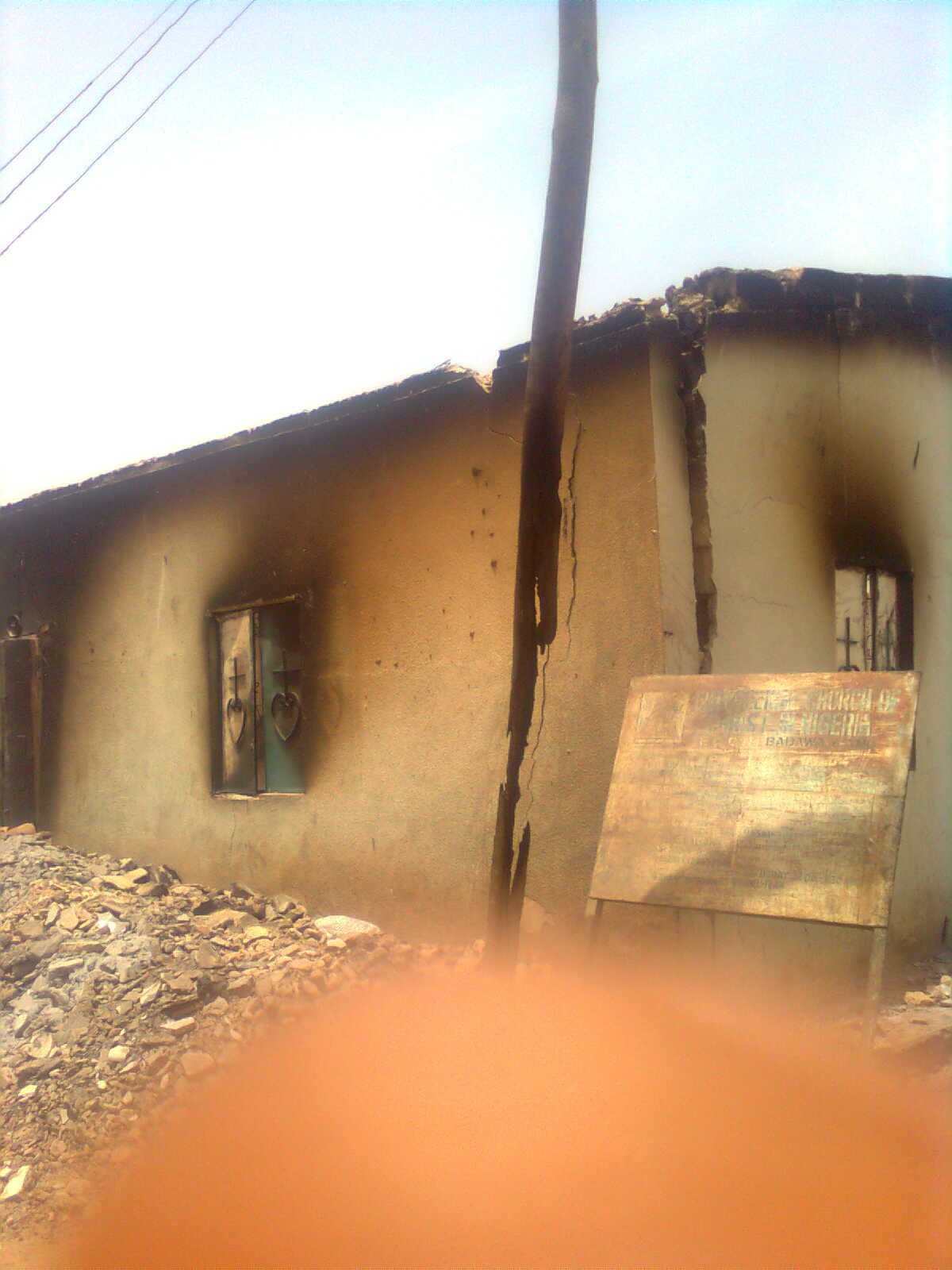
Christmas bombs in Madalla, Jos, Damaturu, and Gadaka: 25 December 2011

St. Theresa’s Church, Madalla, Niger State, following Sunday morning’s bomb blast (c) BBC

Just a quick update. I’m sorry (once again) that I am so far behind on this blog. I have several posts I have been intending to write, including one about the death of a friend, Hausa comedian Lawal Kaura, for whom I wrote a tribute in the Weekly Trust last week.  I have been trying to complete several revisions of academic work and reduce the time spent online. However, with the recent bombings in Jos , Madalla (Niger State, not far from Abuja), and Yobe state, I wanted to quickly post to let all know that my family in Jos and I are fine and things are (so far) quiet in Jos.

Christmas morning, my family and our guests were preparing for our Christmas service, and discussing the horror of the bombing at St. Theresa’s Catholic church in Madalla earlier that morning, when one of our guests, who had gone outside for a few minutes, heard what sounded like a bomb blast. He didn’t say anything about it until a few minutes later when another one went off, and someone came to tell us that there had been two explosions in Jos, near Mountain of Fire and Miracles (MFM) Church near British America. It seems, with the news coming in today, that a policeman was the only casualty in Jos, but in Madalla, up to thirty-five bodies had been found by this morning.

These things–thinking about the people killed while at church on a joyous day when we celebrate the coming of peace and love into the world; and the dread of what may follow–leaves me feeling a bit shattered, as did last year’s Christmas Eve bombings. This year, on Christmas Eve, as we drove home from church, we reminisced about how last year at this time, we had been turned back by panicky policement. We could smell fire and hear gunshots. It wonder if we will ever be able to think of Christmas in the same light-hearted, happy way. It is a terrible thing that now both Muslim and Christian celebrations, sallah and Christmas have become seasons to dread. I am trying to think about how to express it  in my column for this week. In the meantime I will post a few links to articles about the bombings (which, as of this morning, are still the first headlines on BBC and Al Jazeera and apparently CNN, although  my parents are not currently able to pick up CNN). I will also post my column last week, in which I discussed the bombs that went off in football viewing centres a few weeks ago and how I have been thinking about Christmas the past few weeks.

May God maintain the peace and expose the evil people behind these acts. I am grateful for the many concerned friends (most of them Muslims) who sent Christmas texts, emails, and called me from as far away as Germany. Allah ya kiyaye, Ya ba mu zaman lafiya, Ya kai mu gaba. Merry Christmas.

The most extensive report I’ve seen that covers what happened in all three states is the report from Daily Trust: Suicide Bombers spoil Christmas

See also

AlJazeera: Condemnation follows Nigeria Church Blasts

BBC: Deadly Nigeria Bomb Attacks Condemned by World Leaders

Blueprint:   Madalla Bomb explosion: Pregnant woman, kids, scores killed and 3 Killed in Yobe SSS Office Attack 

CNN: Christmas carnage in Nigeria: 5 Churches Bombed

Daily Trust: Two Families of Eight Wiped out in Madalla ; Policeman shot as Bombers Target Jos Church ;

Reuters: Nigeria Leaders rapped after Islamists attack churches

This Day: Jos Blast: Injured Police Officer Dies, Four Arrested

Vanguard: Terror: 40 Killed in Christmas BombingsSuleja bombing: How victims beseiged priests for blessing

[[UPDATE 6:50pm 27 December 2011: Here are some updates on the story.

The Sun is sometimes rather tabloidish, but they have here an eye-witness account that sheds new light on the bombing at St. Theresa’s Church:  “Madalla: Suicide Bomber did it–Church Security Officer”

Also, quite a few Muslim Groups have come out to condemn the bombings, including the Sultan of Sokoto, Jama’atu Nasril Islam (JNI), Muslim Public Affairs Center (MPAC), Muslim Rights Concern (MURIC), Izalat Bida’a Waikamtul Sunnah (JIBWIS), Muslim Congress, and the Malta Ahmadiyya group, which has called the attacks as “inhuman.”  This Day has a good compilation in its article “Muslim Leaders Condemn Christmas Day Bombings”:

Secretary General of JNI, Dr. Khalid Abubakar Aliyu, while reacting to the bombings in a telephone interview with THISDAY, said Islam, as a religion, respects human lives and would do everything to preserve it.

“Human lives must be preserved and protected by all including security agencies; it is rather unfortunate that Nigerians are losing their lives to bomb blasts,” Aliyu said.

The Islamic body also tasked security agencies to fish out the perpetrators and bring them to justice, stressing that it is only when the culprits are fished out and punitive measures taken against them that it would serve as deterrent to others planning to carry out such nefarious activities.

In his reaction, the Sultan of Sokoto, Alhaji Sa’ad Abubakar III, who joined other Muslims in voicing condemnation against Boko Haram, said taking of human lives in the name of religion was strange in Islam.

The sultan, at the formal opening of Islamic Vacation Course (IVC) organised by Muslim Students’ Society of Nigeria (MSSN), B-Zone, said dispute could only be resolved through dialogue and not by violence or bloodbath.

He said Islam abhorred violence and called for unity among Muslims to address the challenges facing them.
“Violence is not part of the tenets of Islam and would never be allowed to tarnish the image of the religion,” the sultan said.

Chastising Boko Haram, another Islamic group, Muslim Public Affairs Centre (MPAC), said “cold blooded murder of innocent worshippers” was “horrifying and sickening”.

In a statement by its Director of Media and Communications, Disu Kamor, MPAC described the perpetrators of the dastardly act as “criminal and devilish hate cultists bent on imposing their evil ideology on us”.

“On this occasion and in similar incidents, Nigerian Muslims and Muslims everywhere stand shoulder-to-shoulder with our Christian brothers and sisters and we are determined to continue to work together to remove the mischief of those seeking to destroy peaceful co-existence and harmony. We feel the sorrow and share the grief of all that were affected by this tragedy – this evil attack is a crime committed against mankind,” MPAC added.

Also, the Muslim Rights Concern (MURIC) said it is “shocked and petrified by this development”.
MURIC in a statement by Dr. Ishaq Akintola disagreed with Boko Haram, which had said it carried out the attack to avenge the killing of Muslims during the last Sallah.

He said: “The attackers cannot claim that they were revenging the attack on Muslims in Jos during the last Eid el-Fitr on August 30, 2011 which left many Muslims dead because Christians celebrating Christmas earlier on December 25, 2010 were the first to be killed in bomb explosions.

“Nothing in the scriptures of Islam justifies this kind of attack. We therefore assert clearly, unequivocally and unambiguously that Boko Haram is not fighting for Nigerian Muslims.”

Similarly, the Chairman of the Sokoto State chapter of Izalat Bida’a Waikamtul Sunnah (JIBWIS), Sheikh Abubakar Usman Mabera, said the killing of innocent citizens, under any guise, is a case of murder and in contrast to Islamic teachings.

“Whoever takes the life of a fellow human being has committed evil irrespective of his religion – whether Christian or Muslim – and will pay for his sins.  So, this is an act of terrorism which is against Islamic teachings,” he said.

Mabera, who frowned on the act, said: “Almighty Allah forbids the killing of a fellow human being. Whoever thinks that he is carrying out Jihad by destroying places of worship and killing innocent citizens is ignorant of Islam because the religion forbids that.”
The Muslim Congress frowned on the Madalla blast and said the continued killing of innocent Nigerians by the activities of Boko Haram is uncalled for and should be condemned by all Nigerians.

The Amir of the Congress, Mallam Abdulraheem Lukman, said in a statement that: “The endemic killings can best be described as inhuman, wicked, condemnable and totally unacceptable in civilised societies.

“The action is even more repulsive during the periods of celebrations and this is highly condemnable.”

Daily Trust further reports in “Boko Haram Not Fighting for Muslims” that “MURIC director Is-haq Akintola said in a statement the bombings were “barbaric, Satanic and absolutely unIslamic.” Daily Trust also reports in “Islamic scholars: This wickedness must stop” that scholars in Kano declaimed the attacks:

Sheik Muhammad Isa described the attack as “unfortunate and heartless,” adding that that no worshipper should be attacked at a place of worship especially on holy days.

He said the attackers were not adherents of any faith as no true believer could cause such harm to innocent people.

Sheikh Usman Saif, another cleric, said God would not spare the bombers “for using a religious period to shed blood and upset people.”

“How can a person or a group of people, who believe in God, hunt people at such a period when people were praying to their God?”

He urged the government to tighten security to stop fanatical religious sects or groups from unleashing terror on people, especially on special occasions.

A female scholar, Ummah Abdul, also condemned the attack, and urged Nigerians to be their brother’s keeper in order to achieve lasting peace and stability in the country. (NAN)

In “Christmas Day Bombings – Muslim Leaders Disown Boko Haram – Sultan -Attack on Churches UnIslamic,” Daily Trust also quotes Bauchi based cleric:

 renowned Islamic scholar and leader of the Dariqa sect, Sheikh Dahiru Bauchi, expressed dismay over the bombing of religious places.

“Even at war front, leaders of the warring religions normally canvass for peace through dialogue but not through killings of innocent souls or burning of places of worship or properties,” he said.

Sheikh Dahiru said even when two sides engage in a religious war, women and children as well as people taking shelter in churches are untouchable as enshrined in Islam.

He blamed lack of punishment for culprits, lack of good leadership and injustice by leaders as being responsible for the rising spate of bombings in the country.

Sheikh Dahiru urged Nigerians to pray for the salvation of the country, and for peace and stability to reign.

Other senior Islamic scholars who spoke yesterday on the Christmas Day bombings are Sheikh Muhammad Isa, Sheikh Usman Saif and Ummah Abdul. They said the attacks were unjustifiable and condemnable.]]]

And here is my column published, on Christmas Eve before the church bombings,  in the Weekly Trust:

(c) Calgary Sun

The small things of Christmas

 Written by Carmen McCain Saturday, 24 December 2011 05:00

 December 10, I was in Jos, and I heard the bombs go off. Deep echoing booms that you could feel in your body. The feeling was like a ripple in water, expanding out in an ever-widening circle. “That sounds like a bomb,” I thought, when I heard it. I did nothing, waited for the news to ripple out to me—what had happened, where, and how many had died.

Two mornings later, I had the bombs in my mind as I made breakfast. I thought of the young men who had been doing nothing more controversial than cheering on a Spanish football match when they had their legs and arms blown off. As people around the world cheered and moaned goals for the Barcelona-Real Madrid game, there was the sound of weeping in Jos.

Outside the kitchen window, I noticed that the tap was running. City water had come. I moved to go outside into the cold to turn the tap off, when I noticed all the birds that had gathered around the tap—little yellow finches fluttering their wings in the puddle the running water had made. They didn’t seem to be bothered by the cold. They flew back and forth, settling on a tree limb and then coming back to bathe. One bird sat on top of the tap, ducking her head down to delicately drink from the flow, flicking her head up and down till she was full.

I thought then of how Christmas is the time Christians celebrate the beauty of small things in a torn up world. Morning sunlight and little birds, a gift of water flowing through a tap to the dry grass. The wonder of a newborn child laid in feeding trough, where donkeys and sheep and goats and cows press around, giving him warmth in the dark silence of the night before the sky explodes with angels’ voices.

Yet the hope and pageantry of Christmas is also mixed up with the horrors of human evil, if you read the story in context. Young Mary, pregnant out of wedlock, and her fiancé Joseph braved the prejudices of a finger-pointing community, the cold inhospitality of a village full of strangers where there was no room in the inn for them to stay. And though later the scholars from the East brought expensive gifts with them after following the star to the young family’s humble house, they also inadvertently brought crisis to Bethlehem when they told King Herod the prophecy of the king to be born there. Mary and Joseph, warned in a dream to escape to Egypt, fled town with the child, only hours before thugs, acting on the orders of a jealous ruler, slaughtered all the baby boys under the age of two in the town.

Where is the sense in such innocent death? There is none. There was no more sense in the slaughter of children in Bethlehem than there had been in the slaughter of young boys in Egypt centuries before, no more sense than there was in the attacks on the village of Kuru Karama in January last year when Muslim families were massacred and thrown into wells, or Dogo Nahawa in March where Christian families were slaughtered under a starry sky, in Damaturu or Maiduguri where churches and mosques alike have been destroyed or in Jos where young boys watching football were blown up in the night. In times of such horrific events, the sun, the stars, the birds, the water on dry grass too can seem to have no meaning. They do not understand, these nonhuman things, how much we suffer.

And yet, the message of Christmas is that the small will transcend the big, that good will grow slowly until it chokes out evil. The baby who survives the massacre will grow up to be the man who brings life to a people. Christians believe that just as Moses survived the slaughter of Jewish babies in Egypt to take Israel to freedom and give them the law, Jesus survived the slaughter of Jewish babies in Bethlehem to show the world the freedom of love behind the law. “Which is the greatest commandment?” Jesus was once asked, “Love the Lord your God with all your heart and with all your soul and with all your mind,” he answered. “And the second is like it: ‘Love your neighbor as yourself.’ All the Law and the Prophets hang on these two commandments.” He demonstrated that love for neighbor not only to his own people, but also to those outcasts and strangers the righteous were taught to shun: corrupt tax collectors and prostitutes, a Roman military commander, an adulteress from the hated Samaritan tribe.

Though Jesus survived the slaughter of his childhood, the great teacher of love and forgiveness was eventually caught in the human cycle of hate and violence. The masses, misled by hypocritical religious leaders, who cared more about their own reputation and security than recognizing the truth of God before them, joined their religious leaders in calling on politicians to execute the man they had called King only a week before.

This is an example, some may say, of why it is better to demonstrate power than humility—of why turning the other cheek when someone hits you does not work, of how hate, ultimately, is more powerful than love, of why it is better to take up your sword and cut off the ear of your enemy as Jesus’ disciple Peter did, than to heal him as Jesus did. “Better to fight, better to kill them before they kill you,” says the man who has lost hope. And yet Jesus’ life could not be contained in death. It echoes out in ever expanding ripples of light.

It is in watching the small things, he taught, that we can learn hope: “Look at the birds of the air; they do not sow or reap or store away in barns, and yet your heavenly Father feeds them. Are you not much more valuable than they? Who of you by worrying can add a single hour to his life?” asked Jesus. “But seek first his kingdom and his righteousness, and all these things will be given to you as well. Therefore do not worry about tomorrow, for tomorrow will worry about itself. Each day has enough trouble of its own.”

So much of our conflict is based on words, on names, cultural differences—on varying interpretations of the law. We would rather judge that which we do not understand than pay attention to the lessons Jesus demonstrated: to live justly, to love mercy, to walk humbly with our God. Yet, if all of us who claim to follow God could put aside theological differences long enough to follow what Jesus taught—to love God and love our neighbors as ourselves, to turn the other cheek, to give our extra cloak to one in need, to be at peace even in times of conflict —then instead of listening in terror for bombs in the night, we could look fearlessly up into the starry sky and sing along to the chorus that still echoes throughout the universe: “Glory to God in the highest, and on earth peace, good will toward men.”

Interview with Ghanaian-British filmmaker Julius Amedume and review of four of his short films

This year on my way from the Port Harcourt airport to Yenagoa to the Africa Movie Academy Awards, I was lucky enough to get to sit beside thoughtful Ghanaian-British filmmaker Julius Amedume, whose film Precipice (2010) had been nominated for best Diaspora Short. He ended up winning the award.

On 12 November 2011, Weekly Trust published as a feature my email interview with Julius. Because of word limits for publication, we had to edit down a few of his responses, but because I don’t have word limits on my blog, I will include a slightly fuller (though still edited down) version of the interview here. After the interview, you can read my review of Amedume’s four short films made while in film school: “Mary and John” (2009), “Lorraine” (2009), “Mr. Graham” (2010), and “The Precipice” (2010). I have also included the short films within this post, but if you are on a slow internet connection (as I am), please wait for the entire video to download before attempting to watch it, as the jumpy start and stop of the download process will destroy your enjoyment of the film.

First, if you want to get a taste of Amedume’s work, watch his 2010 showreel here:

Second, the interview. If you want to read it as published by the Weekly Trust, click on this link or on the photos of the hard copy below. If you want to read the slightly longer version, which includes descriptions of his short films, read on below:

Julius Amedume: I’d love to tell more African stories in my films

Julius Amedume is a Ghanaian-British filmmaker based in the U.K.. He has over eleven films to his credit and a production company, Amedume Films. He won this year’s Africa Movie Academy Award for best Diaspora short for his film Precipice, Best Feature award at last year’s Pan African Film Festival for his film A Goat’s Tail and other awards at festivals around the world.

Could you tell us about your background?

My parents originated from Ghana but I was born in London, England and grew up Balham, south west London. I am the youngest of four children. Even though we were all raised in England, my parents being first generation Africans, always made it a priority to install western values as well as a strong sense of African values.  This has been fundamental to making me into who I am today.

Tell me about your journey to become a filmmaker. 

I first became engrossed in films when I was around four or five. I didn’t start school until I was seven because of health problems. My mum would work days and my dad would work nights. My dad would come home from work and teach me maths and English until he fell asleep at about 11am. I would be left in front of the TV watching westerns, musicals, war films, black and white movies and film noirs until my mum or my siblings came home in the evening..

My parents, especially my dad, kept abreast of technology and we were lucky to have a Betamax, VHS and even a Laserdisc player. I used to watch anything that came out, from art house movies to B movies. Throughout childhood and my early teens I would watch a film almost every day.

On leaving school at the age of 16, I enrolled into Saint Francis of Xavier College in Clapham and made my first short film as part of a media studies course. I ended up writing, producing, editing and directing it. I was originally working with a group of people, but as the amount of work involved dawned on them, they slowly dropped out, leaving me to finish the film.

The film was about the controversial subject of safe sex: three couples who meet in club and what happens later that evening when they have sex, either with a condom or without. The film then jumps to a year later. One of the couple is still together in a settled, stable relationship. The second couple has broken up and the male has a multitude of baby mothers. The last couple has also broken up, but the man learns he has caught AIDS. There was a big AIDS epidemic at the time scaring the nation and as I started to understand the facts, it made me start to think of different scenarios which people could or might find themselves in within the community.   This is what gave me the idea for the film.

This was my first attempt at a making a short film, it also set up the tone and types of films I would be compelled to make along my career path. Looking at the film now, it’s still entertaining , it still  has narrative, but the production values make it seem like a  low budget mess.

I played around for a year with a camera on a Youth Training Scheme which taught me the basics of different areas along the production route.  I went on to do A-level media studies which gave me another opportunity to mess around with video. I still didn’t know what I wanted to do in film. I just knew I wanted to be around it.

When I hit 19, I needed enough money to go to university, so I took a year out which turned into three. I worked in two sports shops and then spent two years as assistant manager in a shop called PROHIBITIO.  We sold high end designer clothes to celebrities and other characters who walked through the door. There were two things that helped me most on my journey to film when I worked there. The first was when American actor Jack Nicolson walked by and I enticed him into the shop. He came in and hung around for fifteen minutes whilst waiting for a lady friend. I was at a transitional stage when I really wanted to study film but my parents wanted me to follow a different path. Jack told me because he loved acting, it didn’t seem like work and he could put in as many hours as god sends. He told me you shouldn’t do any job that seems like work because it’s not making you happy. If you do a job that makes you happy then it doesn’t seem like work. Those words were what I was looking for.

The second thing was the experience dealing with the different types of customers. Because I constantly interacted with people and had only seconds to try to sell them something, I found the tips, tricks and senses gained later helped me in my career when I approached actors, tried to understand them, and bring out the best of their talent.

When I went to university, I did an intensive BSC Hons degree in Communication and Technology at a broadcasting university called Ravensbourne College of Design and Communication. Their Film/TV module was a calculated plus, but the other courses taught me things which I would later utilize, like webpage design, DVD authoring, marketing, psychology, electronics, engineering, broadcasting, satellite distribution signals, etc. It also gave me a safety net. If film failed, I could get a job as engineer, which gave my parents peace of mind.

Upon graduating I immediately went back to doing what I love. By now I had worked out that I really wanted to direct. It incorporated all the other disciplines whilst overseeing the overall project. I got an unpaid runners position at a commercials company. I had been advised this was the easiest way to work your way up to being a director. I started on a Monday and the company went bankrupt on a Friday. I was back to square one but I read it as a sign. Never being someone to wait around, I threw caution to the wind and remembered ‘WE CREATE OUR OWN DESTINIES AND CALL IT FATE’. I decided to open up a production company. The birth of AMEDUME FILMS came in 2002, though a production company had been in my mind since 1999. I didn’t really have any money, but I also knew I had good contacts and good line of credit from working full time. I used this line of credit to gap fund projects whilst I sought investors.

Through my production company, I made three short films, THE MEETING, THE PHONE CALL and THE VIDEOTAPE.  The Meeting, about an intimate conversation between a baker and teacher as they wait for a train, won a best actor and a cinematography award at the Kent Film Festival in 2002. The Phone Call explores the repercussions when a young man receives a phone call from an old school friend asking for a favor. It was nominated for five awards at the 5th BFM international film festival 2002 and won the Best Screenplay award. It was also nominated for the best short film award at the Pan African Film Festival in Los Angeles. As well as taking it to schools and prisons it also screened on various Satellite television channels and MTV Base.  The Videotape was my first fully corporate funded short film.

The Meeting trailer

The Phone Call trailer

The Video Tape trailer

Tell me about your feature film A Goat’s Tail. How was making a feature film different from making shorts? Were there any major challenges in shooting a film across two continents?  

Making a leap from shorts to feature films is a different kettle of fish. The pressures of the production can be catastrophic, especially if you intend to make a film, shot in two continents, on a micro budget.

I had gone to Ghana for three months with my parents so I could chill out and write a script.  When I arrived I suffered from writers block. Nothing managed to make it onto the page. To take my mind off the block, I started to relax and enjoy Ghana. Taking taxis everywhere, my face, body language and attire signaled to the taxi drivers that I was a foreigner. The majority of them tried to exploit me, by trying to double or sometimes triple the fares, but I showed them I wasn’t a “Johnny just come.” Taxi drivers are like your local newspapers, they know everything and have strong views. In our many conversations, they told me they would love to travel to England. The shared consensus was that that coming from there you must be rich. I tried to tell the cab drivers that compared to cost of living, prices were more or less the same. Living in Ghana actually has more benefits like constant sunshine and fresh food. My information fell on deaf ears, but this turned out to be the key that I was looking for to unlock my writer block. The idea for A Goat’s Tailwas born. I spent the rest of my time in Ghana writing out a treatment. The film was about Kojo, a Ghanian taxi driver, who is hired by a beautiful young British actress, Cynthia, to show her around for the day. The day ends with a sexual encounter and a reluctant promise from Cynthia to invite Kojo to England. Arriving on Cynthia’s doorstep four months later, Kojo soon realizes that the grass might not be greener in England and people are not what they seem.

I wrote the script when I arrived back in London. I gave myself a time limit of two years to make this film. My business plan was based on a lot of high calculated risks. In my passion to make the film, I knew nothing could go wrong, but it did, in more ways than one. First, I never managed to raise all the money I needed, and I decided to gap finance the film on about 10 credit cards, which I had amassed with 0% interest over a year from my good credit. This failed me by the end of the film, leaving me vastly over budget and with huge debts. I also decided that renting equipment would be too expensive so I decided to buy all my own equipment from ebay and then sell it after the shoot, so I could reinvest the money into the post production schedule.  When the shoot got delayed, the depreciating costs of the equipment came back to haunt me. I decided to cast a Ghanaian non-professional actor for the lead role. He had never left Ghana before—talk about life mimicking art! Having flown to Ghana with my crew and equipment to shoot the first part of the film, I had scheduled to return back to England with the actor  to shoot the last part, but his visa was denied, not once, not twice, but three times. I fought to exercise his right to come to England especially since all the required paper work was in order. I even had a letter from the Ghana High Commission endorsing the film. I took the decision to an appeals court and got the case transferred to London.  This delayed my film for just over a year but I did feel victorious when I defended myself in the UK case hearing and won.

I am only really touching the surface of the problems I faced and experienced making that film. It’s true when they say everything that could go wrong will go wrong. Physically, it was the hardest film I have made to date. I spent over three years of my life on it. In the darkest hours of wanting to quit, I realized how much I wanted my career and what I was prepared to do to make it happen. Making this film, I would say, was my film school and I grew more confident and learned how to tell stories better. I also understood the different types of problems I could face in the future on any given production.  Having shot, written, produced and directed the film, it confirmed to me I wanted to be writer-director but also gave me a understanding of the other disciplines. The film went on to be nominated for six awards, and it won best feature at the Pan African film festival.

A Goat’s Tail clip

Tell me about your Masters in Directing Fiction at the National Film and TV School. What were the benefits to going back to school when you were already making films and had a production company?

I was accepted into a scheme called Compass Point, with the National Film School and B3 media. Paul Moody, the organizer of the course, and Nik Powell, a visiting guest speaker, both encouraged me to apply to the film school.  I had tried before and was unsuccessful, so I wasn’t sure if that’s what I wanted to do. I had some successes independently and had set up a production company which I had been running for 5 years. But one day I sat back and asked myself –if being a director is something I wanted to do for the rest of my life, if I was to apply and got in, wouldn’t it be like taking two steps back to go three steps forward? With that attitude I applied and beat 450 other applicants to one of the eight places available on the Directing Fiction masters program. I had never been to film school before. I had done a few technical courses in and around film, but instantly I knew this was it. The National Film and Television School is the best film school in Europe. I felt I had been touched by an angel to have the opportunity to go there. I was still financially hindered from A Goat’s Tail and wasn’t sure how I was going to pay the fees. But I was blessed and received a full scholarship from Toledo Productions.

Just being in an environment surrounded by like-minded individuals who share your passion and knowledge for film was enough. But to be lectured  and have master classes by  some of the greats like Stephen Frears, Pawel Pawlikowski, Roger Michell, Ken Loach, Udayan Prasad, Danny Boyle and  Mike Leigh, I felt like a child in a sweet shop. What I also found confidence building was realizing that some of what I was learning from these directors I already knew and had picked up through making my films. Understanding why I did something instinctively made me stronger in assessing my own strengths and weaknesses and more precise at what I wanted from the course.

The films I made during my course of study each had specific learning objectives. With Mary and John, I wanted the experience of working with old people.  With Lorraine, how do I direct up to seven people at the same time and within limited time create believable group dynamics? With Mr Graham, how do I tell a story honestly when the subject matter is something I feel strongly against, and how do I make the audience care about and understand someone who society tells us not to. In Precipice, how do I make a genre piece on a micro-budget, without having the audience dismiss it if it doesn’t live up to the higher budget aesthetics they are used to? If A Goat’s Tail was my film school, then the National Film School was the polishing and prepping I needed for a life long career. The film school really did change me as a person and as a director.

Tell me more about your film Precipice, which won this year’s AMAA award for best short film from the Diaspora.

Precipice had been with me for a while. I grew up watching film noirs and thrillers, and in terms of subject matter, I was first inspired by the case about the scandals surrounding the American company ENRON in 2001/2002 , and the American stockbroker Bernie Madoff .  But ultimately with the lack of ethnic action heroes on screen, I wanted to create a character that would fill that void whilst being able to tell an entertaining commercial, universal story.  My ideas were originally a lot bigger than the short film could handle, but I took one or two strands and streamlined it into a short film. Working with the actor Jimmy Jean-Louis was the essential key to the short film. He is the person I always envisaged and was best suited to fill this void in mainstream cinema.

What was it like winning the AMAA?  How far have your plans gone for remaking Precipice into a  a full-length feature?

Julius Amedume with his AMAA award for Best Diaspora Short film (photo credit courtesy of Julius Amedume)

Winning the AMMA award was extremely invigorating and truly amazing. It’s something I will remember forever and tell my children about. I honestly never expected to win anything that night and I was just thankful I was nominated. I have a saying that “As a director my job is to serve, to serve the audience.” I believe as along as my audience are engaged, inspired, educated, challenged, entertained and happy with my work, my job is done. Audiences keep you going, Nominations are a great pat on the back, and winning awards is a surreal added bonus. I did enjoy winning. I was grinning from ear to ear. It felt great to be embraced by Africa. The film also won the Pan African Film Festival Board of Directors award.

I have developed the ideas around Precipice into the feature length script.  Some of the script takes place in Africa. Roman’s character has been developed to give insight into how he became who he is and where he is going. The ideas, the scenarios, the characters’ motivation, wants and needs can stretch into a franchise of three films. I want Jimmy Jean-Louis to stay as the lead, and a there are parts for a number of integral supporting characters from the different international territories the film is based in. The script has all the original entertaining set pieces an action thriller should have, but it also has a strong emotional core and social message which, like all my work, will create topics for debate.  I have had a lot of interest in the project, pitched as a Black Jason Bourne. We know this film is going to profitable, but Jimmy and I want to make the film the way we want to make it and with the right people. So building the right team and attracting the right investors is key.

What is your creative process like?

When I was growing up my mother used to tell me to be seen and not heard. That stuck with me and I got used to sitting back and just watching people, watching the world, whilst trying to interpret and understand it.  I have a very selective memory, and I tend to only remember stuff that I feel is important to me. For example, I might meet you and instantly forget your name, but if you make an impression, I will remember when we met, what we spoke about, and even what you were wearing. Instead of your name, I remember your spirit or your energy.  If a story, a person or a situation stays with me, I think about it to the point I become obsessive and need to understand every angle of it, every side. Once I understand, then I can let go.  My brain goes through this process with every film I make. But mostly, I have to find something challenging, mentally or physically, or I won’t do it. I have written and directed most of my films. I am a slow writer and always write at night. But I feel I am more of a director than a writer. Ultimately I would love to direct something I have written every five to six years and direct other people’s work in between. At the moment I am working with a handful of different writers on different projects and reading scripts my agents send through.

What is your philosophy of directing actors? How do you get such profound performances?

I put actors through a process. They might not even know it at the time, but I build them up in layers. I do a lot of research and make it available to them so they can see where my mind is. I am quite a deep thinker and it comes across in my conservations with them, which ultimately reflects in their acting.  Acting is about what you think. Everything else is secondary to me. When I do casting sessions I actually hate when actors come with monologues. Most of the time in castings, I never even make them act or read. I just have a nice chat with them and then make my decision. I have worked with professional and non professional actors, and I always find the right person for the right role.

What are your thoughts on Nollywood and Ghallywood and the popular African film industries?

The Nollywood and Ghallywood market is saturated. There are too many films that have flooded the market making these African movies lack high production values, because producers want to make quick money on as small financial outlay as possible. But now the film industry has reached a stage where films with better quality acting, better storylines and higher production values will rise from the rest and will open the doors for bigger investment in movies and the industry so they can compete on an international level. The African market is the second largest film producing market in the world after Bollywood. It has taken a while but they are getting there.  My only experience of working in the African film industry  was when I shot A Goat’s Tail. I am interested in working in Africa, but it depends on the story.

What projects do you have on your plate right now? What are your hopes for the future?

I am working on five or six projects at the moment but I would like to see PRECIPICE get made and make films that change how we think or view the world.

Do you have any advice for aspiring filmmakers?

Stop talking about making a movie and go and make one.

(End)

Third, here is my review of his four short films made while he was at the National Film and Television school. The review was first published in Weekly Trust on 29 October 2011:

On the Precipice: The short, dark films of Julius Amedume

 Written by Carmen McCain Saturday, 29 October 2011 05:00

This year when I attended the Africa Movie Academy Awards, I rode in the bus from the Port Harcourt airport to Yenagoa seated beside Ghanaian-British filmmaker Julius Amedume. Amedume’s short film “Precipice” had been nominated for the best Diaspora short and his feature film A Goat’s Tail had won the best feature award at the 2010 Pan African Film Festival. He told me about his love of suspense films and how he hoped to remake “Precipice” into a full-length feature.  The next night at the award ceremony, he was called up to receive the award for Best Diaspora Short. When after the festival he sent me a DVD of four short films made as part of his MA in Fiction Directing at the U.K.’s National Film and Television School, I realized why “Precipice” had won.

Julius Amedume wins the AMAA for the Best Diaspora Short Film (c) Carmen McCain

The DVD that he sent me included the short films “Mary and John,” “Lorraine,” “Mr Graham,” and “Precipice” all of which are set in the U.K. but deal with human emotions and failures that resonate with almost any culture. After watching the first film “Mary and John,”I sat back and breathed out. I realized I had been holding my breath for much of the film. Rather than proceeding on to the next one, I turned it back and played it again. I ended up re-watching all four of the films that way. Watching it once holding my breath in suspense and then watching it again to savour the details. In the first film in the collection, “Mary and John” (2009, 6 mins) are an old British couple, apparently played by a married couple in real life (Marlene and Eddie Price). In the absence of any other obvious loved ones, the couple seems to be waiting to die. John sits motionless and expressionless, mouth half open watching TV (staring into the camera so his audience becomes the TV he watches), while Mary vacuums the carpet in front of him. The cord of the vacuum machine tugs around his leg, but it is as if he is made of wood. He doesn’t seem to notice. Mary’s life is taken over with taking care of her husband. She feeds him, bathes him, dresses him. Her life is marked by the clicking open of the pill box which is divided into dosages for each day of the week. Other than a powerful flashback with a texture and sound that makes it the emotional centre of the film, each day is the same. The faces of the old couple are mostly still and emotionless, making the heartbreak on Mary’s face and the expression in John’s eyes in the moments where he lifts his face to her and opens his mouth like a child so that she can feed him, all the more devastating. Yet what initially seems to be a short quiet film about old age, has room in it for an unexpected twist. There are powerful understated performances here as well as a thoughtful use of sound.

Watch “Mary and John”

In the second film, “Lorraine,” (2009, 14 mins) the protagonist after whom the film is named is a new girl at school who desperately wants to be accepted. But the story quickly gets much darker than the typical high school movie about teenage angst. There are moments that feel like William Goldings’ Lord of the Flies here, school girls in uniforms capable of stunning cruelties. This is the film that perhaps stuck with me the most. The actress who plays Lorraine(Lisa Diveney) acts with depth and passion, emotions playing over her face as she contemplates the violence she is complicit in. The other girls, too, reveal more about themselves in their expressions and glances than they do in their words.

Watch “Lorraine”

“Mr Graham” (2010, 14 mins) is the slowest and most brooding of the films but contains perhaps the most hair-raising twist of any of them. Mr Graham (Alexis Rodney) remembers the legacy left by his father who “died when I was too old to forget.”  As he travels home at night watching a train slither over the tracks and into the darkness, his father’s spirit blossoms and grows in him. The next day as he goes about his daily duties, he struggles with a secret obsession that threatens the life he had hoped to build.

Watch “Mr. Graham”

The award winning “Precipice” (2010, 25 mins) is the most ambitious of the films in scope, telling the story of a corrupt London banker Jasper (Martin Turner), who has embezzled money and is on the verge of being discovered.  Roman (Jimmy Jean-Louis, who also played in another AMAA award winning film Sinking Sands) is hired by Jasper’s partners to spirit him away. But, although this was supposed to be a simple job for Roman, it becomes complicated when Jasper asks him to make one stop on their way out of town. The two criminals, the embezzler and the hired gun, discover they have more in common than they could have imagined. This short film certainly has enough emotional punch and complexity to carry the full-length film, Amedume wants to make of it.

Watch “Precipice”

Although these four short films have great emotional power, they are anything but sentimental. Almost all of them have suspense and unexpected twists that lead to chilling discoveries. Amedume directs his actors extraordinarily well, in powerful understated performances.  The dialogue here is on the surface, the real drama happens in the moments of silence, where the horrors lurking within even the most innocent looking characters slither into the open. Many of the short films I’ve seen are clever but without well-developed characters. Here, however, the expressions of the actors, the pacing, the framing, give you insights into character that make you feel like you have watched a feature-length film by the end.

Despite the maturity and polish of the films, there were occasional flaws. The sets sometimes seemed a bit too pristine, not lived in enough. In “Lorraine,” an abandoned house suddenly yields forth bounties of food from the fridge. In “Precipice” there are moments in the dark car scene where the cinematographer seems to have trouble pulling focus on Jasper’s face and, as in some Nigerian films that attempt to project great wealth without having access to it, Jasper’s office seems a little modest for a bank executive. But for me, what is best in a film is in its script and the power of performance, the kind of story that forces you to sit down and be pensive afterwards. Amedume’s films do that.

Read together these four films explore the depths of the human psyche in a way that reminds me of the W.B. Yeat’s poem “The Second Coming” from which Chinua Achebe took the title “Things fall apart.” The films that frame the collection, “Mary and John” and “Precipice” are bitter-sweet. These characters on the precipice of death think back on the moments and people in their lives most precious to them. The two films enclosed within this frame, “Lorraine” and “Mr. Graham” explore young characters, their lives stretching out before them, who struggle with passions, in some ways, more horrible than death. Lorraine’s simple search for friendship turns into betrayal, as “the blood-dimmed tide is loosed, and everywhere/the ceremony of innocence is drowned.” In ‘Mr. Graham,’ there is an ugliness welling within him that makes one wonder “what rough beast, its hour come round at last, / Slouches towards Bethlehem to be born?”

If you are intrigued enough to want to check out these films, you are in luck. You don’t have to wait for a film festival or travel to the UK to hunt them down. Amedume told me he plans to upload the four films to his website by 1 November 2011. If you plan to watch them online, though, I beg of you to download them in full before you start watching. They are too good to be ruined by the jumpy start and stop of a slow internet connection. Enjoy.

“Equestrian Elegance at Sallah-time”: a review of the documentary by Professor Abdalla Uba Adamu and Bala Anas Babinlata

A little late, but Barka da Sallah! Eid Mubarak. Da fatan an yi sallah lafiya.

In today’s column in Weekly Trust, I reviewed the documentary Equestrian Elegance, written, narrated, and produced by Professor Abdalla Uba Adamu and directed by Bala Anas Babinlata. To read the column on the Trust website, click on the link, to read the hard copy, click on the photo, or if you have slow internet, just read the piece below:

Equestrian Elegance at Sallah-time

 Written by Carmen McCain Saturday, 12 November 2011 05:00

Before I moved to Kano in 2008, I had heard much about the Sallah celebrations as a “tourist attraction.” Expatriate acquaintances both in Nigeria and outside the country told me of travels to Kano to experience the colour and pageantry of the annual event. In 2008, I attended my first “Hawan Sallah” at the emir’s palace and two days later stood with a friend as the parade of horses and riders, hunters on foot and men on stilts, processed past her Fagge house on the outskirts of the old city. At the centre of it all was the magnificent emir Alhaji (Dr) Ado Bayero, who rode under a twirling silk umbrella. He was greeted with cries of blessing from the crowd, their fists upraised in salute. [For photos of the the “Hawan Nassarawa” during Eid el-Fitr I attended in 2010, click to my flickr album here or for the blog post about it, click here]

What most struck me as I stood with crowd on both days was the community feel of the festivities: onlookers calling out the names of the riders, riders shouting down greetings to friends, the genuine affection in the salutes to the emir. This sense of familiarity is captured beautifully in the 2009 documentary film, Equestrian Elegance: the Kano Sallah Pageantry Festival written, produced and narrated by Professor Abdalla Uba Adamu and directed by Bala Anas Babinlata. Professor Abdalla of Bayero University is one of the most grounded and prolific scholars of Hausa popular culture, with dozens of books and articles published both locally and internationally. His most important contributions, however, go beyond academic scholarship to actual interventions into popular culture: among which was his founding and moderation of the Finafinan Hausa and marubuta yahoogroups, important critical forums for dialogue about Hausa popular literature and film;  the organizing of concerts and award shows for Hausa musicians, and his innovative creation of what he calls “Hausa classical music” by recording Hausa traditional instruments being played without singing. Professor Abdalla also spans the world of scholarship and art with the films put out by his production company Visually Ethnographic Productions.

The documentary Equestrian Elegance (1 hour 28 mins), which was shot in 2008 but has not yet been released for commercial distribution, covers the four days of parades through Kano city during Eid al-Fitr: “Hawan Sallah,” “Hawan Daushe,” “Hawan Nassarawa,” and “Hawan Dorayi,” and the additional day of pageantry “Hawan Fanisau” during Eid al-Adha. A narrative voiceover by Professor Abdalla, explains the events and an innovative animation traces along a map the parade route taken each day, but the film mostly celebrates the details of the festivities from the sunrise on the first day of Sallah to the sunset on the last day. Within this symbolic frame, the rhythm of Sallah is measured out by each procession out of and back towards the palace.

While I admittedly grew a bit weary about an hour into the film, I think the attention to detail here is important. Professor Abdalla told me that the unhurried pacing was intentional: he wanted the film to “unfold in very slow motion, so you can absorb the details.” The focus here was on capturing “the pageantry. Every horse is different. Every rider is different. People stay out there three hours watching and don’t get tired.” His goal was to show the “high level of refinement” in the Sallah parades and the “structural elegance of pageantry.”
Such elegance is captured in the beauty of the cinematography: the close-ups of the courtier crouching to perform the morning gun salute and his graceful almost balletic twirl through the gun smoke; the rich texture of both horse and rider being robed in layer after layer of damask in preparation for the parade; the hazy glow of Kano swathed in harmattan during the final day of “Hawan Fanisau.”

But beyond presenting the elegance of the event, Professor Abdalla told me that another goal was to present to a global audience that sense of community surrounding Sallah. Although Kano’s Sallah festivities are probably some of the most photographed annual events in Nigeria, the photographs taken by tourists are often formally beautiful but distancing. There is little knowledge or intimacy in them.  Here, however, as Professor Abdalla points out you “can see the sense of community. It’s like carnival, a street party, with mom and dad and kids.” And it is this sense of community and lived tradition that I like most about the film. Kano is often either romanticized by the national and international media as a place of “timeless tradition,” an ancient exotic city of fairy tale, or denigrated as, what one foreign blogger termed, “an overgrown village,” a backwards northern outpost with a medieval mentality. Equestrian Elegance explodes both stereotypes, presenting the richness of tradition from insider’s perspective. One of the moments that best captures this delightful mix of light-heartedness and ceremony is in a shot where the dignified male space of the emir’s speech at the government house is playfully undermined by the little girl playing with a balloon directly behind him. As opposed to stereotypes about Kano under shari’a, women are not excluded from the celebration. While they may not be a part of the main spectacle, they take part in the larger community event. Girls and women hang off of balconies and push into the crowds to catch a glimpse of the horses and riders. As Professor Abdalla points out, Sallah is a family affair.

Part of what contributes to this “insider’s perspective” comes from the camera operators’ ability to get up close to their subjects, not the flattened close-up of a zoom camera but the intimate close-up of someone who is a part of the celebration. The subjects of the camera’s gaze sometimes seem to recognize the person behind the camera, and the film is often self-referential. While tourist photographs often attempt to capture the “timelessness” of the event, avoiding shots of other photographers or signs that situate their subjects in a particular modern moment, this film cheerfully revels in contemporary local knowledge of the event. The parade, as Professor Abdalla points out in his narrative commentary, is located in a very specific and recent history, including a route which began as part of the current emir’s Sallah visit to his mother.

There are multiple references to the way in which the event is viewed both through foreign and homegrown eyes.  The tourists become part of the spectacle. They are depicted laughing on the palace balcony or lining up in front of the crowd with their zoom lenses. But more significant are the frequent moments of easy familiarity when local photographers and videographers enter the camera’s view. The camera repeatedly captures the parade processing past photography and video shops, a subtle tribute to the many Kano residents who use the camera to tell their own stories. Professor Abdalla himself makes a cameo appearance towards the end of the film.

The cosmopolitan mix that makes up Kano is also found in the soundtrack of the documentary. The most striking piece of music is Babangida Kakadawo’s praise song “Sarkin Kano Ado Bayero” to the accompaniment of the kuntigi, used to great effect in the moments where the emir appears. However, the soundtrack is also sprinkled with Malian musician Ali Farka Toure’s guitar pieces and another song featuring Egyptian musician Hassan Ramzy. (Professor Abdalla argues the inclusion of these tracks follows international standards of fair usage since the looped excerpts are less than one minute.) While I initially thought the use of non-Nigerian music detracted from the “authenticity” of the film, I find convincing Professor Abdalla’s argument that he wanted to expose people to music from other parts of Africa, a goal in keeping with Kano’s history as a cosmopolitan trade centre.

The borrowed music, along with the slow pace, could be an attraction or flaw depending on the taste of the viewer. I was not a fan of the digital effects in the transitions, which I thought distracted more than they added to the film.  But these moments of imperfection are far outweighed by the strength in the completeness of the film, which moved beyond the picturesque palace durbar to cover the entire procession and its connection to the people of the city. Equestrian Elegance is an important historical resource that is valuable to outsiders trying to learn about the culture and traditions of Kano but perhaps even more so to those from Kano, who want to remember the richness of a lived tradition, Sallah as performed in the first decade of the 21st century.


Mr. Lecturer, Snoop Dogg, and Dbanj’s “Mr. Endowed”

I think I’ve set a new record for neglecting this blog. I have had a series of deadlines on various writing projects, and I didn’t want to allow myself to blog until I met at least one of the deadlines. Now, I have a lot to catch up on.  Since it is impossible to go back and reproduce all the posts I should have posted, I will just start with the most recent–this week’s column in Weekly Trust. This is not my best or favourite column, but it is one particularly well suited for a blog, because I can bling it up with all kinds of videos to make the reading experience more stimulating.  (Forgive me if some of the videos here are a little less than great quality. I was trying to put up this blog post on an internet connection that would usually only let me load about 10 seconds of the video before timing out, so I was posting videos from memory rather than verifying the youtube uploads that were the best quality. Please NOTE that the videos embedded here are being used in this blog post under Fair Use laws for review purposes.)

Mr. Lecturer, Snoop Dogg, and D’banj’s “Mr. Endowed”

 Written by carmen mccain Saturday, 22 October 2011 05:00

 Let’s call him “Mr. Lecturer.” A few years ago, on the last day of an academic conference after the few other women at the conference had left, I went back to my hotel room to relax.

I heard a knock at my door. It was “Mr. Lecturer,” a colleague attending the conference, a big, tall man of probably around fifty. When I opened the door, he pressed himself so close to me that I took an instinctive step backwards and he wriggled into my room. He said that he needed a quiet place to work and he wanted to write in my room. “Do you not have a room in this hotel?” I asked. He replied he did but he wanted to use my laptop because his battery was low. I edged closer to the door and told him that my battery was also low and that I was just going out to eat. I grabbed my bag, ushered him out of the room and wandered in self exile around the streets of the unfamiliar city for a while. Before it got dark, I bought a compilation vcd of Naija music videos from a street vender, then went back to my room and locked myself in.  Around 8pm, there were several knocks at my door. I turned off my lights and refused to answer. I sat in the dark fuming, until I remembered the compilation of music videos I had bought earlier.  With nothing else to do, I slotted the vcd into my laptop. This was the first time I had seen the video for P-Square’s “Do Me,” or D’banj’s “Booty Call.” I knew the songs and frequently sang along to the catchy choruses. But in watching the compilation, which also included music videos from American artists like Snoop Dogg, I grew angrier and angrier. The music videos were full of women in buttock-revealing miniskirts, brassieres, and fish-net stockings. The camera zoomed in on close-ups of their gyrating backsides and heaving breasts. It was like the representation of ‘natives’ by various parts of their bodies that Chinua Achebe noted in Joseph Conrad’s racist novel Heart of Darkness. This time it was women being cut up into body parts. Rarely would the camera focus on a woman’s face.  In D’banj’s “Booty Call,” fully-dressed men sat back and leered, as barely-dressed women pranced and paraded before them.

P-Squares “Do Me”

Dbanj’s “Booty Call” 

As I watched, I grew so angry that I was unable to sleep all night. I was angry at the musicians for objectifying women. I was angry with the women for allowing themselves to be objectified. And most of all, I was furious with Mr. Lecturer for thinking I, the only woman left at the conference and his colleague, albeit a junior one, was “fair game.” (Lord have mercy on his poor students!) The music videos did not make Mr. Lecturer harass me, but both are symptomatic of the same underlying  disrespect for women—a condition captured brilliantly in Eedris Abdulkareem’s music video “Mr. Lecturer.”

Eedris Abdulkareem’s “Mr. Lecturer

I remembered that sleepless night recently when I finally had the bandwidth to download Dbanj’s music video “Mr. Endowed” directed by Sesan and featuring the American hip hop artist Snoop Dogg. It is one of the worst videos, Nigerian or American, I’ve seen.

Dbanj’s “Mr. Endowed, feat. Snoop Dogg”

Don’t get me wrong, I love hip hop and dancehall. Even though I hate D’banj’s and P-Square’s music videos with big cars and scantily dressed women, I admit to the contradiction of still singing along to the lyrics when they come on the radio.  Although I think Snoop is a maddening sexist, I occasionally enjoy his deadpan voice and irreverent raps, which are so outrageous that sometimes all you can do is laugh.  The Bollywood music video “Singh is King” featuring Snoop, for example, plays ironically with Orientalist stereotypes.  There are dancing girls but they are included with a self-mocking wink.

Akshay Kumar and Snoop Dogg in “Singh is King”

Nigeria’s icon Fela Anikulapo-Kuti similarly thrived on the notoriety of extravagant sexuality, featuring topless women on his record albums, mostly naked dancers at his performances, and marrying 27 women in one swoop. Yet, as outrageous as his sexual excesses were, he was committed to the Nigerian masses, fearlessly speaking out against injustice.

Album cover of Fela’s album “Expensive Shit” responding to his imprisonment. (Courtesy of EgoTrip)

Fela and Afrika 70 in performance in Calabar, 1970 (shot by Ginger Baker)

photo credit: Nigerian Curiosity

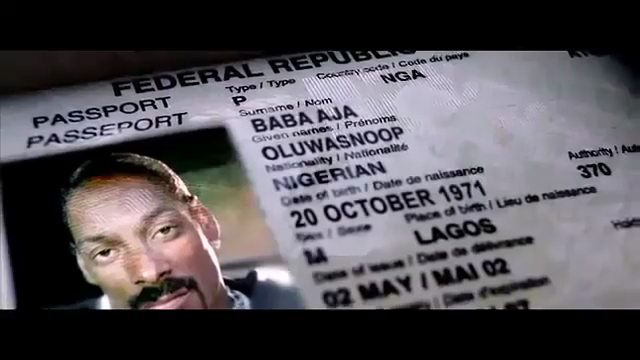
Dbanj, on the other hand, as “Kokomaster” with his “Koko Mansion” and “Kokolettes” groomed to please him, courts the notoriety without any of the social responsibility. He seems to style himself the Hugh Hefner of Nigeria, surrounded by women who are not “queens” (and eventually wives) as Fela called them but mere sexual playtoys. In “Mr. Endowed,” D’banj takes a song with narcissistic lyrics and a mediocre dance track and blings it up with exotic locations and decent cinematography.  The conceit of Snoop being D’banj’s American uncle is clever, and my favourite part of the video is when D’banj presents the American artist with a Nigerian passport, giving him the name Baba Aja Oluwasnoop.  There is also a certain nationalistic pleasure in seeing D’banj cruise the streets of Los Angeles in a green and white Rolls Royce, bursting into Yoruba while dancing around the mansion under a Nigerian and American flag. D’banj implies that he has done all this for Naija, singing, “At the end of the day when my people see me, I bring them joy, they give me a round of applause.” But the rest of the video takes the clichés of wine, women, and song typical of both Snoop’s and D’banj’s videos to new levels of vulgarity. “Uncle Snoop’s” house has an elaborate marble and gold staircase that is decorated by two “vixens” in bustiers and bikini bottoms who writhe around licking their lips and stroking themselves. Musicians wander about flashing fistfuls of dollars, opening suitcases full of blingy time pieces. Snoop is not at his best. His rap is not mixed well, so that his voice is low and you can’t hear what he is saying. He seems a bit lost behind the enthusiasm of his Nigerian “nephews.” I see no redeeming irony here. Perhaps, the repeated instances of one of the musicians walking in on women in the bathroom, one in a bathtub covered with $100 dollar bills and one seated on the toilet using $100 bills as toilet paper is supposed to be funny. To me, it is just embarrassing—a joke with a punchline gone flat. D’banj usually has good beats, and sometimes clever lyrics, sung in a skillful mix of Yoruba and pidgin.  But this “copy-copy” is not interesting or fresh. The music videos I enjoy the most are those that situate themselves in a recognizable Naija. The pitfalls of musicians like D’banj or P-Square and Darey, who make most of their videos in South Africa, or musicians who shoot endless “girls-in-the-club” videos is that no matter the “quality” of the video, they are not being innovative. The videos I most love are those like Eedris Abdulkareem’s old but powerful “Nigeria Jaga Jaga” which uses actual footage of Nigeria or his satirical “Mr. Lecturer.”   TY Bello’s simple but gorgeous “Greenland” focuses on portraits of Nigerians of all ages; elDee’s “Light Up Naija” uses similar simple portraits to highlight his call to unity. TuFace, DJ Jimmy Jatte, and Mode 9 in “Stylee” set addictive rhymes against a backdrop of Lagos traffic and danfos, a Lagos which Nneka also uses cinema-verite style in her video “Heartbeat.” The video for the late Sazzy’s “Mr. Chairman,” is nothing fancy but captures the fierce passion of the Abuja-based musician so well that it takes my breath away.  Recently I came across a beautifully shot music video “Soyeyya” by a hip hop artist XDOGGinit, who raps in Hausa and features humorous acting by Kannywood stars. What makes a video good is not how much money is spent on it but how creative and “true” it is.  I hope to highlight more of the ones I like this year. [Note: These videos may not be as sophisticated or polished as the “club” videos shot in South Africa etc, but they seem to me to have more SOUL.]  And to those musicians who specialize in getting women to remove their clothes for your videos. You may be young and “endowed” now, and there may be plenty of silly girls eager for the fame. But in a few more years, try that and you’ll get called “Mr. Lecturer.” A word to the wise. Eedris Abdulkareem’s Nigeria Jaga Jaga (not the best quality upload but you can see what I mean) TY Bello’s “Greenland” DJ Jimmy Jatt, feat. Mode 9, 2Face, and Elajoe in “Stylee” Nneka “Heartbeat” Sazzy “Mr. Chairman” XDOGGinit “Soyayya”

Congratulations to Kannywood actress Sakna Gadaza and Musa Bello on their wedding, 9 July 2011

booklet distributed at dinner for Sakna Gadaza and Musa Bello's wedding

First of all, another apology for such a long delay in updating this blog, which had to do 1) with my internet server going on a near 2-3 week near-shut-down, 2) travel to Lagos to present at a “Nollywood in Africa, Africa in Nollywood” conference hosted by Pan-African University, 3) the electricity going out in my neighborhood for 1 week and 1 day (in which case, the battery and inverter I celebrated in my last post, has it’s limitations. There has to be a certain amount of electricity for the thing to charge). 4) A nasty case of food poisoning, which put me out of operation for at least two good days.

So, I am only just now posting this piece of Kannywood news, namely, the wedding of Hausa film actress Sakna Gadaza and Musa Bello on 9 July 2011. I attended two of the wedding events, an “Arabian Night” on 7 July, which I arrived scandalously late to even by “African-time” standards only about 15 minutes before the bride took off, partially because I was out shopping for the appropriate “Arabian” attire. 2) The dinner on 8 July, which I arrived on time for and got lots of photos.

So, congratulations to Sakna and Musa. A few photos below:

Sakna sings to her new husband Musa at the wedding dinner. (c) Carmen McCain

Money sprayed for Sakna, as Musa looks on (c) Carmen McCain

The beautiful bride, Sakna Gadaza (c) Carmen McCain

Camera phones were out in full force and Sakna's friend Kannywood actress Zainab Idris pulled out her best dance moves for the occasion (c) Carmen McCain

Kannywood actress and comedienne Saratu Gidado was a great dinner companion. (c) Carmen McCain

Kannywood actors Umar Gombe and Fati Bararoji trade thoughts before the event begins. (c) Carmen McCain

Hausa novelist and film producer Hajiya Balaraba Ramat Yakubu and a friend at the Arabian Night celebration for Sakna Gadaza and Musa Bello's wedding. (c) Carmen McCain

Baballe Hayatu has a quiet moment before the beginning of the event. (c) Carmen McCain

I have more photos not yet uploaded to flickr that I may add as I have internet time, so stay tuned for more pics.

Lecture and Exhibition on Alternative Energy today at Goethe Institut, Kano, the first place in Kano to go “off grid” with a solar-tracking system

The topic of renewable energy, as an environmentally friendly option, has always interested me, even as a young child, but I think growing up in Nigeria, where the power supply is unstable, made me even more passionate about the topic. Renewable energy is more than just a way to be “green;” it is a way to survive, and I am shamelessly evangelistic in my promotion of renewable energy as the best option for Nigeria. We have some of the best sun in the world, as well as excellent wind and hydro resources. We could also do very well with (my current favourite option) gasification of organic waste products. In fact, a family friend who works in renewable energy told me that agricultural factories could basically run themselves and staff housing on the energy produced from waste materials such as husks and corn stalks. Estates could potentially go grid-free as well as enjoying a tidy environment by gasifying their trash or sewer systems.

After spending nearly two and a half years suffering the vagaries of NEPA and refusing, out of principle (and also, I admit, fear) to get a generator, I finally invested in an inverter and battery system. Until a few minutes ago when NEPA came back on, I was working on a power supply from my battery system, without which I would not be able to do my work. The battery charges when I have electricity and supplies me with power to run my laptop, inkjet printer, tv, dvd player, and DSTV device, as well as recharge phones and recharge a battery lamp and phone (You would need a much larger battery and inverter system to run a refrigerator, heating element, or airconditioner). My battery needs about three hours of electricity for a full charge, and when fully charged can provide up to 10 hours of electricity. I use mine very lightly, unplugging printer and TV when not in use, and turning it off when I sleep or go out, and since I purchased it in around February, I have not had my battery run out even once. Although the initial investment is pricier than a generator, it is completely worth it to me. There is very little noise (just a light hum), no unpleasant fumes, and no having to go out and waste time in queues for petrol or having to handle petrol. I bought my system from the Indian company Su-Kam on Ibrahim Taiwo Road, but there are also other suppliers in Kano, such as Dahiru Solar Technical Services Ltd (which built the solar-tracking system for the German cultural liason, Goethe Institut, Kano office) on Zaria Road. My goal, once I am done with my PhD and actually earning a reasonable income (!) is to someday invest in solar and be free of NEPA altogether.

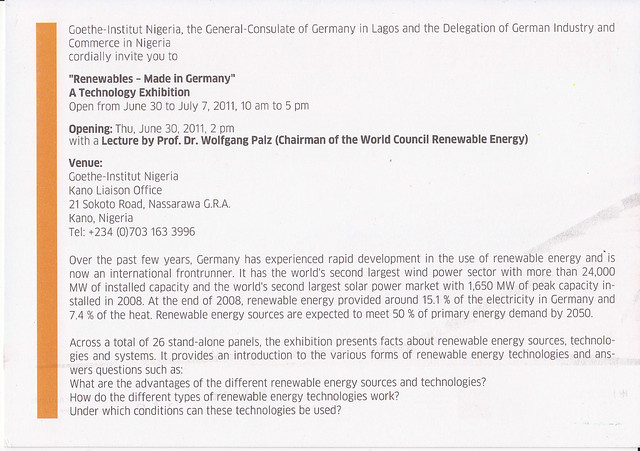
Therefore, I am particularly excited about a lecture and exhibition on renewable energy that is opening today at the Goethe Institut-Nigeria, Kano liason office, co-sponsored by the General-Consulate of Germany in Lagos and the Delegation of German Industry and Commerce in Nigeria. I wanted to get this up a bit sooner, but have been insane with writing deadlines. For those in Kano, seeing this before 2pm, Thursday, there will be  a lecture at that time on renewable energy, given by Prof. Dr. Wolfgang Palz, the Chairman of the World Council Renewable Energy.

Venue: Goethe Institut Nigeria, Kano Liason Office, 21 Sokoto Road, Nassarawa GRA, Kano.

Time: 2pm, Thursday, 30 June 2011

The lecture will open a one week exhibition at the Goethe Institut, Kano on “Renewables-Made in Germany” on “renewable energy sources, technologies and systems,” which has recently been on display at the Goethe, Institut, Lagos. On July 11-15 it will move to Abuja and be displayed at the Hilton Hotel. The exhibition is open from 30 July to 7 July, 10am to 5pm and entrance is free.

The exhibition features German renewable energy technology and “answers questions such as:

What are the advantages of the different renewable energy sources and technologies?

How do the different type of renewable energy technologies work?

Under what conditions can these technologies be used?

The Goethe Institut, Kano, is a particularly appropriate venue to hold the exhibition since the Goethe Institut, which is housed in the old Gidan bi Minsta, parts of which were built back in the 16th century, is the first building in Kano state, and the third in the nation, to be powered by a solar tracking system, a mechanized system which follows the sun for optimum solar power absorption. Although I am generally a bit suspicious of agendas of cultural agencies, I have been very impressed with the Goethe Institut’s programming and support of Kannywood, and have written about it elsewhere in my column.

A few weeks ago I interviewed Frank Roger, the director of the Kano liason office for Goethe-Institut, Nigeria, about the solar energy project he initiated. Click on the photo below to read in hard copy, or scroll below the photo for the text.

In Kano, Goethe Institut goes off-grid with solar power

Saturday, 18 June 2011 00:00 Carmen McCain

When I visited Germany a few years ago, one of the things that most impressed me was that nation’s visible commitment to renewable energy sources. Driving through the countryside, I saw windmills to capture and convert the wind into energy; neighborhoods full of “passive houses”  built and insulated to need very little energy for heating during the cold winter season; and solar panels for conversion of sunlight into electricity on many houses. Why aren’t we doing more of this in Nigeria? I thought. Nigeria is much more blessed with sun than Germany and much more in need of alternate electricity sources. I was particularly excited when I heard that the Goethe-Institut, the German cultural centre established in Kano in 2008, had gone “off-grid” and was now run completely on solar power. In April when the Goethe-Institut hosted the one-day Kannywood FESPACO symposium, the lights were on, the computers were running in the offices. The sound speakers and the digital projector worked without a blink. There was no noisy generator filling the compound with fumes, just a large mechanized frame of solar panels to capture the sun.

I asked Frank Roger, the director of the Goethe-Institute, Kano, about their energy supply, and I’ve included parts of our conversation below. He gave me a little background about German energy politics, the Goethe-Institut, and their solar energy project, highlighting the wisdom of traditional architecture and the great possibilities of solar power to transform the way electricity is experienced in Nigeria and the world. The Goethe-Institut, which has been in Lagos since 1962, focuses on “intercultural exchange and the promotion of various fields of the arts.” When they established a liason office in Kano in 2008, they were invited by the Kano State History and Culture Bureau to move into the old adobe Gidan bi Minista building, the upper floor of which was constructed in 1909. The History and Culture Bureau believes that “the basic structure of the ground floor has been around since the 16th century. It was [first] used by title holders of the emir. In 1903 when the British came to Kano, the first British minister, who was called Frederick bi Minista, resided here. He established the first arts and crafts school in Kano here, so this building has a real history of cultural activities. Later on MOPPAN [Motion Picture Practitioners Association of Nigeria] offices were here, then the copyright commission. When I came in 2008, the house was basically not used.”

“The Goethe-Institut does not pay rent but maintains the building. We renovated the whole building, the plastering, you have to do quite often, checking it after rainy season.  We reconnected water supply and put on a new roof, but there was still the problem of energy supply. Even though this is not far from the government house, still the [electric] supply was very unreliable.

“The easiest way would be to buy a generator and just do it that way. But then the idea [of solar power] came up. There’s one thing about this building and the architecture. It has natural ventilation. It’s quite cool inside so you don’t really need air conditioning. Even though it’s April, it’s very comfortable inside. If you have these modern concrete buildings, you definitely need air conditioning for an office, and then it’s a bit costly when it comes to solar power. If you want to invest in solar, you first have to do a power load survey. You have to know how much you need for consumption, and according to that, then solar company will design you the system you need. That’s why you cannot just say in general what is the size or cost of a solar power system. It is individually designed according to your needs. So the idea was instead of following this generator mainstream that we look for an alternative, and since solar has a big boom in Germany, we said ‘why not?’ Kano is much more exposed to the sun than our belt in Germany with its bad weather and short days in winter. In Kano you have hours of daily sunlight. In August in the rainy season, you can expect 5-6 hours. And in March-April, up to 11 hours of sunlight, so it’s really obvious to use it.  The system we have was installed by Baba Dahiru [of Dahiru Solar Technical Services Ltd], a Kano businessman. And what he always says is that solar is free, and it is true. The energy from the sun comes for free, everyday newly. Of course, first you have quite high investment costs. If you want light at night, you also have to invest in batteries, which are not so cheap. But normally it pays off after about three years.

“We cancelled our NEPA account. Basically with our solar system, we run everything in this office now. We are off grid [disconnected from PHCN], and we have a fridge, our computers, the sound system, printer, copy machine, lights, lighting for exhibition, security lights at night that all run without any problem. We did the official opening in December, but had the test run since August, and it has run [from that time] without problems. You don’t really have maintenance costs. They come from time to time to make sure the screws are still tight. The lifespan of batteries is comparable to that of a generator, so after 6-7 years they have to be renewed. But the PV, photovoltaic panels [which capture the energy from the sun] run with 90% guarantee for 10-15 years, and at 80% rate of performance from 20-25 years, which is a really long term investment.

In addition to reliable electricity, using solar energy has other benefits. “There is no pollution. We don’t contribute to global warming now. There is no noise, which is important for our programmes.  Here you feel it’s a little paradise because it’s so quiet and peaceful. We have installed solar panels not only as our energy supply system but also looked at it as an educational project to spread the idea of alternatives to the oil, coal gas, fossil fuels. Even though Nigeria is at an oil peak now, there will be a time when the oil worldwide will be finished. So, it is a good idea now while you have a lot of revenue from the oil industry to look ahead and invest in future technologies.”

“There’s a lot of investment in renewable energy in Germany now. Wind power is the first, also offshore wind power stations on the North Sea, even solar, though we have bad sunlight, also hydro power, some geotherm, and biological waste.”

After the Fukushima nuclear tragedy following the earthquakes and tsunami in Japan, “it was quite a big debate in Germany. We have something like 17 nuclear power plants in Germany. The majority want to get rid of this risky technology. The people in the renewable energy industry said by 2020 they will completely replace nuclear power in Germany with renewable resources, solar, hydropower. That is like nine years from now.”

The ‘second coming’ of Kannywood

Still catching up on posts I am behind on. This feature piece  “The ‘second coming’ of Kannywood” was published over a month ago now in the Weekend Magazine of Weekly Trust on 21 May 2011, but gives a good summary of the challenges faced by the Kano film industry during the tenure of former ANPP Governor Ibrahim Shekarau, and the “director general” of the Kano State Censorship Board he appointed, Abubakar Rabo Abdulkarim. I also interviewed film practitioners about their hopes as PDP’s Rabi’u Musa Kwankwaso, who had been governor of Kano State from 1999-2003, returns to take up another four year term, aided in his political campaign by the Motion Picture Practitioners Association of Nigeria and Kannywood stars like Sani Danja and D’an Ibro. As usual, to read the hard copy of the article, click on the photos below, or scroll down to read the text I’ve copied here.

The ‘second coming’of Kannywood

Saturday, 21 May 2011 01:42 Carmen McCain

Wednesday evening, April 27, 2011, Zoo Road in Kano, the street lined with Kannywood studios, exploded into celebration. Young men pulled dramatic stunts with motorbikes and shouted their congratulations to Hausa filmmakers. “Welcome back home, brothers. Welcome back from Kaduna,” directors Falalu Dorayi and Ahmad Biffa recall them saying. “We embrace you ‘Yan fim.’ We are together with you. We are happy that he has returned.”The win of PDP

Governor Rabi’u Musa Kwankwaso, incoming governor of Kano State, and also governor from 1999 to 2003 (Photo Credit: Nigerian Best Forum)

candidate Dr. Rabiu Musa Kwankwaso as governor of Kano, his second tenure after a four-year term from 1999-2003, had just been announced.  INEC figures listed PDP as winning 46% of the vote with 1,108,345 votes, closely followed by Alhaji Salihu Sagir of ANPP with 43.5% of the vote with 1,048,317 votes.  To anyone familiar with the Hausa film industry, which according to recent National Film and Video Censor’s Board figures makes up over 30% of  the Nigerian film industry, this association of a political win with film was no surprise. Some of the most visible Hausa filmmakers have become increasingly politically active following a crackdown by the Kano State Censor’s Board, during which many practitioners and marketers of Hausa films had been fined, imprisoned, and harassed. While many of those associated with the film industry supported CPC and Buhari for president, the feeling among many filmmakers in Kano was that for governor any of the candidates would be better than ANPP. The two term ANPP governor and presidential candidate Ibrahim Shekarau, who had initially been passionately supported by

CIMG2970

Former Governor Ibrahim Shekarau, governor of Kano State fro 2003-2011, and ANPP presidential candidate in 2011. (I took this photo during his trip to Madison, Wisconsin in 2007)  (Photo credit: talatu-carmen)

at least some of Kano’s writers and artists, was now deeply disliked by most film practitioners, in part, for appointing Abubakar Rabo Abdulkarim former deputy commandant of the shari’a enforcement group hisbah as director general of the Kano State Censor’s Board. Malam Rabo, as he was known, regularly went onto the radio to denounce film practitioners for ostensible moral defects and had overseen a board which often arrested filmmakers.

After surveying candidates in the gubernatorial race for how they would support film, the Motion Pictures Practitioners Association of Nigeria (MOPPAN), as the association’s president Sani Muazu reported, publically campaigned for Kwankwaso. Movie star,

Comedian Klint de Drunk, with Kannywood stars Sani Danja and Baban Chinedu at an Abuja press conference for NAISOD, 2010. (c) Carmen McCain

producer, director, and musician Sani Danja, who founded Nigerian Artists in Support of Democracy (NAISOD), and comedians Rabilu Musa dan Ibro and Baban Chinedu were among those who lent their star power to the new  governor’s campaign. This public support for PDP among some of the most visible film practitioners had put Kano based filmmakers in danger the week before. Angry about the announcement of PDP’s Goodluck Jonathan as winner of the presidential election, area boys hunted for Sani Danja, threatened other recognizable actors and vandalized studios and shops owned by Kannywood stakeholders. (For this reason, while some filmmakers have come out publicly in support of candidates, there are others who are reluctant to speak openly about politics. The Dandalin Finafinan Hausa on Facebook has banned discussion of politics on its wall, requesting members to focus on discussions of film.) By the next week, however, as Falalu Dorayi relates, the same area boys who had been hunting Sani Danja were now celebrating him.

Producer and makeup artist Tahir S. Tahir with Director Falalu Dorayi celebrating Kwankwaso’s win. April 2011 (c) Carmen McCain

While Governor-elect Rabiu Musa Kwankwaso was seen as the champion of the filmmakers during the 2011 election cycle, it was under Kwankwaso, who first served as governor of Kano from 1999-2003, that the first ban on Hausa films was announced and that the Kano State Censor’s Board was created. Abdulkareem Mohammad, the pioneering president of MOPPAN from 2000 to 2007, narrated how in December 2000, the Kano State Government pronounced a prohibition on the sale, production and exhibition of films in Kano state because of the introduction of sharia. MOPPAN  organized and “assembled industry operators in associations like the Kano State Filmmakers association, Kano state artist’s guilds, the musicians and the cinema theatre owners, cassette sellers association” to petition the government to either allow them to continue making films or provide them with new livelihoods. It was the filmmakers themselves under MOPPAN who suggested a local state censorship board, which would ensure that film practitioners were able to continue their careers, while also allowing oversight to ensure that their films did not violate shari’a law. The censorship board was ultimately meant as a protection for the filmmakers to allow them to continue their work.

Outgoing President of MOPPAN, Sani Muazu points out that MOPPAN’s support of Kwankwaso was because he had promised re-establish the original intent for the censorship board, with a Kannywood stakeholder in the position as head of the Kano State Censorship Board, rather than an outsider who did not know the industry. Most Hausa filmmakers speak of the censorship board as a compromise between the film industry, the community and the government. Director Salisu T. Balarabe believes then Governor Kwankwaso was trying to follow the demands of those who voted for him, “If the government wants to have a good relationship with people it has to do what the people want.” Kannywood/Nollywood star Ali Nuhu said, “I won’t forget how in those three or four months [during the ban], they sat with our leaders at the time of Tijjani Ibrahim, Abdulkareem Muhammad, Hajiya Balaraba and the others.  They reached a consensus, they understood the problems that they wanted us to fix and the plan they wanted us to follow.”

Nollywood/Kannywood star Ali Nuhu on set of Armala with Executive Producer Aisha Halilu. April 2011 (c) Carmen McCain

Although the censors board had banned several films, such as Aminu Bala’s 2004 cinema verite style film Bakar Ashana, which explored the moral complexities of the world of prostitution, and enforced rules on censorship

Aminu Bala’s film Bakar Ashana that was banned by the Kano State Censor’s Board in 2004.

before marketing, filmmakers for the most part did not seem to have major problems with censorship until August 2007, when a sex scandal broke out in Kannywood. A privately made phone video of sexual activity between the actress known as Maryam “Hiyana” and a non-film industry lover Usman Bobo was leaked and became one of the most popular downloads in Kano. Alarmed by what some were calling the “first Hausa blue film,” although the clip was a private affair and had nothing to do with other Hausa filmmakers, critics called for serious measures to be taken. A new executive secretary Abubakar Rabo Abdulkarim (his position soon

Maryam Hiyana, who was seen as a victim in the scandel, became an unlikely folk hero with stickers of her likeness on public transport all over Northern Nigeria. (c) Carmen McCain, 2008

inflated to the title of director general) was appointed by Governor Shekarau to head the Kano State Censor’s Board. He required each film practitioner to register individually with the board, an action he defended as being provided for in the original censorship law. Not long after Rabo was appointed, actor and musician Adam Zango was arrested and sentenced to three months in prison for releasing his music video album Bahaushiya without passing it through the Kano State Censor’s Board. He was the first in a series of Hausa filmmakers to spend time in prison. Former Kano state gubernatorial candidate and Kannywood director Hamisu Lamido Iyan-Tama was arrested in May 2008 on his return to Kano from Abuja’s Zuma Film Festival where his film Tsintsiya, an inter-ethnic/religious romance made to promote peace, had won best social issue film. He was accused of releasing the film in Kano without censorship board approval.  Although Iyan-Tama served three months in prison, all charges were recently dropped against the filmmaker and his record cleared. Popular comedians dan Ibro and Lawal Kaura [both of whom are now late, see my memories of both Rabilu Musa and Lawal Kaura] also spent two months in prison after a hasty trial without a lawyer. Lawal Kaura claims that although they had insisted on their innocence, court workers advised them to plead guilty of having a production company not registered with the

FIM Magazine feature on Ibro’s time in prison, November 2008.

censorship board so that the judge “would have mercy” on them. These were only the most popular names. Others who made their livelihoods from the film industry, from editors to singers to marketers, spent the night in jail, paid large fines, and/or had their equipment seized by enforcers attached to the censorship board.

Although Governor Shekarau in a presidential debate organized by DSTV station NN24 had claimed that “the hisbah has nothing to do with censorship,” Director of Photography Felix Ebony of King Zuby International recounted how hisbah had come to a location he was working on and impounded four speakers and one camera, telling them they had not sought permission to shoot. Other filmmakers complained that there was confusion about under what jurisdiction arrests were being made. Although in a February 2009 interview with me, Rabo

Felix Ebony, director of photography with King Zuby International. (c) Carmen Mccain

also claimed that the censorship law was a “purely constitutional and literary law […] on the ground before the shari’a agitations,” the public perception seemed to be that the board was operating under shari’a law, perhaps because of Rabo’s frequent radio appearances where he spoke of the censorship board’s importance in protecting the religious and cultural mores of the society. Director Ahmad Bifa argued, “They were invoking shari’a, arresting under shari’a. If they caught us, we all knew, that they had never taken us to a shari’a court. They would take us to a mobile court […] But since it was being advertised that we were being caught for an offense against religion, we should be taken to a religious Islamic court, and let us be judged there not at a mobile court.”

The ‘Mobile’ Magistrate Court at the Kano Airport where Censorship Board Cases were tried. This photo was taken in July 2009 during the trial of popular singer Aminu Ala. (c) Carmen McCain

The mobile court Biffa referred to seemed to be attached to the censorship board and was presided over by Justice Mukhtar Ahmed at the Kano airport. After the Iyan-Tama case came under review, the Kano State attourney general found the judge’s ruling to be ““improper”, “incomplete”, a “mistake” and requiring a retrial before a more “competent magistrate.” Justice Ahmed was transferred to Wudil in August 2009; however, censorship cases continued to be taken to him. In January 2011, popular traditional musician Sani dan Indo was arrested and taken to Mukhtar Ahmad’s court, where he was given the option of a six month prison sentence or paying a fine of twenty-thousand naira.  The decisions made by the board and the mobile court often seemed of ambiguous motivation. In 2009, Justice Mukhtar Ahmed banned “listening, sale, and circulation” of eleven Hausa songs, citing obscenity, but obscenity was rarely as easily identified as the cutting political critiques in them.

11 Songs banned by Justice Mukhtar Ahmed. (c) Alex Johnson

The effect of these actions was to relocate the centre of the Hausa film industry away from the flourishing Kano market, to Kaduna. Many filmmakers began to claim their rights as national Nigerian filmmakers, taking their films only to the National Film and Video Censor’s Board, bypassing the Kano State Censorship Board altogether. Such films were often marked “not for sale in Kano” and if found in Kano state were known as “cocaine,” a dangerous product that could, as Iyan-Tama discovered, mean imprisonment for a filmmaker, even if filmmaker had advertised, as Iyan-Tama had, that the film was not for sale in Kano State. Another side effect of these actions was the loss of jobs among Kano youth. Ahmad Bifa pointed out that “the Hausa film industry helped reorient youth from being drug-users and area boys to finding jobs in the film profession. Sometimes if we needed production assistants we would take them and give them money. I can count many that the Hausa film industry helped become relevant people to society. But Abubakar Rabo made us go to Kaduna to do our shooting. So the young people of Kano lost the benefit of film in Kano, […] That’s why there are a lot of kids on Zoo Road who went back to being thugs because of lack of job opportunity.”

Ahmad Bifa, on set of the Aisha Halilu movie Armala, April 2011. (c) Carmen McCain

Although the impact of censorship on film was the most well known, the flourishing Hausa literary scene was also affected, with the director general initially requiring all writers to register individually with the censor’s board. With the intervention of the national president of the Association of Nigerian Authors, writers found some relief when Abubakar Rabo agreed to deal with the writer’s associations rather than with individual writers; however, there still seemed to be a requirement, at times ambiguous, that all Hausa novels sold in the state must be passed through the board. Rabo continued to make often seemingly arbitrary pronouncements about what he considered acceptable literature. In December 2009, for example, at a conference on indigenous literature in Damagaram, Niger, Rabo proclaimed that the board would not look at any more romantic novels for a year.

Abubakar Rabo Abdulkarim, DG of the Kano State Censor’s Board 2007-2011, proclaimed that he would not accept romantic novels for a year. International Conference on Authors and Researchers in Indigenous Languages, Damagaram, Niger, December 2009. (c) Carmen McCain

Those who protest the actions of the board do not have a problem with censorship so much as how censorship has been carried out. The original MOPPAN president Abdulkareem Mohammad argued that the intention of creating the censorship board had been one that would allow filmmakers to continue doing their work, “We really were doing things in good faith to ensure that things do work and eventually it is for the betterment of the majority.” He acknowledged wryly that there were flaws in the law that allowed for it to be abused, “I think that on insight, I would have done it differently.” Current president Sani Muazu continued in this vein saying that although the board had been meant to protect artists it had “become a weapon against artists.”  Director Salisu T. Balarabe says, “There was nothing wrong with making the censorship board but those put in charge of directing the board, sometimes put a personal interest into it.” Novelist and scriptwriter Nazir Adam Salih acknowledged “We have our faults. This is true. But the censor’s board was much harsher than it

Novelist and script writer Nazir Adam Salih passionately responds to Abubakar Rabo Abdulkarim, at the conference in Damagaram, Niger. December 2009. (c) Carmen McCain

needed to be. They put someone in power who didn’t know anything about the film industry, Malam Abubakar Rabo, who slandered and disrespected us.” It was this disrespect and the accompanying arrests that most seemed to upset film practitioners. Danjuma Salisu, who is involved in acting, lighting, and assisting production argued that Rabo’s actions were insulting to those whose careers in film “feed our children and parents and families.” Makeup artist Husseini Tupac argued passionately, “Film is a profession. It is a career.  In the same way a normal person will go to the office everyday, we will go the office, we do our work and get paid. When the honourable Dr. Rabiu Musa Kwankwaso was governor nobody ever came out on the radio and said that actresses were prostitutes, that we were making blue films, that we were rogues. No one came and arrested us.” Producer and director Salisu Umar Santa shared a similar sentiment, saying that he and other

Director Salisu Umar Santa with Dawwayya Productions, April 2011. (c) Carmen McCain

professionals he worked with, like Rukkaya Dawayya and Sadiyya Gyale, had registered and done everything the board required for working in Kano State and yet Abubakar Rabo continued to say that filmmakers were not decent members of society. Producer and Director of Photography Umar Gotip said that he felt like a refugee having to leave Kano. “You are practicing your profession, to the extent that some people even have a degree in it, but they say you are just rogues and rascals. We had no human rights.” Director Falalu Dorayi, claiming that the Kano State Censorship board regularly demanded bribes, asked “How can the one who collects a bribe say he will reform culture.” Cameraman, editor, and director Ahmad Gulu put it this way: “You should fix the leaky roof before you try to repair the floor.”

Despite his ostensible position as enforcer of public morality, Rabo himself came under suspicion of wrongdoing on several occasions. In August 2009, he was taken before a shari’a court by the Kano State Filmmakers Association and accused of slander for statements he had made about the film community on the radio. In May 2010, he was also sued in by Kaduna Filmmakers Association for accusations he had made on radio and television in Kaduna.  In a strange twist, he accused twelve filmmakers, several of whom were involved the lawsuit, of sending him death threats by text message. Police from Kano came to Kaduna, arresting the one person on the list they could locate—Aliyu Gora II, the editor

Editor of Fim Magazine, Aliyu Gora II, and Filmmaker Iyan-Tama, both former inmates of Goron Dutse Prison, after a hearing in Iyan-Tama’s lawsuit against the Abubakar Rabo Abdulkarim, 22 July 2010. (c) Carmen McCain

of Fim Magazine, who was held for a week without trial at Goron Dutse Prison in Kano.  In an even more bizarre twist, in September 2010, Trust and other papers reported that Rabo, after being observed late at night by police in suspicious circumstances with a young girl in his car, fled from police. In the car chase he was also reportedly involved in a hit and run incident with a motorcyclist. After he was eventually arrested and released by the police, Governor Shekarau promised to open an inquiry into the

Filmmakers on location in Northern Nigeria on Sunday, 29 August 2009, read the breaking news Sunday Trust article: “Rabo arrested for alleged sex related offence” (c) Carmen McCain

case [as requested by MOPPAN], but Rabo continued as director general of the censor’s board and filmmakers heard nothing more of the inquiry.

The treatment of filmmakers had the perhaps unintentional effect of politicizing the artists and those close to them. Sani Danja told me he had never been interested in politics until he saw the need to challenge what was going on in Kano State. A musician told me his mother never voted in elections but that she had gone out to stand in line for Kwankwaso as a protest at how her children were being treated. Filmmakers used fulsome praises to describe their delight at Kwankwaso’s

Kannywood star Sani Danja prepares for his the first press conference of his organization: Nigerian Artists in Support of Democracy (c) Carmen McCain

return. Director Falalu Dorayi said “It is as if your mother or father went on a journey and has returned with a gift for you.” Producer and director of photography Umar Gotip said Kwankwaso’s coming was “like that of an angel, bringing blessing for all those who love film.” Even those who are not fans of PDP told me they wished Kwankwaso well, were optimistic about change, and expected him to fulfill his promises in several areas: First, most of them expected that he would relieve Rabo of his post and replace him an actual filmmaker, who as Falalu Dorayi put it “knows what film is.” Secondly, several of them anticipated actual investments into the film industry “like Fashola has done for Lagos filmmakers,” as director and producer Salisu Umar Santa put it, possibly in the form of a film village. And most Kano-based filmmakers I spoke to mentioned their hopes that others who had gone into exile would come back home to Kano. Producer Zainab Ahmed Gusau, who is currently based in Abuja wrote that, “My thought is to go back to Kano, knowing there will be justice for all.We thank God for bringing Kwankwaso back to lead us.”

Hausa film producer Zainab Ahmad Gusai at the Savannah International Movie Awards, Abuja, 2010. (c) Carmen McCain

Other filmmakers saw it as a time for reflection on how they can improve the field. Director Salisu T. Balarabe mused “If you keep obsessing over what happened, the time will come and pass and you won’t have accomplished

Hausa film Director Salisu T. Balarabe on Zoo Road in the days following Kwankwaso’s win. April 2011. (c) Carmen McCain

anything. We should put aside what happened before and look for a way to move forward.”  Hamisu Lamido Iyan-Tama, the politician and filmmaker who was imprisoned for three months, focused on the positive, calling on filmmakers to continue making films that would have meaning and would build up the community.

Many also looked beyond the own interests of film to the entire community.

Ahmad Gulu, Kannywood cameraman, editor, and director, on Zoo Road in the days following Kwankwaso’s win. April 2011. (c) Carmen McCain

Ahmad Gulu, cameraman, editor, and director said “The change has not come to film practitioners alone. It has come to the whole state of Kano. Back then people would accept politicians who would put something in their pockets but now things have been exposed.” Star actor, director, and producer Ali Nuhu similarly pointed out that progress was not receiving money from politicians, saying that one of the most important changes Kwankwaso could bring would be a focus on electricity, drinking water, and children’s education. Writer Nazir Adam Salih said that if Kwankwaso could simply fulfill the promises politicians and leaders had been making for the past thirty years to provide electricity and water, he will have done his job. And finally two directors of photography Umar Gotip and Felix Ebony pointed to the need for peace and unity in the state. “He should try to bring people together,” said Umar Gotip. “This kind of fighting that has arisen between Muslims and Christians is not right. We should live together as one.”

Producer Bello A. Baffancy shows off his Kwankwaso support, Zoo Road, April 2011. (c) Carmen McCain

‘Yan Fim on Zoo Road following Kwankwaso’s win, April 2011. (c) Carmen McCain

The Danger of a Single Story and the Good Samaritans of Arewa

I don’t think I’ve ever been so behind on this blog as I have been this time, going for nearly two months without posting anything. Forgive me. I have been overwhelmed by several other writing projects and much too much travel. I’ll try to catch up on links to a few of my pieces in Weekly Trust in the next few days, but I thought that last post should be followed by the column that came right after it.

To read the hard copy, click on this link to be taken to a flickr page where you can read it online. Otherwise, scroll below the photo and read the text as copied below (I’ve made a few small edits and added links for this blog).

The danger of a single story and the Good Samaritans of Arewa

Saturday, 30 April 2011 00:00 Carmen McCain

In a crisis such as we had last week, one comes out of it shell-shocked, horrified by the acts of inhumanity human beings are capable of. How can a human being cut another human being’s throat, send them hurtling into flames? What reason is there behind the destruction of property, the burning of churches, and mosques, the killing of youth corpers, the massacre of villagers? The killing of youth corpers in Bauchi has understandably led to rage around the country. Facebook pages have been created in their honour and linked back in particular to the page of Ukeoma Ikechukwu, whose last status update as was how he was nearly killed forresisting election malpractice was tragically prescient.  The murder of these young people on the cusp of their lives is horrifying and must be appropriately responded to by reforms to a system which too often leaves corpers insufficiently protected. Yet, I am also appalled by the irrational mob-mentality, the backlash of hatred I’ve seen on the internet, directed not just against the murderers of the youth corpers but against the entire ambiguous region of the north, lashing out often as much against other victims of violence as against the perpetrators of it. As I wrote this article, I got into a surreal and sickening online argument with someone passionately calling for innocent people from the north to be murdered in retaliation for the deaths of her fellow youth corpers.

Much of this rhetoric comes from people who have never been further north than Abuja and who stereotype an entire region the way Africa is stereotyped by ignorant outsiders, but some of it is furthered by those who have lived briefly in the “north” and have had traumatic experiences. One woman, who schooled in Jos, recounted how her own neighbors turned against her in a crisis and would have, she presumed, killed her “had not a good Samaritan intervened.” What is glaring to me in this story is that she focuses on the betrayal and treachery of those who attacked her to denounce the entire “north”, while mentioning the acts of the “good Samaritan” as only a postscript. While this is certainly an understandable response to a terrible experience, it is also only one side of the story. In “The Danger of A Single Story,” author Chimamanda Ngozi Adichie has spoken of how the insistence on “only negative stories” creates “stereotypes. And the problem with stereotypes is not that they are untrue, but that they are incomplete. They make one story become the only story.”

In these times of crisis, it is the horrifying stories that make the headlines, the betrayal, the treachery, the youth corpers murdered, the children trampled by mobs, the places of worship burned. Far less heard are the stories of ordinary human beings behaving with decency, treating their neighbors as they themselves would want to be treated, yet I argue that these people are far more numerous than the extremists and rogues who pillage and kill. It is not that there are not many stories of violence, abuse, and injustice against minorities in the north, for there are, and they must be addressed, but it is that these experiences are only a small part of the larger story. Adichie asserts that “I’ve always felt that it is impossible to engage properly with a place or a person without engaging with all of the stories of that place and that person. The consequence of the single story is this: It robs people of dignity. It makes our recognition of our equal humanity difficult. It emphasizes how we are different rather than how we are similar.”

Last week I told the story of Pastor Habila Sunday, who was defended in Kano by a Muslim man who told his attacker “before you kill him, you’ll have to kill me.” An article in NEXT of 24 April, recounts the story of Adamu Bologi, a Muslim librarian in Minna, who risked his life multiple times to help several Christian families to safety. There are many other stories of this sort, less heard because they are less dramatic, but which illustrate people acting out true neighborliness. Last week, I thought I had lost a close friend of mine–a Christian–to the violence in Kano. I called her dozens of times but both of her phones were switched off for days. When I finally heard from her, she recounted a harrowing story. As the tension mounted that Monday, April 18, her manager at work suggested she leave her car in the office. He thought she would be safer if he gave her a ride home. However, around Unguwa Uku, they ran into a roadblock of burning tires manned by rioters. “There was no way we could pass, so we slowed down.” Hoodlums began beating the car and breaking the glass of the windows. One of them reached through the window and snatched her handbag which held her phones and her keys. “When they saw me with my hair open, they said, ‘She’s a pagan, bring her out.’” Her manager protested “I’m a Muslim, I’m a Muslim,” but as he saw that these thugs, who appeared drugged up and high, wanted to injure her anyway, he accelerated and sped through the block, driving through fire, to get to the other side. Seeing that it would be too risky to continue on to her house, he dropped her at a police station. She eventually was able to call a friend, who came with her husband a few hours later to take her home with them. She stayed with this Muslim family for another week until she felt safe enough to go to her own home.

Another young man, Suleiman Garba Sule who teaches part time at a school while waiting for NYSC to place him, told me how when the news of the violence in Kaduna and Kano reached them, two Christian members of the staff, originally from Kaduna, were terrified. Their Muslim colleagues advised that they stay on the school premises until the roads became safe, and they ended up staying overnight in the school management house, until Suleiman called and told them it would be safe to leave. Dangiwa Onisemus wrote me that his aunties and cousins were protected by the “Muslim community in Malali technical school, Kaduna. Even as I speak, the Christian faithfuls are still staying there…. The Muslim community stood firm to see that the Christians are not touched.”

My friend, Dr. K. Korb  in Jos wrote me of a family friend, a Fulani Muslim, who had only recently finished building his house on a plot of land that happened to be in a majority Christian neighborhood. “During the post-election violence, the Christian youths came to attack his brand new home. His Christian neighbors, including a number of youths and old men, confronted the angry crowd. Pointing in the direction of his own home, a Christian neighbor told the youths, “See over there? That is my house. If you are going to burn down this house, you must burn my house down first.” The angry youths relented and moved on.” Our friend “was thankful … but he feared for his family’s safety so he moved them back into his brother’s house in the Muslim part of town. Shortly thereafter, the Muslim youths came to attack the house next to our friend’s brother that happened to belong to a Christian. Our friend and his brother quickly moved the Christian family into the brother’s house to protect them. Once the family was safely inside, our friend and his brother confronted the angry crowd and told the youths that they would not burn down that Christian house. The angry youths relented and moved on.”

These stories do not all contain  great heroic feats, just accounts of human decency, of neighborliness and friendship that show how interconnected communities actually are. These are the stories that are not often heard but which are the most common in times of crisis. And it is these stories that are the most helpful in pursuing justice, for it is only when we see those who are different from us as our neighbors and our brothers that we will be able to work together to change corrupt systems which perpetuate such violence.

Threat of hate, hope of Love: Thoughts on the post-election crisis April 2011 (Also looking for stories of Christians and Muslims protecting each other)

Broken glass along Zoo Road on 19 April 2011 following the post-election violence in Kano, 18 April 2011. (c) Carmen McCain

I had a really hard time writing my column last week. I felt mute. The post-election crisis was something I felt that poetry could address better than any sort of attempt to make sense of it in prose, which is why I have gone a week on this blog without posting anything about the violence that followed the presidential elections, other than Edvard Munch’s painting “The Scream,” which expresses about how I felt last week, and a quickly composed poem that I wrote to go along with the painting. But because I have a weekly column to write, I pushed this out, with many misgivings, to my editor later than I’ve ever turned anything in. Bless his good heart, he did a great job of editing what I sent him. I’ve made 2 small last minute changes in the text I copy below.

In the column I mentioned one story of a pastor who was protected by a Muslim brother at a car park here in Kano. This morning, I read this very touching article in NEXT, about a Muslim man in Minna who risked his life to save several Christian families. He told Next reporters that he took inspiration from the life of the Prophet Muhammad (who had also in a charter of privileges given to St. Catherine’s monestary in Egypt said: “Verily I, the servants, the helpers, and my followers defend them, because Christians are my citizens; and by Allah! I hold out against anything that displeases them.”):

“I kept thinking of the prophet,” he said. “One day some men came to kill him and failed. As they fled, the prophet noticed that they were going in the direction of his more militant supporters, Saidi na Ali and such. So, he told them not to go that way, to avoid the route because they might get themselves killed. He helped them make good their escape. That is my example. That should be our example as Muslims.”

I would like to focus on these stories (less heard but very common) of Muslims protecting Christians and Christians protecting Muslims in time of crisis (especially the most recent crisis) in my column for this week. If anyone has such a personal story or knows someone who does, could you please email me by Tuesday night at carmenmccain @ yahoo.com with the story and phone numbers for verification purposes.

Here is this week’s column. To read the original as published, click on the link here to read it on the Weekly Trust website or on the photo below to read a hard copy. Otherwise, read on below the photo.

Threat of hate, hope of love

Saturday, 23 April 2011 00:00 Carmen McCain

Monday morning, 18 April, I heard the roar of a mob and gunshots on the street outside of the compound where I stay in Kano. I stayed at home, checking Facebook and Google news, making calls to friends to make sure they were OK.

As the rioting on the streets quieted to an uneasy calm, the fighting continued in Kaduna and elsewhere. Violence in the streets unleashed violent words on social networks in cyber space. Regional, political, and religious biases began to crack through the net, with friends and strangers calling each other barbarians and beasts, fools and hypocrites, questioning the commitment of the other to live in the state of Nigeria.

Burnt house of a leader in Kano, taken 19 April 2011 (c) Carmen McCain

Although I’ve lived through crises in Jos and I’ve read of previous crises in Kano, this was the first time I’ve experienced serious rioting in the North’s largest city. The current violence seems to have started out as political outrage against Northern leadership seen as betraying the interests of the people. Whether or not they had anything to do with the current elections, current and former leaders were targeted.  In Kano alone, the house of former speaker Ghali Umar Na’abba; the house of former ANPP presidential candidate Alhaji Bashir Tofa; the residence of the Galadima of Kano, and others were set afire. Even the emir of Kano was not exempt from the rage, as his Dorayi palace was attacked and burnt. Government offices were also burned, including, ironically, the Kano Pension Board office where records are kept. If it had remained at that, we could perhaps describe it, somewhat simplistically, as a revolution of the northern proletariat against a resented elite, but there was something uglier here than class rage. As sympathetic as I am for the leaders who lost property to the mobs, what I find the most alarming is how politically-motivated mayhem spilled over into violence against non-elite communities stereotyped as the “other” and assumed to be “at blame” for this disenfranchisement.

Broken glass in the window above Karami CD Palace, photo taken 18 April 2011. (c) Carmen McCain

On Tuesday, I stopped by Gidan Dan Asabe on Zoo Road, which hosts a complex of studios, to check on friends. Kannywood actor Mustapha Musty and musician DJ Yaks described how a mob of young men had come searching for a well-known actor who had campaigned for PDP. Although he was not there, the mob threw stones at glass and ripped down signboards. This ‘scape-goating’, as Hausa filmmaker and Kannywood elder Aliyu Shehu Yakasai, explained to me is often less a question of ideology among the unemployed youth in the streets as an excuse to loot and steal. Political fervor was mixed with opportunism. The glass front of Karami CD Palace was knocked out and hundreds of thousands of naira worth of property looted, from VCDs to the ceiling fan to money stored in a cabinet. The internet café next door was not spared, as its glass was also smashed and some printers and computer accessories looted.

Baba Karami standing in front of Karami CD Palace with all the glass broken out of the shop front following the post-election violence in Kano 2011, photo taken 19 April 2011. Compare to photos taken in 2009, and note how all the goods have been stripped from front of shop, but business continues on. (c)Carmen McCain

Karami CD Palace 2009. (c) Carmen McCain

“Everybody has a right to vote for

Baba Karami in Karami CD Palace, 2009. (c) Carmen McCain

anyone they want,” Mustapha Musty told me. Although he thought it was best for actors not to campaign for politicians so as not to alienate fans, he told me his brother had recently been voted into the House of Assembly under the CPC. “But they didn’t care, yesterday, whether you were actually CPC or PDP,” he said. They just destroyed everything. Musician DJ Yaks described reasoning with one mob and hiding from another in a small generator room while trying to lock up an office. He told me that actors and musicians were easy targets because “people know our faces,” and that they were all assumed to behave and think the same way, when in fact many of them had the same political loyalties as their attackers.

ECWA Church Badawa burnt during the 2011 post-election crisis, Kano. Sent to me by Rev. Murtala Mati. Please do not repost without permission.

The CPC presidential candidate, Mummadu Buhari has recently pointed out a far more serious issue, “it is wrong for you to allow miscreants to infiltrate your ranks[….] the mindless destruction of worship places […] is worse than rigging elections.” On 21 April, I spoke with Reverend Murtala Mati, a Kano indigene who has a weekly radio program “Ban Gaskiya Kirista” on Pyramid Radio. He had researched and put together a list of twenty-two churches burned in Kano during the rioting, seventeen in Nassarawa Local Government and six in Kumbotso Local Government. There were seventeen confirmed deaths of Christians, and fifty bodies yet to be identified. “What does this political problem have to do with Christians?” Reverend Mati asked me in an earlier meeting on 19 April. He speculated that Christians were scapegoated because of an assumption that “those who do not vote for CPC are Christians. They think PDP is a Christian party because the presidential aspirant was a Christian.”  Yet the assumption that Christians are a monolithic group voting along religious lines is not correct, he argued. “Many of our members voted CPC,” he told me, saying that Christians had the same concerns about living conditions and corruption as their Muslim neighbors. The spilling over of politics into religious identity has meant even more severe consequences for Kaduna, where Civil Rights Congress reports over two hundred from both faiths’ communities dead, and churches and mosques alike left smouldering.

As the news of violence in the North spread across the country, I saw the similar assumptions of monolithic identity applied to the entire north or to all Muslims by those who posted virulent, hate-filled rants on the internet. And while words do not literally kill, burn, or break, they fan a flame of hatred and misunderstanding that threatens to engulf Nigeria. The problem with the assumptions made by both the irrational mobs that destroy in the north and in rants of those who stereotype the entire north in conversation and media, is they make assumptions about entire communities, they group “those to blame” for their struggles as members of one whole career, one whole religion, one whole class, or one whole ethnicity, overlooking the complexity that lies within.

Hope lies in fragments, in the stories of human love and goodness that emerge out of ruins. Pastor Habila Sunday, who pastors a church in Kwanan Dangora village, Kano State, and had worn a church T-shirt to travel in on Monday, told me how at Unguwa Uku Motor Park he was threatened by a man with a knife. A Muslim man held back the man wielding the weapon, and told him “This man is one of us. He has nothing to do with politics. Before you kill him, you’ll have to kill me.” He then hid the pastor in a nearby shop and sat outside for four hours guarding the door. When a policeman they had called refused to enter the neighborhood, the man escorted the pastor on a winding path to the main road. The actions of this Good Samaritan, who risked his own life to protect a fellow Nigerian, are representative of many Muslims and Christians who protected both neighbors and strangers. These stories are less heard, but they provide hope that Nigerians are knit together more closely than the rhetoric and the terror committed by the most extreme of the society admit.

As I left DJ Yaks’ studio on Tuesday, he turned on a yet-to-be released song by Ibrahim Danko that floated out into the blackened streets and expresses wistfully what I think most of us long for at this time :

“I say, why, why, why, we dey hate each other? /I say, why, why, why, we dey fight each other? / I say, why, why, why, we dey kill each other […] One love, people together/ Nigeria…”

(c) Carmen McCain

ash

whathavewedone
toourselvestoourearthtoour
humanity?

The Scream (1893), Edvard Munch (Courtesy publicdomainclip-art.blogspot.com)


we killed
love we killed
hope

dark is heavy
empty-toned

does  light wait
beyond the blade
of time or

have we finally crushed
our source

into this dead earth?