Category Archives: Kannywood

Arresting the Music. Arresting Hope. Arrested for playing at a wedding “without permission”

Last night I wrote a post about a story my friend told me about some musicians being arrested for playing at a wedding “without permission.” However, since the case is still ongoing, I have decided to take down the post until things are a bit more settled.

[UPDATE: 16 March 2010: Abdulaziz A. Abdulaziz has just published a story in Leadership on the Alliance Francaise episode  that mentions the incident I am referring to here:

Meanwhile a six-man band known as Police Band who perform at weddings in the state was equally smashed by agents of the board on allegation that they were performing without a permit of the board. The band is led by one Solomon alias Solo, an emerging entertainer.

Members of the band were mopped up and taken to a court which subsequently sentenced them to six months with an option of fine of N20, 000. The group was thrown behind bars but was later released after paying the fine.]]

When I first heard about this story, my friend told me that the Police Band was registered with the Kano State History and Culture Bureau….

Readers may remember that two weeks ago, the Kano State Censorship Board also shut down a 23,000 euro international concert organized by the French embassy and the Kano State History and Culture Bureau, being hosted at the Alliance Francaise, for not “seeking permission” to hold the event.

Hausa Home Video Resource Centre

The Mass Communication Department at Bayero University has been very generous in their hosting of me while I have been doing my research in Kano. As part of my appreciation for their help, I am helping them to coordinate and put together a blog for the Hausa Home Video Resource Centre. You can check it out the blog, which I started working on yesterday, here:

The Hausa Home Video Resource Centre is an initiative of the Department of Mass Communication at Bayero University in Kano, Nigeria. It was founded with the aim to provide access to information about the Hausa film industry for researchers, journalists, and the general public and to provide useful resources for practitioners in the industry. It is currently being coordinated by Carmen McCain, a PhD candidate at the University of Wisconsin, Madison and a visiting scholar in the Department of Mass Communications at Bayero University

In the next few months, we hope to provide access to archived newspaper articles about the Hausa film industry, updates on resources for Hausa film practitioners, and summaries of Hausa films for the general public. You can access photos and documents at our picasa site: http://www.google.com/profiles/hausahomevideoresource#about

You can contact the Hausa Home Video Resource Centre at hausahomevideoresource @ gmail.com. We welcome any feedback or suggestions on how we can improve the site or the centre.

French Ambassador rejects the conditions of KS Censorship board for lifting ban on music festival, Punch Reports

Today’s Punch carries an update on the recent cancellation by the Kano State Censorship Board of KAMFEST, the annual music festival hosted at the Alliance Francaise. [It took my browser a long time to open the Punch link. If you can’t get it to open, you can also find the article by Oluwole Josiah at Online Nigeria, unfortunately not credited…]:

The French Embassy has said it would not accept the conditions given by the Kano State Film Censor Board for lifting the ban on the annual music festival known as KANIFEST.

It also said it was unsure of staging the annual festival this year or next year, as the position of the Kano State Government would determine the fate of the festival.

French Ambassador to Nigeria, Jean-Michel Dumond, told our correspondent in an exclusive chat on Monday that discussions with the officials of the censorship board revealed that they were targeting one of the participating singers who was said to have criticised the board for banning music within the state.

He said the board wanted the singer to be withdrawn from the concert, but that condition was not acceptable to the embassy.

“We don’t want to be involved in that kind of situation where it has to do with this person or that person. Ours is to ensure that we promote culture and get the festival to benefit the people.

“If it is reduced to an individual or dealing with one person or the other, we are not interested in that. We have been discussing with the officials of the government, and we do not really have anything to do with the censorship board,” Dumond said.

He noted that the Kano State Governor was not aware of the decision of the censorship board and would be seriously disappointed at the turn of events.

To keep reading the Punch article, follow this link.

When I heard about the closure of the event on Saturday, I was told by filmmakers the rumour that the reason the event had been shut down was because popular Hausa singer Maryam Fantimoti, called the “the box of songs” by Hausa comedian Ari Baba (as cited in FIM Magazine, July 2009, p.41)  was slated to perform. (Maryam was also one of the finalists in Partners in Transforming Health in Nigeria in 2009). In a July 2009 interview with Fim Magazine, Fantimoti responded to a question about registering with the Kano State censorship board (my translation in italics):

Ana ta zuwa ana rijista da Hukumar Tace Finafinai ta Jihar Kano. Ke kin je kin yi kuwa?

People are going to be registered with the Kano State Film Censor’s Board. Have you gone?

Ban je ba, kuma ban yi ba, domin ni dai ba kamfani ne da ni ba, koyaushe ina gidan mu; in ka ga na fita an bugo waya ne ana nema na sannan in fita.

I haven’t gone, and I haven’t registered, because I am not with a company. I’m always at home. If you see me go out, it’s because I have been called [to work], that’s when I go out.

Ai ba kamfani ba, wai a matsayin ki na mawakiya tunda mawaka ma duk su na zuwa suna yi.

Not that you are a company, supposedly it’s supposed to be done because you are a musician, since all the other musicians are going to do it.

Ni ban sani ba, domin ban ga takarda a rubuce ba, kuma ni komai nawa cikin tsari na ke yi. Kai, ni tun da na ke jin mawak’a, na ke jin labarin su, ban tab’a jin an ce Shata ko Garba Supa ko D’ank’wairo ko Hassan Wayam da Barbani Choge sun yi ko suna da rijista ba. Shi kenan kuma don mu aka raina sai a ce sai mun yi wata rijista?

Me, I don’t know, because I haven’t seen anything written on it; everything I do is done properly and in order [NOTE: the translation of this last sentence could be off.] Kai, ever since I have listened to singers and heard news about them, I’ve never heard that [a list of older “traditional” Hausa musicians] Shata or Garba Supa or  D’ank’wairo or Hassan Wayam or Barbani Choge were registered. So, now we are held in contempt unless we go and do some registration?

[Note, that on the question of individual registrations for musicians, writers, or filmmakers, Director of the Kano State History and Culture Bureau (a Kano state government agency which helped plan the music festival), Ali Bature opined, when I asked him, a few days ago, that there was no such specification in the Kano State censorship law. The entire censorship law can be found in the library of the Kano State History and Culture Bureau for those interested in looking through it. If this interpretation of the law is correct, Maryam’s understanding that it was only companies that were supposed to register with the censorship board would be correct.)

Although Maryam Fantimoti was not able to perform at the music festival that was shut down by the Kano State Censorship Board, you can hear her singing along with DJ Yaks on his song “Rukky,” one of the songs featured (timecode 12:09) during the recent 26 February interview VOA did with DJ Yaks. ” (The link to the sound file is here–the written interview here.) “Rukky” can also be found on DJ Yak’s myspace page. (Please note that DJ Yak’s music is not for sale in Kano.) I will link to any other of Maryam Fantimoti’s music I can find online, as I find it.

She is also the female voice in the songs featured in the Hausa film Zo Mu Zauna

Update: 3-day international music festival cancelled by Kano State Censor’s Board

Daily Trust, 1 March 2010, p. 7

In an update to my last post, I spoke briefly today with Alain Service, the director of the Alliance Francaise in Kano, and he confirmed that the Kano State Censor’s Board sent a letter to the Alliance Francaise about two hours before the three-day KAMFEST music festival, an annual event that has taken place at the Alliance Francaise for the last 6 years, was to begin. Service said the letter told them to stop the festival. He claimed that the letter gave no other reason for cancelling the event other than saying that they had no right to hold the event without informing the Censor’s Board.

There were also brief articles in the Daily Trust and by AFP about the cancellation of the three-day event, which was to feature artists from Nigeria, Niger, Chad, and France.

The AFP news report says:

Sharia police ordered the closure of an annual music festival funded and organised by the French embassy in northern Nigeria at the weekend, local officials and diplomats said on Monday.

“We have banned the music festival for the reason that we were not notified and our permission was not sought,” Abubakar Rabo Abdulkarim, head of the film censorship board in the northern Kanoregion, told AFP.

The French embassy said they had been told they could not stage the event at the local French cultural centre as they did not have prior authorisation.

“Following a notification by the Kano state censorship board, the Kano festival of music is cancelled” the French embassy said in a statement emailed to AFP.

The embassy has organised the three-night KANFEST music festival for the past six years through its cultural centre in Kano, featuring performances from Nigeria and other African countries as well as French musicians.

It seems strange to me that the Kano State Censor’s Board had the power to halt the event, when another Kano State agency, the History and Culture Bureau had helped in planning the event. One person I spoke to at the Alliance Francaise said that she thought the Censor’s board was limited to censoring films, but that since the event was cancelled at the Alliance Francaise she had heard that the censor’s board is saying that even performances at weddings have to gain permission from the censorship board ahead of time. When I asked the director of the History and Culture Bureau, Ali Bature about the relationship between the two state agencies, he said that the History and Culture Bureau had a “cordial relationship” with the Kano State Censor’s Board and had in fact been instrumental in helping to found the board in 2000 as a way to protect filmmakers and allow them to continue making films after the establishment of shari’a law in Kano State. He did, however, note, when I asked him, that there was no legal basis in the Kano state censorship law, for the individual registration of artists. He said the expectation was that guilds would be registered with the censor’s board but that individual artists were the guild’s responsibility. A copy of the entire Kano State Censorship law can be found in the Kano State History and Culture Bureau, for anyone who would like to peruse it. According to film industry practitioners I have spoken to, censor’s board workers on multiple occasions(one such occasion is described in one of my March blog posts) have visited locations of films being made in Kano to check whether each member of the cast and crew is individually registered with the board. Although I was not able to confirm this with Mr. Service, the rumour I have heard from multiple sources is that part of the reason the Censor’s Board shut down the event was because Maryam Fantimoti, who is not registered with the Censor’s Board, was slated to perform at the event.

[[UPDATE 3 March 2009. In an article in today’s Punch, “France Rejects condition for lifting ban on Music Festival,” [If you have trouble getting the link to open, you can also find the article copied here] Oluwole Josiah reports:

French Ambassador to Nigeria, Jean-Michel Dumond, told our correspondent in an exclusive chat on Monday that discussions with the officials of the censorship board revealed that they were targeting one of the participating singers who was said to have criticised the board for banning music within the state.

He said the board wanted the singer to be withdrawn from the concert, but that condition was not acceptable to the embassy.

“We don’t want to be involved in that kind of situation where it has to do with this person or that person. Ours is to ensure that we promote culture and get the festival to benefit the people.

“If it is reduced to an individual or dealing with one person or the other, we are not interested in that. We have been discussing with the officials of the government, and we do not really have anything to do with the censorship board,” Dumond said.

He noted that the Kano State Governor was not aware of the decision of the censorship board and would be seriously disappointed at the turn of events.

Josiah also reports that:

The French Embassy has said it would not accept the conditions given by the Kano State Film Censor Board for lifting the ban on the annual music festival known as KANIFEST.

It also said it was unsure of staging the annual festival this year or next year, as the position of the Kano State Government would determine the fate of the festival.]]]

Today, I passed by a roundabout near the government house several times, and the banner advertising KAMFEST was still there, flapping abandoned in the breeze.

Kano State Censorship Board shuts down Kano Music Festival hosted at Alliance Francaise, Kano

I was told the following information by several people I will not name. I cannot, at this moment, verify the details of this report, only that it is oral testimony (over the phone) from several people who were involved in the event. I hope to talk to someone in the administration of the Alliance Francaise tomorrow to get more concrete details.

Apparently, yesterday, 26 February 2010, the three day Kano Music Festival, being hosted at the Alliance Francaise in Kano was shut down on the first day of the event by representatives of the Kano State Censorship Board and not allowed to continue with the rest of it’s scheduled events. According to one person I talked to, the festival was closed down because Hausa musician Maryam Fantimoti was to perform and she was not registered with the Kano State Censorship Board.

The organizers of the event had brought musicians from other parts of Africa and Europe to perform at the music festival. According to one press release on the Guide 2 Nigeria website:

There will be performances from several musical groups from across the globe including the famous Soubyana Music from Chad, the Dangana group from Niger, the Nassiru Garba group from Nigeria and the Trio Belhumeur from Upper Brittain.

Another source told me that over 20,000 euros had been spent on the cultural event, which did not end up holding, as it was closed by representatives of the Kano state government.

The Alliance Francaise has hosted the Kano Music Festival (Kamfest) for six years in a row.  The event had the support of the Kano State History and Culture Bureau.

Readers may recall that this is coming on the heels of a recent closure of 15 shops by the Kano State Censorship Board for selling films on the history of Islam. The Kano State Censorship Board has also been responsible for multiple arrests and business closures of those working in entertainment related fields. In a related closure of a cultural event, the hisbah closed down a fashion show organized in honour of designer Zainab Hamza in May 2009.

Allah ya jikan Kannywood actress Safiya Ahmed and director/producer Zulkiflu Muhammed

Safiya Ahmed (courtesy of Ibrahim Sheme at Bahaushe mai ban Haushi)

Inna lillahi wa Innah Ilahim Raji’un.

I received an email yesterday telling of the death of the young Kannywood actress Safiya Ahmed after an illness. She passed away in Kano on 26 February 2010. Safiya’s final words in a recent Fim magazine interview, when she was asked if she had anything to say or advice to give to her colleagues in the film industry,  were:

Kira na ba ya wuce in ce mu ci gaba da yin addu’a. Kuma ina kira da mu ji tsoron Allah, mu so junan mu.

I don’t have more to say except that we should keep praying. Also, I’m calling on us to fear God and love each other.

Safiya’s death comes only a week after the death of Kannywood director and producer Zilkiflu Muhammed (Zik) on the 18th of February, 2010. His obituary can be found in last week’ Aminiya. Ibrahim Sheme also has a tribute to Hauwa Ali Dodo, Zulkiflu Muhammad, and Safiya Ahmed on his blog Bahaushe Mai Ban Haushi.

The late Zulkiflu Muhammad (courtesy of Ibrahim Sheme on Bahaushe mai ban Haushi)

Allah ya jikansu. Allah ya sa su huta.

Amin

(UPDATE 27 December 2013. Unfortunately, the Fim Magazine site, which had a photo I had previously linked to now seems to be defunct.)

To read other tributes I’ve written for Hausa actors and filmmakers gone before their time, see my posts on

Actress Hauwa Ali Dodo, who died 1 January 2010,

Actress Amina Garba, who died on 21 November 2010,

Comedian and director Lawal Kaura, who died on 13 December 2011,

Actress Maryam Umar Aliyu, who died on 12 April 2011,

Director Muhammadu Balarabe Sango, who died on 1 December 2012

Interview with me in last week’s Aminiya

Here is an interview Bashir Yahuza Malumfashi of the Hausa language weekly Aminiya did with me in December while at the Indigenous Language Literature conference in Damagaram, Niger, December 2009. It was published in last week’s Aminiya, 5-11 February, on pages 20-21. Despite the awful pictures of me, I was quite pleased with how the interview turned out (and pleased with how he edited and corrected my Hausa!). To read the interview, you will probably have to download the photos and open them at 100%. (If the photos are showing up too big to read, try clicking on my home page link. It should allow you to access beyond the margins. UPDATE: 13 February 2010: Actually probably the best way to read the article(as pointed out by Desertgills) is to click on the photos–that should take you to my flickr page. After that click on the All sizes icon at the top of the photo and pick “original size”–that should make it big enough to read… UPDATE 7 April 2010, I actually just found an online version of the interview, so no need to go to all the trouble clicking on photos.)

There were several funny things I thought I should note. First of all, the headline on the front page of Aminiya is “Ta Karya Hannun Mijinta kan Kud’in Cefane”/”She broke her husband’s arm over cooking money.” Aminiya typically features sensational tabloid-style headlines to human interest stories like this. I laughed when I saw it though, because of all the photos on the front of the paper, mine is the only one of a woman. So, naturally, the reader might think that there is this crazy baturiya who broke her husband’s arm….

from Aminiya 5-11 February 2010, pages 20-21

The second cringe moment comes on the second page (page 21) when I am talking about 19th century writers who were writing about “love” in addition to other social issues. I was making a point about the dangers of judging novels as “merely” romance novels because they include elements of romance, and also pointing out that Jane Austen, the Bronte sisters, and other literary icons of the early 19th century were writing in a reading culture that was filled with the popular “Gothic romances,”  often called “trash” in their day. Jane Austen mocked these novels in her satirical Northanger Abbey, while Charlotte and Emily Bronte took the tropes of the Gothic Romance to the next level in Jane Eyre and Wuthering Heights. My point was that these writers were reacting to and building on this popular literature and a reading culture that is necessary for the emergence of any literature. I remember in the interview, talking about “Jane Austen” and the “Charlotte Bronte.” Unfortunately, that somehow got transcribed as “Jeane Austin” and “Sheldon.” Please note, that while Sidney Sheldon is a popular writer, he was not writing in the 1800s, and he was not whom I was referring to…

Here is a summary of the interview in English.

Malam Bashir asks me how I started to become interested in Hausa.

I tell him that I grew up in Jos, where my father is a professor at the University of Jos, and I started learning Hausa there. But when I started my MA degree at the University of Wisconsin, Madison, I was required to learn an African language and decided to continue with Hausa. I went to Sokoto, where my teacher Dr. Malami Buba brought me Hausa novels and films.  I had been planning to base my research on English language Nigerian literature, but when I started watching Hausa films and reading Hausa novels, I realized that there were a lot of people outside of Hausa speaking areas who had no idea it existed, even to the point where people often complain about the lack of reading culture in Nigeria. But I saw it was not the case in the North where people were reading Hausa.

He asked me what I could say about Hausa writers and filmmakers.

I said that they really impressed me. I said I had always been interested in writer’s movements and the history of literature [such as the Romantic poets etc]. When I came to Hausaland, I realized that the sort of literary/art movement I had always been interested in was happening here in Hausa. I said that I was impressed by how writers and filmmakers and singers often worked together. I mentioned Ibrahim Sheme’s novel ‘Yar Tsana as particularly impressive and said I also loved the novels of Balaraba Ramat Yakubu, Ado Ahmad Gidan Dabino, Nazir Adam Salih, etc.

He asked me about which films most impressed me. This was the most embarrassing part of the interview because there were films I wanted to talk about but I couldn’t remember their names. I mentioned Sani Mu’azu’s film Hafsat and the film Zazzab’i.

He asked me about the importance of the Hausa language in the world.

I said it was one of the most important languages in Africa, that some statistics show it has more speakers than Swahili, which means it is the largest language spoken in Africa after perhaps Arabic. I also thought that the proliferation of Hausa films and novels was helping the development of Hausa. I gave the example of those who were not of Hausa ethnicity but who enjoyed the films. I mentioned also that when visiting the office of VOA-Hausa earlier that year, one of the reporters showed me some Ghanaian Hausa films made in Accra.  I further mentioned the writer Ngugi wa Thiong’o who is always talking about the importance of writing in African languages. Also if we look at the history of literature in English, if writers like Shakespeare [Chaucer] etc had not chosen to write in their own languages, although English was not yet the language of power at the time, English would be a much poorer language and we would not have these great literary works with us.

He asked me if I was thinking about writing a book in Hausa.

I said that there were certainly writers who wrote in languages of their adopted countries, like the Polish-British writer Joseph Conrad and the Russian-American writer [Vladimir Nabokov]. However, I said that my Hausa was not strong enough to write a book yet, but maybe if I lived in Northern Nigeria for the next fifty years, my Hausa would be good enough to write creatively in it. Right now I write in English.

I’ll skip the next question and move on to the first question on page 21, where he asked me what I think about what happened between filmmakers, writers, and the Kano State Censorship Board.

I said that I had much to say about this but I would focus my comments on my own area of expertise. Since I know about literature and the history of literature in English, I would talk about the parallels between what I saw here and what happened then. I said that Jane Austen and the Bronte sisters [which somehow got transcribed as “Jean Austin and Sheldon”] were writing in England during the 1800s, and they were writing about love. They were writing during a time when there were lots of books floating around [Gothic romances etc] that people said were not great literature, that these novels were spoiling the upbringing of young girls etc (the same things that are being said now about Hausa literature). But I said that though the novels of Austin and the Brontes talked about love, they also talked about other social issues of the time, poverty, and class and injustice.  I said that we could draw a parallel between this English literature and contemporary Hausa literature. Although there are films and novels that focus on love, there are also a lot of other social issues that are caught up in these stories. During the conference in Niger, Malam Rabo (the head of the Kano State Censorship board) proclaimed that he would not read any more love stories for a year [he said that writers should focus on more “important” social problems like declaiming drug use, etc]. But I would ask him, if he says he will ban love stories, what will that do to Hausa literature and films? There is danger if there is someone sitting in the government saying that writers and filmmakers must write or make films about certain prescribed issues and not about others. There should be some amount of distance between creative artists and the government, because the writers and filmmakers are the voice of the ordinary people. They have the power to present problems that ordinary people suffer, so they shouldn’t be prevented from bringing these things out. Also, if Malam Rabo says that for a year he will refuse to read love stories at the censorship board, this is a way of suppressing the voice of women, because many of the stories classified as “littattafan soyayya”/love stories are those novels written by women. Also, these books might deal with romantic love but they are also about problems of the household and the relationships between husbands and wives. If you say that writers must write about the problems of drugs etc., it seems that you are saying that the problems on the street are more important than the problems of the household or the family. I believe it is very dangerous to say you are going to ban an entire theme in literature and only allow the themes you are interested in. Each writer should be allowed to write on those things that he or she wants to write about. If you want to send a message to the readers, then you can write your own book. If the readers like it, then they can read your book and leave behind the love stories, but one mustn’t prevent writers from writing about their lives. There are a lot of complaints about writers writing on adult themes that spoil the upbringing of children, but there are other avenues to address this beside issuing bans. For example, there could be a law passed [like that of the National Film and Video Censors Board] that books with adult themes cannot be sold to children–there can be a differentiation between books written for children and those written for adults.

Bashir Yahuza Malumfashi asks me about what I think about Malam Rabo’s statement at the writer’s conference about how the foreigners and Europeans who said they were interested in Hausa language and culture were not really interested  in it–that they were just tricking and deceiving people for ulterior motives.

I say that I can only talk about myself–that there is no way that I can know about the motivations of every other European or foreigner who comes here. But I said that I truly do love Hausa language, literature, and culture. I came here to this country to do research and I would love to stay and live here and continue to raise the interest of those outside in Hausa language and culture. I am certainly not lying about this. I truly love Hausa and Hausa people.

He finally asks me about my marital status and whether I could marry a Hausa man and live here.

I said that marriage is according to God’s will, and that I will follow whatever God has prepared for me.

Allah ya jikan Hauwa Ali Dodo…


The late Hausa Actress Hauwa Ali Dodo “Biba Problem,” courtesy of Ibrahim Sheme at Bahaushe Mai Ban Haushi

Forgive me for not posting this story earlier. I have not been well, and to be honest, I found this story so depressing, I couldn’t bear to post it earlier–also part of the reason I didn’t post last April about the death of Jamila Haruna, who I had seen and asked for an interview only weeks earlier.

Last week on New Years Day, I was with my friend Hausa novelist and poet Sa’adatu Baba as she was preparing for her wedding party. Ibrahim Sheme, editor of Leadership newspaper and publisher of Fim Magazine, called to congratulate her, but when she passed the phone to me so that I could greet him, he told me some more sobering news. Hausa film star Hauwa Ali Dodo, also known as Biba Problem after the character she played in one of her earliest films Ki Yarda da Ni (a film adaptation of the popular novel of the same name by Bilkisu Funtua) had been killed in a road accident a few hours before on the road from Jos to Kaduna, one of the latest in a series of Hausa film industry deaths on Nigerian roads.

Hauwa Ali Dodo was an actress with one of the longest acting careers in Kannywood. In a 14 March 2008 Nigerianfilms.com article, “Top 10 Northern Actresses,” posted on ModernGhana.com (likely lifted from another location that I could not find with a google search. Modern Ghana News and Nigerianfilms.com regularly lift articles from other sites without citation, as I have been told by other disgruntled journalists and discovered personally when they lifted my interview with Sani Muazu from this blog–in my case they eventually DID cite me when I sent the administrators enough complaints!), she is described as one of the top ten actresses in Kannywood and as:

the longest surviving actress in the hausa movie industry after becoming popular with the villain role she played in KI YARDA DA NI. She is gifted with spontanous acting skills and has to her credit three hits out of the highest selling movies in the hausa movie scene. These hits include KIYARDA DA NI, SANGAYA and DASKIN DA RIDI.

Ruqayyah Yusuf Aliyu gives a more extensive biography, in her personal remembrance of the actress: “Biba Problem: Sunset for Kannywood’s Star” in Sunday Trust 3 January 2009.

Born some 35 years ago, the late Hauwa was the longest serving actress in the industry. Since her debut in the film, Ki Yarda Dani, she never looked back. She was gifted with spontaneous acting skills, and had to her credit a number of hits in top selling Hausa films. These hits include Kiyarda Da Ni, Sangaya, Daskin Da Ridi, Buri, Gaskya Dokin Karfe and Na Gari to mention a few. Her spectacular and extra ordinary acting skills won her a number of awards while she was a nominee for both local and international awards on several occasions.

Among her awards were best actress in the Yahoo, Majalisar Finanfinai awards in 2002 and 2005, Yahoo Group Movie Award in 2007, Stars in the Movie Award (SIMA) for Best Actress in 2008, among others.

Here are links to a few other articles about the loss of Hauwa Ali Dodo.

Kannywood news online article posted on January 1. Kannywood News Online also has an interview with Kannywood superstar Ali Nuhu

An anecdotal Weekend Triumph article “Biba Problem is Dead” published on 2 January.

A short article from Vanguard “Hausa Film Star Dies in Road Accident” published on 2 January

An article from the Saturday Tribune on 2 January that combines the story of her death and another unrelated accident related death in “New Year Tragedy: Hausa Movie Star, Teenager die in Car Accidents.”

A People’s Daily Online piece, “Kannywood/Nollywood actors, friends, family mourn Hauwa Ali Dodo,” with short statements about Hauwa from family and friends.

The death of the Hausa film actress is the latest in series of high profile Kannywood deaths on the road. As work in Hausa films involves much travel (as well as publicity-related and personal travel–Hauwa Ali Dodo was coming back from attending a polo match in Jos. Veteran actress Jamila Haruna, one of the most recognizeable “mother” actors in Hausa films, was killed in April 2009 on the Abuja-Kaduna road, coming back from the PDP national convention), the  “hungry road” Wole Soyinka has so often written about has claimed some of the most talented and well-known members of Kannywood. The death of Hauwa Ali Dodo on New Years Day in particular brings back sad memories of the death of Kannywood leading man Ahmad S. Nuhu on the Kano-Azare road three years ago on New Years Day 2007. In June of last year,  Newspage Weekly published a feature,  “How Top Stars Perish on Nigerian Roads” listing at least 19 Kannywood road fatalities.

1. Balaraba Mohammed
2. Ahmed S. Nuhu
3. Hajiya Jamila Haruna
4. Hussaina Gombe (Tsigai)
5. Shuaibu Dan Wanzam
6. Malam Kasim
7. Nura Mohammed
8. Ali Bala
9. Maijidda Mohammed
10. Hamza Jos
11. Tijjani Ibrahim
12. Umar Katakore
13. Shuaibu Kulu
14. Baffa Yautai
15. Hajiya Hassana
16. Aisha Kaduna (Shamsiyya)
17. Rabiu Maji Magani
18. Hajiya Karima
19. Kabiru Kabuya

The facebook status of a one of my friends, a Kannywood actor, shortly after the news of Hauwa’s death broke read “Allah ya jikanmu.” “May God forgive us.” It is the phrase, more commonly “Allah ya jikansa” or “Allah ya jikanta” (May God forgive him/May God forgive her) used when someone dies.  For those in Kannywood and all of us travelling so often on these hungry roads, death lurks close by.

“Allah ya jikanmu duka”

UPDATE

To read other tributes I’ve written for Hausa actors and filmmakers gone before their time, see my posts on

Director Zilkiflu Muhammed (Zik), who died 18 February 2010,

Actress Safiya Ahmed, who died on 26 February 2010,

Actress Amina Garba, who died on 21 November 2010,

Comedian and director Lawal Kaura, who died on 13 December 2011,

Actress Maryam Umar Aliyu, who died on 12 April 2011,

Director Muhammadu Balarabe Sango, who died on 1 December 2012

“No One Can Tell Us How to Live”:Interview with Sani Danja in Sunday’s Leadership

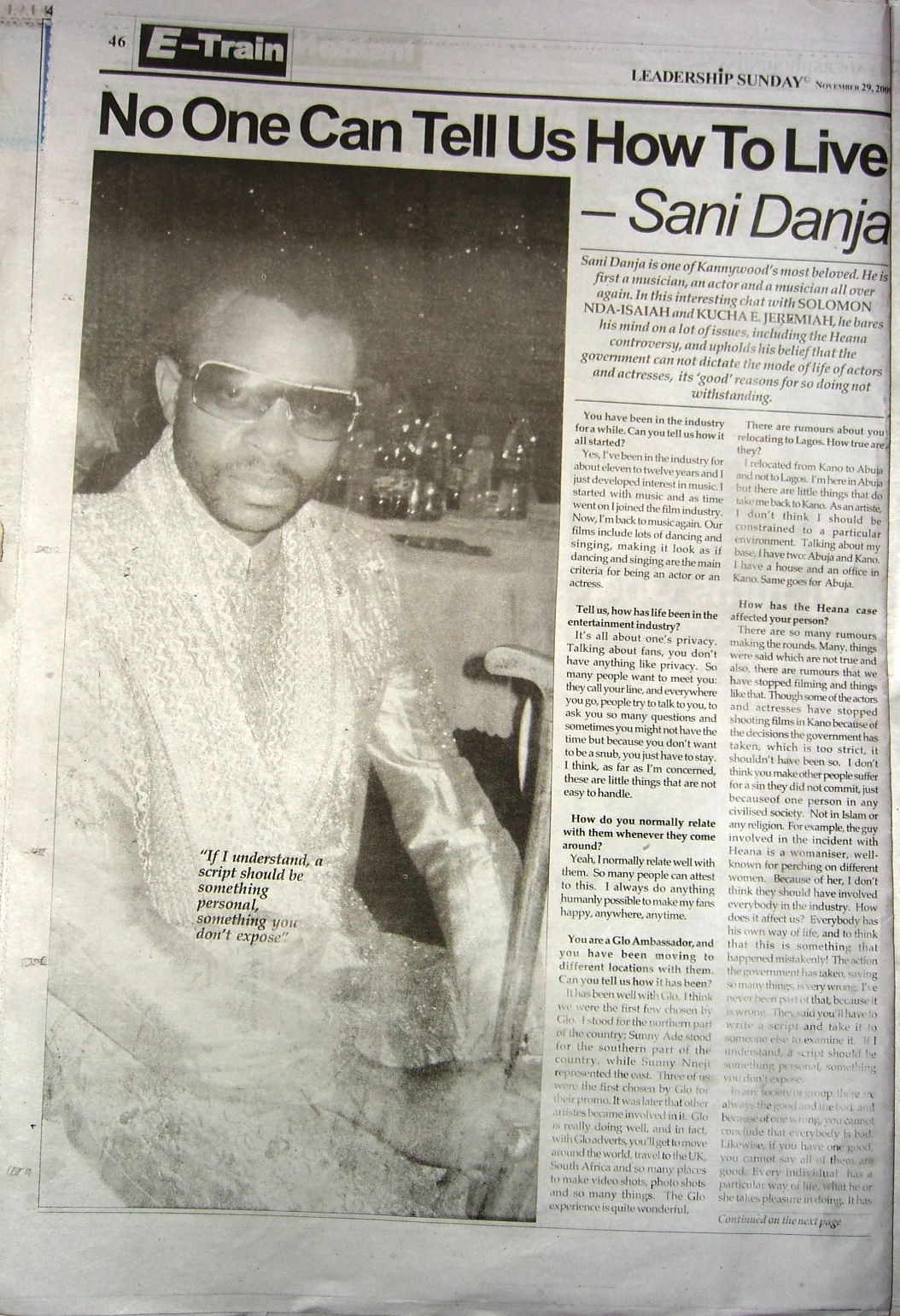
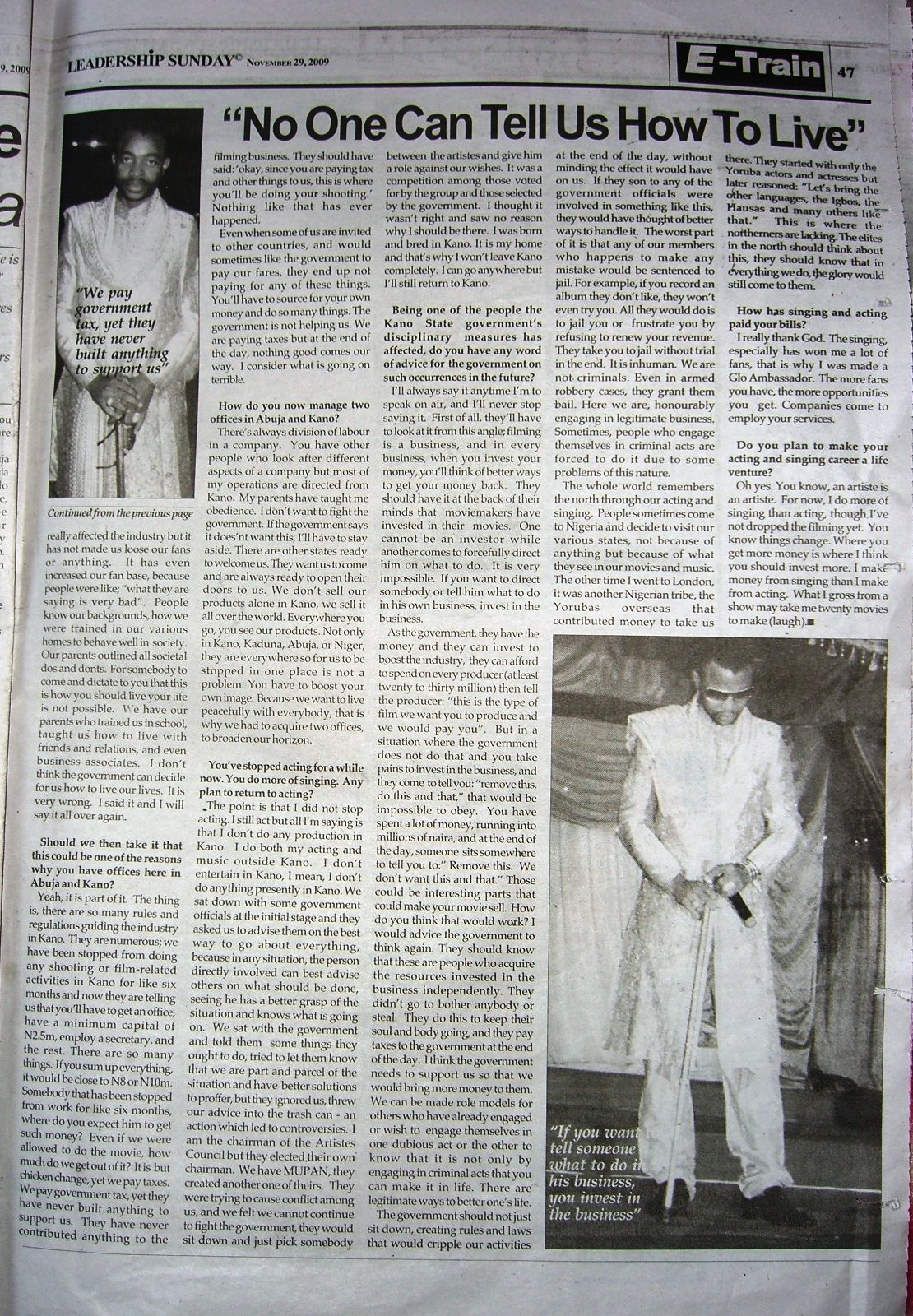
There is a great interview that Solomon Nda-Isaiah and Kucha E. Jeremiah did with Hausa film and music star Sani Danja in this week’s Sunday Leadership. Since I can’t find the online version of the article, I will post a photo of the hard copy here and a few excerpts from the interview. This article comes from Leadership Sunday, November 29, 2009. Pages 46-47. (Unfortunately, after posting I realized that the text is not big enough to read. To read, you might have to download the photo and read in a photo viewing program.)

In the article Sani Danja talks about his music and film career, his activites as a Glo ambassador, and his opinions on the recent actions of the Kano State government on Hausa filmmakers.

Here are a few excerpts. To read fully, you may have to download the photo:

When being asked about the reasons he decided to relocate to Abuja, although having offices in both Abuja and Kano, Danja says

“The thing is, there are so many rules and regulations guiding the industry in Kano. They are numerous; we have been stopped from doing any shooting or film-related activities in Kano for like six months and now they are telling us that you’ll have to get an office, have a minimum capital of N2.5m, employ a secretary, and the rest. There are so many things. If you sum up everything, it would be close to N8 or N10m. Somebody that has been stopped from work for like six months, where do you expect him to get such money? Even if we were allowed to do the movie, how much do we get out of it? It is but chicken change, yet we pay taxes. We pay government tax, yet they have never built anything to support us. They have never contributed anything to the filming business.

In response to the management of two offices in Abuja and Kano, he replies:

There’s always division of labour in a company. You have other people who look after different aspects of a company but most of my operations are directed from Kano. My parents have taught me obedience. I don’t want to fight the government. If the government says it doesn’t want this, I’ll have to stay aside. There are other states ready to welcome us. They want us to come and are always ready to open their doors to us. We don’t sell our products alone in Kano, we sell it all over the world. Everywhere you go, you see our products. Not only in Kano, Kaduna, Abuja, or Niger, they are everywhere, so for us to be stopped in one place is not a problem. You have to boost your own image. Because we want to live peacefully with everybody, that is why we had to acquire two offices, to broaden our horizons.

When asked if he had any advice for the government on disciplinary measures against filmmakers, Danja says:

First of all, they’ll have to look at it from this angle; filming is a business, and in every business, when you invest your money, you’ll think of better ways to get your money back. They should have it at the back of their minds that moviemakers have invested in their movies. One cannot be an investor while another comes to forcefully direct him on what to do. It is very impossible. If you want to direct somebody or tell him what to do in his own business, invest in the business.

As the government, they have the money and they can invest to boost the industry, they can afford to spend on every producer (at least twenty to thirty million) then tell the producer: “this is the type of film we want you to produce and we would pay you”. But in a situation where the government does not do that and you take pains to invest in the business, and they come tell you: “remove this, do this and that,” that would be impossible to obey. You have spent a lot of money, running into millions of naira, and at the end of the day, someone sits somewhere to tell you to: “Remove this. We don’t want this and that.” Those could be interesting parts that make your movie sell. How do you think that would work? I would advise the government to think again. They should know that these are people who acquire the resources invested in the business independently. They didn’t go to bother anybody or steal. They do this to keep their soul and body going, and they pay taxes to the government at the end of the day. I think the government needs to support us so that we would bring more money to them. We can be made role models for others who have already engaged or wish to engage themselves in one dubious act or the other to know that it is not only by engaging in criminal acts that you can make it in life. There are legitimate ways to better one’s life.

The government should not just sit down, creating rules and laws that would cripple our activities at the end of the day, without minding the effect it would have on us. If the son to any of the government officials were involved in something like this, they would have thought of better ways to handle it. The worst part of it is that any of our members who happens to make any mistake would be sentenced to jail. For example, if you record an album they don’t like, they won’t even try you. All they would do is to jail you or frustrate you by refusing to renew your revenue. They take you to jail without trial in the end. It is inhuman. We are not criminals. Even in armed robbery cases, they grant them bail. Here we are, honourably engaging in legitimate business. […]

Rawa da waka a finafinan Hausa/Singing and Dancing in Hausa films

In my recent interview with VOA, I mentioned that one of the things that first drew me to Hausa films is the singing and dancing.  Let me explain a little bit more. I love the singing and dancing in the films because it is both an enjoyable break from the storyline with a bit of spectacle and, often, an important moment in commenting on the overall storyline (whether foreshadowing, summarizing, or sermonizing upon the larger events of the film.) The singing and dancing is pleasurable to watch and  also tends to be more tightly edited and choreographed than the rest of the film.

While I know many critics who don’t like the songs and dances and also know quite a few filmmakers who tell me they want to make films without singing and dancing, I hate to see this aspect of Kannywood films be dismissed without thought.  The song and dance sequences are what distinguish Hausa films from their Nollywood neighbors and, when well done, add a great deal of pleasure to the experience of watching the films.

In the interview I mentioned a few videos, which I will insert here.  [Please note that the videos embedded here are being used under FAIR USE laws, for review purposes.] The first is Jamila Chassis with Sani Danja and Mansura Isa (who later married in real life). I have actually only seen the song and dance on YouTube and have not watched the entire film. But it is one of the most delightful Kannywood song and dances I have ever seen, both for the catchy song but also because of the goofy flirtatious dancing. While I know many are concerned about the objectification of women in these dances, the dancing here is playful rather than sexual–and milder than most dancing I’ve seen at wedding bikis in Kano.

I also mentioned the song “Zazzabi,” again with Sani Danja and Mansura Isa, although this time the main characters are not dancing. The cinematography here is a bit grey, static and unimpressive, but I think the editing to the music is well done. Most impressive are the lyrics, sung by Sadiq Zazzabi, and the way in which the song edited together with shots of the main characters metaphorically encapsulates the story of the film.  I will not elaborate here because I don’t want to ruin the twists and turns the story takes. However, the song interacts with the larger story brilliantly. [UPDATE. 27 December 2013: In a later post, I translate the lyrics of “Zazzabi.”]

Finally, I mentioned the choreography in Albashi 2 (starring Abbas Sadiq, Zainab Idris, and Adam A. Zango), which I think is quite well done. I also love the costumes and the attention to colour here. I have here a trailer for Albashi 2 rather than a selection of the entire song (the genre of the trailer for Hausa films is worthy of a post in and of itself), but I think it illustrates what I mean. The pleasure, at least for me, is not in the “shaking body” of the female dancer (as is sometimes asserted in critiques of the dancing in films) but in the choreography and colour of the piece. Start watching at 1:08.

There are other examples I will elaborate on this blog another time, but let me share one last delightful example from the trailer for Shugabanci. Start at timecode 1:37. How can you not love a dancing “Nigeria”?!!

Please note that these videos are used according to Fair Use policies for review purposes.

UPDATE

For other happy posts on Kannywood, see

Congratulations to Abba El Mustapha and Fatima M. Shuwa on their wedding celebration.” 19 June 2010

“The ‘second coming’ of Kannywood.” 26 June 2011

Congratulations to Kannywood actress Sakna Gadaza and Musa Bello on their wedding 9 July 2011.” 5 August 2011

“Translating (and Transcribing) the Hausa film song Zazzabi [Fever].” 8 November 2013

“Kannywood Award 2013.” 22 November 2013